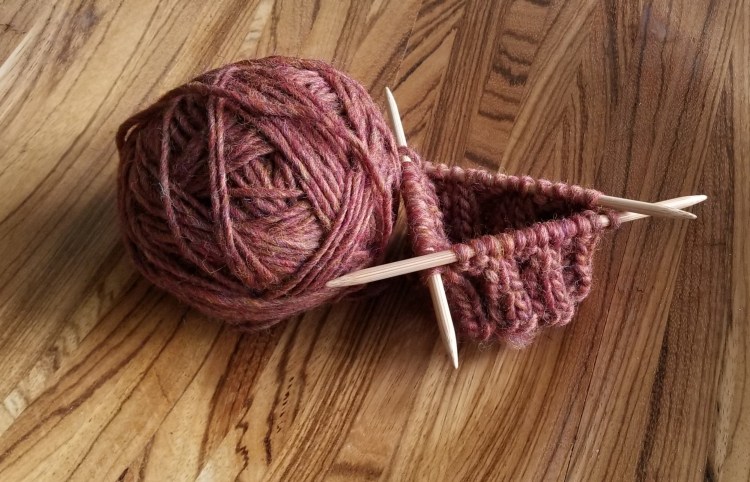
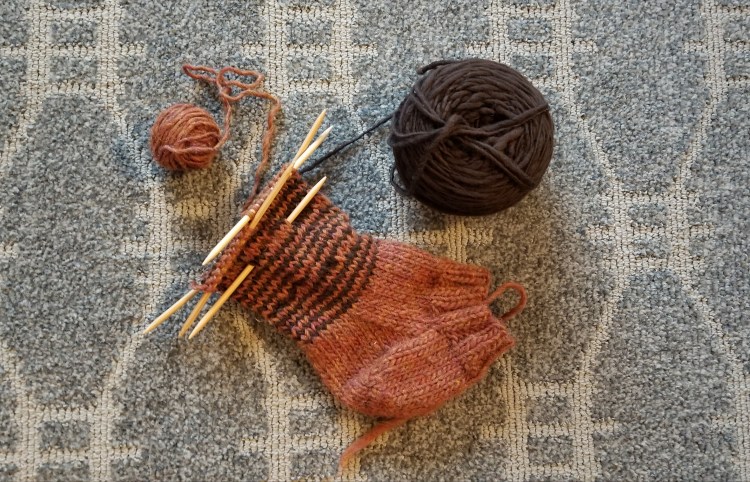
After finishing the brown socks I completed over the summer, I needed another knitting project for fall. After browsing through patterns I had flagged as favorites, I decided to make Slipper Socks by Veronica Van that were designed for bulky yarn. The pattern is for a basic cuff down heel flap sock adapted for thicker yarn, with a short cuff like a sneaker sock. I found a ball of single ply wool yarn that looked like the right thickness in a bag of miscellaneous yarn that had already been rolled into a ball and did not have a label. I did not know how many yards there were but it looked like enough (note to self…do not make assumptions like this). I got started on the project and the first sock was completed quickly due to the thick yarn.
Beginning of a slipper sock
Meanwhile as I made progress on the slippers, we were preparing for yet another trip. The slippers project would be coming on the trip. After the last couple of years of minimal travel due to the pandemic, this year I went on more than the average number of vacations.
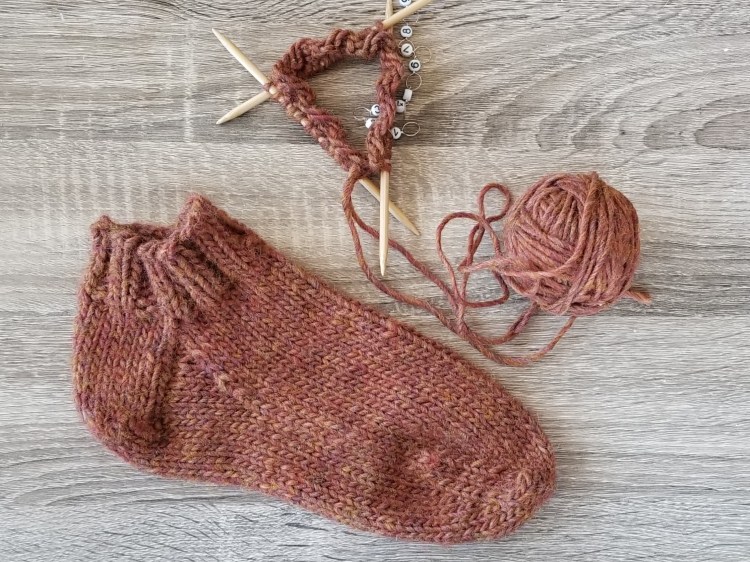
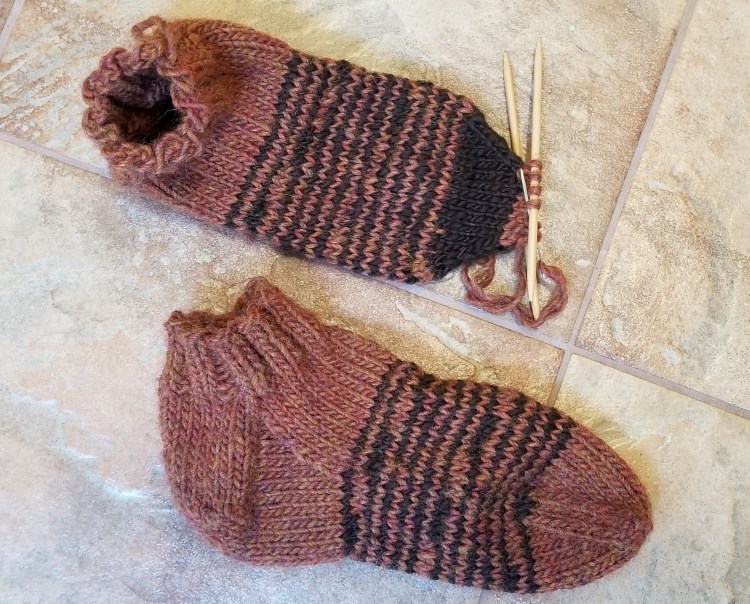
One slipper done, the second one started
I finished the first slipper quickly and got started on the second one. But OH NO there was not going to be enough yarn to finish the second sock! This was typical that a project I thought was going to be easy and quick turns into a bigger more time consuming learning experience.
Oh no there is not going to be enough yarn to finish the second slipper
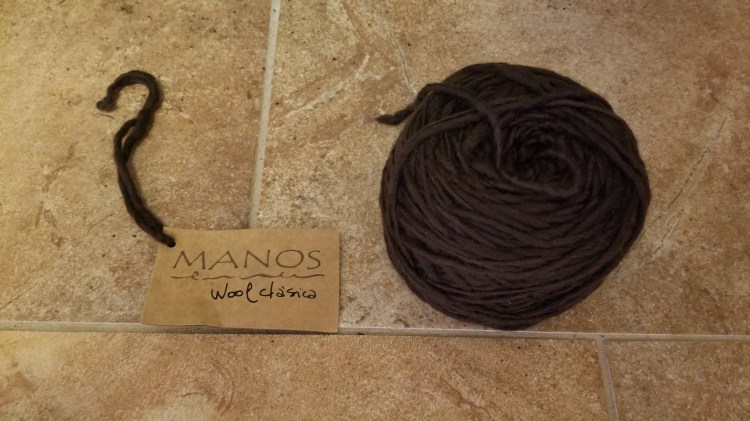
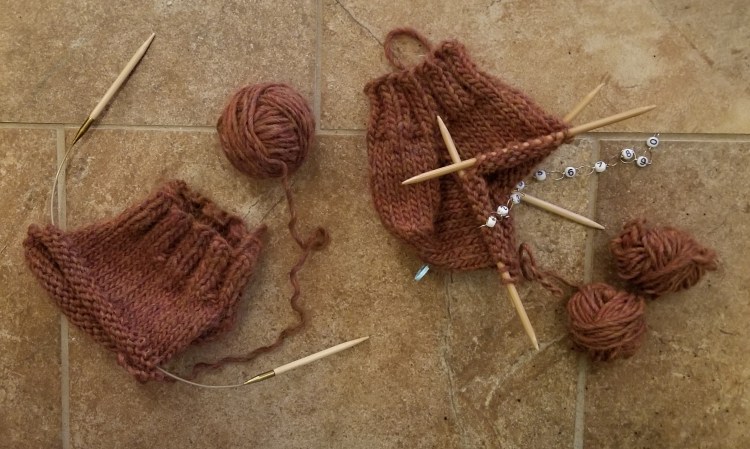
I found some brown yarn that would work to supplement the yarn I was already using, and ripped back the slipper that was already done. I would figure out how to incorporate the brown yarn into each sock while traveling.
Brown yarn to use with the other yarn for both socksBoth socks ready to start knitting the foot section incorporating the brown supplementary yarn
After being home for only a week after our road trip to the southeast, we flew to the Bay Area of California for Thanksgiving. We stayed with Wayne’s sister and husband, Yvonne and Gayle, who live in Alameda, an island connected to Oakland by a bridge. We were able to do some sight seeing, and spend time with our young adult daughter Britta, who recently settled in Oakland after years of nomadic living consisting of various adventures and learning experiences.
I was planning on giving these socks to Britta, so I wanted to finish them before we left California. She wants to experiment with adding a leather bottom, but if that does not ever happen she can wear them as is.
Our first outing in California was taking the BART Bay Ferry from Alameda over to San Francisco. At $2.75 each way for seniors, this was a bargain. We walked along the waterfront from one end where the Ferry dropped us off to the other end where the touristy areas and Ghiradelli Square are located. I was craving a Ghiradelli Mocha but when we finally got all the way there, the lines were long and the beverages were overpriced, so I gave up that idea. We considered walking back to the ferry via Chinatown, but it was getting dark and we were running out of time. We have been there before, so it was not the highest priority this time.
View on the ferry from Alameda to San Francisco
The next day we went on a long day outing to the north with Britta and her boyfriend Isaac. It happened that we were going right by a place Britta had heard about that sells leather scraps by the pound. Britta has been making cool things out of leather, so we stopped there and she bought a big bag of leather pieces for cheap. Maybe some leather from that haul will end up on the bottom of the slippers.
Leather scraps for sale by the pound
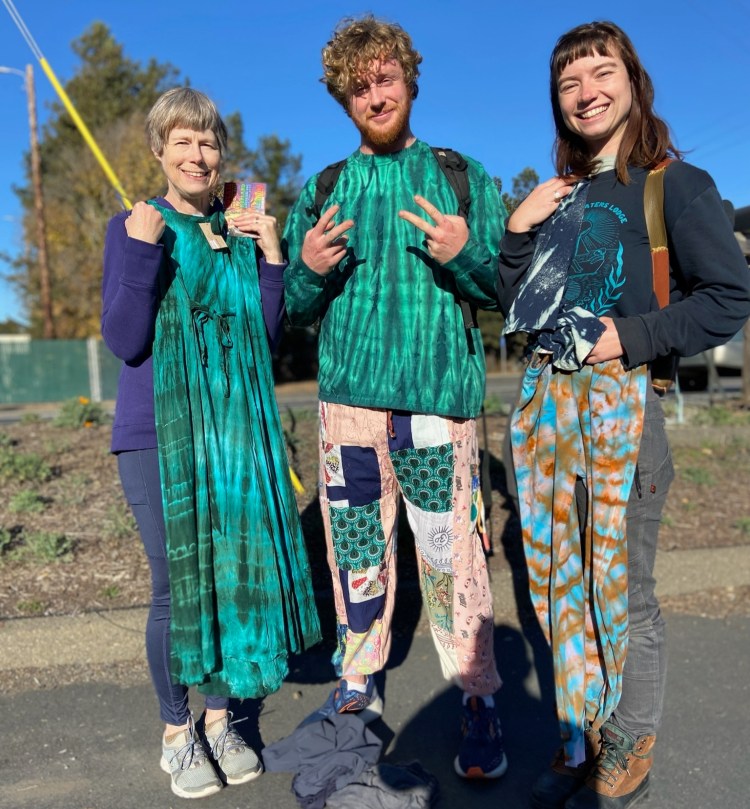
The next stop was a tie dye shop that we heard about from Wayne’s other sister Marlene, called Cali Kind Clothing Co. The son of Marlene’s friend is a graphic artist working for this business. It was a fun place, and naturally we had to buy some things.
Tie Dye shop
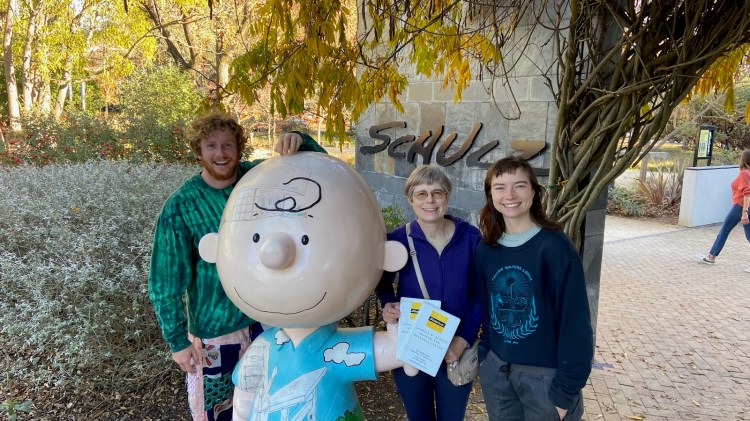
The next stop was the Charles Schultz Museum in Santa Rosa. Charles Schultz grew up in St. Paul, Minnesota, and also lived in Minneapolis after his marriage. We have another convoluted connection in that the brother of my aunt’s late husband, Jim Sasseville, worked as a cartoonist with Charles Schultz. The Peanuts cartoons were a little before Britta and Isaac’s time, but we all found the place interesting.
At the Charles Schultz Museum in Santa Rosa
After we were done at the Charles Schultz Museum we drove west towards the coast where we wanted to find the filming location for Alfred Hitchcock’s “The Birds” at Bodega Bay. We saw the school building in the movie off of the road but kept going. After that it was getting dark and it was so foggy we could not see anything, so we found a place to eat dinner and then headed back to drop Britta and Isaac off in Oakland.
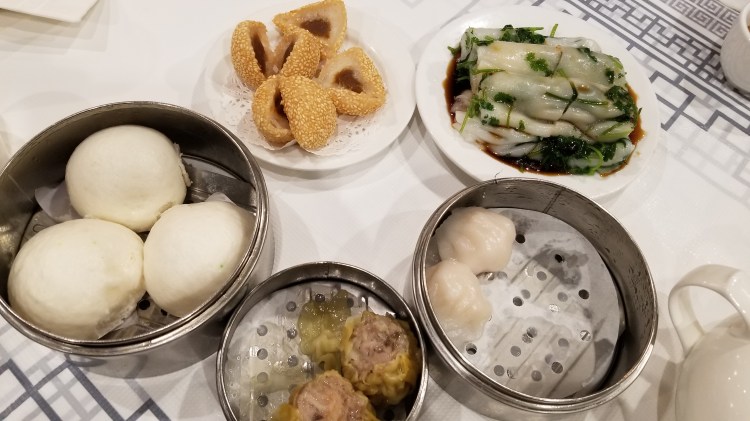
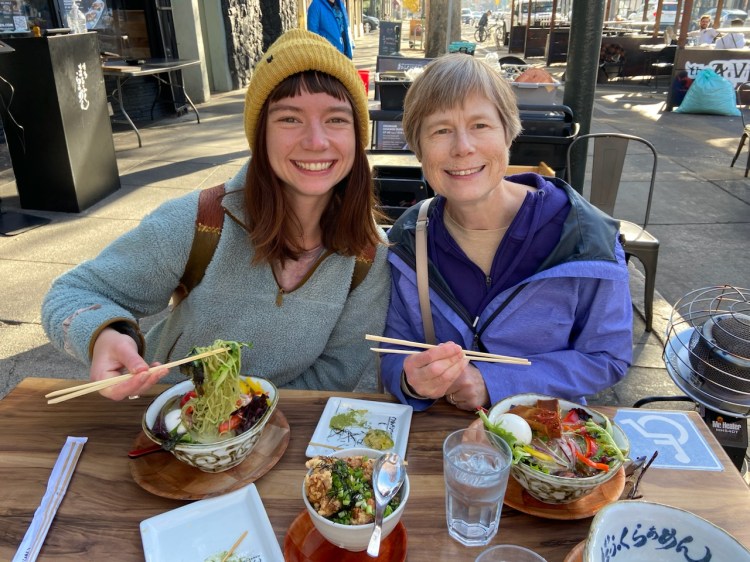
Other activities with Britta on this trip included seeing the two businesses where she has part time jobs (a small gym with a smoothie bar and spin cycle classes, and a fancy spa), going for a walk around Lake Merritt in Oakland, going to a Dim Sum restaurant she and Isaac like (a new experience for us), and going out to eat at a ramen place (not your cheap ramen noodles from the grocery store).
Dim SumNot your grocery store ramen
In Alameda we enjoyed the mild weather by going on a hike to Pinnacles National Park with Wayne’s sister and brother-in-law, and a couple of bike rides and some walks. One evening we walked to a Pizza restaurant for dinner. Yvonne hosted a wonderful Thanksgiving meal for their family including their two young adult children who were home for the week, the two of us, and Britta and Isaac
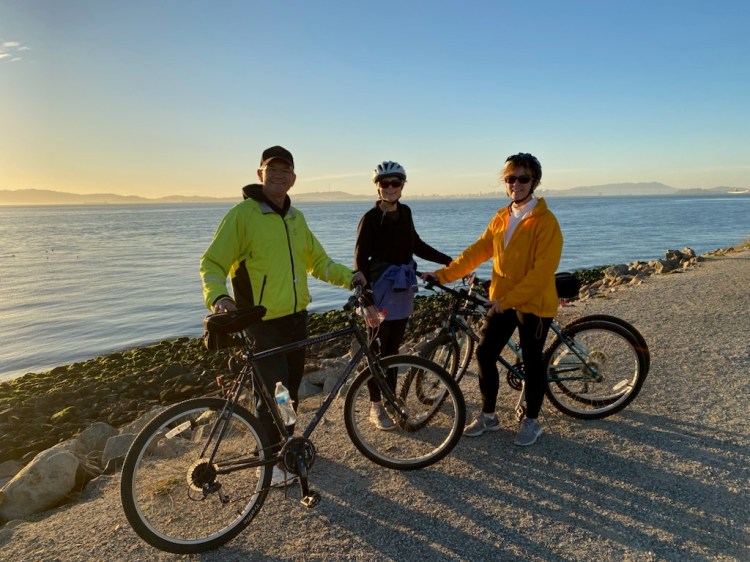
Bike riding in Alameda
The neighborhood in Alameda where Wayne’s sister lives has a lot of trees and traditional looking houses with nice landscaping. Alameda has a downtown with restaurants and shops and a cool old restored movie theater that is walking distance from their house.
During down times at my sister-in-laws house I worked on the slippers. There are multiple ways I could have incorporated the brown yarn into the pattern. The brown yarn was thick and think which was not ideal, so it made sense to minimize any problems related to this factor by alternating the two yarns as I knitted the foot. Instead of changing colors exactly every row, I knitted four extra stitches before changing yarns to avoid a jog effect at the yarn transition point. The result was a kind of exaggerated thick and thin look.
Incorporating the brown yarn with stripes
When I got towards the toe of the second sock, I was not sure if there was going to be enough of the original color, so I knitted part of it with brown.
Almost done with the slippers
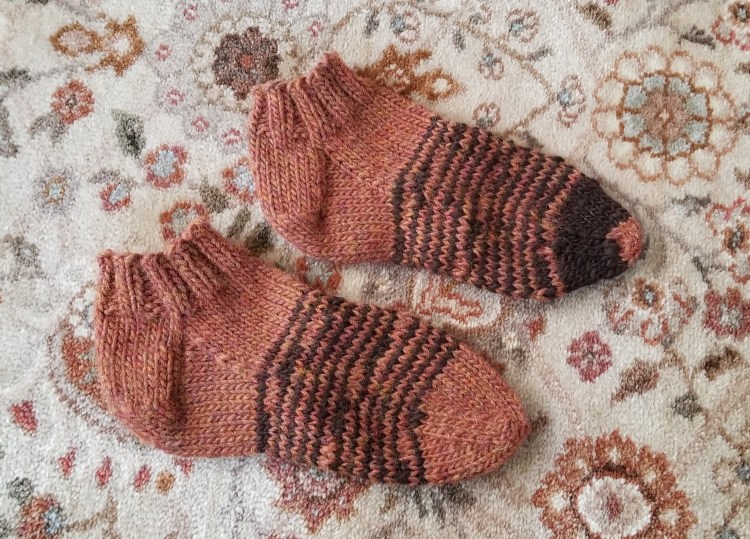
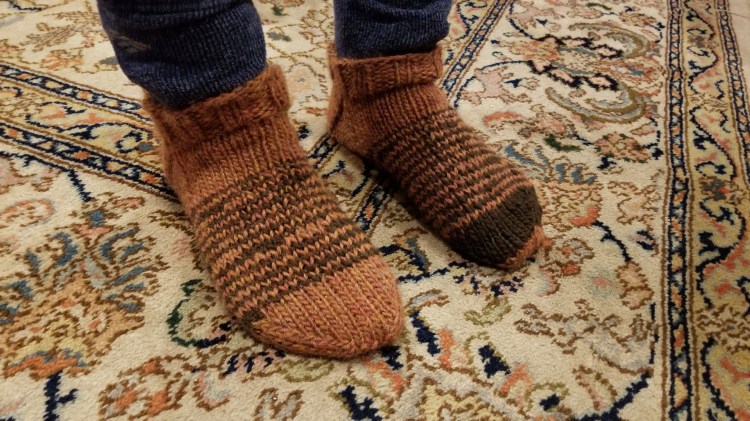
They turned out to be funky one of a kind slippers, and I was pretty sure my daughter would like them! It was nice of my sister-in-law to have rugs that matched the colors of the slippers.
Completed slippers
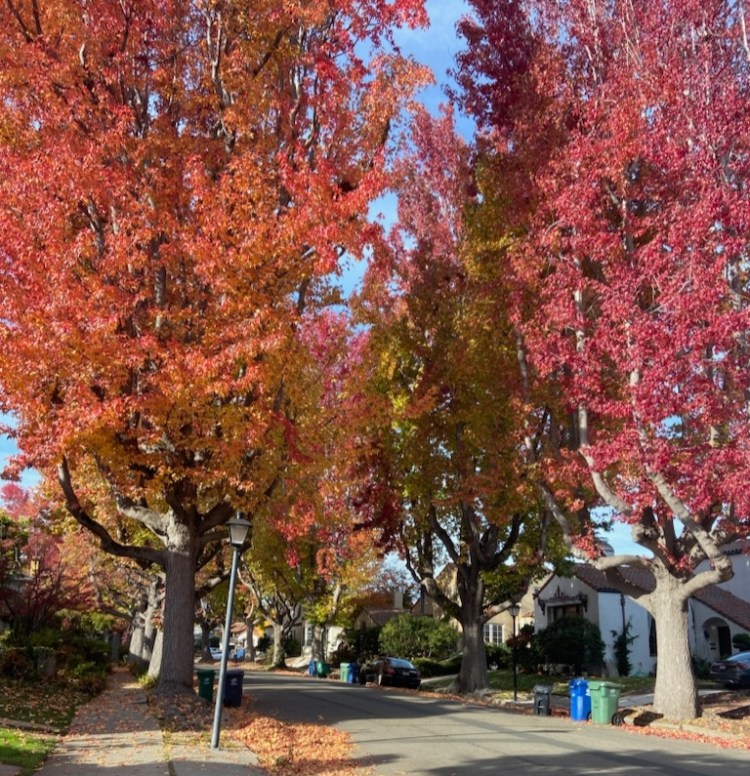
This fall we had an amazing extended fall color experience that included Minnesota, Tennessee, Alabama, North Carolina, Virginia, and finally California. The next photo was taken in Alameda in late November!
Late November fall colors in Alameda (on garbage day apparently)
The last evening there I gave Britta the completed slippers, and we had a bon fire. It was winter in Minnesota when we got back home, so this respite of weather in the 60’s was great.
Britta wearing the slippers at my sister-in-laws house
My second project on the floor loom was a set of 100% cotton dish towels. I like making towels because they are practical, make good gifts, and are still functional even if they have mistakes or turn out wonky. Towels on the floor loom can be wider than towels made on my 15″ wide rigid heddle loom, and can have a more complicated weave pattern.
I measured out the warp yarn using my new warping board at home, using white with enough length for four towels 22″ wide on the loom. That seemed too wide, but they will shrink after washing, so the final width will be less. The recommended density for the yarn is 12 ends per inch, so I had to measure out the yarn 266 times around the warping board. That is 22″ X 12 ends per inch, plus one extra on each end.
Measuring out the warp yarn
I brought the bundle of measured out warp yarn back to Tangles to Treasures so Torri would available to guide me with “warping” the loom. In the photo below you can see each end threaded through a slot in the reed.
Yarn ends threaded through slots in the reed
The next step was done from the back of the loom. Each of the ends was threaded through the “eye” in a heddle, the thin metal strips hanging vertically and attached to one of the four harnesses. This part is very putzy but is important as it makes the pattern.
Threading the yarn ends through the heddles
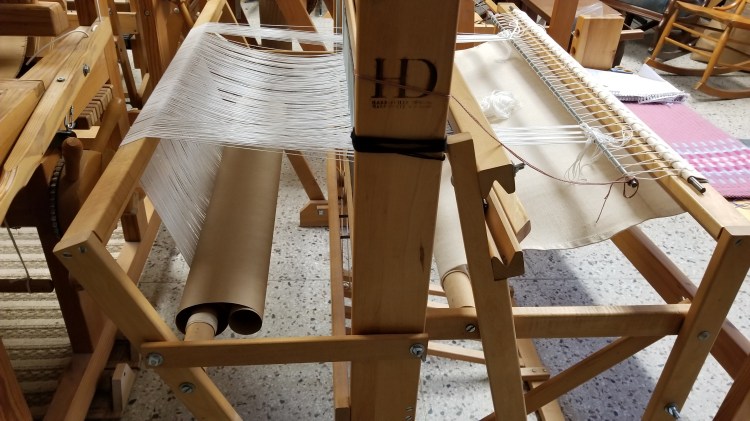
After all the ends were threaded through the heddles, they were tied on to the back and wound around the back beam. You can see the warp yarn wrapped around the back beam with some brown paper in the next photo from the side, and also the opposite process of tying the other ends on to the front.
Almost done warping the loom
Once the project was “warped”, I was excited to bring the loom home and continue with the weaving there. It would have fit in the back of our pickup truck, except that the big hitch for our fifth wheel trailer is bolted to the middle of the truck bed. It can be removed, but it is a hassle and heavy and Wayne did not want to do that. Instead we used my cousin’s more beat up truck. He helped Wayne lift the loom up into the truck bed and tie it down for the 12 mile drive to our house. Wayne and I were able to get the loom off the truck and in the house. It is not very heavy, but it is awkward. We placed it in the living room behind the sofa so I can see the TV and out the windows towards the lake while I am weaving.
Torri had made some dish towels last year using a variation of a twill pattern that I admited, so she showed me how to create that for my project. Getting a certain pattern involves both the order in which you thread the ends through the heddles, and which harnesses are up or down as you weave the weft rows. There is a standard way that weaving patterns are communicated on paper or electronically. I found a free website, http://www.treadl.com, where you can play around with making or documenting a pattern. Honestly this is still confusing to me, so I understand that it is gibberish for anyone who has not done weaving with multiple harnesses before. Following is an image of my pattern in treadl.com, showing how to thread the heddles, which pedals to press in what order (which then lifts the harness it is attached to), and what the pattern will look like if you do this.
The pattern for my towels
One repeat of the pattern includes 20 rows. Torri wrote out a chart showing the treadling for the pattern on a scrap of paper and taped it on the loom where I can see it while weaving. Each single number represents a pedal, each group of two numbers means two pedals pressed at the same time. There is post-it note strip that I can move along as I complete each subset of four rows. I have seen notes like this on Torri’s weaving projects and honestly they did not mean anything to me until I actually did the weaving myself.
A chart showing what treadles to push for each row
The following photo shows hemstitch at the beginning of the first towel and two repeats of the pattern.
Hem stitch and two repeats of the pattern at the beginning of the second towel
I wanted to do the second towel with a rolled hem (folder over and stitched down) instead of hemstitch and fringe. Torri gave me some thinner yarn, almost like thread, to use for weaving some rows at the beginning and end of the towel so it will fold nicely without being too thick. The color was darker blue than what I was using for the weft yarn. The next photo shows the end of the first towel with hem stitch at the bottom, some spacer rows that will be fringe on the first towel, the rows of darker thinner yarn for the hem of the second towel, and one repeat of the pattern at the beginning of the second towel.
The end of the first towel and the beginning of the second towel
In the middle of weaving the second towel a leather cord used to hold together two wood parts of the loom broke. That was a problem as the loom will not work with a broken harness cable. I was able to figure out a temporary solution, but realized that some refurbishing of my loom would be a good idea when this project was finished. That will be a topic for a future post.
When I got to the end of the second towel, I got mixed up when weaving the rows of thinner yarn for the hem. I alternated pressing pedals 1 and 2 together, and then pedals 3 and 4 together, instead of alternating 1 and 3 with 2 and 4. What happened was that the yarn went over and under every two threads, instead of every other thread which makes a looser weave. You can see this in darker blue section on the photo below. I noticed the mistake after I was almost done with the hem rows. I should have undid it and started over but I decided to see how it worked for a hem, compared to the way it was supposed to be. Or maybe I was just being lazy and hoped it would be OK.
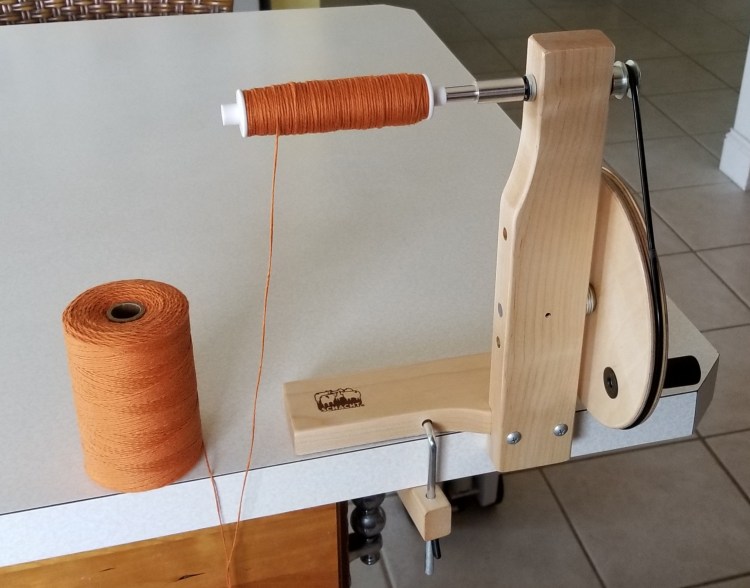
The first two towels were blue. The third towel was going to be orange, so I used my new bobbin winder for the first time at home.
Using my new bobbin winder to prepare weft yarn for the next towel
The next photo shows the beginning of the orange towel, and also the end of the second blue towel, where I used the wrong weaving pattern for the thinner dark blue hem rows. There is also a spacer section in between that will become the fringe for the orange towel.
Incorrectly woven darker blue hem rows, and the beginning of the orange towel
When I got towards the end of the fourth and last towel using green yarn, I could see it was going to be shorter than the other three as I was running out of warp yarn. I wove a little bit farther than I should have. The back end of the warp yarns were too close to the heddles, so when I pressed the peddles, it was hard to get the weft yarn between the correct warp yarns. I ended up removing some rows and was able to get the towel finished. Torri had showed me when to stop on my first project, but sometimes you have to make a mistake in order to remember the right way.
Three of the towels had hem stitch and fringe to finish off the ends. I have been confused by hem stitch all of my two year weaving career. I think it is because I seem to be directionally challenged. The instructions will be for one direction and one end of the weaving. But sometimes you need to reverse the instructions to do the hem stitch from the other direction, or at the other end of the towel. I think I finally got it this time. I like doing hem stitch once I figure it out and get in a rhythm. One reason I like the hem stitch finish is that it is complete, there is not any more hand work other weaving in the ends. I think the rolled hem looks nicer, but it is more work.
After removing the project from the loom, I zig zagged the end of the plain weave hem rows on the second blue towel with my sewing machine, so they would not come undone when I cut the towels apart and before I could get the rolled hem done.
Four towels removed from the loom
After discussing with Torri, we agreed that the hem rows with thinner yarn that I wove with the incorrect pattern might work but not look good. The next photo shows the towel with the woven hem rows folded over to show both ends. The one at the bottom is the incorrect one.
Folder over towel showing the correct and incorrect rows of thin yarn for the hem
To fix this problem I did a hem stitch at both ends and then removed the thin rows of yarn.
Doing hem stitch instead of rolled hem
I measured the length and width of each towel at this point. They were all between 20 and 21 inches wide on the loom, and between 28 and 33 inches long. After weaving in all the loose ends and fixing a place where the yarn had snagged, I ran them through the washing machine and dryer with a load of laundry.
The average final width was 17.6″ which is 80% of the original width on the loom of 22″ before weaving. The length of each towel also shrunk by about 20%. The longest one was about 26″ long after washing, the shortest one when I ran out of warp yarn was closer to 23″.
I started with 4.5 yards of warp, which is the maximum length on my warping board. That was supposed to work out to 18″ of loom waste on the ends, plus 36 inches for each of four towels, including the fringe or hem. I wove the first three towels too long, so the last one was shorter. I will be able to use this information to make at set of more evenly sized towels next time.
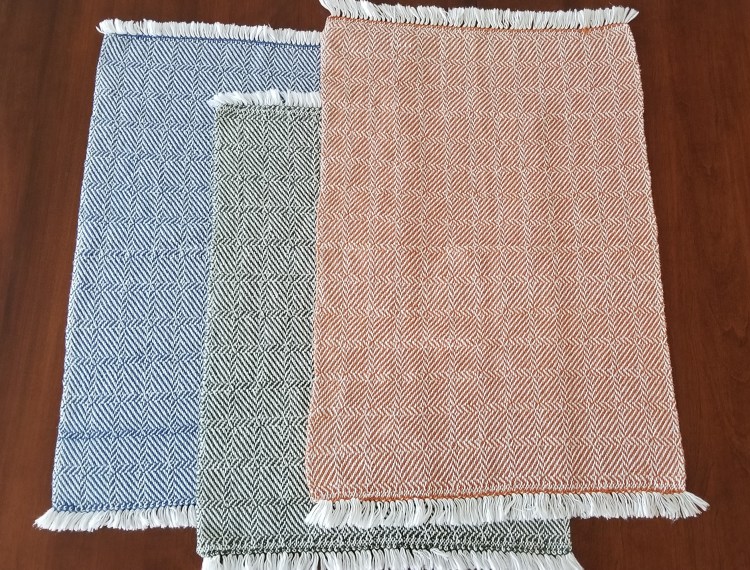
Showing off three of the four towels after washing and dryingShowing the pattern up close
There are infinitely many possible pattern and yarn combinations for weaving. Dish towels are a good way to experiment, and figuring out weaving patterns is a good way to keep my mind active. I look forward to making another set of towels with a different pattern, after I do a little refurbishing on the loom.
In October Wayne and I went on a two week road trip to Tennessee, Alabama, North Carolina, and Virginia, putting 4000 miles on our Honda CRV. Our fifth wheel trailer sat in the driveway while we were gone, as we had family to stay with for 11 of the 14 nights we were away. We have not used our RV since we came back from Arizona last spring :(. Summer is nice on the lake where we live, and we are busy with guests coming and going at our house and the extended family cabin, so we are not inclined to go on a trip during that time. We had talked about taking the RV west in late summer to visit Wayne’s aunts in Coeur d’Alene, ID, and then continuing on to Glacier National Park. By the time we started researching camp site options, they were all booked. The trip southeast was a good alternative for viewing fall colors while also visiting with cousins. Maybe we’ll do the RV trip next year now that we know how early to start making arrangements.
Preparation for the trip included deciding on a knitting project to bring along. It needed to be portable and keep me busy for the entire trip. SOCKS of course! I decided on some Schachenmayr Regia 6-ply yarn I had on hand, for a toe up sock with a Fleegle heel. I liked knitting this heel pattern one other time, but that sock did not have quite enough stitches around for my foot, so I wanted to try it again with the right number of stitches. I used my ball winder and scale to divide the yarn into two balls of equal weight for two at a time knitting. The label suggested needle size of 3 to 5 which appealed to me because that means fewer stitches than a typical sock yarn that uses a size 1 needle. After knitting up a swatch I realized I had to go down to a size 2 in order to get the right density for socks.
Dividing the sock yarn into two equal size balls
On the first day of this road trip we drove 180 miles from our house to Minneapolis. There are always errands to run in “the cities” that we can’t do at home, so we took care of a few things and then dropped our dog off at my friend’s house before arriving at my sister’s house for dinner and overnight. We appreciate that the door is always open there for family or friends.
The next day we drove to Chicago, arriving at our son James and daughter-in-law Kelsey’s condo in time for dinner on Saturday (10/8/2022). They had just returned from a two week trip to Croatia so were still getting over jet lag. We offered to provide take out dinner, but they were already in the process of making some homemade soup that was very delicious. It turned out that the next morning was the Chicago Marathon. The route goes a few blocks from their condo in the Pilsen neighborhood, so streets were blocked off making it difficult to venture out that day. Instead we watched the runners for a little while which was a new experience for us, and then had a relaxing afternoon watching football, or knitting in my case.
We left first thing the next morning (Monday 10/10/2022) so as not to interfere with James and Kelsey working from home, but also because we had a long drive all the way to my cousin Dan’s house near Knoxville, TN. Their house is on the Tennessee River and also about 45 minutes from Great Smokey Mountain National Park. Tuesday we went on a boat ride.
Wayne, my uncle Jim, and my cousin DanOn my cousin’s boat
I worked on my knitting, and we all watched pretty scenery and admired the properties along the shore while we lounged on the boat and had snacks for lunch.
I worked on my sock knitting project while we were on the boat
The next two days we drove, explored and hiked in and near Great Smokey Mountain National Park. That is the most visited national park because there is no admission fee, and also because it is a reasonable driving distance for so many people. The following photos were taken from Look Rock Tower on the Foothills Parkway, and at one of many scenic overlooks along the road.
Smokey Mountain National Park from Look Rock TowerScenic overlook
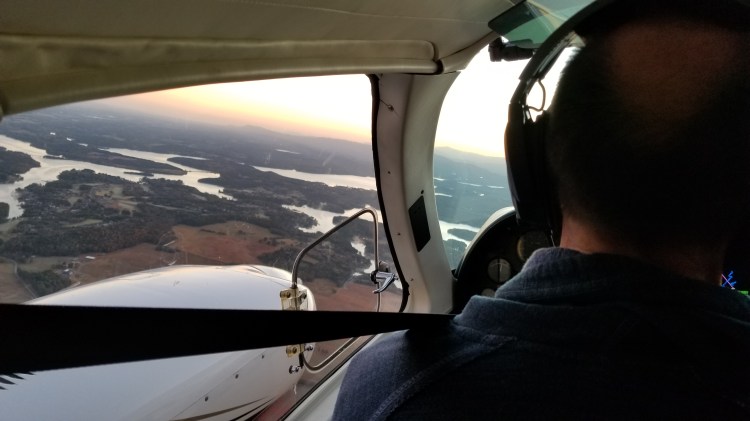
My cousin Dan and his wife Liz both served as pilots in the Air National Guard for many years, and now they are both UPS pilots. Dan owns a Cessna 310 airplane. He had told us that they wanted to take us on an outing flying to Asheville, NC, for brunch. Sure, why not? We did not really know what that entailed but it turned out to be quite an adventure. The conditions were right for flying on our last day there (Friday 10/14/2022) which started out very early in order to get to the airport, fly to Asheville, and Uber to Grove Park Inn in time for brunch.
Early morning airplane ride
The Grove Park Inn in Asheville was built in 1913 with granite boulders that were hauled to the site using mules, wagons and ropes. It is a popular place today with lodging and dining, a golf course, and a spa. There are two ginormous fireplaces in the lobby with rocking chairs where anyone can sit and relax whether or not you have reserved a room. We had a fabulous brunch with a view out the back of the building.
The historic Grove Park Inn
One of two massive fireplaces in the lobby of the hotel
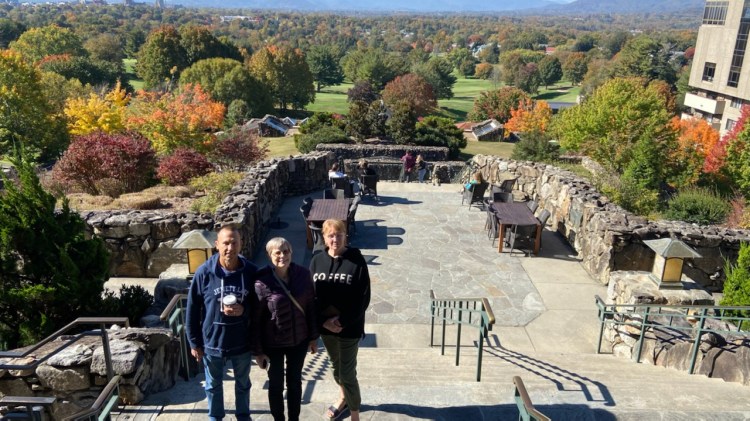
The view from the back of the Grove Park Inn
After we were done with our meal and had walked around the hotel, it was time for the plane ride back to Tennessee. Honestly I was a little nervous about flying in a small plane, but Dan is about the most conscientious pilot there could be. The return flight was a little bumpy but all in all it was a wonderful experience.
My cousin’s airplane
Our car was waiting for us at the airport when we got back from brunch. We drove directly from there to Birmingham, AL, where cousin Ross (Dan’s brother) lives, again arriving in time for dinner (do you see a pattern here?). We were not there very long and it was kind of out of the way, but we wanted to see where Ross and his wife Kim live, and visit with them a bit. Kim and I spent Saturday afternoon (10/15/2022) at the Kentuck Festival of the Arts about an hour away, while Wayne and Ross watched the Tennessee versus Alabama college football game. Even though Ross lives in Alabama he was rooting for Tennessee, where he is from and went to graduate school. It was a very exciting game and they were happy that Tennessee won. We did not see any of Birmingham other than their neighborhood, so I guess we’ll have to go back another time.
We left Ross and Kim’s house late the next morning and drove east to Murphy, NC, which is near John C Campbell Folk School, one of my bucket list items. I have dreamed of taking a class there for years. It has not worked out yet, but at least I got to see the place on this trip. We had enough time to check out a short river walk and stroll around the small main drag area of Murphy in the late afternoon (Sunday 10/16) before it got dark out. All the shops were closed, but we lucked out with dinner. First we tried to eat at a place that had good reviews, outdoor seating, and a guy playing live music on the patio. The hostess informed us that even though there were many empty tables, they only had enough staff to serve customers with a reservation. We were allowed to sit at the bar outside for a few minutes and listen to the music. After that we walked to a local brew pub and had a super delicious meal. We had talked about celebrating our anniversary with a nice dinner during the trip. Even though this meal was fairly low budget, and our anniversary was in September, we had such a nice time that we decided to call this the anniversary dinner.
“Anniversary” dinner at a local brew pub in Murphy, NC
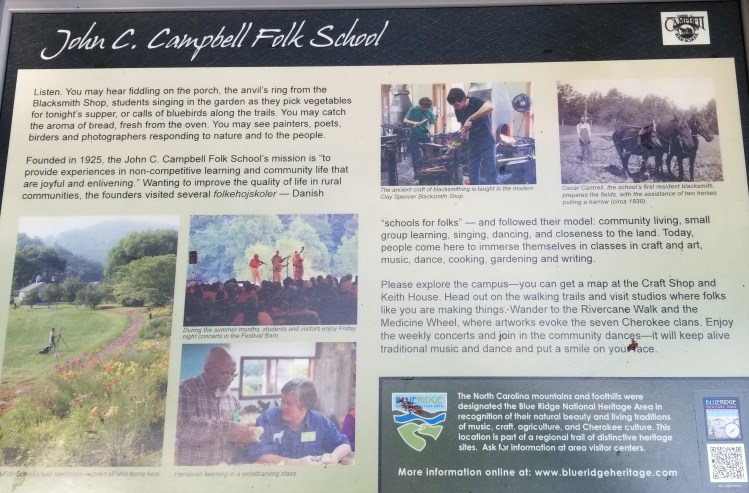
The next day we went to check out John C Campbell Folk School, a place where you can take week or weekend long classes in many traditional crafts, music, and cooking. I loved it there and took many photos, but it is hard to get a sense of the place based on any particular couple of pictures. It was very peaceful and beautiful there. They have multiple craft studios, and buildings for lodging, meals, community activities, gardening equipment, and a gift shop and history center. Each building was unique. The property has both wooded and open meadow areas. Due to covid, the only buildings that were open to the public were the gift shop and history center. After checking those out, we walked around and saw all the other various buildings. There were classes going on in some of the studios including shoe making, spinning, weaving, and pottery. Technically we were not supposed to go inside the studios, but we peeked in the doors, and in some cases the people inside said to come on in, or they were working outside where we could interact with them for a few minutes.
Part of the John C Campbell property, with the garden in the background
After we had walked around for awhile, it was lunch time for the instructors and people taking classes. We came upon this group who were using part of their lunch time for a music session.
Students at the folk school playing music during their lunch break
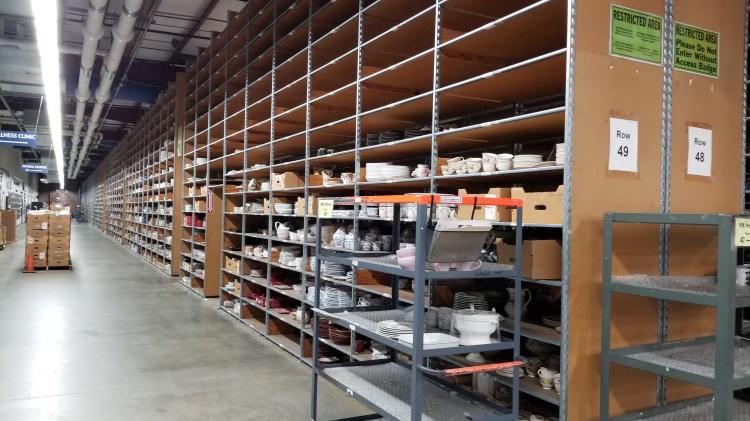
Our next destination after John C Campbell Folk School was McLeansville, North Carolina, the location of Replacements, LTD. Replacements is a business that buys and sells previously owned china, crystal, sterling silver, jewelry and collectibles. It started in 1981 with one guy buying a few things at garage sales, and over the years has expanded to include a massive warehouse and distribution center. If you break a piece of your china or crystal, this is where you can find a replacement. Depending on current supply and demand of specific patterns, they will pay you for your items. Most of their business is conducted online and by mail. They have a big showroom for sales in person, and in certain cases you can get an appointment to do an in person drop off of stuff that they have already agreed to buy. My sister and I had quite a few things to sell of our mom’s and our own, and since we were going that way anyway, we arranged to drop off our five boxes of stuff in person rather than mail them. It was difficult to part with some of the things that we sold, but it is part of a long process of sorting, offering to our kids and other young adults, and purging, so that we each will have only one household of things that we love, will use, and have a place for. Following are photos of a display at Replacements with one dinner plate each from hundreds of different china patterns, and then a photo of one of many long aisles of shelves going to the ceiling with inventory.
Display of china patterns at Replacements, LTDOne of many aisles of shelving for inventory at Replacements, LTD
Our next planned activity after dropping off the dishes was to visit Monticello, Thomas Jefferson’s home in Charlottesville, Virginia. I had wanted to do the full guided tour that includes all the rooms and floors of the house, but we messed up and by the time we tried to get tickets online a couple of days ahead they were sold out for that option. Instead we reserved tickets for a self-guided tour.
We were done at Replacements by noon on Tuesday (10/18/2022), but our Monticello visit did not start until 3:00 pm on Wednesday. Wayne’s cousin and his wife live in Arlington, VA, near Washington D.C, so we left him messages to call us and started driving in that direction, which was on the way to Monticello. We were prepared to stay in a hotel and hoped they could meet us for dinner. As it turned out they invited us to their home for dinner and overnight. We had a good visit before leaving early the next morning to drive west back to Monticello.
On the way, we had a funny incident with GPS navigation. We were on an interstate highway, but for some reason the GPS told us to get off the interstate and go on to a narrow windy side road. We could see the highway on our left. Big trucks carrying logs kept coming from the other direction, with barely enough room to pass us while we edged way over as far as we could without going in the ditch. Then we noticed signs over on the highway for a toll station and realized what had happened. Wayne had set the GPS to avoid tolls! Haha we got quite an adventure on that side road, but avoided the toll! Shortly after that we were routed back on to the highway.
The self guided tour at Monticello included audio content available by smart phone instead of a live person, so it worked out OK. We were able to walk around the grounds, see the rooms underneath the house that included areas for making beer, storing wine, cooking meals, etc, and get a 45 minute presentation of Slavery at the plantation.
Thomas Jefferson was an intelligent and complicated person who made important contributions as one of the founding fathers. He has been described as a polymath, someone who is knowledgeable or skilled in many subjects. He was a self taught architect, a lawyer, a scientist, an inventor, a musician, a writer. He was also a typical plantation owner with slaves. He believed that slavery is wrong and made efforts to abolish it, but eventually realized that future generations would have to make that happen. The Monticello organization is now doing a good job of addressing the topic of enslaved people on the planation, telling it like it was rather than sweeping it under the rug. I don’t think it is right to judge people from the past using todays standards, but it is a difficult topic for another day.
There were some qwerky things inside the house I found interesting. The staircase to the second floor was very steep and narrow, located in the center of the house. Thomas Jefferson believed that grand staircases were a waste of space. There was a dumbwaiter to bring wine up to the dining room from the storage area under the house. The dining room had multiple small tables for more intimate conversations rather than one large dining table.
Steep narrow staircase at Monticello
When Thomas Jefferson died, he was in debt and most of his belongings and assets were sold. There has been an effort to find and purchase back his things. The actual boots he wore are on display in the bedroom. Apparently they are both the same, there is not a left and a right.
Thomas Jefferson’s actual boots
There is a professional actor that plays Thomas Jefferson for the Monticello organization. He gives talks for tourists and is featured in educational videos that are available to watch on the Monticello.org site and on Youtube. He does an amazing job being in character.
Thomas Jefferson played by a professional actor at Monticello
I really enjoyed our time at Monticello, other than that we did not get to see the upper floors of the house, and that it was cold and windy outside. It was the last thing on our itinerary other than driving all the way back to Minnesota. We were done there at about 5:30, so we decided to drive a few hours towards home before stopping for the night. We got to a town that had all the usual road trip hotels, but they were all full. Oh no! We found one place off the main area with availability. When I was growing up, on the few road trips we took as a family, we would either stay with relatives or friends on the way, or at a budget motel. My mom would have always ask to see a room before booking to make sure it did not smell funny and to make sure the bed was tolerable. At this sketchy motel we followed her lead. The proprietor showed us two rooms, and one did smell funny, so we took the other one and I am glad we asked!
Getting those extra hours of driving in allowed us to make it all the way to Chicago the next day (Thursday 10/20/2022) where we stayed overnight at our son’s condo. We arrived in time for dinner again, but this time we paid for some take out Chicago Deep Dish style pizza.
We got up early the next morning (Friday 10/21/2022) and left before our son and daughter-in-law were even up. We made it all the way home to Fergus Falls after stopping in Minneapolis to pick up things we had left at my sister’s house, eat some just made apple crisp, and pick up the dog at my friend’s house. It was a long day, but by that time we just wanted to get home.
I got a lot of knitting done over many hours of driving, but the socks were not finished yet when we arrived home. The toe and foot part of each sock was complete, and one heel was done. I thought I took a photo, but I guess not.
The fall colors were at their peak at home before we left, and in the areas we traveled to. By the time we got home, the leaves were all down and it was starting to look like early winter. Actually, it snowed once while we were gone, but thankfully did not stick.
I plugged away on the socks at home, and in the following photos they are almost done, and then finished.
Almost done with the socks
The cast off is Jeni’s Surprisingly Stretchy Bind-Off. I purposely made it very loose, so they are nice and stretchy. The toes are a little too pointy, so noting that for future hand knit socks. Otherwise I like how they turned out.
Saturday, October 1, was fall Fiber Day at the Ellison’s Sheep Farm in Pelican Rapids, Minnesota. This is my second favorite day of the year, after Spring Fiber Day. I attended with my sister, Betsy, and our friend, Mary Lou. Regulars and newcomers from near and far are always down to earth and friendly, and enjoy comparing notes on projects and lives.
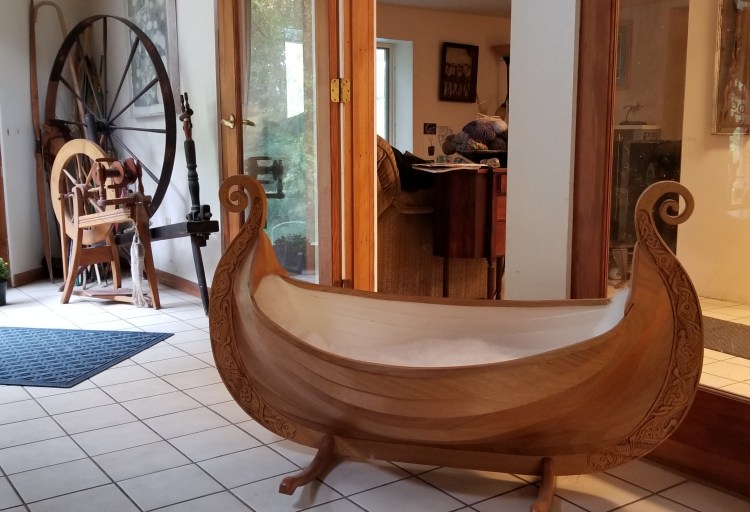
The event was held outside for the most part. Food for the potluck lunch was set up inside the house where there is a big entryway containing a modern spinning wheel, an antique spinning wheel, and an amazing Viking boat replica baby cradle hand made by Dave Ellison.
Spinning wheels and a hand made replica Viking boat cradle
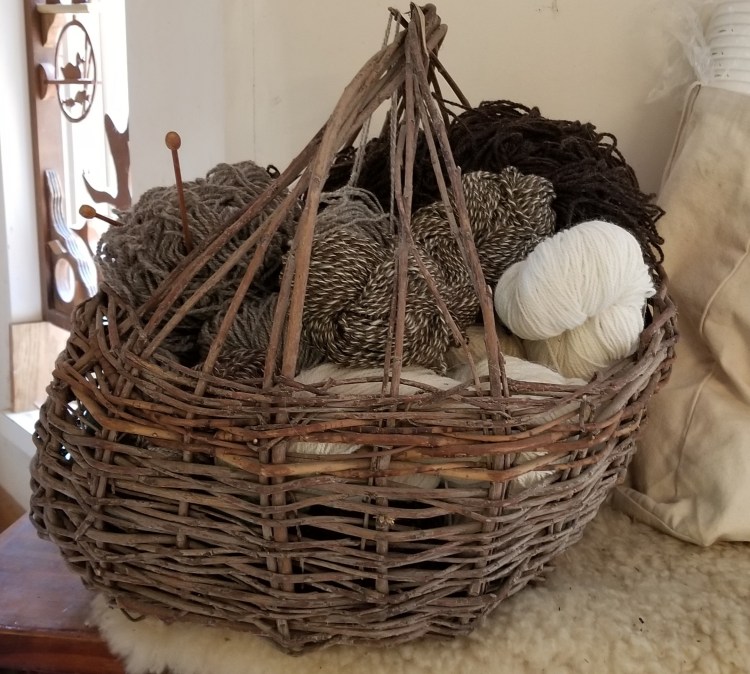
Also in the entryway is a hand made basket containing yarn produced by a local mill using wool from the Ellison’s sheep.
Basket with yarn from the Ellison’s sheep
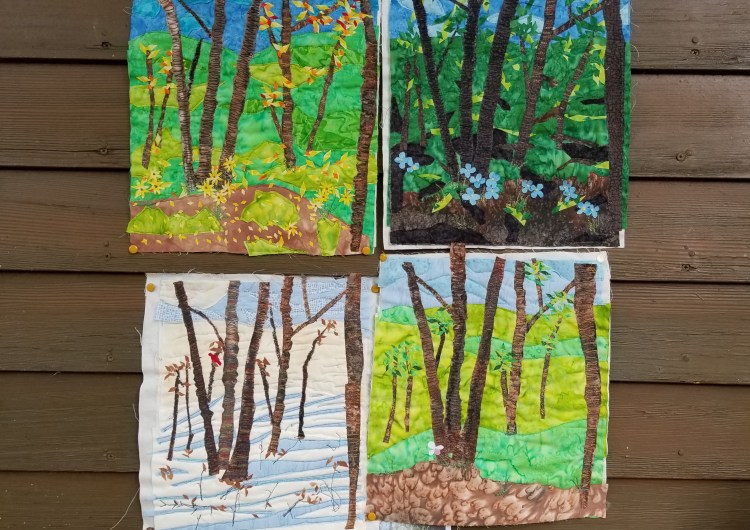
The deck and side yard was set up with chairs and tables. There is yarn and wool for sale. There is yarn hanging from trees. There are examples of fiber projects on display.
Yarn from the Ellisons sheep is for saleSomeone knit this beautiful shawl from Ellison yarnThe same scene in 4 seasons made out of fabric
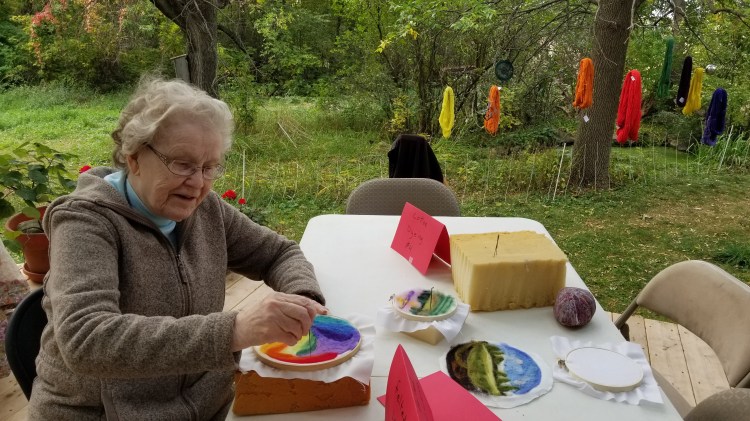
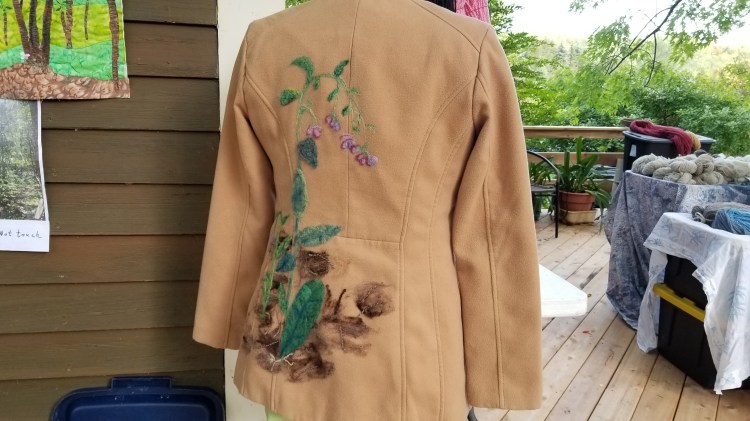
Grandma Alice was teaching visitors how to needle felt a landscape “painting”.
Needle felting a landscapeJoanie Ellison needle felted on this wool coat
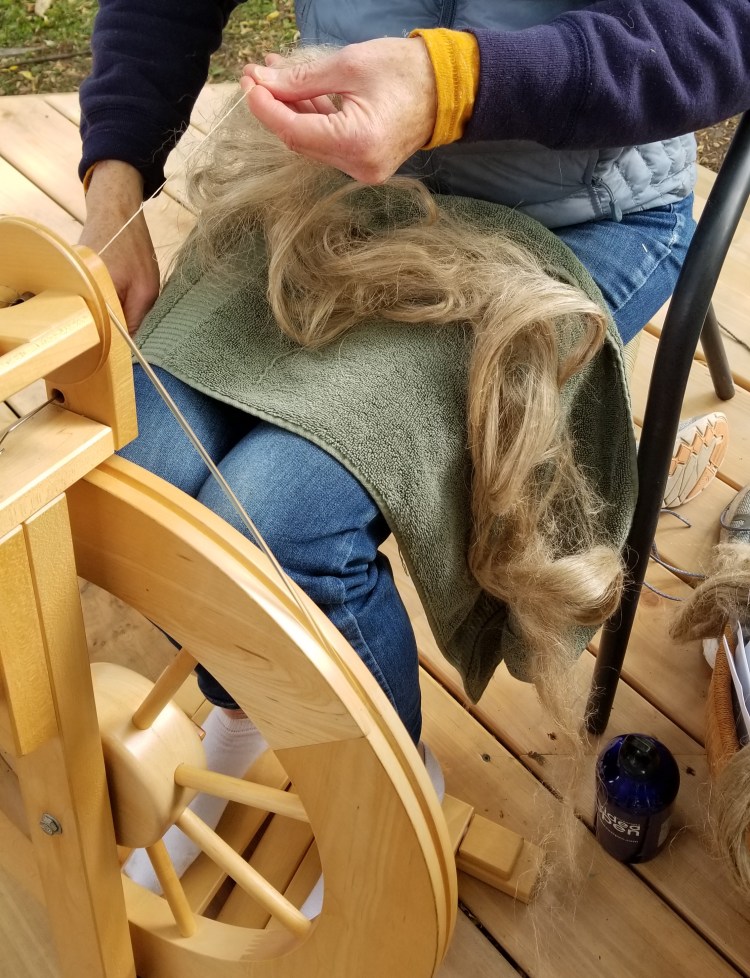
I brought flax fiber I had purchased at Shepherds Harvest Sheep and Wool Festival in the spring. Spinning flax fiber into linen yarn is a very different experience than spinning wool. The fibers are very long and wiry. The traditional way of holding the fiber and keeping it organized while spinning is with a distaff. I do not have one of those, but read about other methods including laying some of the fiber on a towel on your lap. It is also recommended to get your fingers wet as you spin. I brought a towel and a sponge in a small plastic container for my first try at spinning the flax.
Some flax fibers on a towel on my lap, ready for spinning
I found that the spinning part was not that different from spinning wool, although the fibers are much longer. However I was having trouble with the flax fibers in my lap getting tangled. Next time I will try having fewer fibers in my lap and see if that works better.
Spinning flax
My sister Betsy does not knit or spin or weave, but she has made some beautiful quilts in the past. Her current outlet for creativity is learning to draw and paint. She brought supplies to work on some sketching at Fiber Day. You can see the two of us in the next photo enjoying our activities, while sitting on the deck next to the house.
I am spinning, my sister is sketching
Following is another view of my spot on the deck with two other spinners on my right side.
Three spinners
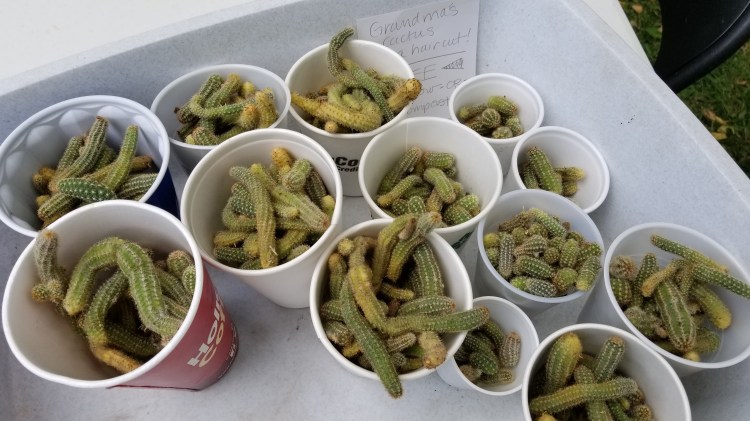
Someone brought little containers of pickles, but no, they were baby cacti. Apparently you can stick either end in a little pot and it will grow!
Baby Cacti
One of the activities at Fiber Day is dying. Following is a photo of Joanie Ellison at a table with her containers of dyes and other related supplies.
Joanie with her supply of dye
There were dyes for cotton or other plant fibers that work with cold water. Joanie had a supply of cotton dish towels and pint size jars if you wanted to try this. For the cold water dying, soda ash fixer is mixed with dye in the water to allow the dye to attach to the fabric.
Soda ash fixer and dye for cotton yarn or fabric
The next photo looks like canned produce, but instead they are 100% cotton dish towels stuffed into pint jars with the soda ash fixer and dye. This cold process and type of dye works for plant fibers like cotton and linen. I intended to dye a tee shirt or dish towel, but I regret that I got busy with other activities and never got to it.
Cotton dish towels in a dye solution
Dying for wool and other protein fibers was heating in big pots over a fire.
Wool yarn in dye pots over a fire
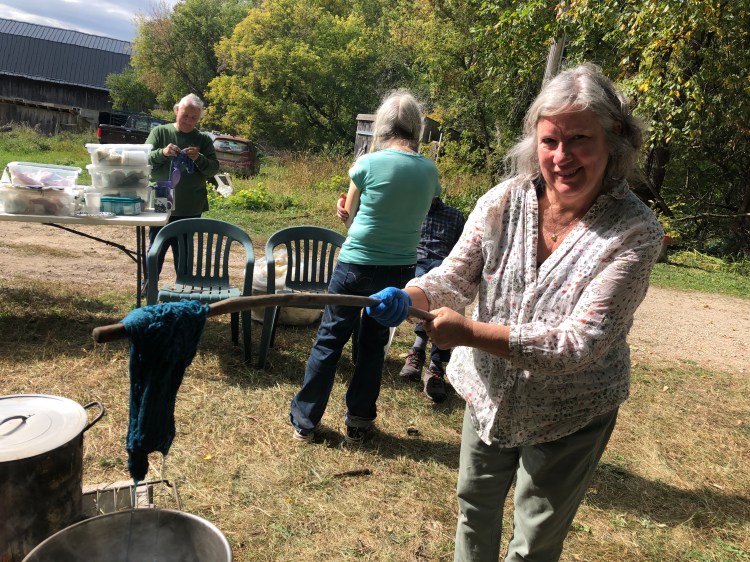
Mary Lou used a big stick to take her yarn out of the pot.
Mary Lou taking her yarn out of the dye pot
Yarn removed from the dye pots is hung on a drying rack to cool off and dry out.
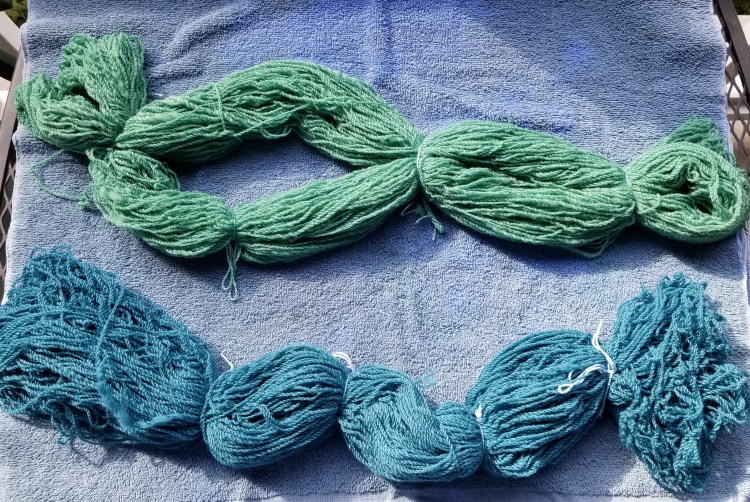
Mary Lou’s dyed yarn was laid out to dry at our house after Fiber Day was over.
The yarn Mary Lou dyed sitting outside to dry
I worked on a carding project with the Ellison’s big electric drum carder. The drum carder can be used to card wool after shearing and washing, to prepare it for spinning. This time I used it to blend four different fibers that were already carded into roving and could have been spun as is, but I wanted to blend them together. I had camel/silk roving I bought at Shepherds Harvest Sheep and Wool Festival, and two different blue colors of merino wool, and a bit of purple wool that I had dyed myself at Fiber Day some earlier time. Sometimes for a fiber blending project the various fibers are weighed and divided into groups so that you know that content of your resulting batts, and they have a consistent blend of the different fibers. I have done that in the past, but this time I just started feeding the fibers in to the machine without measuring. I added the fibers in a consistent order until the drum was full, then removed the batt and started again.
Fiber I brought from home to blend using the drum carder
The fibers gets fed in at the bottom where the small roller grabs it and feeds it around and on to the big drum.
Feeding fiber into the drum carder
After you have added as much fiber as you can or want, it is peeled off and the result is a batt.
My blended batt coming off the drum carder
I completed three big batts which are now waiting for me to spin.
Blended fiber ready to spin
I recommend Fiber Day for anyone interested in any activity involving fiber, whether you are just learning or an expert. It is a wonderful day hanging out with amazing people.
For years I have wanted to learn how to weave on a floor loom. I used to get a catalogue in the mail for John C Campbell Folk School in North Carolina. They have weekend and week long classes on dozens of traditional crafts in a beautiful setting. I would pour over the catalogue reading about weaving classes and other classes I might take one day. The timing has never been right, and for other reasons it has not happened. Fortunately, a different way to learn weaving on a floor loom has come about recently.
When we moved to the Fergus Falls area I met Torri at Tangles to Treasures. She is a very accomplished weaver and fiber artist with multiple looms of all sizes and types in her storefront space. The smallest loom makes a 4″ x 4″ square. The largest loom has a weaving width of 60″, has 10 harnesses and 12 treadles, takes up 7′ by 7′ of floor space and stands about 6.5′ feet tall. In between are looms of all sizes and types, including multiple harness looms that sit on the floor or a table, rigid heddle looms, frame and tapestry looms, looms ideal for making rugs, and inkle looms for making straps.
There are five floor looms in this photo taken at Tangles to Treasures
Two years ago I bought a 15″ wide portable rigid heddle loom that sits on a table or stand, and makes items like scarves and tea towels. It has been a perfect way for me to learn about weaving in an approachable way. I have enjoyed making some nice things for myself and for gifts.
New floor looms cost thousands of dollars. Torri had a used four harness 42″ wide floor loom with a 36″ wide weaving width for sale at a very reasonable price. It sat there for a long time while I was busy learning the basics of weaving on the small loom. This summer I finally thought “I could buy that”. I was not sure whether I was ready to take on this new challenge and invest even more money in equipment. On the other hand, it was the perfect time while I live in a house with space for a floor loom, and I would be able to get lessons from Torri. When I found out that another customer had expressed interest in the used loom, I decided to go for it before it was too late. The original owner was someone I know, and I happened to run into her in Fergus Falls that very day. I went ahead and paid for the loom, but it was the end of summer before I had time to start lessons. Following is a photo of my new loom.
My new loom
Many concepts and terms I learned for the rigid heddle loom also apply to the floor loom, but there was still a lot to learn and accessories to buy. Torri guided me through my first project while the loom was still in her storefront space. I made a scarf with a twill pattern using yarn I had on hand. Twill is common weaving pattern that a four harness loom can do that a rigid heddle loom cannot do.
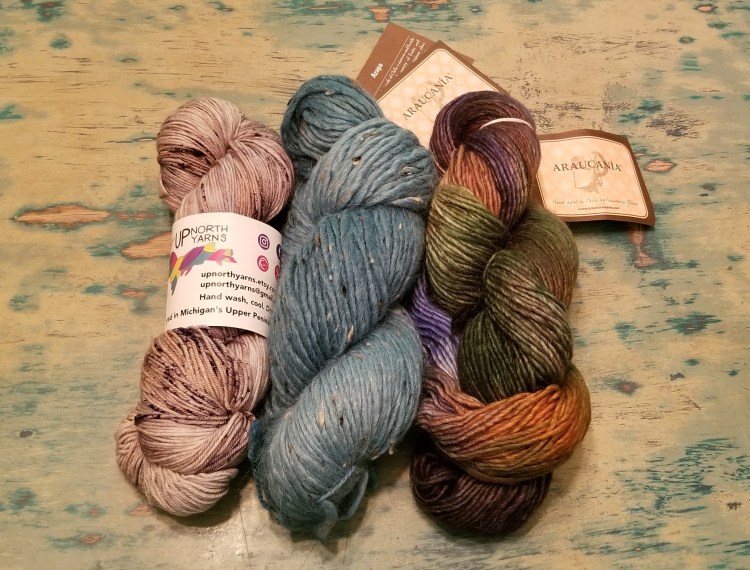
Following is a photo of the yarn for my first project. I bought the yarn on the left when I was in Michigan this summer. It is a brand called Araucania, made in Chile, with a fiber content of 70% merino / 20% alpaca / 10% silk. The yarn on the right is 75% merino / 15% silk / 10% cashmere Madeline Tosh Pashmina from my stash.
Yarn for a scarf
The first step in the project was measuring out the warp yarn using a “warping board”, a wood frame with pegs sticking out. At one point the yarn is crossed the opposite way for each round which helps keep it in the right order when threading on the loom. You can see the “cross” in the photo below at the top. After measuring out one pass around for each warp yarn, loops of yarn are tied around at several spots so that it stays orderly and cannot turn into a tangled mess when removed from the warping board.
Measuring the warp yarn with a warping board
After removing the yarn from the warping board it is made into a “chain” for storing until ready to put on the loom.
Yarn measured and ready for warping the loom
There are steps for getting the warp yarn on the loom. It is hard to explain without using weaving jargon and hard to understand if you are not looking at the process in person. Feel free to skip the text and just scroll through the photos. The following photos show the process of getting the warp yarns threaded through the “reed” and then the “heddles”.
Yarn ends threaded through the slots in the reed
The reed is a rectangle with slots to keep the warp yarns lined up the right distance apart. Heddles which are wires with an eye in them that are attached to multiple harnesses, behind the reed. This is all confusing until you actually work with it yourself. Patterns are formed by the order in which the warp yarns are threaded through the heddles and harnesses. The next photo shows some of the warp yarns threaded through heddles and tied on to the back apron bar.
Threading the yarn ends through the heddles, from the other side
The following photos show all the warp ends threaded through the reed and heddles and then tied on to the back apron bar.
Yarn ends threaded through both the reed and heddlesYarn ends tied on to back
The warp yarns were then wound on to the back beam and the other ends tied on to the front apron bar.
Yarn ends tied to the front apron bar
Once the loom was “warped” it was ready to prepare the weft yarn for weaving.
Weft yarn for the scarf
The weft yarn was wound on to bobbins with a gadget called a bobbin winder. The bobbins go on shuttles for efficient weaving.
Using the bobbin winder to prepare the weft yarn for weaving
Finally after hours of preparation it was time to start some actual weaving.
Some plain weave rows used for hem stitch, followed by rows in twill patternAnother view of the weaving in progress
After I finished weaving the weft rows I removed the scarf from the loom, twisted the fringe, and washed it gently.
Weaving complete and project removed from the loomMaking fringeCompleted scarf with only a bit of yarn leftover
You can see the twill pattern on the close up photo below, and also on a pair of denim jeans.
Twill pattern up closeClose up of some denim
The scarf matches the early fall colors.
My husband and I are currently on a road trip to Tennessee, Alabama, North Carolina and Virginia to visit cousins and do some sight seeing. We stopped to see the campus of John C Campbell Folk School while we were in North Carolina. It is a beautiful, peaceful place. Now I really want to go back and take a class!
View from one of the buildings at John C Campbell Folk School
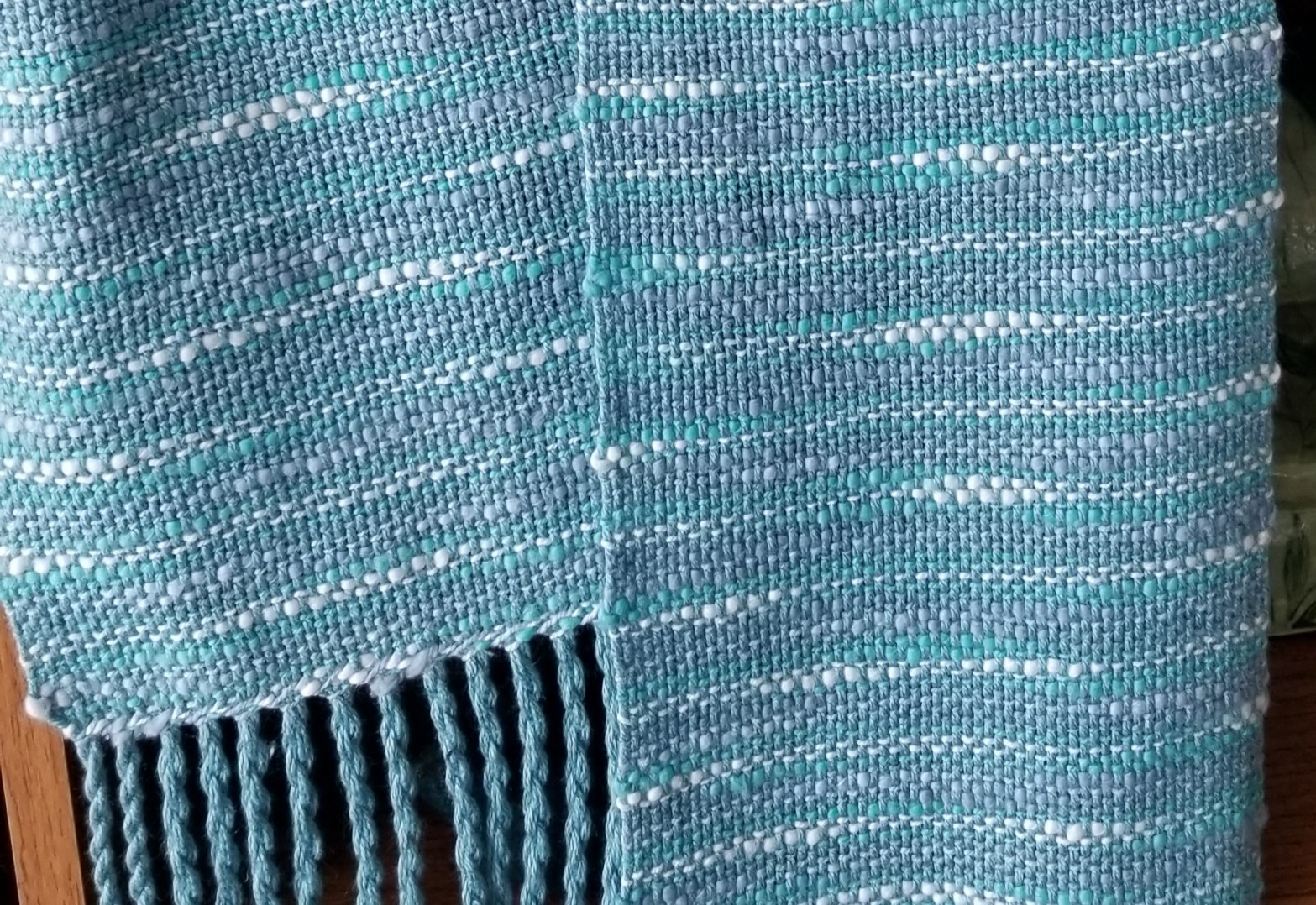
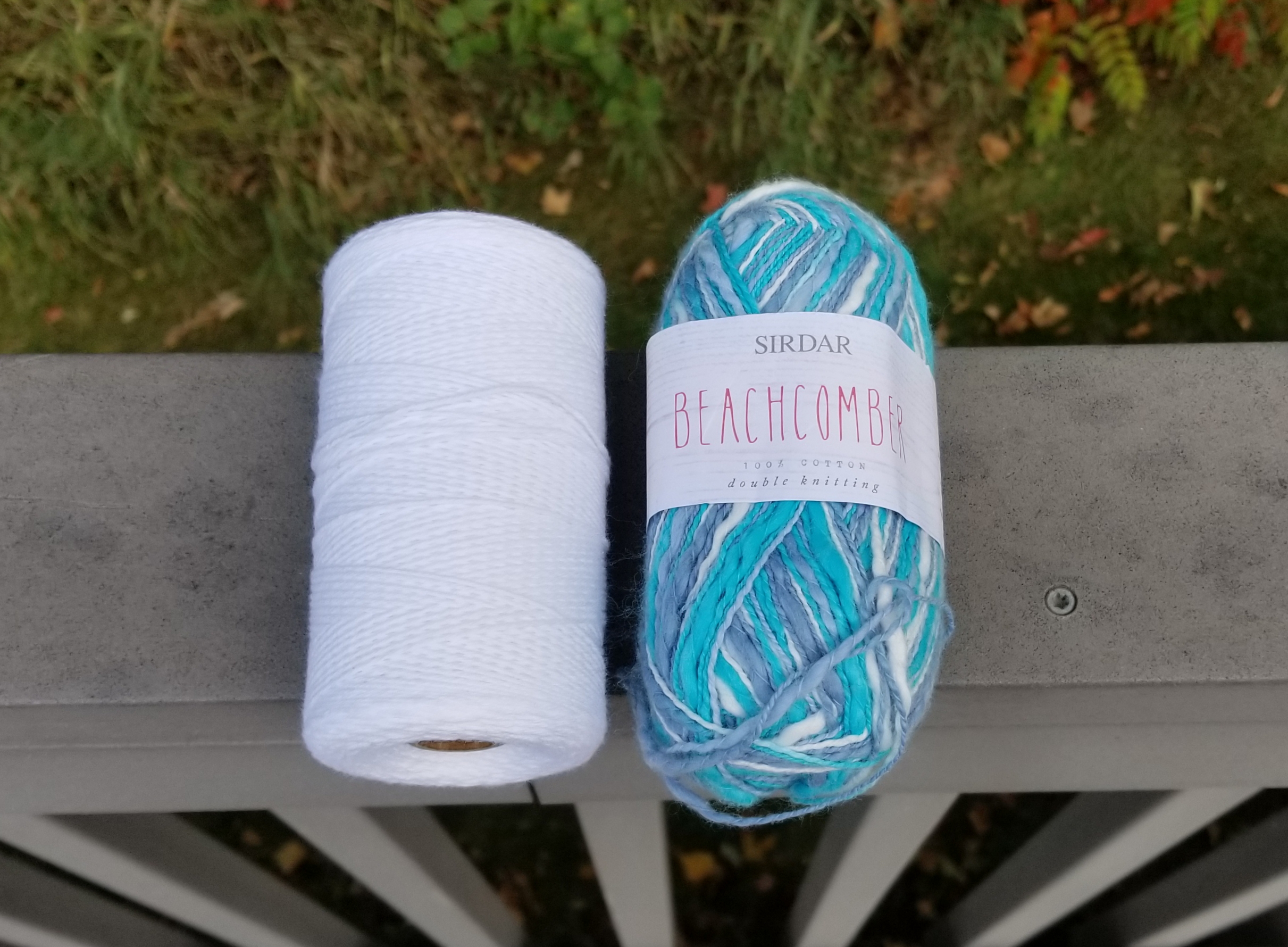
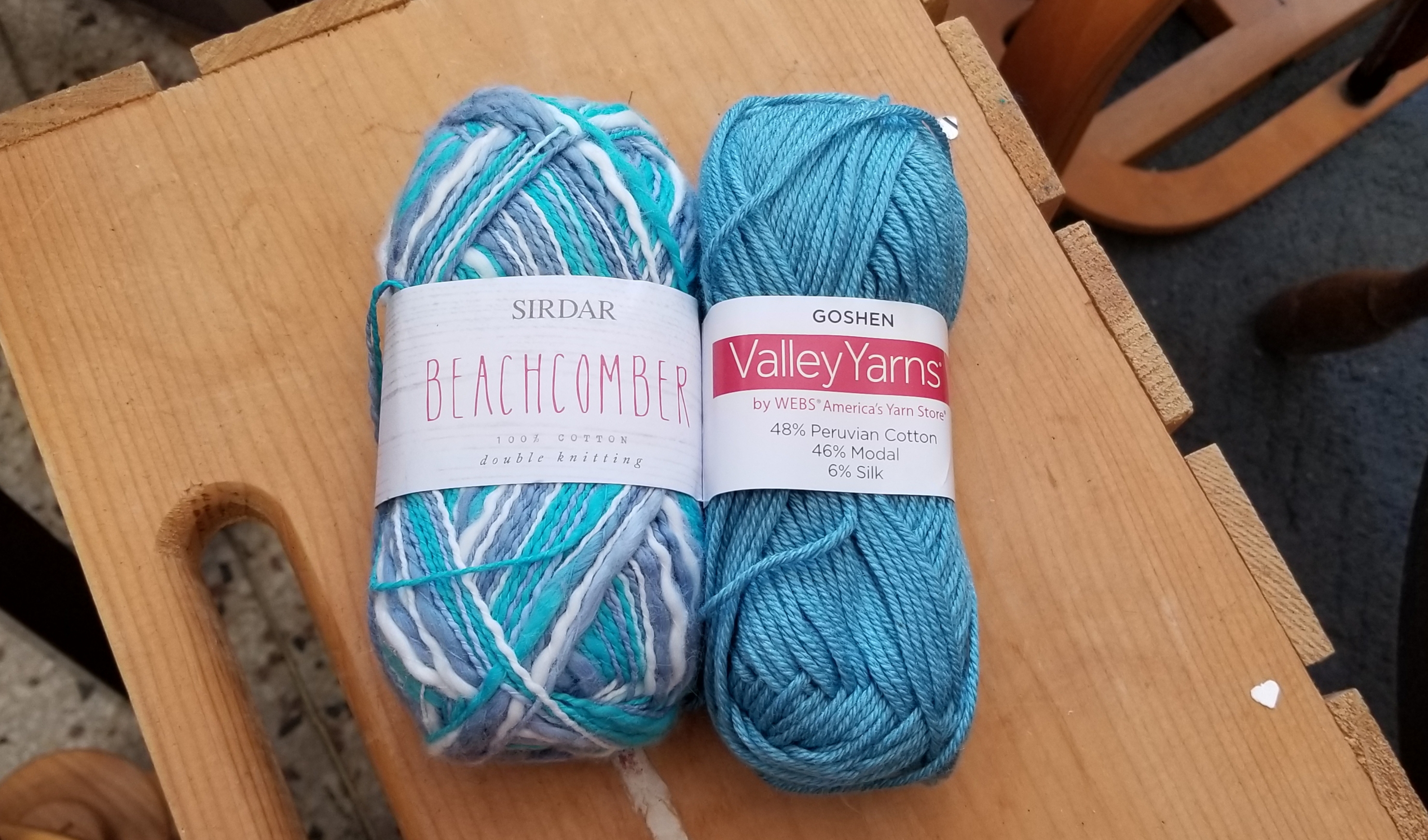
Last fall I wove a cotton scarf on my Rigid Heddle Loom with white cotton warp yarn, and using variegated turquoise, gray and white thick and thin cotton weft yarn. There is a blog post about it here. I posted the scarf on my ETSY shop and someone bought it right away. I thought it would be interesting to try the same scarf again using blue cotton/modal/silk yarn for the warp instead of plain white. The photos below show the yarns used in the first version of the scarf last fall, followed by the yarns in the current version.
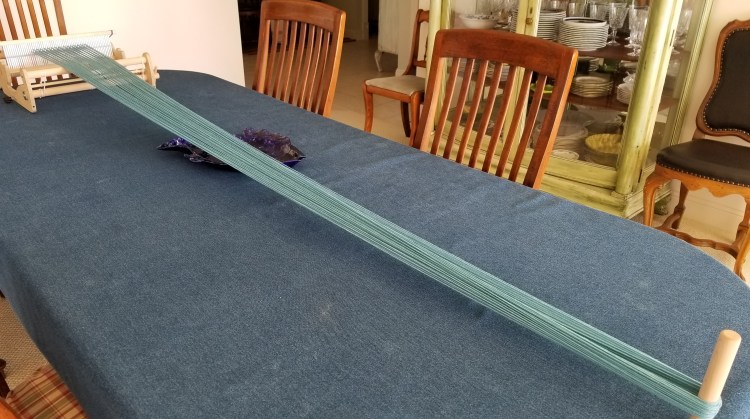
The first step was to put the blue warp yarn on the loom. Luckily my dining room table with all the leaves in it is just the right length for a scarf.
Warping the project on the dining room table
The next photo shows a close up view of the warp yarns going around the back apron bar on the loom, and two yarn ends threaded through each slot in the reed.
Close up of the warp yarn measured out
The next steps in preparing the warp were winding the eight feet of warp yarn around the back beam so it was all contained on the loom, threading one of the ends from each slot through the adjacent hole in the reed, and tying the ends on to the front apron bar. The finished scarf was closer to six feet, with the extra two feet used up in fringe, loom waste, and “take up” (the warp yarn going up and down over and under the weft yarn). I did not take any photos of this part of the project. In the next photo you can see the yarn ends tied on to the front apron bar and the beginning of the weaving. There are some header rows that were removed later, followed by the hem stitch that finishes the end, and the first few inches of scarf.
Beginning of scarf tied on to the front apron bar with header rows, hem stitch and a few inches of weaving
There were hours of weaving weft rows, but I worked on it here and there with a long break during the middle of summer, so I don’t know how long it took. Skipping ahead, the next photo shows the hem stitching in progress at the other end of the scarf. I had to consult my instructions for hem stitching after not doing it for so long.
Working the hem stitch at the end of the scarf
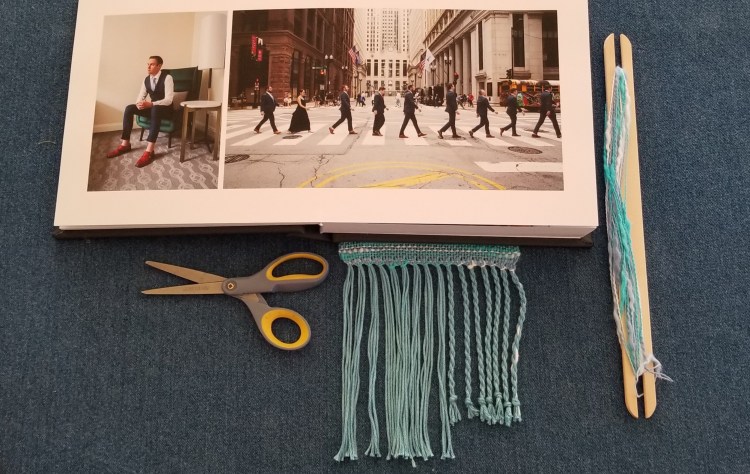
Once the hem stitching was complete, I cut the warp ends off the back apron bar leaving enough length for fringe, unwound the scarf off the front beam, and cut the ends off the front apron bar leaving enough for fringe there too. In order to twist professional looking fringe from the loose ends, I anchored the end of the scarf down on the dining room table using the heavy photo album from my son’s wedding.
Making the fringe with my son’s heavy wedding album holding the scarf in position
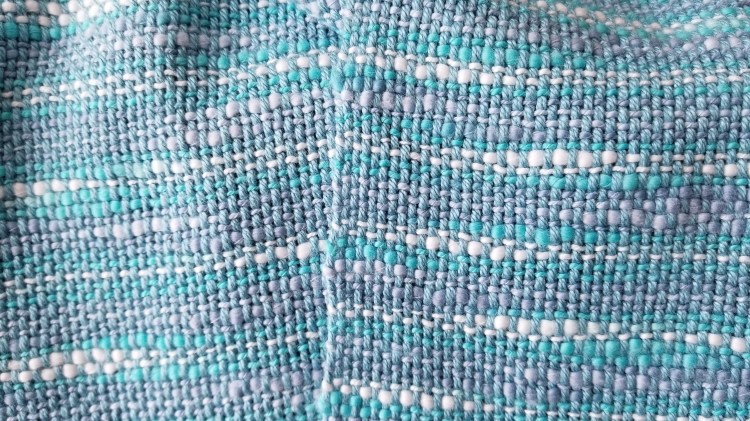
Following are photos showing a close up of the weaving after it washed, and a photo of the completed scarf wrapped around a bust of me that my mom made years ago.
Close up of the weavingA bust of me that my mom made, wearing the scarf
Lastly are photos showing the second version of the scarf with blue warp yarn, next to the first version of the scarf with white warp yarn. They are both nice, but I think I like the second one better.
Since completing this scarf I have stepped up my weaving game. Watch for future blog posts with details.
Most of my readers are not interested in an entire blog post about another pair of hand knit socks. Instead I am sneaking a sock project into this post about a ladies trip I went on in July. I have traveled with high school friends in the past to Savannah, New Orleans and Quebec City. This time four of us went to the Traverse City area of Michigan, where I have some connections. My cousin lives in Glen Arbor near the Sleeping Bear Dunes National Lakeshore, and my niece and her husband own and run Falling Waters Lodge in Leland. It was not a hard sell talking the group into going there, as it is a beautiful and wonderful vacation area. I made reservations for a suite at Falling Waters Lodge a year ago to make sure we would be able to stay there.
Getting to Traverse City from Minnesota is not easy. You can fly, but it is expensive, there are not many options for flights, and sometimes they get cancelled at the last minute. It takes about 12 hours to drive whether you take the southern route through Chicago, or the northern route through the Upper Peninsula of Michigan. There is a ferry boat that goes across Lake Michigan, but taking that involves getting up very early to accommodate the schedule and there is a lot of waiting around while they load all the cars on the boat, so it does not save any time. My friend Sheri and I decided to drive the southern route on the way there and the northern route on the way back. The other two friends, Kris and Marla, purchased plane tickets to Traverse City.
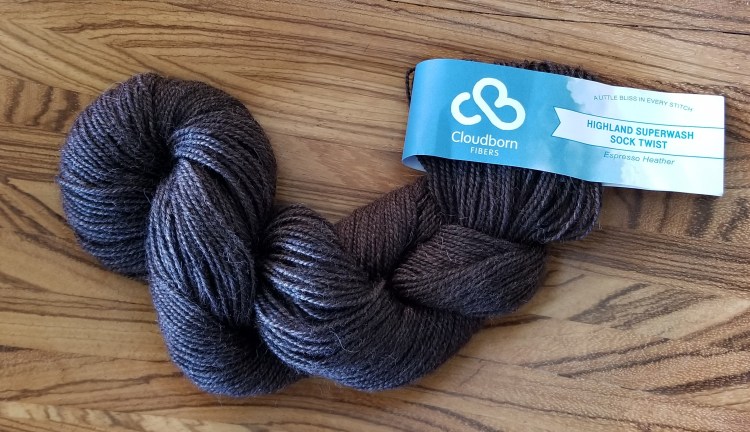
A pair of socks was the perfect knitting project to bring on the trip since it does not take up much room and likely it would keep me busy for the entire trip, so I would not have to bring a backup project. I picked out some brown wool and nylon Highland Superwash Sock Twist yarn I had bought on sale last winter. It is a tiny bit thicker than most sock yarn, which means I could go up one size needle and have fewer stitches per inch.
Sock yarn for a trip project
I brought the sock yarn to the beach at the cabin during our family reunion, so I could get started on the project before the ladies trip. There was a lot going on in my head and I forgot to use my ball winder to make a ball out of the hank of yarn before heading to the beach. Instead my cousin-in-law held her arms out while I manually wound a ball. I did not get much farther than preparing balls of yarn for each sock before leaving on the trip a few days after the family reunion was over.
Making the hank of yarn into a ball
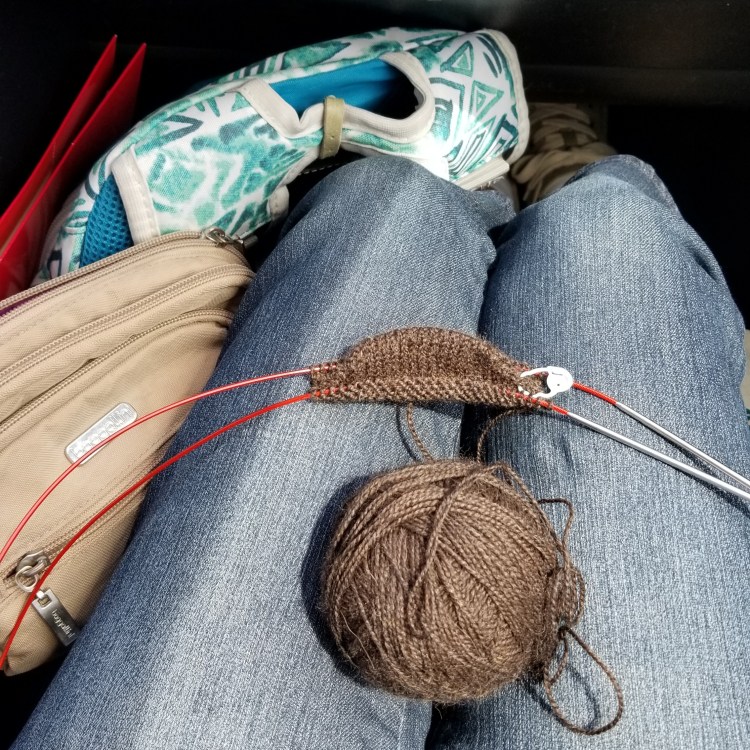
My journey started with driving three hours to Minneapolis, where I stayed overnight at my sister Betsy’s house. At the last minute Betsy needed a ride to Muskegon, MI, which was only a little way off our route, so she rode with us that far. In the morning the two of us met up with my friend Sheri for the first part of the trip from Minneapolis to Chicago where my son lives. The following photo is a typical scene of my lap on any road trip, with the brown sock project in progress, and my backpack and purse crammed in next to me. Usually our dog is also on my lap, but she was not invited this time.
Starting the sock project in the car
We had arranged to stay overnight at my son James’s condo in the Pilsen neighborhood of Chicago, which is a very Latino area. When we arrived in the afternoon, James and his wife Kelsey were still busy working from home, so we walked around near their place until time for dinner at a fun Mexican restaurant nearby. We left at 7:30 am the next morning just as Kelsey was starting her first zoom meeting of the day.
Delicious Mexican dinner in the Pilsen neighborhood of Chicago
The next leg of the trip took much longer than we had planned, but worked out OK. We had told Kris and Marla that we would pick them up at the airport in Traverse City at about 12:30 pm when their plane arrived. It turned out that was never a reasonable plan, but it was more impossible after we realized that dropping my sister off in Muskegon added an hour and a half to our itinerary, and also I had forgotten that it is an hour later in Michigan. Oops. We were able to contact our friends and tell them to take a taxi from the airport to the cute main drag of Traverse City to have lunch and kill time until we could get there.
My sister was going to be spending a few days with her son-in-law’s mother, Gretchen, in Muskegon. Gretchen lives in a typical house for normal people but it has an indoor swimming pool. Someone had built walls around what was originally an outdoor pool. Of course we had to stop and visit a bit, get a tour of the house, and check out the pool. It was really nice and we were temped to get our bathing suits out of the car and go for a swim, but then we would have been even later picking up our other friends.
Traverse City was hopping when we finally got there at 4:00 pm. After finding Kris and Marla and a bathroom, we drove to Falling Waters Lodge in Leland. My niece and her husband, Emily and Cooper, bought this place from the estate of his grandfather after he passed away. Cooper used to work there during summers when it was owned by his Grandpa.
Selfie with Falling Waters Lodge in the background
Falling Waters Lodge is right on the Leland River where there is a dam, and where the river empties into Lake Michigan. They have tee shirts that say “Best Dam Lodge”. Across a short bridge over the dam is historic Fishtown, a cute row of shops and location where actual commercial fishing still happens.
Historic Fishtown is right across from the Lodge
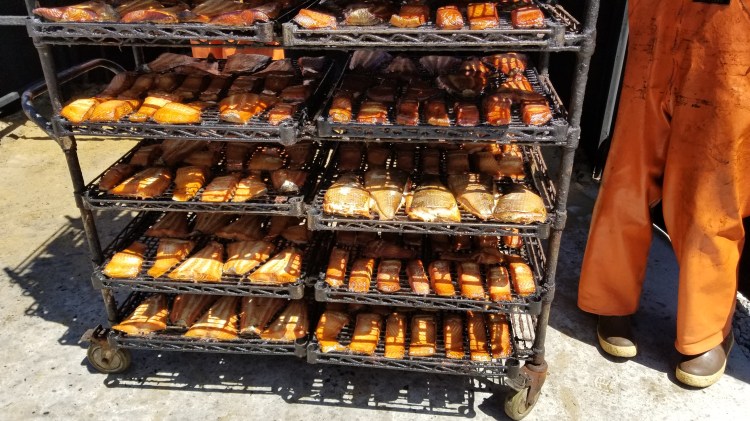
Along with nice shops, an amazing sandwich place, and a small history center, there is a business that sells smoked fish in Fishtown.
Smoked fish being prepared in Fishtown, Leland, MI
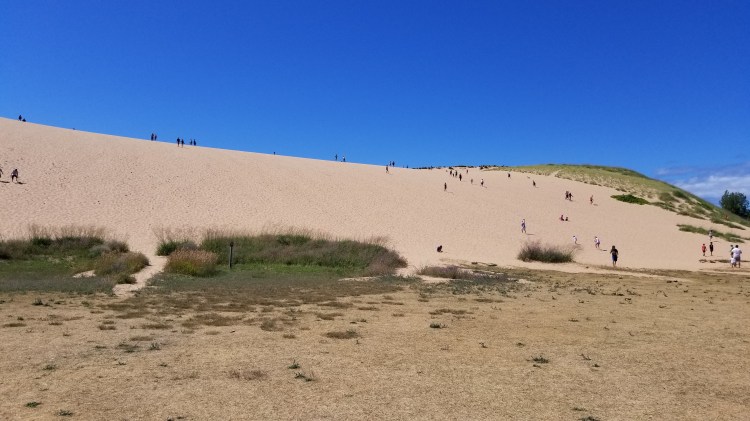
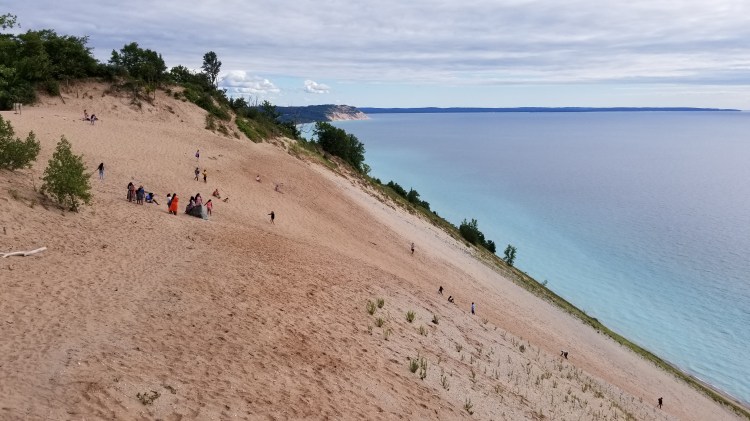
One of the must do activities in this area is going to the sand dunes at Sleeping Bear Dunes National Lakeshore along the coast of Lake Michigan. There is a 284 feet high main dune with easy access. Climbing the dune is a lot harder than it looks. If you have more time and a lot of energy you can continue after you reach the top for a longer hike with amazing views, continuing on all the way to Lake Michigan. There is also a seven mile scenic drive with various marked points of interest where you can stop for more information and more views.
The Dune Climb is more imposing that it looks in this photoOne of the stops on the scenic drive at Sleeping Bear Dunes National Lakeshore
Selfie while at the sand dunes
My cousin Lissa lives in Glen Arbor. She runs a wine tasting room, Glen Arbor Wines, in addition to her day job as editor at Traverse Magazine. There had been a memorial service for Lissa’s mother Mary Turak, my mom’s first cousin, one week before our time there. Mary was my knitting mentor and owner of The Yarn Shop in Glen Arbor. After she retired in 2018, I bought all the inventory that was left from her shop (click here to read about that). Because of the memorial service, Lissa’s brother Jon and his family were in Glen Arbor when I got to there. I cannot remember the last time I had seen him so it was a wonderful opportunity to catch up after many years. Even my friends who had never met these people enjoyed an evening sitting around the camp fire at Glen Arbor Wines listening to some of his crazy stories from teenage years at camp in the area. Glen Arbor Wines regularly has live music on the front porch, so we also had a couple of relaxing times partaking of that.
Live music at Glen Arbor Wines
Other fun things we did were kayaking on the Crystal River, visiting a historic light house, looking in many cute shops, having a picnic lunch in Sutton’s Bay, watching the sunset over Lake Michigan a block from where Lissa lives, and having dinner on a lawn outside a restaurant with live music playing.
While driving around we happened upon two yarn shops. I do not need any more yarn, but naturally I had to buy something at each one. At one place I bought two skeins of some beautiful alpaca, merino wool, and silk blend yarn that will be good for woven scarves. At the other shop I bought some sock yarn in a color called “Petoskey Stones”. Petoskey stones are common to the area, so I thought it would be fun to have a pair of socks that would remind me of this trip.
Pretty yarn display at one of the shopsSkeins of yarn I purchased in Northern MichiganCooper and Emily with me in Glen Arbor
I think everyone had a fun time on this trip. The friends kept saying they want to go back as there were so many things we did not have time to do, including hiking and bike riding. I don’t know if that will really happen, but I know I will be back there, maybe with our RV.
On the last day of the trip Sheri and I dropped Kris and Marla off at the airport at 11:00 am and then headed towards the Mackinaw Bridge for the scenic northern route home through the Upper Peninsula of Michigan and across Wisconsin. We had expected to drive part way home and then stay overnight in a hotel before completing the home stretch of the trip. However once we were on the road we ended up driving all the way to Minneapolis, arriving at 11:30 pm. The next morning I met up with my daughter who had arrived from the west coast for a visit. We drove together from Minneapolis back to the lake for the next segment of a busy summer.
I did not get much knitting done on the trip, other than in the car. Most of the sock knitting happened after I was back home, usually in the evening in front of the TV, or sometimes at the cabin when visiting with guests. I finally finished the socks in September, eight weeks after winding the yarn into balls.
Almost done with the socks back at Jewett LakeCompleted socks
I am not much of a gardener. I would rather be doing something else, but am willing to put in a limited amount of effort to get some fresh produce. Our garden had several phases this year, starting in the spring with Wayne preparing the area by digging out the old growth and weeds from the previous season, and then putting in some small tomato plants from the garden store. I participated in phase one by weeding the raspberries and rhubarb, planting green bean, zucchini, carrot, and beet seeds, and putting down some wool mulch I got from my sheep farmer friend.
Phase two of the garden involved watching the plants and weeds come up and wondering what was what. Once the plants were big enough (and I had googled to get photos of what they were supposed to look like), I weeded and thinned. Phase three was getting some actual produce and doing periodic weeding to keep it looking nice and orderly. Phase four was when summer activities got out of hand, and while I continued picking produce the weeds started to take over. Phase five is now, when we continue to get tomatoes and zucchinis, but I have given up on weeding, it looks like a jungle, and you can barely find the produce to pick.
The following photo was taken at the beginning of August. Everything looks very lush and green, and weedy.
Lush and weedy garden in August
Wayne has talked about planting strawberries but so far it hasn’t happened. My grandmother used to have a strawberry patch that was full of ripe berries in June of 1982, the first time I brought my husband to the family cabin when we had been dating for only a few months. Between the strawberries, the good fishing, and the classic cabin, I think the deal with me was set in Wayne’s mind that weekend. This spring I heard about hanging baskets of strawberry plants at Walmart, so I bought one of those as an alternative. When my sister was visiting I also went to a U-pick it place and bought one big box of just picked berries We made strawberry shortcake, ate a bunch plain, and froze the rest.
Hanging basket with a strawberry plant
I am not sure the wool mulch was such a great idea after all. Weeds grew up through it and when I tried to pull them out, they got tangled in the mat of wool and it was a battle. In addition to taking care of the vegetable garden, I spent hours weeding in the flower bed and brick sidewalk in front of the house before we had company in the middle of July. Picking the weeds out of the bricks is tedious, and it is discouraging when all the weeds are back after a few weeks.
My uncle who lives near us keeps bees. I think this has involved more work and problems than he expected, but it is great for the plants and gardens in the neighborhood, and good to have a source of organic honey. One time this summer he found one of the bee boxes knocked down and broken apart with pieces scattered about and honey licked off. The bee boxes are heavy and up off the ground, so he thinks a bear did this. We had heard of bear sightings in Fergus Falls 12 miles away, so it is possible. I can’t help having a vision of pooh bear with his hand in the honey jar.
I do not know what I am doing with the vegetables, so I made a chart with some information about each type of vegetable I planted and including a range of dates when they should be ready to start harvesting. The beets had the earliest harvest date, followed by the zucchini.
I was not sure how to tell if the beets were ready, or what would happen if I left them in the ground too long. I picked a couple before the target date because they looked ready. They were small but big enough to cook and eat. I chopped and stir fried the beet leaves with some zucchini and onions. As it turned out, the beets I picked weeks later were even smaller. I tried to watch for zucchini as I prefer to pick them when they are small, but of course I regularly found huge ones that I missed hiding under some leaves.
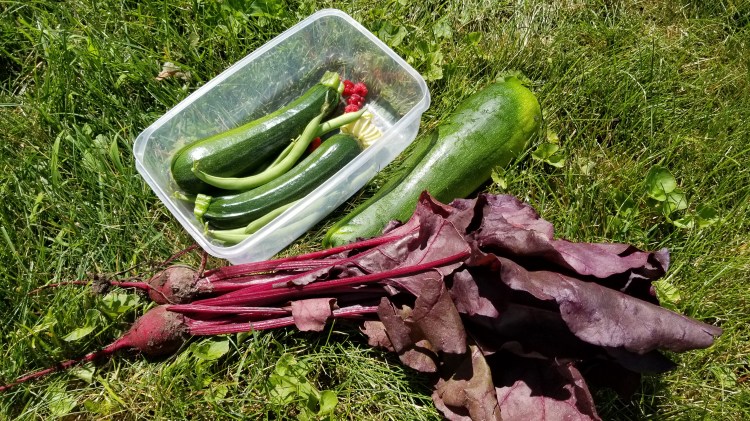
The earliest produce from our garden
The next thing ready to pick were green beans. They are prolific and you have to pick them every day, or at least every other day. They are delicious and we had some at almost every dinner for weeks, but there were still more than we could eat. Last year I tried freezing some after reading up on the best method. Several sources online suggested you did not have to cook or blanch them first, so I just washed and cut them up and put them in meal size bags. Over the winter we ate some of them which honestly were not that good. They were kind of rubbery, like the frozen green beans from the store. I put them in soup instead of serving them plain.
At the end of July I was away for a week. I was worried about being gone for that long with the beans coming fast and furious, and knowing that the zucchini can grow very quickly. Wayne said he would check the garden while I was gone. When I got back there were quite a few rhubarb stalks ready to pick. We had another round of guests, so I made my favorite Rhubarb Dream Dessert and froze some.
Rhubarb from the gardenMy favorite rhubarb dessert
Wayne said he checked the beans every other day while I was gone, but he must not have looked very carefully, because I picked an entire gallon ice cream pail full. And I found a ginormous zucchini. I know from experience that you can look and look and not find any zucchini to pick, and the next day there will be a huge one. I like to slice up the small zucchini and stir fry them with a bit of olive oil. I have a couple of recipes I like that use the big ones, including Chocolate Zucchini Cake and Zucchini Cheese Casserole.
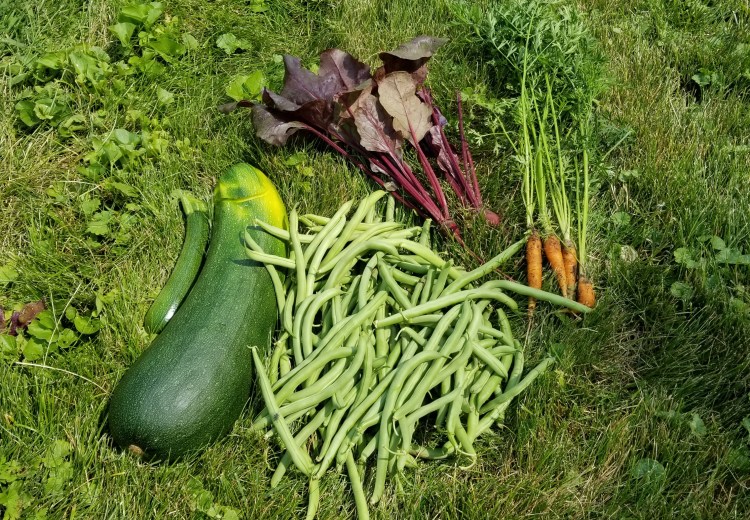
I picked a couple of carrots which turned out to be very small, and three beets which were even smaller. Wayne thinks we should not bother with beets and carrots again due to the small harvest, but I like seeing them grow and eating them. The next photo shows everything I picked on the day I returned from my vacation away.
Produce after being gone for one week
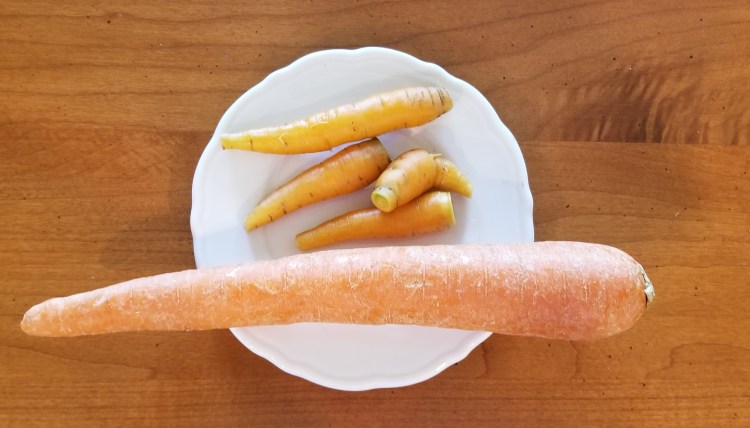
The following photo shows my tiny carrots next to a normal size one from the grocery store. The carrots tasted delicious raw.
My carrots next to one from the grocery store
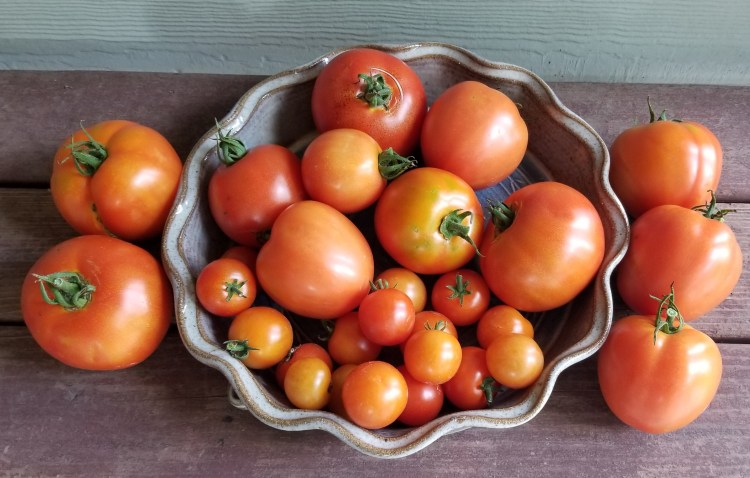
We have been getting many tomatoes. I found that it works best to pick them before that are completely ripe, before an animal takes a bite. They seem to ripen up fine in the house.
Wayne loves to go fishing, so we regularly have fish dinners. Fish tacos has become a favorite meal for company. Wayne prepares the fish, cooks it, and cleans up the mess, while I prepare the rest of the meal. His go to method is frying with beer better, although there are variations depending on what ingredients we have on hand. It is always a winner, but we are very aware that this is not the most healthy way to cook. We have experimented with baking the fish. It works and is good too, but the fried method is everyone’s favorite. Following is a photo of Wayne with a walleye that is Minnesota’s most prized fish.
Wayne used to take our kids out fishing regularly when they were younger, and he enjoys providing this experience to any visiting children. Our young adult daughter does not go fishing much any more, but she did get a fish tattoo. She was here in August with her boyfriend who had never been to Minnesota or caught a fish. Wayne took them fishing, and fortunately they caught several fish while having a fun bonding experience. Next is a photo of Britta’s bass tattoo next to a freshly caught bass.
My daughter’s tattoo next to a freshly caught fish
My time spent in the garden seems worth it when we have meals featuring produce we grew ourselves, or that are locally sourced or freshly caught from the lake. There are two farms down the road that put out freshly picked corn on the cob each day for a couple of weeks. It is self serve where you take the number of cobbs you want and put the money in a box.
Company dinner of fresh caught fish and local corn on the cobb
The following photo is a meal of fish caught the same day, potatoes from my uncle’s garden, and tomatoes from our garden. The beans are from the store, as we had eaten all of ours.
Summer meal with fresh produce
Now in September there are still tomatoes growing among many weeds, and a few zucchini that are hard to find, but the garden is about done for the season which is OK with me.
I live in the retirement home my parents built down the road from our extended family cabin. The cabin is known by family and friends as the Red Cabin, the Red Cottage, or simply the cabin. It was built in 1923 by my great grandfather and is still in use today. Currently the cabin is an LLC with nine owners who are descendants of my grandparents, with the goal of making it available for all family members. Because we live near by, Wayne and I take care of many chores related to the property. I love the place and am willing to do the bookkeeping, pay bills, schedule and pay the cleaning lady, manage reservations, send out necessary communications to family, and keep all the paper files. Wayne spends hours mowing and checking on other maintenance needs.
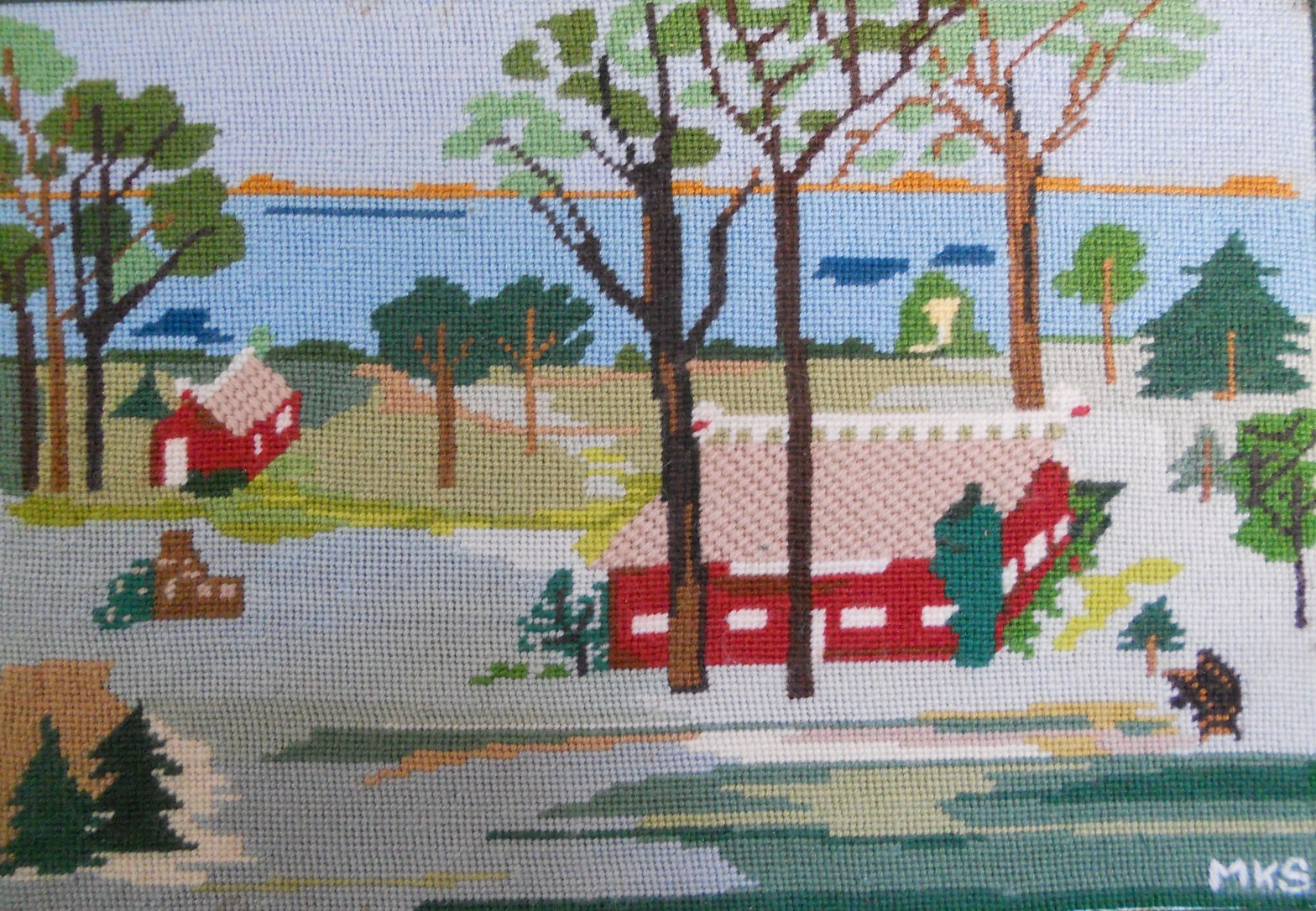
Following is a needlepoint I did of the cabin yard in the 1970’s. My grandma painted the scene on the canvas, so I remember it was not easy to make the color transitions.
Every summer there is a family reunion when my mother’s family members with their children and grandchildren gather at the cabin. At one time there was a compound of seven homes or buildings where extended family could gather at the lake all at one time. A few of these options are no longer available, but we can still get about 30 people housed for the first weekend of the event. A few families stay all week.
There are some activities at the reunion that people look forward to every year, starting with a kick off dinner of wood fired pizza on the grill courtesy of one of my uncles who loves to cook. There are several potluck dinners in the yard, followed by a multigenerational kick ball game that goes on until the mosquitos come out, or this year until a dog popped the ball. One morning there is a pancake breakfast at Phelps Mill park about 15 miles away, featuring our family made maple syrup (click here for a post about that). Many attendees bike to the park. My 84 year old uncle biked both directions this summer!
There are always extra people staying at our house during the reunion, sometimes filling up every bed. It is all very fun but also exhausting. Between getting ready for the big event, having a house full of people, recovering afterwards, and other summer guests and activities, I don’t get very much knitting or weaving or spinning done during this prime time of the season.
Earlier in the summer I had thought of knitting a baby sweater. It is fun to knit baby things. They are cute and knit up quickly. My daughter-in-law’s cousin who lives in Fergus Falls recently had a baby girl, so I decided to make a sweater using yarn I already own from my 2018 yarn store liquidation purchase (read about that here).
Yarn and pattern for a baby sweater
I usually knit with natural fibers, but Baby Blossom Chunky yarn out of 70% Acrylic and 30% Nylon is a better choice for a baby garment since it is washable. This is a self patterning yarn, but I was not sure how the pattern would look on the sweater. The pattern I used, Quick Oats, is available on Ravelry. It says it takes “a couple of evenings” to make. It took me a lot longer than that because I did not sit down and knit for entire evenings, and I also had to redo some sections to fix mistakes.
I wanted the sweater to be baby size, but not too small. My own children were big, and my son actually never fit into size 0-3 months. The Baby Blossom yarn is thicker than the yarn that the pattern was written for. I knew it would work if I just went ahead and starting knitting, but I was not sure exactly what size the final result would be.
Neck of the sweaterYoke of the sweater completed
I had the sweater almost done by the time of the family reunion in July.
Making progress on one sleeve
My niece from Northern Michigan loves coming home to spend time with family in Minnesota. She and her husband own and run Falling Waters Lodge in Leland, Michigan, so it is hard for them to get away during the peak of summer. A few years ago Emily convinced her husband to make the effort to come to the reunion. I can’t remember all the details, but he had made arrangements to fly from Traverse City, MI, to Fargo, ND, which is about an hour from the lake. We have all heard about problems with cancelled flights and lost luggage due to current staffing problems. However there have always been challenges at smaller airports with limited numbers of flights each day. Cooper had agreed to come to the reunion that year despite having to miss participating in an Ultimate Frisbee tournament. At the last minute, Cooper’s flight got cancelled and there were not any more flights to Fargo until the next day. The next day the flight got cancelled again. I think he was finally able to get a flight three days later after many of the people had already left the reunion. Emily was so disappointed. Cooper was frustrated that he not only missed most of the people and fun activities at the reunion, he also missed the frisbee event because he was at the airport trying to get on a flight that was getting repeatedly cancelled.
Not surprisingly, the event this year was affected by covid. Emily and Cooper made arrangements for their duties at the Lodge to be taken care of, and drove to Minnesota with their two large Berne Doodle dogs. They got to participate in the annual kick off pizza on the grill dinner, hanging out in the cabin with cousins playing games, a kickball game, and some beach time. Then Cooper started to feel unwell and spent the next outdoor group meal in their room sleeping. At the end of the evening when he was not getting better he took a covid test. The result was positive. My husband and I, our son and his wife, and my sister and her family, had all been in close contact with Cooper visiting and playing games inside the cabin. The other families at the reunion only saw him outside in the yard so they were not worried about exposure. Emily and Cooper packed up and headed for home first thing the next morning. I know Cooper had a good experience before he got sick, so I hope this does not affect his desire to come again next summer. The rest of us who were exposed isolated at our house for the next five days. We missed out on some activities and visiting with extended family but otherwise it was not so bad. No one else tested positive for covid which seems suspicious, but that is another topic.
One thing that made the reunion interesting this year was the number of dogs at the event. I counted 10 ranging in size from tiny to giant. At my house we had another niece with her four month old German Shepherd puppy Azora, my son and his wife with their one year old mixed breed medium size dog Winnie, and our own 10 pound 14 year old Yorkie Poo Lyla. Lyla does not really know how to play with other dogs, is not used to sharing her space, and cannot hear very well, so sometimes she snaps at people if they startle her. She was confused about having her food moved to a different location. Several times the other dogs found her food and ate it. There were a few accidents and conflicts, but over all it went pretty well. Winnie figured out quickly how to sneak through the gate we had casually leaned against the space separating the kitchen and back hall from the living and dining area, stepped easily over the low barrier we have to keep Lyla from going upstairs, and figured out she could bust out the front screen door if it was not locked. Winnie also dug a big hole in the front lawn. Once she got into some of my hand spun yarn but no harm was done.
I did not take very many photos this year, but I have a few featuring all the dogs. In the next photo there are three dogs on the dock and one on a paddle board.
Dogs on the beach
The following photo was taken inside the cabin. The small dog on the left is our Yorkie Poo. The two big dogs on the right are my niece’s Berne Doodles. Every time I see them together I think of the book “Go Dog Go” by P.D. Eastman. “Big Dog. Little Dog. Black and White Dogs”.
Go Dog Go. Big Dog. Little Dog. Black and white dogs.
In addition to the three dogs at my house, my cousin had her three small dogs, my uncle had his two Golden Retrievers, another cousin brought his large Goldendoodle and my other uncle who lives near the cabin has a Springer Spaniel. The dogs had fun racing around in the yard and chasing after balls thrown in the water.
Winnie ready to go after the ball in the water
My son and his wife and I happened to be in the right place at the right time to get a sailboat ride with my cousin. We all got on the boat and left my husband Wayne in charge of Winnie. However as the sailboat moved away from the dock Winnie swam after us faster than Wayne could stop her, so we had to drag her onto the boat.
Sailboat ride with Winnie, three other dogs on the dock
My son and his wife were able to stay for a whole week, working remotely during the week days. After all the other reunion guests had left, my daughter-in-law’s parents came for the weekend from their home in southern Minnesota. We invited the cousin and his wife from Fergus Falls over for lunch, so this family group could spend time together and see the new baby. Everyone admired the baby sweater, although it turned out to be toddler size rather than infant size.
Sweater complete
Summer is short and precious in Minnesota. When one is making plans, it is easy to schedule in visitors and trips back to back without thinking about how that will actually play out. After the busy reunion week I had a few days to regroup and prepare for a ladies trip to northern Michigan with three high school friends, followed right away by another reunion at the lake with Wayne’s side of the family. It is all good!!
I usually have several blog posts in draft mode, but sometimes none of them are ready when I want to publish two weeks after the last one, or the timing isn’t right for the topic, or I don’t want to publish about socks multiple times in a row. For example, last winter there was a post about socks I knit as a Christmas gift for my daughter. It was ready to go, but I had to wait until after I gave her the socks before publishing it. Those scenarios are times to post about a past project before I started blogging.
When I first started spinning over 15 years ago I made a scrapbook of my projects and fiber adventures. That was the only scrapbook I ever made. There was a time when some people really got into scrapbooking. There were entire stores and companies dedicated to this hobby. My version of scrapbooking was to slap photos in an album and hand write a few captions. I was very good at documenting our lives this way until I went back to working full time after having a half time schedule for many years, which coincided with the end of film photography for our family. We have photo albums starting from the 1970’s and going until 2005, numbered and with the years documented on the spine. I even used the double prints you got with paper photos to make duplicate albums for each of the kids. Of course now they do not want those and I may even have tossed them when we moved three years ago.
After 2005 my husband managed the digital photos and for many years I did not pay attention to where or how to access them, or have the energy to figure it out. Currently we have a system of uploading photos to Amazon Prime Photos, which Wayne loves because you can view them on the TV. He makes digital photo slide shows that serve as photo albums for our personal use, or for events like milestone birthdays, weddings or memorial services. The spinning scrapbook I made was like an earlier version of this blog, except that hardly anyone has seen it. This post is about a project documented in my scrapbook.
In 2010 a friend and I went to Shepherds Harvest Sheep and Wool Festival in Lake Elmo, Minnesota. If you live in Minnesota and are a fiber crafter, you have probably heard about this large festival with many vendors, classes, demonstrations, food, music, and fiber animals. I was there again this spring and posted about about it here. It is normally the same weekend as Mother’s Day which was often a problem for me in the past when the kids were younger. There were several obstacles to my attendance including the fact that it is usually the same weekend as Fiber Day at the Ellison’s sheep farm in Otter Tail County (read about that here), it is often the same weekend as Fishing Opener, and also for a number of years my daughter had a fastpitch softball tournament the same weekend. My husband’s annual fishing opener trip with friends was non negotiable, so that left me to take our daughter to the softball events. I could have skipped the softball tournaments, but I did not want to do that. Once my daughter was done with school and travel sports, I was free to choose between Shepherds Harvest and Fiber Day while my husband went fishing. I would usually choose Fiber Day as it is so much more personal and hands on.
At Shepherds Harvest in 2010 I bought a recycled Silk Sari. The vendor had a large selection of old saris that could now be repurposed into something else. She was demonstrating how to fold and cut a sari into diagonal narrow strips for spinning into sari silk yarn. It was hard to decide which sari to buy, but I purchased one in a beautiful periwinkle color.
The photos of the sari project are scanned from the paper photos in my scrapbook. The colors are all over the place and are not very accurate. Unfortunately I cannot take new ones, so these will have to do. Following is a photo of the sari as it was when I purchased it.
The recycled silk sari from Shepherds Harvest Sheep and Wool Festival
I trimmed the raw edges with pinking shears so they would not ravel. Then I folded the sari fabric in half and sewed across edges to make a large tube. The process is the same as making tee shirt yarn, except this is woven fabric so it is cut on the bias to give it some stretch and reduce raveling. I laid the large tube out flat with the seam in the middle, and then cut diagonal strips, without cutting all the way through the folded edge at the top. That resulted in creating one long bias strip of fabric about 1/2 to 3/4 inches wide, with periodic seams from where I sewed the edges together. The color in the photo below is too lavender, but shows the cutting in process.
The next photo of a scrap left after cutting the strips shows the pattern and color most accurately of the selection I have, although it will show up differently depending on what device it is being viewed on.
A scrap from the silk sari
Once I had cut the long strip of fabric, I spun it on my spinning wheel to make a version of yarn. The process of spinning fiber involves three steps: drafting, followed by twisting, and then winding on to the bobbin. In the case of the long silk sari strip there is no drafting of fiber. There is only twisting and winding on. It is a good project for a new spinner since you only have to manage two steps instead of three.
The next photo shows the resulting yarn. There are little flaps of fabric poking out at the places where there was a seam in the bias strip. The fabric could be trimmed down so it does not stand out so much at the seams, but I thought it was a fun look.
Recycled silk sari yarn
I used part of the silk sari yarn in a shawl with some other yarns. I wore the shawl to a wedding in the Los Angeles area once during the summer. Normally it would have been warm out, but there happened to be an unusual cold snap that weekend. The wedding was at a beach club on the ocean and all the ladies with sleeveless dresses were freezing. The wedding couple happened to have a supply of pashminas as gifts for the women guests. I don’t think they had any idea how useful the pashminas would be when they were planning the wedding! I think there is a photo of me wearing the shawl (probably with a pashmina on top of it) at the wedding, but it would be in with the lost years of photos between paper albums and Amazon Prime storage of photos.
Shawl I knit with a selection of yarns, including the silk sari yarn
I still have one small ball of the silk sari yarn left that is not enough to make anything. When I come across yarn from past projects it is fun to reminisce about where I got it or how it came about, and how successful (or not) the project was.
What is left of the my silk sari yarn
I have never seen recycled silk saris for sale at any fiber fair since I bought this one. A couple of times I have researched buying another one online, but have not found the same large selection of entire saris. I would love to make more silk sari yarn if I ever find the fabric again.