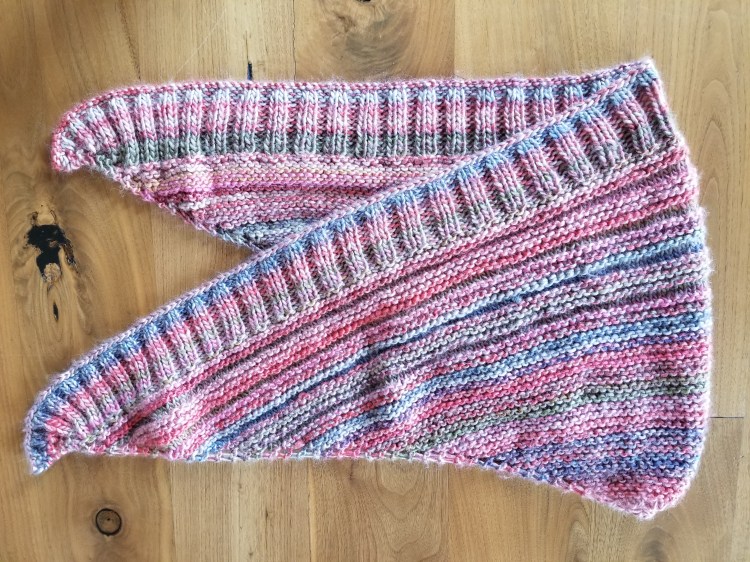
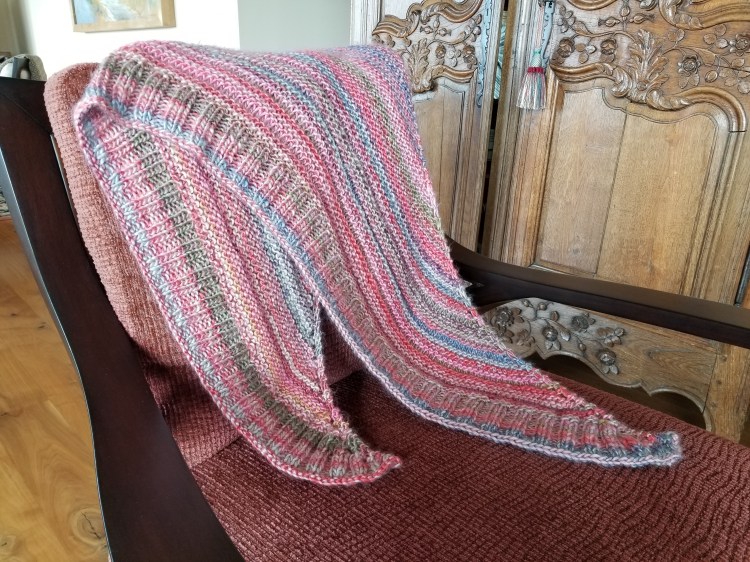
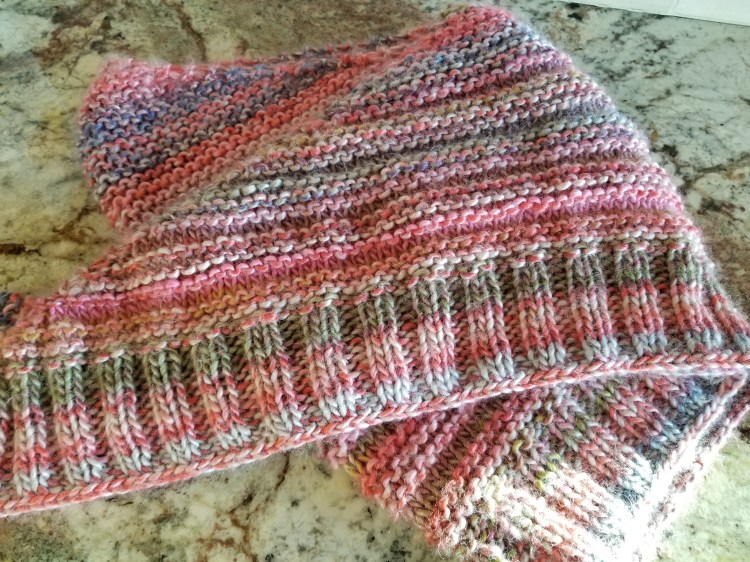
I finished knitting a shawl. It is not as interesting as the purple and gold scarf, and there is not much of a story behind this project other than I needed some things to work on while away from home on the snowbirding trip. Knitters usually bring materials for several projects on a trip because heaven forbid if you were sitting in the car or on a plane for hours without a project.
One thing I like about knitting and weaving and spinning is that there are infinitely many fibers and yarns and colors and patterns so that there is always something new and different to make. Sometimes that makes it overwhelming to decide what to do next or which yarn or fiber to use.
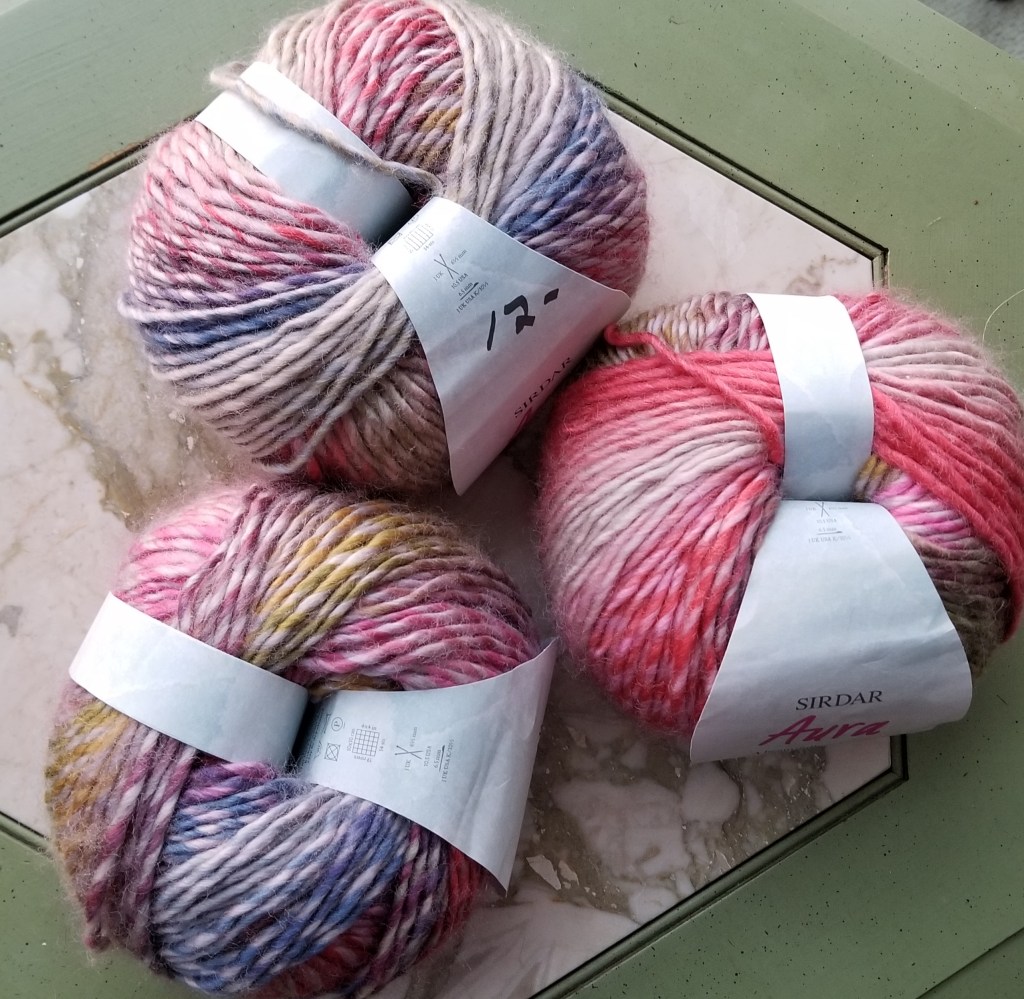
The main criteria for picking out the yarn in this case was to not buy anything. Many of you know that in October of 2018 I bought the entire inventory of a small yarn shop that was going out of business. At the time I did not have a plan for what to do with it, but I figured that once in your life you get to do something crazy. I will write more about the yarn shop purchase in a separate post.
Sirdar Aura yarn for the shawl
My yarn shop inventory is for sale at Tangles to Treasures in Fergus Falls, and also available for me to use. Even though I own thousands of dollars worth of yarn, sometimes I still cannot find the right thing for a particular project. In this case it was not hard.
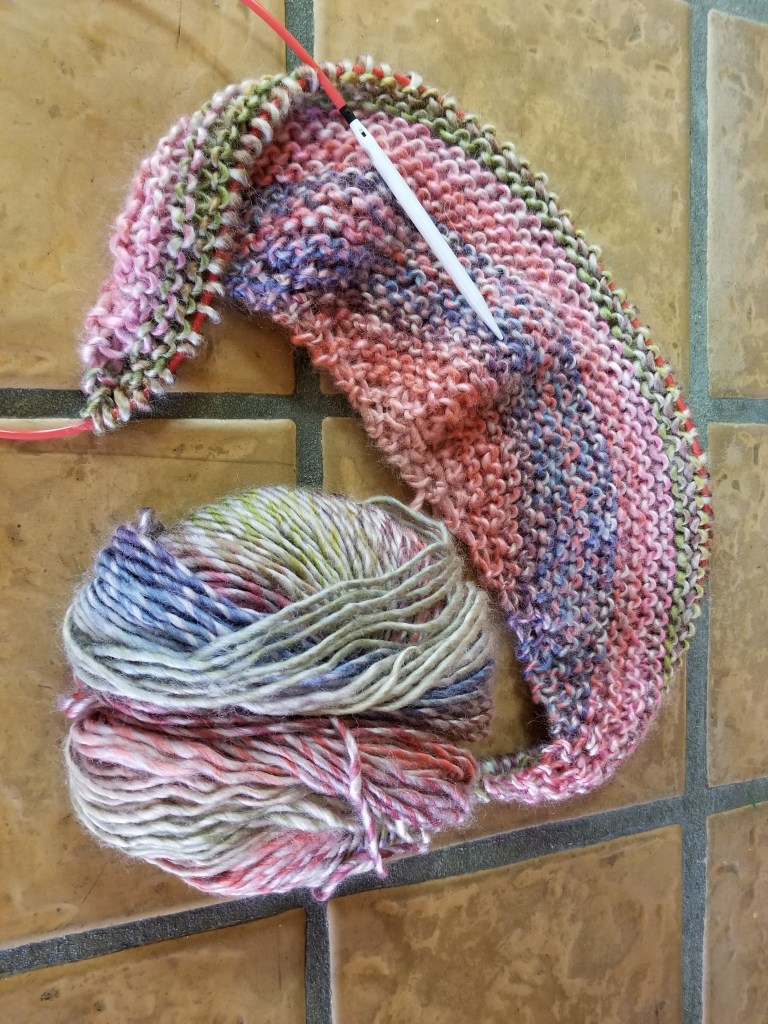
Torri had knit a beautiful shawl with a pattern I liked called “Among the Shadows Shawl”, so I purchased the pattern on Ravelry. The nice thing about a Shawl is you can make it work with many different types of yarn, and I had no trouble picking something out from my yarn shop inventory. It was thicker than what the pattern called for, so that if I followed the pattern exactly the Shawl would come out larger. Instead I did some math to figure out the number of stitches and rows and pattern adjustments that would result in about the same size as the original. But it doesn’t matter exactly what size it comes out to be. Which is good because often my knitting projects do not come out the way I am expecting.
Getting started on the shawl
Another thing about fiber art that keeps me interested is that there is always something new to learn. This shawl pattern had a different kind of bind off that I had never seen before. I liked it and will probably use it again.
My next knitting project is a pair of socks with thin yarn, instead of the bulky yarn used for the shawl. Socks are nice for a trip because the project does not take up much room and is very portable.
We are enjoying our time in Arizona and grateful we have been able to partake of this opportunity to get a break from winter. It is hard to visualize snow and cold while walking around outside without a jacket or boots, and without worrying about slipping and falling. At home I have trouble giving myself permission, or knowing how much time is OK, to spend on things that are not necessary or productive. For many years when working full time while raising kids there was zero extra time. I am still getting used to the idea that being retired, and here in this place, there is time to relax, work on knitting and weaving, participate in events at the RV Park, hike, go on interesting outings, take naps. When we get back to “normal” life in Minnesota, there will be more things requiring my time.
The RV park has live musicians scheduled to perform every Wednesday and Thursday during happy hour. Recently we listened to two Jimmy Buffet style guitar playing brothers while enjoying an amazing desert sunset on the patio area around the pool.
Sunset at the RV Park pool
We also spent some time in the Billiards room at the RV Park on a rare rainy day. I used to be good at pool back in the day, but clearly I need a lot of practice now.
Having a really bad game of pool
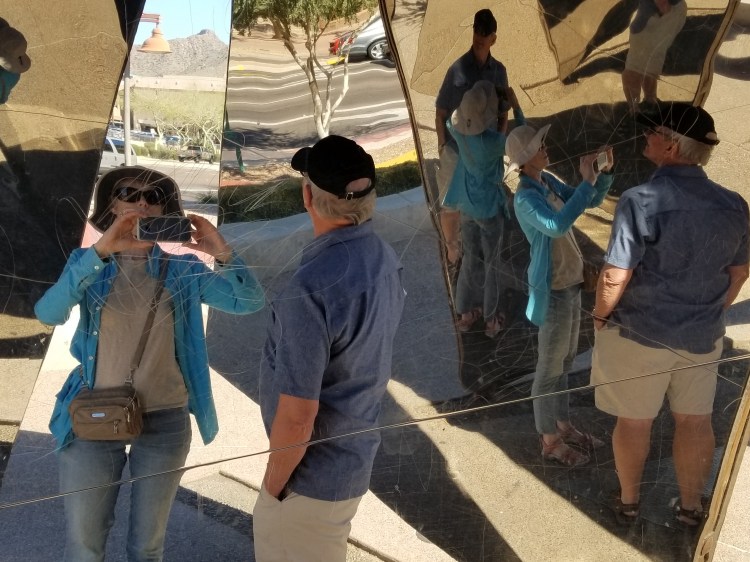
The Museum of the West in Scottsdale is super interesting with art and artifacts from the old west. https://scottsdalemuseumwest.org/ There is some cool street art in Old Town Scottsdale including a sculpture, “The Doors” by Donald Lipski, that looks like a kaleidoscope when you step inside.
A display of chaps at the Museum of the West“The Doors” by Donald LipskiInside “The Doors”
The Desert Botanical Garden in Phoenix was worthwhile https://dbg.org/, but we have seen some beautiful sights while hiking too.
At the Desert Botanical GardenOut hiking
There was a cowboy theme party at the RV Park where residents came wearing fun western costumes. Another night we went to dinner at a burger joint in Apache Junction, just to the west of Gold Canyon. There was a live band playing, with locals dancing while wearing jeans, cowboy hats and cowboy boots. They were not costumes.
We met some friends from Minneapolis for brunch in Old Town Scottsdale. It is ironic that we hardly see these friends at home, but went out of our way to get together with them here. We also spent an evening with some of Wayne’s cousins. One lives in the Phoenix area, the others were visiting from North Dakota and Minnesota. Everyone we talk to at home knows someone who is here.
While staying in our rental unit we have collected cans, bottles, plastic and cardboard for recycling like we do at home, assuming there must be pickup or collection here. When I inquired at the information desk, they said that there used to be recycling collection but the service that came to pick it up “dropped” them. WHAT? Instead I was given a list of several locations in the Mesa area where you could drop off your recycling. When we were on an outing in that direction we loaded the bags of recycling into the car to drop off while we were out. When we got to the first address, it was a community services building, but we could not see any dumpsters or containers. I went inside to ask, and was informed that they “no longer do recycling” anywhere in Mesa. ARE YOU KIDDING ME? We tried several other options on the list we got at the RV park, but did not have any success.
After the brunch in Scottsdale we tried another recycling drop off that Wayne found by searching on the internet, that was on the way back to Gold Canyon. When we got there it was another bust. Not ready to give up, Wayne decided to google recycling in Scottsdale. There seemed to be an option there, so we drove back 10 miles to within blocks of where we had brunch, and BINGO there were drop off dumpsters. In the end, I think we caused a larger carbon footprint by driving all over looking for a drop off place than was saved by recycling of our items.
Goldfield Ghost Town in Apache Junction was a little touristy for me, but I liked their Cowboy Commandments.
Our time in Arizona is wrapping up. Now that we have experienced this snowbirding thing, I can see why people do it. You can bet we will be back here next winter, one way or another.
My adventure girl daughter bought me a skein of qivuit yarn from a shop in Skagway, Alaska, when she was working there for three months in the summer of 2019. Qivuit is the fine underfur from a musk ox, which is eight times warmer than wool and softer than cashmere.
Qivuit yarn is expensive due to being very desirable but labor intensive to produce. You can’t exactly shear a musk ox like a sheep. The qivuit wool underlayer is shed each spring during molting. Fiber is collected during the molt, picked off pelts after a hunt, or gathered from objects the musk ox has brushed against.
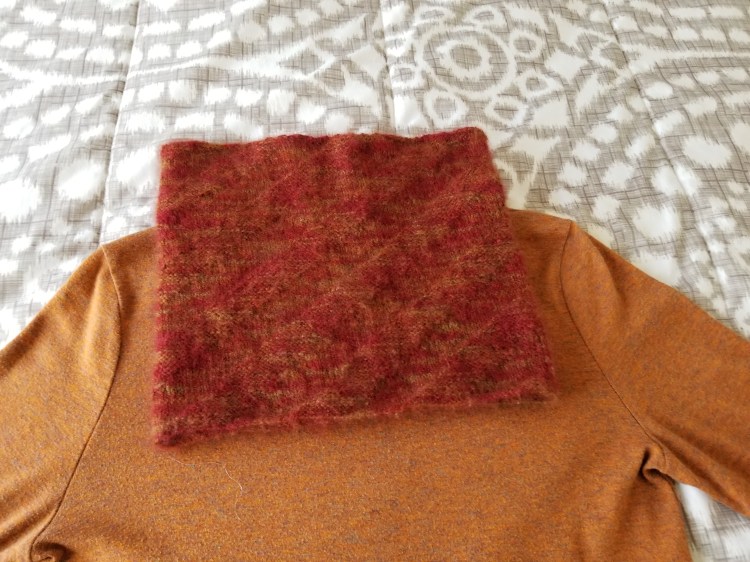
The shop in Skagway provided a web site with a few patterns that could be made with a one ounce skein of qivuit yarn. I selected a cowl with a simple stitch pattern that could be knit without constantly looking at the directions. Cast on 141 stitches on circular needles, knit 10, purl 10. Experienced knitters will know that makes a pattern of diagonal bands of knit and purl stitches. I tend to use a lot of stitch markers to keep track of things, making it more obvious when to do something different and easier to notice of you drop a stitch.
Getting started with the qiviut cowl
It was slow going due to tiny stitches with fuzzy yarn, and I had to undo and re-knit a few sections to fix mistakes. I have had more time to knit than usual while traveling and in our rental unit in Gold Canyon, so I finally finished the cowl after starting it last fall.
The completed project
When it is bunched up on my neck, the diagonal pattern does not show very well. However I like that it results in a reversible cowl, the same inside or outside.
I would be wearing this cowl if I was back in Minnesota, but it is not needed here in Arizona. It will have to wait in my closet until next winter.
Wayne and I drove from San Diego back home to Minnesota last fall. On the way we scoped out some 55+ RV Parks in Arizona, where many retired Midwestern folks go to get away from winter. Wayne’s parents used to spend a couple of months in one of these parks in Brownsville, Texas. They loved it. My parents never had any desire to leave in the winter, other than a few short trips to visit family and friends in warm places. I was not sure how I felt about the whole idea, but was willing to check it out.
Driving through Phoenix there seemed to be hundreds of retirement communities and RV Parks. We saw many that seemed like big parking lots with RV’s lined up. Thumbs down. Heading east, we happened upon one in Gold Canyon on the very eastern fringe of the metro area. This place had a small golf course, beautiful desert landscaping and green spaces, a nice pool, bistro, gym, large activities building, and views of the Superstition Mountains in the background. The landscaping and green space with mountain view made all the difference. Thumbs up, I could see myself there. At the time we had a lot on our plate so we continued on to Minnesota and got busy with what we needed to do at home.
In January after things started to settle down, we decided to call Gold Canyon RV and Golf Resort to get our name on the waiting list for a “park model” rental for the month of February. The lady on the phone confirmed that it was a long shot, but she would take our name. We were surprised when she called us back shortly after that, and now here we are in Arizona!
We left Minnesota on a cold day near the end of January with fog, icy roads, and frost coating the trees. It was beautiful, but made for scary driving. When we got to the RV & Golf Resort two days later it was 77 degrees. That only lasted a couple of days and then it was much cooler with freeze warnings, but at least there was no chance of snow. Average high temperatures for the first half of February are in the low 70’s, but it cools off rapidly as soon as the sun starts to go down.
Leaving Otter Tail CountyA winter wonderland in western Minnesota
The RV resort has “streets” with small “lots” to rent for your recreational vehicle, mixed in with park model homes to rent or purchase. In the middle is a common area with a big building that has a billiard room, library, ballroom, craft rooms for sewing, woodworking and jewelry making, a laundromat, meeting rooms, a coffee shop/bistro and golf shop. Outside the building are tennis and pickle ball courts, a pool, and a patio where you can hang out and listen to musicians around a fire pit. And of course there are some obligatory shuffleboard courts. Following are photos of the main building, Wayne standing in front of our rental unit with the mountains in the background and me standing inside our “house”.
The community buildingWayne standing in front of our rental, with the Superstition mountains in the backgroundThe kitchen and part of the living room before we got it all cluttered up
Park model homes are sort of a cross between an RV and a “tiny house”, but bigger and not meant to be towed around. The one we are renting is 400 square feet with a bedroom, full bathroom, compact but complete kitchen and a living area. It is all very cozy and nice. There is a large overhang on the side with space to park your car, and room for an outside table and chairs and grill. Some of the park model homes are bigger with extra rooms or decks on the side.
A 55+ RV and Golf Resort is a community, as opposed to just lodging. People are very friendly. Many residents are active and social with tennis, pickle ball, golf, bingo, and a plethora of other activities. There is a giant board posted with all the clubs and activities going on. Another board has a list of upcoming events such as musicians coming on site to perform, pot luck dinners, bus trips for various outings and trips, etc.
This is half of the activities board. If you can’t find something to do, that is your problem.
I am doing most of the same things I do at home, but it is warm out instead of cold and snowy. I brought some knitting projects, and my table loom with a supply of yarn. We are walking and hiking. There are yoga classes. I can work on the blog. I can do the family cabin bookkeeping from here. I can read books. I can take naps. There are many interesting outings such as the Museum of the West, with large collections of cowboy art and artifacts.
I have been trying to get rid of stuff and live smaller, so I was looking forward to seeing what it was like living in the 400 square foot space. So far I like it. There is less time spent on cleaning and maintaining. More time for things I want to do.
There are endless opportunities for hiking around hereSo many different kinds of cactus
Wayne was looking at old photos on his phone the other day. What do you know but he found some that he took six years ago when driving through this area, and he happened to make a random stop at one RV Resort – THIS VERY ONE! That was long before we were ever in a position to partake of the experience. We are now thinking about buying an RV. Maybe next winter we will be back here with that. Stay tuned.
My husband, Wayne, has been an avid fisherman ever since his dad started taking him fishing as a child. Jewett Lake, where we live now, is a beautiful, clean, spring fed lake known for good fishing. Wayne likes the solitude of sitting out in the boat alone, as well as sharing the experience with a friend, or teaching a child during the annual family reunion. One of my favorite meals in the summer is fresh caught fish with baked potatoes, green beans and tomatoes from my uncle’s garden.
For those of you who do not live in a cold climate like Minnesota, it may seem unbelievable that people fish all winter by drilling a hole in the ice. After a sufficient amount of time with temperatures near zero, the ice is 15″ to 18″ thick. Four inches is safe for walking. With 15″ of ice you can drive a truck on the lake.
The ice fishing experience ranges from sitting on a bucket out in the elements with your pole, to lounging inside a specially designed recreational vehicle equipped with heat, beds, sofas, a complete kitchen, and a TV. Between those extremes are tent style shelters and a range of huts on wheels in various sizes and designs.
There are many ice fishing houses of all types out on Jewett Lake. This winter someone plowed a 2 lane “road” from the public access out to an area in front of our house, making it easier for others to tow their ice house to the same area. Some of the fancy ice houses appear to be occupied most of the time with lights on at all hours, making one wonder how much fishing is actually happening. I believe that the amount of time spent in a “man cave” ice house is not necessarily related to how many fish are being caught.
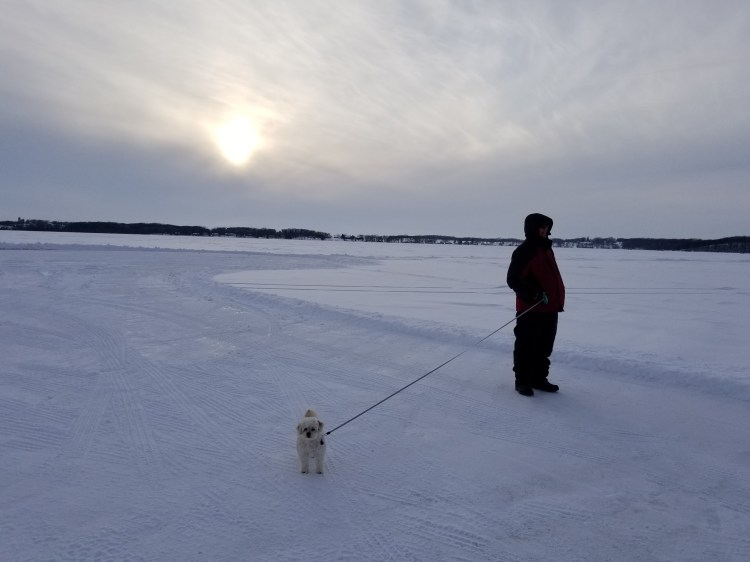
Lyla enjoys a late afternoon walk on the lake with WayneA few traditional ice shacks
Wayne had done a bit of ice fishing years ago with his uncle on Lake Minnetonka, west of Minneapolis, so he had an idea what was involved. Now that we are living at the lake and needing a winter activity, he decided to try it again. $600 of new equipment and a trip to the bait shop later he was ready to head out on the ice. Wayne’s very old ice auger is not working, so on a couple of mild days he tried his luck with no shelter and using a hole someone else drilled. One fish was caught, but broke the line and got away, so we have not had any fish dinners this winter.
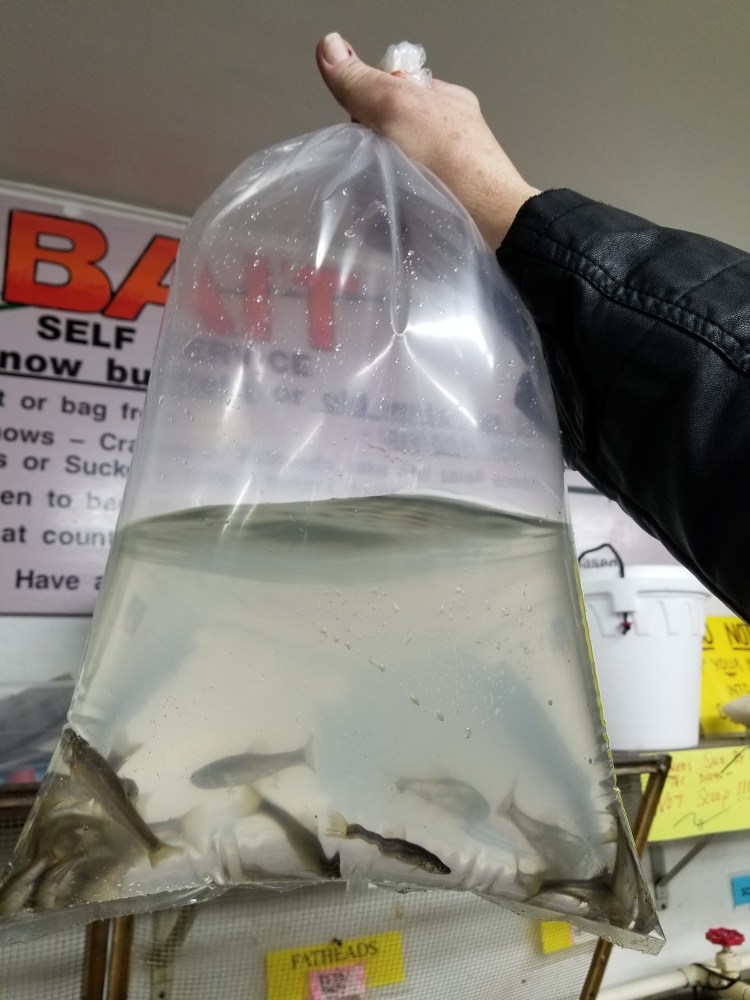
Minnows are used for ice fishing bait
Multiple holes were left by a previous fishermanA village on the lakeA generator is necessary for powering the TV in this deluxe rigLast year someone shoveled a spot for ice skating
Every year there are a few people who try to go out too early or too late in the season. Ice fishing houses must be removed from the lake by the beginning to middle of March, depending on the location, or risk a fine from the DNR. Or worse, they might get stuck in snow that has melted and refrozen.
We’ll see if Wayne actually catches anything this year. I will be watching from the living room window.
Learning to weave has been one of the skills on my bucket list. I pictured one of those ginormous looms the size of a small room.
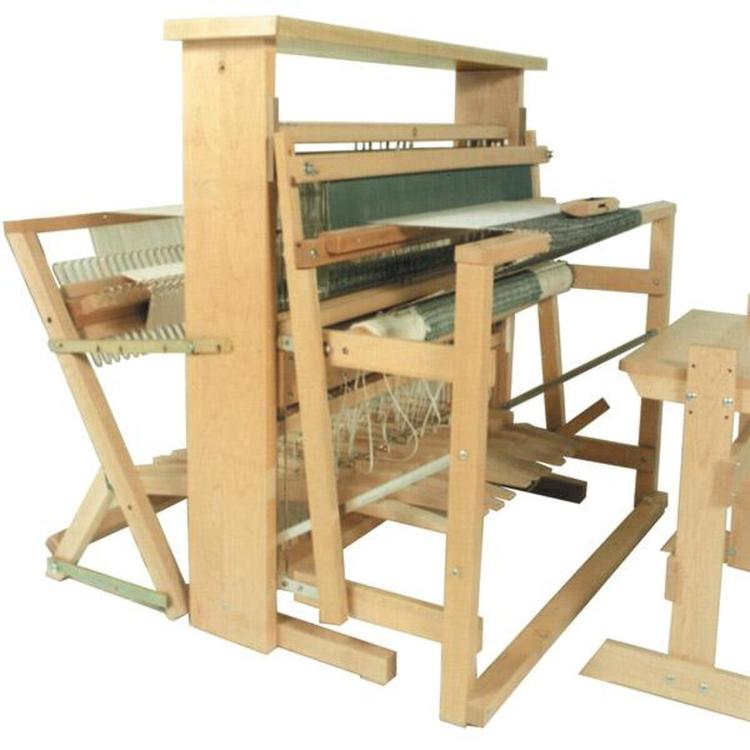
There are many different types of looms that can make everything from a simple narrow strap to a wide fabric with a complicated pattern. After seeing Torri Hanna use a floor loom at Tangles to Treasures, I realized that was a bit ambitious for a beginner. Instead I bought a “Rigid Heddle” loom that sits on a table or stand, and can make a project as wide as 15″.
Floor Loom
Rigid Heddle Table Loom
The loom I bought came with the parts in a box, like a piece of IKEA furniture.
The table loom before assembling
There is a whole new vocabulary to learn in order to put the loom together and set it up for a project. The next photo shows the assembled loom with the “warp” yarn measured out for a scarf.
The “Warp” yarn is measured out
After the warp yarn is measured out it is attached to “apron bars” (like dowels) at both ends and wound up around the back “warp beam” (a thicker dowel). The project is rolled from the back “warp beam” to the front “cloth beam” as weaving progresses until all of the warp yarn is used up, or until your project is the right length. Following is a photo of my loom all ready to begin the actual weaving.
“Warped” and ready to begin weaving
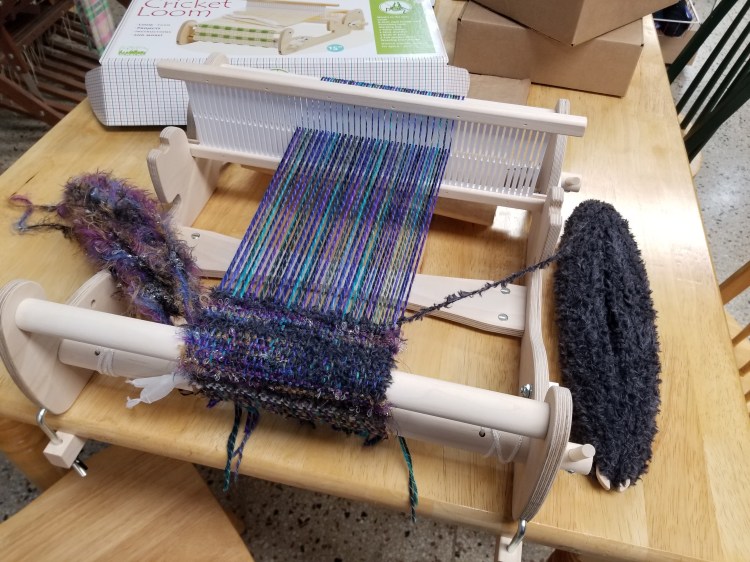
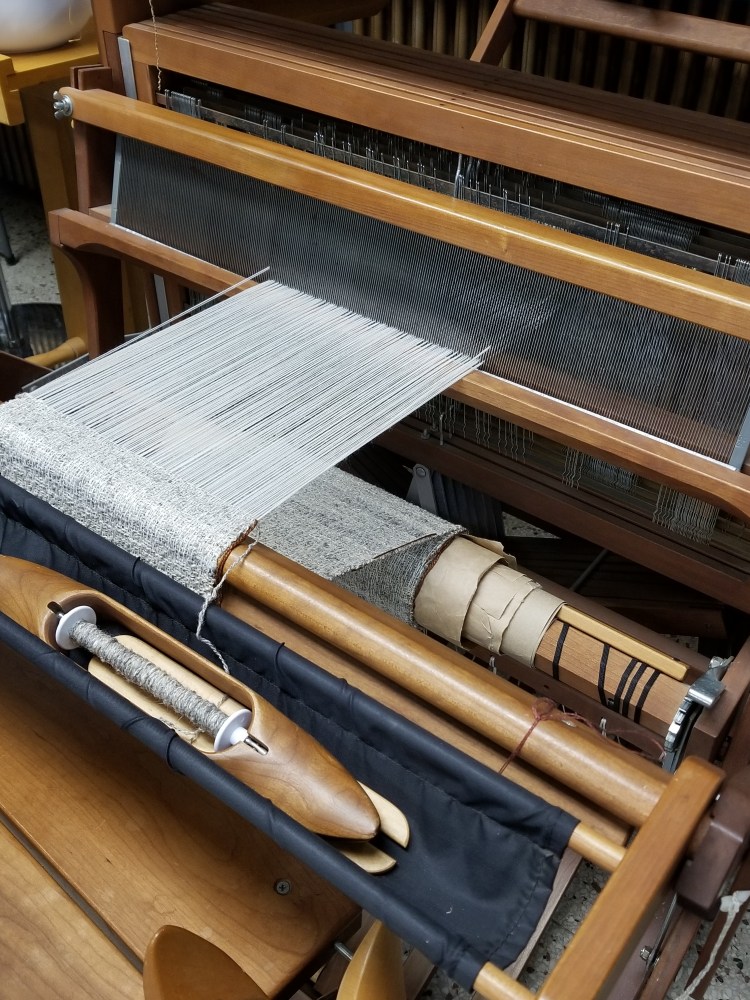
I forgot to take a photo showing my weaving in progress. Instead I have a picture of a scarf Torri was making on a rigid heddle table loom, the same thing as what I bought, so you can see what it looks like. The yarn that is woven back and forth is called the “weft”.
Torri’s project in process
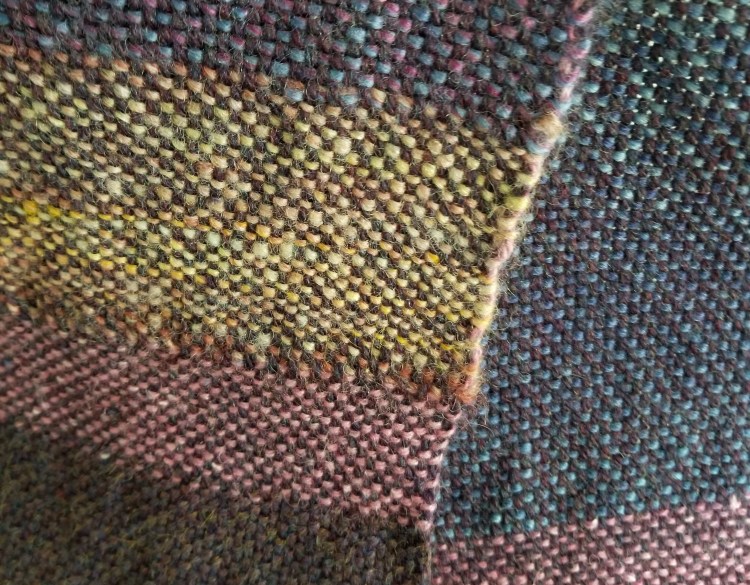
My first completed scarf is about 7 or 8 inches wide. Most of the yarn I used was already in my stash, leftover from previous projects. I alternated the different yarns in a random way. The final result has a few problems, for one thing you can see where the weft yarns are too loose at the sides in some places. I learned a new technique for making fringe. Overall it turned out OK for my first try.
Yarn from my stash used for the weaving projectMy first completed woven scarfMy scarf up close
There are so many options for using yarn and fiber in creative ways, and always more projects in my head. I look forward to making another scarf soon, improving on the skills I learned with the first one.
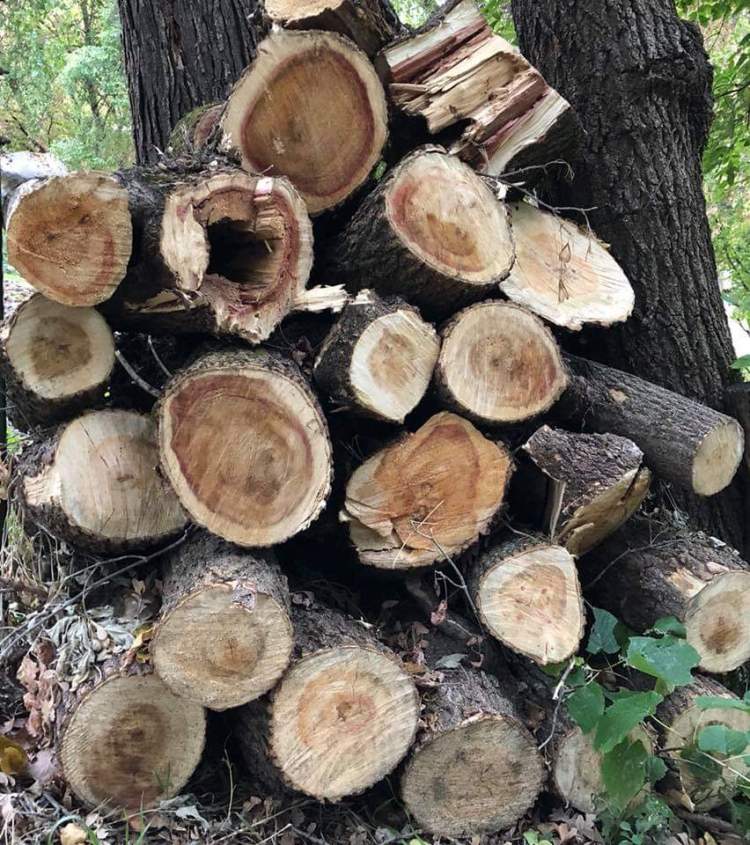
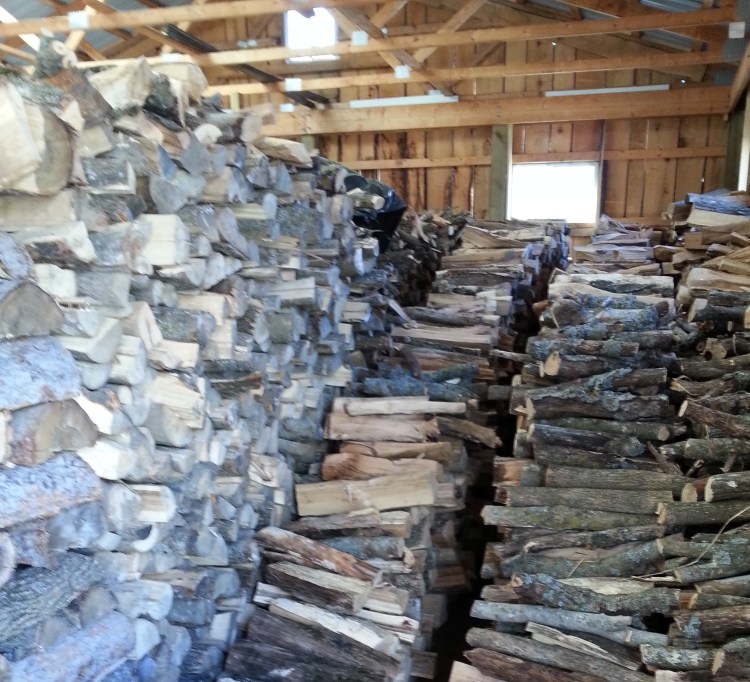
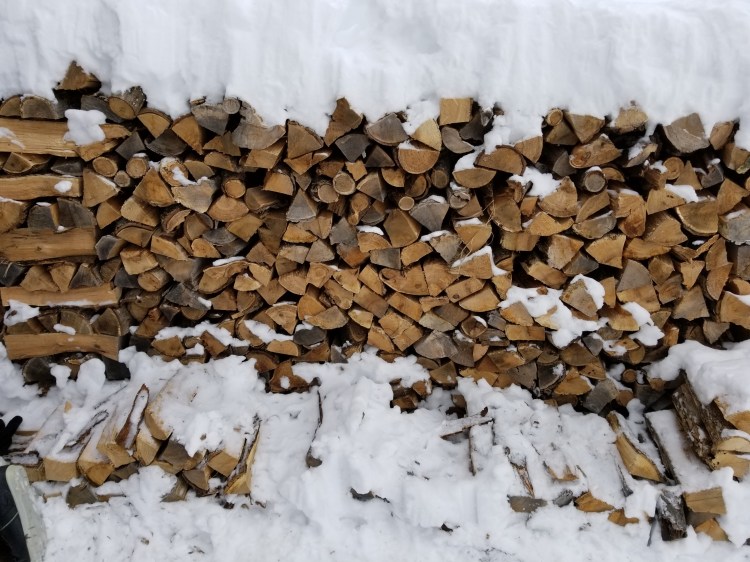
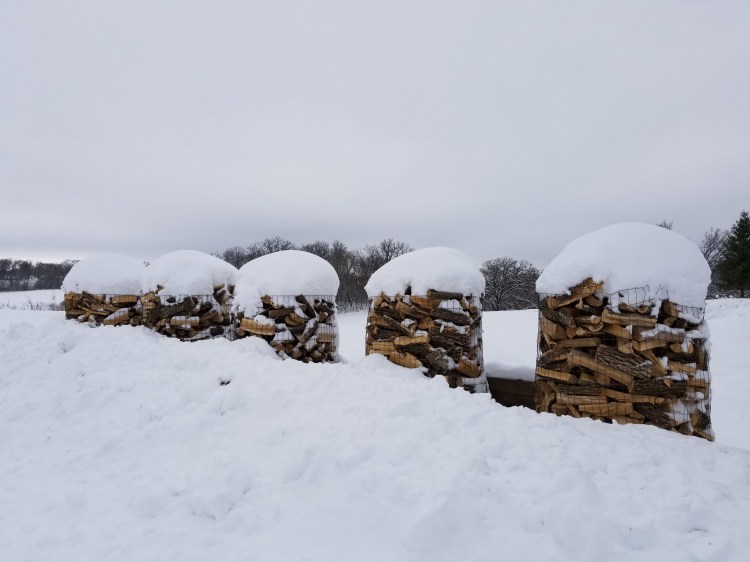
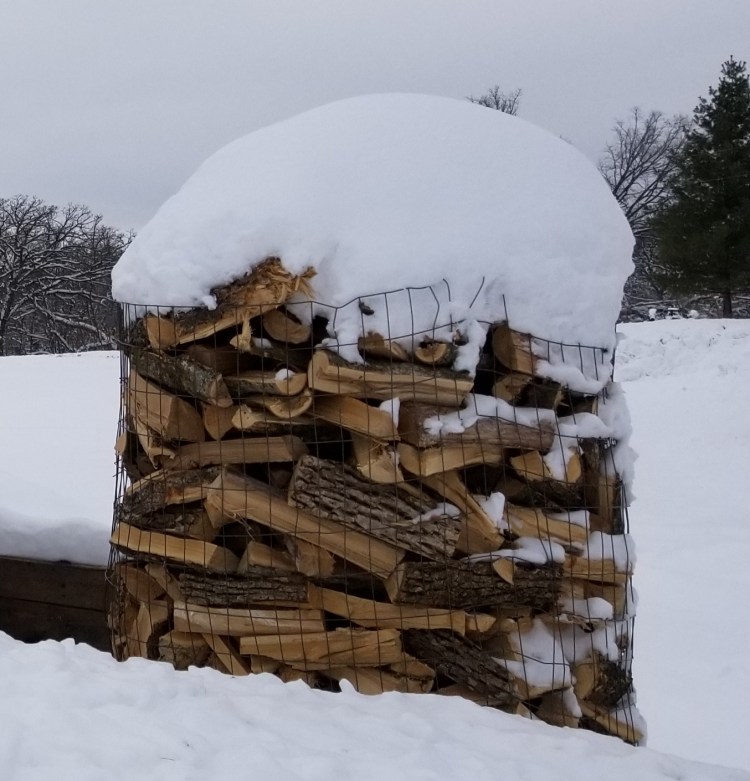
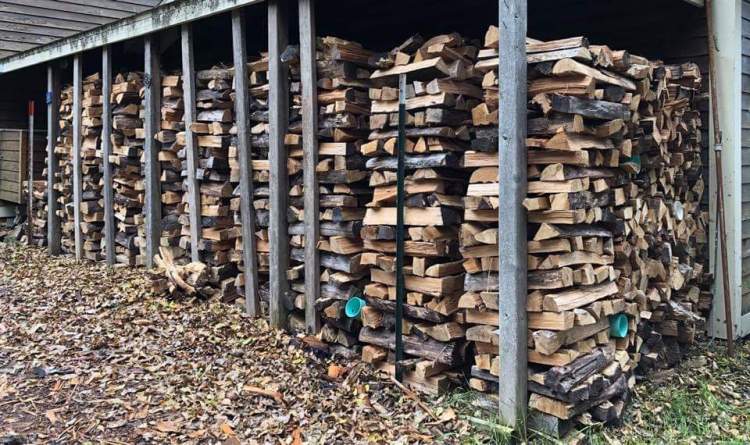
I don’t think there are any covered bridges in Otter Tail County, but there are plenty of woodpiles. My sister Betsy and I had taken photos of the massive woodpile created during a family work weekend that included splitting and stacking wood needed for the maple syrup evaporator. Later, after we found some creative woodpiles when driving around in the area, Betsy posted photos of a couple of them on Facebook. Recently, I came across more woodpiles and thought it would be a fun blog post. Betsy gets credit for the title. Enjoy The Woodpiles of Otter Tail County.
Waiting to be split for firewoodBetsy and a cousin operating the log splitterSplit wood stacked in the syrup shed
A few random wood piles seen out and about in Otter Tail County.
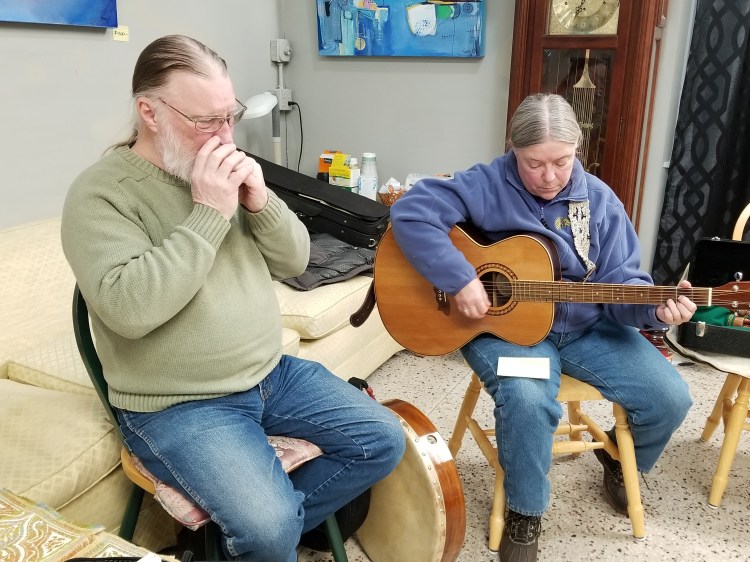
There is a group of musicians in Otter Tail County who get together every month to play Celtic music. The venue they had been using closed, so the last 2 jam sessions were held at Tangles to Treasures in Fergus Falls. I helped Torri move furniture around to prepare for the January event. Due to bad weather and member travel plans, there were only a few people at the recent session, but it was a wonderful evening of music, fellowship and spinning.
The musicians take turns picking out something to play. The others may be figuring it out on the fly. There is casual conversation, and there are breaks for snacks and beverages.
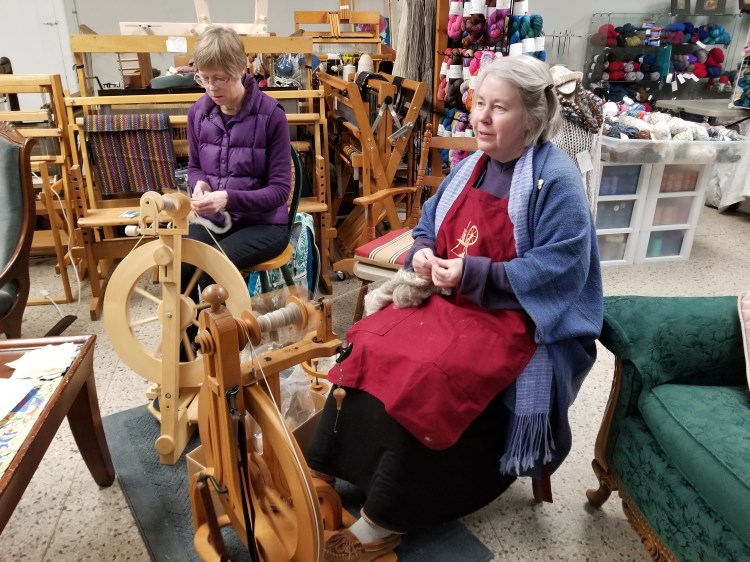
Torri is spinning more yarn for a weaving project she is in the middle of, shown in the next photo. And noting that is not her biggest loom.
Following is a colorful photo of yarn for sale in the background at Tangles to Treasures http://www.tanglestotreasures.com/. The Racing Rabbit yarn is hand dyed by a woman living in the area. The baskets at the bottom of the photo have yarn that I spun. It is mostly wool, but some of the skeins include other types of fiber such as alpaca or bamboo. I dyed some of the fiber myself but most of it was already dyed before I blended it together for spinning.
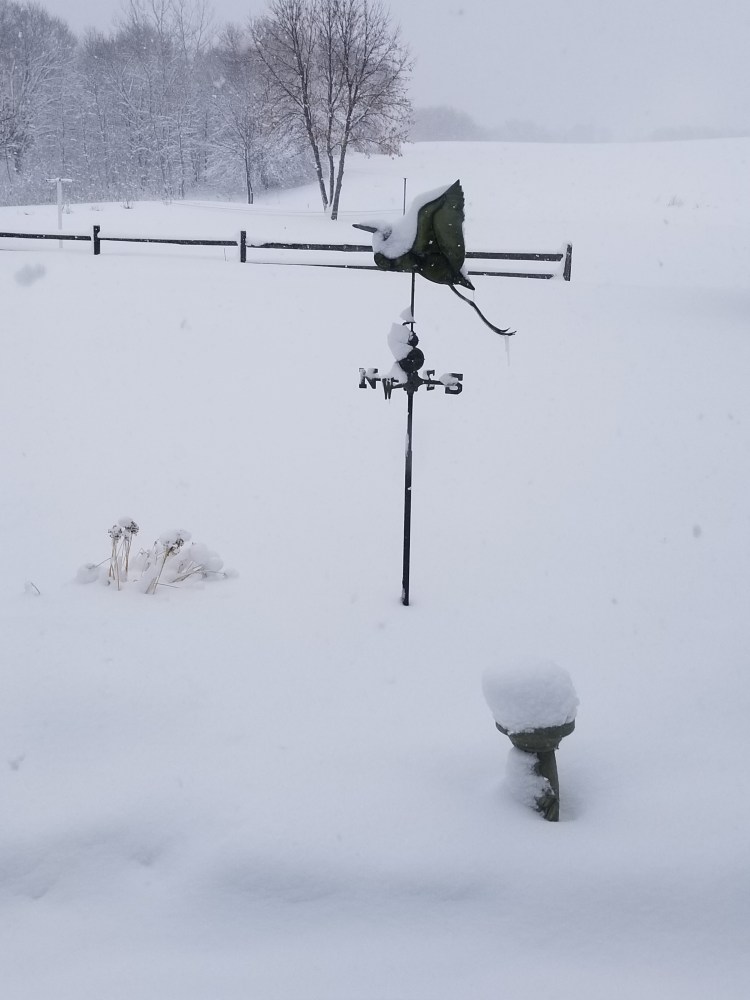
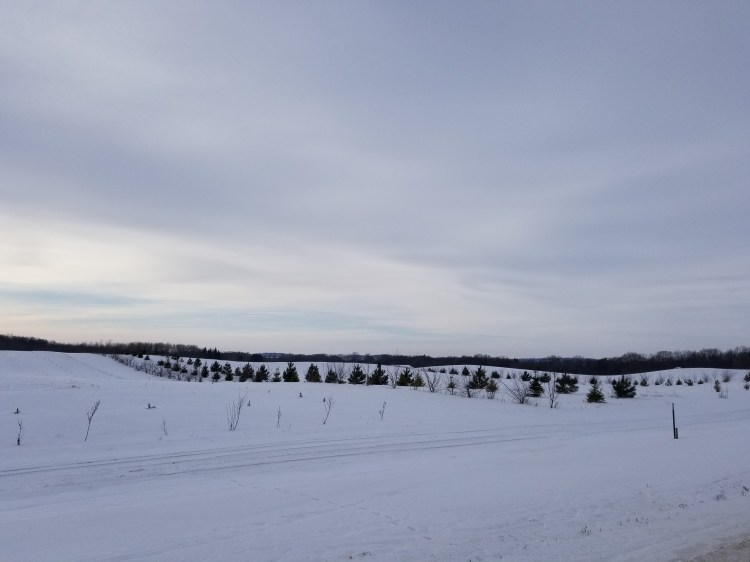
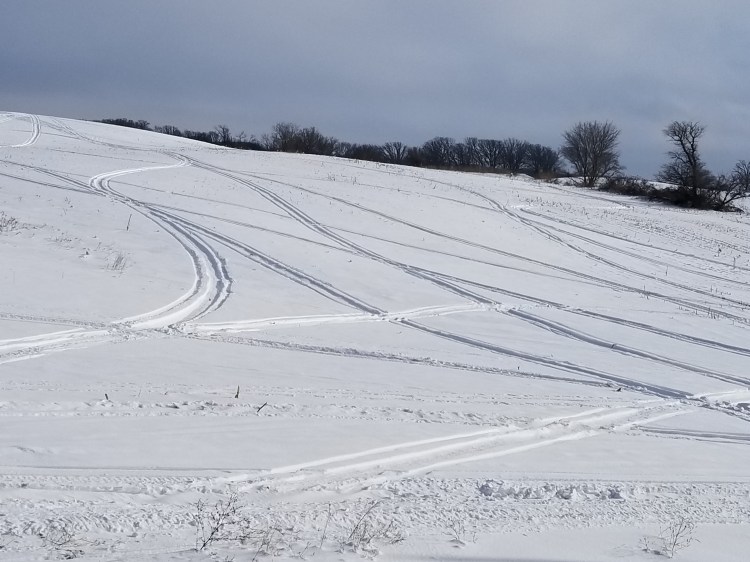
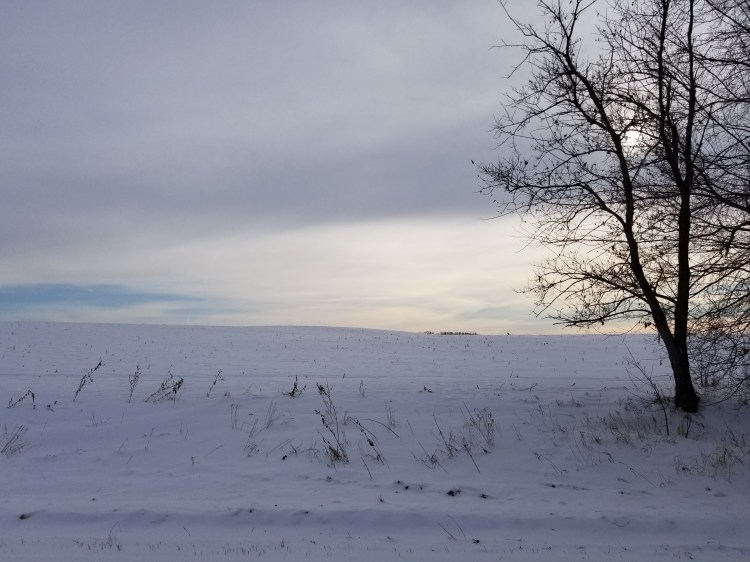
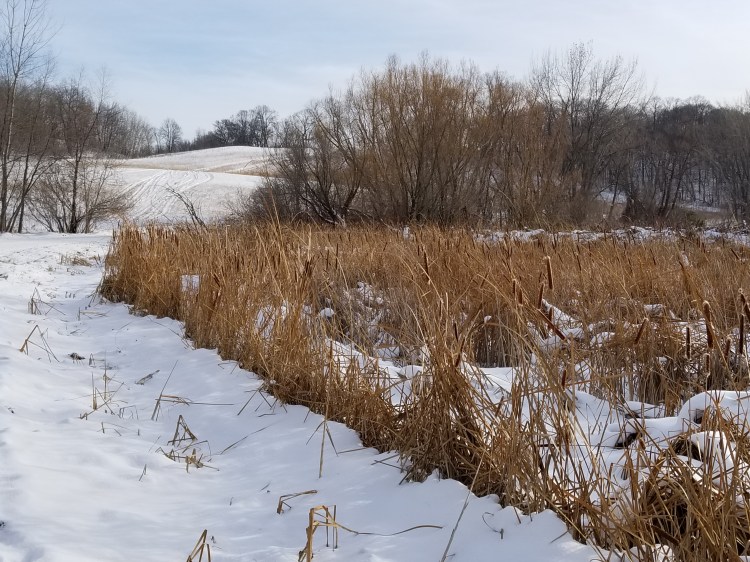
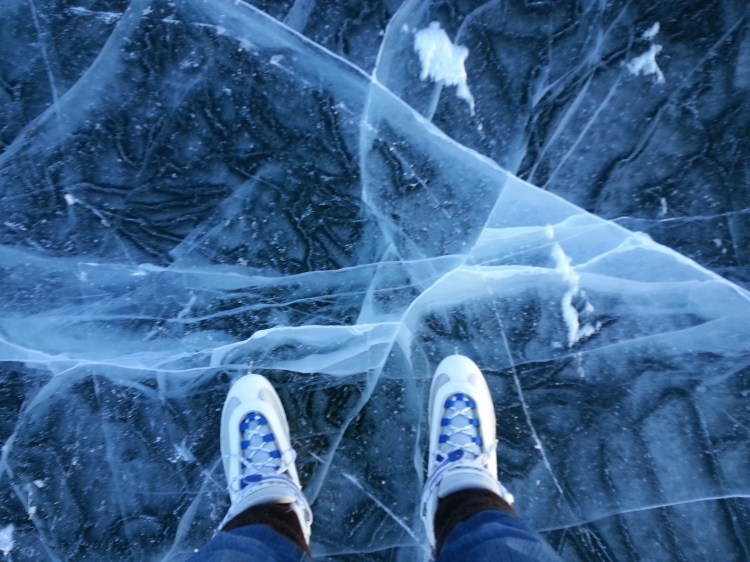
Winter is beautiful. Back when we were still contemplating the idea of living up here full time I had nightmares about winter driving, especially in the dark. That still terrifies me, but the good thing about not having a regular job is that you can stay home if conditions are bad. Looks like I will be getting some knitting and chores done over the next few days with snow in the forecast and a low of -18 degrees tonight. More snow on Friday and Saturday with winds gusting to 40 mph. Following are photos of some artistic looking winter scenes taken when it was “nice” outside.
I recently finished making a skein of yarn. It is always exciting to see what it looks like as a complete product. I am never 100% sure at the beginning of the process exactly what the outcome will be.
My recently completed skein of yarn
I have been knitting forever, but learned to spin wool into yarn about 14 years ago. I have always loved all the colors and textures of the fiber world. It is amazing to think that you can take an endless supply of fiber and make an infinite variety of necessary, useful, and beautiful end products. The first time I saw someone using a spinning wheel I thought it was the coolest thing I had ever seen. I knew I had to learn how to do that. It took a year of thinking about it before I took steps to learn. After borrowing a spinning wheel from a friend who was out of the country for four months, I bought one for myself.
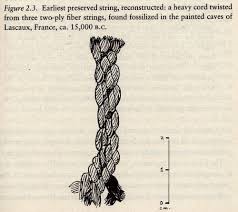
People first figured out how to twist overlapping plant fibers into string at least 20,000 years ago. It was a turning point in human history to be able to make and use string and ropes for tying and pulling, nets and snares for catching animals and carrying things, and belts to use with primitive clothing. Note the image* of a reconstructed piece of fossilized string found in the caves of Lascaux, France, ca. 15,000 BC.
Until the industrial age, thread and yarn for all fabrics and textiles was spun by hand using various tools depending on the time and place and purpose. That includes all clothing, undergarments, stockings, outerwear, sheets and blankets, towels, rugs, ropes, sails, bags and baskets. Think about that. Many women spent all “spare” time they had on textile production.
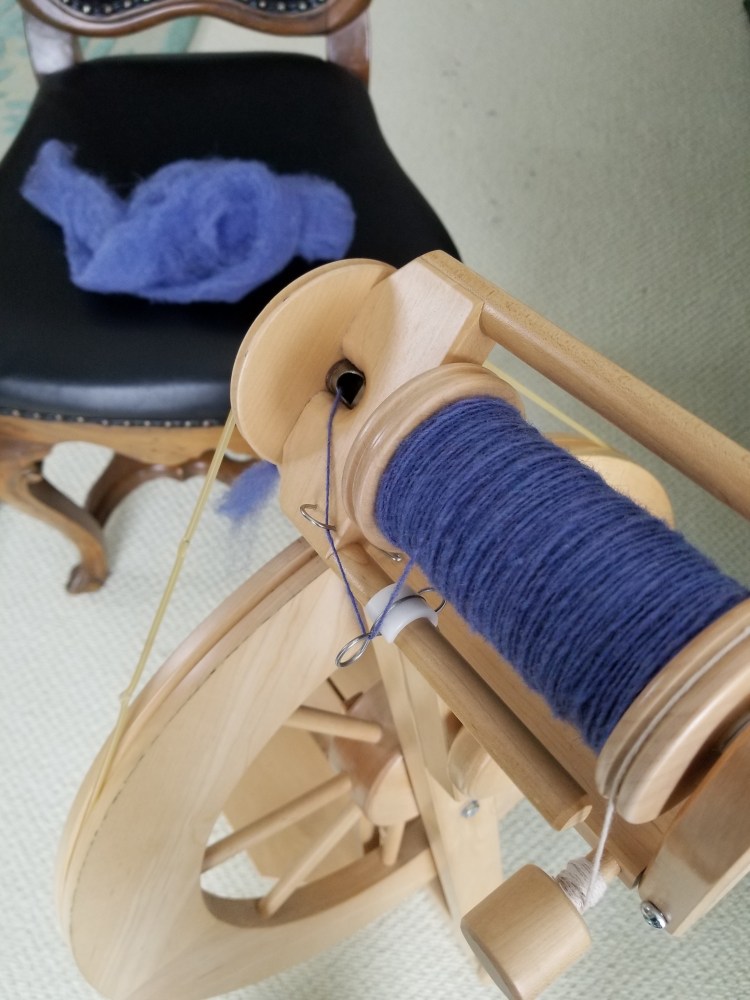
Fiber can be prepared for spinning in many different ways. My recent yarn started out from two different sources of fiber. I had bought a “cloud” of a pretty blend of wool dyed blue, turquoise, and purple at the North Country Fiber Fair in Watertown, South Dakota this fall. I spun that on one bobbin.
I already had in my stash a ball of blue roving that I bought from Joanie Ellison’s Northcroft Farm in Pelican Rapids, MN. Joanie had dyed the wool herself before having it processed into roving at Dakota Fiber Mill in North Dakota. I spun some of that on another bobbin.
I plied them together using the spinning wheel and VOILA it became a 3.5 ounce (100 gram) skein of bulky two ply yarn, about 220 yards long. It will be for sale at Tangles to Treasures. http://www.tanglestotreasures.com/
* The image of fossilized string came from a fascinating book called “Women’s Work: The First 20,000” Years by Elizabeth Wayland Barber.