Cottolin Towels

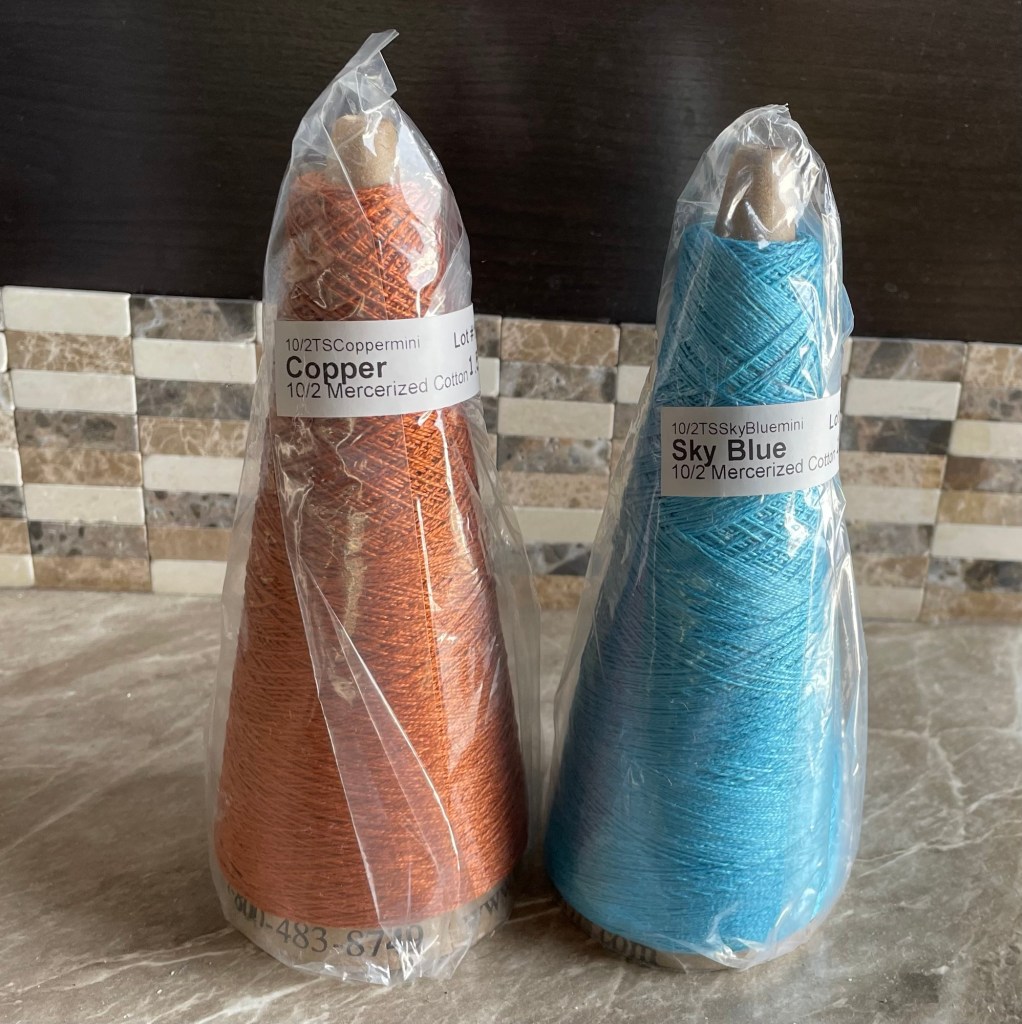
After weaving towels I loved using Gist Duet cotton/linen blend yarn, I was excited to try weaving with Cottolin, another cotton/linen blend yarn that is thinner and has a larger percentage of cotton. I bought some tubes online at yarn.com, and later when I was in Minneapolis I bought more at the Weavers Guild store. Pictured below is a small cloth I made for my daughter using red Duet yarn for the weft.

Fermenting jar cover made with Duet cotton/linen blend weft yarn

I had not paid much attention to the Weaver’s Guild in the past when it was located in the Textile Center in Minneapolis. When we lived in the Twin Cities, before I started weaving, I had been to the Textile center a number of times to see exhibits at the Gallery, visit the gift shop, use the dye lab and generally explore.

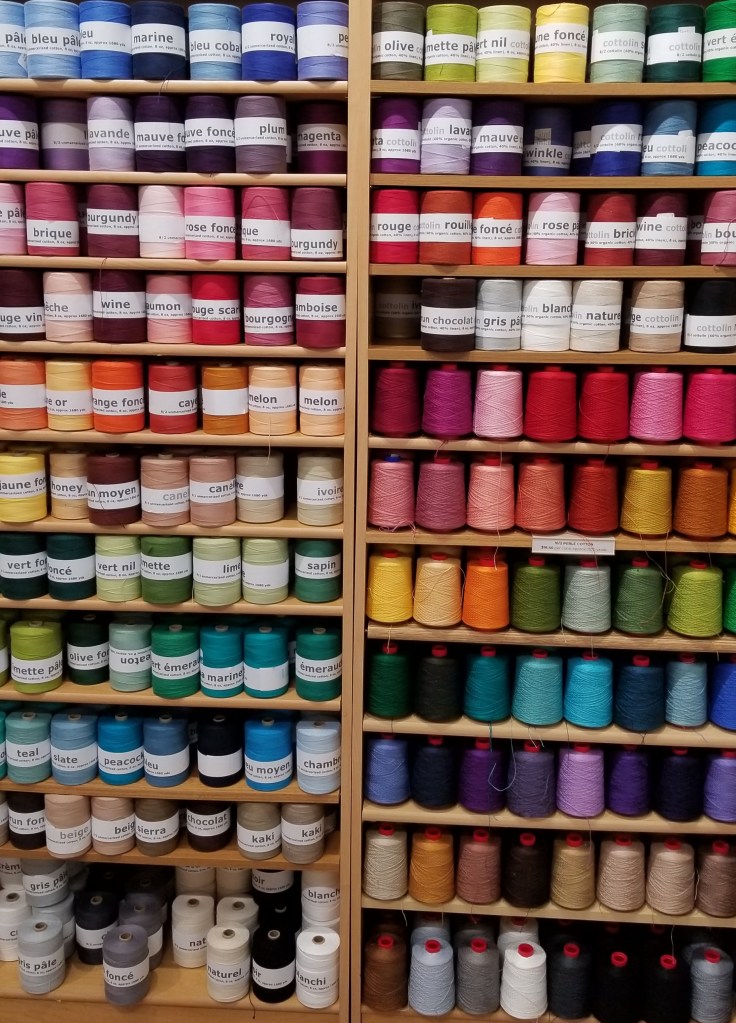
Meanwhile the Weaver’s Guild moved to the Minnesota Center for Book Arts building, also in Minneapolis. I went there this summer with my artist sister-in-law with the goal of buying some Cottolin yarn in person, so I could see the colors in person, and not have to pay shipping. We both enjoyed walking around inside the building and checking out all the interesting exhibits and offerings there, including Gallery space, a book store, classes and workshops related to book making, space for events and book talks, and a coffee shop. The Weaver’s Guild has looms, weaving yarn and supplies for sale, as well as space for weaving classes in the building. Following is a photo of yarn for sale at the Weaver’s Guild store.

Weaving yarn for sale at the Weavers Guild store in Minneapolis

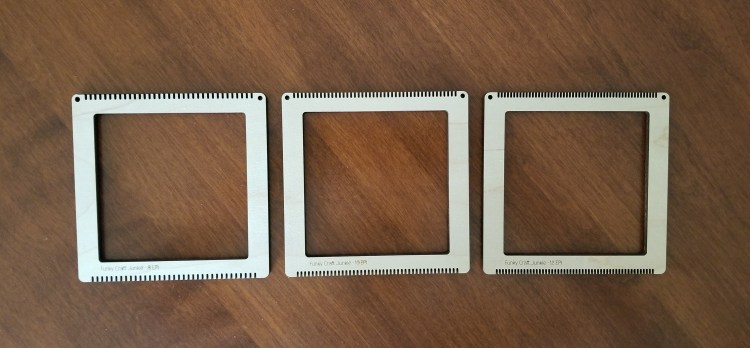
Cottolin is thinner than any other yarn I have worked with, so I did some research on how many ends per inch I should use for warping a set of dish towels. There is a range depending on your pattern and how dense you want it to be. I decided to buy a set of three tiny sample looms so I could weave up small pieces of fabric with two different densities. They are small wood frames about five inches wide with notches across the top and bottom, the right distance apart for eight, ten, or twelve ends per inch.

Set of tiny sample looms, five inches wide each

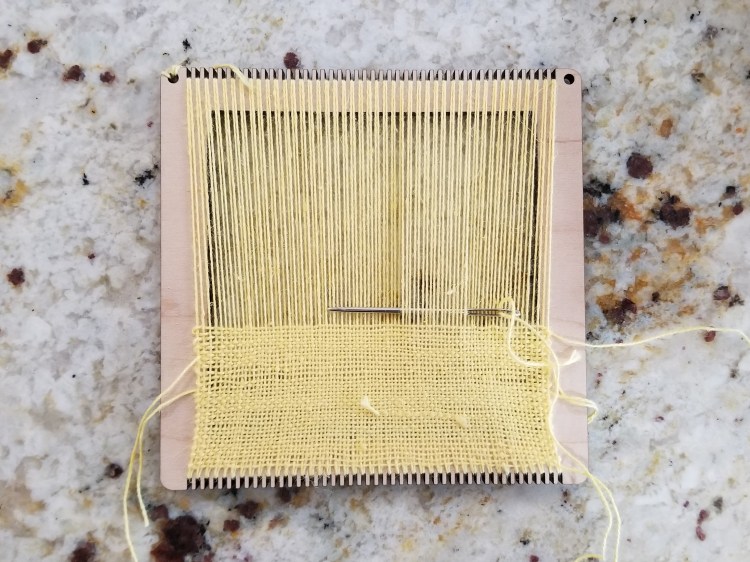
This project of making samples sounded easy and quick but it wasn’t. For one thing I was deciding between 20 and 24 ends per inch. That requires putting two ends in each slot of the ten or twelve end per inch mini loom. Winding the yarn on to the loom was not hard, but it was tricky to weave the weft yarn through the warp with a needle.

The first sample I made was plain weave at 20 ends per inch. I used a comb that I normally use with my drum carder to pack each row. It was hard to keep the sides from drawing in, and hard to keep the tension even.

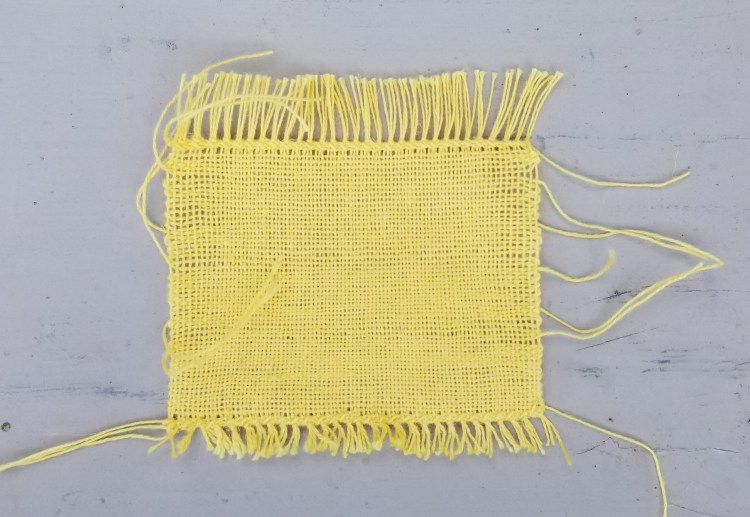
Sample at 20 ends per inch

Following is the first sample with hem stitching at each end, before washing.

First sample

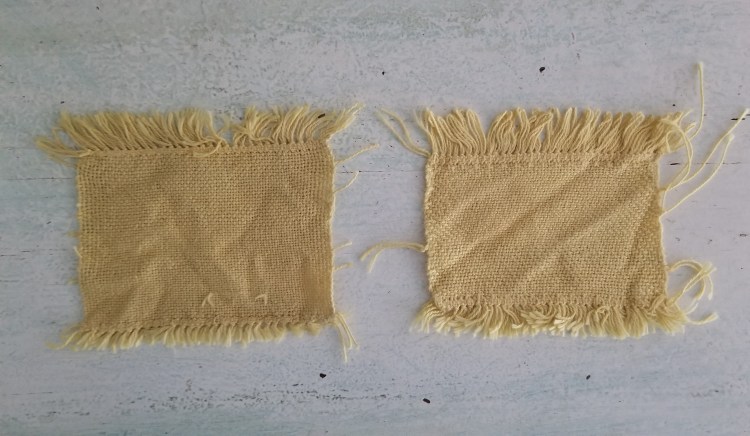
I made the second sample with 24 ends per inch, and with twill instead of plain weave. The twill (over two under one) with so many ends made it hard to get the needle in and out of the right warp yarns. It was slow and frustrating and I made a lot of mistakes. I did not bother to weave in the ends or fix the mistakes. It was an interesting exercise but probably not worth the hassle. I decided to use 24 ends per inch for my towel project, which is what Torri, my weaving mentor, recommended from the beginning. Following is a photo of the two samples after washing. They are wrinkly, even after ironing.

Tiny weaving samples with plain weave and twill, 20 and 24 ends per inch

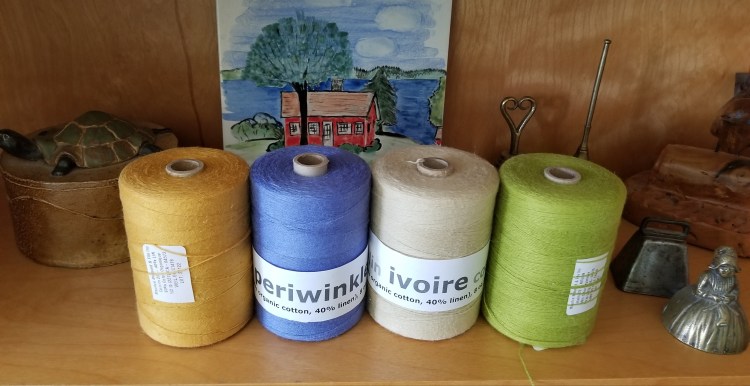
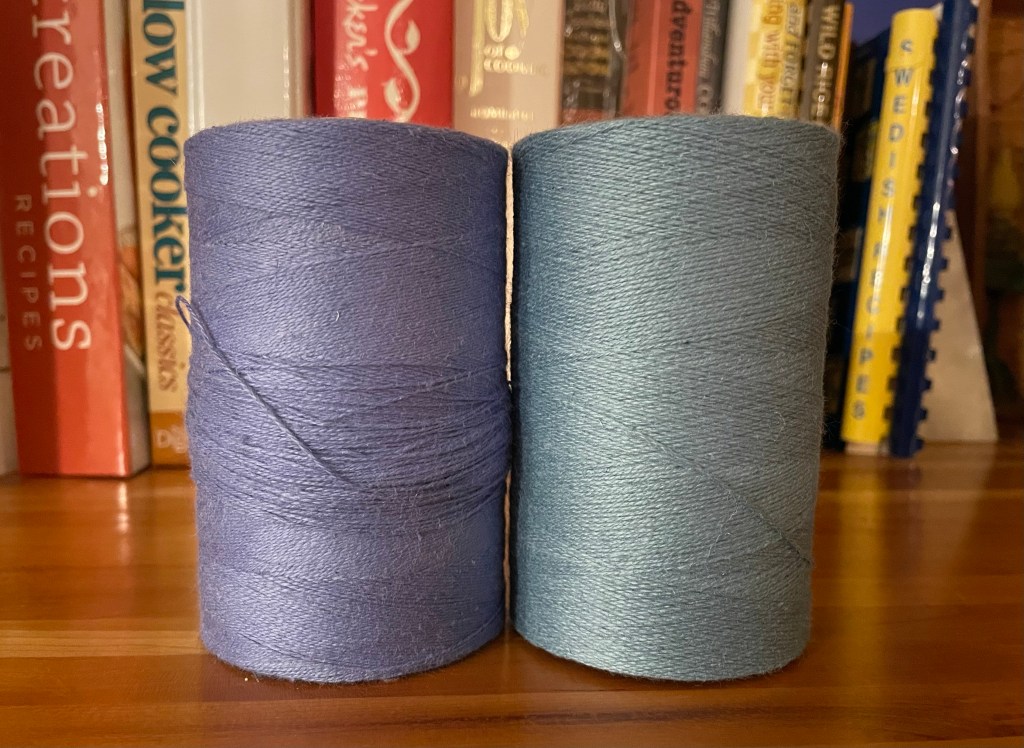
I picked out colors of the Cottolin yarn to use for my set of four towels, which are shown in the next photos. The warp yarn is the natural. The blue in the first photo is a pretty periwinkle color. I like the way the yarns coordinate with the painted tile my aunt made of our family cabin years ago. For the forth towel I used a different color of blue, leaning more towards turquoise. The second photo shows the two blue yarns next to each other.

Two different colors of blue used in this project

Once I had decided to go with 24 ends per inch, and selected patterns from my weaving pattern book, it was time to warp the loom. This was by far the largest number of warp ends I had used in any project. My towels were 20″ wide on the loom, with 24 ends per inch, plus 1 extra one each side. That is a total of 482 yarn ends. I used my warping board to measure out the warp yarn in three groups, but I did not take a photo.

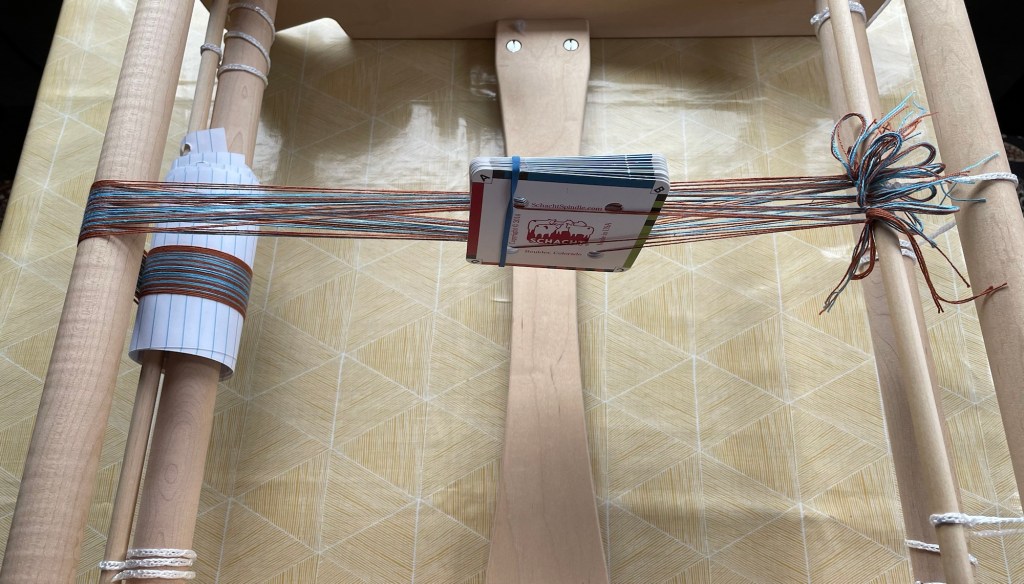
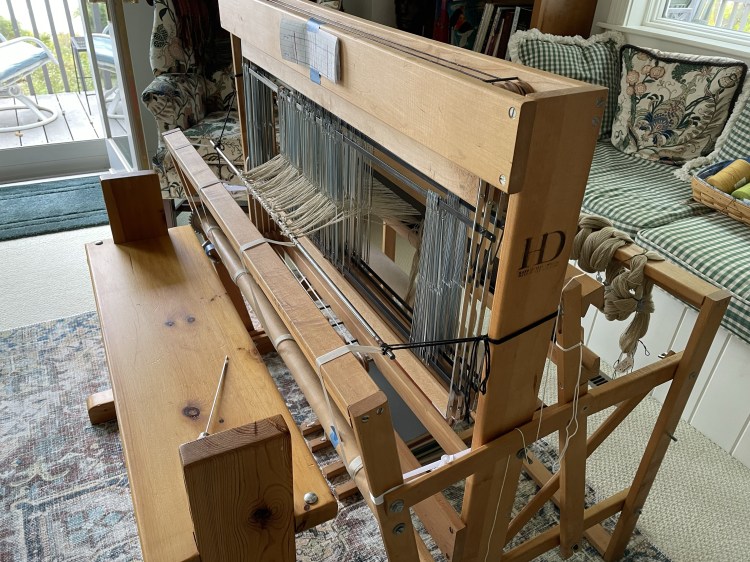
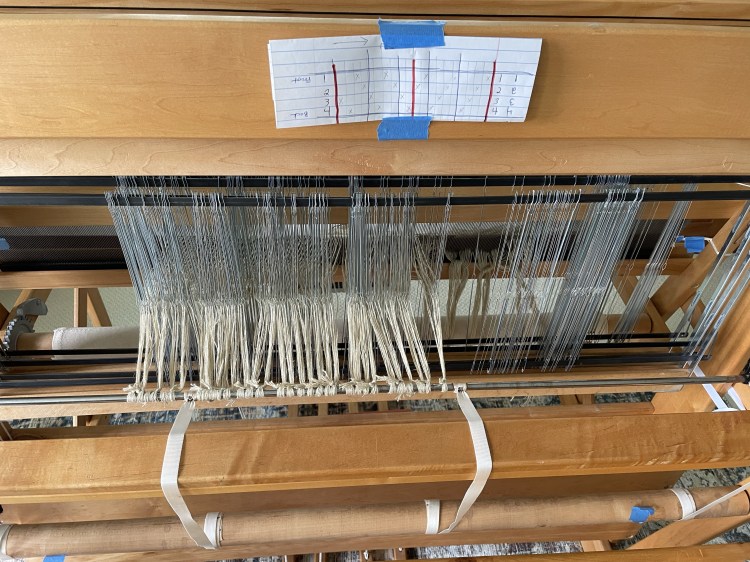
Warping the loom is the most time consuming part of weaving. First you put each yarn end through a slot in the reed from the front. In this case I needed two yarn ends in each slot in order to get 24 ends per inch. I did not take a photo of this step. The next part is putting the yarn ends through the heddles. The pattern tells you in what order to thread the yarn ends through the heddles on each harness. I will not try to explain that this time….just go with it or skip on. I made myself a chart to follow as I was threading. It took me a few projects to understand that the patterns read right to left, but since you are sitting at the back of the loom when threading the heddles, you read the pattern from left to right. My pattern had a repeat of 20. In my chart the rows from 1 to 4 are the heddles, with 1 being in the front and 4 being in the back.

The chart I made for threading the heddles with the pattern I was using

The next two photos show about half of the yarn ends threaded through the heddles and tied on to the bar at the back, from two different angles.

About half way through threading the heddles
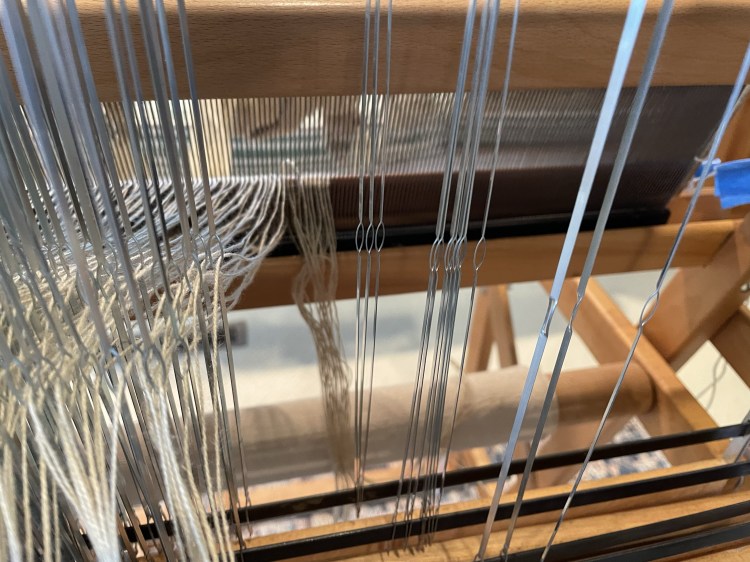
Close up of yarn ends threaded through the heddles and tied on the back rod

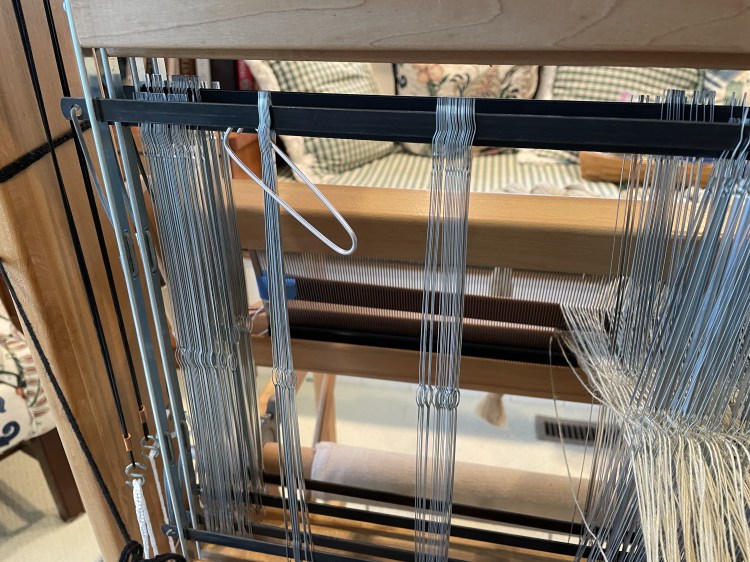
I realized far into the process that I had gotten got mixed up when preparing for threading the heddles. I had pushed too many off to the left of the working area, so that when I got to the end of threading I was going to run out of heddles before I ran out of ends to thread. The next photo shows the remaining heddles at the right side, which are less than the number I needed.

Not enough heddles left for my pattern

Torri recommended that I undo the bars that hold the heddles on, slide off the number that I needed from the left, and slide them back on at the right side. This was easier than it sounded. I used a knitting stitch holder to make sure the heddles all stayed in the same direction when I took them off and put them back on the other side.

Sliding a number of heddles off of the left so could put them back on the right side

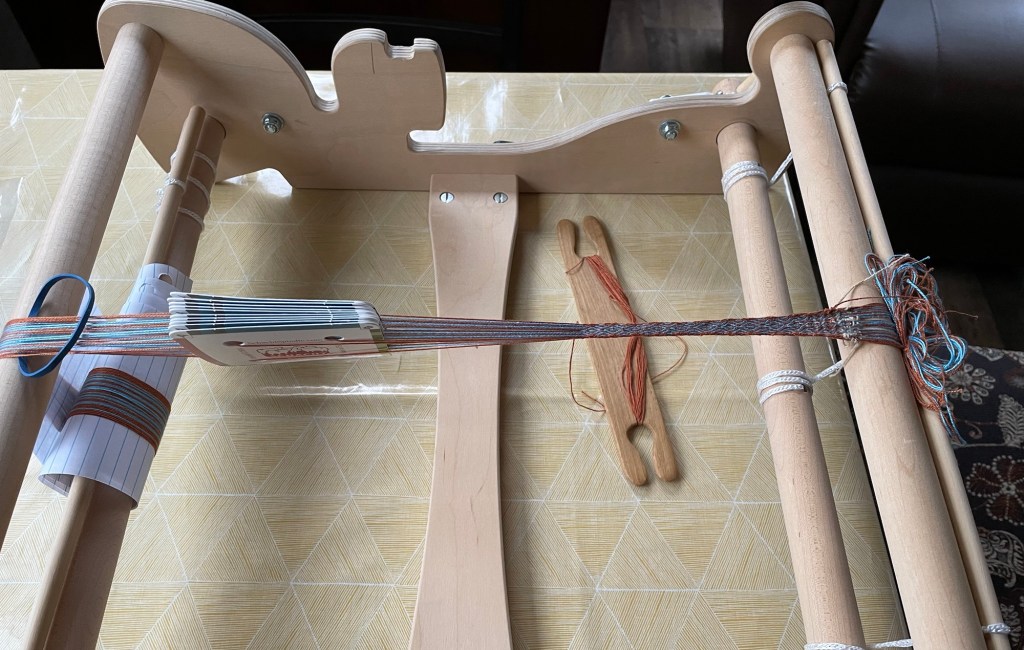
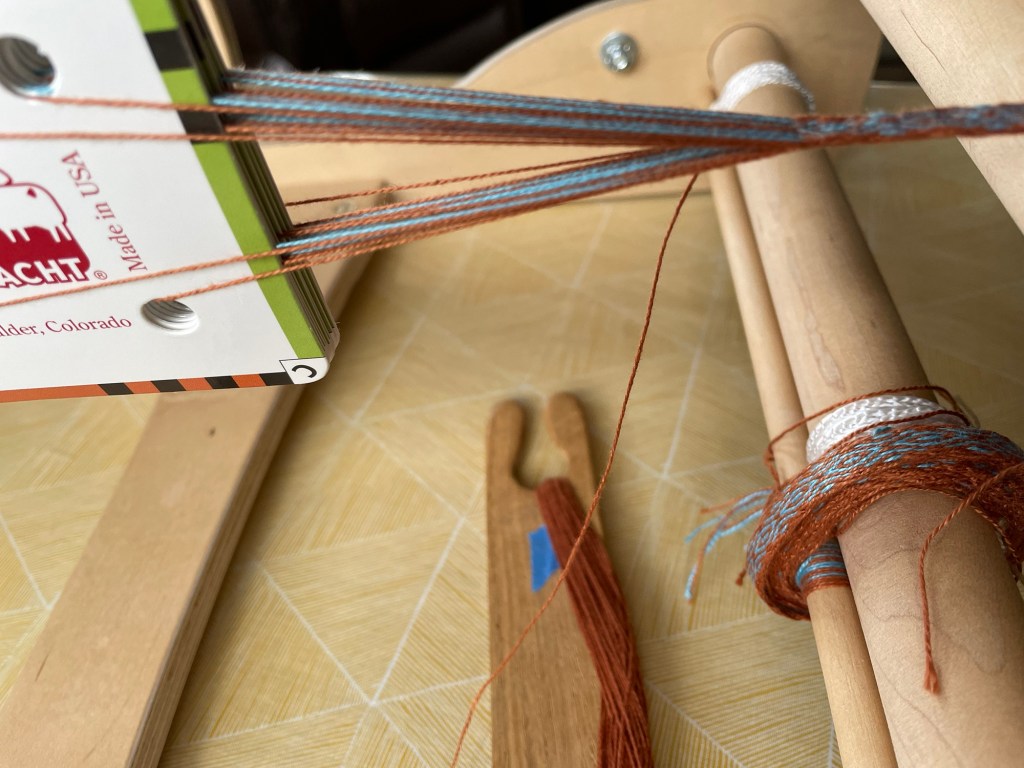
After all the measuring of warp yarn (not pictured), “sleying the reed” (also not pictured) and threading all the yarn ends through the heddles, I was finally ready to weave. I started with some dark blue header rows (that would later be removed), and then wove three plain weave rows of the periwinkle blue Cottolin for the hem stitch at the beginning of the first towel.

Hem stitch at the beginning of the first towel

The first towel was a herringbone pattern.

Herringbone pattern for the first towel

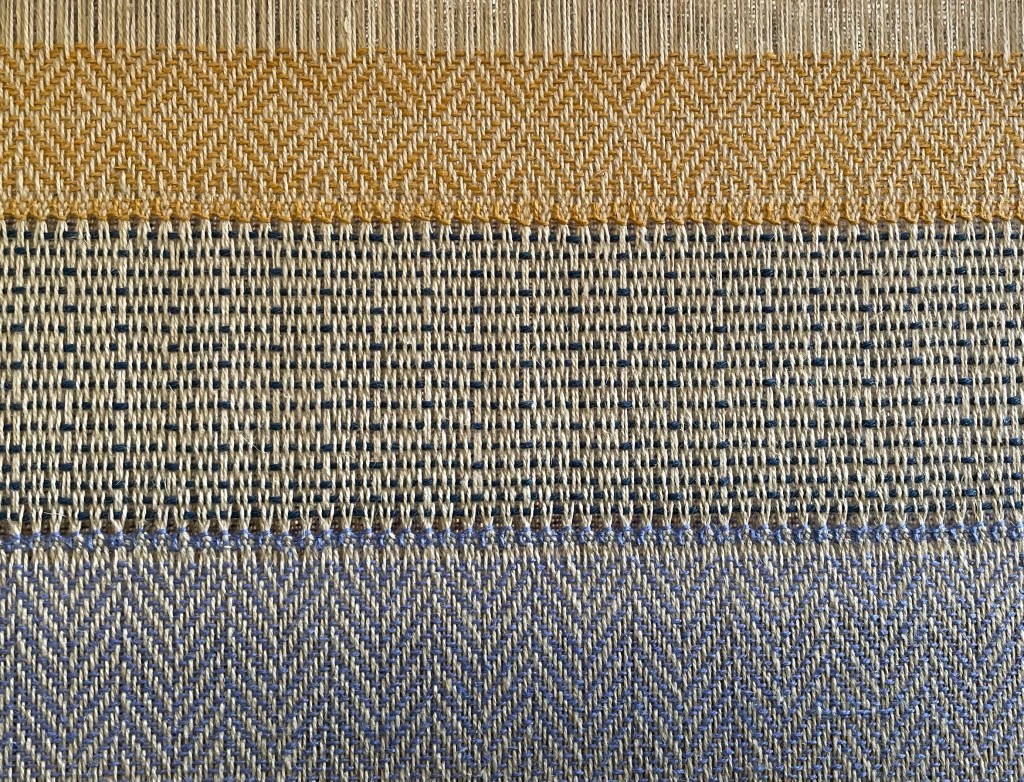
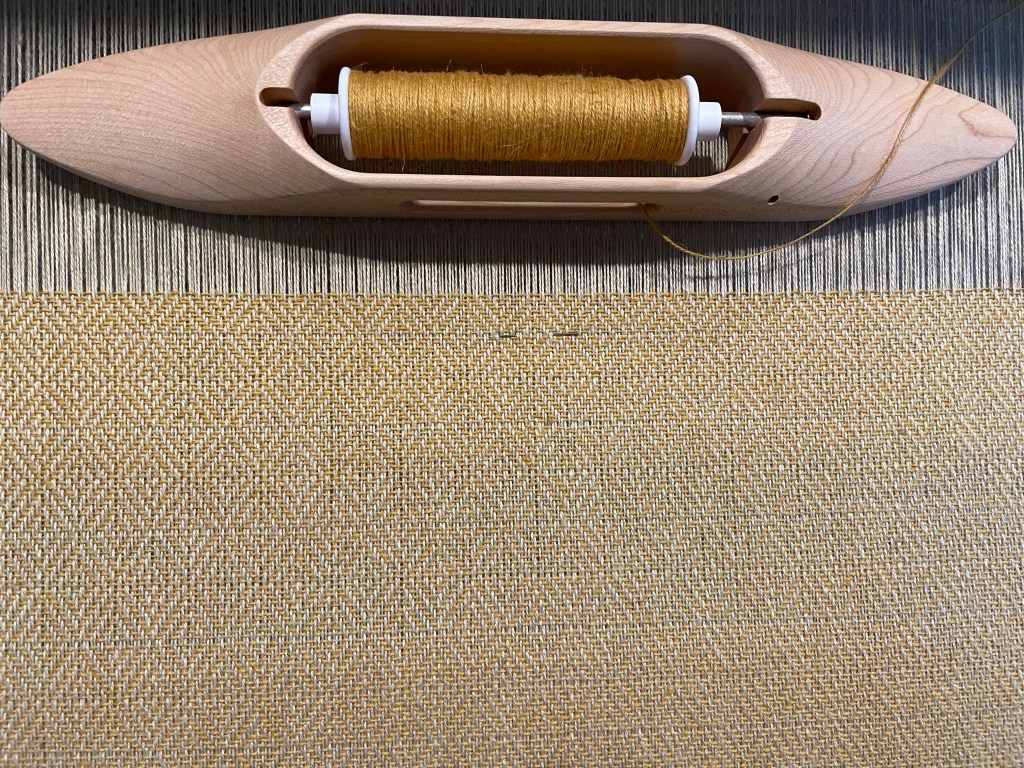
After doing hem stitch at the end of the first periwinkle towel, I wove a bunch of plain rows in the dark blue as filler between the first and second towel. Later those rows of weft yarn were removed and the warp yarn became fringe. The beginning of the second towel is shown below, using yellow with a different weave pattern forming diamonds. You can see the pattern better if you squint.

End of first blue towel, beginning of the second yellow towel

Following is a photo showing more of the yellow pattern of diamond shapes.

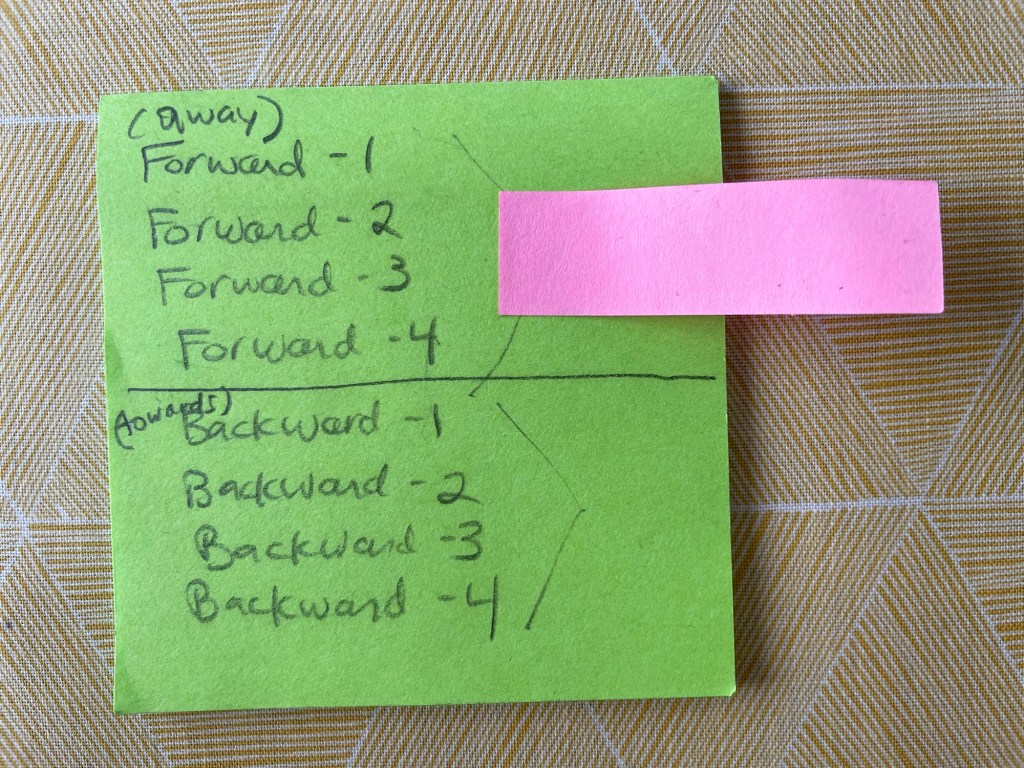
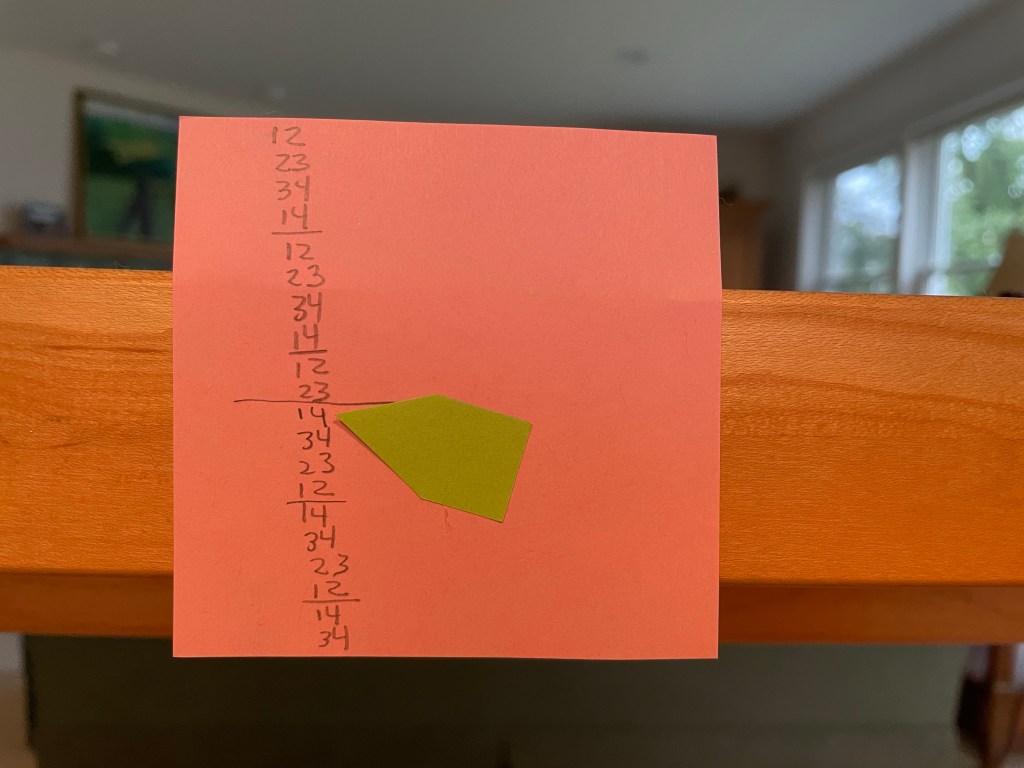
The third towel had a more complicated treadling pattern, in green weft yarn. I was not sure how much I liked it based on the photo in the pattern book, but I like it a lot after seeing it in a real project with more rows than could be shown in small sample photo in the book. This pattern has a repeat of 20 rows. I taped a post it note on the loom with a tape flag so I could keep track of which row I was on. I also put a pin in the weaving at the beginning of a repeat, so if something did not look right or I made a mistake, I could find where to start over that section. After awhile it was easier to make sense of the pattern and to see when it looked right or not.

My post it note with the treadling pattern for the third towel

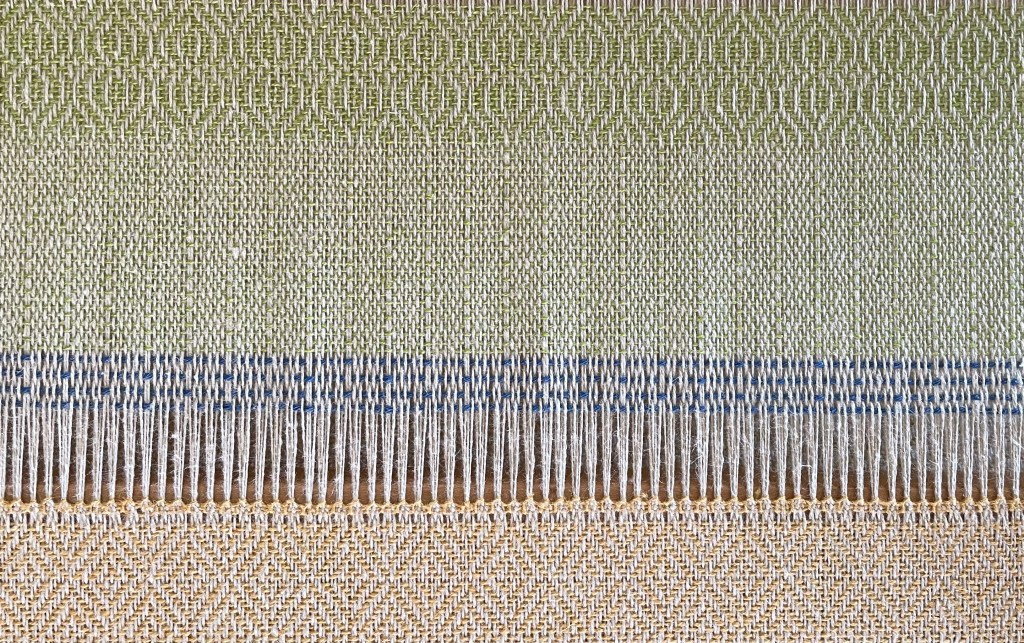
For this towel I decided to do a rolled him instead of hemstitch and fringe. For the rolled hem I wove some plain weave rows on each end. Following is a photo showing the plain weave for the hem of the green towel, and the first repeat of the pattern, after the end of the yellow towel, with some spacer rows in dark blue.

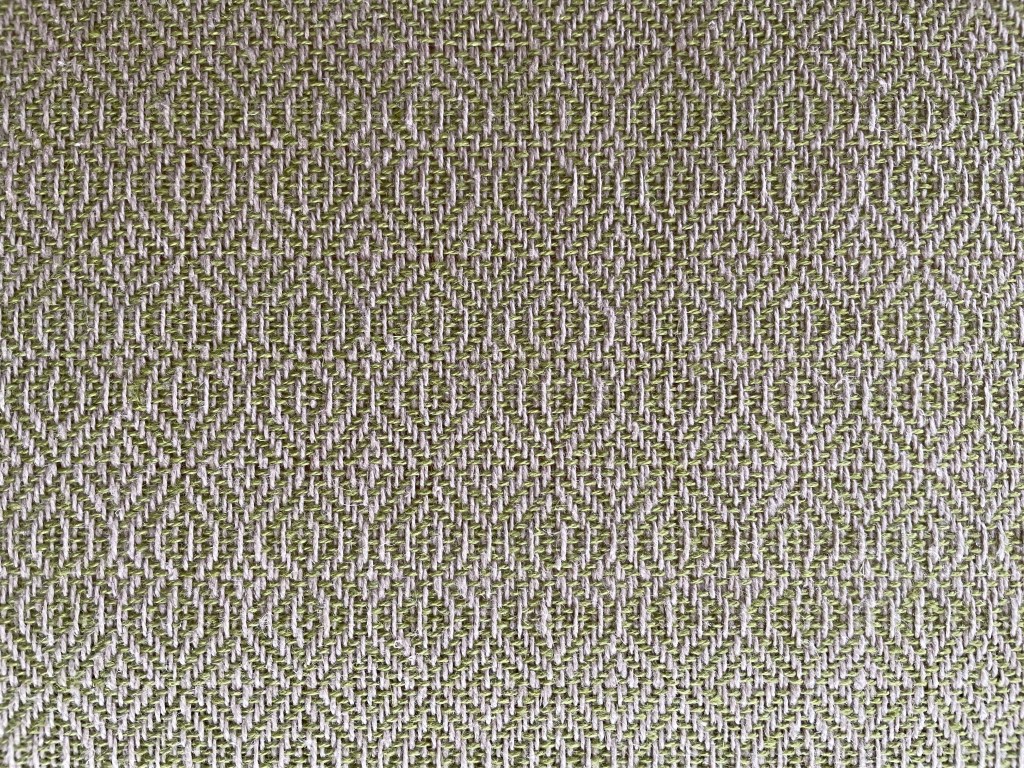
Next is a photo showing a bigger section of the green pattern.

I was trying to finish this project before our Thanksgiving trip to California, so I could give one of the towels to my sister-in-law as a hostess gift. When I got to towel number four, I thought maybe I would just do plain weave for the entire towel instead of one of the more complicated patterns. Because of the threading for my patterns, plain weave is a little different and looked kind of interesting. The following photo shows the plain weave at the beginning of the forth blue towel, after the plain weave rows for the hem of the third green towel. It is hard to tell the difference in the two blue yarns I used in these photos, but the first one was very periwinkle, and one for the forth towel was leaning toward turquoise.

End of third green towel, beginning of forth blue towel

I added some yellow stripes to make the plain blue towel look a little more interesting. After getting a ways along I did not like it and had to make a decision. Keep going and finish it faster but not like it that much? Or undo what I had done and start over. I decided it was better to love the outcome, and that I was not in that much of a rush. Following is a photo of the blue plain weave with yellow stripes that I ended up undoing.

I did not like this and ripped it out

I started over again with blue using the same pattern as for the green, with some plain weave at the beginning for a rolled hem again, instead of fringe.

Take two of the forth towel in blue, with the same pretty pattern used in towel three

When I was done with the weaving, I removed the whole thing from the loom and zig zagged on my sewing machine each plain weave end on the last two towels, so it would not come undone when I cut the towels apart.

There is always waste warp yarn at the end of a project. After cutting the towel project off the loom, I had about 30″ of warp yarn left on the loom. With 482 ends at 30 ” long each, that is about 400 yards of yarn!!

482 yarn ends of waste warp yarn, 30” long each

After cutting the four towels apart, I washed the first two towels with fringe just in time to pack the periwinkle blue herringbone towel in my suitcase for the Thanksgiving trip. I kind of randomly picked that towel to give my sister-in-law, but it turned out to be the perfect choice.

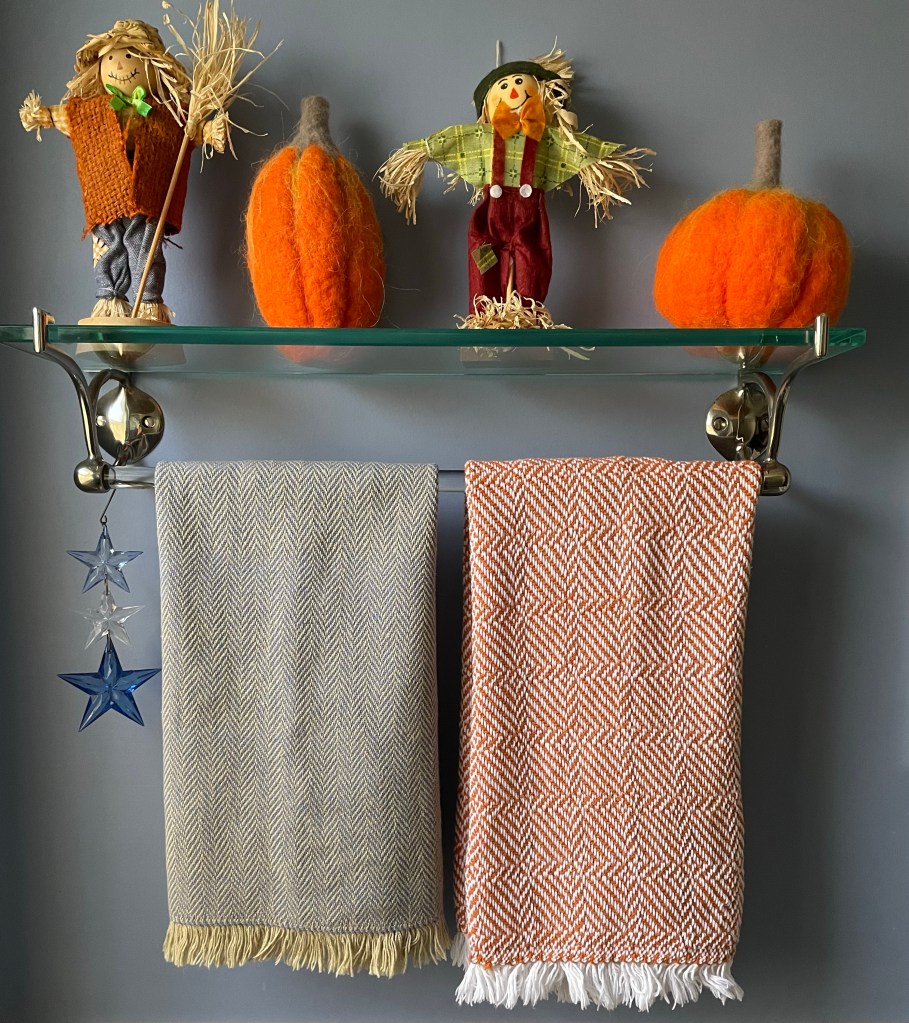
After I gave my sister-in-law her towel, she hung it up in their main floor bathroom which happens to be painted periwinkle blue! I had not remembered that. Also displayed there was the orange towel I have her last Thanksgiving.

Towels I gave my SIL this year and last year, in her bathroom

After we got back from the Thanksgiving trip I hemmed and washed the third and forth towels.

Not washed yet, hemmed and waiting to be hemmed

The next photo shows the first two towels, both made with hemstitch and fringe, after washing (before I gave the blue one away).

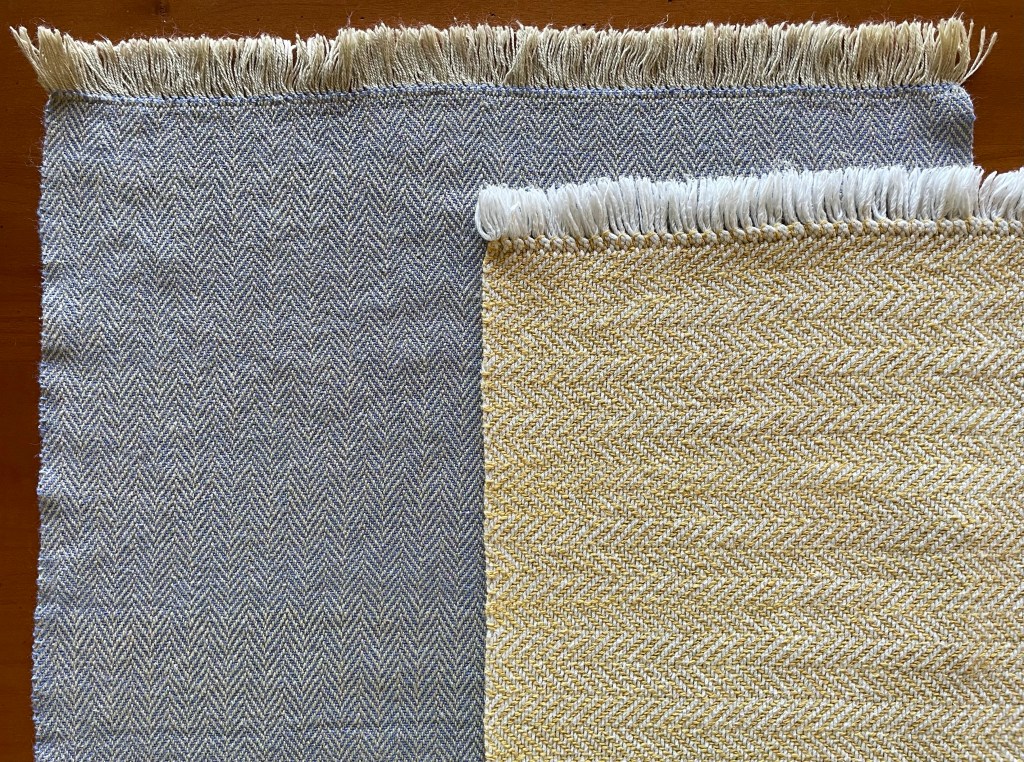
Before this project, my favorite towel that I had made was the yellow wonky towel (see blog post about that here). It was made with cotton warp and Duet cotton/linen blend weft using a zig zag pattern. The earlier yellow towel is heavier and the zig zags are going the other direction. I love the feel and weight of the Cottolin towels, but I really like the bigger scale of the zig zags on the yellow towel. I could figure out how to get that look with the Cottolin if I put my mind to it. You can see these two zig zag towels side by side below.

Two zig zag towels, one I just made with cottolin, one I made earlier with thicker 100% cotton

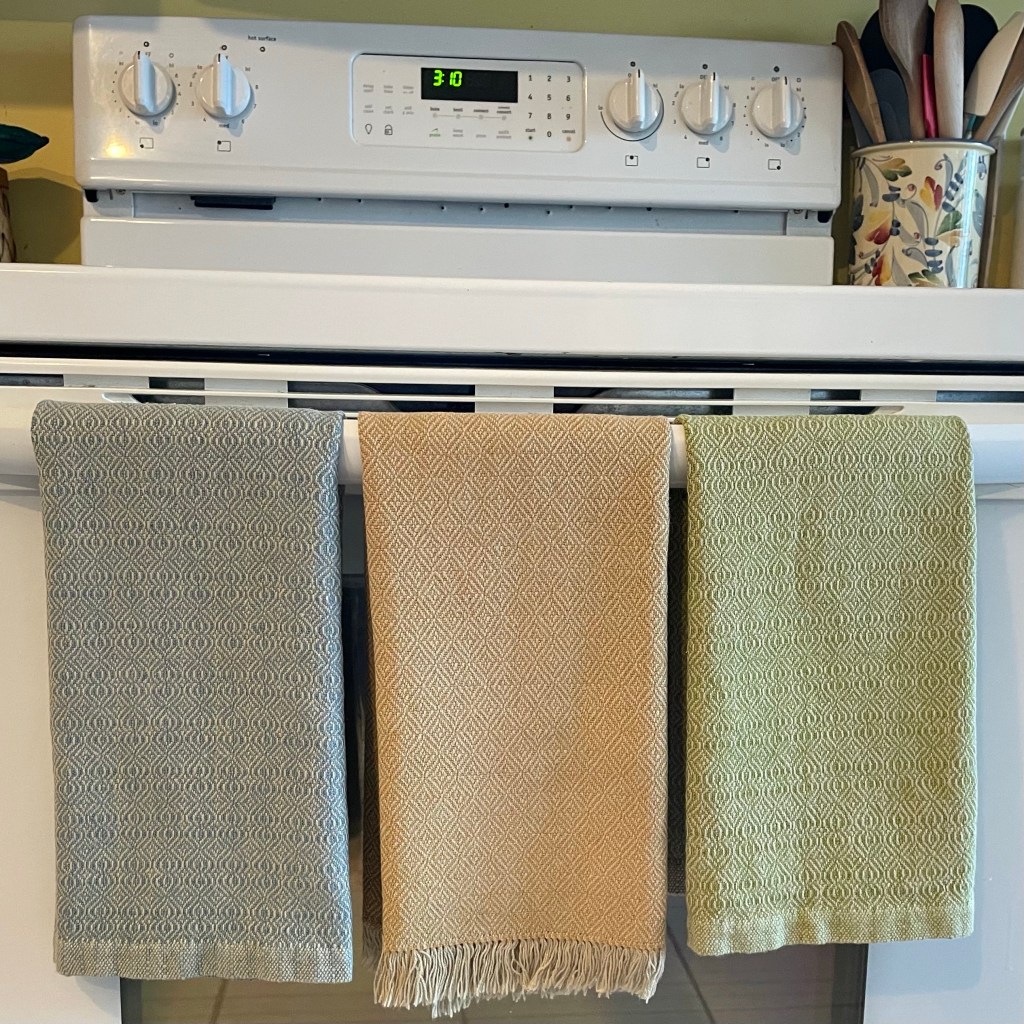
Three towels from the Cottolin project are shown below (the forth one is in California), hanging up on my stove handle. They will all likely end up as gifts too. I love these towels. They turned out well, look and feel nice, and will dry dishes beautifully.

Due to the pattern and number of yarn ends, I needed to use my floor loom with multiple heddles for this project. I will make more Cottolin towels for sure, when I have time to weave again on my floor loom. Before that happens, I will be working on rigid heddle weaving projects and other things NOT using my floor loom while we are in Arizona over the winter.

Up North Socks

I went to the LYS (Local Yarn Store) Leelanau Fibers in Suttons Bay, near Traverse City, Michigan, when I was on vacation with friends in July 2022. I wrote about that fun trip in a post you can read here. Many brick and mortar yarn stores have gone out of business. When you do come across an independent yarn store with unique products that you can’t buy in a big online store, it is a treat to browse. I have always loved taking in all the colors and textures in a yarn store. And of course I cannot leave the store without buying something, whether I need it or not. At Leelanau Fibers I bought some sock yarn from a local business called “Up North Yarns”.

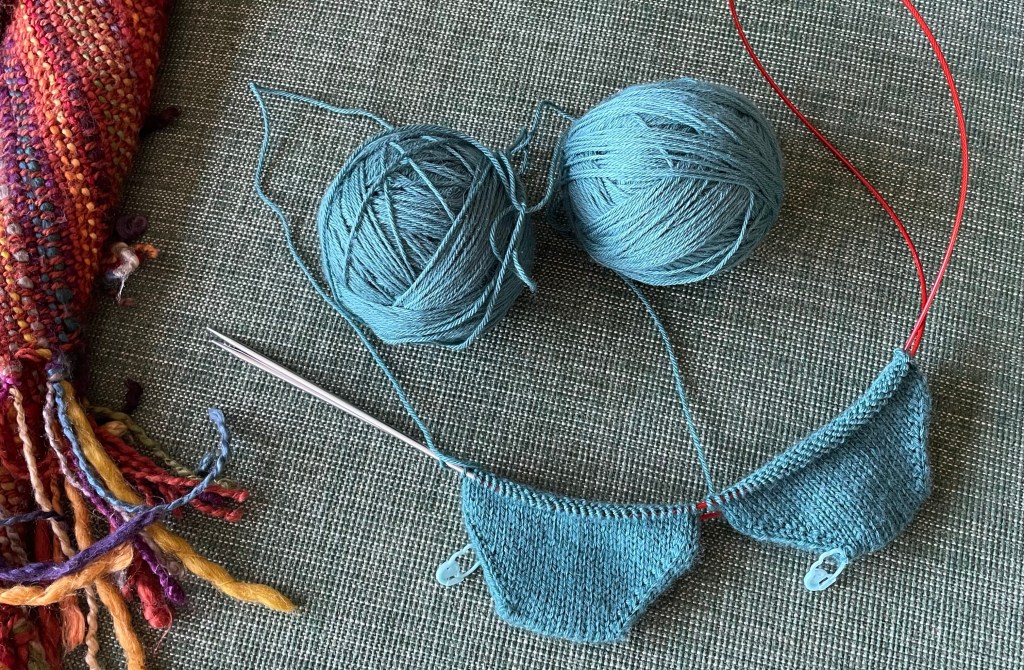
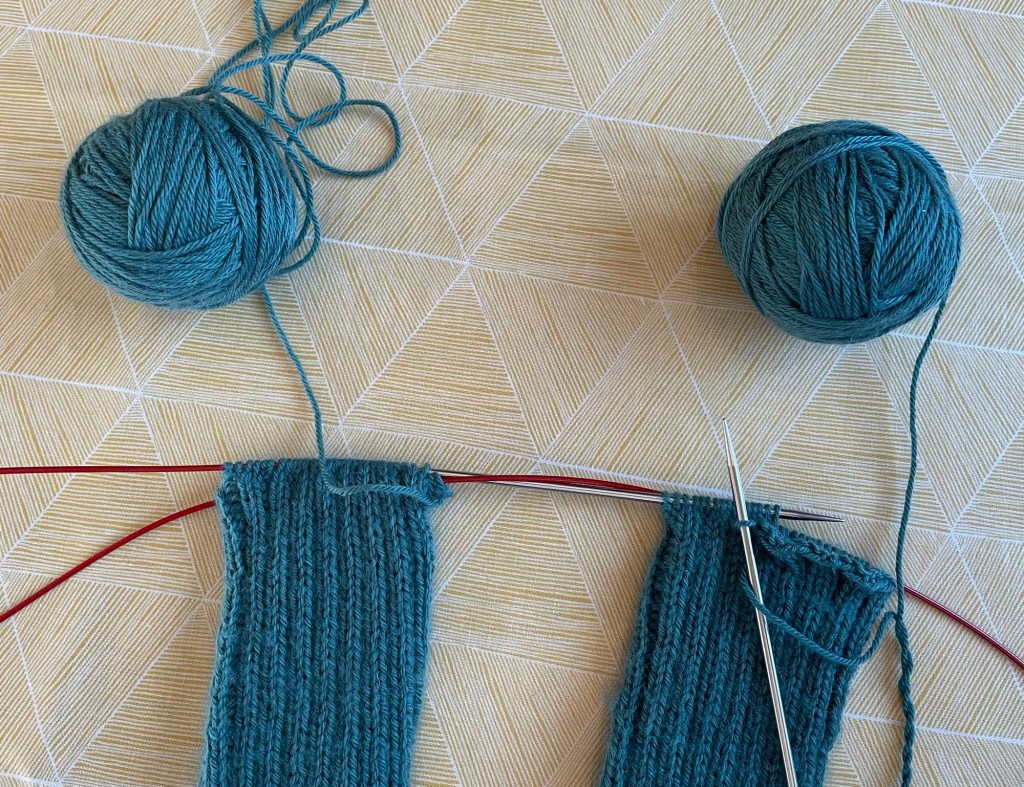
I cast on a pair of socks with the Up North yarn in the spring of 2023, with both socks on a magic loop needle. The background in the next couple of photos look like the floor of our RV, so it must have been at the end of March or beginning of April.

Beginning of a pair of socks

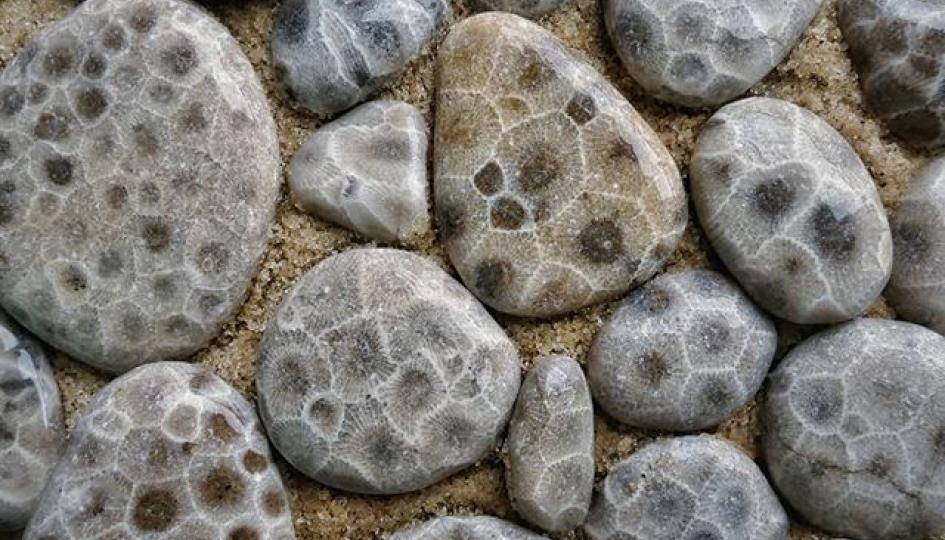
The color of the yarn is called “Petoskey Stones”. The Petoskey stone is Michigan’s state stone. I found a photo online of some Petoskey stones, which you can see below, and which look very much like the colors in the yarn.

Petoskey Stones, the Michigan state stone

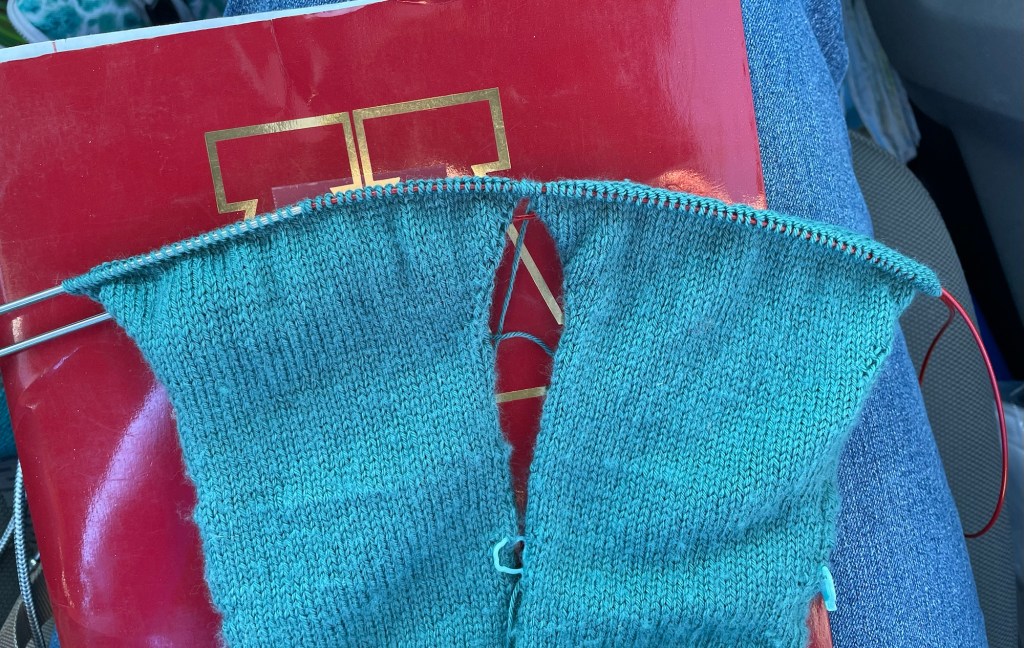
I had a busy summer and got side tracked with other activities, so the sock project sat in a basket for months. Finally in the fall I make some progress on the feet.

Making progress on the feet

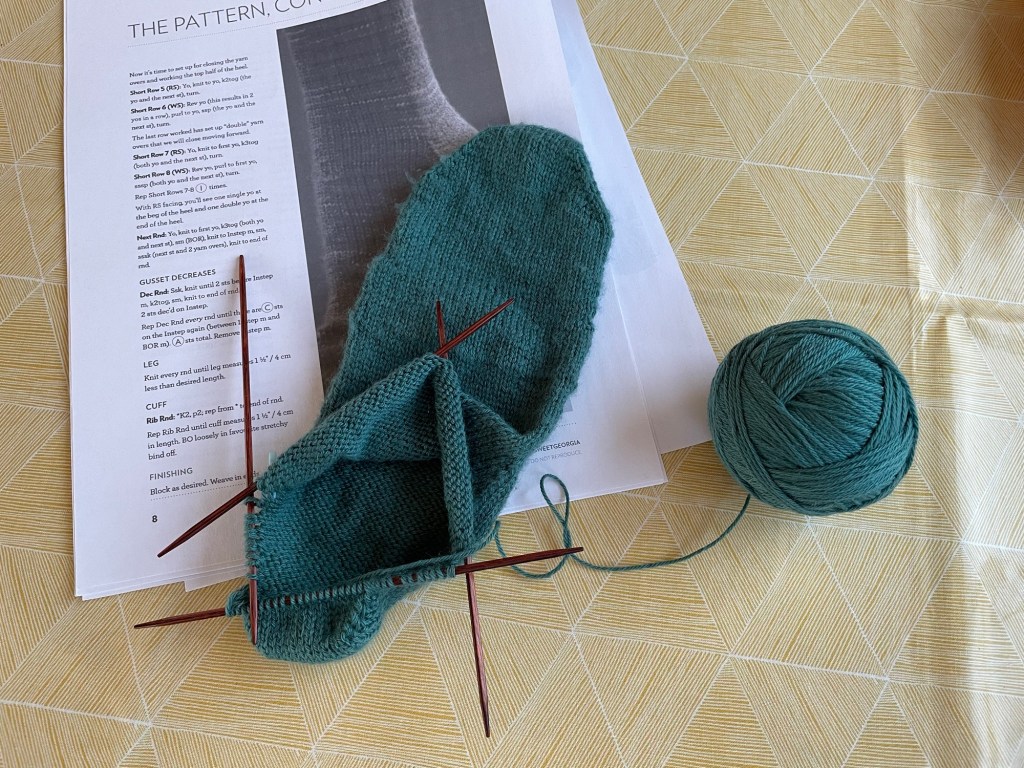
When knitting socks from the toe up, it is a little tricky to figure out when the foot is the right length to start the heel. I measured with my sock ruler and compared to another sock that I had knit. I thought it was the right time. I prefer to knit the heel with only one sock on the magic loop needle, so I took one sock off and put the stitches on double pointed needles to get them out of the way. I added a stitch on each side to make sure the heel would be deep enough, and knitted the first heel using the Fish Lips Kiss Heel pattern. When the heel was done I slipped the sock on my foot to make sure it was right. It was not right at all. It was clearly straining in every direction, being both too short and too narrow. I compared it to the other completed sock and found it was narrower. It was wide enough to slip over my narrow foot, but more width and length were needed to make it fit the rest of my foot. ARGGG. I ripped out the heel stitches and reminded myself it is about the process, not a race to finish the project.

After knitting another half inch or so on to the foot, I added another stitch on each side to make it a bit wider and knit the heel again. With the extra length and additional stitches, it seemed right. I moved the sock with the completed heel to the double pointed needles, and moved the other sock back on to the magic loop needle to work that heel in the same way. For the record you can knit the heels of both socks while they are both on the magic needle, but I prefer to do the heels one at a time.

One heel complete, working on the second one

After completing the second heel, I put both socks back on the magic loop needle, added yet another stitch on each corner of each sock, and then knitted another half inch before starting the cuff.

Starting the ribbed cuff

I was a little worried that the cuff might be too big around since I had added six stitches to each sock. But because the cuff is ribbing, it bunches together and fits the shape of your foot.

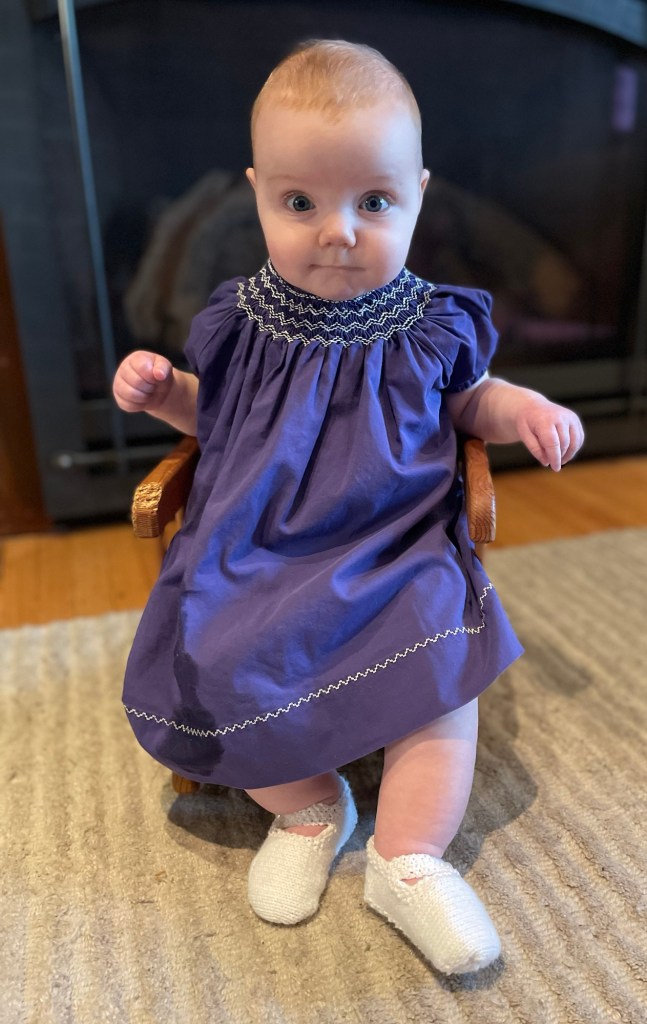
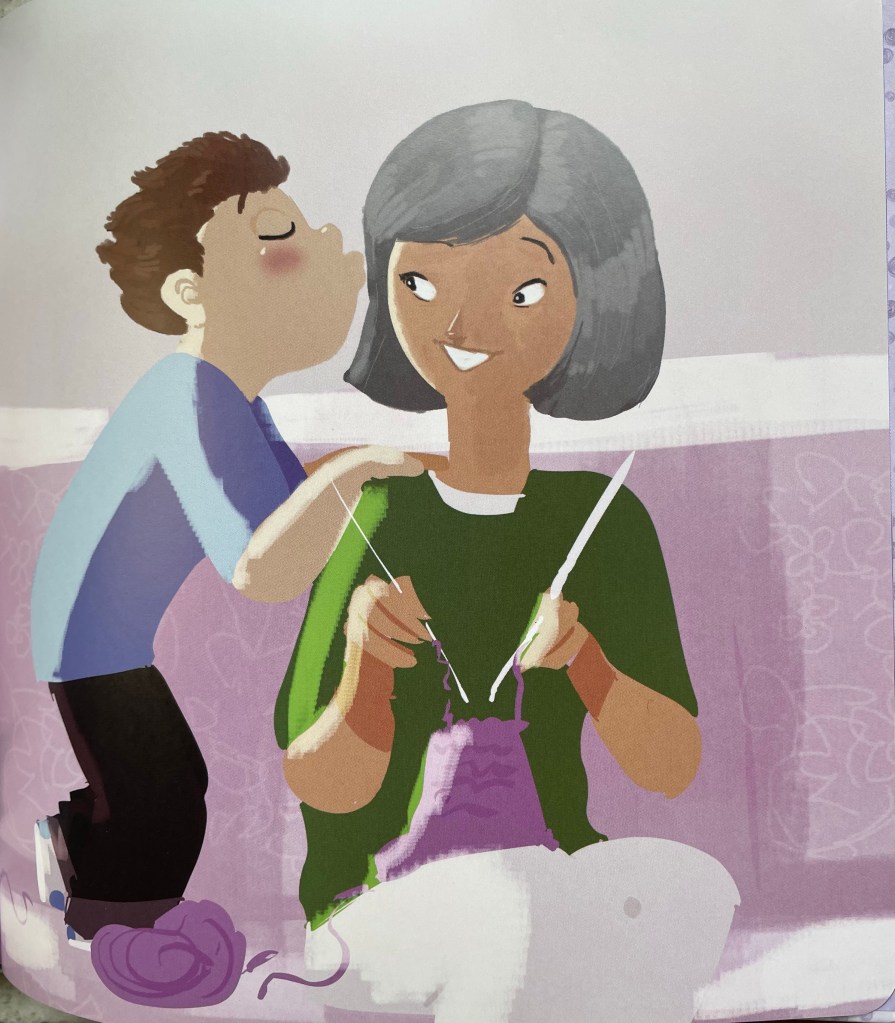
I worked on knitting the cuff while we were in St Paul recently at our son’s house. He is on paternity leave until the end of the year. We were happy to help take care of our granddaughter while our daughter-in-law was on a work trip. Blair has many board books. At almost five months old she enjoys sitting on our lap and looking at the pages as we read to her and talk about what is going on with the illustrations. There is one children’s book showing a range of activities that grandmothers might do with their grandchild, such as baking, riding bikes, having a picnic, painting, etc. One of the drawings is attempting to show the grandmother knitting, or at least I cannot think of what else they might be trying to portray. Apparently the author, illustrator and editors had no idea what knitting looks like. Anyone who has learned how to knit, or paid any attention to how knitting works, will notice several things wrong with the drawing below from the book.

Drawing from a children’s book, attempting to show someone knitting

It looks like the grandmother is holding chopsticks. This is not how you hold knitting needles. And there are no stitches on the needle. And there are yarn ends coming from the project to both needles. I am tempted to write a letter to the author to point out these errors. I think they should have the illustrator draw a new accurate drawing of the grandmother knitting.

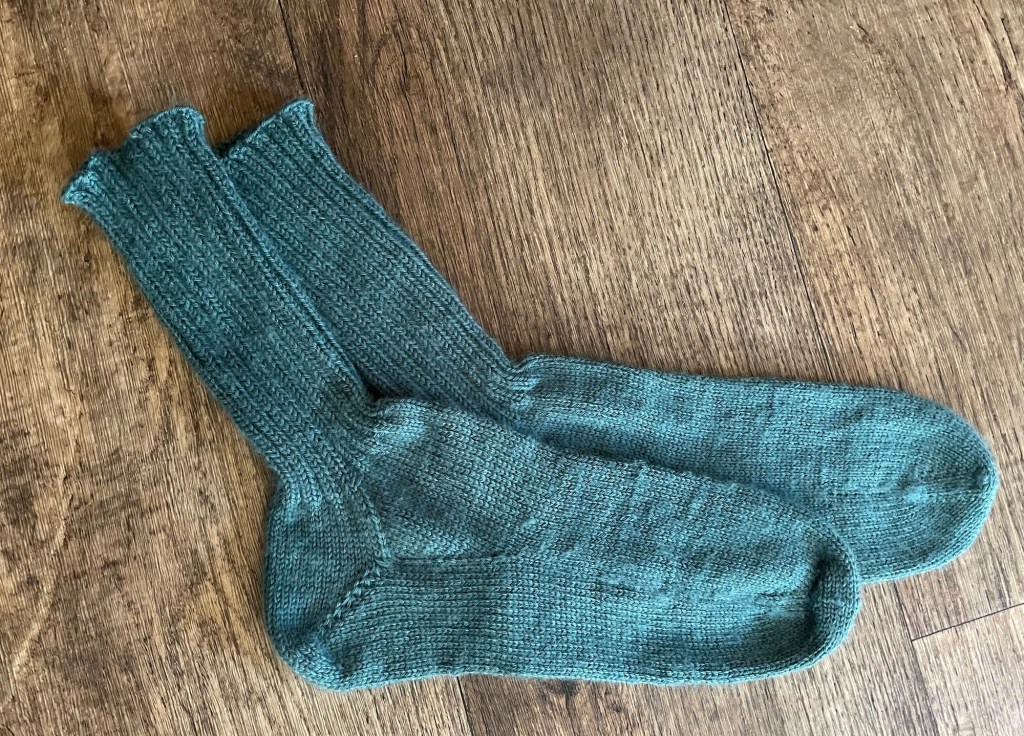
I finished the socks after we were back home. The yarn is so soft and they fit beautifully. The color looks good with my sneakers and with my hiking shoes. I will think about the trip with my friends and the Traverse City area every time I wear these socks.

Completed “Up North” socks
Ready for hiking

Scarf Repair OR Crazy Cat Lady

A friend from Minneapolis asked me if it was possible to repair a hand knit scarf she had made that one of her cats had gotten into. Shelley showed me a photo with a chunk out of the middle of the side. She is not an experienced knitter, and did not have any leftover yarn or did not know where it was.

My friend’s scarf damaged by her cat

I offered to undo the damaged part and then graft together the remaining rows for her. Shelley was happy with that idea, so I picked up the scarf from her during our next trip to the cities.

In addition to the ruined section on the side, there was a place where a piece of yarn was still attached but had gotten pulled way out. You can see that in the next photo.

A chunk out of the scarf, and a loose length of yarn

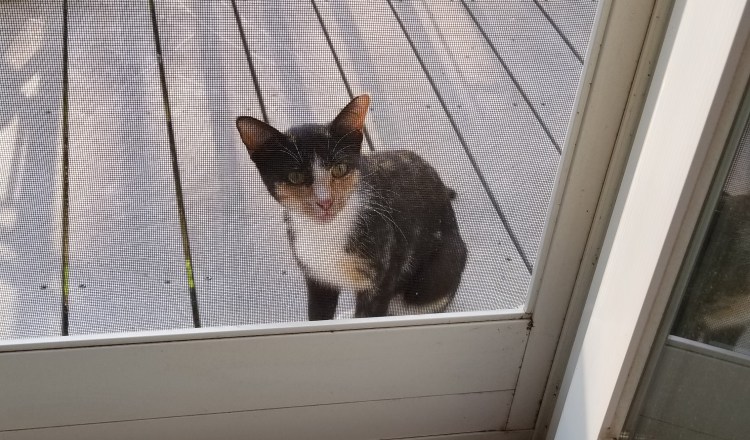
My friend is not someone you would think of as a Crazy Cat Lady, but there is a back story about the cat situation she finds herself in now. In the summer of 2021 Shelley was included in a ladies weekend at our family cabin with some friends from high school. During that time a stray cat was hanging around the cabin. We do not normally see cats outside in our neighborhood so it was unusual. This cat was very thin and looking for food and attention. We first noticed it when it climbed up the outside of the cabin and was looking in the kitchen window. I did not want to encourage the cat to stay, so we did not offer it any food, knowing there were plenty of mice and other options outside for a cat.

The stray cat looking inside our house from the deck

I like cats. We had a Siamese cat when I was growing up, and as an adult our family had two cats for many years. But I had visions of the time when I was in middle school and my family went camping. A stray cat hung around our campsite and that time we did give it some food. Later the cat wanted to come inside the tent. It must have been very cute and persistent, because we let it in. During the night the cat threw up all over our sleeping bags. I don’t remember the rest, but I am sure my mom was not a happy camper.

Back to the time with my friends in 2021, the stray cat kept coming around, visiting cabins and homes all along our side of the lake. The next day my group of friends was having dinner at our house about a third of a mile from the cabin. We were enjoying time on the deck which is above a walkout basement. The cat climbed the lattice from the ground level up and on to the deck. My husband Wayne was there standing in the doorway from the deck to the living room, with the door open, telling us to make sure the cat did not go in the house. The cat slipped inside the house as he was saying this. Everyone laughed and laughed. My daughter happened to be home at the time and she was easily able to pick the cat up and bring it back outside. Shelley was very concerned that someone was neglecting this cat, or more likely it was a stray, and she wanted to bring it home with her. The other people in the group all thought that we needed to make sure it did not belong to someone. After the friends all went back home, I made inquiries over the next few days.

My daughter holding the stray cat

Meanwhile, Wayne noticed that there were two kittens with the cat. They were very skittish and would not let him get close. A few days later there was only one kitten. Two weeks later we had not identified an owner and Shelley still wanted the cat. We were able to lure the mother cat into the garage easily, and the one remaining kitten followed her in. We got the two cats in a carrier and a box, and I took them to the humane society so they could check for a chip and make sure the kitten was old enough to separate from the mother. They did not have a chip (not surprisingly) as they were probably barn cats. I left the kitten there and Shelley drove three hours from the Cities and got the mother cat.

The stray cat on top of the snowmobile in our garage

Shelley was in for a surprise about six weeks later when the mother cat had four kittens in her house! Her daughters said they would take two of the cats but that never happened, and other offers to take a kitten also fell through. To this day she still has all five of the cats.

Four surprise kittens born in Shelley’s house
The four kittens after a number of weeks

One of the these five cats ate Shelley’s scarf, probably the one that also likes to shred up toilet paper. Fixing the scarf was pretty easy. I ripped out about three rows rows of knitting that were damaged, and then grafted the two halves of the scarf back together using kitchener stitch. I had done kitchener stitch before, but on something that was knit in stockinette stitch (knit one row purl one row). This scarf was knit with garter stitch (knit every row). I was not sure if kitchener stitch was the same for garter stitch, but I found several youtube videos showing what to do. It was slightly different, so I am glad I checked.

The two halves of the scarf after removing the damaged rows

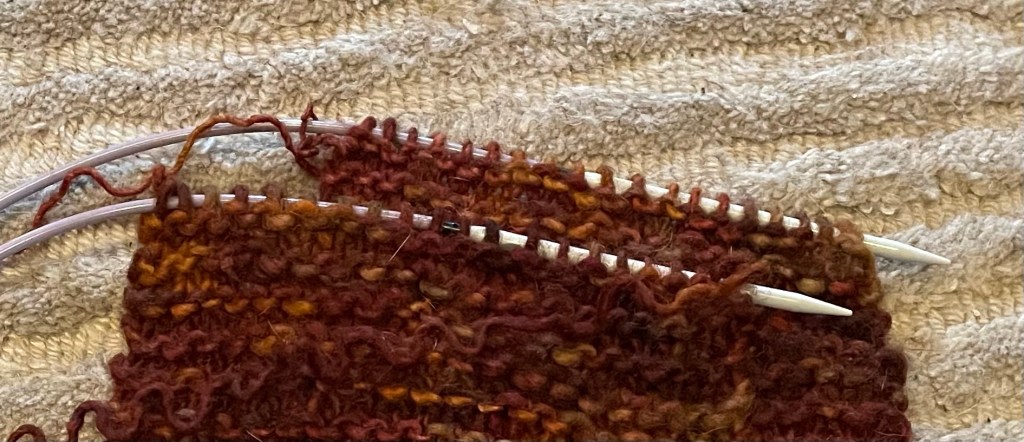
I put the live stitches on needles with the purl bumps facing me and laid the two halves together, according to the instructions.

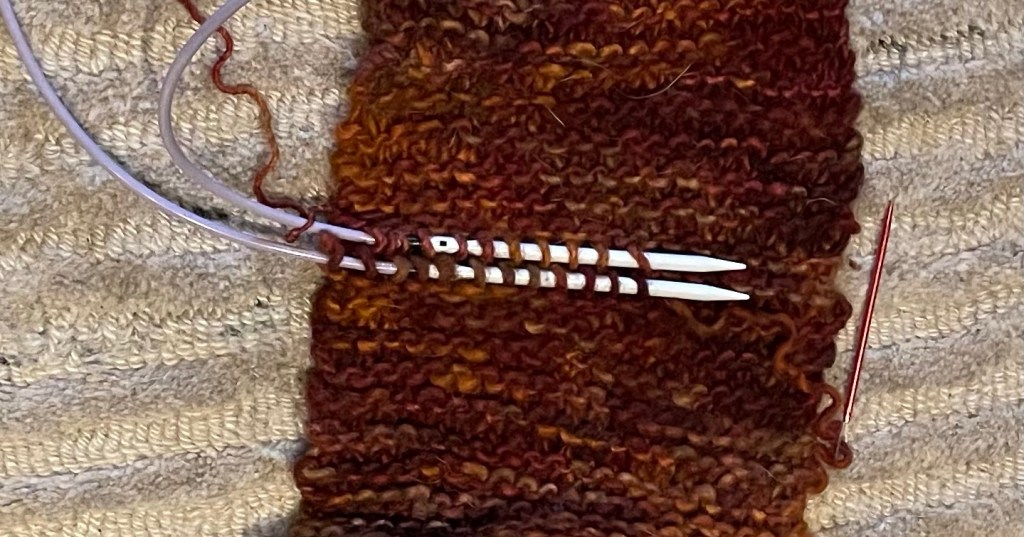
Ready for kitchener stitch

Kitchener stitch is worked with a yarn needle and length of yarn, weaving the yarn in and out of the live stitches following a pattern that mimics what happens when you are knitting. In the next photo I have joined about one third of the stitches, moving from right to left.

Kitchener stitch in progress

The following photo shows the rows completely joined. I put a stitch marker on the joined row so I could identify where it was. If you did not know, you probably would not be able to find it.

A marker showing which rows have been joined together

I also gently picked at the yarn on each side of the loop of yarn that had gotten pulled out until it was close to back the way it was supposed to be. The next photo (sorry for the poor lighting) shows the scarf back in good shape.

The scarf repaired, with a marker showing where the damaged row had been

Sometimes I have a hard time thinking of what to write or getting a blog post to come together. Other times like this one the words flow out of my head faster than I can type them. I was happy give Shelley’s scarf a second life, and it was fun to reminisce about that summer cabin time with my friends. I wish all blog posts were that easy!

Basket Weaving Class

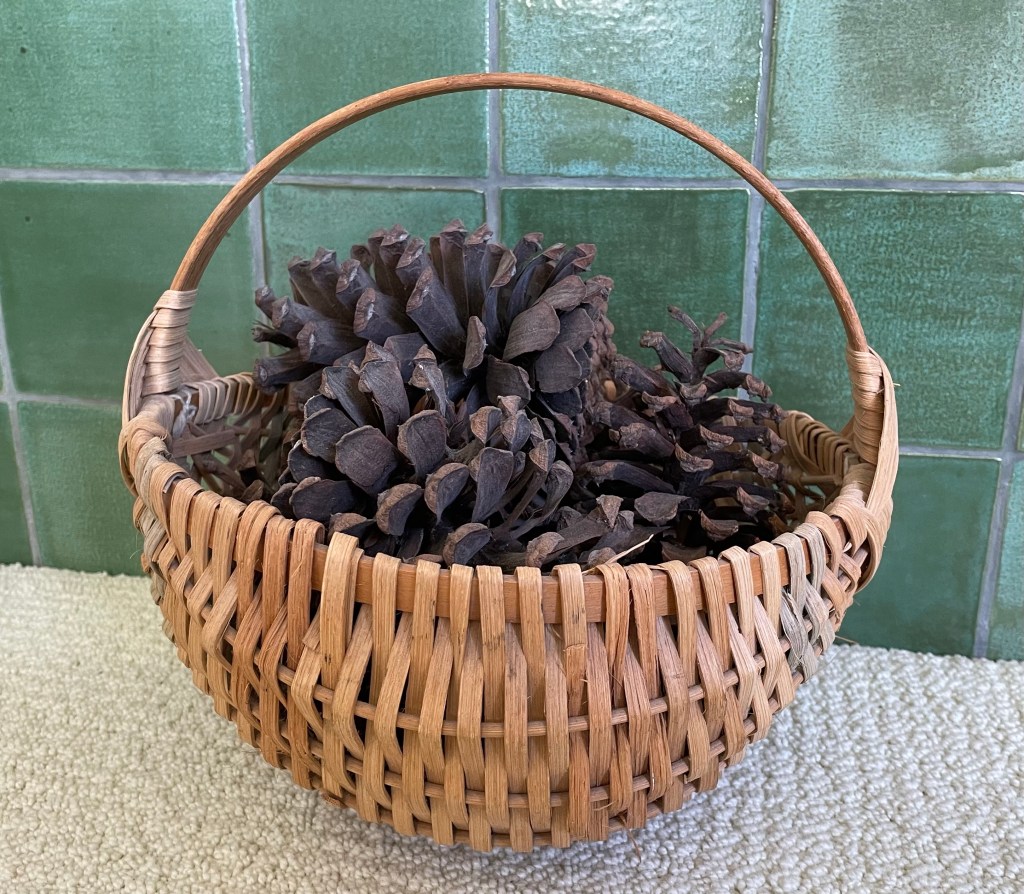
I have always loved baskets. Every basket is functional, but a handmade basket is also a beautiful work of art. Over 30 years ago my sister-in-law Marlene and I made baskets at the home of her cousin, Karen, who organized the get together. Karen invited an experienced basket maker to come and lead the afternoon session to a group of friends and family. All the materials were provided for a minimal fee of $10.00. We had a fun time and I came home with a basket that has been sitting in front of our fireplace ever since then. Sometime later when my sister lived in North Carolina, I collected giant pinecones from her yard that ended up in the basket. We have pine cones in Minnesota, but not that big!

The basket I made over 30 years ago, still on display in the living room

I have another basket that my grandmother passed down to my mom. There is a notecard inside the basket that says it was purchased by my great grandmother, Mary Chase Laramie, from Native Americans (likely Ojibwe Indians) near Lake of the Woods in the early 20th century. Lake of the Woods is a large irregularly shaped lake, about 70 miles long by 60 miles wide, on the border between Minnesota and Canada. It is the 6th largest lake in the United States, after the Great Lakes, and known for excellent fishing.

Mary Chase had been an independent unmarried woman with a thriving homemade cosmetics business. After moving from Wisconsin to Crookston in northwestern Minnesota, she met John Laramie, a railroad engineer with four children whose wife had died. Mary was not keen on marriage but felt the children needed a mother. She married John and they went on to have four daughters together, including my grandmother. Mary and John owned a farm near Warroad, a small town on the Canadian border near Lake of the Woods. People in Minnesota know it as Hockeytown USA due to it’s strong hockey tradition and number of high school championship teams, as well as multiple Olympic and NHL team players, despite having a population of less than 2000. More importantly for this anecdote, Warroad was once one of the largest Ojibwe villages on Lake of the Woods (according to Wikipedia).

Basket made by Ojibwe indians at the beginning of the 20th century

Once when I was watching Antiques Roadshow they talked about people bringing in items they thought had belonged to a famous person, with a story of how it came to be in their family and been passed down through multiple generations. But after examination, the Antiques Roadshow expert would determine that the item could not have belonged to the famous person due to materials or processes used much later than the person had lived. In the case of the Ojibwe basket, I am going to stick with my story given the time and place where my great grandma lived and the history of that area.

Following are photos of two more baskets I have (that I did NOT make). I use both of them for storing yarn, roving for spinning, spinning wheel bobbins, knitting projects in process, and whatever other random fiber related thing I don’t know where else to put. The contents change regularly. Sometimes I empty one of the baskets out and use it to bring things to an event.

Two baskets I did not make but love and use

I have been watching for the right opportunity to make another basket for years now. There are plenty of places that offer basket weaving classes, but other activities have had higher priority. Recently I became aware of a weekend basketmaking class offered in Fergus Falls. The first time I saw the information I dismissed it, thinking I did not have time. Later I saw another reference to the class and I decided to go for it. There would not be a more convenient opportunity to make another basket.

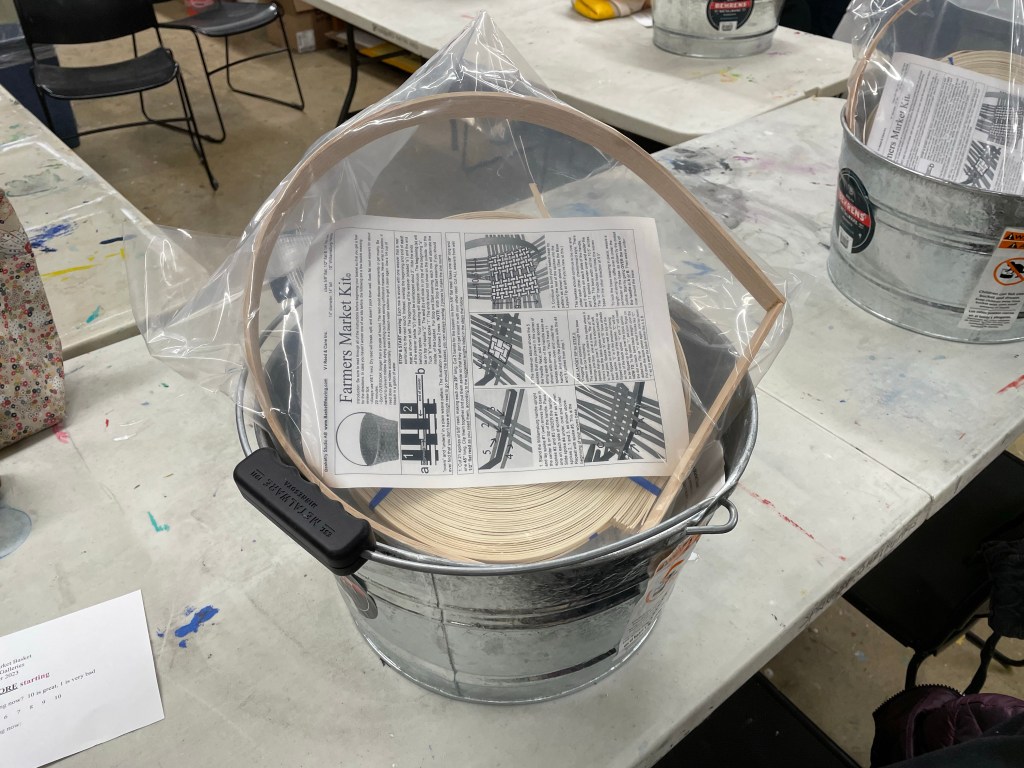
The class was offered through the Kaddatz Galleries, a non-profit organization that offers art education and gallery space. The teacher was Martha Bird, an artist and nurse from Minneapolis. Click here to see her web site. There was a full day of instruction on Saturday, and another half day session on Sunday. Each of the 5 students in the class received a kit with all the necessary materials for a fee of $85 (much less than retail value), plus the use of other accessories needed, such as a bucket, scissors, tape measure, clothespins, etc. Following is a photo showing the bucket with supplies, before anything was unpacked.

Bucket “O” supplies for making a basket

Inside the plastic bag were more than enough rattan reeds in three different sizes, plus a wooden rounded handle attached to a base. The first step was to cut 21 pieces of 5/8″ wide reed 29″ long. The strips of reed (called “stakes”) were then soaked in the bucket with water just enough so they would be able to bend without breaking, about one or two minutes.

Reeds soaking in water for a short time

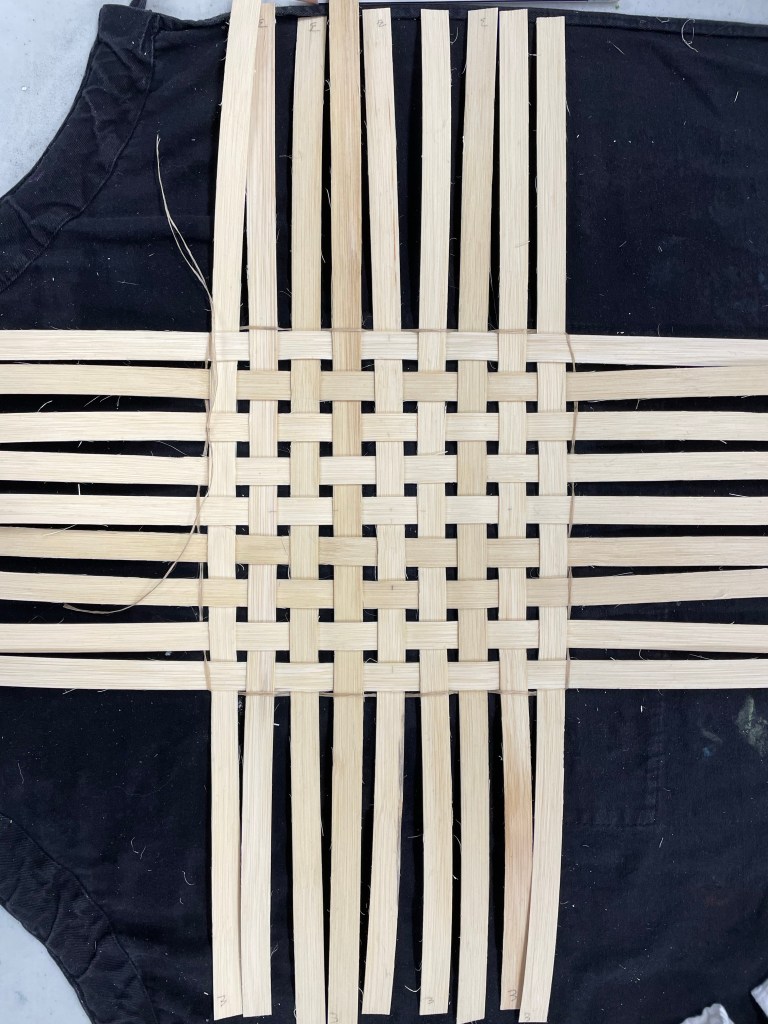
The bottom of the basket was made by weaving the 5/8″ “stakes” over and under each other and around the handle base. Eleven stakes were needed going perpendicular to the handle base.

We used five on each side going the other way to make a square basket. You could have used less and had a more rectangular basket.

Base of the basket done

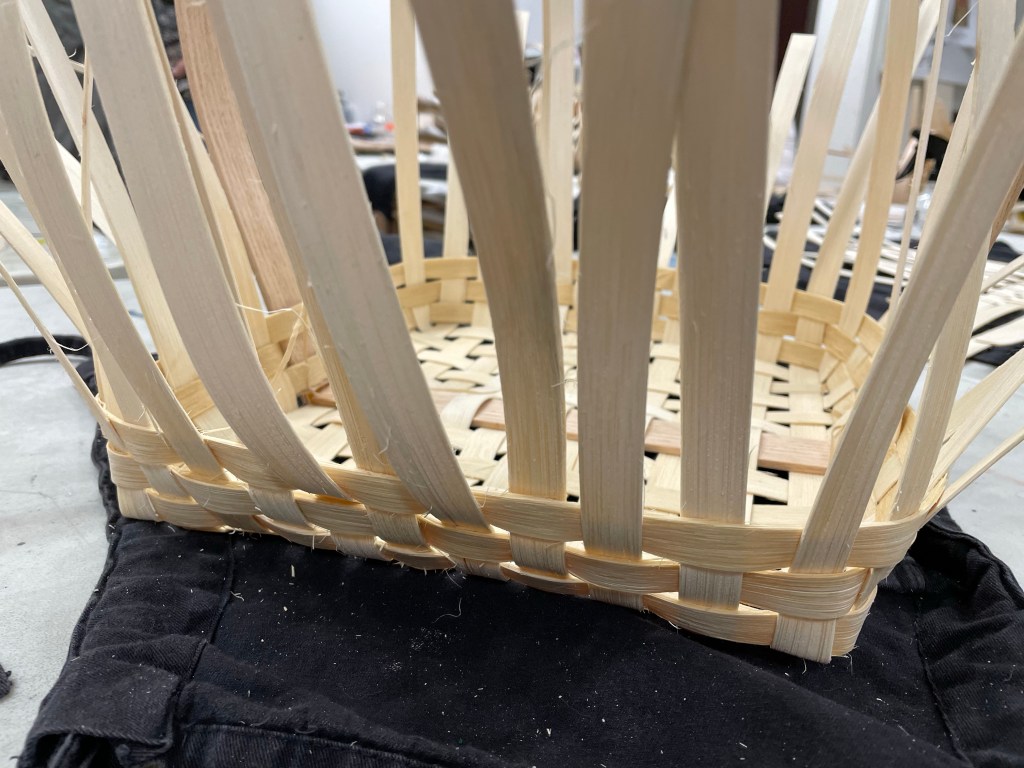
The reeds have a smooth “good” side and a “bad” side that is more prone to shredding. The bad side was supposed to be on the inside, but it was not always easy to tell them apart and some reeds seemed to have two bad sides. I ended up with some bad sides on the outside. After the base was finished, it was time to spray it with some water so the stakes could be bent up for the sides. The sides were made of 1/2″ rattan “weavers”. We cut a total of 11 weavers measuring from 45″ to 48″. The longer ones were used at the top of the basket where it was wider. The rows at the bottom were the hardest to weave in, it got easier as you went up.

Clothespins were used to hold the reeds in place as we were working, especially closer to the bottom.

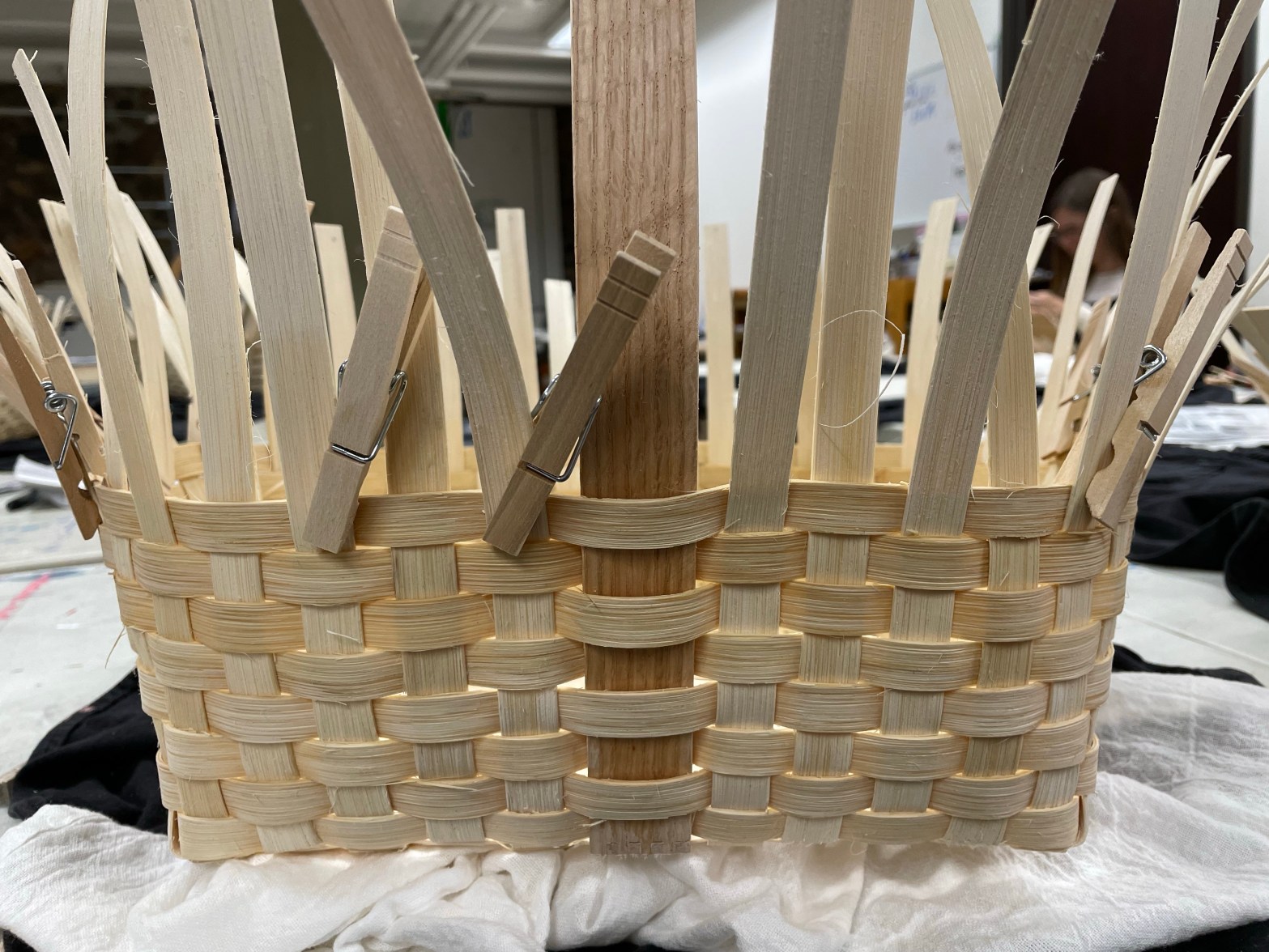
You could make your basket shorter by weaving in fewer rows, but we all had 11 which left enough of the sides sticking up to finish off the top properly. The reeds sticking up on the outside were folded over, trimmed and tucked in. The alternate reeds sticking up on the inside were cut off level with the top. The next photo shows the outside reeds folded over and held in place by clothespins before I trimmed and tucked. The photo after that shows the basket after all the trimming, tucking and cutting.

Every other vertical reed folded over and held down with a clothespin
The folded over reeds have been trimmed and tucked in. The alternating reeds have been cut level with the top

I did not get a good photo of the last part in progress when we wrapped some of the 3/4″ reed around both the outside and the inside at the top, and lashed it on with a long piece of narrow reed.

Everyone in the class had the exact same materials, but each basket came out a little differently. Mine was wider at the top. Some were more square. Each one had its’ own style. The finished size of my basket was 15″ x 13″ at the widest part of the top, and 10″ x 9 1/2″ at the bottom, and 6″ tall.

My completed basket

One of the women in the class did some extra credit. After learning the technique at the class on Saturday, she and her seven year old son collected cattail reeds Sunday morning and made a five inch square basket using rope for lashing and a handle at the top. It turned out amazingly, as you can see in the photo below.

Small basket made with cattail reeds the day after the first session by classmate’s son

After completing the market basket on Saturday, there were enough materials to make a another smaller basket during the half day session on Sunday. We all decided to make napkin baskets that would be square, lower, and not have a handle. The beginning was the same except without the handle. We used nine reeds each direction which turned out kind of big for napkins when we were all done.

The bottom of the second basket, with no handle

Skipping ahead to the last step that I did not photograph on the first basket, the following photo shows the strips of reed getting lashed on at the top of my second basket. One of the students brought a length of old rope from her garage, so I added some at the top of my basket.

The finished size of my smaller basket is 8″ x 8″ at the base, 10″ x 10″ at the top, and 4″ high. It is too big for the everyday napkins we use, but could work for larger entertaining paper napkins, or does not have to be for napkins at all. Following is a photo of the completed second basket. On the second row from the bottom at the back in the photo you can see a mistake where I missed weaving behind one of the vertical “stakes”. I did not notice it until it was too late to fix. Oh well.

My second smaller basket

I was very happy with how both baskets came out, despite a few imperfections.

My two completed baskets

Everyone in the class had a good experience interacting with each other and working together learning a new skill. Martha was a wonderful teacher, explaining all the detailed steps in ways we could follow, and patiently giving individual help as needed. I could have found plenty of other things to do over the weekend, but I am so glad I decided to take this class.

Hot pads and Scrubbies

There is a big range of skill and interest and complexity in the fiber world. There are crafters and makers and artists. There is fiber craft and fiber art. There are people working on crafts with inexpensive materials, people creating simple or complicated items using more expensive natural fibers. Fiber projects can be functional things like clothing or dish towels, or art pieces such as a wet-felted “painting”, or they can include both function and art.

One of the things I love about fiber art and craft is the variety of materials and infinite possibilities of what you can do with them. I love all the colors and textures. There is always something new to learn.

Once I visited the home of a woman who knit exclusively cotton dish cloths. She had stacks and stacks of them. On the other end of the creative spectrum, people make one of a kind fiber art pieces that do not fit in any category. My friend pointed out that someone could take stacks of dishcloths and make an artistic statement out of them, so then it would be art. There are no rules, you can do or make what you want based on your skill and interest and budget.

I tend to make things that are on the more practical end of the range, but they can be creative and beautiful, even if they are not “art”. I like to have a mindless knitting project going that I can work on while watching TV. Usually I also have something else in progress involving more skill and creativity.

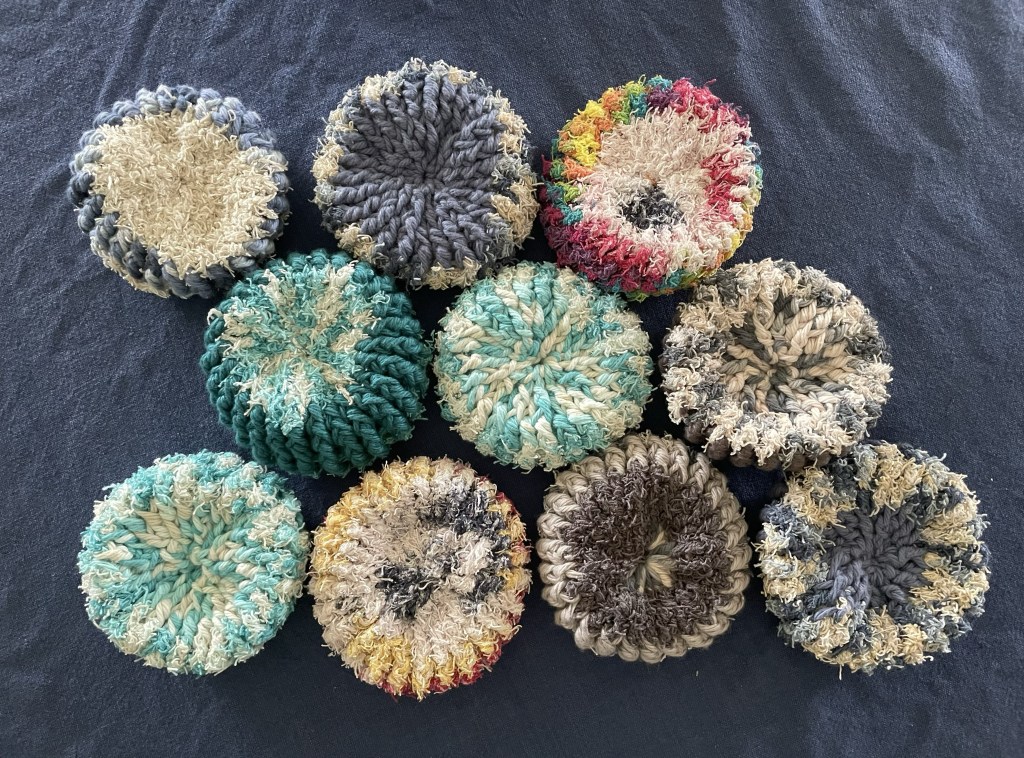
I participated in an outdoor Craft Fair (click the link to read my blog post about it) in March of 2021 at Gold Canyon Golf & RV Resort in Arizona, when the regular gift shop was closed due to Covid. I had not planned ahead for this or prepared products that were likely to sell. I offered knitted hats and other wool items I had for sale in my ETSY shop at the time, because I had them with me in a box. There was not much interest in wool items there, although I sold one hat. Someone asked if I had any kitchen scrubbies for sale. I didn’t, but I told her I would make some if she brought me the yarn. I found a crochet pattern for Kitchen Scrubbies and made a bunch of them for her and to sell. They were easy and quick to finish. After the craft fair was over I put the extra kitchen scrubbies in a bag where they have been ever since. Following is a photo of the scrubbies that I had left from March of 2021.

Crocheted kitchen scrubbies

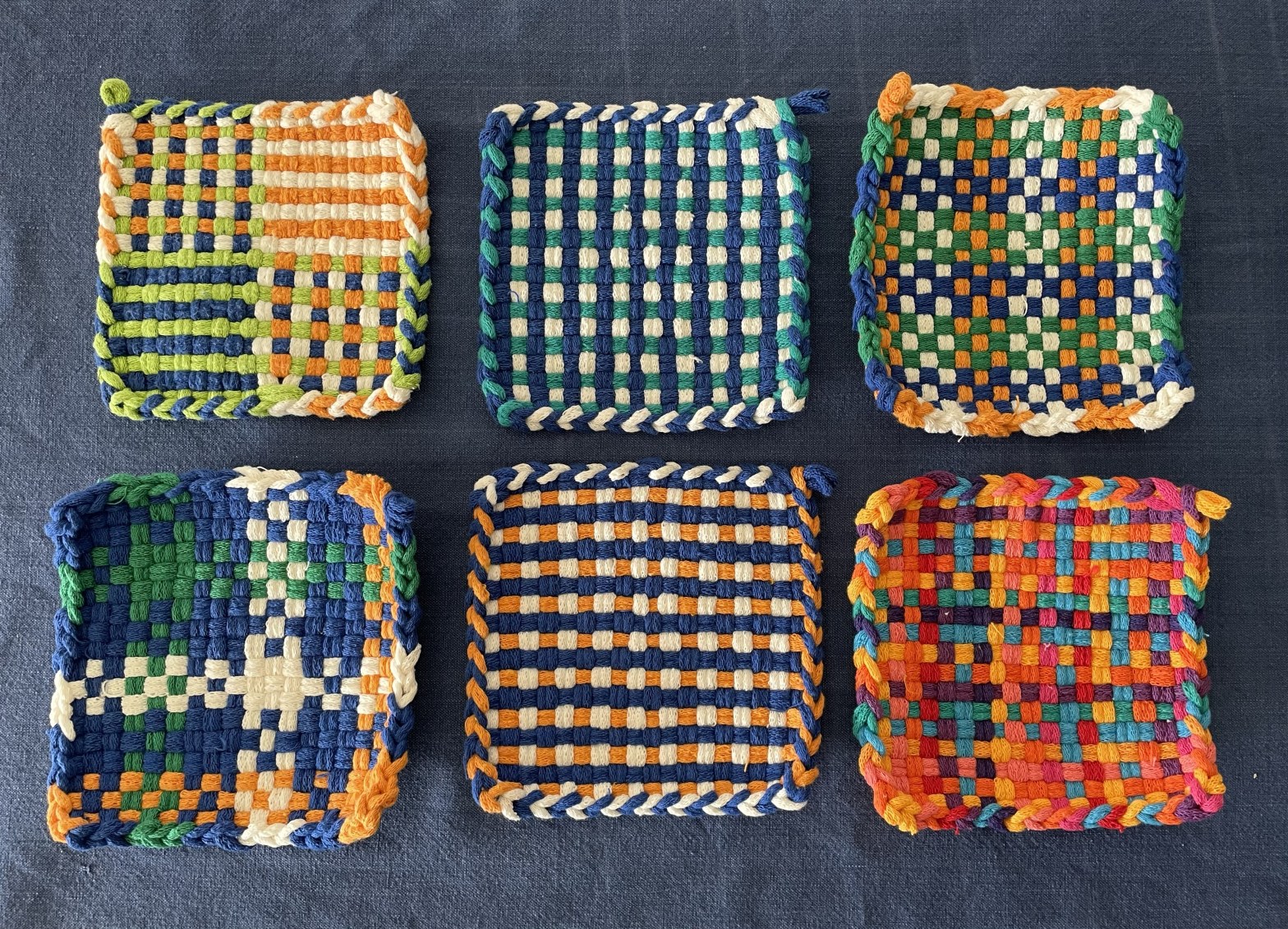
Another practical item I have made are potholders on a potholder loom. These basic looms are marketed to children, but adults use them too. You can make a potholder while watching TV or while in the car. There is some creativity deciding how to arrange the colors of stretchy loops, and the result is a useful product that makes a good gift. I published a blog post, Weaving on a Potholder Loom, in April of 2022. I made a few more this fall.

Potholders made using a potholder loom

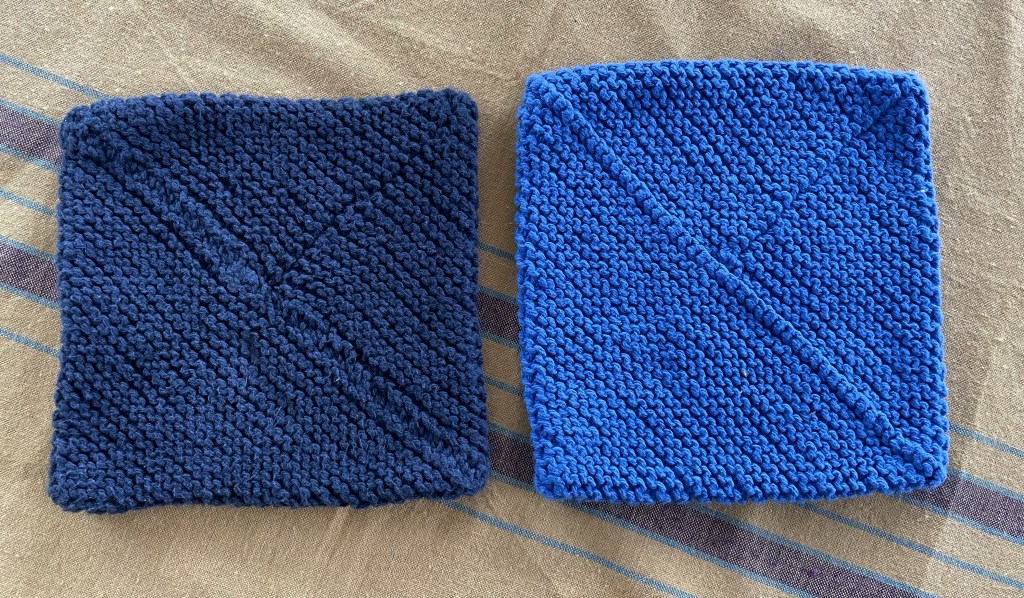
Late this summer I saw a pattern for a knitted Double Thick Potholder that would work using Peaches & Creme cotton yarn I had on hand. It looked like another easy project that would result in something practical. This pattern is very clever but hard to visualize how it is going to work until you actually knit it up. You knit a tube with a circular needle, then divide the stitches on to two needles and do a three needle bind off. That gives you a double thick rectangle with the top sewed shut and the bottom open. You then fold it so that the open end is re-arranged diagonally and whip stitch it shut. I made a couple of mistakes on my first try at this pattern, and my whip stitching did not look great.
After understanding how the pattern worked, I thought of a variation that would come out looking better and I made another one. Instead of a normal cast on, I used a provisional cast on so that there were live stitches at the beginning of the tube. When I got to the last step, instead of whip stitching the open end shut, I arranged them as if I was going to do that, but instead I put the live stitches on needles and did another three needle bind off.

Following is a photo taken while riding in Wayne’s fishing boat, when I was near the beginning of the second potholder. Not a bad place to work on my knitting.

Starting a knitted potholder on the boat

After the right number of rows, I rearranged the stitches on to two needles. The next photo shows the second potholder as I was ready to work the three needle bind off at the top. You can see the live stitches from the cast on at the bottom, being held with waste yarn.

Setting up for three needle bind off

The three needle bind off is about 1/2 way done in the next photo.

Three needle bind off

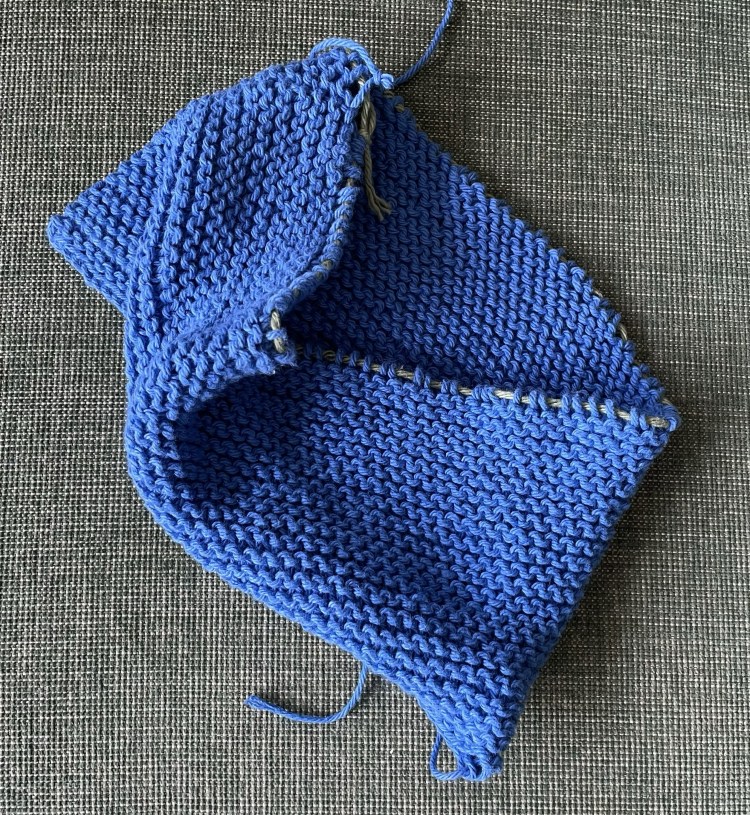
After binding off the top edge, it was time for the clever tricky part that is hard to visualize. You take the open end and rearrange it diagonally.

After arranging the stitches it magically becomes a square. If I had followed the pattern the second time, the live stitches you see would be normal cast on stitches from the beginning that would be whip stitched shut. Instead, I put my live stitches on two needles and removed the waste yarn.

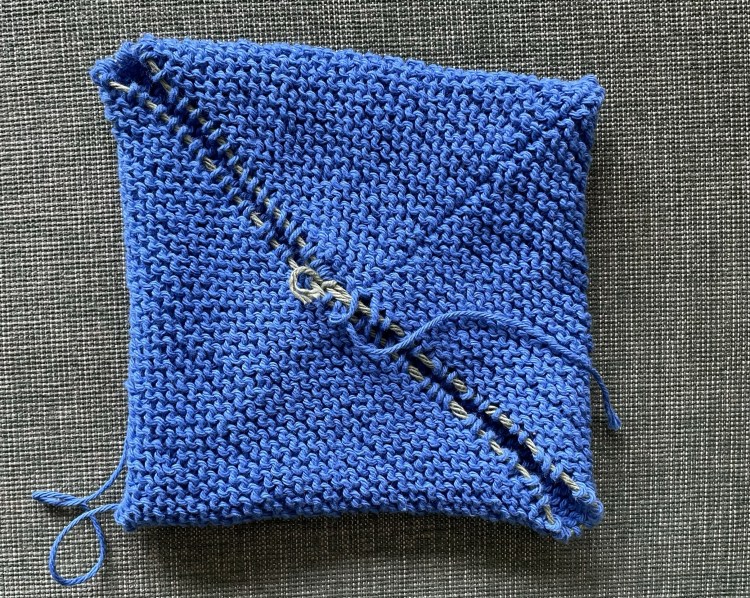
After doing a three needle bind-off on the original live cast on stitches and weaving in the ends, the potholder was finished. Voila!

I did not take any photos of the first potholder as it was in progress. Following is a photo of the completed first potholder next to the more successful second potholder. You can see what a bad job I did with the whip stitching on the first one. I made a few other mistakes that I did not bother to fix. I am pleased with the second potholder. It is plenty thick for using on hot pans and a good size at about 7″ x 7″.

First and second attempt at a knitted double thick potholder

The knitted potholder takes longer to make than kitchen scrubbies or potholders using the potholder loom. I will not be knitting any more potholders for now as I am on to other projects. I started knitting a pair of socks months ago, I am working on weaving some kitchen towels on the floor loom, and I have two different spinning projects going. Stay tuned.

Woven Baby Blanket – Same Yarn

After I finished knitting a cotton baby blanket for our granddaughter there were two skeins of yarn left. I thought it would be fun to weave a blanket with the remaining yarn, which would result in a different look and feel, with a flatter texture and the colors interacting in a different way.

There wasn’t quite enough so I ordered three more skeins of the same yarn in a solid color instead of the variegated colorway I used for the knitted blanket. I thought I was ordering lavender, but it turned out to be more pink than I was expecting. This is often a problem when ordering yarn online. Colors can look different depending on the lighting and what device you using. My photos of the yarn and project in this post vary from pink to lavender.

Universal Cotton Supreme yarn for woven baby blanket in plain and variegated

There are options for how to use the plain and variegated yarn to get various looks in a woven product. I could alternate sections of the solid and the variegated in the warp for stripes. If I did that for the warp but also alternated sections of plain and variegated in the weft I would have plaid. I decided to keep it simple and warped the loom with the solid color (the long way), and wove the weft (back and forth) with the variegated multicolor yarn. Since the variegated yarn changes color at random intervals, I got random horizontal stripes.

I also had to decide how many ends per inch to use, which would determine the density. Torri, my weaving friend and mentor, recommended 12 ends per inch. Research from different sources indicated that 8 or 10 ends per inch might be appropriate for this yarn. Torri suggested weaving a small sample and washing it in order to see what the final product would be. Since she was suggesting 12 ends per inch I made a sample with that. There is not a right or wrong answer, it depends on what result you want.

I found some instruction online for making a cardboard sample loom. Later Torri told me I could have used a five inch square of cardboard and less yarn, but oh well.

Making a sample using a cardboard mini loom

Following is the sample after washing. It is only finished enough so the ends would not come unraveled in the washing machine.

Sample completed

My swatch was pretty dense. It was a valid option to make the baby blanket with this density. I had in mind something a little looser, so I decided to go with 10 ends per inch instead of 12, which also meant it would not use as much yarn. Given the tension problems I had with my last weaving project of crooked towels, I decided to start measuring out the solid color yarn for the warp in town at Tangles to Treasures where Torri could supervise. She gave me some good tips as usual, and then I finished at home. This time I propped the warping board on a chair at my house. It worked but I am still looking for the perfect spot for this step.

Measuring the warp yarn

I made three bundles of warp yarn (a “warp chain”) instead of one big one, to avoid having some of the ends longer than others. The next photo shows the warp yarn ready to be threaded on to the reed (“sleying the reed”).

Ready to begin “sleying the reed”

I invited Torri to come out to my house on a Sunday when her store is closed to help me wind the warp on to the back beam. It seems hard to get this part right and after the problems I had the last time I needed some reassurance. I had all the ends “sleyed” through the reed and heddles and tied on to the back by the time she came, so it was ready to wind the warp ends around the back beam.

The first thing we did was some checking to make sure all the yarn ends were in the right places. We found one yarn end that was threaded through a heddle on the wrong harness. Torri showed me how fix this problem by putting a temporary heddle using a piece of string in the right place on the correct harness. You can see the white string in the middle of the next photo amongst the metal heddles.

White string heddle added in to fix a mistake

You can also see the white string heddle in the next photo, near the left side, taken from the back of the loom. This project is the widest by far of anything I have made at 32″. My loom has a maximum weaving width of 36″ but I was worried about trying to use every inch.

32″ of warp yarn

After all the setup was complete and I finally got started with the actual weaving it went fast. The variegated yarn for the weft caused random stripes going across.

Weaving in progress

My goal was to have the blanket be about 36″ long. I cut a piece of string that long that I looped on the side about every four inches, so I would know when I had woven that much. What is always hard to remember is how much less you end up with than what you started with due to “take up” and because the warp yarn is under tension. By the time I got to the end of the string, I barely had enough warp yarn left. I should have allowed for more waste by measuring out my ends longer than I did. I had trouble weaving the last couple of inches because the ends were too close to the harnesses. In the photo below you can see the end of the completed weaving on the left, and the other end of the yarn tied to the back very close to the harnesses.

Barely enough warp yarn

Following is the weaving straight off the loom. It measured about 32 inches long, even though I got close to the end of my 36″ long piece of string. I think that is because the weaving was under tension on the loom, but relaxed when I took if off.

Off the loom before securing the ends or washing

Instead of hem stitching the ends, I took groups of four ends and tied an overhand knot.

Securing the ends with knots

I trimmed the fringe to about 1 1/4″. After washing, the blanket was about 28″ x 28″. I love the way this project turned out. It is soft and has a nice weight and can work as either a small blanket or a baby bath towel.

Knotted fringe on the woven blanket, looking too pink
The two blankets side by side

My daughter-in-law sent me photos of the baby on the two blankets. The first photo is on the woven blanket. The next two are on the knitted blanket. Their dog Winnie is checking out the baby and the blanket, and then Winnie has taken over on the blanket.

My granddaughter on the woven blanket

There was yarn leftover after I finished weaving the blanket. It is kind of like when your leftovers are not quite enough for dinner, so you cook more food, and then there are leftovers again after that. There was still enough yarn to weave two hand towels on my 15″ rigid heddle loom. This time I used the variegated yarn for the warp and the plain yarn for the weft. The next photo shows the completed hand towels, with the stripes going the long way instead of the short way for a different look.

Two woven hand towels using leftover yarn

After finishing the hand towels, there was STILL some yarn left. I knit a washcloth with half plain yarn and half variegated yarn. This pattern is all knitting with some yarnovers, but no purl stitches. Somehow I got one purl stitch in the middle that I fixed by undoing all the stitches in that column and re-doing them back up with a crochet hook.

Fixing a mistake in the washcloth

Following is the finished wash cloth, next to the remaining unused yarn.

Dish cloth using leftover yarn

There is probably enough yarn left for another wash cloth. I noticed that the solid color yarn is on sale….noooo I will not buy any more. I think I have had enough of this yarn for now.

Linen

I have been into linen for awhile now. Weavers have been using linen fiber for thousands of years, but recently the fashion industry has rediscovered it. Clothing made from linen or linen blends is currently for sale everywhere.

Linen is made from the flax plant, and is one of the oldest fibers used for spinning yarn and making fabric. 10,000 year old (approximately) fragments of woven linen textiles have been discovered in West Asia and Mesopotania according to Wikipedia and other sources.

We have “linen closets” and call textiles for our home “linens” because in history they were made primarily out of linen. Knowing how much work it would be to grow flax, process it for spinning, spin linen thread, weave it into fabric, and produce a final product is mind boggling. Until the industrial age in the mid 1800’s all the spinning and weaving and sewing would have been completed by hand. No wonder average people did not have very many clothes.

I have two pairs of 13 year old 100% linen wide leg crop leg pants that I love. They are sooo comfortable, can be dressed up or down, and work for both hot days or cool days. Early this summer while shopping at TJ Maxx for something to wear to my daughter-in-laws baby shower I found a new pair in exactly the same style as the pairs I already had, but in a fun fresh tangerine color. I bought them but ended up wearing something else to the shower. I don’t really need three pairs of linen pants, but they will probably last for another 13 years.

Linen wide leg crop pants purchased in 2023 on the left, off white 13 year old linen wide leg cropped pants on the right.

I have been exploring linen yarn for weaving. I wove a couple of things using Duet cotton/linen blend yarn from Gist. I love how it feels and drapes.

Duet cotton / linen yarn from Gist

Examples of things I wove with the Duet yarn are pictured below. One of my favorite weaving projects ever is the red and white zig zag jar cover I made for my daughter, using plain cotton for the warp and the red Duet for the weft. The blue towel on the right was made with two colors of blue Duet, using a free pattern for the Rigid Heddle loom from Gist (Running Stitch Towels) that said to use 12 ends per inch. It is very loose. If I ever make another towel with this yarn for both the warp and weft I will try using 16 ends per inch on the floor loom for a slightly more dense fabric.

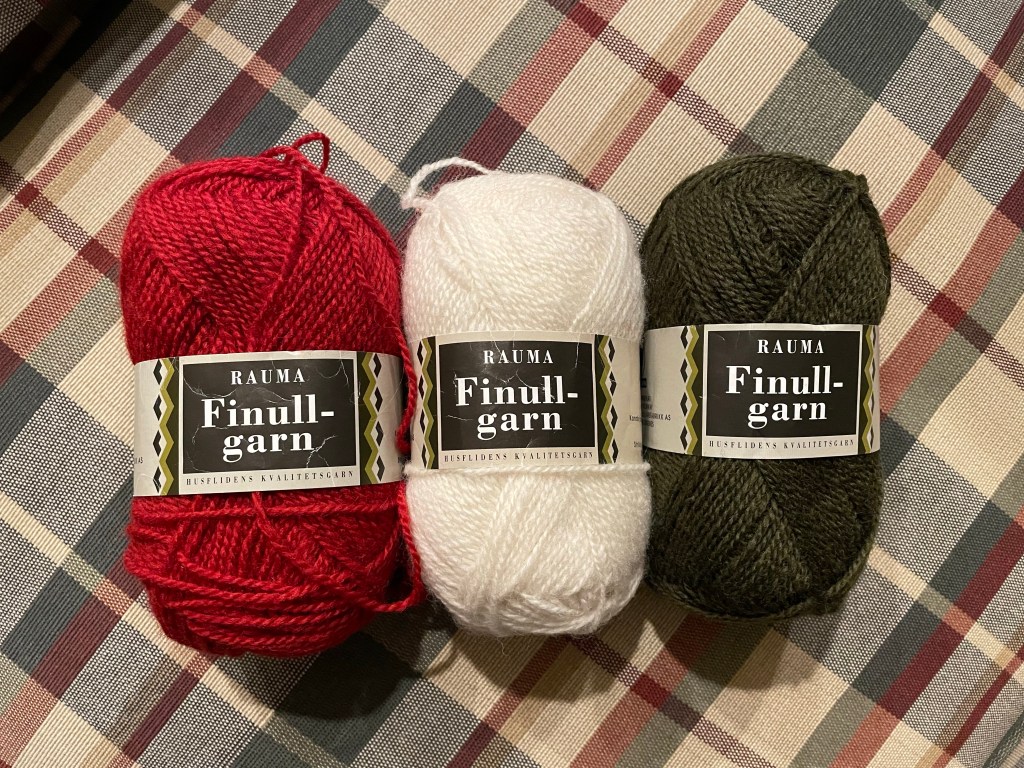
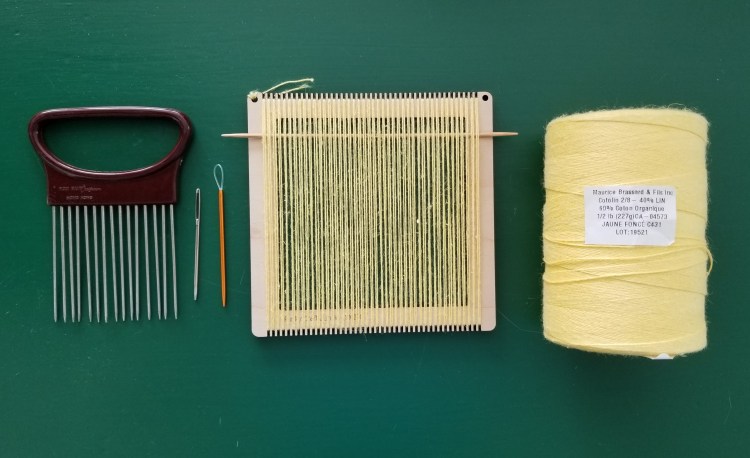
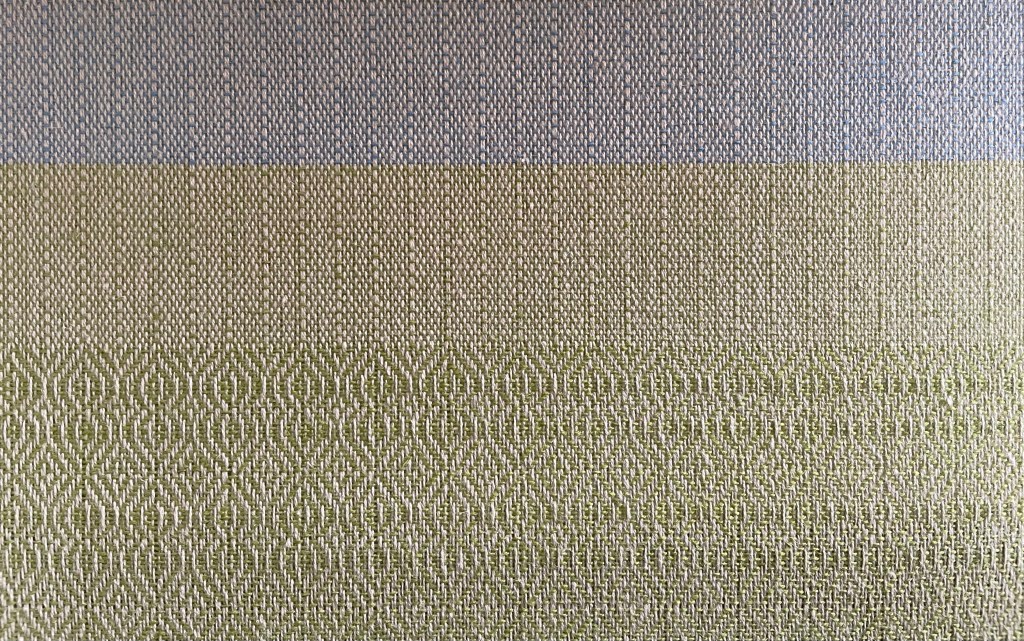
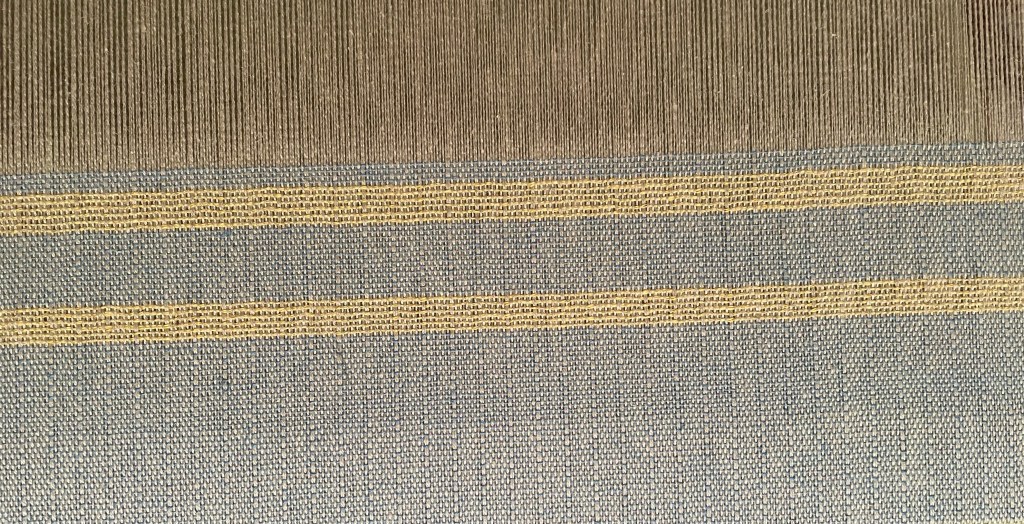
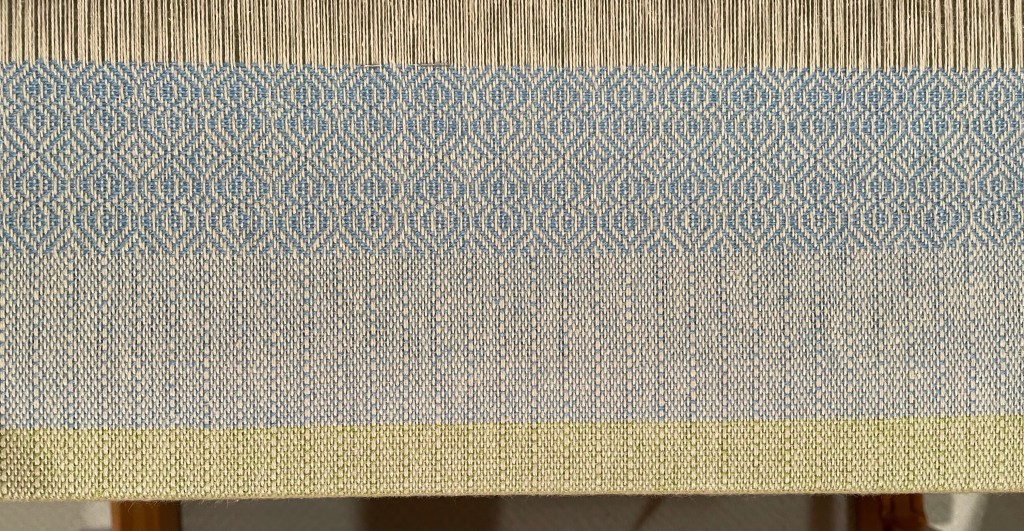
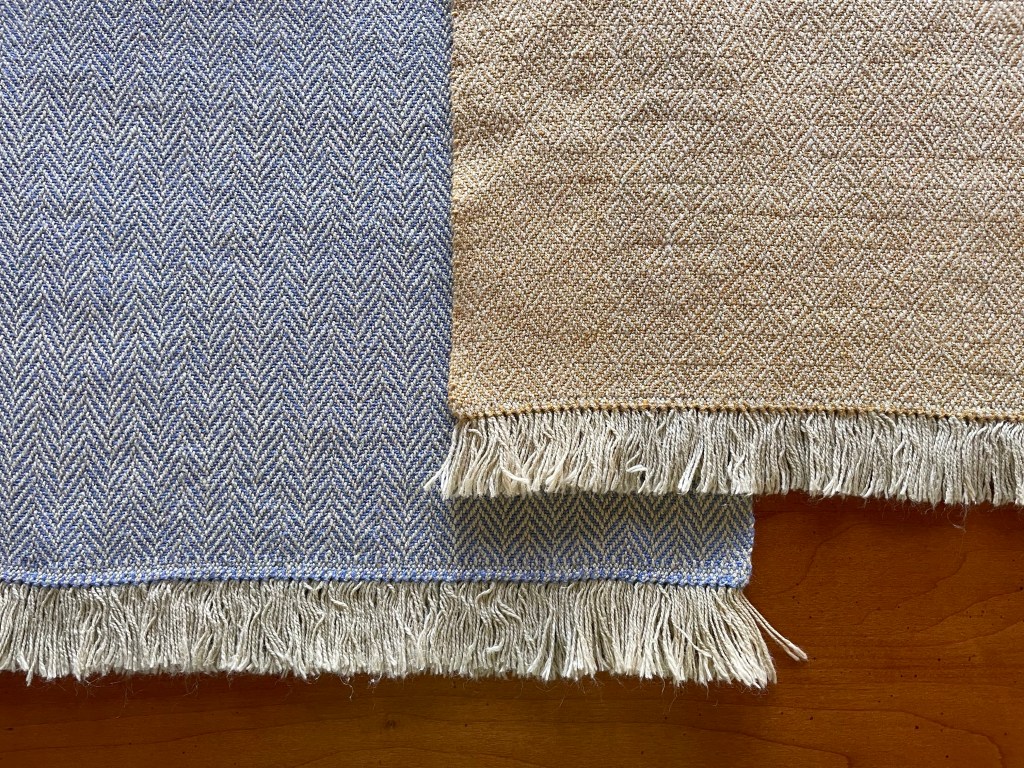
Following are photos of another cotton/linen blend weaving yarn called Cottolin. It is thinner than the Duet, and has a larger percentage of cotton. My next project on the floor loom will be towels using this yarn.

I bought some flax for spinning into linen at the Shepherd’s Harvest Sheep and Wool Festival. I thought it would be interesting to try spinning that, and using it in a woven dishtowel.

The flax looks like course hair, as you can see in the photo below. People do use it for doll hair.

Flax fiber for spinning into linen

I looked up instructions online for spinning the flax fiber. The traditional method involves using a distaff, a sort of pole attached to a spinning wheel that holds the fiber and keeps it organized. You often see these on antique spinning wheels. I do not have a distaff and did not want to buy one. Some sources had tips including getting your fingers wet as you spin, and laying the fiber out on a cloth on your lap. I tried both of these with some success. I found that if I tried working with too much at once it got very tangled up as shown in the following photo.

Tangled up flax fiber after trying to hold too much at once

As long as I held a small amount at a time I was able to spin the fiber the same way I spin wool, except that the fibers are a lot longer and there is zero elasticity. I successfully spun part of a bobbin of usable linen yarn.

Part of a bobbin of linen yarn spun from flax fiber

Attempting to spin flax was a good experience but I did not enjoy it enough to want to spin the entire 100 grams in the package I had bought. I might bring the rest to fall Fiber Day and see if someone there wants to give it a try. Given my limited amount of time for spinning, I would rather spin other fibers I have in my stash.

It was a lot easier to buy spools of natural colored linen yarn online, pictured below. Comparing the price of the flax fiber to the commercial linen yarn after the fact is enlightening. I paid $18 for the 3.5 ounce bag of flax fiber, which then requires many hours of work to spin it into linen yarn. The 8.8 ounce cones of Undyed Wetspun Warp Linen I bought were also $18 but they are ready to go, I do not have the spend hours spinning first. And now I see they are on currently sale for $12.59!!

Cones of natural colored linen yarn all ready to go, next to the bronze bust of my dad that my mom made

At spring Fiber Day I was able to dye some of the commercial natural colored linen yarn using supplies provided for dying plant fibers. First I had to unwind the yarn from the cone and make it into skeins using my niddy noddy.

Following are photos of jars of Dharma Fiber Reactive Dye at Fiber Day. This dye can be used on natural fibers including cotton, rayon, hemp, linen, silk, wood, cane, and rattan. A different type of dye is used for wool and other animal (protein) fibers.

Dye used for cotton, linen and other plant fibers

The first step was to soak the yarn in water with soda ash, which helps the dye to absorb better. After that the yarn was immersed in jars of water with the dye. This step required a minimum of three hours but I left the yarn in the dye bath until the next morning back at our house.

Linen yarn in jars of dye

The colors were very intense when I took the yarn out of the jars. I used tons of water washing it with synthrapol (to set the dye) and then rinsing it out. A lot of dye came out during the rinse process, but plenty of color was still left after the water ran clear. I love the way it turned out. I still have some of the natural yarn left undyed, so I might dye more at the next Fiber Day at the end of September.

Hand dyed linen yarn

My head is full of ideas for weaving, spinning and knitting projects. I am looking forward to weaving dish towels using all the different linen and cotton/linen yarns I have collected, when I can get to it.

Baby Ensemble

Over a year ago in 2022 I knit a baby sweater. This was well before our first grandchild was conceived, but at the time I was looking for a smaller project using yarn I already had on hand. I knew I would be able save it for a future shower gift.

I used a free pattern from Ravlery, New Baby Cardigan, with 50% Acrylic / 40% Wool / 10% Nylon Berrocco Vintage Chunky yarn. This pattern is knit from the bottom up in one piece, with the neck and front bands added on by picking up stitches.

Yarn and pattern for a baby sweater

I can hardly remember now, but based on the backgrounds in the photos below I believe they were taken in hotel rooms on the way home from Arizona. The first one shows a few inches at the bottom of the sweater.

First few inches knit

The next photo shows the knitting split for the sleeves, with some shaping added at the center front.

Split for the sleeves

The shoulder seams were joined after the front and back were done. Following is a photo showing stitches picked up for a sleeve.

Picking up stitches for the sleeve

I had to make adjustments due to using thicker yarn than the pattern was designed for. I thought I had done it correctly, but after completing the sleeves, I could see they looked a little too short in relation to the width. It was not supposed to have 3/4 sleeves!

Sleeves too short

Many sources came up on the internet when I looked up “average child sweater measurements”, but the numbers were all over the place. It was not always clear what they were measuring. Were they measuring an actual child or clothes for a child? Sweaters have different types of sleeves, so where were they measuring from? I gave up on that and decided it would be a good idea and not very hard to make the sleeves longer.

It was easy and quick to rip out most of each sleeve and start over. I did the math to refigure out how many rows were needed to get the right length, and when to do the decrease rows. The new version looked more right.

Stitches were picked up for the neck ribbing, and finally I hand sewed a length of grosgrain ribbon on the inside of the front band where the buttons would be attached. It was not part of the pattern, but seemed like it would give a better foundation for sewing the buttons on and provide some shape.

Gross grain ribbon sewed inside the front band on the button side

I liked this pattern because it looks good for either a girl or boy, and did not require sewing any pieces together at the end. However all the picking up of stitches to knit on the sleeves, front band, and neck band caused a ton of ends to weave in, not my favorite thing either.

I was very happy with the final result. I like knitting cute child size clothing, because they get done faster, so you can move on to another thing. And if you make a mistake (likely in my case) it is not such a big deal to re do part of it or even the entire project.

This winter in Arizona, I saw some baby size blue jeans at Target that had ruffles on the pockets and were about the same denim color as the sweater. I bought a pair along with a onesie to go with it, creating a cute ensemble. I enjoyed my shopping at Target since we don’t have one anymore in the town where we live in Minnesota, which is a bummer. I used to shop there regularly when we lived in the Minneapolis area.

Minnesotans especially love Target since it started here. Target was a spinoff of a local department store, Dayton’s. Eventually Target got bigger than Dayton’s and became the parent company. Target then acquired Marshall Fields and rebranded the Dayton’s stores, and later Macy’s bought Marshall Fields. Dayton’s is now history but Target is still successful on its own. Following is an older photo in front of the downtown Minneapolis Dayton’s store with the Mary Tyler Moore tossing her hat statue on the sidewalk in front.

Mary Tyler Moore statue in front of the Dayton’s store in downtown Minneapolis (photo found on the internet)

This sweater has been finished for a long time, but I had been waiting for the right time to write about it. In the meantime, last winter we found out about our granddaughter who was born this summer so finally I had someone to give this ensemble to.

The blue hat in the photo I knit out of the same yarn earlier is for a bigger child than the sweater. I gave the sweater, onesie and jeans to my daughter-in-law at the baby shower in the spring. The baby is now six weeks old, too small to model the outfit. I hope she will be the right size in the fall when warmer clothes are needed. Meanwhile, I have been on to other spinning, knitting and weaving projects.

100 Years of the Cabin

It has been longer than normal since I published a blog post as I have had a lot going on over the last couple of months. I kept thinking that I would be able finish one of several drafts with only a little bit of effort. I finally realized that it was OK to take a break until things settled down and I could give it the attention it needed.

We had our annual family reunion at the lake last week. This year we celebrated the 100 year anniversary of the Eriksson “Red Cabin”, which was built in 1923 by my mother’s paternal grandfather. My mom spent entire summers at the “cottage”, as she called it, and I have spent time there almost every year of my life. The cabin has always been a happy place for me, my sister, and many cousins.

Wayne and I were very busy for weeks with preparations for the event, in addition to other unrelated things that were happening. Because of my skill set and because we live near the cabin, and because I am retired and have time, many planning and preparation tasks fell on me. Wayne was doing his share also, including going over to the cabin multiple times a day moving sprinklers around due to new grass planted during a very dry period. Other people contributed a lot too.

The culmination was about 50 people for dinner in the yard at the cabin on Saturday, July 15, with a live band playing in the background. My uncle, with some younger assistants, made his usual pizza on the grill while all the attendees mingled, caught up on family news, ate, and listened to the band. There was another large group dinner outside on Sunday with almost 40 people, followed by a multigenerational kickball game. On Monday morning we had the regular 15 mile bike ride to a Phelps Mill park for pancakes with family made maple syrup.

Pizza master

Some people traveled three hours from Minneapolis for a short day trip to see all the extended family in one place and participate in the celebration. Others stayed for an entire week. We had 11 people and 5 dogs in our house over the first weekend. Aunts and uncles and cousins stayed in the cabin and other lodging nearby. A few people who were only there for one or two nights stayed in a hotel 12 miles away.

We have this reunion every summer, although most of the time it is smaller. The pizza dinner happens every year, there are always additional large group meals, everyone looks forward to watching or playing kickball and the bike ride with pancake breakfast. The next photo is from an earlier year, with my son about the kick the ball.

Kickball game after dinner

People always contribute food to the group meals, but it has usually been a bit disorganized and last minute, and then when the meals are over there are only a few people who step up to help with cleanup. This year my sister and I created a google spreadsheet and assigned people ahead of time to bring salads, side dishes, and dessert, or to help with prep and clean up. A few people, younger and older, who have not helped in the past were surprised to have an assignment.

I am good at doing the planning, but once everyone was there and things were happening it felt out of control fast. Several people commented on how relaxing the group meals were. That is wonderful, but I have to say it was not relaxing for me. By Monday afternoon I hit a wall and could not make one more decision or accomplish anything. Fortunately everyone staying at my house understood and gave me a break.

We had a selection of 100 year anniversary tee shirts and sweatshirts with two different designs created by our graphic designer cousin. My sister and I, with input from a few others, narrowed down the apparel and color options. It turned out to be complicated as there were different colors available for each of the apparel options and the same colors did not work for the two different designs. A local company built an online store so family and friends could place orders before the reunion. Following are photos of a couple of people wearing their shirts with the two different logos and some of the colors offered.

My niece and her husband
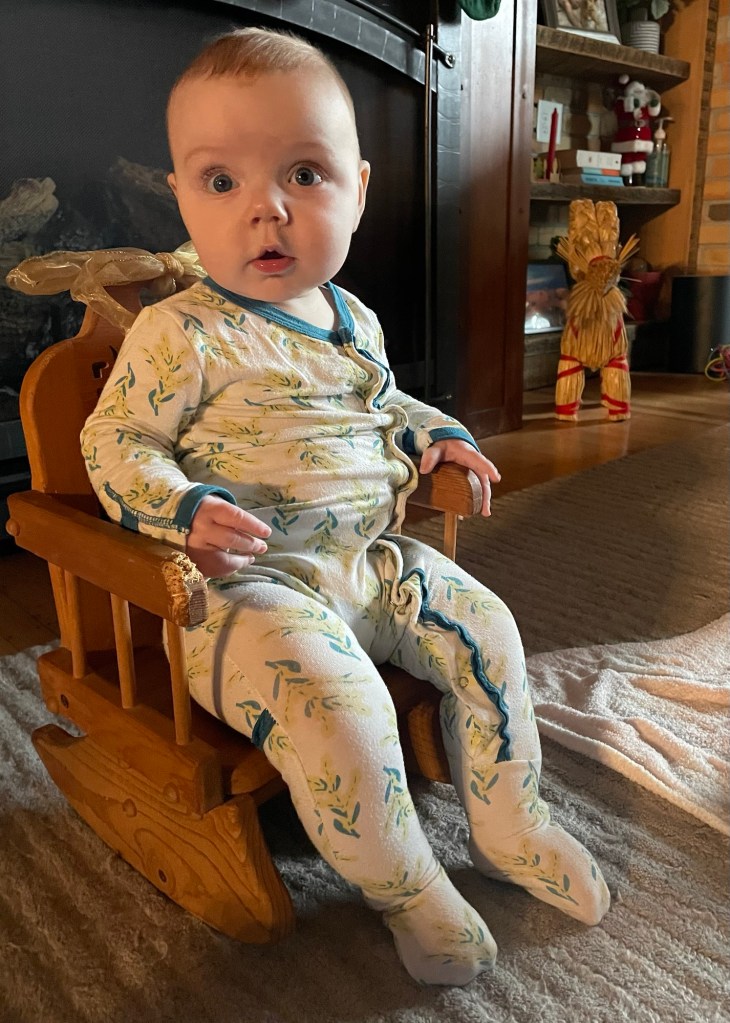
My son, his wife, the baby, and my brother-in-law. Notice the blanket wrapped around the baby. I made that.

I upcycled a youth tee into a baby size dress for our new granddaughter with help from my sister. The following photo on the left is my concept drawing. I did not have much time and was trying to make it easy, so I envisioned the fabric extending out to make a mock sleeve. We had to make a quick trip to Minneapolis before the reunion, so I had cut the shape and got it started, and was able to try it on the baby before too far into the process. I got the width right, but the “sleeves” did not look good. My sister helped me change the design to actual sleeves which made a big difference in the final product. It was not that hard, but she knew what shape to cut the sleeve pieces.

The new baby modeling her upcycled tee shirt dress

I made a giant family tree for the reunion that I was able to display on one large poster board. Included were 125 people from 8 generations down to the youngest family member, our granddaughter born less than a month ago. I tried using some actual family tree software but there did not seem to be a way to print off a paper copy in a format that worked for my purposes. Instead I entered all the names and information in a spreadsheet program, formatted boxes around each person, printed it off in sections, manually drew the lines, and pasted the sections together. My husband described it as a 5th grade project with a grade of B+, but my sister gave me an A+. Personally I was pleased with the result. It was too windy during both of the large group dinners over the weekend to display outside on the easel my sister had loaned us, and instead was propped up inside the cabin against a window so it was visible from outside. I don’t think very many people looked at it or appreciated it.

My sister made a photo memory book using an app called Mixbook that she has used before. I spent quite a bit of time on this project also. Included were vintage photos from 1923, and photos representing all the generations and years until now. It was a ton of work to find and upload appropriate pictures, remove duplicates, narrow down photos to the right number so the book was not too big, add years and captions, and try to represent a century of people and activities. Only one copy was printed because we knew that as everyone looked at it during the reunion, people would find mistakes in identification of people and years. A group photo was taken on Saturday just before the kickoff pizza dinner, but a few people were not there until Sunday. My cousin-in-law, a professional photographer, took a separate photo of the missing people later and will attempt to photoshop them in. It may end up being a “funny” version if she cannot get it to look right. Either way will be great! The draft of the photo book is waiting for corrections and addition of photos from this year, then we will print another copy to keep in the cabin and for whoever wants their own copy.

Unfortunately, we had to put down our 15 1/2 year old 10 pound yorkie-poo dog during the reunion week. She had been declining for months and we were not sure she would make it this long. Lyla was still going on short walks even a week ago. One day shortly before all the guests came she wanted to walk the entire 1/3 of a mile from our house to the cabin. I think the cabin was her happy place too. On a day when we were preparing fresh fish taco dinner at our house for 15 people, Lyla had reached the point when it was time and I took her to the vet that afternoon. It was hard and not ideal timing, but we were grateful that she had a long happy life, and that our daughter visiting from California was able to spend some time with her. We had a small group of family present for a short memorial service in the yard, and then we all went in the house to finish getting ready for the dinner party. It was good to be busy and with people.

On a happier note, we had been thinking about getting a pontoon boat for awhile. My parents never used the lakeshore at their house where we live, so it needs some work before we can safely get people down there and put up a dock. There is currently a very old rickety wooden stairway down a steep wooded bank to get to the undeveloped shoreline. Wayne has contacted several contractors with requests to come and look at it but they all seem to be booked up and not in a hurry for our business. In the meantime, Wayne was watching listings for a used boat that met his criteria for both the boat and the motor. We almost bought one before the reunion. The boat was perfect, but the motor was sketchy. Another one came up for sale later that was the same model boat that had been refurbished, had a good motor, and came as a package with the trailer and boat lift. Meanwhile, my uncle had offered for us to keep it on his shore for the rest of this summer. Wayne bought that boat, after most of the people attending the reunion had already gone home. He put in a make shift dock on my uncles property, using a couple of extra sections the cabin owns.

Our new / used pontoon boat

After the photo was taken, Wayne added another section of wood to bridge the gap between the shore and the beginning of the dock.

Our lake association scheduled a rummage sale day for the Saturday at the end of our family reunion. Families around the lake were encouraged to set up a yard sale and notices were sent out in the area. We decided to participate. There was already a lot going on, but my sister and her daughter and son-in-law were able to help select and move things into the garage before they left. Many things that no one wanted had already been set aside in the basement. Wayne found more things in the garage my dad had bought that had never or barely been used. On the morning of the sale, we put everything out on tables or propped up near the road. We sold a few items and met some neighbors, but more importantly, we got it all out of the house. After the sale was over we packed everything up for either donation or consignment at a shop in Minneapolis.

On Saturday evening, after all close and extended family had left and the rummage sale items were cleared away, Wayne and I had our maiden voyage on the pontoon boat. We enjoyed a leisurely cruise around the perimeter of the lake. I was finally able to relax. We have more company coming in upcoming weeks, so we look forward to taking guests out on the lake. For now I am enjoying the quiet, although I keep looking around for Lyla.

Wonky Towels

Before Christmas I completed a weaving project of jar cover cloths for my daughter’s fermenting projects. I was in a hurry so I could get them in the mail. There was a bit of extra warp yarn left that I might have woven into something, or it could have been considered as waste yarn. It seemed like a lot to throw away, but I was too busy getting ready for the holidays to weave anything with it. I left the extra warp yarn on the loom and secured the loose ends so they would not accidentally get pulled out of the heddles and reed before I could decide what to do with it. It sat there like that until we got back from Arizona in April.

Warp yarn waste from the my last project in December

After we were back home for a few weeks in the spring, I decided to try adding more off white 8/4 cotton warp yarn to the leftover ends from the last project that were still on the loom. The jar covers were narrower than I wanted for a set of kitchen towels, so first I added some warp ends on each side the same length as the leftover warp yarns. I cut 12 lengths of yarn for each side, tied them on the back and threaded them through the reed and heddles. The next thing was to measure out warp yarn for a set of three towels, 206 ends for each yarn end already on the loom, including the 24 ends I had just added. I tried a new place to hang the warping board, in the basement where we have a row of hooks on the wall. Above the hooks are some photos my sister, Betsy, took years ago of a particular spot in the yard during each season.

The warping board in a new spot
Photos taken from the same spot in each season

It was hard to get the warp yarn off the warping board. I must have wound it on too tight, although it did not feel like it at the time. Wrapping too tight probably caused the rounds on the outside edge to be shorter than the rounds on the inside end. There was another mistake I made that was not a disaster, but next time I will remember and do it correctly.

After my warp yarn was measured and ready to go, I started tying on each end to one of the waste ends already on the loom using a weaver’s knot. It was the first time I had tried this process, and my first time making weaver’s knots. It was a slow process.

Tying new warp ends on to the existing waste yarn using a weavers knot
Close up of the ends getting tied together

After all the ends were tied on it looked like a very big mess.

All the new ends tied on

I carefully pulled each knot through the reed and heddles to the back, and then straightened it out. The following photo taken from the back looks much less scary.

I wove the first towel with the same zig zag pattern as the red jar cover I made in December, using the same cotton/linen blend yarn in yellow (Duet cotton/linen blend from Gist). I used a T pin to keep track of the beginning of a pattern repeat.

The warp on the left side was quite a bit tighter than on the right side. There are reasons why this can happen, but I was not sure what caused the problem in this case. After completing the hem stitch at the end of the yellow towel I cut off the ends and re-tied the warp yarns on the front for the second towel, so I could attempt to fix the tension.

For the second towel I used blue 8/4 cotton for the weft yarn, with a pattern from the book “The Handweaver’s Pattern Directory” by Anne Dixon. It turned out to be the same pattern I tried for one of the jar covers I made earlier, in the same color. The other time I missed one row of the pattern so it did not turn out right.

Blue towel using pattern correctly from the book

The following photos show the incorrect version of the pattern on the left, and the correct version on the right.

The same thing happened with the tension on the blue towel. The left side got tighter than the right side. One thing that can cause this is if the loom itself is crooked or unlevel. I checked and did not find any evidence of these problems. I decided to finish off the second towel earlier than I had planned so I could try and fix the tension problem again, before the third towel.

After completing the hem stitch, I rolled the weaving forward as far as I could until the knots in the warp yarns got to the heddles in the back. Then I re-wound it back on to the back beam, hoping the tension would be more even between the left and right side. It wasn’t.

Back of the loom with the warp yarns rolled forward until the knots got to the heddles.

The tension was still tighter on the left, but I did not know what else to do, so I went ahead with the third and last towel for this unfortunate warp. I reminded myself again that these are just towels. They still work if they are crooked or wonky.

For the third towel I found another pattern in the pattern directory book and started weaving in green 8/4 cotton. It has the appearance of stripes, but only uses one color in the warp.

Green towels using a pattern from my pattern book

Following is a photo of the end of the second blue towel and the beginning of the third green towel, with some spacing rows in white. There is a dumb mistake on the hem stitching at the beginning of the green towel.

I made a dumb mistake doing the hem stitch on the green towel

At the beginning of the green towel I did the hem stitch backwards! AAHHHHH! I have had trouble with hem stitch in the past but now I KNOW how to do it. I just spaced out and did it backwards. I did not notice until I removed the towels from the loom. I picked out the stitches of the hem stitch and redid it. The next photo shows the corrected version.


End of blue towel, beginning of green towel, with hem stitch redone

After I removed the towels from the loom I also noticed a couple of spots near the end of the green towel, in the same row, where a weft row skipped some warp yarns that it was supposed to go under. At the time I was weaving those rows the knots in the warp yarn were in between the heddles and the reed (see the next photo). While weaving this last couple of inches I had to fiddle with the warp yarns to make sure the knots were not catching on to each other so that all the right warp yarns were in the UP or DOWN position. I am surprised this only happened on that one row. After the fact I used a piece of scrap green yarn and wove it through by hand the correct way, but also going over the big loop sticking up to make sure it stayed down. It looks bad but I wanted to make sure those big loops did not catch on anything later, when using the towel. The next photo shows the knots in between the heddles and the reed, where they kept catching on each other. Ideally my warp yarn would have been longer so that the knots would have stayed on the back of the heddles. It would have been longer except that I cut the warp yarns and retied them on after the first towel.

Knots where I added on to the warp yarn advanced to the front, between the heddles and reed

Following is a photo showing the bad row with the two big loops that should have been under some white warp yarns.

One row of weaving where the weft yarn did not go under all the correct warp yarns

The problem with the warp yarn tension with one side tighter than the other caused each towel to be longer on one side, ranging from 1/2 inch to one inch. I will be the only one using them, and so probably no one else will notice.

This project had multiple problems. Adding more warp yarns on each side, and then adding on to the leftover warp yarns from before contributed to or directly caused my tension problems, and made it hard to weave the last few inches where the knots were catching on each other. The fact that I had a bit less waste yarn at the end of this set of towels was not worth the extra hassle and problems that resulted. Not sure if I would do that again, certainly not when using this relatively inexpensive yarn. I am not complaining. Everything is a learning experience and I got some functional towels out of it that did not look too bad.

Despite the wonky shape, I love this yellow zig zag pattern towel. The cotton/linen yarn gives a really nice feel and weight.

The yellow towel with cotton/linen weft yarn is my favorite

The blue towel is fine but not my favorite.

The blue towel is fine but not my favorite

Something happened with the green towel where the last third of the rows look different. You can see in the photo below how there is more white showing on the left side of the photo, which is the bottom or end of the towel. I swear I followed the pattern exactly the same. Possibly I was not packing the rows as tight to compensate for the warps yarns on one side being too tight.

The green towel looks different on one end

I can use these crooked towels and they provided me with some learning experiences, but it was a relief to be done with them. I hope my next project does not have as many learning experiences!

Three crooked towels