Nome Schoolhouse

I recently went on an overnight stay at the Nome Schoolhouse, a fiber arts retreat center and fiber mill located in Nome, North Dakota. Everything about this place, along with how it came to be, is amazing.

Two gals with fiber related businesses decided to combine resources. Chris had a fiber mill in her barn. Teresa taught needle felting, and sold kits with supplies and detailed instructions. They used all their money and raised more to purchase an old schoolhouse in Nome, North Dakota. The school building had been abandoned after being in use from 1916 until 1970.

Chris and Teresa undertook an ambitious project of restoring and expanding the building, transforming it into a fiber arts center with space for classes, retreats, events, overnight stays, meals, and a gift shop. Chris’s fiber mill equipment was moved to the basement of the school building, with the needle felting kit materials. They are producing products for sale using every scrap of fleece from Teresa’s sheep, plus wool purchased from other sources. Following is a photo of the Nome Schoolhouse today, from the cover of one of their brochures.

The Nome Schoolhouse

My friend Mary and I finally found an opportunity when we were both available to visit the Nome Schoolhouse. We signed up for a Sunday “Maker’s Afternoon” that was followed by dinner, an overnight stay in one of the hotel rooms on site, breakfast and lunch the next day, and a mill tour.

Mary drove two hours to get from her house to my house in west central Minnesota. Together we drove another two hours west and a bit north to get to Nome, in the middle of nowhere North Dakota. It was worth it.

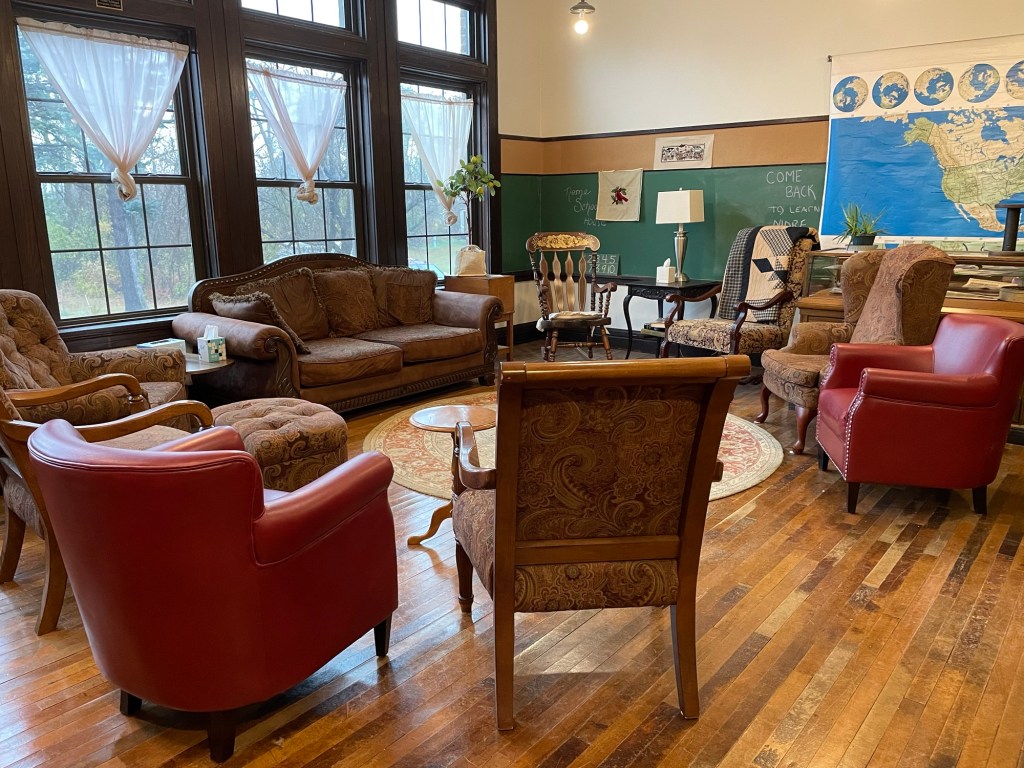
Communication from the Nome Schoolhouse staff about our visit was great, with messages to confirm our plans and let us know where to go when we got there. Upon arriving, we put our project supplies in the History Room that was up one level from the main entrance, and then found our hotel room up another level and down a hall. The next photo is the History Room, one of the original classrooms that is now used as a gathering room for people to hang out and work on projects. It looks sooo inviting, and so like an old school room. We sat in here during the first afternoon and evening, when we were not walking around gawking at everything and scoping out other rooms in the building.

The History Room at the Nome Schoolhouse

Someone donated a giant 12 harness floor loom. My friend Torri, experienced weaver and proprietor of Tangles to Treasures in Fergus Falls, was recruited to assemble the wood parts into a working loom. Torri’s daughter helped her warp a complicated project which is now on the loom waiting for someone to weave some rows. There is a large rigid heddle loom on a stand in front of the big floor loom, along with a smaller tapestry loom.

Looms ready for weaving in the History Room

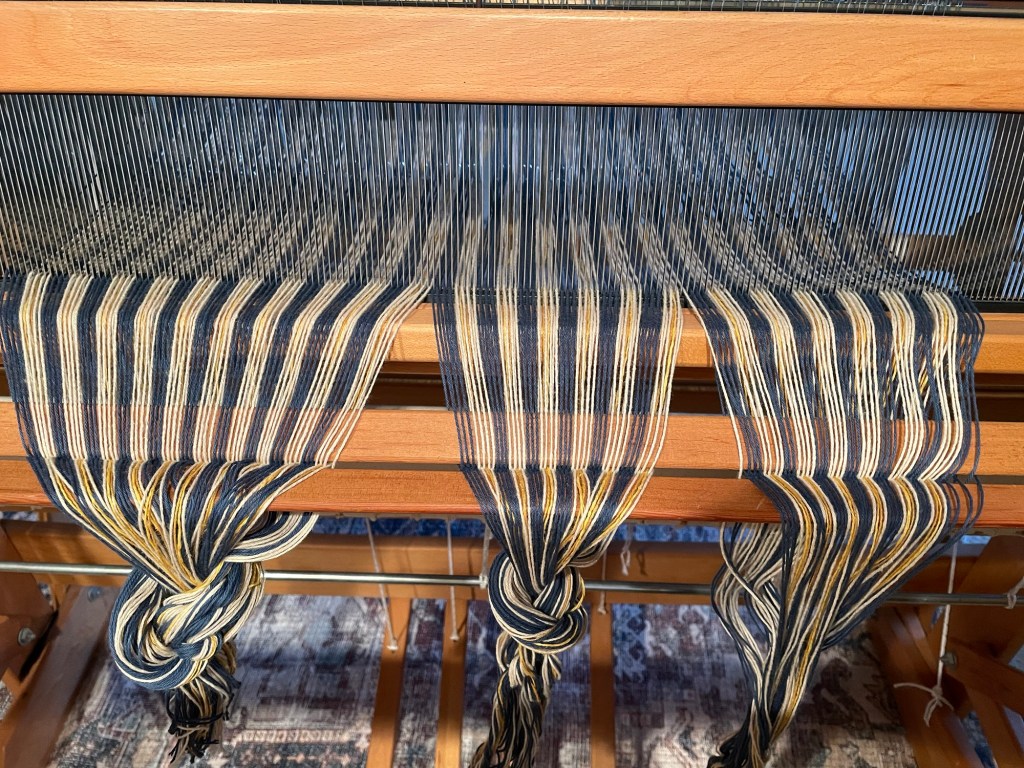
Following is a photo of the project Torri warped on the big loom.

The next photo was taken from the third floor landing, looking down to the main entrance.

Everywhere you look there is art on display, along with antiques and items that had once been in the school or are related to the school. When word got out the Chris and Teresa were restoring the building, people returned many items that had been removed from the building or belonged to former students. Some items on display have been in the building all along, like old textbooks.

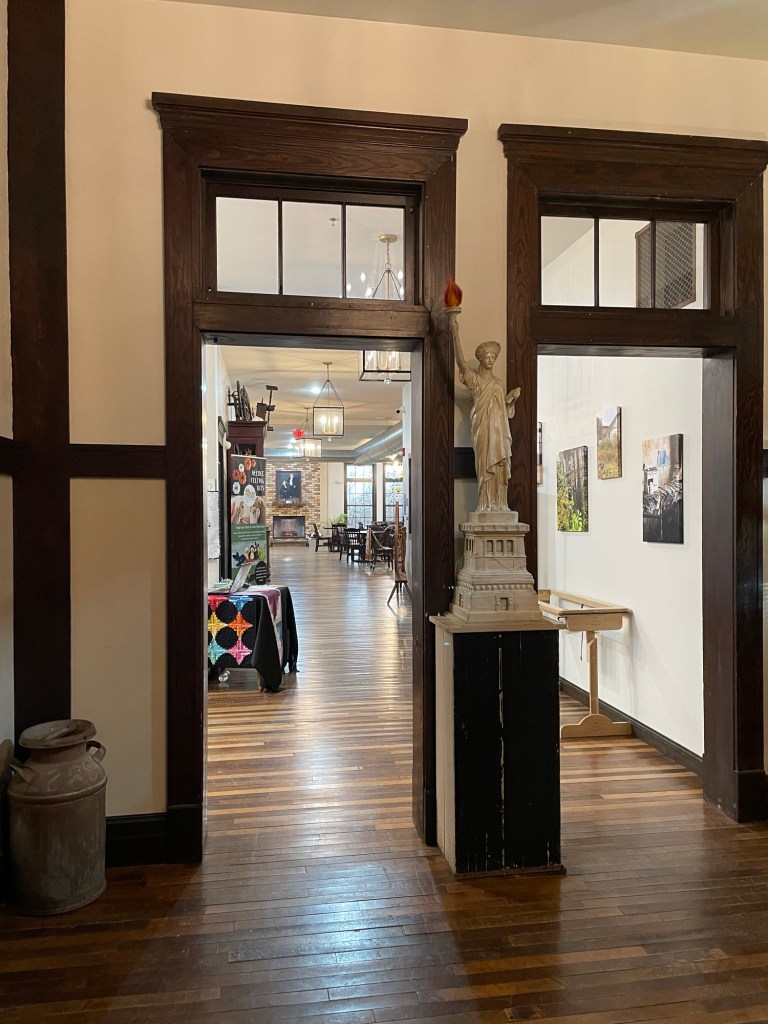
Following is a photo showing a replica of the Statue of Liberty that was in the building when it was used as a school. You can see the dining room down the hall at the back of the building.

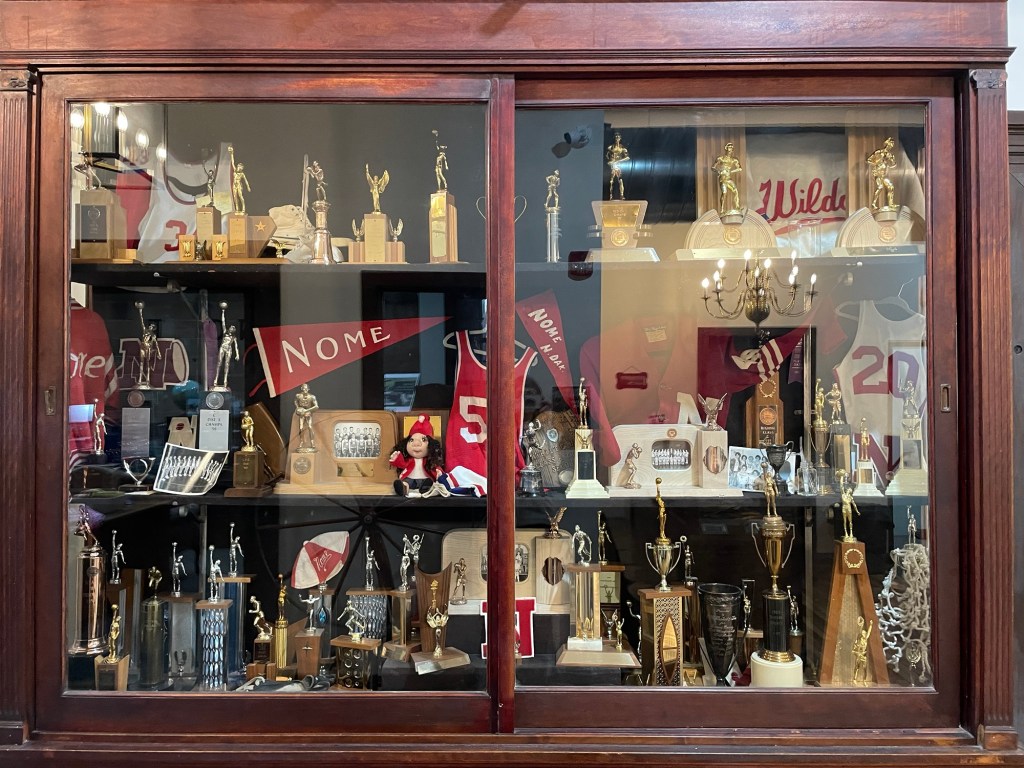
The trophy case in the hall is filled with items that people gave back to Chris and Teresa after they found out about the building restoration.

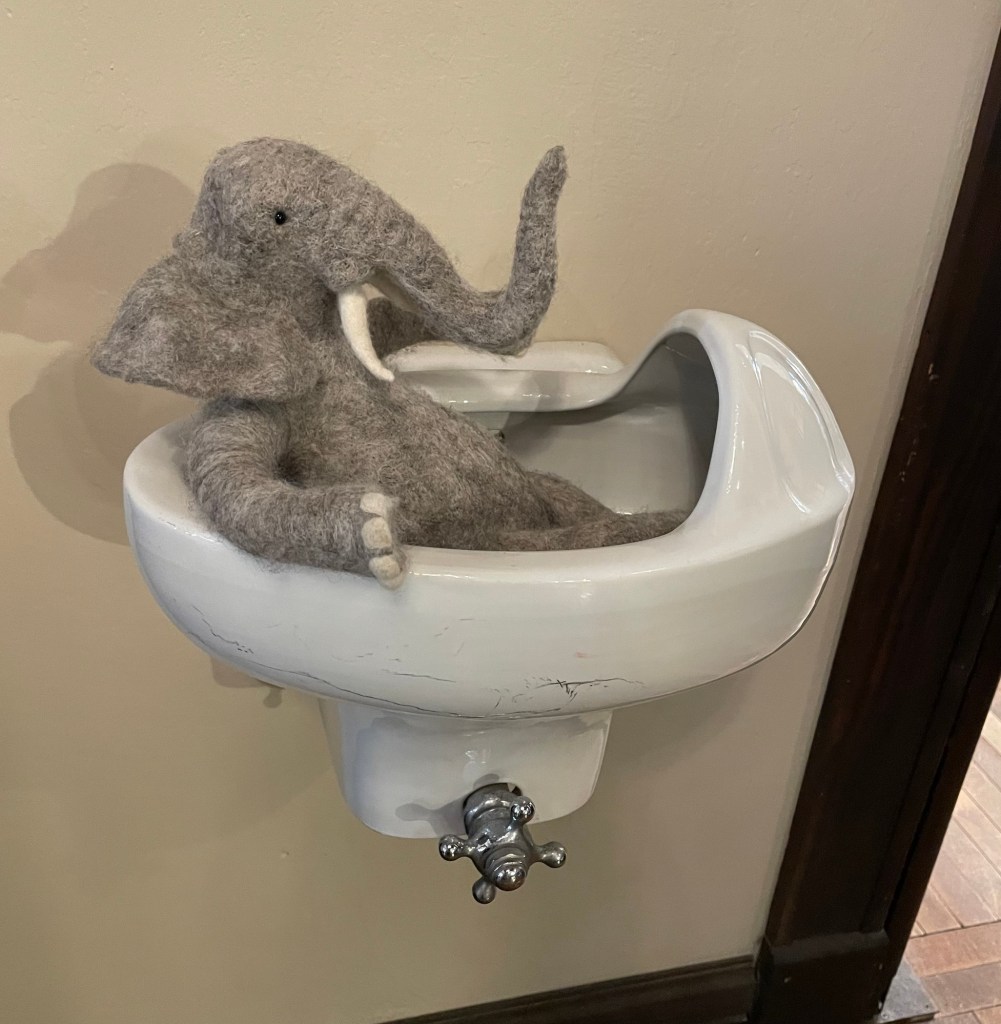
A needle felted elephant lives in a non-functional drinking fountain in the hall.

I liked the fiber art representation of the building that has an old school desktop for a frame.

The view out the back of the building from the dining room was beautiful.

In the hallway where the hotel rooms are located there was a small lounge with a couple of easy chairs, many books, and a coffee station.

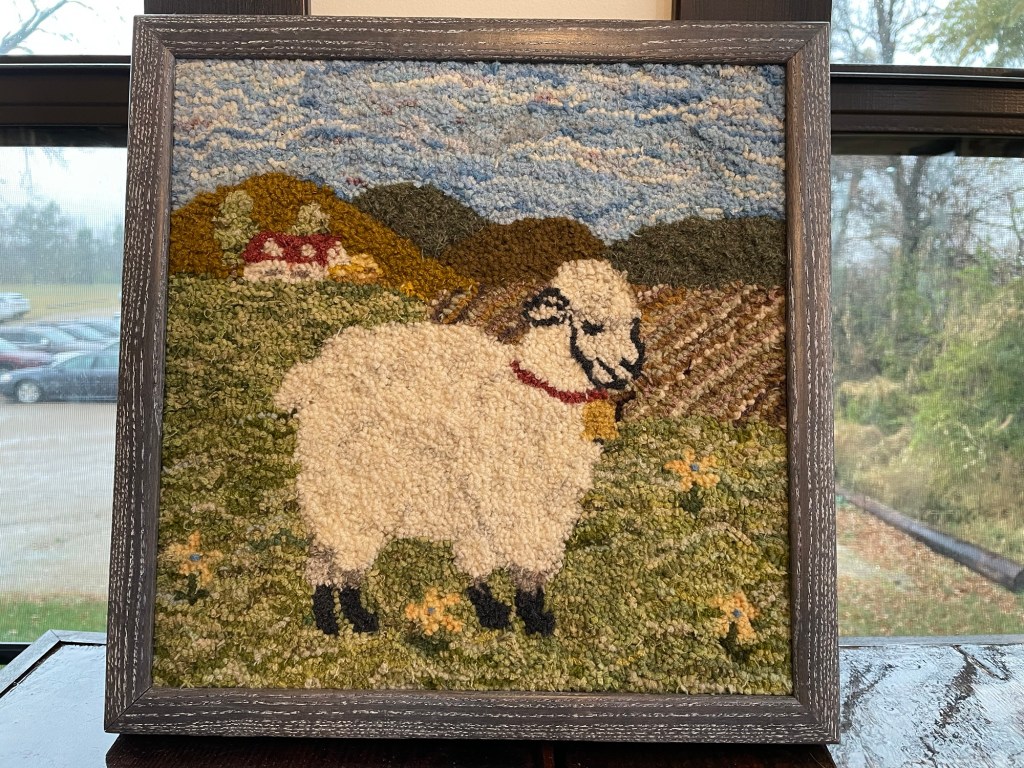
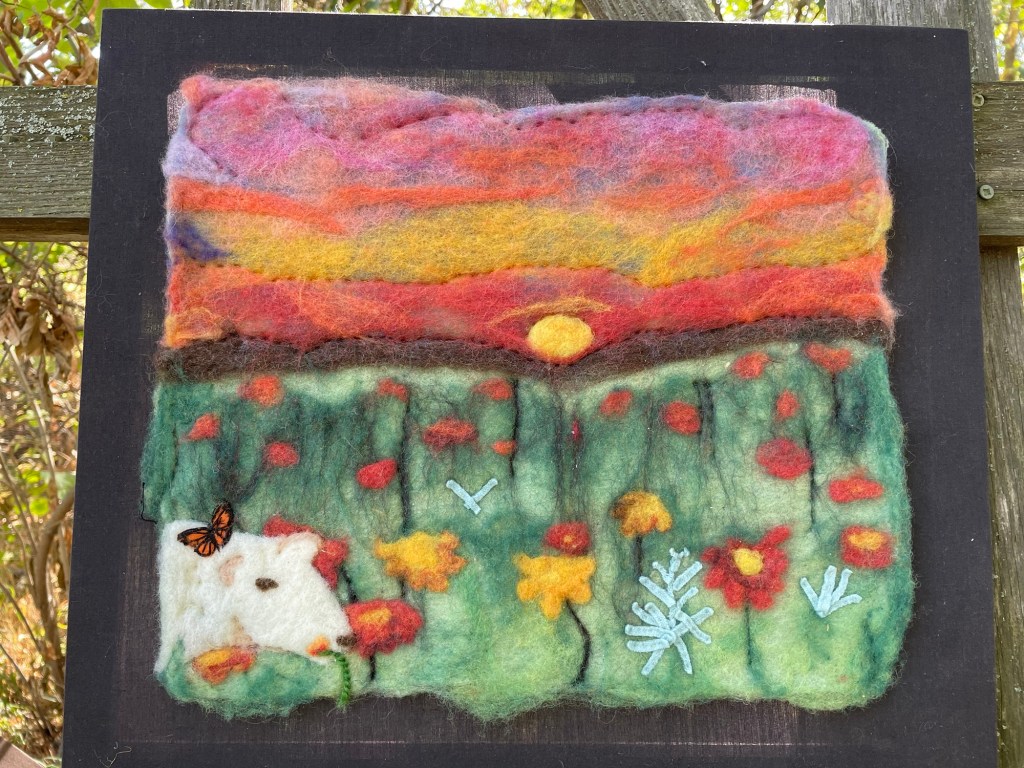
Following is another fiber art scene on display, of a sheep of course.

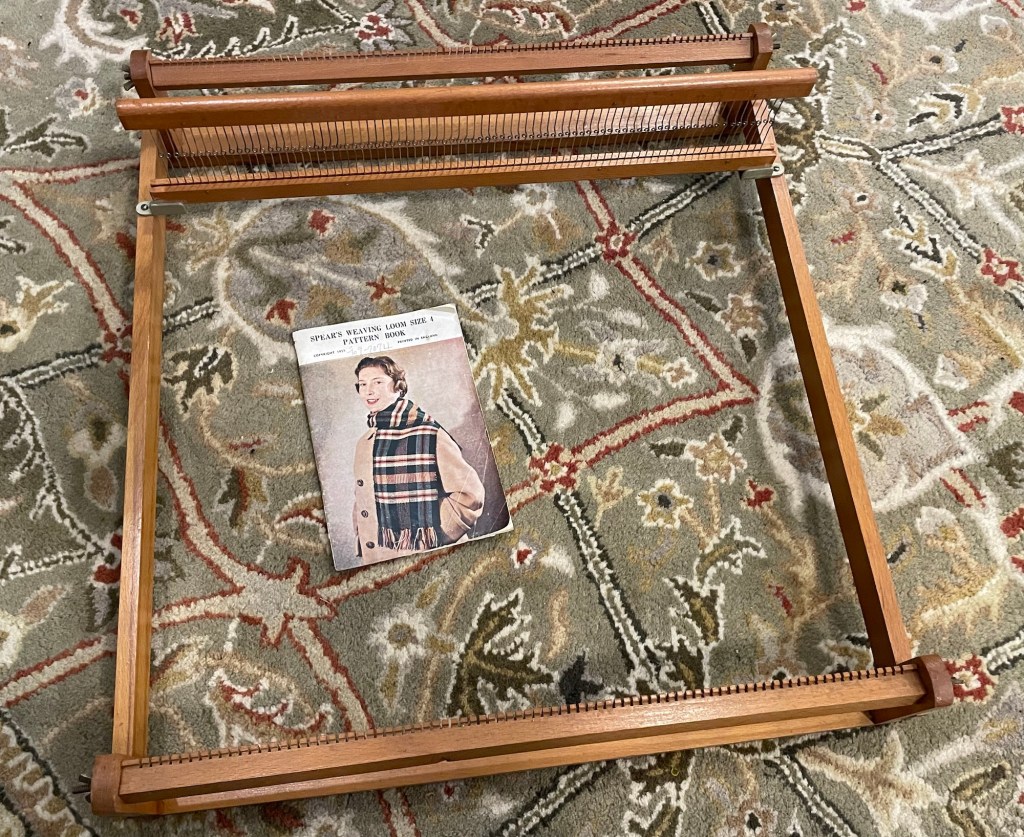
Mary brought a needle felting project, and a vintage loom that she had received as a child but never used. The loom was manufactured by Spear’s in England; you can find these for sale online.

Following is the Spear’s loom assembled, with the original instruction book.

The loom is a version of a modern rigid heddle style loom.

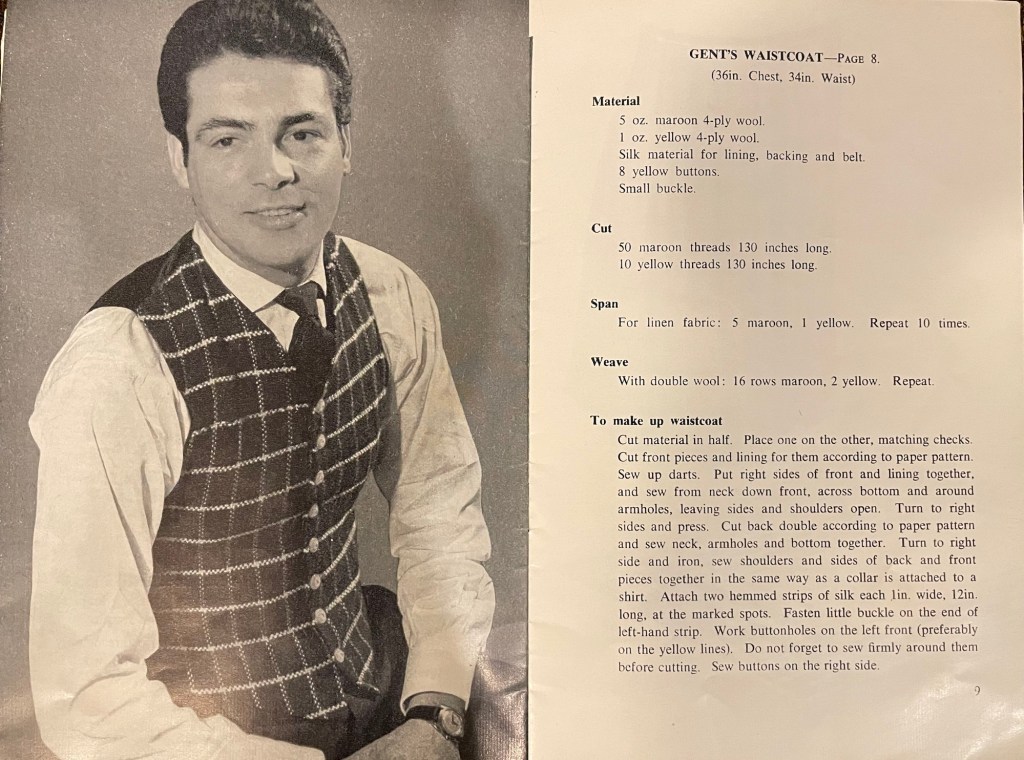
In case you want to make a “waistcoat”, a pattern is included in the instruction book.

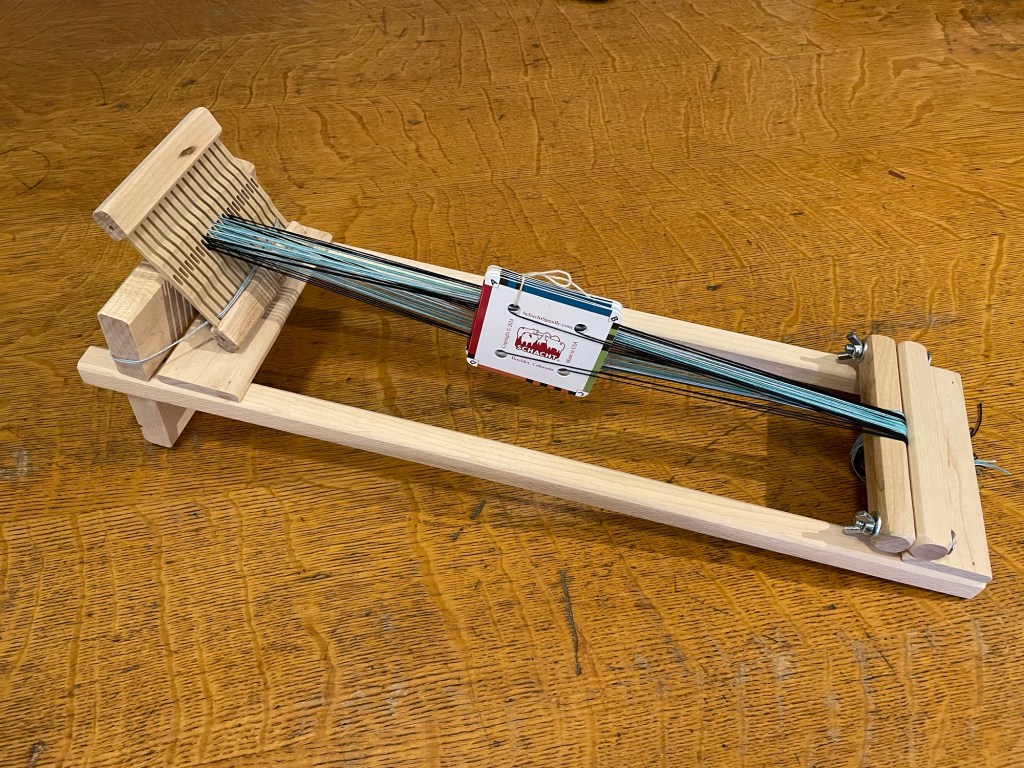
I brought my spinning wheel, a knitting project, and a newly acquired four inch wide loom. I bought the narrow loom to use for tablet weaving, but it is a rigid heddle loom that came with a reed. I wanted to make another pair of shoelaces using weaving cards. Normally you would be either rigid heddle weaving with the small reed provided OR weaving with cards. After threading my yarn ends through the tablet weaving cards, I also threaded them through the reed just to keep them orderly.

Narrow loom to hold tablet weaving cards in place and yarn in order

I used some yarn that I thought was very similar to the yarn I used last spring for shoelaces (you can read about that project here), but it turned out to be a bit thicker and have a different texture. I am not sure I like it. I did not get very far, made a lot of mistakes, and probably won’t finish the project until we get to Arizona this coming winter. Or maybe I will start over with different yarn. I am going to bring this small loom to Arizona and until then I have other things I will be doing.

An attempt at tablet weaving

The giftshop has yarn produced in the mill on site, needle felting kits, baskets, weaving and spinning equipment and supplies, Nome Schoolhouse merchandise, and various other fiber related products for sale.

In the giftshop

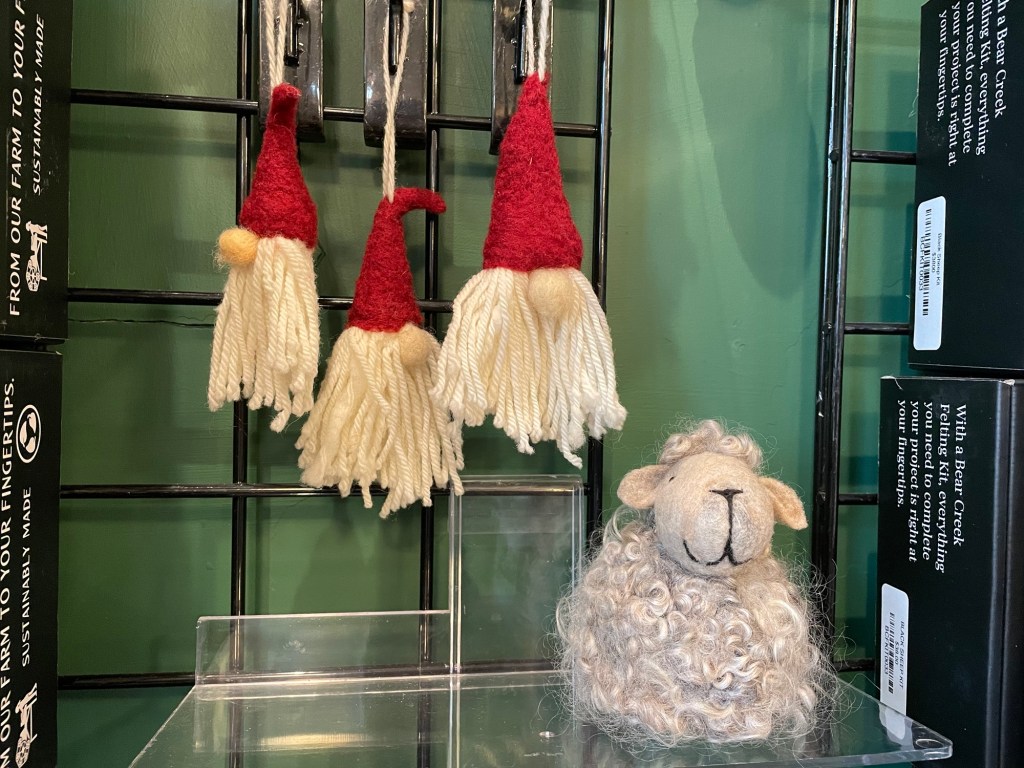
Following is a photo of crocheted gnomes for sale in the gift shop, along with some caps and dryer balls. The woman who makes the gnomes happened to be staying at the Nome Schoolhouse with her mother the same two days my friend and I were there. They had come from somewhere farther west in North Dakota for a quilt show that was going on in the gym. While we were hanging out in the History Room after dinner, they joined us and worked on their projects, including crocheting more gnomes.

Gnomes, caps and dryer balls for sale

There are also kits for needle felted gnomes (and other cute things). Gnomes are very big right now!

I loved looking at all the display cases with Nome Schoolhouse related memorabilia and fiber related art.

We paid extra for a tour of the mill in the basement. Chris previously had the mill equipment in her barn near Kindred, ND, about 40 miles east, before being relocated to the Nome Schoolhouse. The first stop of the tour was the skirting table. After fleeces are washed (by hand in a big sink), parts of fleeces that are unsuitable for batts and yarn are removed. However noting that nothing is thrown away. Even the dirty bad parts that are removed from a fleece are used for something.

Teresa and Mary at the skirting table

Behind the skirting table is an area used for dyeing. Following is a photo of custom blended dyes stored in jars.

I had seen the mill when it was in Teresa’s barn years ago. The way that came about was that I had an entire raw fleece that needed to be washed before I could do anything with it. Having washed smaller amounts of fleece with mixed success, I knew I did not want to wash an entire fleece. I saw on the website for Chris’s mill at that time that washing a fleece was one of the services her business offered. My husband and I had a fun outing driving to her farm and delivering my fleece to be washed. Chris showed us a few of her fiber animals, and the mill equipment.

Chris told Mary and me how she bought the vintage mill equipment in 2009 from a guy in England, and had it shipped to North Dakota. She hired the previous owner to come and stay at her house for 3 weeks to show her how to operate the machines. After that he went back home to England, and any questions or issues had to be handled by phone (before facetime or zoom was an option). Fortunately, Chris’s husband is good with machines.

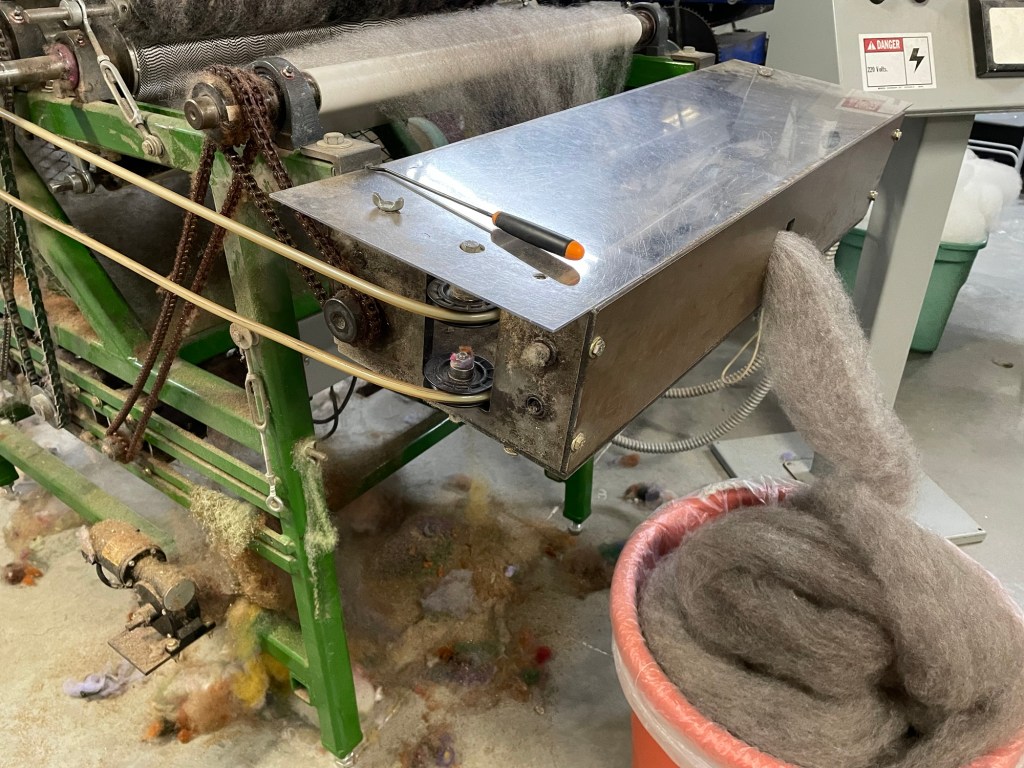
Following is a photo of the picker machine that is used to separate and fluff out locks of wool in preparation for carding. It is also used for blending different types of fiber.

Fleece entering the picker machine

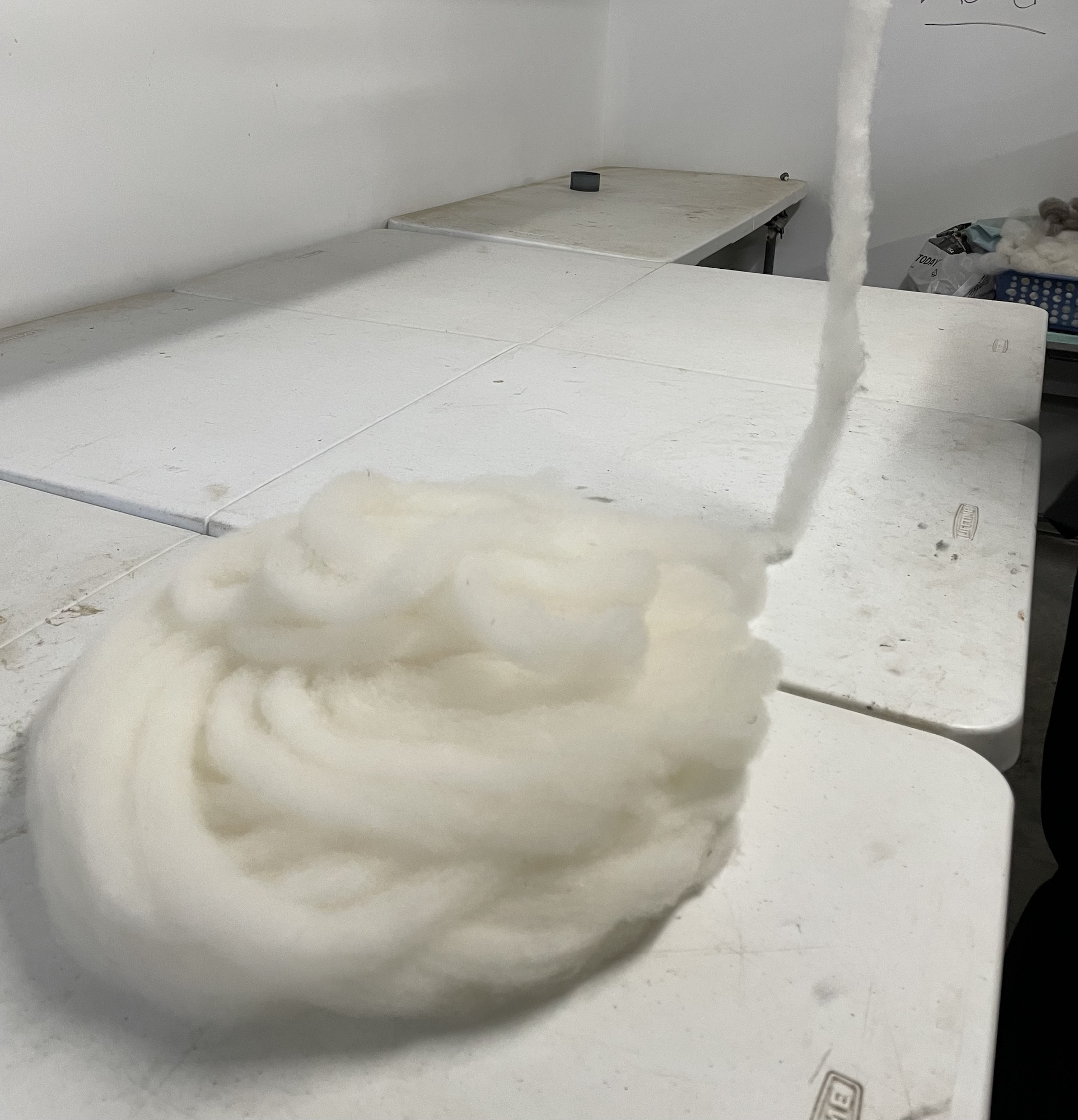
The next photo shows fleece coming out the other end of the picker, ready for carding.

Fleece coming out of the picker machine

I have a hand crank drum carder for making batts. I like using the larger electric drum carder at Fiber Day because it can process so much more in a shorter amount of time. Chris has an enormous carding machine on steroids, as seen in the following photos.

Fleece being fed into the giant drum carder
Drum carder from the other side
Roving coming out of the drum carder

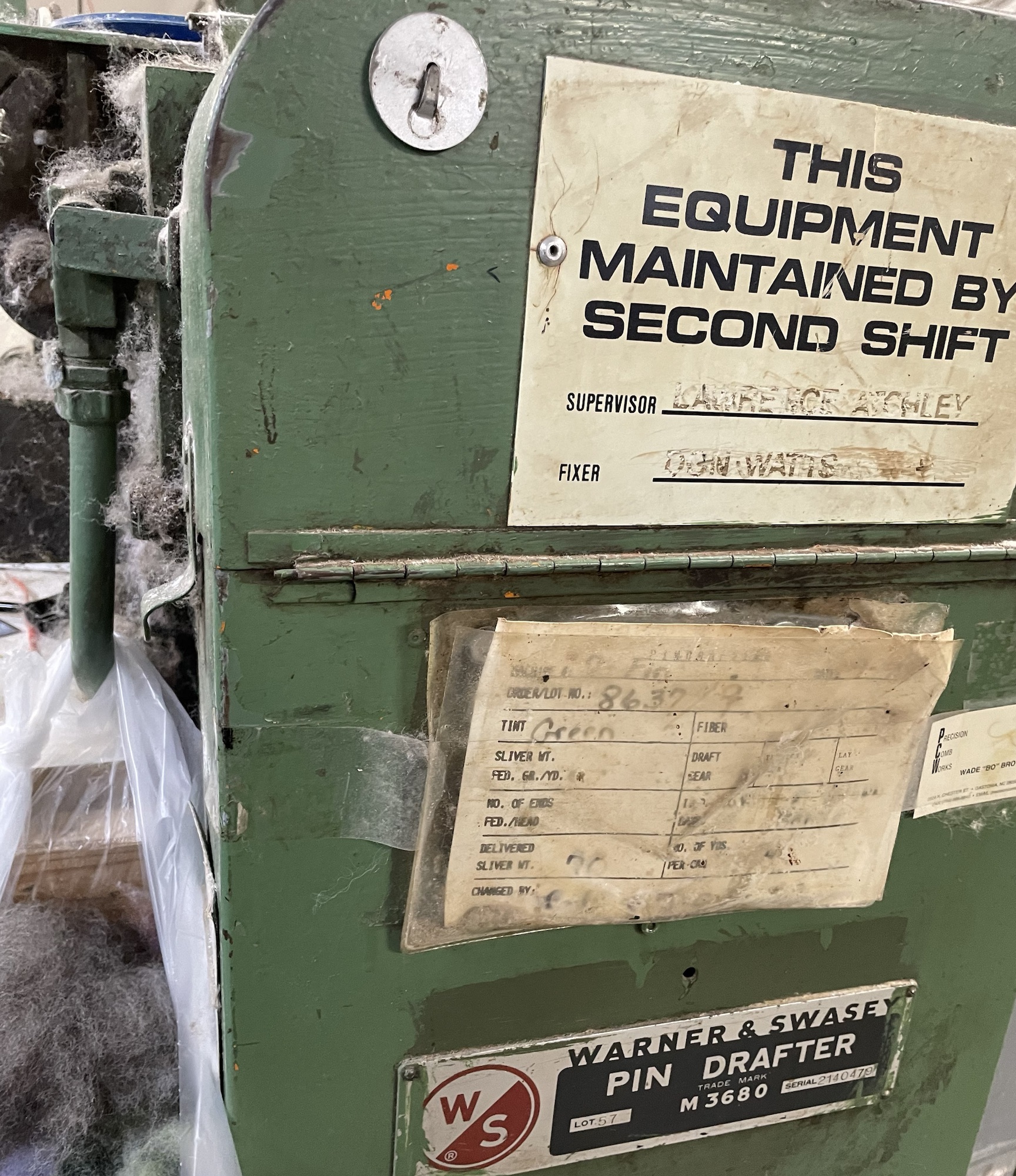
Roving from the drum carder is sent through the pin drafter machine to make it into narrower strips for spinning into yarn.

The next photo is the “skeiner” machine that processes strips from the pin drafter into a single ply yarn.

The skeiner machine twists a singles yarn

The last step is plying together strands of singles yarn into a multiple ply yarn. Following is a video showing the plyer machine plying together two strands and winding it onto a cone.

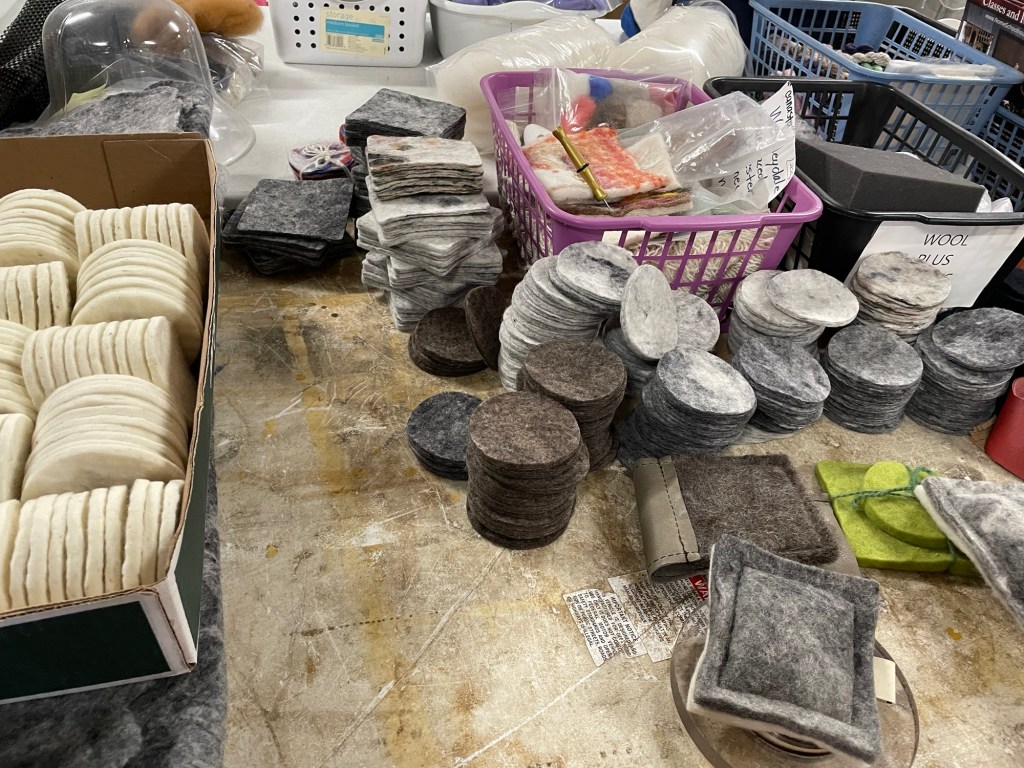
There is a another machine to make felt mats with scraps of wool that are not able to be used for needle felting or spun into yarn.

Squares of wool felt are layered and sewn together to make pillows used as a work surface for needle felting.

Smaller pieces of wool felt are cut up into coasters and cupholder liners.

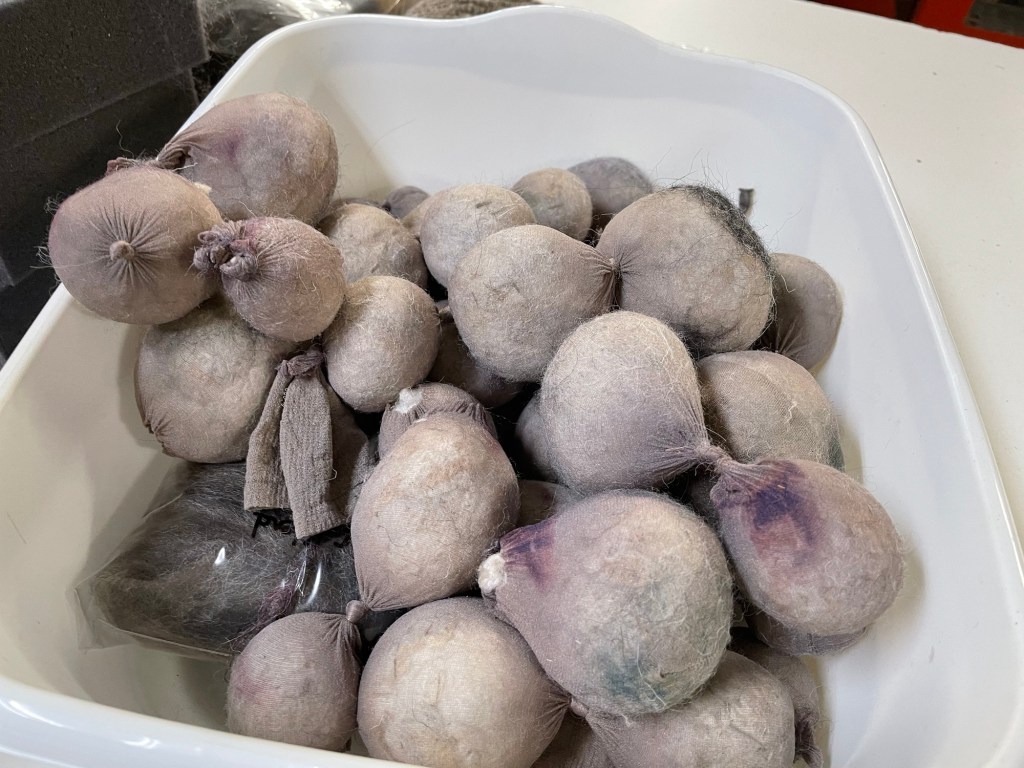
Dryer balls are made out of scraps of wool. While in process they are tied inside old nylon stockings.

Dryer balls being made
Completed dryer balls

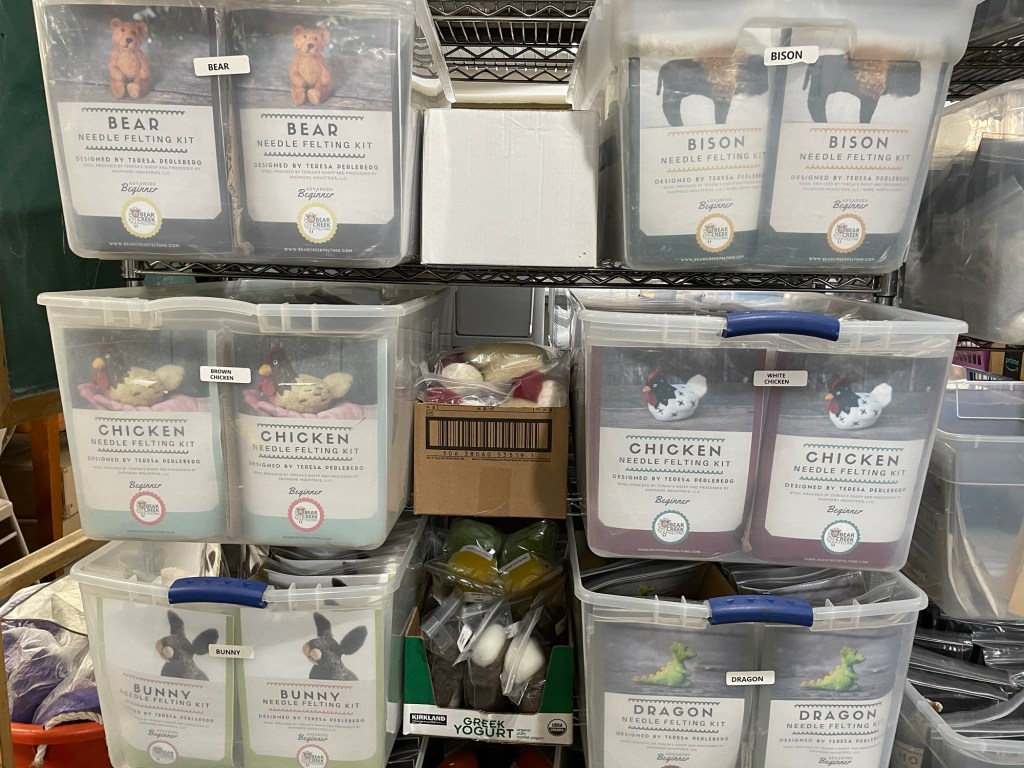
Needle felting kits are packaged in plastic bags for efficient shipping, and also boxes with necessary supplies for the in-person store.

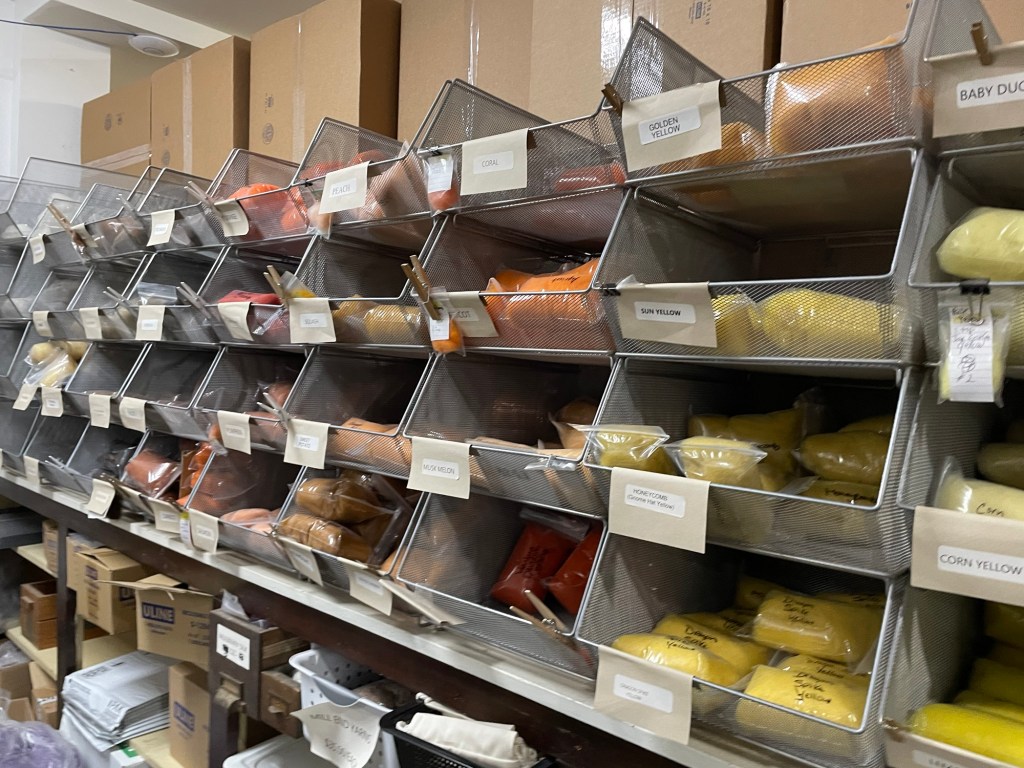
Following is a photo of little bags of fiber for felting in many colors.

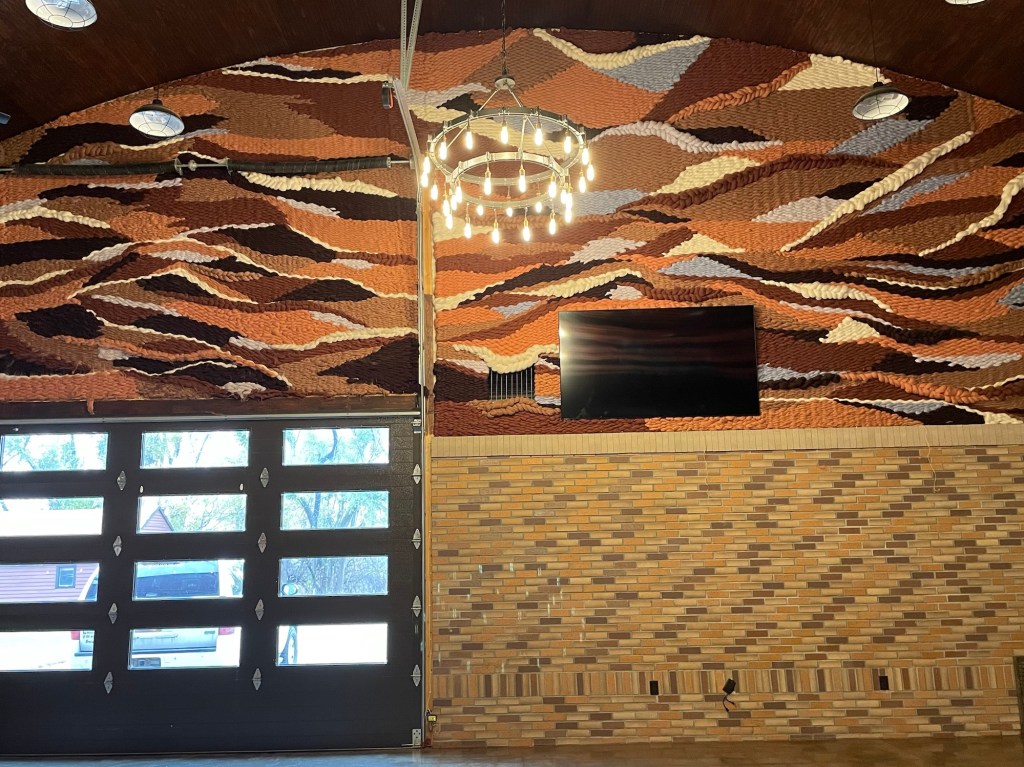
After the mill tour we checked out the gymnasium. I did not get a good picture, but following is one end that has a huge weaving covering the top half of the wall. This space has a commercial kitchen and bar area, and is available to rent for events.

There were several photo books with images from specific years of the school house renovation. The next photo from the cover of one of the books shows what the building looked like when it was purchased, with overgrown trees and a cinderblock entryway built on to the front.

Here is another one with Chris and Teresa in front of the building before renovation.

Mary and I were sad when our visit was over and we had to leave (and go back to reality). We look forward to coming back another time with more people.

Tied on Towels

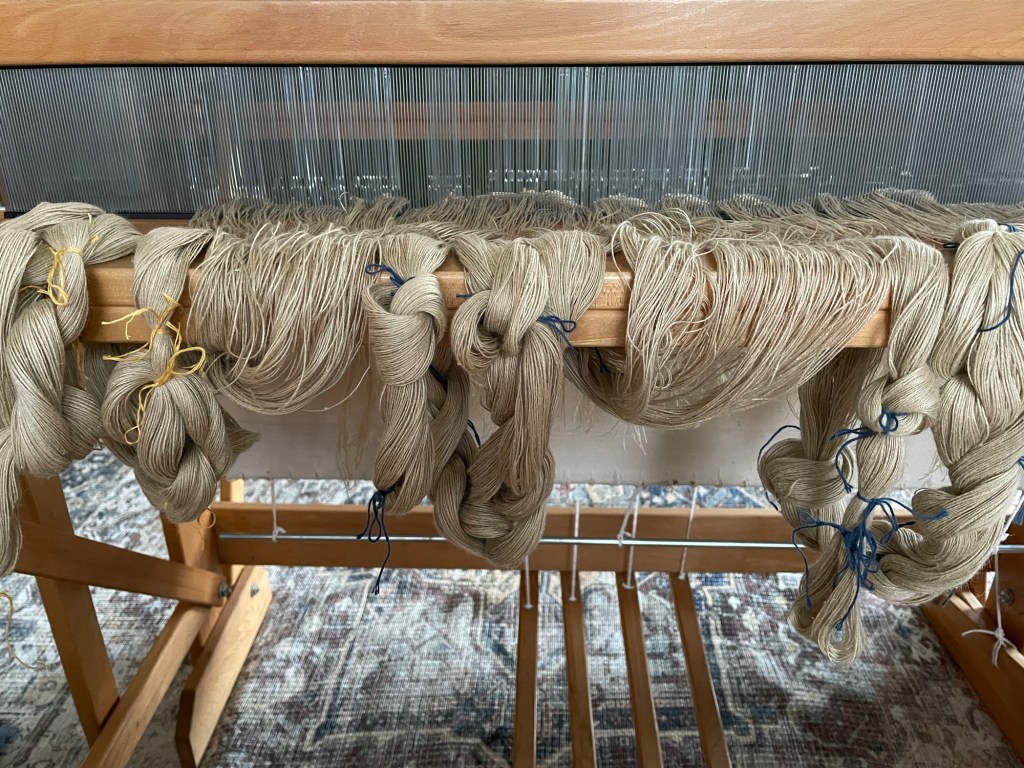
In the spring of 2024 after we got back from Arizona, I wove a set of dish towels on my floor loom (blog post with photos is here). When I was finished there was a lot of warp yarn left that I did not want to waste. I tied the yarn ends loosely so they would not get accidentally pulled out of the reed before I decided what to do with it. It sat there like that with many people and little children and dogs brushing past all summer.

Waste warp yarn left from pervious project

In September, I finally had time to work on another floor loom project where I tied the warp yarn on to the ends left from the other project. I could have just pulled all the extra warp yarn off and started over, but it seemed wasteful. Tying ends on, rather than starting over, means you avoid the time consuming process of threading all the 317 ends through the reed and the heddles, assuming you want to use the same pattern. Also, the new project will have less warp waste. I still had to tie each new end on to an old end, and work them through the slots in the reed and the holes in the heddles to the other side.

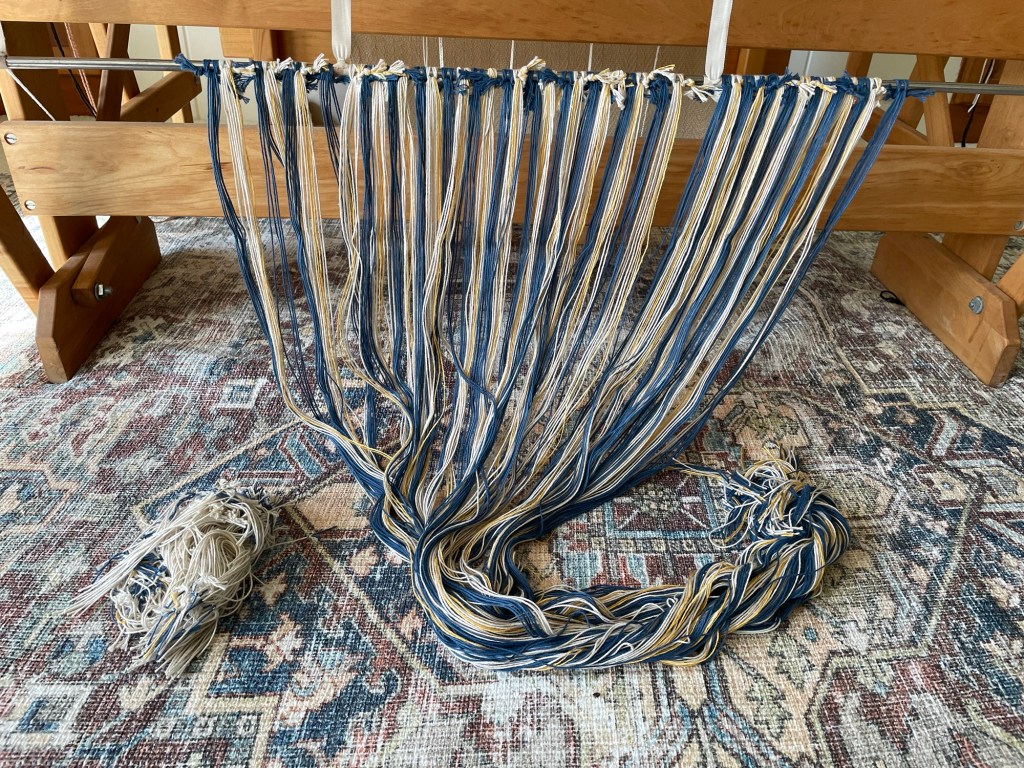
The previous project had warp yarn with stripes of blue and off white cotton, and a few yellow stripes of cotton/linen blend yarn. The new project had warp yarn all the same off white 8/4 cotton. I was interested in seeing how the same pattern would look with only one color warp yarn, and only one color weft yarn. Following is a photo with the new warp yarn measured out and waiting to get tied on to the previous warp yarn ends.

New warp yarn measured and ready to start tying on

This post has a lot of weaving details, so I expect some (most?) readers will skip over the text. Scroll to the end if you want to see the final completed towels without all the steps to get there.

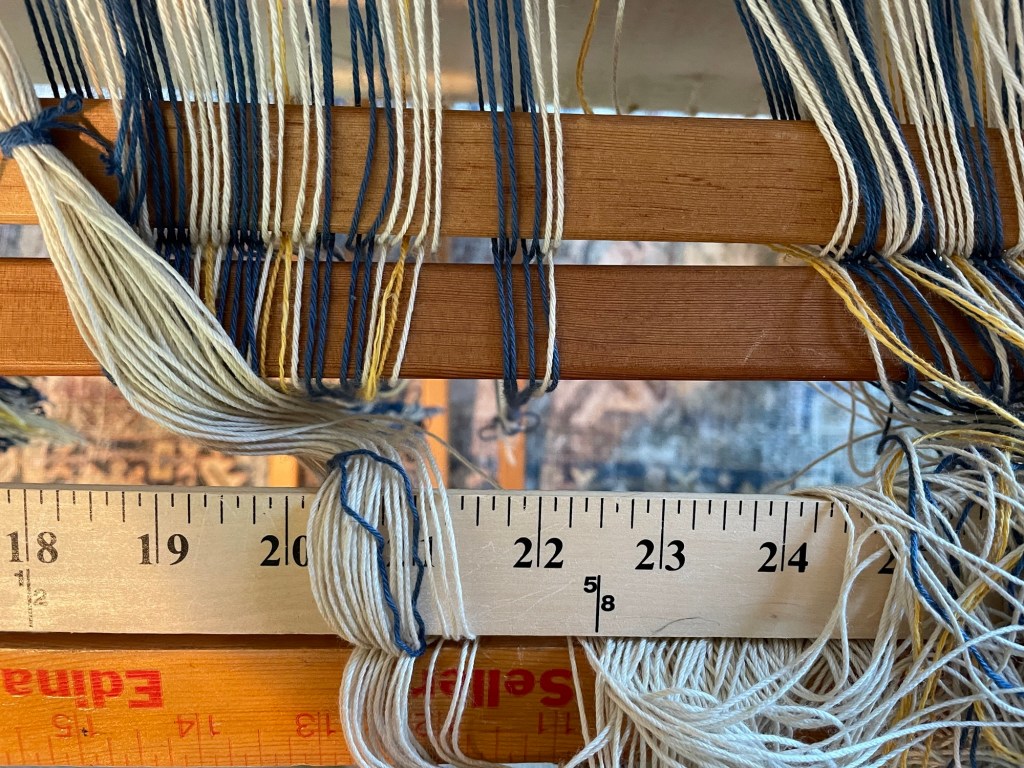
I researched ideas for tying the new warp ends on successfully. The most important tip I found was to use two sets of lease sticks to preserve the “cross” in the existing warp ends and in the new warp ends, since I had two ends per slot in the reed. I only have one set of lease sticks, so I used two yardsticks for the second set. The next photo shows the two sets of lease sticks with some of the ends tied on.

Tying on of ends in process, using two sets of lease sticks

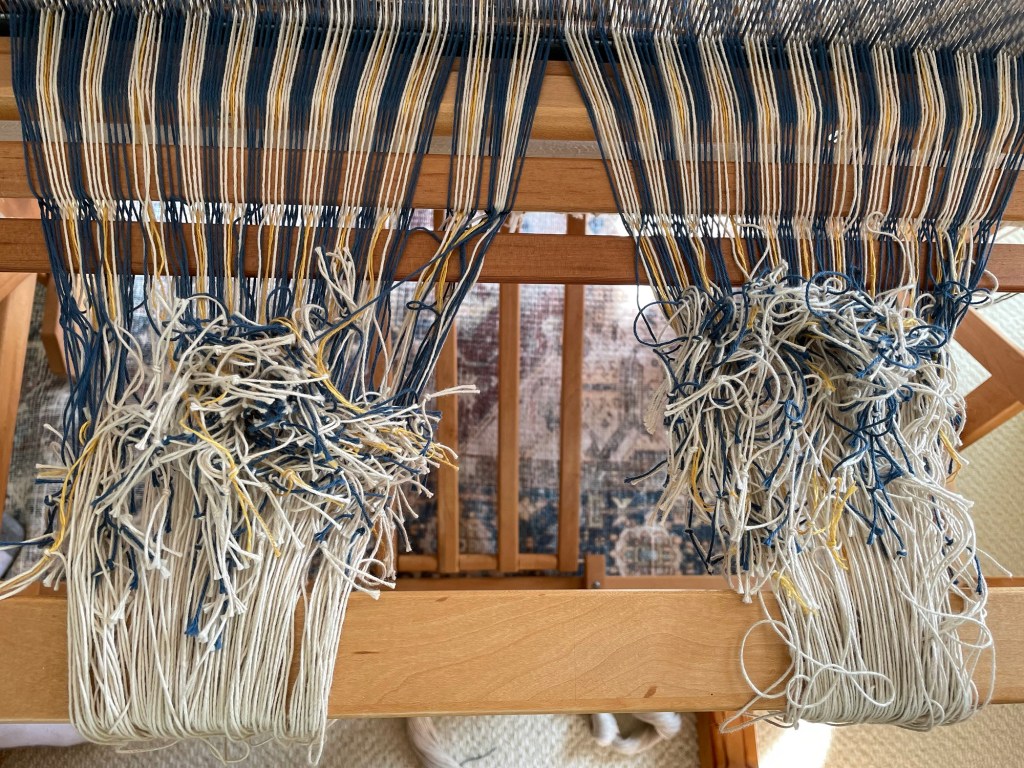
After all the ends were tied on and I removed the yardstick lease sticks, it looked like a mess.

All yarns ends tied on

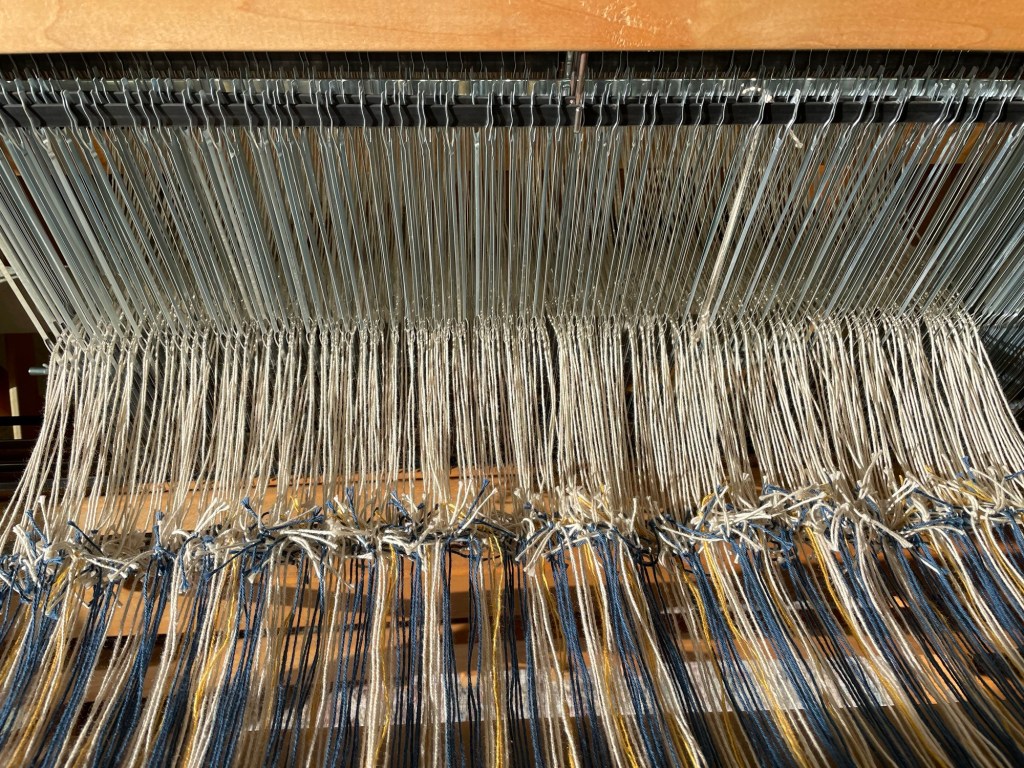
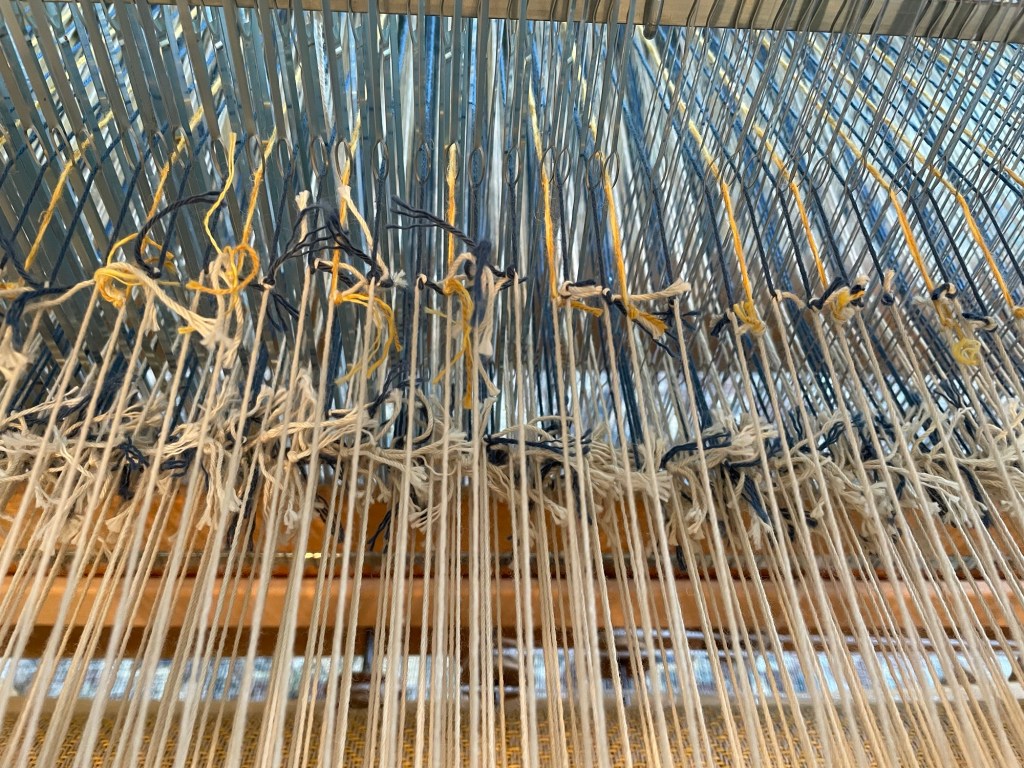
It was tricky to pull all the knots where the new ends were tied on through the slots in the reed and the holes in the heddles. The following photo shows the back of the loom after all the knots were on the other side, and I was ready to wind the warp yarn on to the back beam.

Knots pulled through to the back of the loom

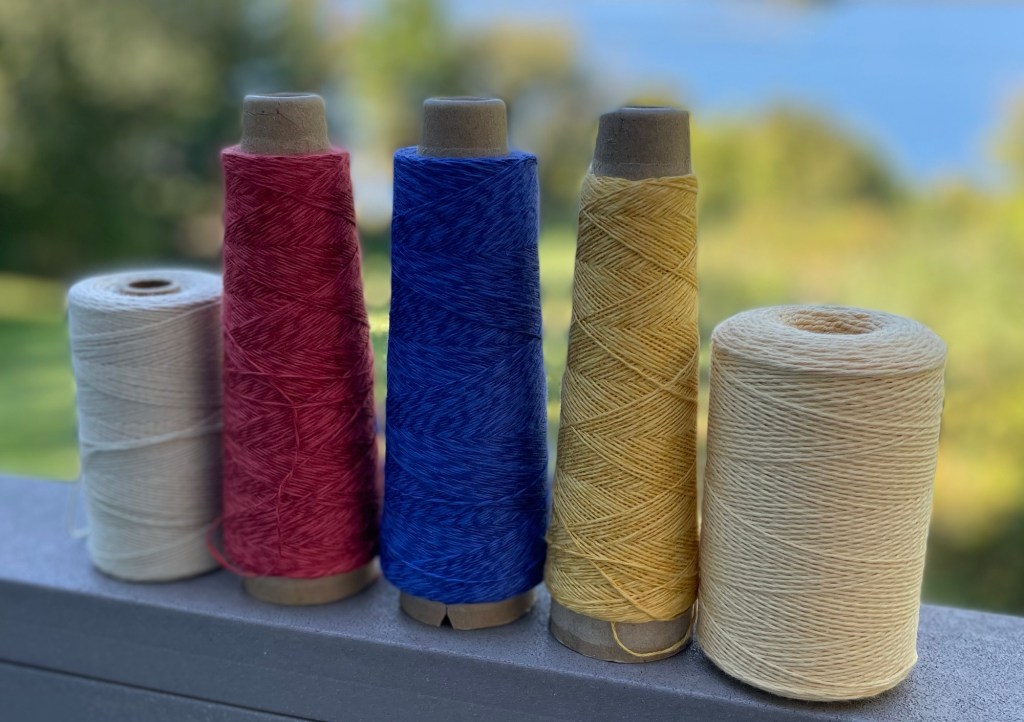
I had measured out enough warp yarn for three towels. The photo below shows all the yarns I used for the project, including the warp yarn off white 8/4 cotton on the left, three colors of Gist Duet cotton/linen blend weft yarn for three different towels, and yellow 8/4 cotton on the right used for a forth smaller towel.

Yarn used for this project

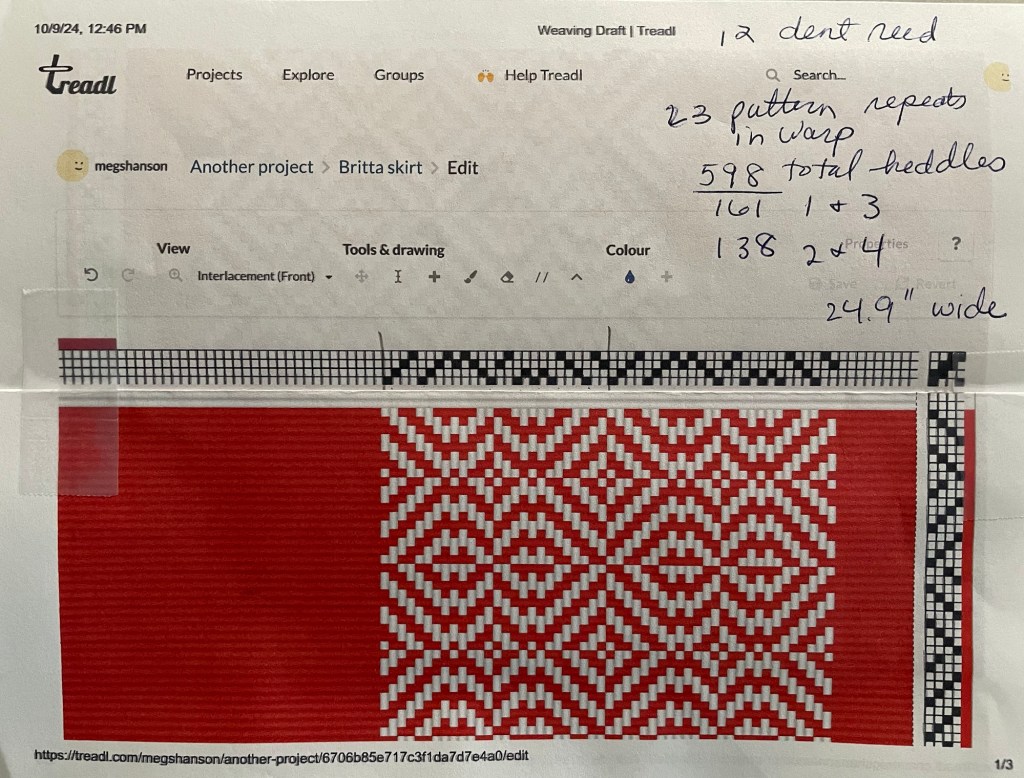
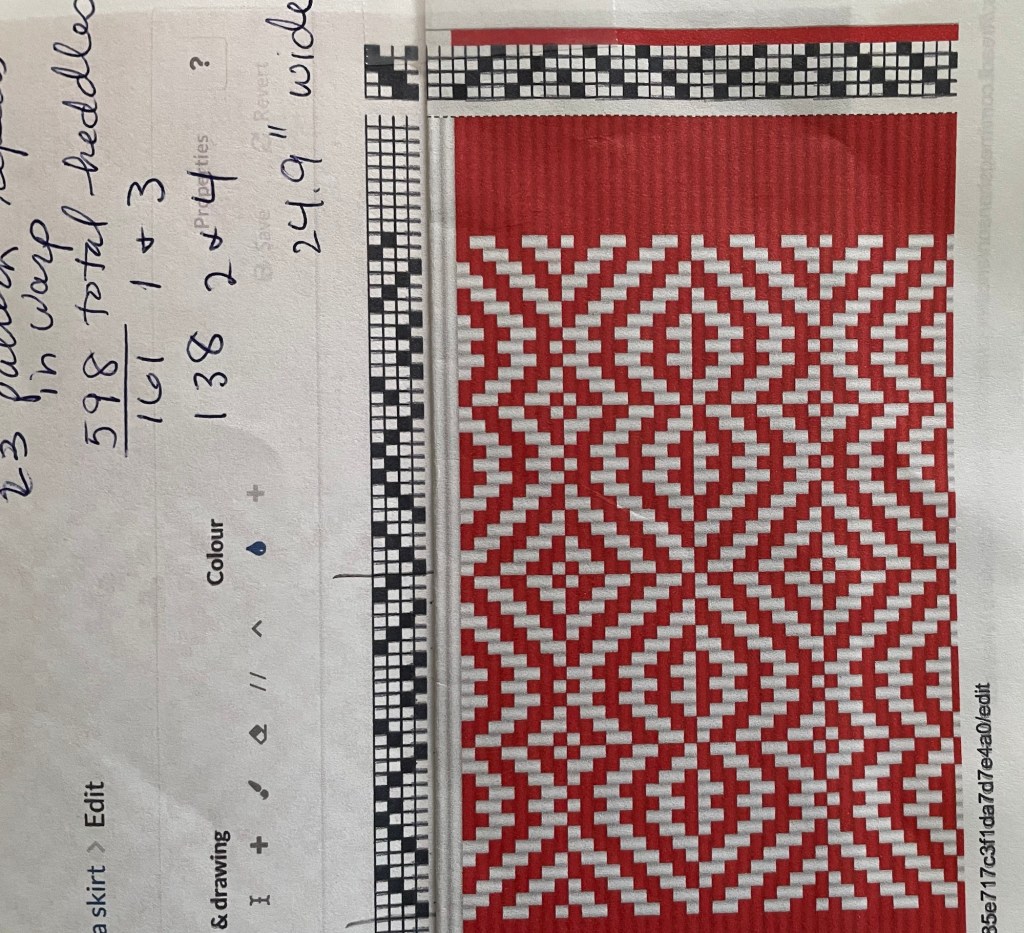
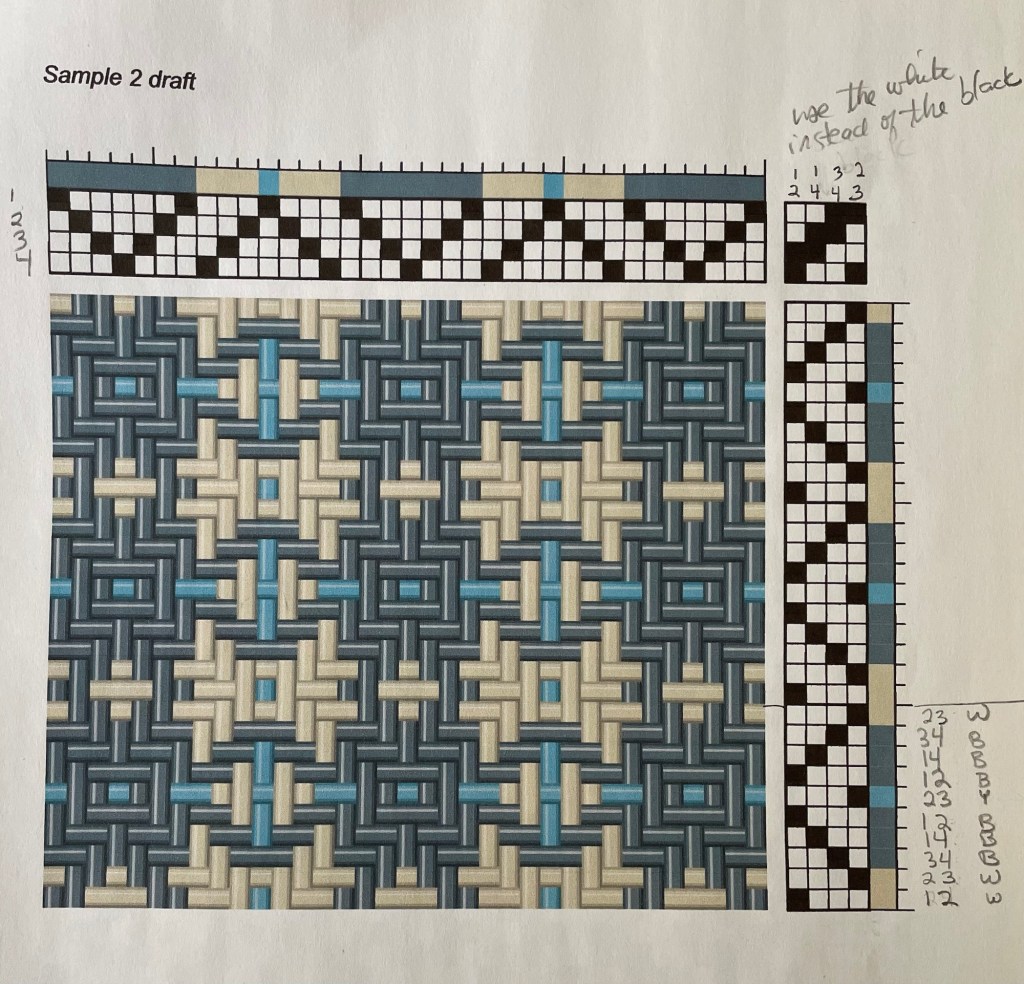
Following is a photo of the pattern used for the first towel in this set, with multiple colors, the way I made it the first time in the spring.

The pattern used for the first red towel

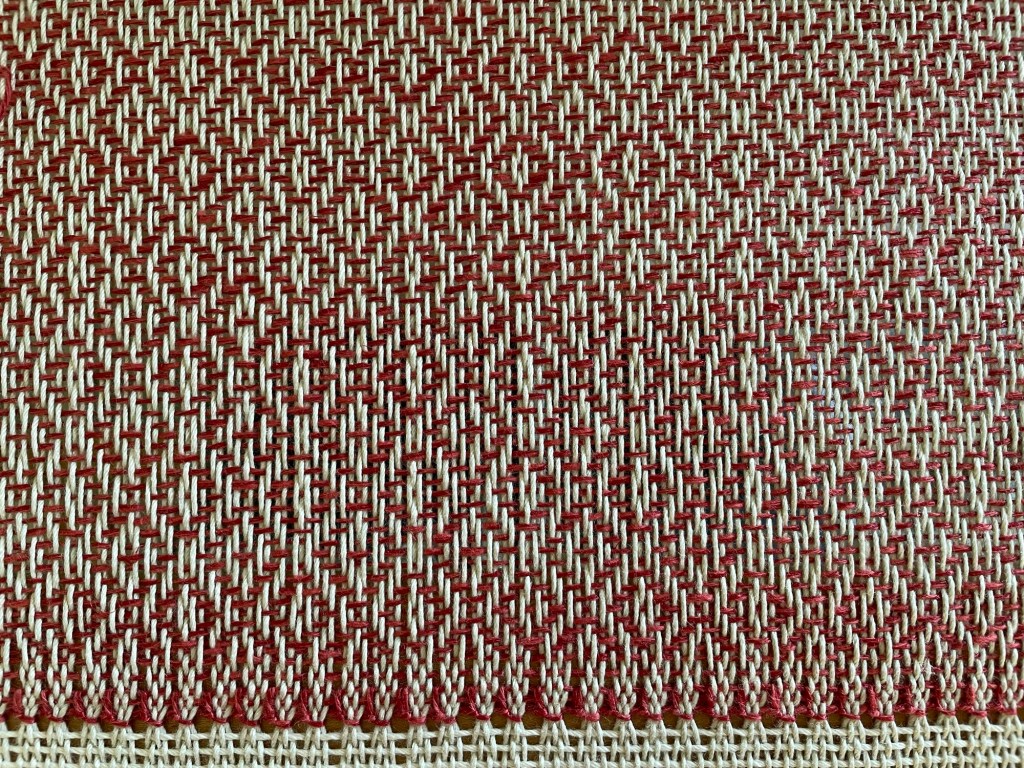
The next photo is the first towel in progress on the loom, using the pattern above, but with off white warp yarn, and red Gist Duet cotton/linen blend weft yarn.

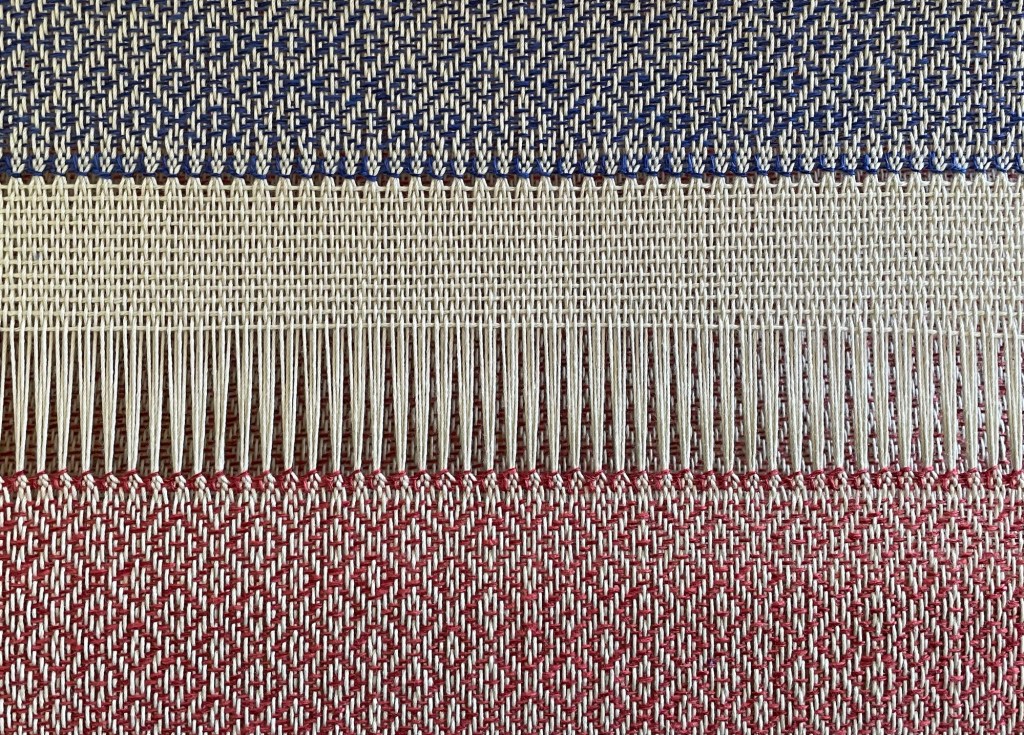
After finishing the red towel and weaving some spacer rows, I started the next towel using weft yarn of blue Gist Duet cotton/linen blend. The treadling pattern is slightly different. The area in between the two towels will become fringe.

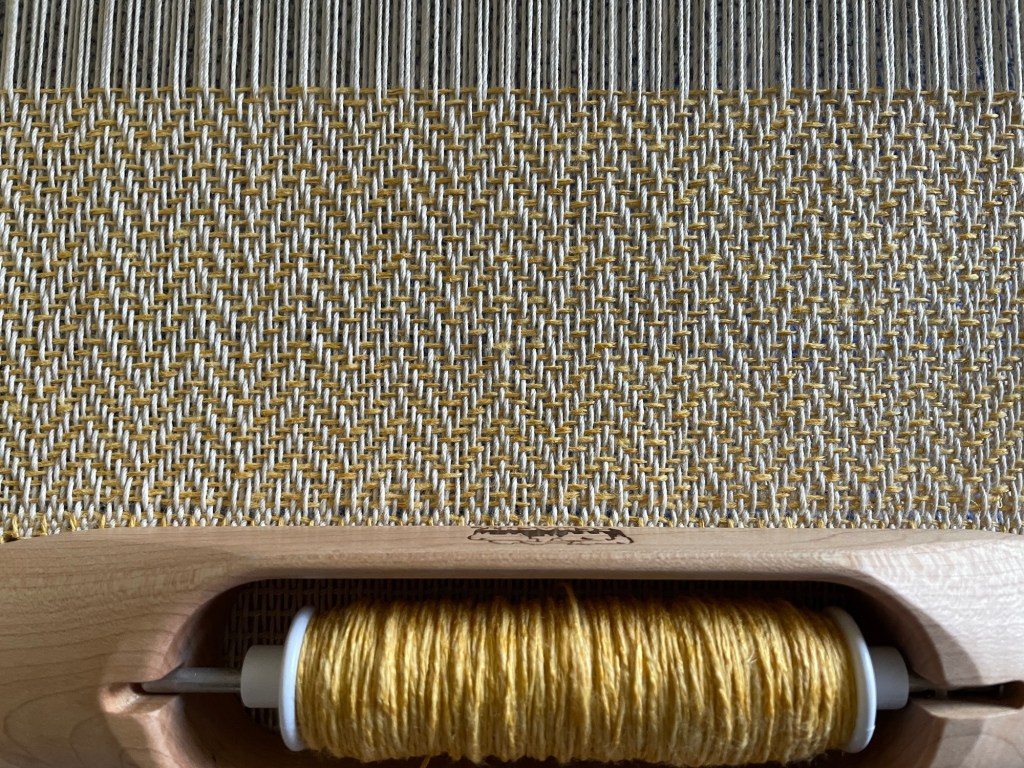
After the blue towel was the right length, I started a new one with a different easier treadling pattern using Gist Duet warp yarn in yellow.

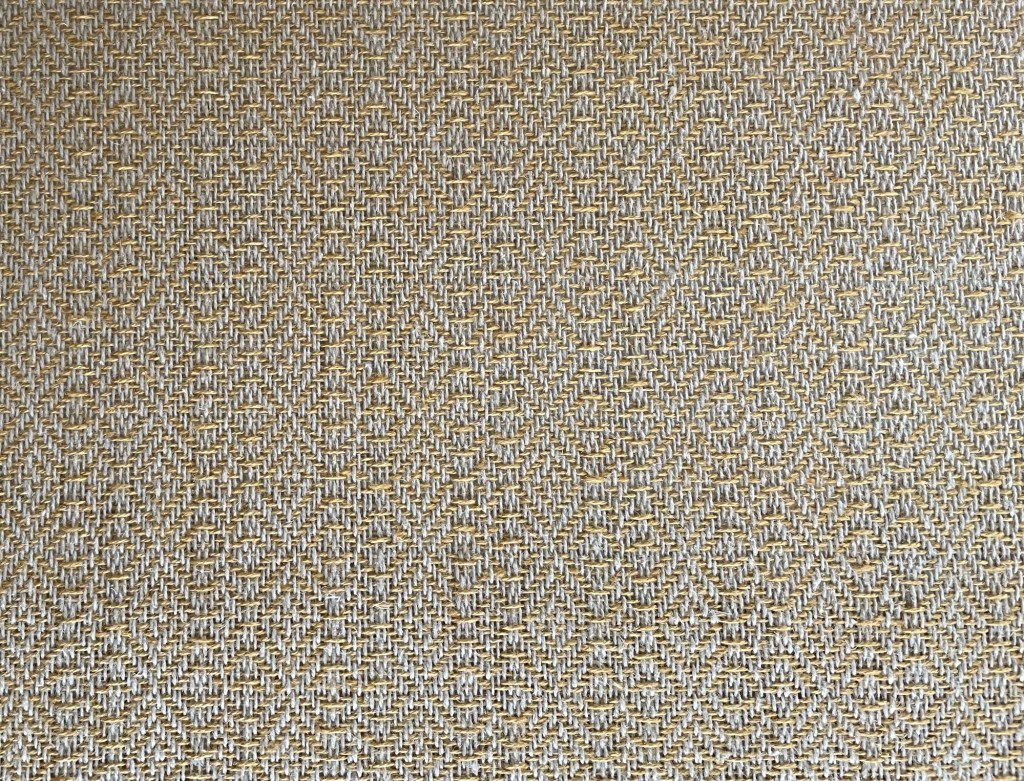
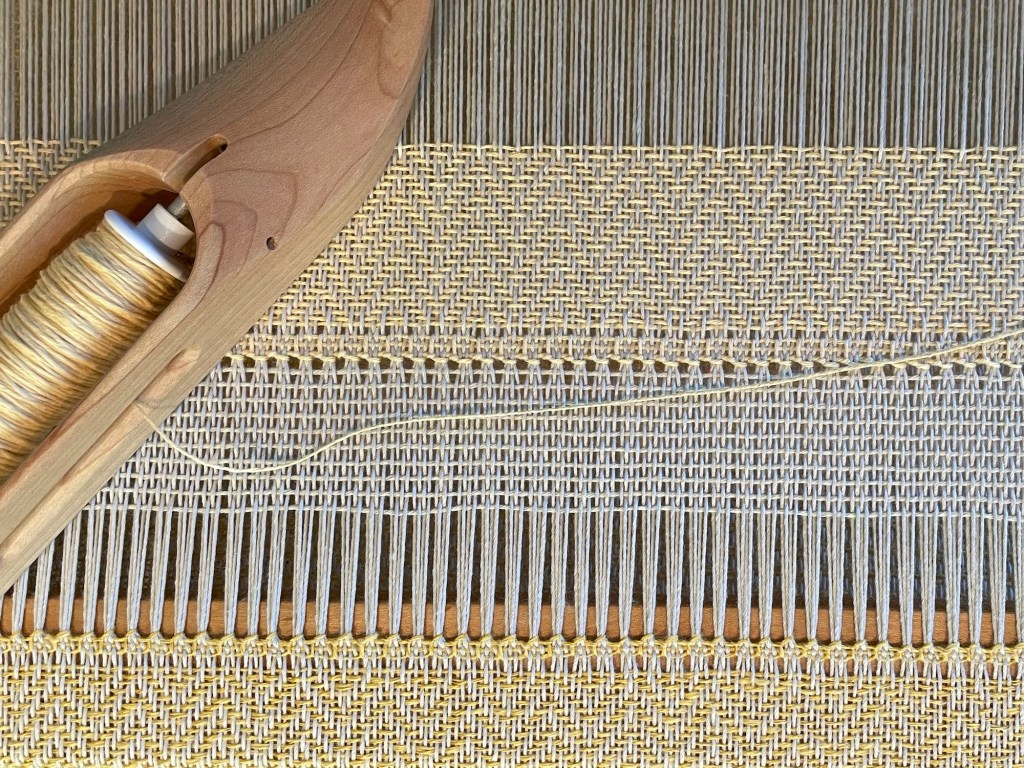
When I finished weaving the red, blue and yellow towels, there was still some warp yarn left. It was not enough for a whole towel, but it was enough to do some sample weaving using a different weft yarn for comparison. I used the same treadling pattern as the yellow towel, but with weft yarn of yellow 8/4 cotton instead of the Gist Duet cotton/linen blend. The 8/4 cotton is a bit thicker, so I wanted to see how those two weft yarns compared with the same warp yarn and ends per inch.

Same pattern with two different yellow weft yarns

Once the knots rolled forward from the back beam and came close to the heddles, they got tangled up and it was hard to get a good shed (the space where the weft yarn goes across to weave a row). I had to get all the knots back through the holes in the heddles and through the slots in the reed again, this time from the back to the front. I wove some rows with big floats where warp yarns were not in the right place. I was not too worried as this was just a sample. I figured out that this problem could mostly be fixed if I stuck my hand in and separated the warp yarns from each other before each weft row.

Knots all tangled up

After I wove as far as I could, I hem stitched the end and cut the completed weaving off the loom. There was still all that warp yarn waste from the spring project, the same as before. This time I cut it off as I had something else in mind for my next project, that would require a different pattern using a different reed with more ends per inch. After removing all the waste warp yarn I saved it, what for I don’t know what. It is a lot yarn that can be used for something.

Waste yarn left at the end of the project.

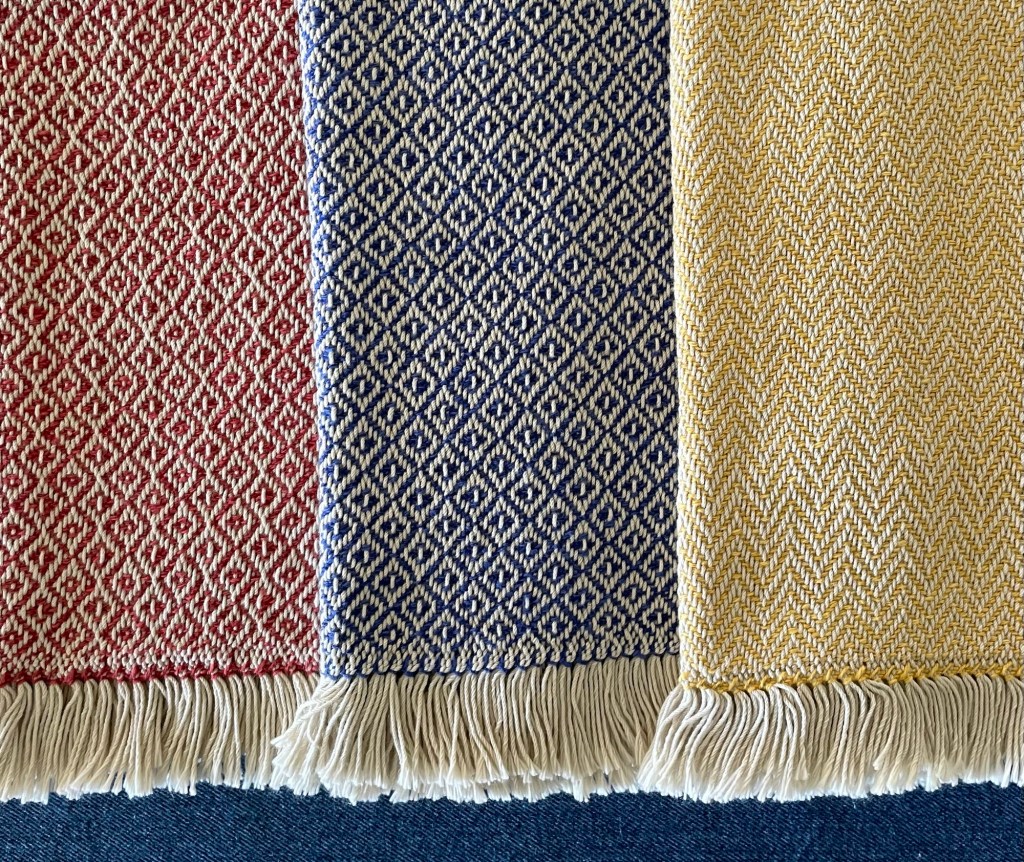
Following are photos of the completed towels after I wove in loose ends, and washed and dried them in the washing machine and dryer. It was amazing to me to see the difference between the corresponding towels from the spring, this time using the same pattern but without the stripes.

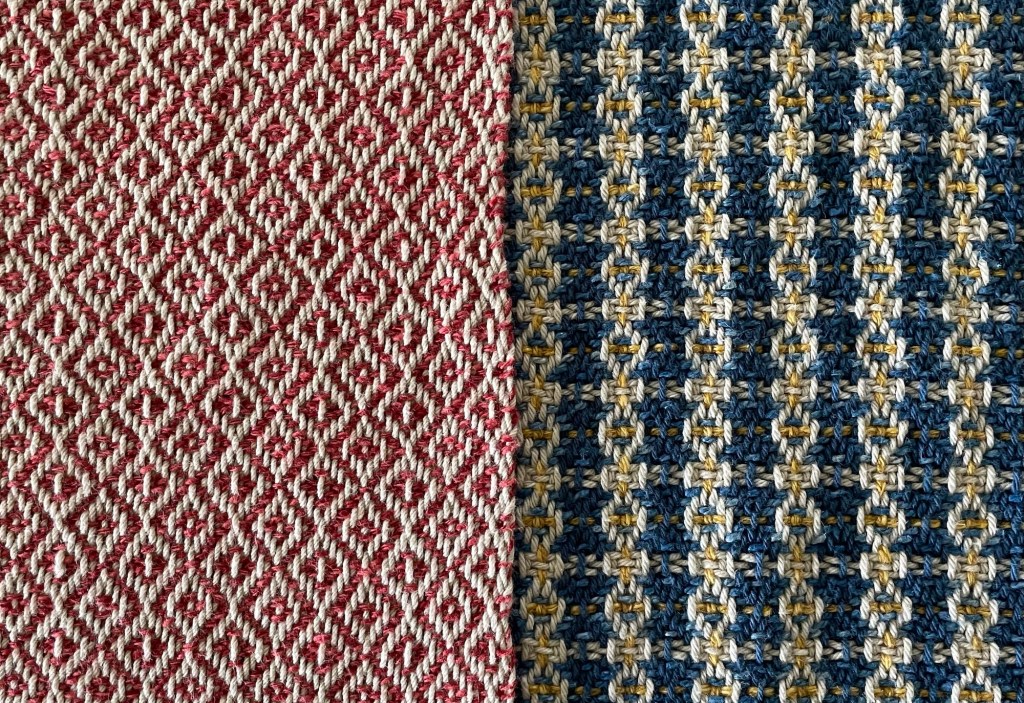
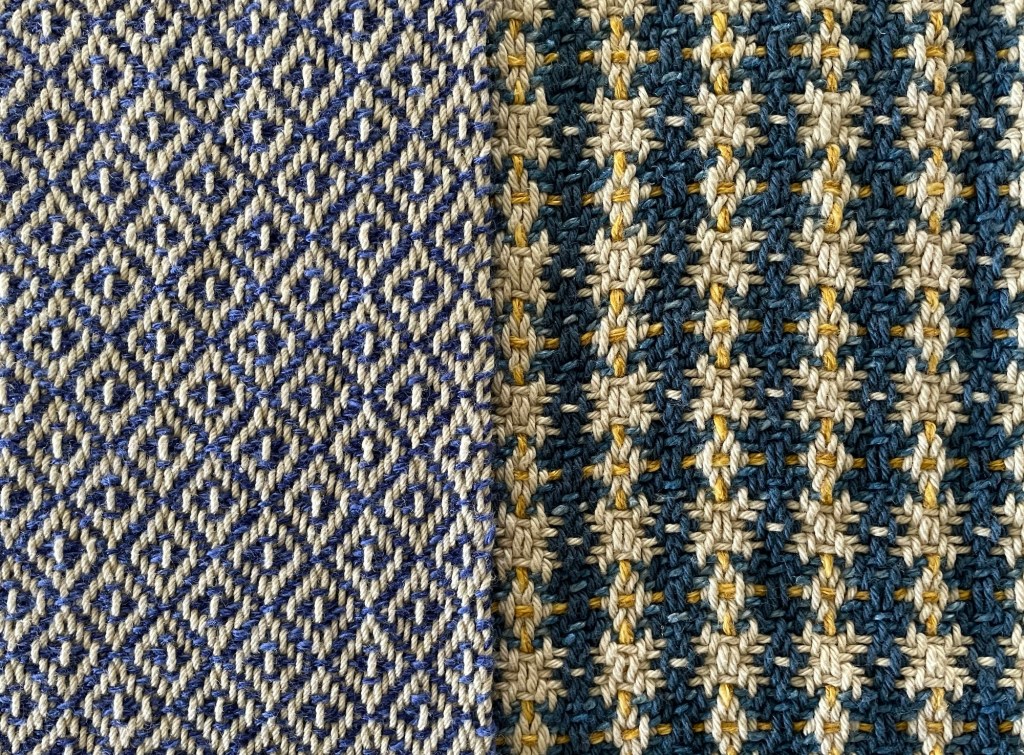
The first towel has all off white for the warp, and all red Gist Duet cotton/linen blend for the weft, shown next to the towel with the exact same pattern but with stripes and a different combination of yarns from last fall. It is hard to believe they are the same pattern.

Same pattern, different yarn

The next photo shows the blue towel and the corresponding striped towel with a slightly different treadling pattern and different yarns. There are five white stripes in the towel on the right, compared to only three white stripes in the towel above (among other small differences in the treadling pattern).

Same pattern, different yarn

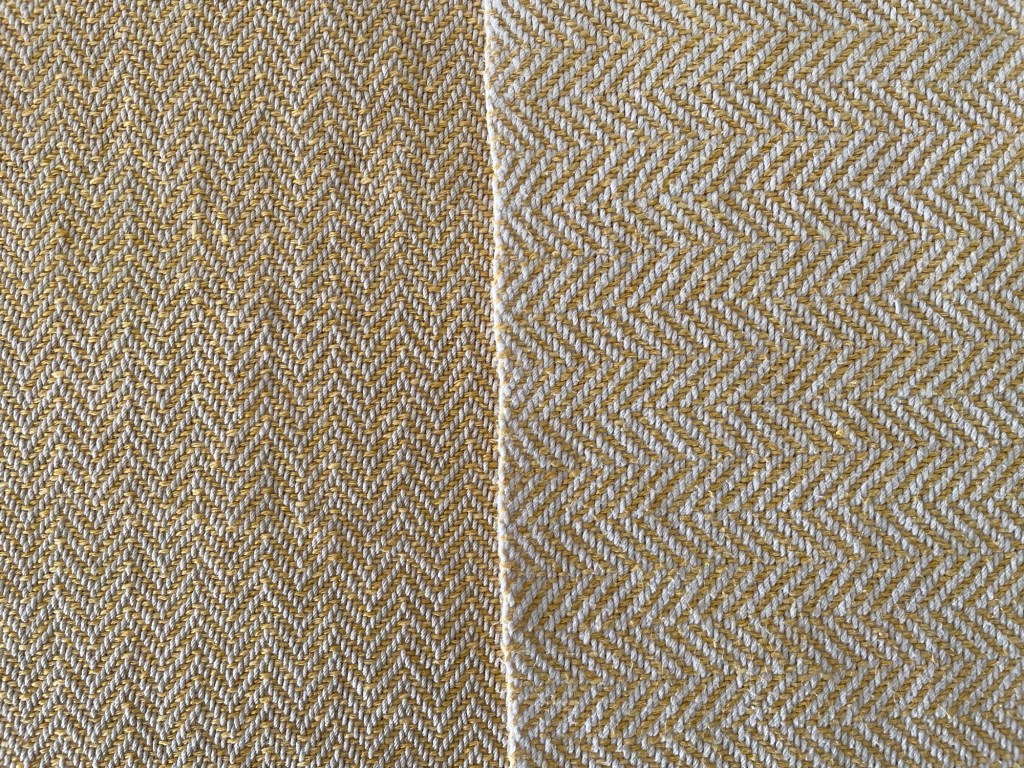
The next photo shows the new yellow towel with a zig zag pattern on the left, next to another towel I made quite awhile ago with a different zig zag pattern going the other direction. The towels have the same two yarns (8/4 cotton warp and Gist Duet weft). The difference, beside the pattern variation, is that the new towel on the left has 16 ends per inch, which is denser than the older towel made with 12 ends per inch.

Same yarns with different pattern and different density

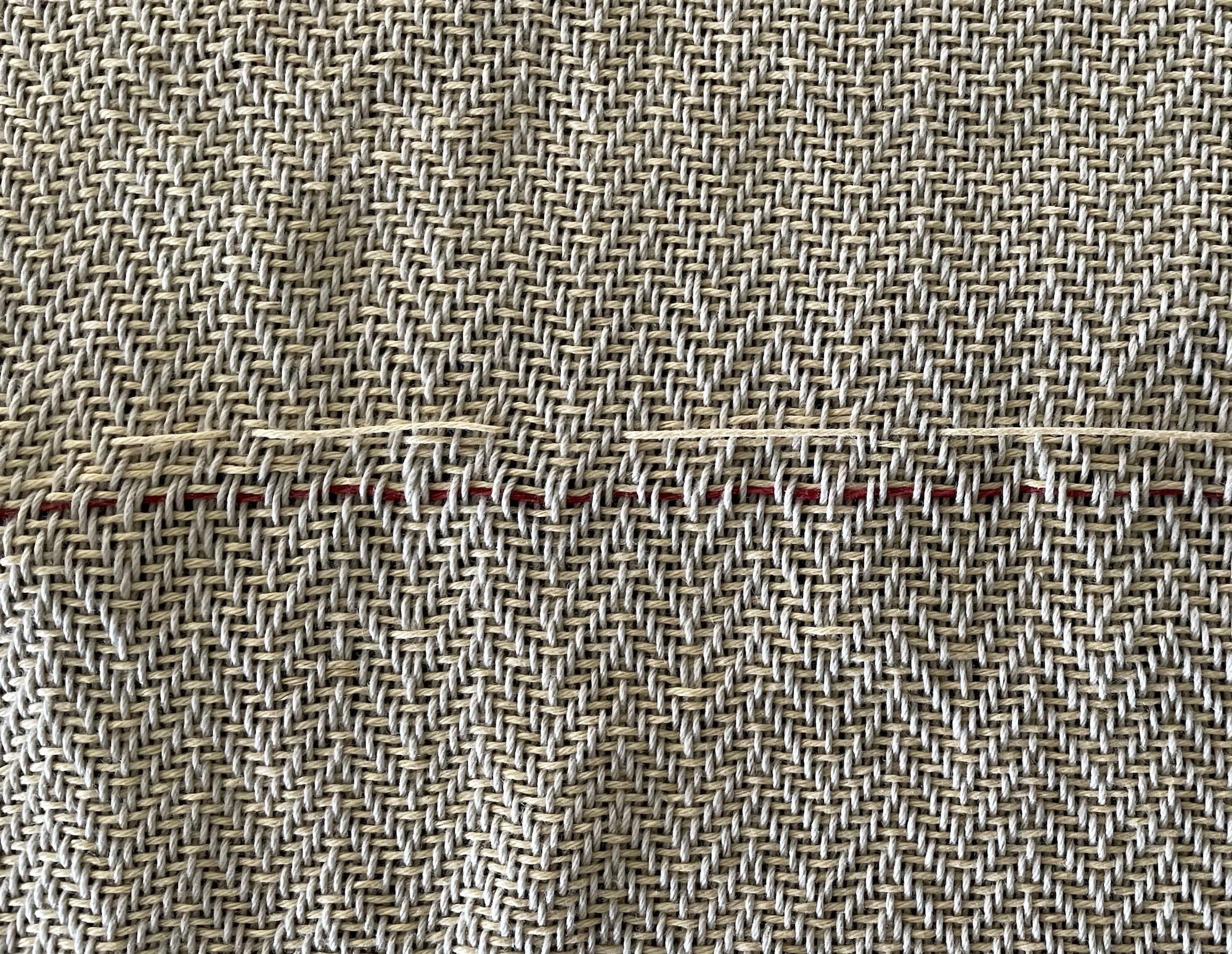
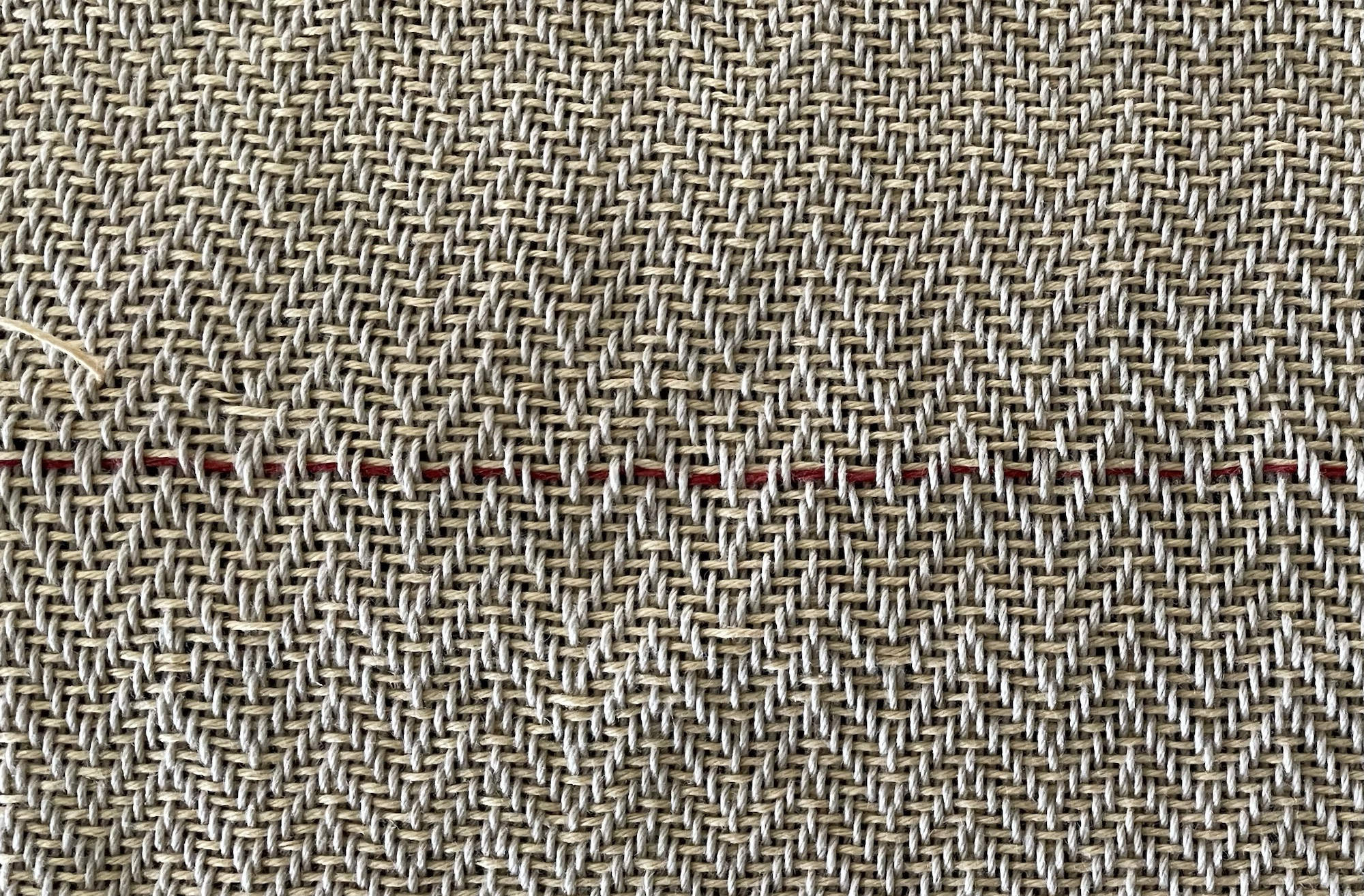
Following is a photo showing the last sample weaving, before washing, with the loops where the tangled up knots in the warp yarn caused big floats. There were other rows with mistakes also caused by the warp yarn knots, but they were not so bad. I decided to try to fix the one really bad row by weaving in a new piece of yarn by hand. In order to see the pattern better, I wove a piece of red thread through a different corresponding row of the pattern. The photos below show the bad row with the temporary red yarn on the left, and to the right, the same towel after I fixed the bad row.

Following is the last small sample towel with the bad row fixed and temporary red yarn removed, after washing. There are mistakes but it is a lot better.

Last small sample towel after fixing the bad floats

The last sample towel was woven with the same treadling pattern as the yellow zig zag towel, but using yellow 8/4 cotton for the weft yarn, instead of the Gist Duet cotton/linen blend. The 8/4 cotton is a bit thicker.

Same pattern and ends per inch, but different weft yarn

Lastly is a photo of the three towels from this project next to each other, not including the smaller sample towel with the mistakes.

I am very pleased with how these towels come out. They look and feel nice, and I learned a lot in the process of weaving them. I am already on to another floor loom project I am very excited about that will be featured in a future post.

Sock Machine Gnome

Many years ago I saw images of antique circular sock knitting machines. I have always thought they were a cool, interesting part of history.

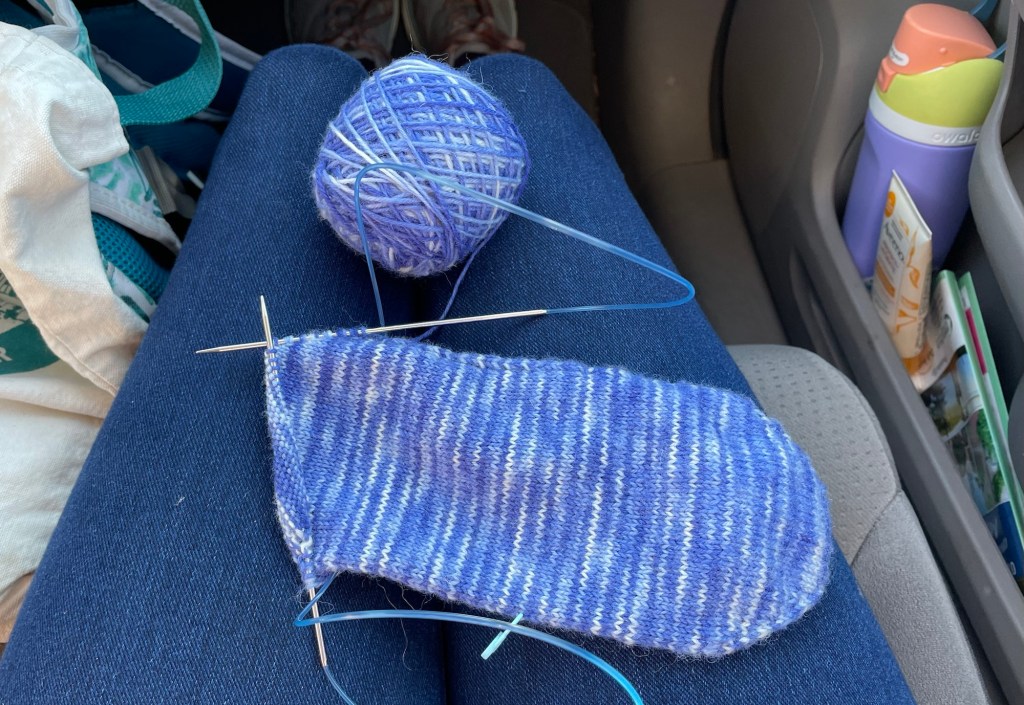
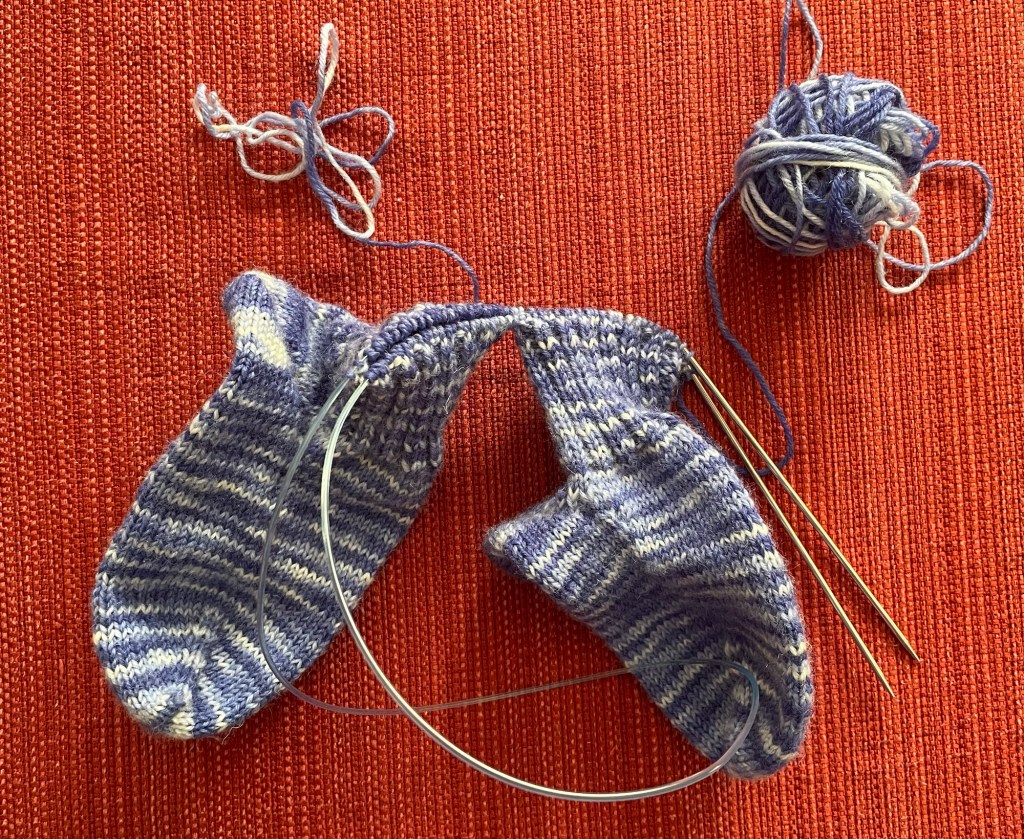
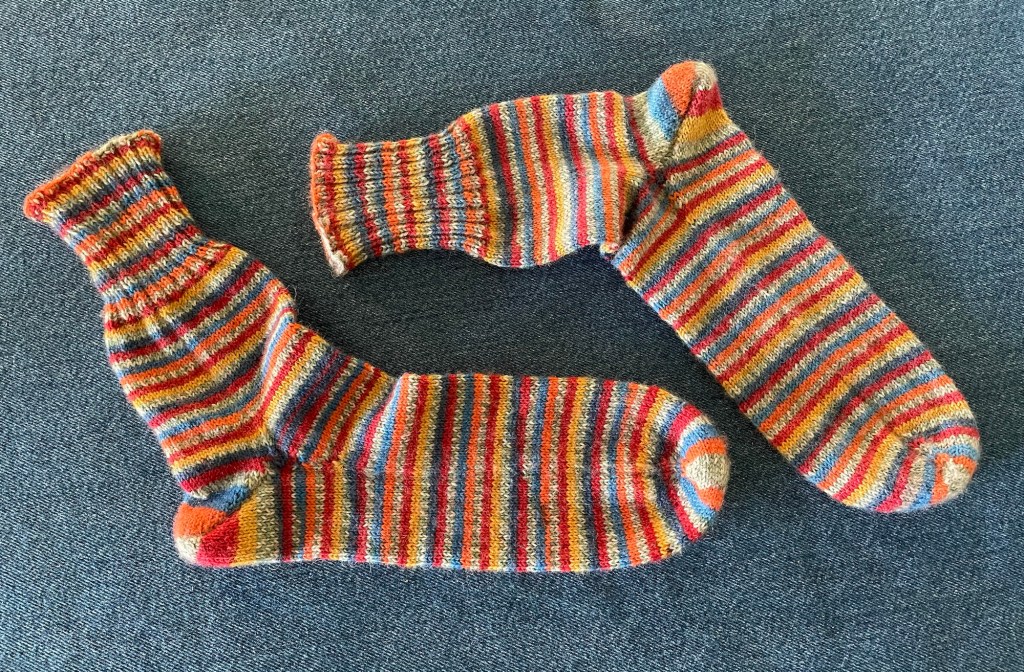
In the last few years I have been knitting socks and learning about sock construction, but it takes me a long time to make one pair. I would like to make more socks for myself and for gifts, but I can only manage to knit a couple of pairs per year. Most of my knitting happens while watching TV (unless there is part of a project that requires extra focus) or while a passenger in the car. I saw a meme online that there should be a Netflix category for shows that you can watch while knitting haha.

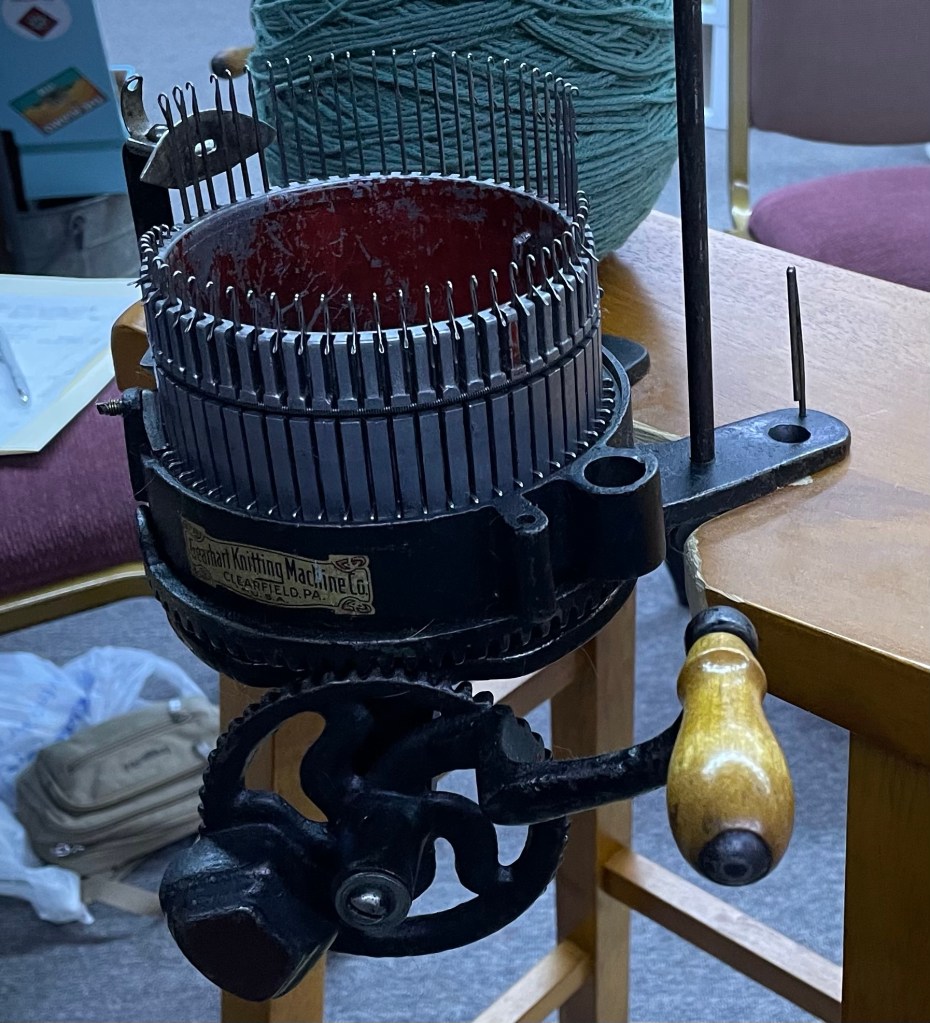
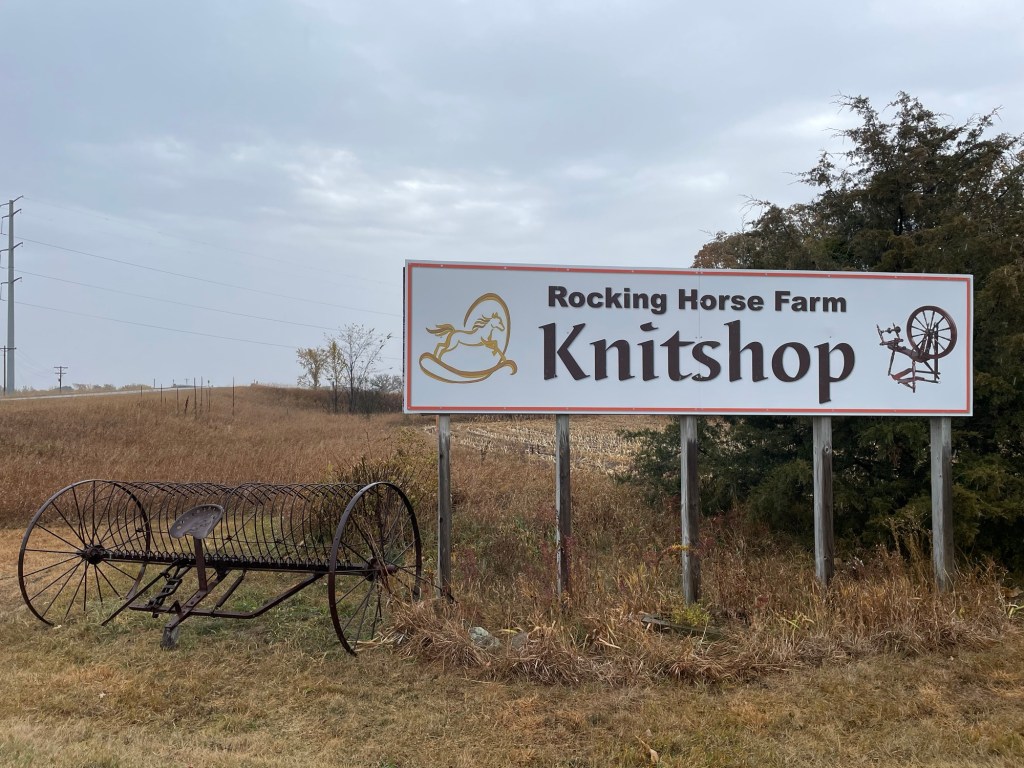
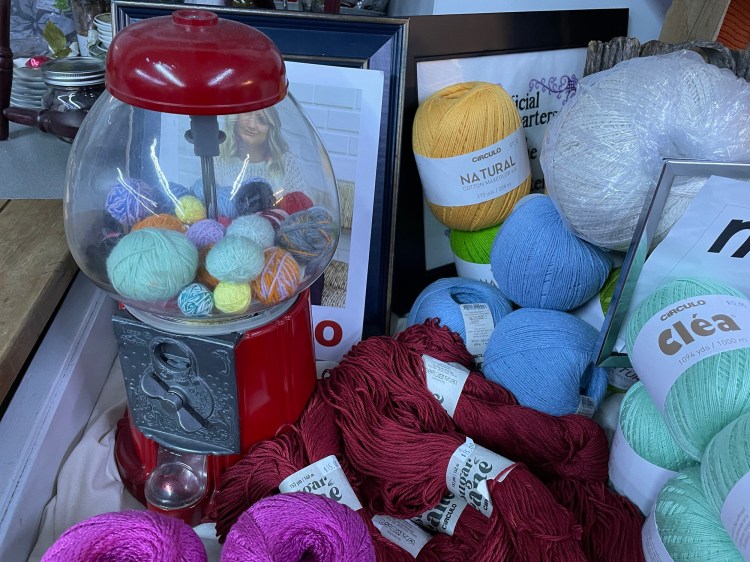
It turns out there is an active community of people using restored antique circular sock machines (referred to as “CSM”s), as well as newly manufactured machines. I became aware of one of these groups within range of my home, and attended a get together (called a “crank-in”) last April at the Knitshop at Rocking Horse Farm in St. Cloud, Minnesota. This business sells yarn and supplies for knitting, spinning, and weaving, with a focus on machine knitting. Following are a couple of photos I took there last spring.

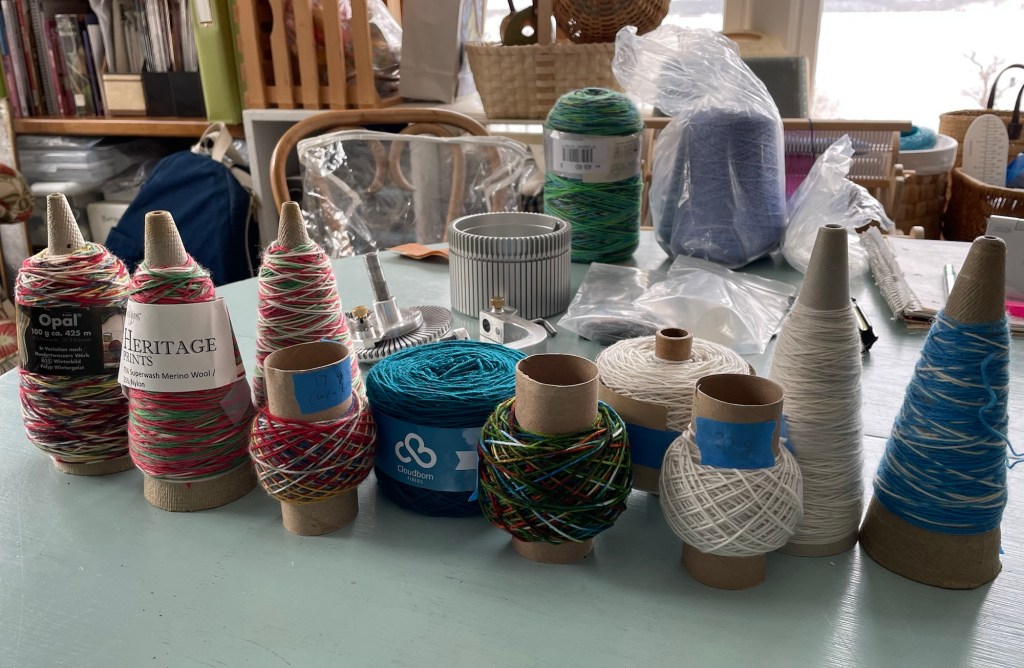
Yarn on cones for knitting machines
Yarn gumballs

Recently I was supposed to be on a trip with friends in Asheville, North Carolina. We were disappointed to have to cancel the trip due to devastating damage there from hurricane Helene. We were grateful that we received full refunds for the Airbnb and car rental, and for our flights, even though they had been booked with tickets that only allowed for a credit for future travel.

Instead of going to Asheville, my friends and I went on an outing to the Minnesota Landscape Arboretum. It was a beautiful, warmer than average day for looking at the fall gardens and displays, and walking on their Three Mile path. A series of fun scarecrows were set up near the main building. Our visit there ended at the Arboretum’s Apple House, where we all bought bags of locally grown apples. In case you did not know, the Honeycrisp apple was developed at the arboretum’s Horticultural Research Center.

One of the scarecrows on display at the arboretum

On the way back home from the Twin Cities, it worked out for me to stop in St. Cloud, for the fall get together of the Circular Sock Machine “crankers”. Cancelling the Asheville trip was a bummer, but I was glad to be able to attend this event instead. I was very eager to observe and ask questions. The people there were all friendly, had stories to tell about their CSM and what they were making, and were happy to answer my questions and share their knowledge. Several people were using antique CSM’s from the early 1900’s. These machines are metal and basically last forever. There was a man at the event who is well known in the sock machine world, Pete Oswald, who works on adding missing parts and restoring old CSM’s that have been found on ebay or in antique shops. A few people had new CSM’s made by the Erlbacher Knitting Machines company, that have been designed to be compatible with antique Gearhart machines. There are other brands of new metal sock machines, and a company that makes 3D printed plastic CSM’s. They are quite a bit cheaper, but, well, they are plastic.

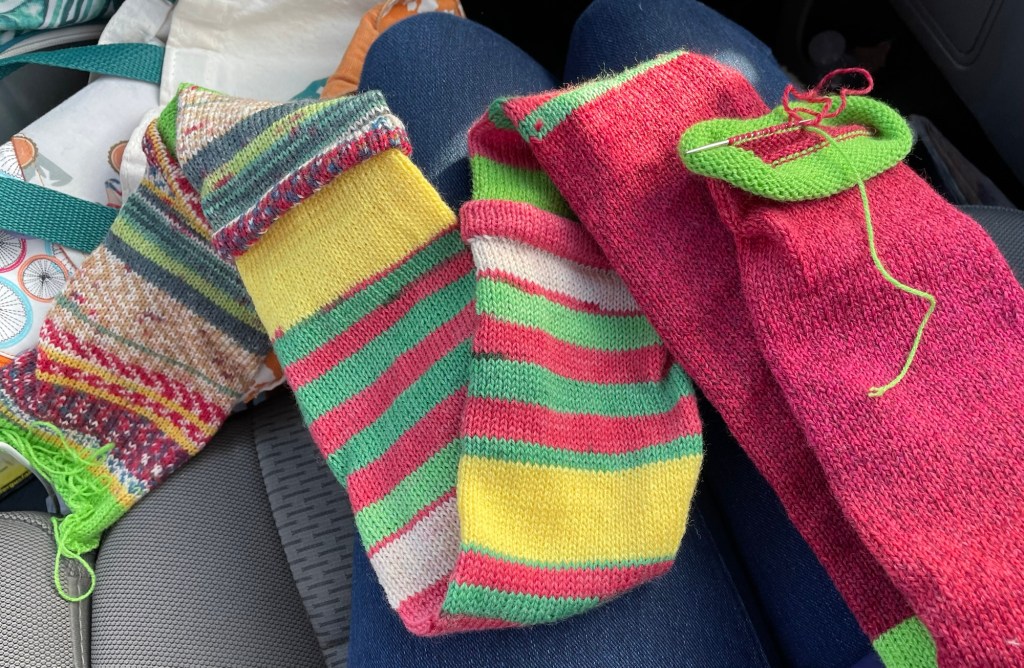
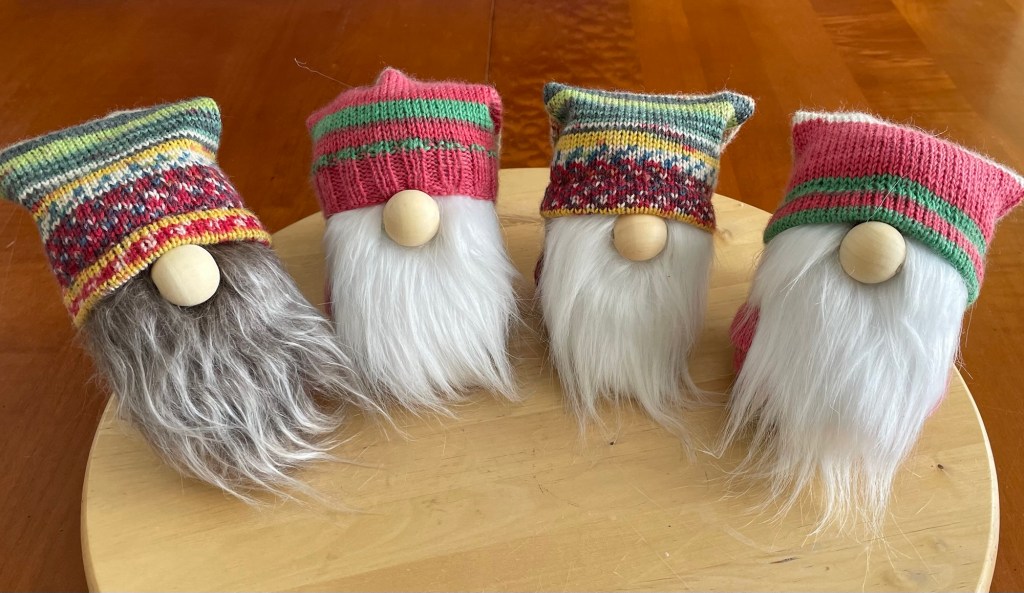
Some people at the event were making socks, but others were making gnomes using supplies and a pattern provided. The pattern is free on the Erlbacher web site.

Gnomes made on a circular sock machine

I was only expecting to observe and get information to help me understand how the sock machines work, and the differences between the various CSM’s and related accessories. One of the experienced crankers, Deb Oswald, steered me to her CSM, and got me started making a gnome. Deb is the wife of Pete, and these two are gurus in the CSM community around the country. They have 30 years of experience with sock machines. At the time I did not realize the level of expertise I was getting in on. It was a great opportunity to actually use Deb’s Erlbacher machine and end up with a fun outcome.

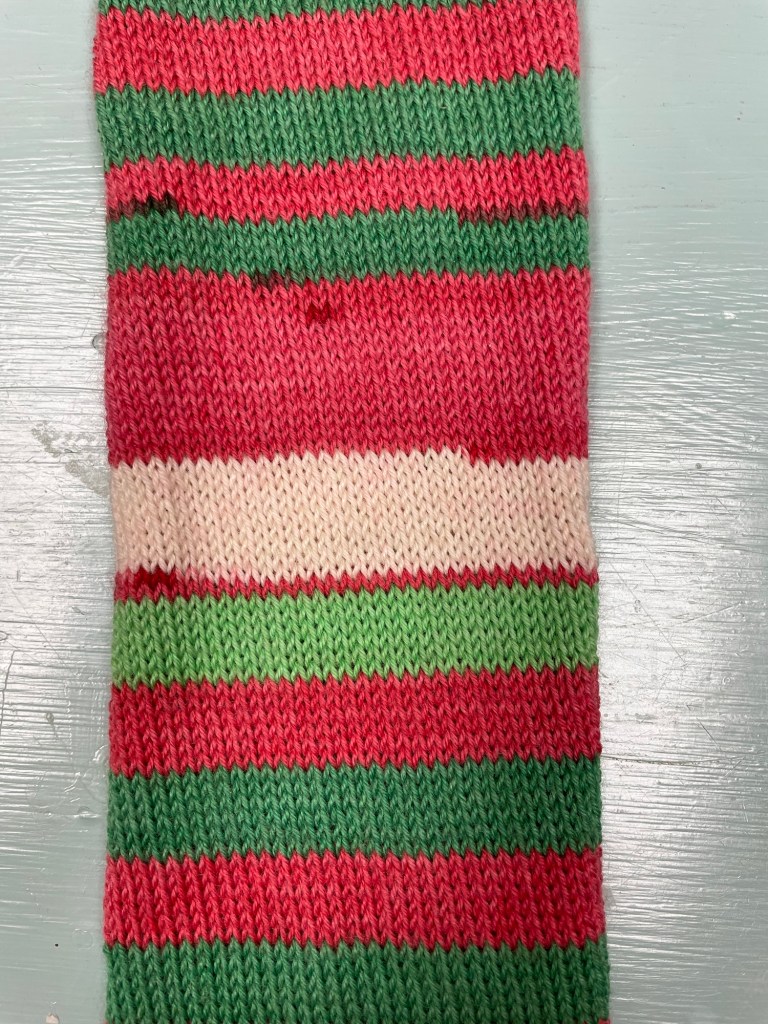
The first step was to pick out which self striping yarn I wanted to use for my gnome. There was a box of samples, showing what some yarns looked like knitted up. I liked the one you can see on top of the pile in the photo below, so Deb found the cone of that yarn.

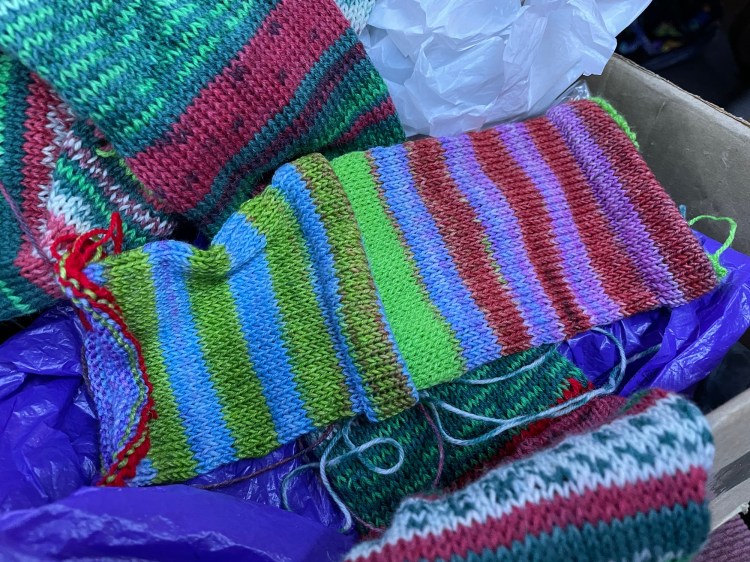
Samples of self striping yarn knitted up

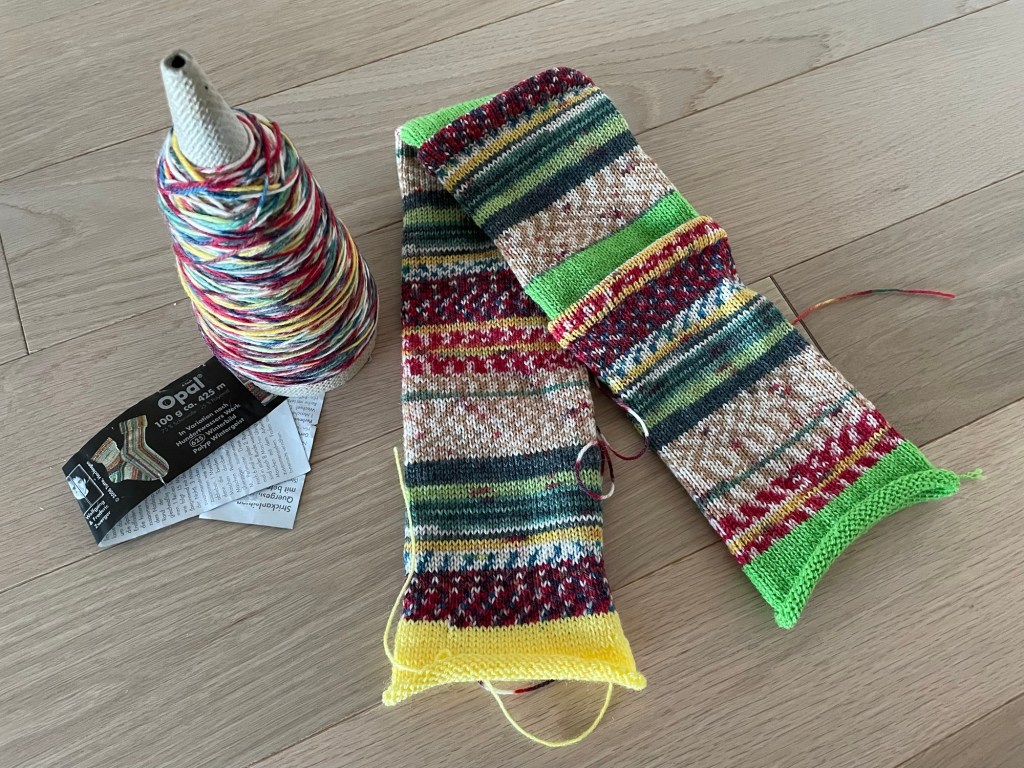
Following is the cone of yarn I picked out for my gnome. Yarn should be on a cone for use with a sock machine, rather than a ball or skein. You can buy yarn already on a cone, or use a special winder to get it onto a cone.

The cone of yarn for my gnome

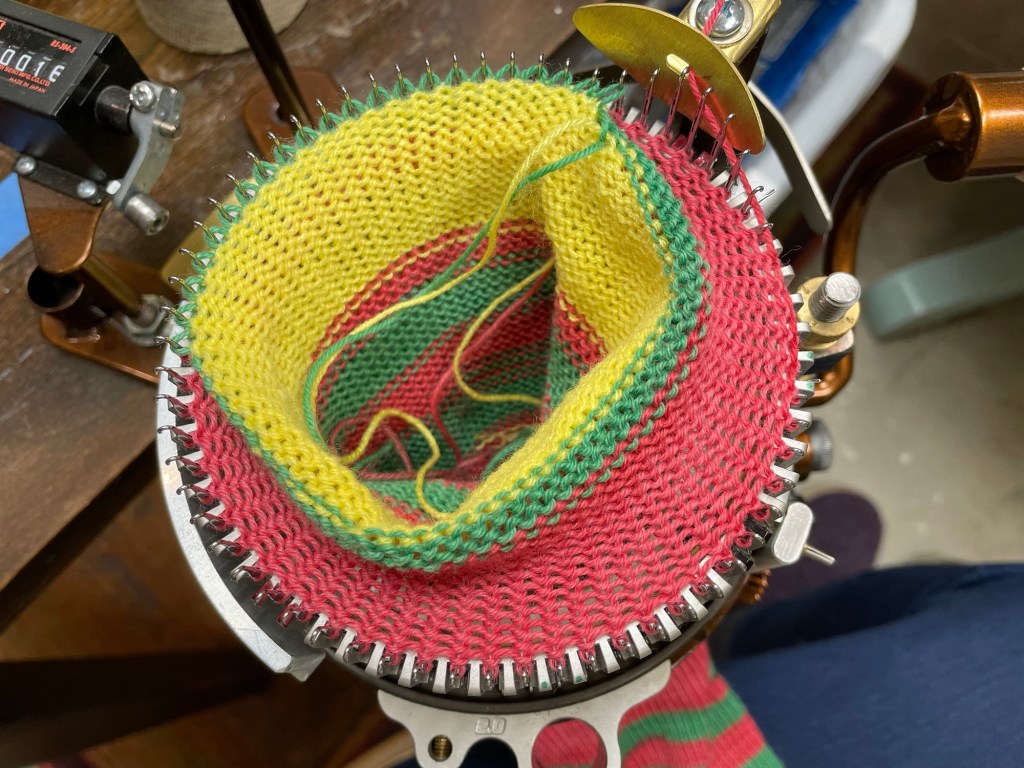
I cannot explain exactly how a sock machine works, but there is a cylinder with needles that go up and down to pick up and knit the stitches. A handle is manually turned to make the cylinder go around once for each row of knitting. Following is a photo of Deb’s CSM with part of my gnome in progress.

Rows of knitting cranked on Deb’s sock machine
Close up of the rows knitted on the CSM

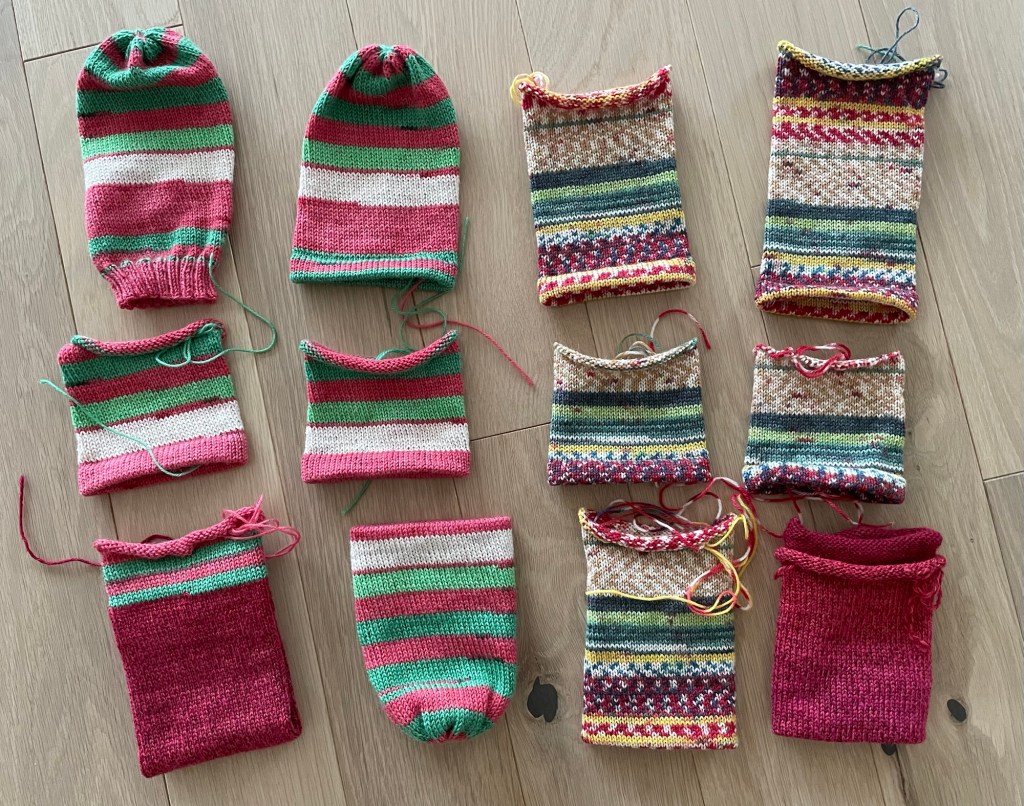
I cranked out three different tubes separated by waste yarn. Each tube had a specific number of rows according to the pattern. The CSM has a row counter so you can easily keep track of when to stop. Two of the tubes had a hung hem on one end. That is a common way to finish the cuff of a sock when using a CSM, in place of ribbing. It is sometimes used in hand knitting also, at the edge of a hat or sweater. The ends of each tube that did not have a hung hem were gathered together using the yarn tail. The next photo shows the process of using a tool to pick up the stitches at the end of the tube using the yarn tail, just where the waste yarn starts. After yarn was threaded through each stitch, the red waste yarn was removed.

Picking up stitches at the end of a tub, before removing waste yarn

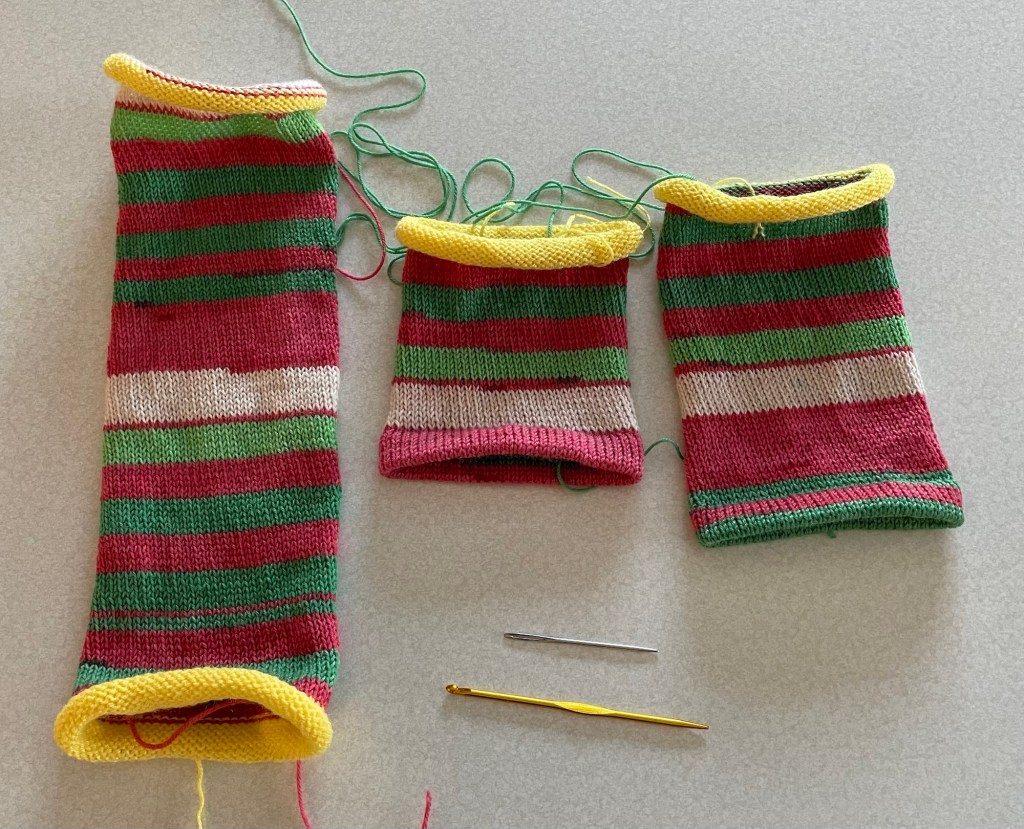
The following photo shows the same green, blue and purple tube that I was working on in the photo above, with the hung hem at the bottom and the top gathered together. On my right leg are the other two tubes that have not been separated from the waste yarn. I dropped some stitches when trying to do the hung hem, so Deb fixed it up as well she could.

Parts of a gnome

The three parts of the gnome are displayed below, before being assembled. The longest tube on the right, with both ends gathered up, will end up being the bottom of the gnome, after folding the two ends inside each other.

Gnome parts ready to assemble

The next photo shows the blue and purple bottom part folded and stuffed, with the head stuffed and basted on and nose sewed in place. The furry stuff would get glued on next for the face, and lastly the hat was basted on.

Partially assembled gnome

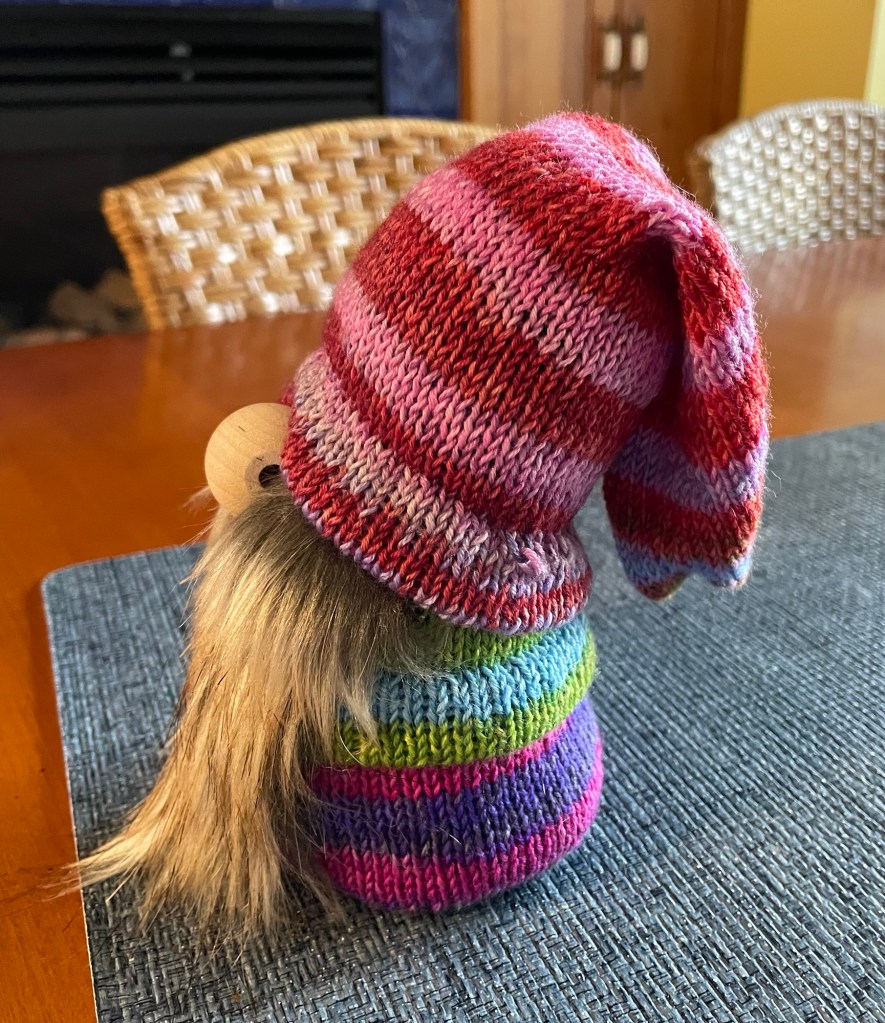
After sewing the hat on, my gnome was complete! I accidentally cut off part of the fur on one side of the nose, so my photos are all from the other side.

My completed gnome!

A woman I met at the April crank-in, Amanda, was there again. At that event she talked about having made 180 – 200 pairs of socks since getting her CSM last fall. She has made a bunch of money selling socks at Shepherds Harvest Sheep and Wool Festival, and other fiber fairs. At this CSM gathering, Amanda shared that one time when she did not have any clean socks, it was faster to crank out a new pair, rather than do the laundry. She cranked out three pairs of socks at this crank-in!! You can find Amanda’s Broken Unicorn Crafts Facebook page here.

Following are more photos of my gnome from the side and back, with better lighting at my house.

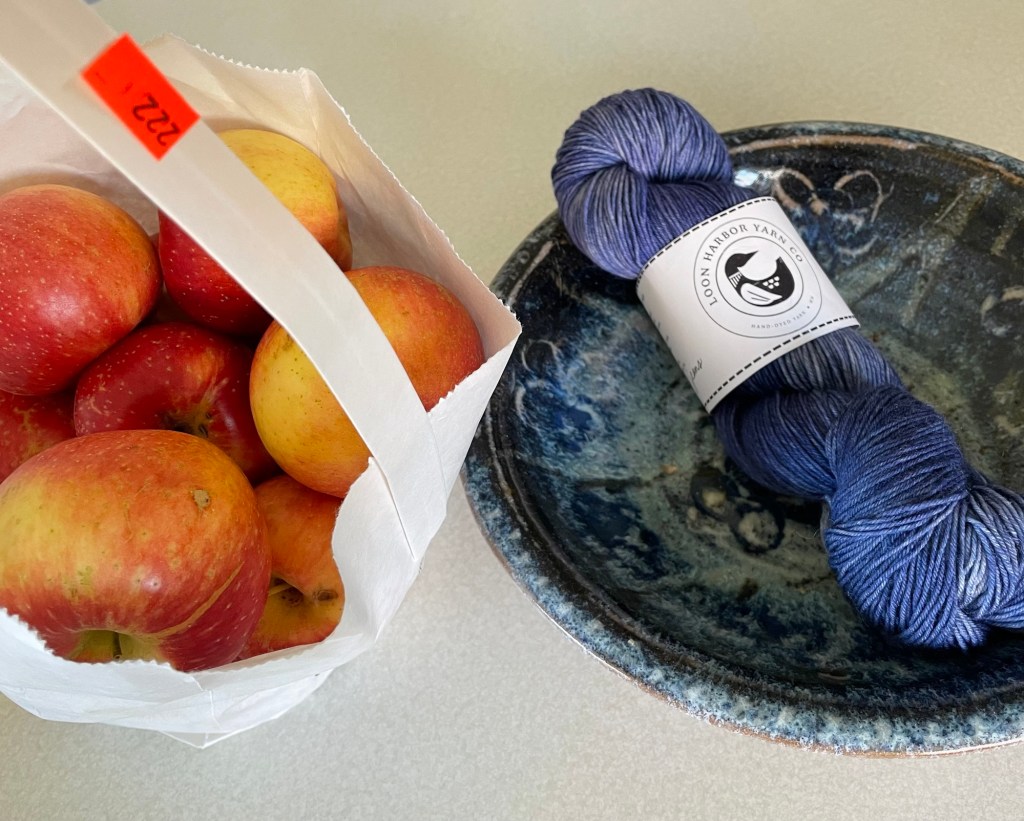
Before leaving Rocking Horse Farm I bought a skein of pretty blue sock yarn, shown below next to my bag of apples from the Arboretum Apple House.

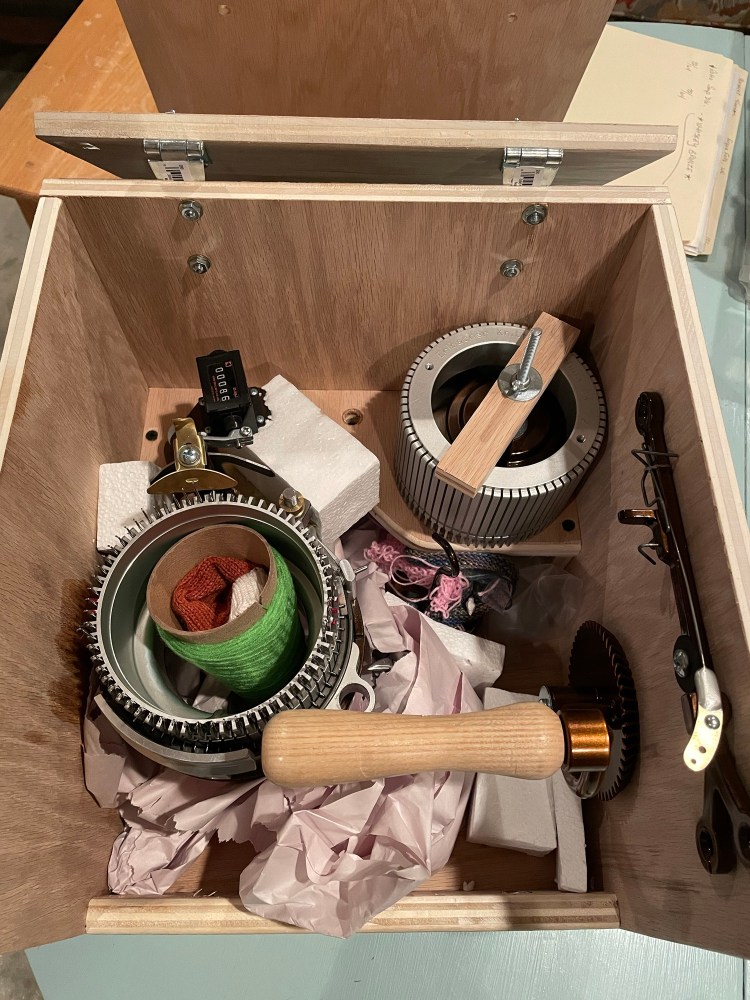
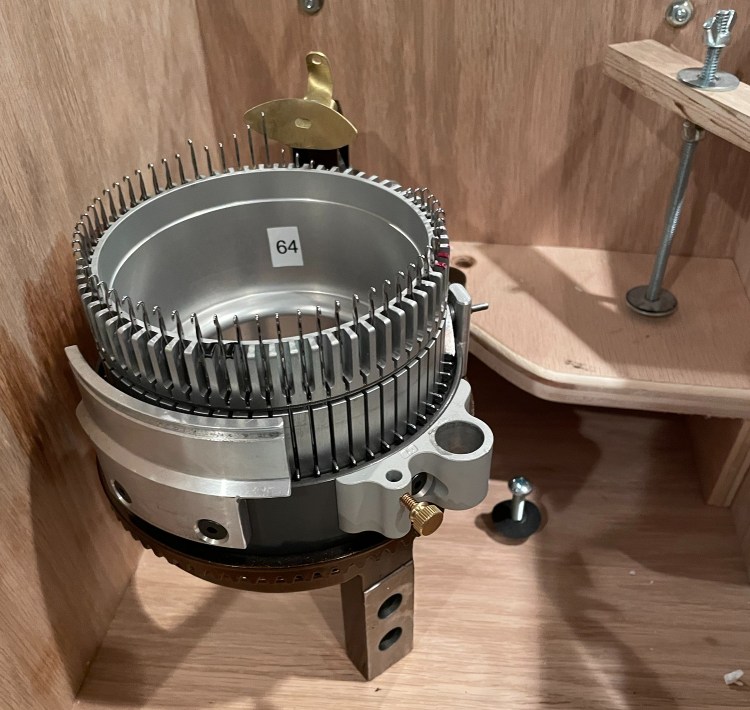
As a wrap up to this fun weekend, I ordered my very own circular sock knitting machine from the Erlbacher company. It will be about a month before I get it, as each machine is custom made to order and they have a back up of orders. I am very excited about this new direction in my fiber journey.

Red Bandana Cowl

My sister Betsy used to have a lightweight scarf that she used like a bandana, wrapped around her face and tied in the back for outdoor winter activities. It was a gift from our great aunt when she was in high school many years ago. The scarf was accidentally left behind at a skating rink, where it got buried in snow. Later when Betsy went back to look for it, she could not find it.

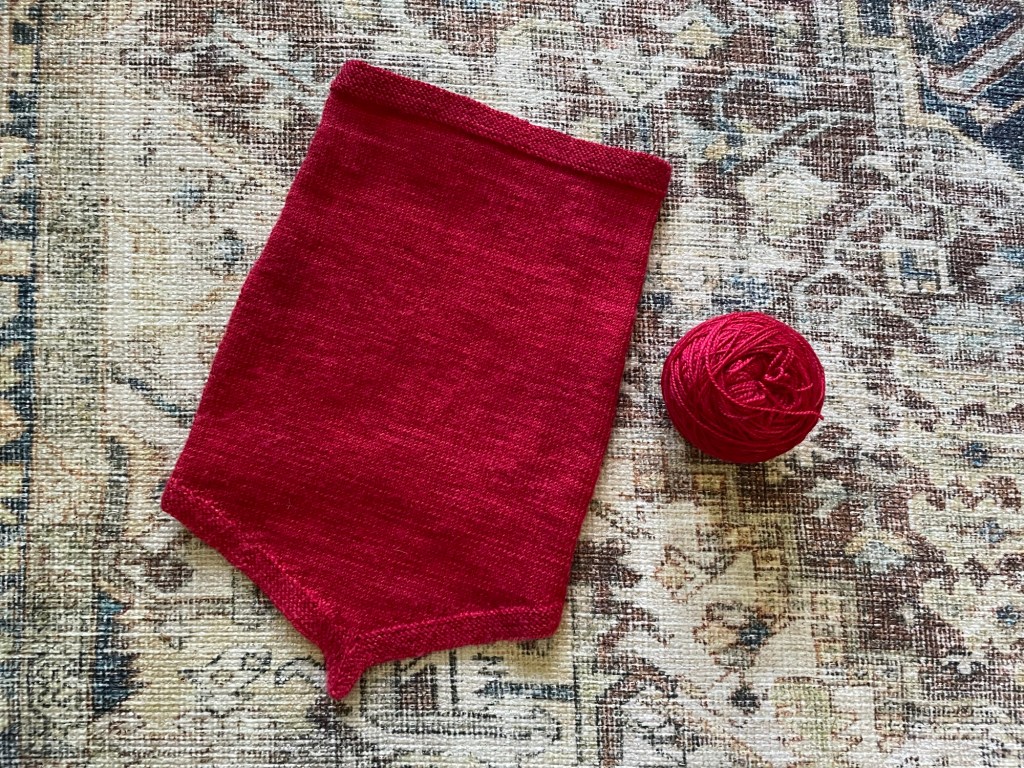
After offering to weave Betsy a new scarf, I saw a free Bandana Cowl pattern from Purl Soho that looked like it would be fun to try and maybe even be better. The pattern can be found here and also on Ravelry. I used this same pattern to knit a cowl while on the cruise trip in June. Knitted in very soft fingering weight yarn I thought it would work like the scarf she lost.

I started working on this project for Betsy last March when we were in Arizona, and actually finished it before I knit the other bandana on the cruise vacation. For various reasons I am finally posting about it now.

I had been wanting to go to Tempe Yarn & Fiber while we were in the Phoenix area last winter, but it is 30 miles from where we stay in Gold Canyon. Finally we went on an outing in that direction, when we also had time to stop there. It was a lovely shop where I found some custom locally hand dyed red merino and silk yarn that was just right for my sister’s bandana project.

Local yarn shop in Tempe, Arizona
Locally hand dyed yarn

An employee made a ball for me out of the very large and slippery skein. It took quite a while because the yarn kept slipping out of place. While waiting in the car I am sure Wayne was wondering what was taking so long.

Winding the red yarn into a center pull ball

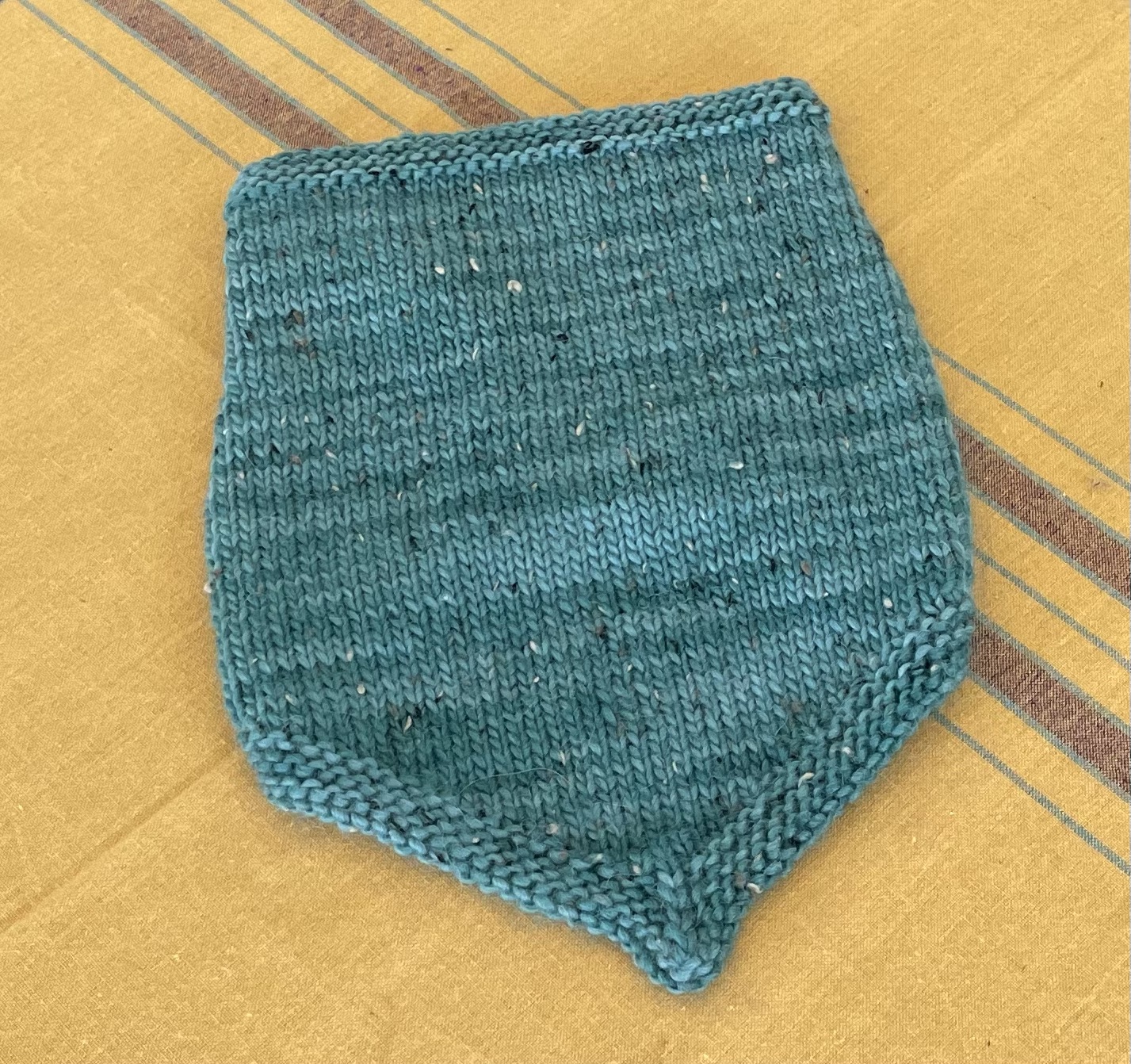
The yarn suggested for the pattern is worsted to bulky weight, but my sister preferred a very thin bandana with fingering weight yarn. I made a faux circular swatch using the School of Sweet Georgia method that involves knitting all the rows from the same direction on a circular needle, resulting in a bunch of loops on the back. I cut the loops so the sample would lie flat after I gently washed it.

Swatch made using the School of Sweet Georgia faux circular swatch method

Using the gauge I came up with, it worked out to about double the number of stitches that the pattern had. I cast 177 stitches on to my long size 1 circular needle, using long tail cast-on. Every knitter doing the long tail cast on has had the experience of running out of tail, then starting over with a longer tail, and ending up with too much tail left. As per usual I had to start over a couple of times.

After the stitches were on the needle I realized that I could not join in the round because the cord was too long, and that I had not paid attention to the length of the needle needed for the project. I am sure magic loop is possible where a very long needle is used for a small circle (like for socks), but after playing around with it I gave up.

The pattern as written requires a 16″ circular needle. In the sock weight yarn I needed it in size 1 / 2.25mm. I own an entire set of interchangeable circular needles, every size of double pointed needles, a drawer of random fixed length circular needles, and a bunch of straight needles that I never use. I had with me in Arizona the set of interchangeable circular needles and all the double pointed needles, because, you know, you might need one. My circular needle set only goes down to size 5. I did not want to drive all the way back to Tempe to buy size 1. It is available online, but it was too late to mail it to Arizona for arrival while we were still there.

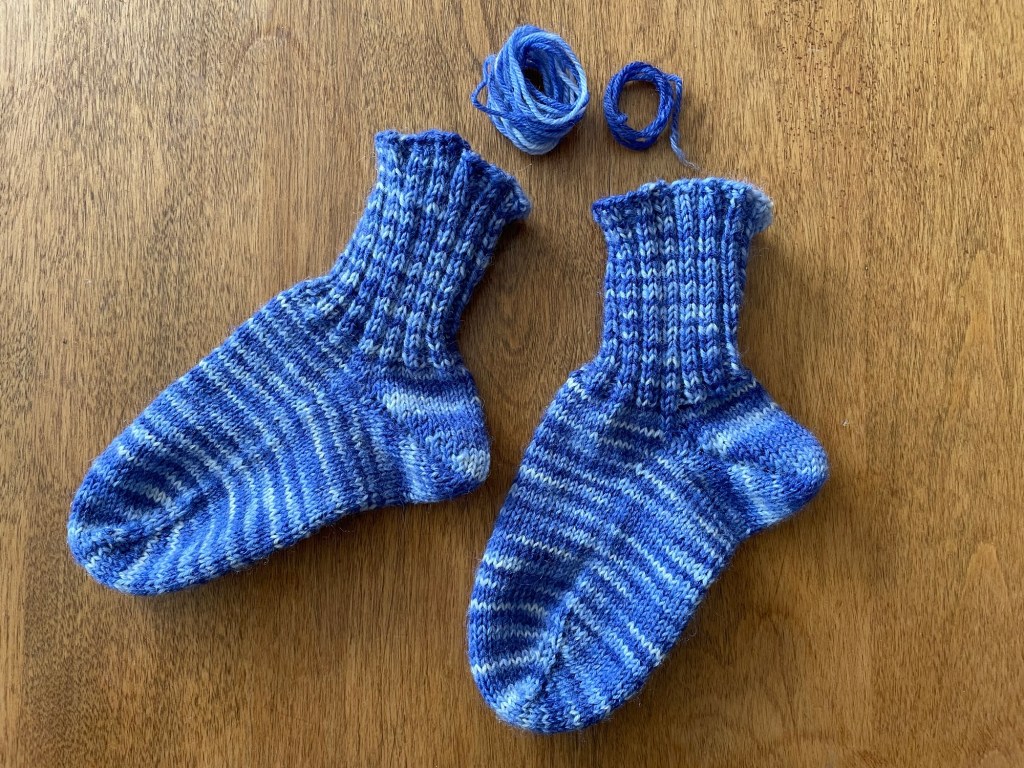
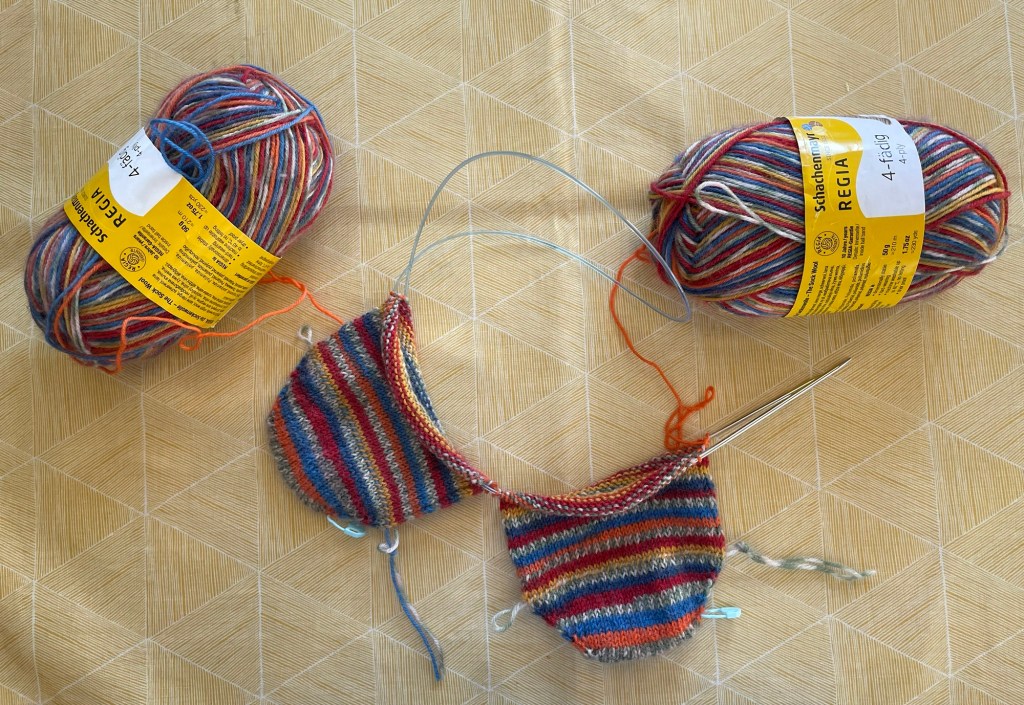
This project went on the back burner, and instead I worked on some self striping socks I had started for my son (that I finally just finished). After we got home I ordered the 16″ size 1 circular needle and started over on the bandana/cowl. The next photo shows the project cast on to the correct size circular needle.

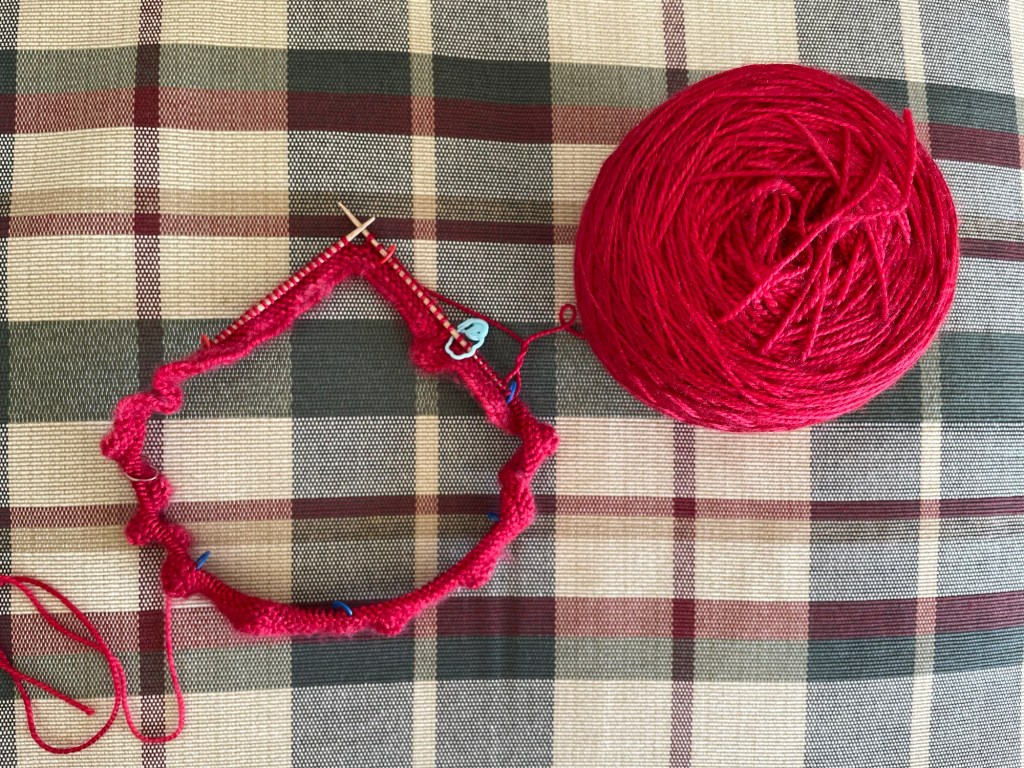
Beginning of the bandana cowl

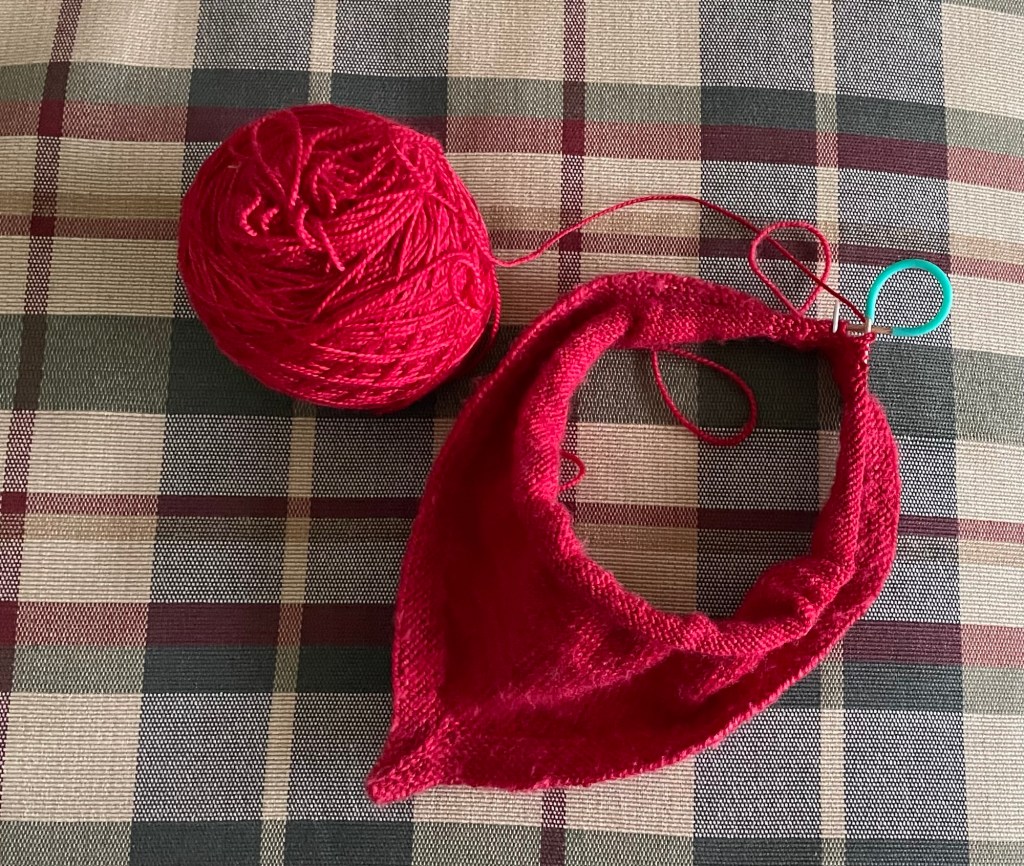
After several inches of knitting and completion of the border and next section, it was not looking right at all. I realized that the section after the border was supposed to be garter stitch, but I had been knitting in stockinette stitch. I ripped it back and did that section over. The purpose of the garter stitch border is to keep it from rolling up in addition to looking nice. It was still rolling up, but I hoped that it would lay flat after blocking, or it would be tucked in my sister’s jacket where it would not show. Following is a photo of the project after I fixed the incorrectly knitted section. It still looks different than the photo on the pattern, with the tip being more pointy.

I got the bandana almost done while we were visiting at Betsy’s house in the Twin Cities. Her cat was interested in the yarn. While we were there I put the live stitches on waste yarn so Betsy could try the bandana on to make sure it was going to fit snugly around her face. It would not be hard to make it a little narrower or wider if necessary. Luckily it was just right.

Betsy’s cat is very interested in the yarn

Back at my house I knitted more rows and took photos of the back, before and after steaming it with a pressing cloth to make the border lay flat.

The shape of my bandana does not match the photos in the pattern. There are short rows causing the pointed shape in the front. I could have figured out how to make the shape match the pattern with the thinner yarn, but by the time I noticed it was coming out differently, I decided it did not have to look exactly the same as long as it fit and worked for the purpose. Following is a photo from the pattern next to a photo of the cowl I knit on the cruise vacation, to see how the cowl looks as the pattern was written.

Photos follow of the front and back of the completed cowl adapted for the thinner yarn.

Completed cowl from the front
Completed cowl from the back

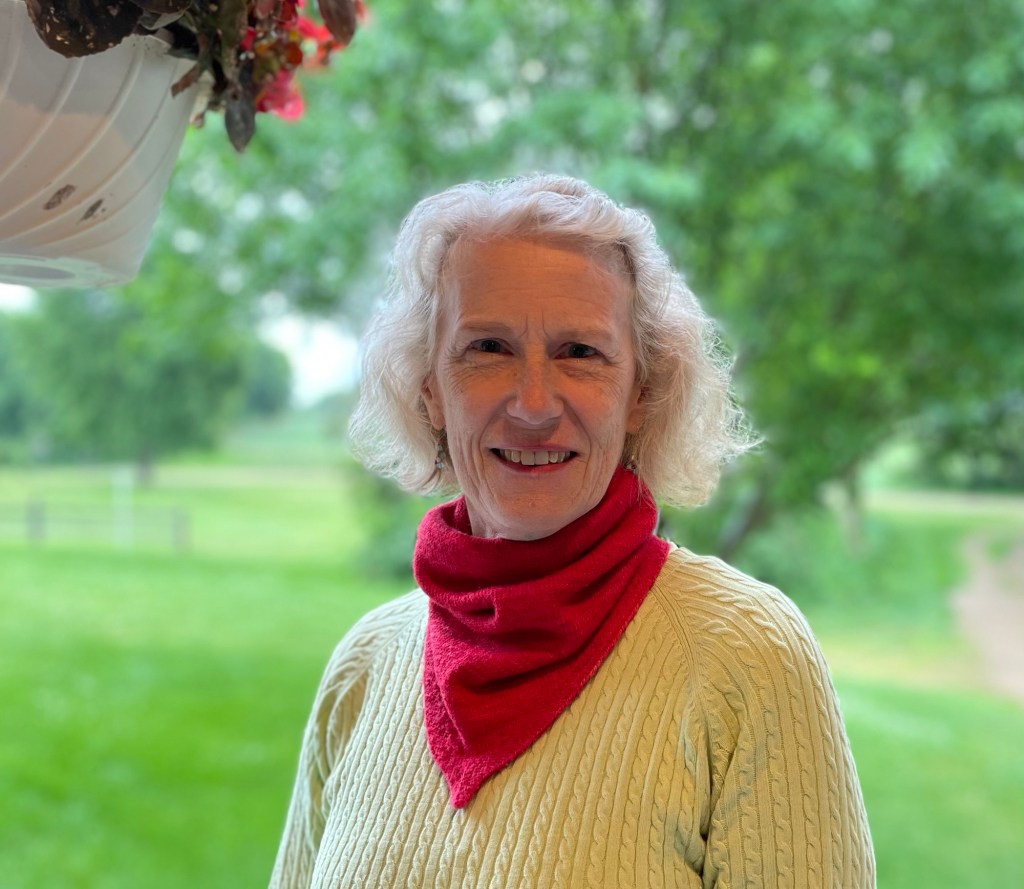
The pattern is called a “Bandana Cowl” and it has features of both of those things. What I ended up with using the thinner yarn and pattern modifications is more like this neck gaiter for sale at REI. Following are some photos of Betsy modeling the completed cowl / bandana / gaiter.

This cowl can also be used as a kerchief or head scarf.

I was trying to make an exact version of the Bandana Cowl pattern in the thinner yarn, but it turned out longer with a shallower angle at the bottom, and a pointier tip. What I ended up with for Betsy works perfectly for what she really wanted.

My daughter had also asked about a woven bandana for hiking, so that is added to my project idea list. Meanwhile I am weaving a different thing for my daughter that I am excited about. Stay tuned!

Fall Fiber Day 2024

Saturday, September 28, was fall Fiber Day at the Ellison’s sheep farm in Pelican Rapids, Minnesota. I love, love, love Fiber Day.

You never know what the weather is going to be for Fiber Day, but you do know there will be amazing people doing cool things. Joanie and Dave are wonderful and generous hosts of this semi annual event. My friend Mary Lou came up from the Twin Cities for the weekend, to visit with me and attend Fiber Day. Meanwhile, my husband and two of his fishing friends from the cities were having a guy weekend at our extended family cabin, down the road from our house.

Both spring and fall Fiber Day can be cold, wet, or windy, or any combination of those conditions. We have been having stretches of above normal temperatures here in Minnesota this fall. There was a lot of rain over the summer, but none since the beginning of September. Fall Fiber Day was dry with a high was 85 F, which is very warm for late September in Minnesota. Meanwhile I saw a report that it got up to 117 F in Phoenix that day. The southeast states were dealing with devastation from Hurricane Helene, and now there is another hurricane about to hit. I was supposed to go to Asheville with some friends in the middle of October, but that trip has been cancelled.

Whatever the weather, I love seeing so many colors and textures, and different ways people are using fiber for art and functional products at Fiber Day. I don’t know who made this beautiful needle felted “painting” that was set up on an easel in the yard.

Following are a couple of photos taken looking out over the Ellison’s property from the back yard.

Joanie’s sister-in-law had a mini class in the kitchen on knitting cuff down socks. I sat in on the class for awhile, working on a pair of toe up socks that were almost done. I got some tips for future sock knitting and enjoyed the camaraderie.

Knitting class in the kitchen

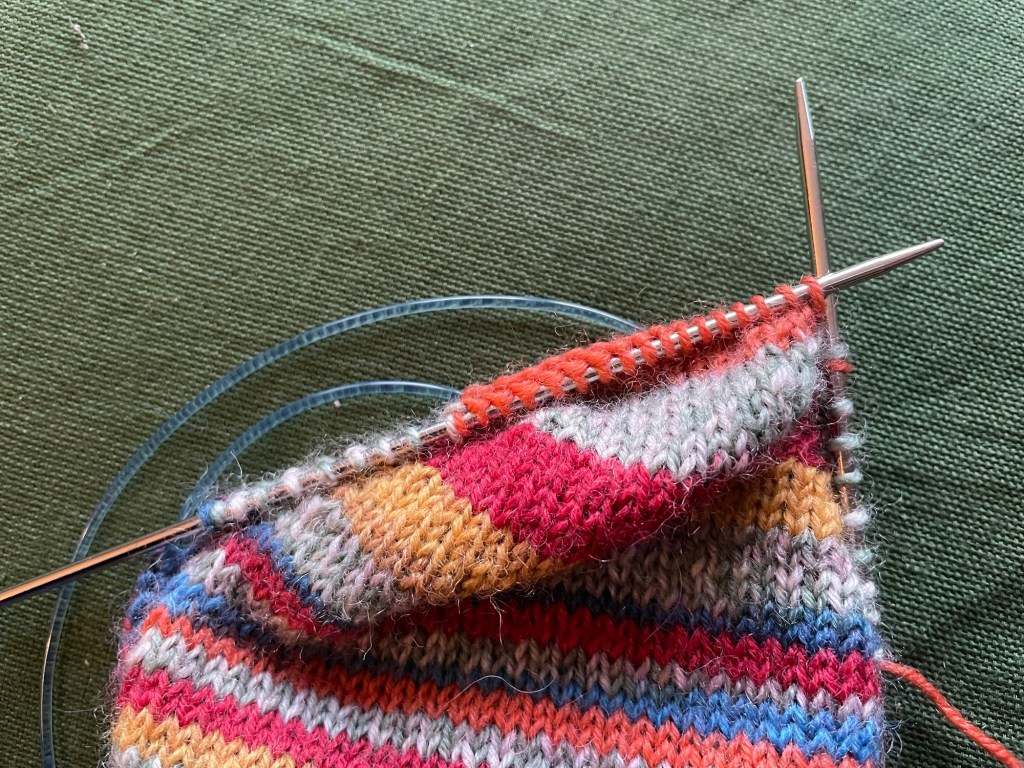
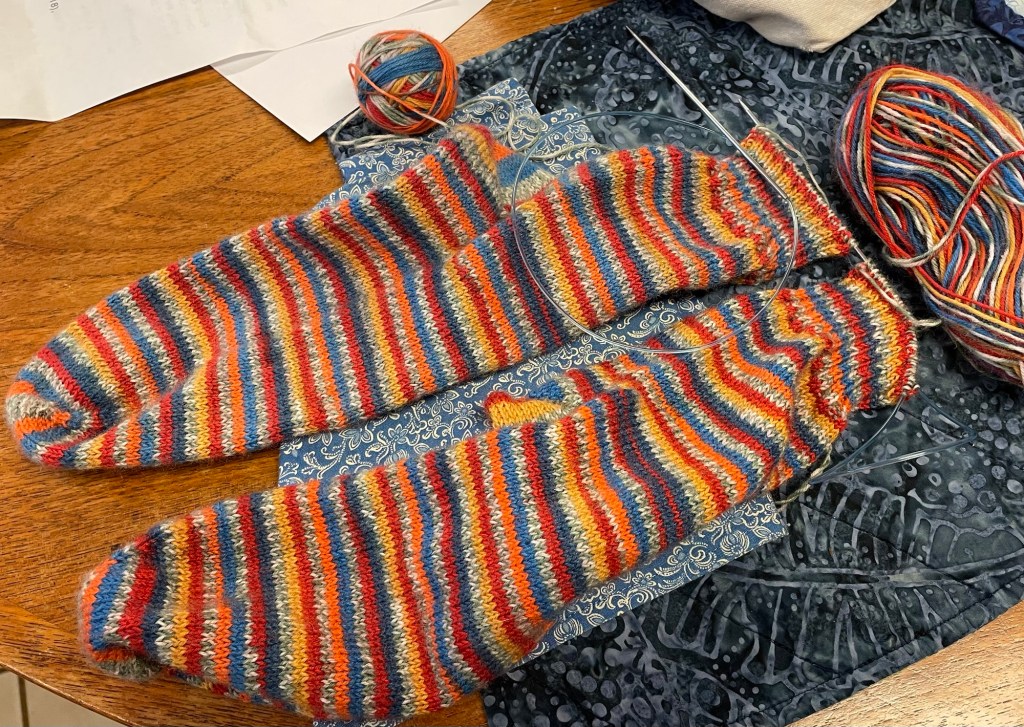
I am so close to finishing this pair of self striping socks for my son. Just a few more rows of cuff to go.

Socks for my son almost done

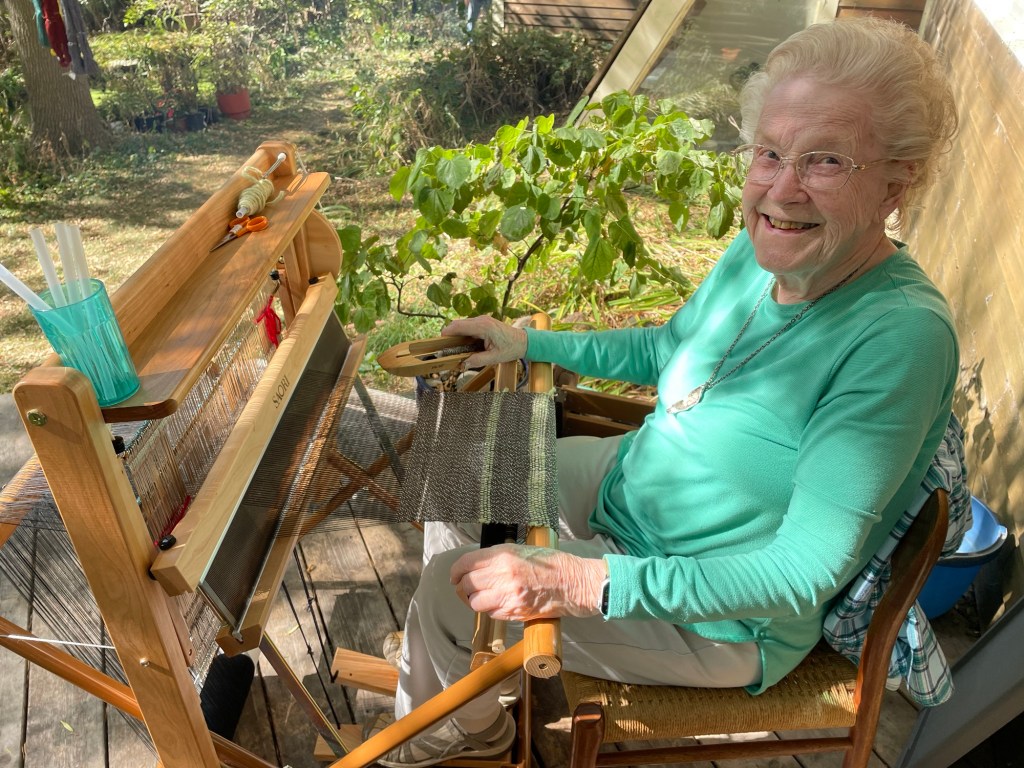
Grandma Alice, age late 90’s, was working at her Saori weaving loom on the deck. Saori looms are sort of a cross between a rigid heddle loom and a floor loom with two shafts, designed for free form art projects. Grandma Alice was working on a pretty plain weave scarf.

Grandma Alice weaving on her Saori loom

A man I did not recognize walked past with a giant garbage can lid “tray” of raw wool fleece from the Ellison’s sheep. He was going to soak it in Joanie’s washing machine to remove the dirt and lanolin. I don’t know what he was going to do with it after that.

A garbage can tray of raw wool fleece

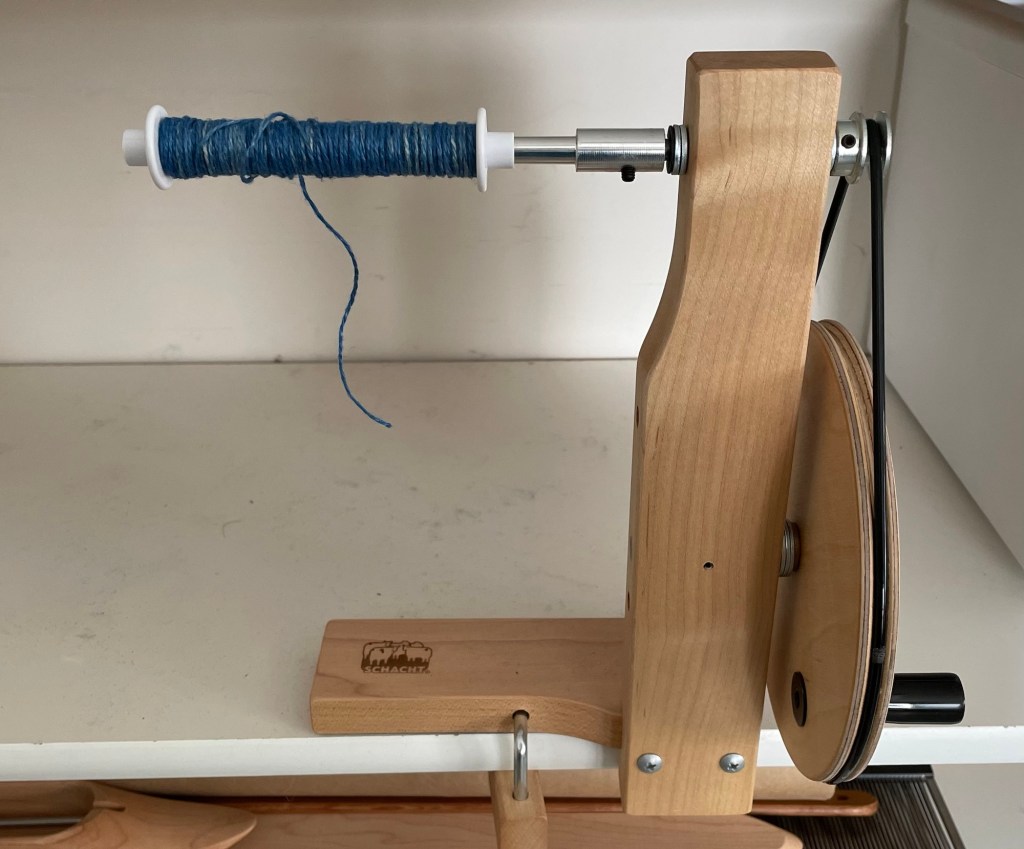
As usual, I brought my spinning wheel with a project underway. This pretty variegated blue and white batt was purchased at a Fiber Festival. Usually I card my own batts with wool and other fibers from my stash, but this ready to go batt was too tempting. I peeled off a strip from the batt for spinning.

Spinning from part of a wool batt

Last spring at Fiber Day, and again this fall, attendees were encouraged to bring hand made clothing and accessories that were not being worn or did not fit, to offer up for someone else to love and use. I brought a few items I had knitted, and some store samples that came from my yarn shop inventory purchase in 2018.

Hand made items offered for another person to love

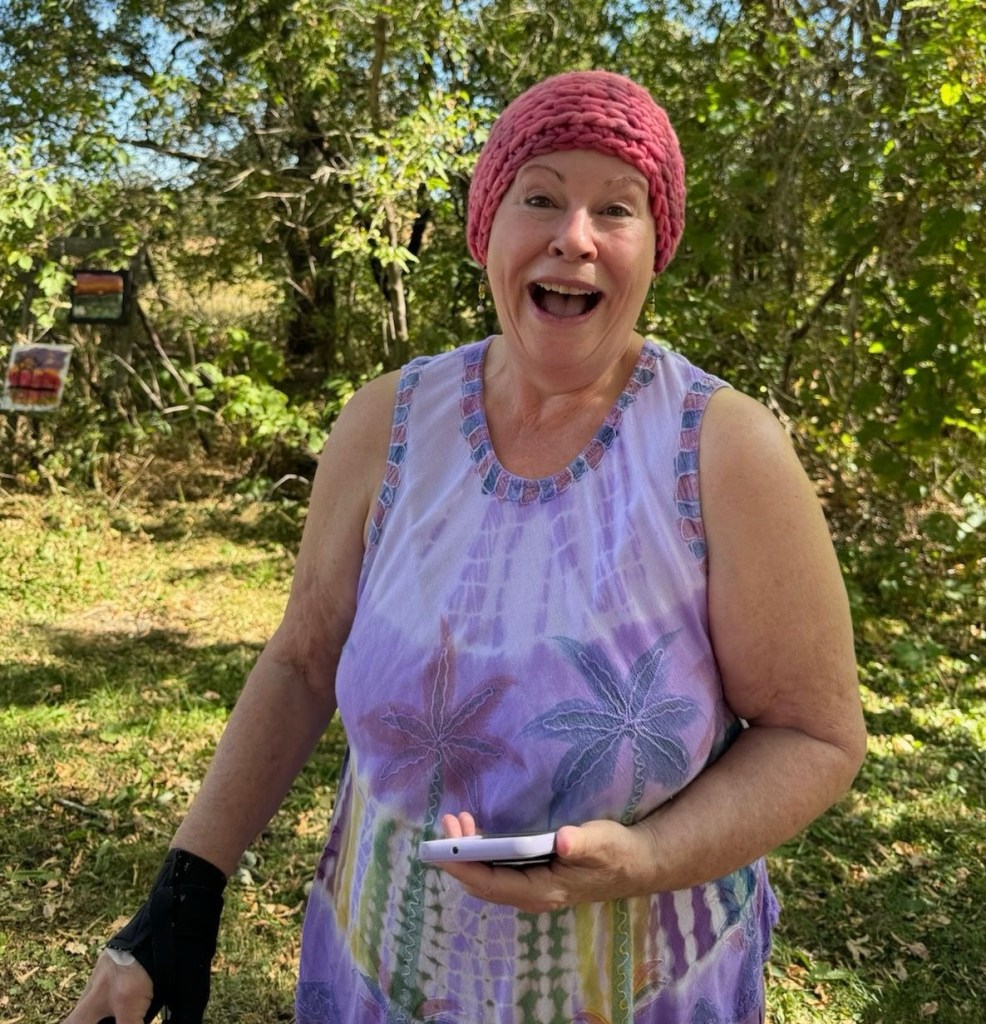
A woman I had met at Fiber Day in years past, Athena, took a headband I knit a long time ago. It did not fit or look right on my head, and was not a good color for me. She loved the headband and was so excited to have it!

A headband I knitted on Athena

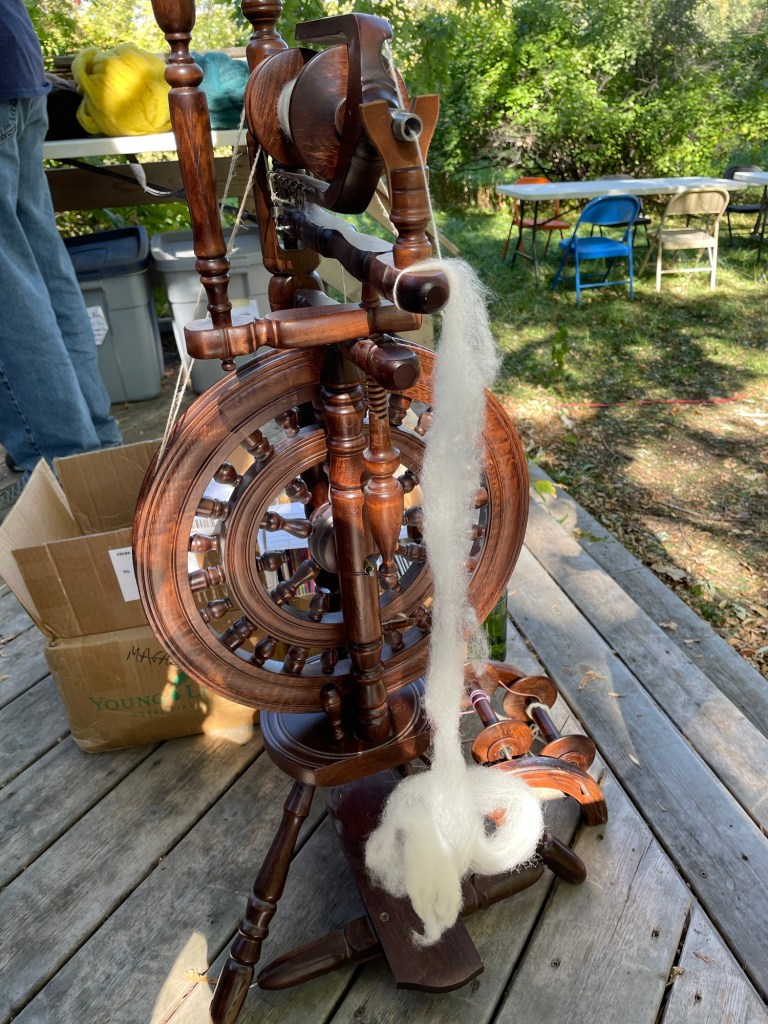
Athena brought a Kromski Minstril spinning wheel that was not right for her. It was a perfectly good wheel, but due to a knee replacement she was having trouble using it. She bought a different spinning wheel that worked better for her, and was offering this Kromski wheel up for free. A year and a half ago my cousin’s young adult daughter, Chelsea, had come to spring fiber day. She was a prolific crocheter, and was very interested in learning to spin. I gave her some instruction on my spinning wheel and she caught on right away. Chelsea wanted to have her own wheel, but a new one is expensive and it can be hit or miss finding a good used spinning wheel. I texted Chelsea right away to see if she wanted this wheel, after spinning on it myself to make sure it would be suitable for her. Chelsea said Yes, so I brought it home. She is super excited and I will bring it to her in the Twin Cities the next time we go there.

Kromski Minstril spinning wheel

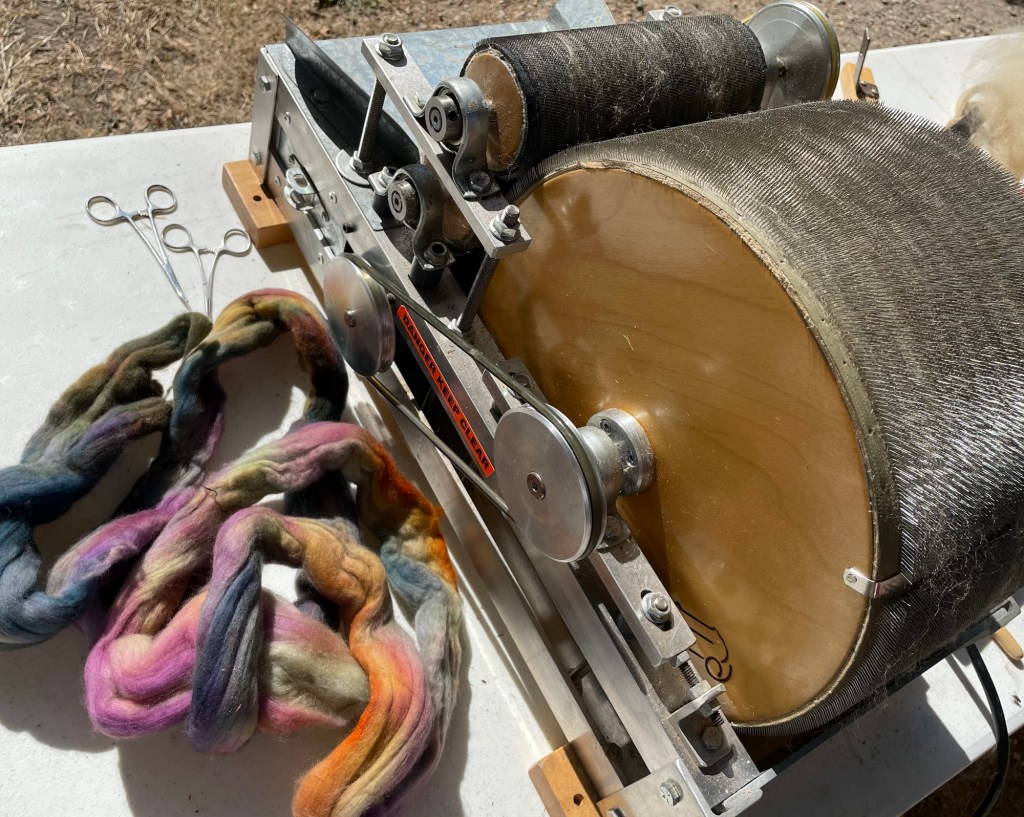
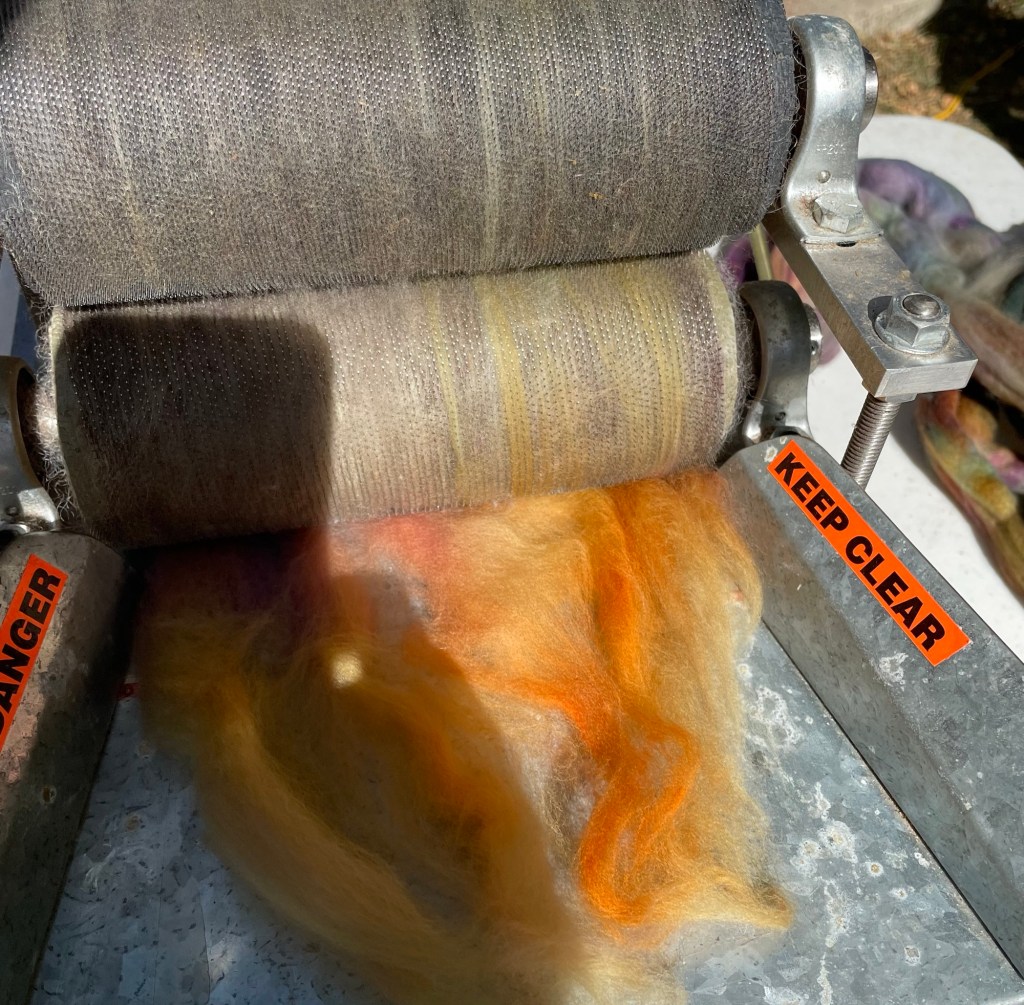
Usually at Fiber Day I use the big electric drum carder to blend wool and other fibers into batts for spinning. I already have a lot fiber that is prepped to spin, but I had another idea. I have been working (for a long time) on spinning a commercially prepared hand dyed “braid” of merino wool. It is beautiful but requires quite a lot of unfolding, fluffing out, separating, and pre-drafting in order to spin without major frustration. I thought maybe if I ran it through the drum carder that would get it in a better state for easier spinning.

Ready to card some merino wool braid

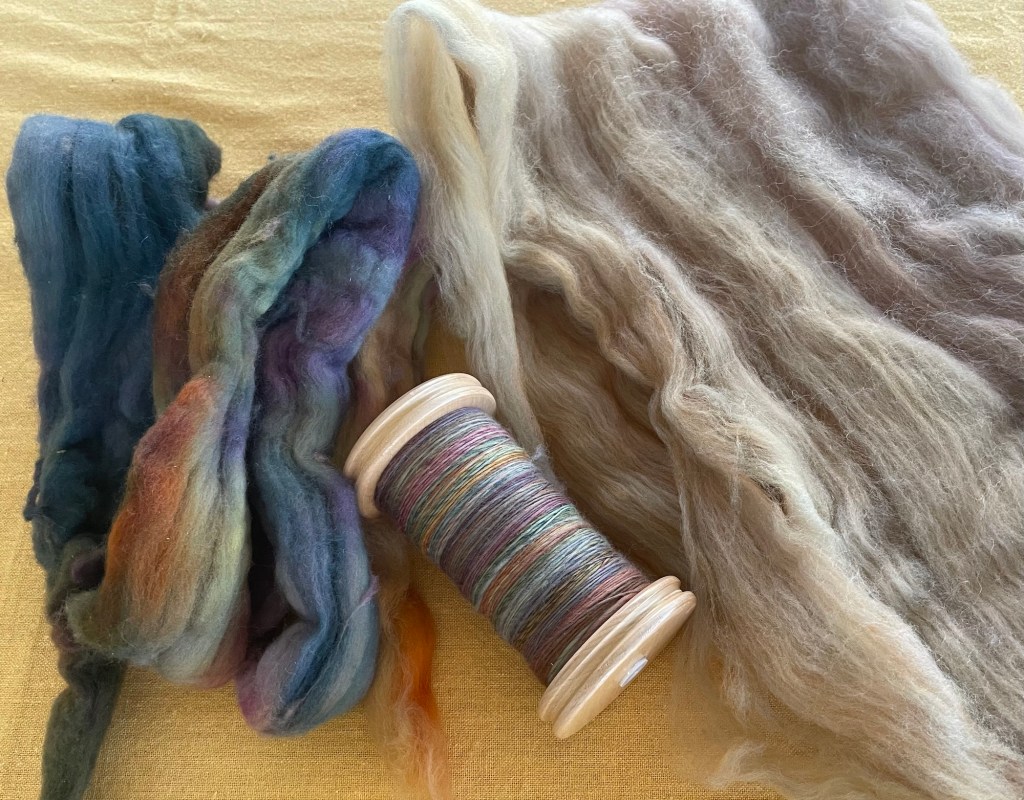
After a short time I decided not to continue carding the pretty braid. In order to feed the wool through the machine, I had to unroll, fluff, and separate the fiber. After that it was almost ready to spin and did not need to be run through the drum carder, and I did not like the way the batt was looking. The beautiful colors were all melding together into a grayish tan with some yellow. Also it was too hot standing in the direct sun where the drum carder was set up. The following photo was taken later back at my house, showing some of the original braid, one bobbin of it that I had already spun, and the part that I ran through the drum carder. It looks more gray in the photo than it really is, and there is more yellow.

The original braid, a bobbin full of singles spun, some of the braid carded

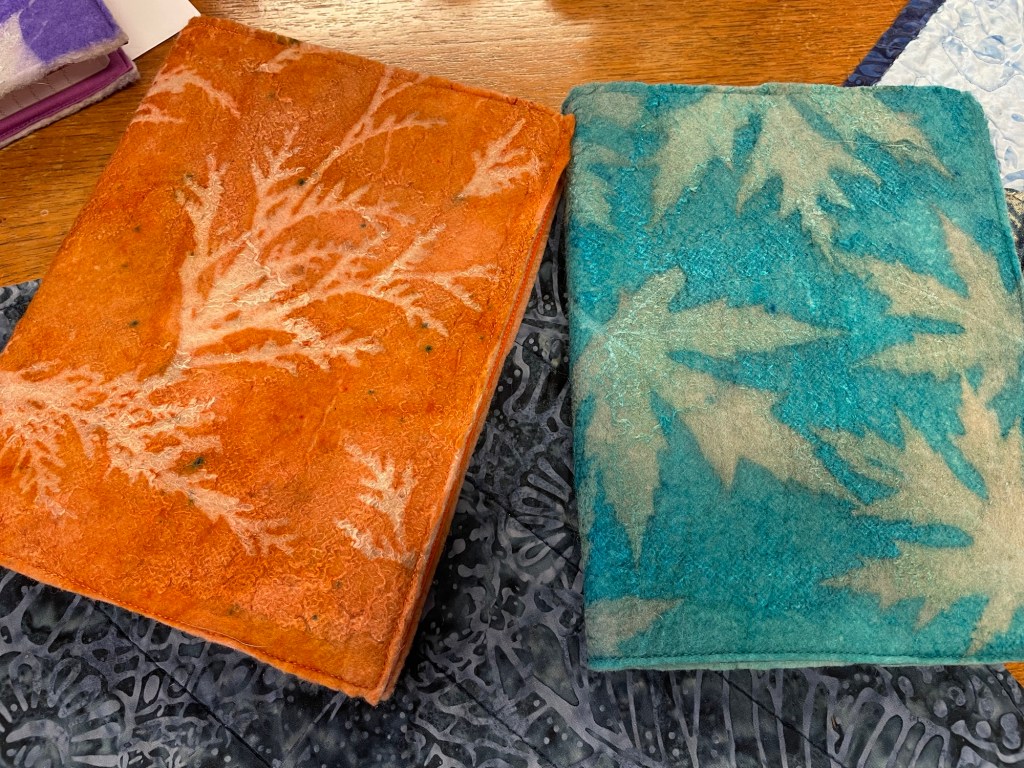
Someone brought these felted notebook covers for show and tell at Fiber Day. I don’t know how they got the leaf designs on, but they are so pretty!

A group of musicians had a jam session in the living room.

Sometimes I do a dyeing project at Fiber Day. There are dye pots over a fire, ready to go for dyeing wool and other animal fibers. Joanie has fleece and yarn for purchase, along with supplies for dyeing. Last time I dyed some 100% linen yarn in jars using cold water, with the right type of dye for that. I did not feel like doing any dyeing this time. I was busy enough with my spinning, knitting, a bit of carding, and visiting with people.

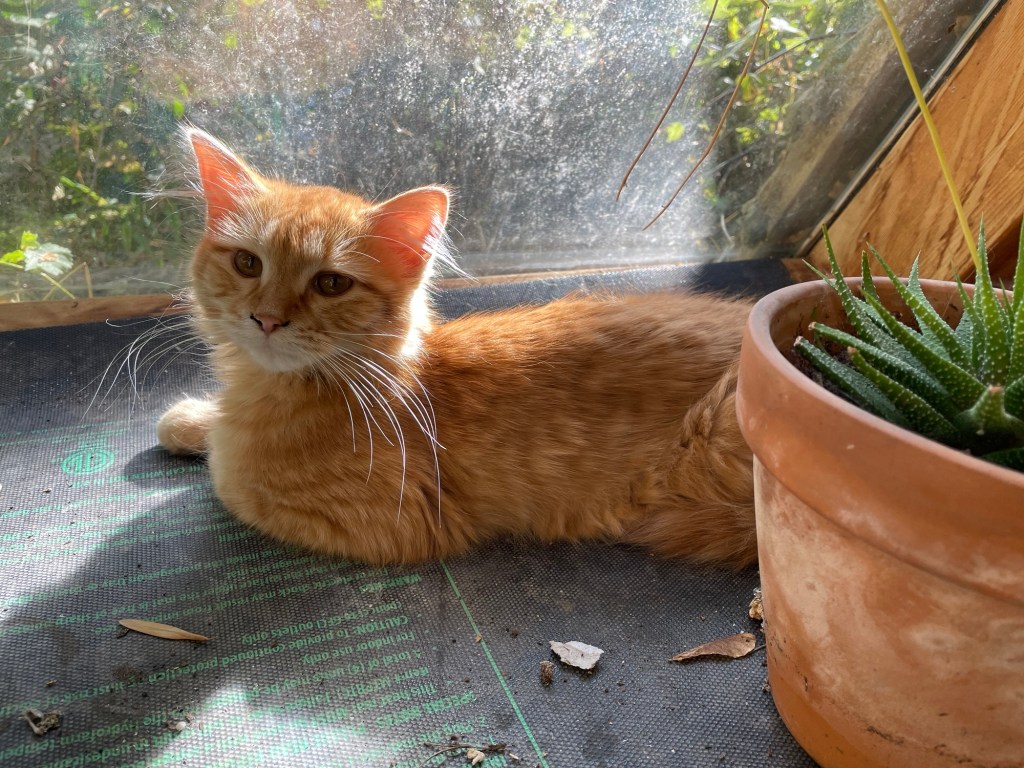
This young cat was hiding in a window well. I bet her fur would be lovely blended with some wool fiber.

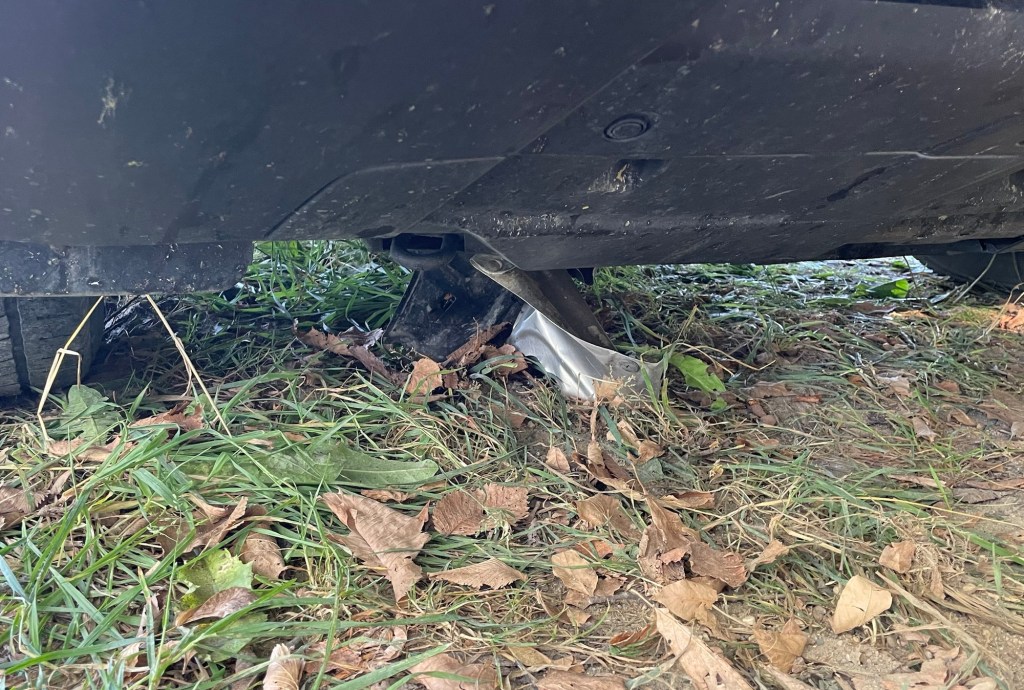
At the end of the afternoon I went to get my car from where it was parked in a field down the long driveway. As I started to drive the car toward the house to load up all the stuff we had brought with us, there was a terrible scraping noise. It turned out there was a big mangled piece of metal hanging off the underside of the car near the front. I was worried that I was going to have to call AAA, and have Wayne come and get us. I backed up so I was not blocking the driveway and walked back to the house to consult with Dave Ellison. Dave figured out that a “heat shield” had come loose, and he was able to unscrew what was left of it and get it off. He assured me there was no problem driving the car without the heat shield. We agreed that it must have already been loose before it caught on something when I drove the car on the field.

A piece of mangled metal under the front of my car

I was worried Wayne would give me a hard time about driving on that field and doing a bad thing to the car, but he understood the situation and had an idea about how and when the heat shield had come loose.

The piece of metal in the trunk, after being removed from under the car

The rest of the weekend was relaxing, hanging out with my friend and working on our projects. Knowing that Wayne was at the cabin with his friends, and with Mary Lou visiting, I could call it a fiber retreat. Whatever chores I might have been doing were happily postponed that weekend.

Click here for a link to my post about Spring Fiber Day 2024, when I did some dyeing, and carding on my blending board.

Scotland Trip Part 4 – London and Back Home

This post is the forth and last about our trip to Scotland and England in July, which happened because my husband got tickets to the final round of the British Open golf tournament at Troon.

So many things have happened since then. It is already fall, and I am glad to be wrapping up this series of posts. My first Scotland trip blog post, about our time in Glasgow at the beginning of the trip, can be accessed here. The second post about our tour of Outlander filming sites, can be accessed here. The third post about our time in Edinburgh can be accessed here. This last post is about our time in London at the end of the trip, and getting back home.

Honestly, I was not excited about going to London. I was there once a long time ago, and I would have preferred spending more time in Scotland. Because Wayne had never been to London, I was willing to tack it on at the end of the Scotland trip so he could check that off his bucket list.

The train ride from Edinburgh to London took a little over four hours. We were on our own, as the rest of our travel group went back home from Scotland. The train route passed pretty scenery, and stopped in some towns along the way.

View out the train on the way from Edinburgh to London

Our hotel in London was a Travelodge near King’s Cross Station. The building was old and historic looking, and not what you imagine when thinking of a chain hotel. The location was great and it worked for our needs, but there were a couple of odd things about it related to being an old building. We had to go through a maze of hallways to get to our room using our card key twice, taking the elevator to floor three and then going down half a flight of stairs. There was not any air conditioning, so we had to keep the window open. I liked having the fresh air and the temperature was comfortable, but there was a lot of urban traffic noise on the street below our room. There was a note in the bathroom about keeping the door shut when taking a shower to avoid setting off the smoke alarm. They needn’t have worried, the water in the shower was luke warm.
Our Travelodge Hotel

The last goofy thing about the hotel was that after I took a shower and washed my hair at 9:30 pm the first night, I could not find a blow dryer in the room. My hair dries pretty fast, but normally I spend a few minutes with a blow dryer and round brush. Going to bed with damp hair meant that the next day I was going to have a very interesting hair style. Later I asked the attendant at the hotel lobby about it. She said that if you are on the forth floor you get a blow dryer, but otherwise not, and that I could have asked for one. That seemed very strange to me, and by this time I did not need one any more.

We had some time to walk around in the afternoon and evening after checking in. I am not good at directions and did not have anything in mind to do. I was happy to follow Wayne’s lead as we headed towards the Thames river, not sure how far we would go. Following are a couple of photos I took while we were out and about.
London double decker red bus
A red phone booth

We walked through the Theater District. If we had made it a priority, I am sure we could have found last minute tickets for one of the shows.

The Theater District

We walked through a nice outdoor shopping mall with stores and restaurants called “The Brunswick Shopping Centre”. We ended up finding a place to eat dinner there later.

Brunswick Shopping Centre

Our route took us into the Covent Garden neighborhood and through a farmers market in a historic looking building. We saw the iconic red phone booths everywhere.

Covent Garden Market (farmers market)

We walked through Trafalgar Square and past the National Gallery in the Charing Cross area.

Trafalgar Square, with the National Gallery in the background

We kept on on thinking “we’ll go a little farther as long as we are in this area”. We ended up walking all the way from our hotel to the River Thames and back. I am not sure of the exact route we took, but the following map shows that is about three miles one way.

I had done zero research on how we might spend our limited time in London. Since it was Wayne’s idea to go there, I was happy to let him come up with a plan. We decided to buy tickets to the Hop On Hop Off tourist bus for the next (and only) full day of sightseeing. It was not cheap, but after walking over 16,000 steps the first day, it seemed like a good idea, and would allow us to hear some commentary while getting around.

We realized that King’s Cross is the train station used in the Harry Potter story. In the morning, before catching the sightseeing bus, we had enough time to go inside the station to see some Harry Potter tourist displays. There was a luggage cart halfway in the wall heading for Platform 9 3/4. People were standing in a line waiting to get photos standing next to it. We did not have the time nor interest for waiting in the line, but we got this photo standing nearby (after an employee waived us farther away from the display). There was a gift shop with Harry Potter merchandise and a few other displays around the station.

Harry Potter luggage cart heading for Platform 9 3/4

Several people had recommended that since we only had one full day there we should see the Tower of London. Wayne bought tickets ahead of time. Of course I had heard of the Tower of London, but I did not really know what it entailed. In my head (and in my ignorance) I imagined one tall tower. In actuality there is an entire complex including a huge palace and fortress. Following is a map since it is hard to get a feel for the whole place from a few photos.

Map of The Tower of London site
The Tower of London

We joined a tour group guided by a “Yeoman Warder”, also known as a “Beefeater”. Yeoman Warders have been guards at the Tower of London for hundreds of years. Although the Beefeater position today is ceremonial, all are retired non-commissioned officers of the British Armed Forces with at least 22 years of military experience.

Our Yeoman Warder tour guide at the Tower of London

The White Tower building in the middle of the complex was built by William the Conqueror in 1078. This is where Elizabeth I and others were “sent to the Tower” in the 16th and 17th centuries.

The White Tower

We waited in a long line to see the Crown Jewels that have been kept at the Tower of London since the 13th century. It was kind of a blur walking past all the items, and photos were not allowed. On display are gem stones, an 800-year-old coronation spoon, some crowns worn by royals, and thousands of diamonds. The collection includes the Koh-i-Noor 105.6 carat diamond that originally came from India thousands of years ago. Click here for an article from Smithsonian Magazine with information about the controversial history of this diamond, including how it came to be in possession of the British in colonial times. Maybe it is time to give it back?

Living quarters inside the Tower of London

There is a “secret” entrance from the river.

There was a lot of interesting information and history provided by the Yeoman Warder tour guide, but I cannot remember much of what he said. After leaving there, we got on a tourist boat that was part of the Hop On Hop Off route. It was a good way to get a boat ride and see the sights from a different vantage point, and also get us to the area where Buckingham Palace is located. We saw two famous bridges across the Thames from the boat. Following is the “Tower Bridge” which is near the Tower of London. This bridge is what people think of when singing the children’s song “London Bridge is falling down”.

The Tower Bridge

The other famous bridge we saw is actually called the London Bridge, but is a contemporary style, and does not make one think of the nursery rhyme. There have been different bridges here for 2000 years. The one from 1831 until the late 1960’s was purchased and moved to Lake Havasu City, Arizona. It was replaced in London with what you see today, in the photos below.

The London Eye, viewed from the tour boat across the river, is the tallest “Cantilevered Observation Wheel” (fancy term for an enclosed Ferris Wheel) in Europe at 443 feet tall (135 meters). It opened in 2000 as a temporary exhibit. Later it was granted permanent status and is now the most popular tourist site in the United Kingdom.

The London Eye Ferris Wheel

There are many tourist sights within easy walking distance of Buckingham Palace. In addition to the Palace, there is Westminster Abbey, St. James Park, Big Ben, Trafalgar Square, the National Gallery, and Piccadilly Circus.

Westminster Abbey
St. James Park

The Mall runs parallel to St. James Park, ending at Buckingham Palace. There are photos and videos of Queen Elizabeth and other royals in parades on the Mall with throngs of people crowding the sidewalk. I got a photo of Wayne standing on the Mall with Buckingham Palace in the background, minus crowds of people and with no royals anywhere.

On “The Mall” next to St. James Park, with the Palace in the background
Buckingham Palace and the Queen Victoria Memorial

The bus back to our hotel took us through the Piccadilly business area and other neighborhoods. After resting and freshening up, we headed back out for dinner. Wayne had some kind of meat pie for his last dinner of the trip.

A day and a half was enough time for us to see some of London. I had been intimidated thinking about navigating around in a big city. There were a lot of people everywhere, but the main tourist sights were easy to get to and clustered in a couple of areas.

The next morning we took the subway to the airport. Our direct flight from London Heathrow to MSP was uneventful. On the return flight I worked on the second Sofie Scarf that I started at the beginning of the trip. This time I knew I had enough yarn, so I did not have to worry about running out before I finished the project.

Knitting on the airplane

It was late afternoon central time when we arrived back in Minnesota, late evening London time. Our son picked us up at the airport and brought us back to his house, where our car was parked. We both wanted to get home, and Wayne was worried about how tall the grass was going to be at our house. He loaded up on caffeine drinks and we made the 3 hour drive to our house in West Central, Minnesota.

Before we left for the trip, the produce in our small garden was starting to grow. When we got home there were tons of green beans. Every possible bud had a bean on it that was ready to pick. We could not eat it fast enough and I had to give some away.

Green beans ready to pick when we got home

There were also some cucumbers ready to pick, but I swear I did not plant any cucumbers. What I remember is making only two mounds for the zucchini and planting fewer seeds per mound than last year, when we got way too many. I was trying to keep the garden manageable. We did plant cucumbers two summers ago. I don’t know if I actually did plant cucumber seeds, or if there were some dormant seeds in the ground that grew.

Surprise cucumbers in the garden

After we were home I finished knitting the Sofie scarf.

This Sofie Scarf is the correct shape with a point in the middle, as opposed to the orange one I made earlier when I had to improvise due to not having enough yarn.

Following is the obligatory Sofie Scarf photo in a roll shape.

After the usual transition period following a big trip we were busy with guests and summer activities. When my sister Betsy visited she modeled the Sofie Scarf.

The Scotland and London trip were two months ago already, and I am very glad to be done posting about it.

Scotland Part 3 – Edinburgh

This post is the third in a series about our trip to Scotland in July, which came about because my husband got four tickets to the final round of the British Open golf tournament at Troon. It seems like ages ago already, good thing I took notes about what we did each day. My first Scotland trip blog post, about our time in Glasgow at the beginning of the trip, can be accessed here. The second Scotland trip blog post, about our tour of Outlander filming sites, can be accessed here.

On our last day in Glasgow, my husband Wayne and our son James used a rental car to go golfing. They returned the rental car in Edinburgh, after dropping off all of the luggage at our lodging there. Wayne’s friend Keith went back home after the golf tournament and other activities in Glasgow. I took the train from Glasgow to Edinburgh with Ingrid, our Swedish friend and former au pair, and my daughter-in-law Kelsey with our granddaughter Blair.

We all had positive experiences using trains and buses to get around on this trip, only using rental cars a couple of times. However, there was a little mix up when buying the train tickets out of a machine in the Glasgow train station for the ride to Edinburgh. We thought we were buying three adult one way tickets. As they started coming out of the machine we grabbed three, not knowing that our purchase included six tickets, with a return ticket for each of us that we did not need. When the conductor (is that what they are called?) came around on the train to punch our tickets, he said that mine was not valid. At first we thought he was joking, and then we explained and protested, but he made me buy another ticket. We finally figured out that one of the three tickets we had taken from the machine was a return ticket. Oh well, we got to our destination, and it could have been worse.

Our Airbnb was a 10 minute walk from the train station, conveniently located less than two blocks from the Royal Mile, the main drag in Old Town Edinburgh. It was a small two bedroom apartment that came with a porta crib and highchair. Being on the third floor with no elevator, we got our exercise climbing up and down the stairs, in addition to a lot of walking around sightseeing.

The first afternoon in Edinburgh we scoped out the area. Following are a couple of random photos.

Edinburgh
Edinburgh
The Canongate Tolbooth, built in 1591

On our second day in Edinburgh some of us did a Harry Potter walking tour. I am one of a few people who have not read the Harry Potter books. I have seen a couple of the movies, so I know what the general story is and who the main characters are. The tour included information on the author, J.K. Rowling, sites in Edinburgh that are related to the books, and about Edinburgh in general.

I don’t remember everything from the tour, and some of the details about the book went over my head. I do remember that J.K. Rowling had split from her abusive husband and had a restraining order against him. She went to Edinburgh with her infant daughter to start fresh. She would walk around with the baby in a stroller, and when the baby fell asleep she would go in whatever coffee shop was nearby and work on her writing. It was a tough time for her. When the manuscript was finished it was rejected by 12 publishers before finally one bought it. They encouraged her to use her first initial instead of her first name, because they thought that the expected audience of young boys would not buy a book written by a woman.

The Elephant House, one of the coffee shops where J.K. Rowling spent time writing, while sitting in the back looking out over Edinburgh Castle, is sometimes considered the birthplace of the Harry Potter series. Actually, she had already started writing the first book before she came to Edinburgh. The original location had a fire and is under renovation. We walked past the current location on Victoria Street.

Kelsey and Blair in front of the Elephant House cafe

Victoria street is a picturesque winding street off the Royal Mile that became the inspiration for Diagon Alley in Harry Potter. It is a UNESCO World Heritage Site.

Victoria Street, the inspiration for Diagon Alley in Harry Potter

There was a lot of fun art inside the Elephant House cafe, including this painting that gives a better image of Victoria Street than my photo.

Artwork of Victoria Street inside the Elephant House Cafe

The next photo was taken while we were waiting for the Harry Potter tour to begin. Blair wanted to have whatever beverage the adults had, so occasionally she was holding an unopened can of something (possibly even beer), or an empty paper coffee cup. She also waved at every statue we passed on the streets.

We spent quite a bit of time on the tour at Greyfriars Kirkyard. Some of the Harry Potter characters were inspired by names on the gravestones.

At Greyfriars Kirkyard

It is said that George Heriot School, which can be seen from Greyfriars Kirkyard, was the inspiration for Hogwarts, but J.K. Rowling has said this is not true.

George Heriot School behind Greyfriars Kirkyard

J.K. Rowling’s handprints are in the sidewalk at the Edinburgh City Chambers.

J.K. Rowling’s handprints in the pavement

The Harry Potter tour included information on the Grassmarket, an area of shops and restaurants in the Old Town. It has been one of the main marketplaces in Edinburgh since 1477 (according to this Wikipedia article). At that time it was a livestock market with a pasture at one end where horses and cattle grazed.

Edinburgh Grassmarket

The tour guide told us about “Half Hangit Maggie”. In 1742 Maggie Dickson worked at an Inn after her husband had left her. There are various stories about where he went and how the rest of the story played out. Anyway, she was tried for hiding the fact that she had a baby, possibly with the son of the Inn keeper. She was hanged for her crime at the Grassmarket. However she was not actually dead and woke up inside the coffin on the way to the graveyard. Having been hanged she could not be tried again, so Maggie was now a free woman. After this the law was changed so that a person must be hanged “until they are dead”. Maggie lived for another 40 years. I found an interesting article with more details and versions of this story and life in Edinburgh at that time. Click here if you want to learn more.

I had a hard time getting a good photo of the Grassmarket. I found an image online of a beautiful watercolor painting by Henry G. Duguid, currently at the National Gallery of Scotland, that shows what the area would have looked like in 1850, with Edinburgh Castle in the background.

Watercolor of the Grassmarket by Henry G. Duguid, 1850

That afternoon we all paid for entrance to Edinburgh Castle, which is on a hill at one end of the Royal Mile overlooking the city. It is quite impressive

Edinburgh Castle

There was a painting displayed inside the castle from 1750, which again gives a better representation of the whole thing than my photos.

A painting of Edinburgh Castle from 1750
Edinburgh Castle
Edinburgh Castle

St. Margaret’s Chapel, built in 1150 and named for Queen Margaret, is the oldest building in Edinburgh Castle. It was small with pretty stained glass windows. My name is Margaret so I had to include some photos.

Inside St. Margaret’s Chapel
Stained glass window in St. Margaret’s Chapel

That evening we had dinner at Edinburgh Street Food, an upscale food court. According to their website they are “a bold and eclectic foodies paradise filled with the best independent traders in Scotland”. It worked well for us to each order the type of food we wanted, and to sit outside where birds could eat the food Blair tossed off her placemat.

Dinner at Edinburgh Street Food

The next day Wayne took the train by himself to St. Andrews, the birthplace of golf. James would have enjoyed going, but he was a good husband and dad, and stayed back with Kelsey and Blair. Wayne was amazed to find out that the famous golf course at St Andrews is open to the public, and even has a walking path that follows the entire course. The next photos are a very scenic photo he took on one of the holes, and his beverage in the clubhouse after walking the entire course.

One of the holes at the St Andrews golf course
Wayne’s beer in the clubhouse at St Andrews

While Wayne was on his outing, the rest of us went for a walk to a playground in Edinburgh. On the way we passed the Palace of Holyroodhouse at the other end of the Royal Mile. The British Royal family stays there when in town, but if they are not in residence it is open for tours. We saw the outside but did not do a tour. We thought we were going to end up near Dean Village, a neighborhood with picturesque architecture and an interesting history of water mills. Somehow that was a different direction and soon it was time to get back for Blair’s morning nap.

Near the Palace of Holyrood House
Palace of Holyroodhouse

While Blair was napping I did some shopping. All along the Royal Mile there were dozens of stores selling stacks and stacks of Harris Tweed products (scarves, bags, gloves, blankets, throws, shawls, etc). Harris Tweed wool fabric is spun, dyed and hand woven in the Outer Hebrides in the north of Scotland. I had read about a place near the castle that was supposed to have looms weaving fabric in the lower level with a viewing area. Wayne and I went in there before the castle tour, but it was very touristy and the weaving on the lower level had been discontinued. I had scoped out two shops near our Airbnb that had really nice textile products, so I bought a couple of items from them. I bought a skein of yarn from one of the shops that matched a throw blanket on the sofa in the Airbnb.

A souvenir skein of yarn

The other shop where I bought several things was called Scottish Textiles Showcase. They had products from some specific makers around Scotland. Note the green wool coat in the lower right of the following photo.

The next photo shows the items I bought at the Scottish Textiles Showcase, including a another skein of yarn, of course. I also bought three small bags made by the shop owners out of Borders Tweed fabric woven in Langholm, Scotland.

My souvenirs from the Scottish Textile Showcase

Kelsey, Blair and I had been in this shop together earlier. Blair modeled a wool headband.

After I was done with my shopping, Kelsey went out on her own while Blair was still sleeping. She came back with a wool coat. The same one that you can see in the window in my photo above!

After Blair’s nap was over we walked to the National Museum of Scotland where there were two different interactive play areas for children, along with many other typical museum displays. While James and Kelsey were busy with Blair, Ingrid and I saw Dolly the Sheep, the first mammal cloned in 1996 in Scotland. I assume this display is the actual sheep, which seems a little creepy to me.

Dolly the Sheep

We went through an exhibit on life in 18th Century Scotland. That time period is when Outlander takes place, so Ingrid and I thought it was especially interesting. I enjoyed seeing the following weaving loom and spinning wheel.

There was another fun exhibit of clothing throughout the years, another one of my interests. We all needed a dress like this for social distancing during covid.

For our last dinner in Edinburgh James and Kelsey had a date night, while Ingrid and Wayne and I stayed with Blair.

Date night in Edinburgh

After James and Kelsey left for dinner, Ingrid and I went out in search of some take out food to bring back to the Airbnb. We thought it would be appropriate to get dinner at the World’s End Pub, which in the 16th Century was just on the inside of what was then a walled city. Being mentioned in Outlander, I have a photo of it from the outside in my Outlander Tour post. It turned out that they do not offer take out, and also it was very crowded.

The World’s End Pub

After poking our heads inside a couple of other restaurants, we found the Nether Bow Port Cafe & Bistro on the Royal Mile. It was not crowded, they were happy to package our order for take out, the price was reasonable, and it did not take very long.

We enjoyed our traditional Scottish fish and chips dinner in the Airbnb while Blair was sleeping. The meal came with hummus and pita bread. I don’t know why that was paired with this entree, but it was also good.

Take out fish and chips dinner

On our last day in Edinburgh Ingrid went back to Sweden, with invitations for all of us to come and visit her there. I hope she was serious because we will likely take her up on the offer at some point. James and Kelsey moved to a hotel near the airport for their trip back home the following day. That again involved James taking all their stuff in an uber, and Kelsey and Blair taking the train (since they did not have a car seat for Blair to ride in an uber). Wayne and I took the train to London.

I really liked Scotland, especially the countryside and small villages we saw. I wish we had had more time to explore the Highlands, the islands to the far north, and some of the wool, weaving and textile related destinations. Maybe some day.

Wayne observed that in all our travels in foreign countries we have had the most trouble with the language in Scotland, where they speak English. There were times when we could barely understand what was being said. Watch for my next post about our day and a half in London and getting back home.

Scotland Part 2 – Outlander Tour & Sites

I am a big fan of the Outlander books by Diana Gabaldon, as well as the TV series adapted from the books. It is a saga involving romance, action, drama, history, and time travel, with a strong female character. The basic premise is that Claire, a British WWII combat nurse who is on vacation with her husband in Scotland, accidentally travels back in time 200 years to the same location. She falls in love with 18th century highlander Jamie Fraser, and many adventures ensue. Some people are turned off of the TV show by the graphic violence and sex. Personally I don’t like that either, and sometimes have to close my eyes or fast forward. The books are a completely different experience, being long and with more every day happenings in between all the drama. Also, the way you imagine the intense scenes when you are reading is quite a bit different than what you see on TV.

While planning our trip to Scotland this summer, I was excited about the prospect of seeing some Outlander filming sites. We signed up for a one day Rabbie’s Outlander Tour originating in Glasgow. I picked one of several tour options that worked out logistically, and that included three castles and two towns used as filming locations for the TV show. The sites included in the tour are places that would be interesting for anyone who likes history, even if you are not an Outlander fan. Click here for a map of the stops on the tour. In addition, I saw a few other sites in Glasgow and Edinburgh that were not part of the Rabbie’s Tour.

I published a blog post in July 2020 about a tie shawl I knit that is similar to shawls worn by Claire in the TV show (click here for the link) . That post has gotten the most views of all my blog posts by a very large margin. I assume this is due to having Outlander in the title and also including Outlander tags on the post. As of today, the all time number of views of the “Outlander Inspired Tie Shawl” post is 12,393. I have a few posts that have around 2,400 views, and a few with 500 or 600. Most posts have closer to 70 or fewer. It will be interesting to see what happens with this post.

Spoiler alert if you have not watched all of the TV episodes or read the books, as specific events and scenes will be mentioned. I am going to assume that readers are familiar with the characters and locations in the story. If you are not, there is a detailed summary on Wikipedia here.

The first stop on the Rabbie’s tour was Doune Castle, which was used for Castle Leoch in the TV series. Castle Leoch is the home of Colum and Dougal MacKenzie, Jamie Fraser’s uncles. Jamie and Claire arrive there on horseback when we first see it in Episode 1, after Claire has accidentally time traveled through some standing stones from 1945 to 1743. On the show there are many scenes of daily life in the castle.

This castle was also used for filming scenes in Monty Python and the Holy Grail, and Game of Thrones.

Doune Castle / Castle Leoch
In the courtyard at Doune Castle / Castle Leoch
Inside Doune Castle / Castle Leoch

The kitchen at Doune Castle was recreated exactly in the studio for filming. There was a massive fireplace.

Wayne and Ingrid in front of the kitchen fireplace at Doune Castle / Castle Leoch

The next stop on the tour was the town of Falkland, used as the filming site for 1940’s Inverness. The real city of Inverness is farther to the north. This is where Claire and Frank are having a second honeymoon after WWII is over. Frank is doing genealogy research on his ancestor from the 1700’s, Black Jack Randall. There is a well known scene that takes place here where the (presumed) ghost of Jamie is standing in the square looking up at Claire in the window of the bed and breakfast where she and Frank are staying. We got a photo of Wayne standing in the same spot where Jamie is standing in the TV episode.

The famous spot where the presumed ghost of Jamie stands
The Bruce Fountain in Falkland

In the story, Claire and Frank are staying at Mrs. Baird’s Bed and Breakfast. The building used for filming is called the Covenanter Hotel. We had a lovely lunch there.

Lunch at the Covenanter Hotel with our travel companions, Ingrid, and Keith
The Covenanter Hotel, used for Mrs. Baird’s B and B

The sign for the Bed and Breakfast used for filming is hanging inside the building.

The Bed and Breakfast sign from filming is inside

Following is another view from the village square. The shop with the green door is where Claire looks at a vase in the window.

Fayre Earth Gift-shop with the green awning is used as Farrell’s Hardware and Furniture Store, where Claire looks at a vase in the window

The third stop on the tour was Midhope Castle, the filming site for Lallybroch, Jamie’s family home. There was a fire at Midhope Castle, so the interior is not accessible. A big board with photos taken during filming was set up outside. The following photo from the display shows Claire and Jamie riding away from Lallybroch.

A photo taken during filming at Midhope Castle / Lallybroch

And here is a photo I took of the same view, but closer to the gate.

Filming for Outlander season eight was recently completed, and also a prequel about Jamie’s parents and Claire’s parents is underway. I had been thinking that it would be fun to see some actual filming. In reality, if that had been going on during the dates we were in Scotland the sites would not have been open for tourists.

Wayne walking through the gate towards Midhope Castle / Lallybroch
Standing on the steps of Midhope Castle / Lallybroch

I read online that a plan was approved in 2022 to turn the Midhope Castle site into a Distillery with meeting rooms and accommodations. That would be amazing and popular, but we did not see any evidence of construction or improvements.

The forth stop on the tour was Blackness Castle, used as the filming site for Fort William in the show. There is a real Fort William farther to the north. Fort William is where Jamie gets flogged, and where he has to rescue Claire from Black Jack Randall.

Blackness Castle / Fort William

There was a tour guide in costume talking about life in the castle and Outlander scenes filmed there. For the scene where Jamie has to rescue Claire, he climbs up the outside of the building and into the room where Black Jack Randall is keeping Claire. Some creative license is used during filming, because the room is not actually at the location where Jamie climbs up the wall. There was also some running up of stairs that did not line up with where Jamie ends up after that on the show. After Jamie gets Claire, they make their escape by jumping off an outside wall into the water. In actuality there is not any water there.

Blackness Castle / Fort William

Following is a photo taken inside the courtyard where Jamie gets flogged.

The courtyard where Jamie gets flogged by Black Jack Randall
While watching the TV scene where Jamie gets flogged, you can see the copper color streaks on the wall
Blackness Castle / Fort William

The fifth and last stop on the Outlander tour was the picturesque town of Culross. This location was used as the filming site for the village of Cranesmuir in the TV series due to the many preserved 17th and 18th century buildings. Cranesmuir is the village near Castle Leoch where Geillis Duncan and her husband live at the beginning of the series. Claire frequents the town regularly for supplies, and to visit with Geillis. The witchcraft trial takes place in this town.

The ochre colored Culross Palace in Culross was built around 1600. The yellow paint was too expensive for commoners, so was considered a sign of opulence.

Keith, Wayne and I standing in front of Culross Palace

A couple of Outlander scenes take place at the square in the following photo, including one where a boy has his ear nailed to a post.

The Mercat Cross

For filming the buildings were all painted gray to make the location less recognizable. After filming was complete the buildings were repainted in the original colors.

The garden behind the palace was used as the filming site for Claire’s herb garden at Castle Leoch.

Claire’s herb garden

There was a great view of Culross from behind the palace.

While in Glasgow and Edinburgh, I saw a few more filming sites that were not part of the Rabbie’s tour. The cloisters area of the University of Glasgow campus was used as a filming site for Harvard University, when Clair and Frank live in Boston in the 20th century. Harvard does not actually look like this, not sure why they used it for filming.

University of Glasgow

There is another Outlander filming site in Glasgow that I did not get to see. The Glasgow Cathedral was used for the scenes in France when Claire volunteers at the L’Hopital des Anges.

I saw a couple of Outlander filming sites in Edinburgh. Jamie has to rescue Mr. Willowby at the World’s End Pub on the Royal mile. Back when Edinburgh was a walled city, this 16th century pub was just inside the wall, thus the end of the world as known by many of the inhabitants. It was very close to our lodging and still a busy pub.

The World’s End Pub

When Claire goes back to the 18th century after she finds out that Jamie is not dead, he has a print shop in Edinburgh. The filming location is on Bakehouse Close, a side street (a “close”) off the Royal Mile.

Bakehouse Close, where Jamie’s printshop is located

In the TV episode Claire walks up the steps to Jamie’s Print shop.

Wayne on the steps to Jamie’s print shop
Looking back out toward the Royal Mile from Bakehouse Close

The Palace of Holyroodhouse, at the lower end of the Royal Mile in Edinburgh, is where Claire and Jamie meet with Bonnie Prince Charlie in the series. The British Royal family stays in this palace when visiting Edinburgh. If they are not in residence, it is open for tours. I saw the outside, but did not have time for a tour.

The Palace of Holyrood House

There are more Outlander filming sites that I did not have time to see, and/or that were too far away. People always ask me if we got to see the stone circle at Craigh na Dun, near Inverness, that are the time travel portal. The location used for filming is on someone’s private property, and the stones used for filming were made out of foam painted to look like stone. There are other actual stone circles in Scotland, but they were all too far away. We did not see any standing stones on this trip.

I tried to check my facts and information about the locations I saw, but it is possible I got something wrong or read information on another site that was not correct.

It was very exciting to see so many Outlander related locations, which are also cool places in their own right. I am going to have to watch some Outlander episodes again now that I have seen the actual places where filming happened.

Watch for two more blog posts about our Scotland trip. The next one will be about time in Edinburgh, and lastly about the end of the trip in London and getting back home. I posted about the beginning of the trip in Glasgow earlier, you can read that here.

Scotland Part 1 – Glasgow

Three weeks after returning from a Danube River cruise trip this summer, we set off for Scotland. It is unheard of for us to go on two big trips back to back. We did not intend for this to happen, but sometimes you have to say Yes.

The river cruise trip had already been planned and paid for when Wayne was offered four tickets to the final round of the British Open golf tournament in Troon, Scotland. Wayne is a big golfer, so this was a bucket list opportunity not to be turned down. The way to get tickets is to put your name in a lottery for years on end and hope you eventually get selected. This year Wayne knew we were going on the other trip so he did not really want to get the tickets, but he felt that he needed to apply in order to keep his name active in the system. He thought that asking for four tickets to the final round would assure that he did not get them, and he almost missed the email informing him that he was being offered the tickets.

Wayne went to the Master’s golf tournament in Augusta, Georgia, a couple of years ago. I am not a golfer and did not go on that trip. In this case I was very excited about going along on a trip to Scotland. Our son James is also a big golfer and had gone with Wayne on the other golf trip, so it was natural to invite him and his wife Kelsey on this trip to use two of the tickets. They came and brought their one year old daughter, Blair. Wayne’s work/golf/fishing friend Keith also met us in Scotland to use the forth ticket.

It was a different trip with a one year old than it would have been otherwise. The logistics were more complicated, they had to be flexible and sometimes make last minute changes to plans.

When James was a baby we had a Swedish au pair for about six months. Ingrid was a neighbor of my relatives there. She had just finished high school so it was a good opportunity for her and a big help for us. We had not seen Ingrid since then but had been keeping in touch all this time. Ingrid also met us in Scotland. We joked that she was the Granny Nanny, since she would be able to help care for Blair while on the trip. The next photo is Ingrid holding James in the summer of 1990.

Ingrid holding James in the summer of 1990

Preparing for the trip was easy as I used the detailed packing list I had made for the Danube River cruise trip, with some clothes swapped out for the cooler, wetter weather in Scotland.

Packing included picking out a knitting project for the trip. I have to have something to keep my hands busy in the airport, on the plane, and during down times. I decided to make another Sophie Scarf, using Baby Alpaca/Merino Wool/ Silk yarn I bought in Juneau, Alaska, years ago.

Blair ate snacks and was dressed for comfort at MSP airport while we waited for our flight to Glasgow, that included a connection in Amsterdam.

Blair looking comfortable at MSP airport

There was a lot of time for knitting on the long overseas flight.

We took the train from the Glasgow airport to the city center, and then walked for 20 minutes to our hotel. Kelsey had booked rooms at a conveniently located hotel using reward points, but at the last minute the hotel rebooked us to a different one that was farther away from where we wanted to be. It also had a weird young people party vibe. We realized that hotel rooms were scarce and expensive due to the golf tournament, so despite the location and strange atmosphere, we were grateful that Kelsey was generous with her stash of rewards points from work travel. Following is a photo of James and Kelsey walking through the streets of Glasgow on the way from the train station to the hotel.

Our son and daughter-in-law walking from the train station to the hotel

The first evening there Ingrid met up with us at our hotel, our first time seeing her in 34 years. It did not seem like any time had passed at all, except that James was a little taller haha.

Seeing Ingrid for the first time in 34 years

It was quite a ways from our hotel to Buchanan Street, the main tourist street in Glasgow, which was near the train and bus station and other touristy sights.

Buchanan Street, Glasgow

After we were all settled in our hotels and taken a rest, Wayne wanted to check out some pubs with Keith while the rest of us found a child friendly restaurant for dinner. We found one that had a high chair, but did not allow children after eight o’clock. That seemed odd but worked for us as we were all pretty tired.

Wayne and Keith in a Pub

The next day Keith, Ingrid, Wayne and I went on a Rabbie’s Outlander Tour that we had booked ahead of time. There will be a separate blog post about the amazing day we had touring filming sites for the Outlander TV series. James and Kelsey spent the day on their own in Glasgow with Blair.

For our second full day in Glasgow, the entire group went on an outing to some Highland Games at Lochearnhead, and to Loch Lomond National Park. This involved rental cars which was an adventure in itself. Renting two rental cars were not more expensive than one bigger vehicle, but gave us more flexibility and a smaller car was easier to drive on narrow roads. James, Wayne and I took an uber to the airport rental car location. James rented a car with a car seat and drove back to the hotel to get Kelsey and Blair. Wayne and I waited at the rental car place for Keith and Ingrid to arrive by train, each from their respective hotels (which were a lot closer to the train station). Keith drove the second rental car with Ingrid, Wayne, and I. Due to starting out from different locations and times, we agreed to meet in Callander, a town on the way to the Highland Games. While waiting for James and Kelsey there we had time to check out a shop with Scottish products, including a size 12 months kilt. It would have looked adorable on Blair, but No, I did not buy it.

Size 12 months kilt

We found a cute cafe with a big assortment of pastries and savory sandwiches and pies.

I ordered a traditional Scottish “steak pie”. It was good and tasted like pot roast in a crust.

James, Kelsey, and Blair found us at the cafe and also ordered some breakfast. I would have enjoyed spending more time in Callander, but after finishing our food we left for the Highland Games event.

James, Ingrid and Blair

Driving in Scotland was pretty wild. They drive on the “wrong” side of the road (assuming you live in most any other place). James drove a manual transmission rental car, so he also had to manage the “stick” with his left hand. The roads in the countryside were one narrow lane in each direction with no shoulder. The roundabouts were going the wrong way. So confusing! Keith and James both did a great job driving and Keith later said it he thought it was fun. We saw many fields with big flocks of sheep while driving in the countryside.

The highlands part of northern Scotland is separated from the lowlands area by a fault line. Callander and Lochearnhead are at the southern edge of the highlands, about an hour and a half from Glasgow. The country is not very big compared to what we are used to in America. The vast majority of the population is in the central area including Glasgow and Edinburgh, which are only about 45 miles apart. It is about 300 miles from Glasgow to the Orkney Islands on the far north side. I would have loved driving to the far north, but alas there was not enough time to do everything.

We were lucky that there was a Highland Games event that was not too far away and on one of the days we could attend. This fair like set up with athletic competitions, dancing, food, and music was a great way to experience Scottish culture.

Wayne pretended to dead lift this giant rock. We actually saw someone get it off the ground.

There was a field and lake off to the side with a beautiful view of the mountains.

Earlier in the summer in Munich we saw hoards of Scottish people in their kilts. Now here at the Highland Games we saw a vendor selling German food.

A vendor selling German good at the Highland Games in Scotland

There was a parade with people representing their clans marching around the field.

Scottish dancers ranging in age from about 5 to teenagers were getting ready to compete. I saw a little girl who looked adorable practicing her routine. She gave me permission when I asked if I could take her photo. She put the rest of her costume on and then posed for me.

Dancers competing at the Highland Games

James and Kelsey bought a blanket so they could sit down with Blair and watch the festivities.

Wayne would have liked to stay longer at the Highland Games, but Blair was starting to get fussy and we also wanted to see Loch Lomond National Park that was a short drive from where we were.

We had planned on hiking at the national park. Unfortunately it started raining. Between the rain and Blair needing a nap it turned out to be a short hike, but it made for a memorable experience. Following is a map at the park showing all the hiking trails.

Kelsey and Ingrid hiking
Posing in the rain at the national park

After the short hike James and Kelsey wanted to get back to their lodging. The rest of us stopped for dinner at Lock Lomond Arms, a classic looking Inn near Lock Lomond, a big lake. Ingrid and I both ordered salmon. It was probably the best meal we had on the entire trip.

My excellent salmon meal

Wayne ordered Haggis, the very Scottish meatloaf type of recipe that you do not want to know what is in it. He thought it was quite good.

Wayne’s haggis meal

Scotland is one of few places where Coke is not the most popular soft drink. Instead the locals prefer something called Irn Bru that I am told has a very unique hard to describe flavor with hints of cream soda, bubble gum, ginger and rhubarb. I am not much of a soda drinker, but Wayne and James were buying cans of it. It does not sound appealing to me, but I regret not even tasting it.

Irn Bru, the most popular soft drink in Scotland

While Wayne, James, Kelsey, and Keith were at the golf tournament for most of the third full day, Ingrid and I took care of Blair. That consisted of walking around Glasgow with Blair in the stroller, meals, and naps at the hotel. There was a coffee shop in a big city park that also had a playground.

The University of Glasgow had some beautiful architecture.

University of Glasgow
University of Glasgow in the background

Wayne, James, Kelsey, and Keith had a great experience in Troon watching the final round of the British Open golf tournament.

At the golf tournament

On our last day in Glasgow, Wayne and James played a round of golf, using a rental car to get there.

Golfing near Glasgow
Golf course near Glasgow

While Wayne and James went golfing, Kelsey, Blair and I had breakfast in a cute coffee shop, while Ingrid rested at her hotel .

Breakfast at a coffee shop

Wayne and James had taken most of our luggage with them in the rental car when they went golfing. After they were done, they drove the rental car to Edinburgh, dropped off the bags, and returned the rental car there. Ingrid, Kelsey, Blair and I took the train from Glasgow to Edinburgh after Blair’s morning nap.

Taking the train from Glasgow to Edinburgh

Watch for my next blog post about our day touring Outlander filming sites. After that there will be posts about our time in Edinburgh, and wrapping up the trip with a day and a half in London.

Sophie Scarf

After we got back from our Danube River cruise trip, I was looking for a one skein pattern to knit using the orangish yarn I bought in Germany.

Yarn purchased in Rothenburg, Germany

I decided to try the Sophie Scarf pattern which has been popular lately. This is a shallow triangle shaped scarf with I-cord on the sides that is just long enough to tie around the neck. There is a shorter and longer version for once or twice around the neck. When I first looked at the pattern I balked at the price. I thought it was $30.00, but it was Danish kroners, which converts to around $5.00. I was happy to pay that amount. Click here for the pattern on the designer web page, Petite Knit. It is also available on Ravelry.

My 50 gram ball of yarn Cashmere Queen yarn from Germany is a blend of 45% wool, 35% cashmere, and 20% silk. It is very soft and suitable for something next to the skin.

The pattern is all straight knitting with some slipped stitches to form the I-cord edges, and increases on one side. The scarf gradually increases until you get half way, and then decreases to make a long narrow triangle shape. The pattern includes a suggestion to weigh your yarn, and to finish increasing when you have exactly half of the yarn left.

I like this pattern a lot. It is easy to follow, and once you get going it is not necessary to look at the pattern. I used my Twice Sheared Sheep row counter to keep track of when to do the increase and decrease rows.

Based on the pattern requirements and the size of my ball of yarn, I thought I had enough for the scarf. When I got around half way I would have weighed the remaining yarn, but I was not at home where I have a scale. I kept knitting, assuming it would be OK. Later when I was almost done, it was clear I was going to run out of yarn before I got to the end of the scarf. Darn.

I was still working on the project when we left for our second big trip of the summer. Watch for details in my next post about how this second big vacation in a row came about. In the car on the way from our home to the Twin Cities I un-knit a bunch of rows so I could adapt the pattern in order to finish with the amount of yarn available. I worked on and finished the scarf on the airplane.

Slipping three stitches at the end of every row for the I-cord edge

The scarf had also been getting wider than I wanted, so in order to keep it narrower and also conserve yarn, I stopped increasing and knit even for a number of inches before decreasing for the second half. I also started doing the decrease row more often. I kept knitting this way until I get very close to the end. I was so hopeful this was going to work that I kept on knitting until I used up every inch of yarn…before I got to the end of the scarf. I had to un-knit some rows again and make a sharper angle of decreases. Even with that I barely had enough yarn to finish the last stitch.
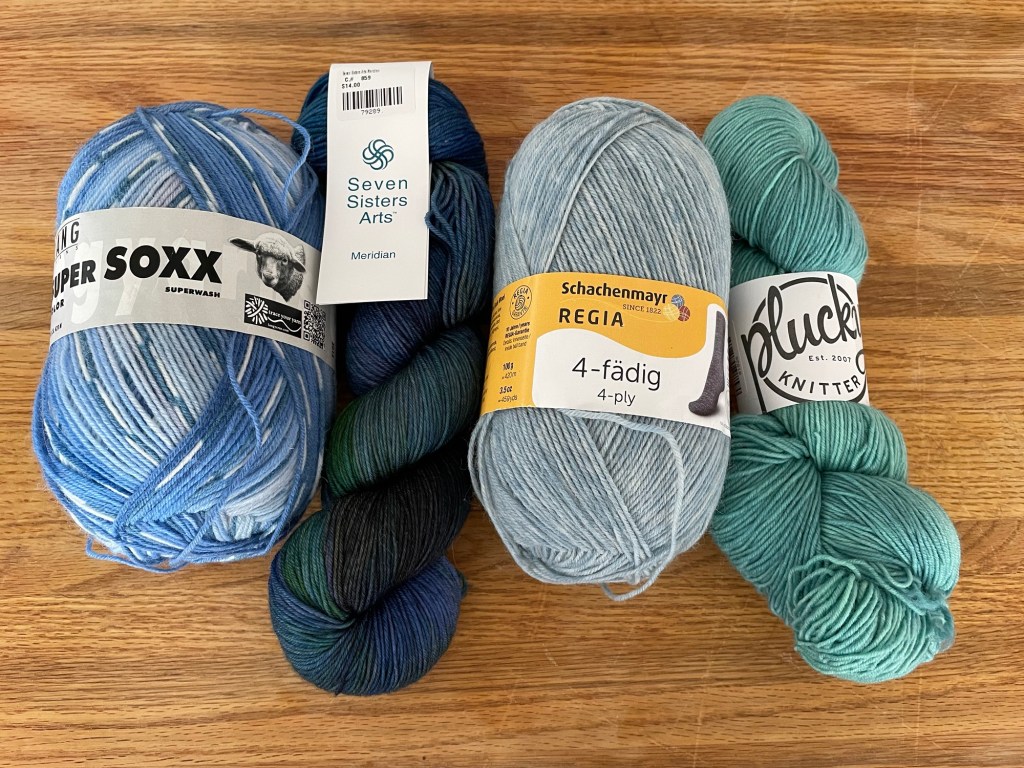
The end did not match the beginning and I was not very happy with the way it looked. In order to make a symmetrical scarf I would have to rip it back almost all the way and start over (and use my scale to determine when to start the second half). I concluded it was not worth it and no one would notice, or else it would just be a unique looking scarf. In the next photo you can see that there were only a couple of inches of yarn left at the end.

The end of the scarf with only a few inches of yarn left

In the following photo you can see the beginning and the end, highlighting the different shapes.

The end of the scarf has a sharper angle than the beginning

On the Ravelry page for the pattern there are over 19,000 people who have posted their photos of this scarf. A common way to photograph the completed pattern is in a roll like a crescent.

I used to wear fashion scarves to work regularly. Since I retired, we moved to the lake, and we have been spending three months of the winter in Arizona, I have not been wearing scarves. It is cold in the evenings in January and February in Phoenix, so I plan to bring my Sophie Scarf with me and will wear it there for both fashion and warmth.