
In May I attended Fiber Day at the Ellison’s Sheep farm in Pelican Rapids, Minnesota. It is about a half hour from my house, and one of my favorite days of the year. I have written about this semi-annual event multiple times and taken many photos in the past you can see here and here and here.
This spring at Fiber Day I only took a couple of photos related to a dyeing project I worked on there. I had some skeins of cotton and cotton/linen blend yarn that I would be more likely to use if they were a different color. I gathered them all up and took a photo.
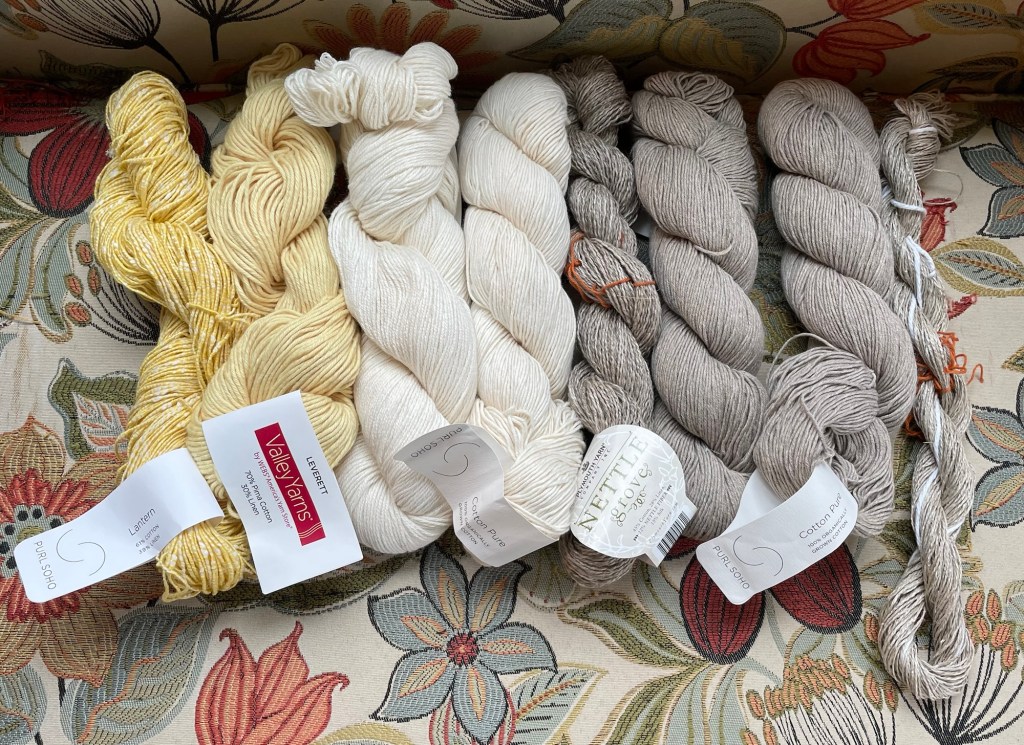
The yellow skein on the far left is Lantern from Purl Soho, described as “a creamy white cotton core wrapped with a colorful linen thread”. It is discontinued. The next yellow yarn is Leverett from Valley Yarns, also a cotton/linen blend. The two white skeins are both 100% organically grown cotton from Purl Soho, in different thicknesses. The natural color yarn next to the white is Nettle Gove by Plymouth Yarn. It is 45% cotton / 28% Linen / 12% Nettle / 15% silk. There are two skeins of Cotton Pure from Purl Soho in a color called “warm rock”. Lastly, there is some 100% natural color linen yarn leftover from a tube I bought on the internet years ago.
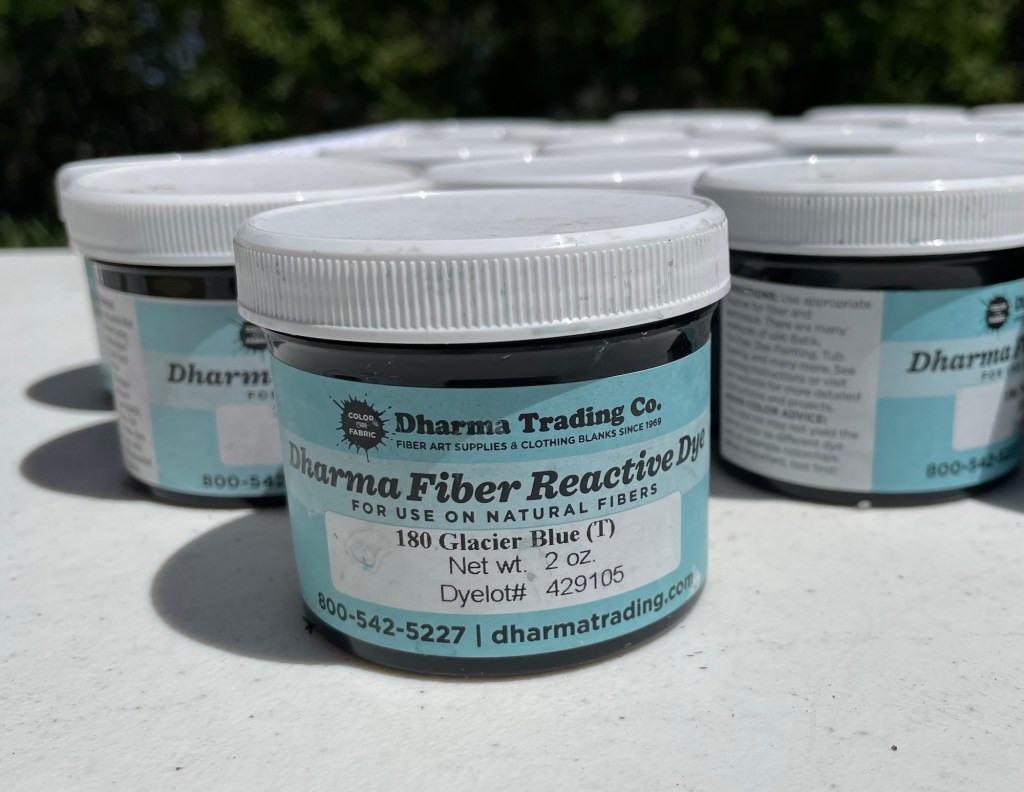
All of these yarns are made from plant fibers which use a different dye and process than for wool and other animal fibers. For dyeing cotton and plant fibers, there are many colors of Dharma Fiber Reactive Dye available to use at Fiber Day. I did not have a plan going in, but when I got there decided to dye all the skeins with Glacier Blue, because I thought that would work for all the different yarns, knowing they would each look a little different, or maybe a lot different.
The first step was to prepare the yarn so that the dye would bond to it by soaking it in water with soda ash for about 45 minutes.
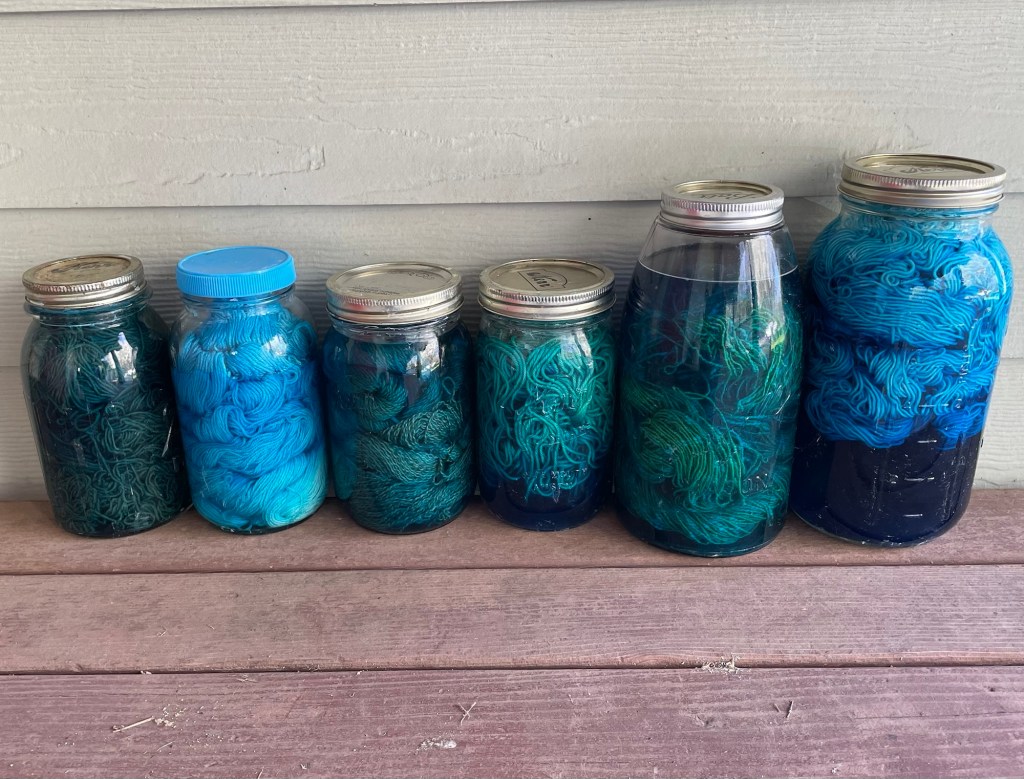
I had brought some big jars from home that I have used before for dyeing, and that will not be used for food. After the yarn was prepared, it was put in the jars with water and dye. I took the following photo at Fiber Day.
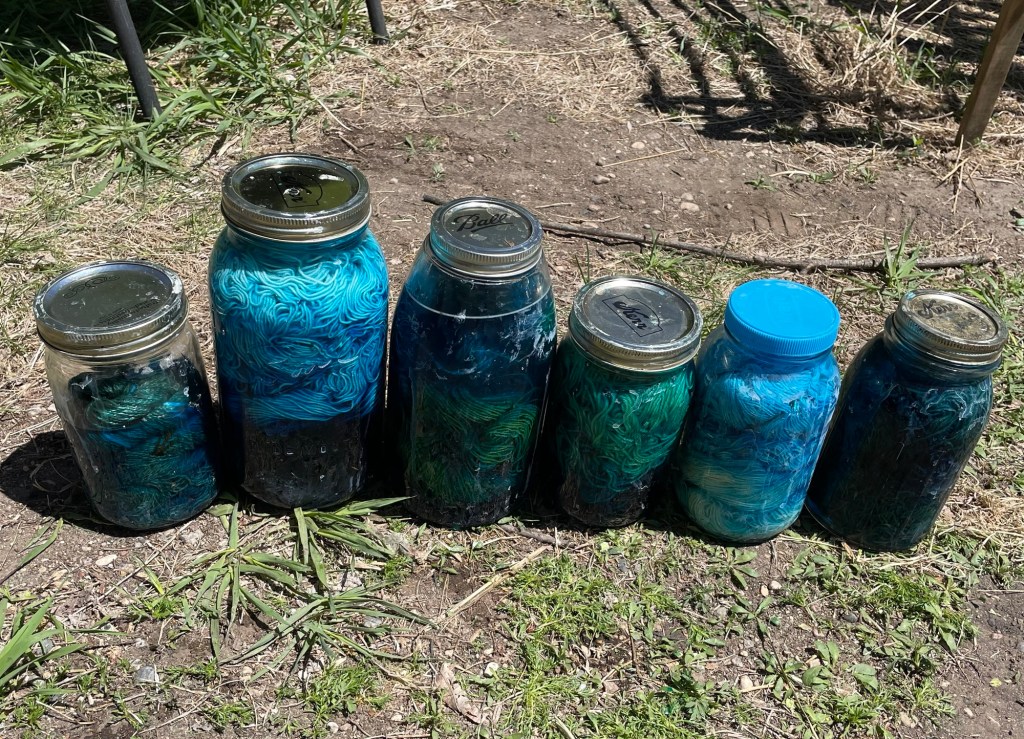
The yarn was left to soak in the jars for about 24 hours. I took another photo back at home.
The next afternoon I took the yarn out of the jars and rinsed out the extra dye. I know when dyeing wool yarn, if you use the correct amount of dye, the water should rinse out clean. That is not what happened in this case, so probably there was more dye than needed, or maybe the fiber reactive dyes do not work the same way. I rinsed out a lot of dye, and then hung the skeins on a drying rack and left them outside to dry.
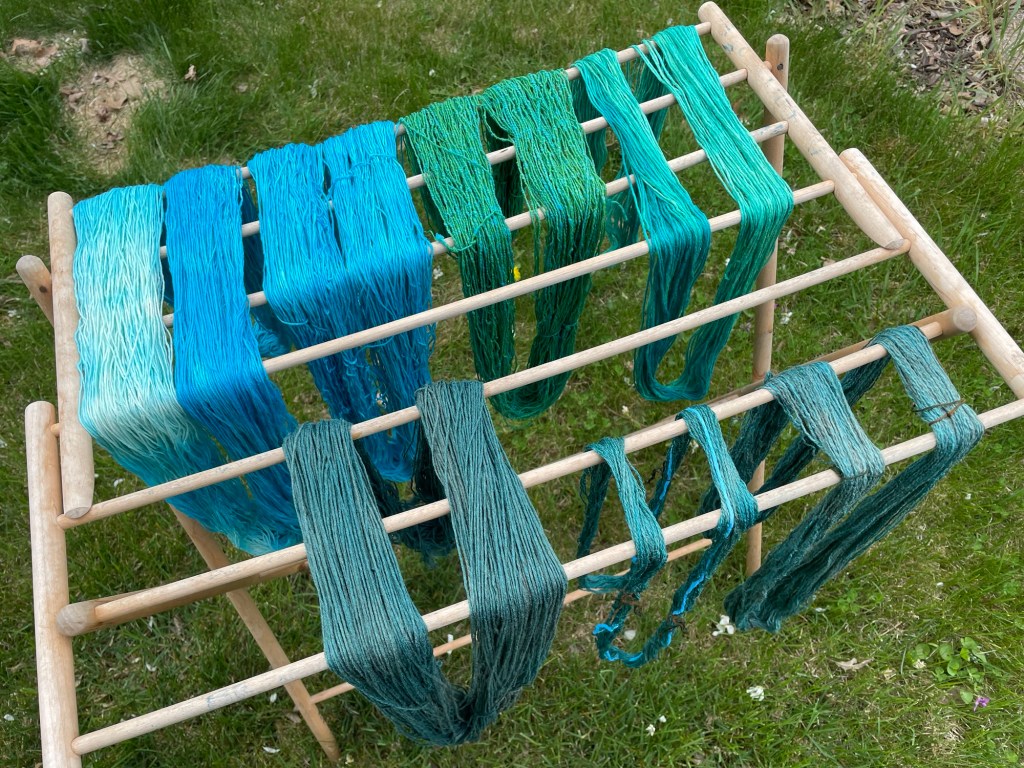
It looked like the yellow and white Lantern yarn was still yellow while in the jar, even the next day, but I guess you can’t tell what is going on until you take it out. That yarn is the very green looking yarn on the back row of the drying rack in the photo above. Up closer you can see that the white core of the Lantern yarn is blue, the linen component is green.
The yarns that were white to begin with turned blue, no surprise. The yarns that were yellow became shades of green. The natural colors changed to shades of teal. Some of the yarns came out variegated, where the dye was not evenly distributed inside the jar.
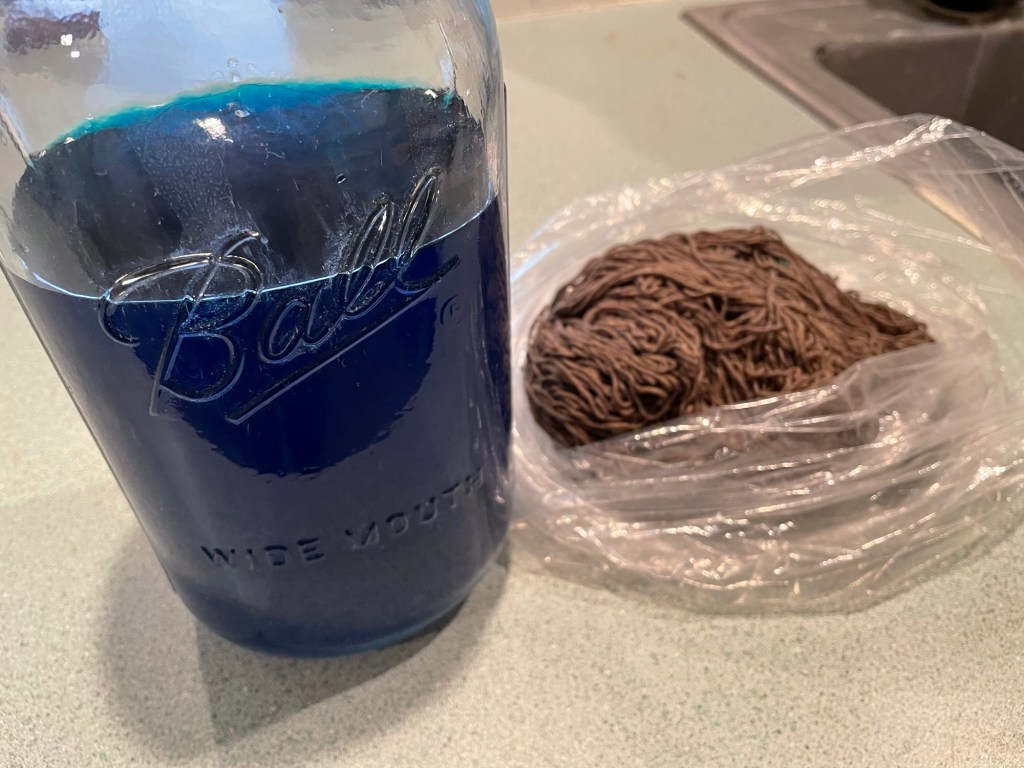
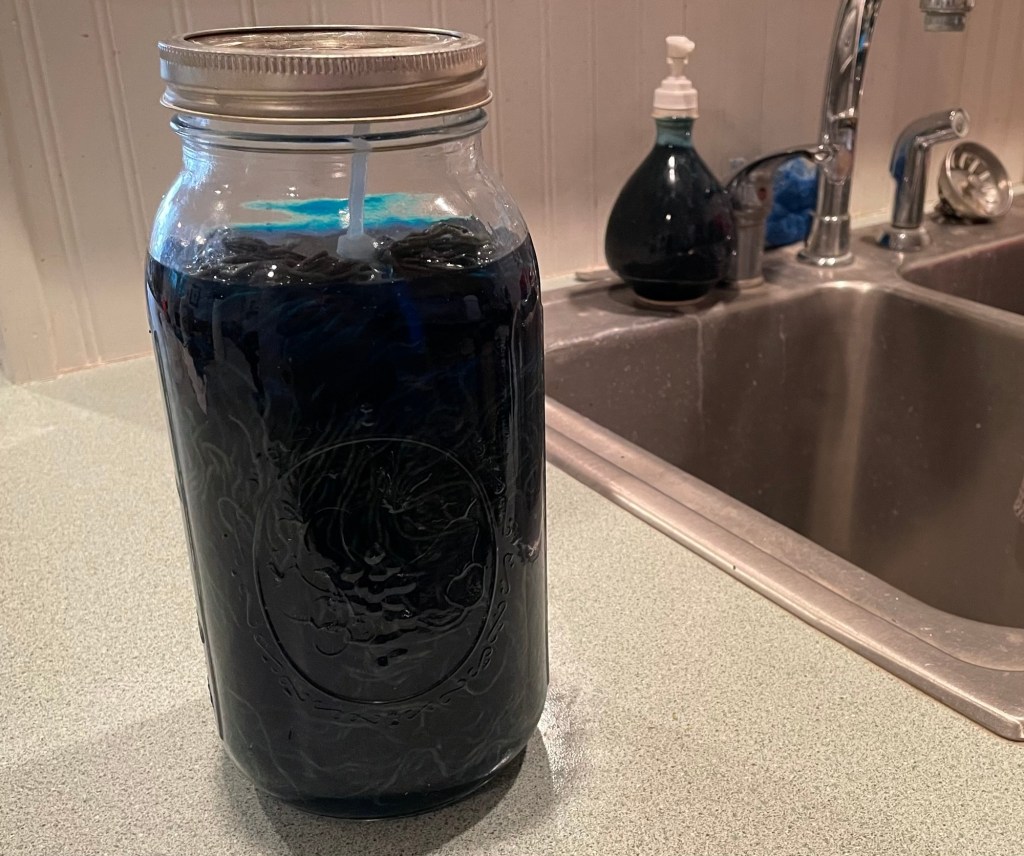
I accidentally left behind one of the natural color skeins of yarn that had soaked in the soda ash, but had not been dyed. When I was loading up the car at the end of the event, somehow the plastic bag with the wet yarn got left behind. I went back and got it the next day, and put it to soak in one of the jars that I had removed yarn from, that still had dye in it.
I was reminded that after dyeing the yarn should be washed in Synthrapol, which helps to remove excess dye. I had a tiny amount on hand, and instructions online said you should use 3 tbsp for 8 pounds of fabric. I might have been able to get away with the bit I had, but ended up ordering another bottle.
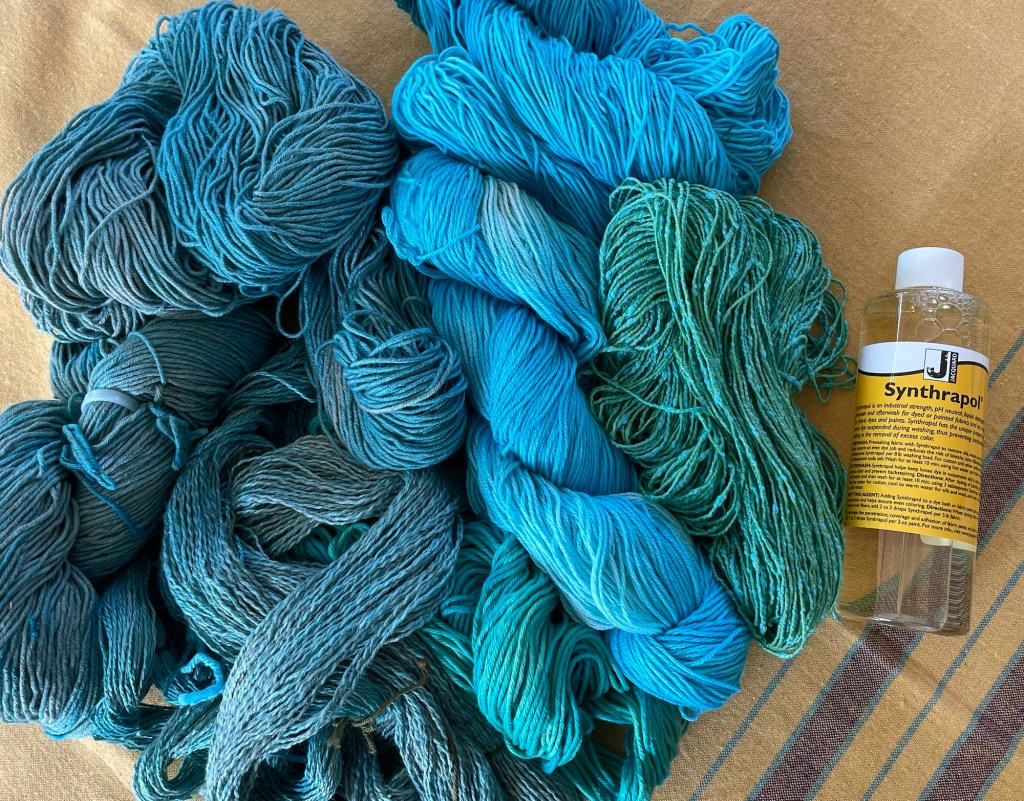
The Cotton Pure yarn is very soft. It is more of a knitting yarn, but can also be used for weaving. I tried using it for weaving a dish towel when I was a new weaver. The finished towel looked nice, but the fabric did not wear very well. Now that I have more experience weaving, I think this yarn will be better with more yarns per inch for a tighter weave towel, or for a lightweight loose weave scarf.
My friend Mary Lou has been learning to weave on my 15″ Schacht Cricket Rigid Heddle Loom. I got her started with a project last fall. She took the loom home with her and finished some towels on her own. This summer she brought the loom back when visiting for a weekend. I had been thinking about wanting a wider rigid heddle loom. Mary Lou was thinking about getting her own loom. We agreed she would buy my 15″ Cricket loom with all the accessories for half of what it would cost her to buy it all new. I put that money toward a new Schacht 25″ Flip Folding Rigid Heddle Loom. It works the same way as the smaller loom, but is wider, has an option for a second reed for more complicated projects, and can fold and fit in a bag for portability. It is much bigger and take up more room than the 15″ loom.
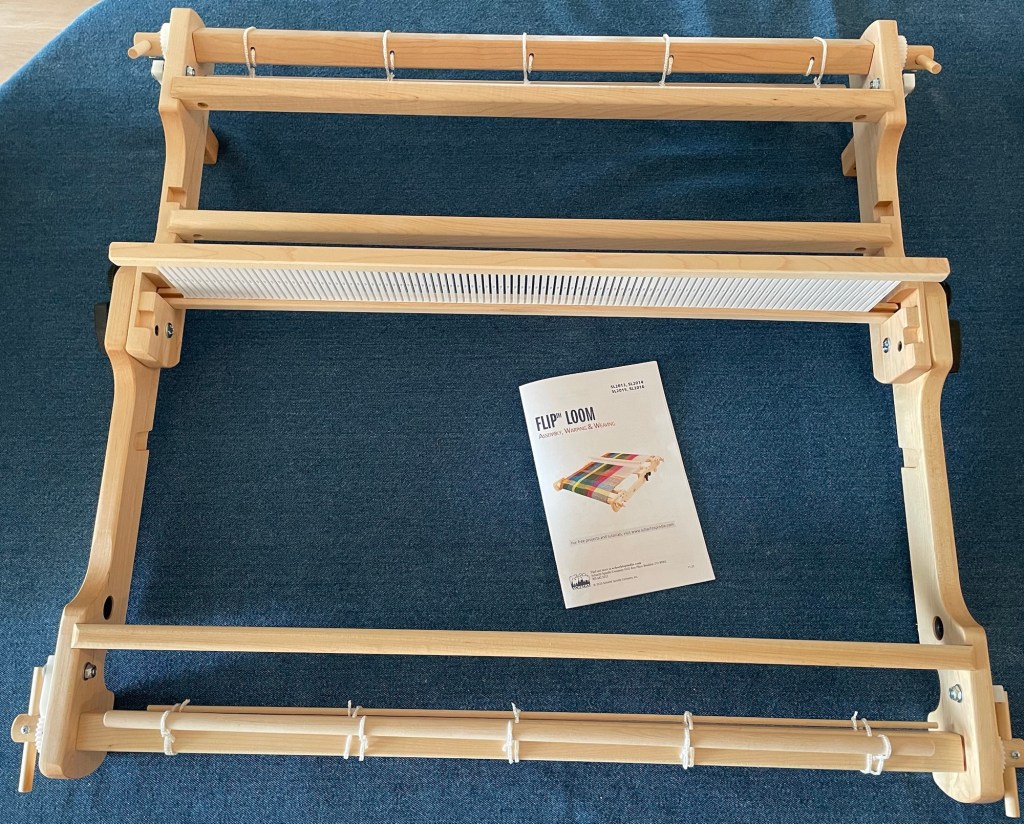
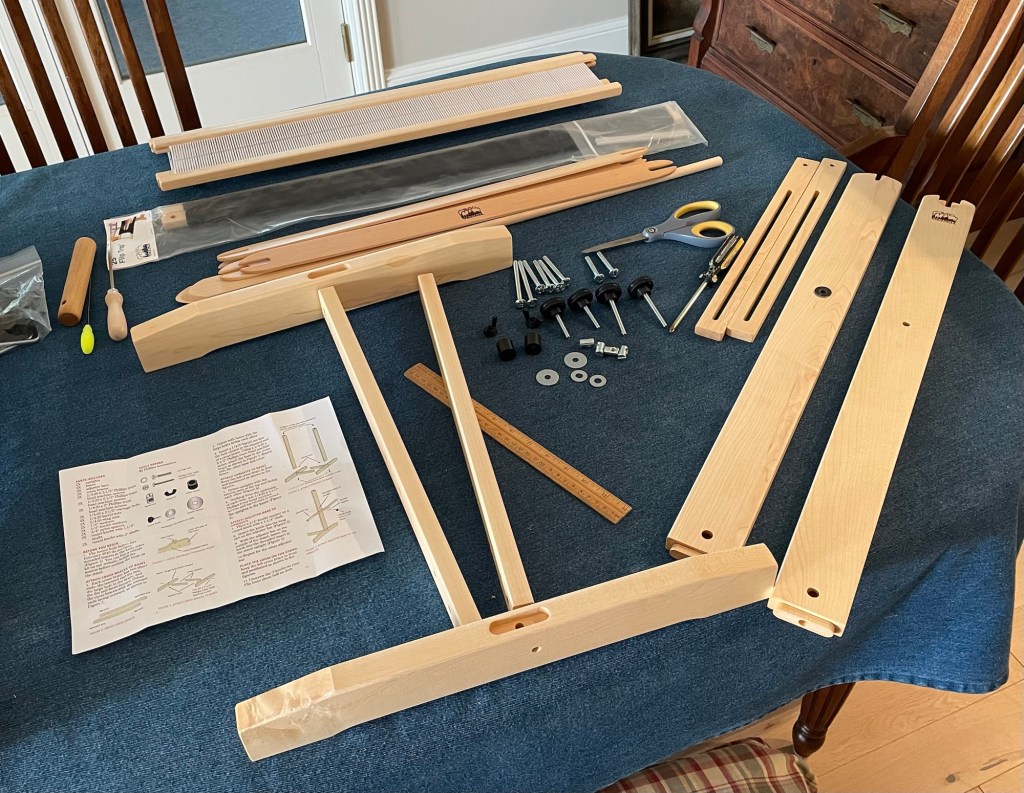
I bought the optional stand, so that it can be used without taking up space on a table. Also the height when on the stand is more ergonomically correct for weaving than the table. The following photo shows the parts of the stand before assembly.
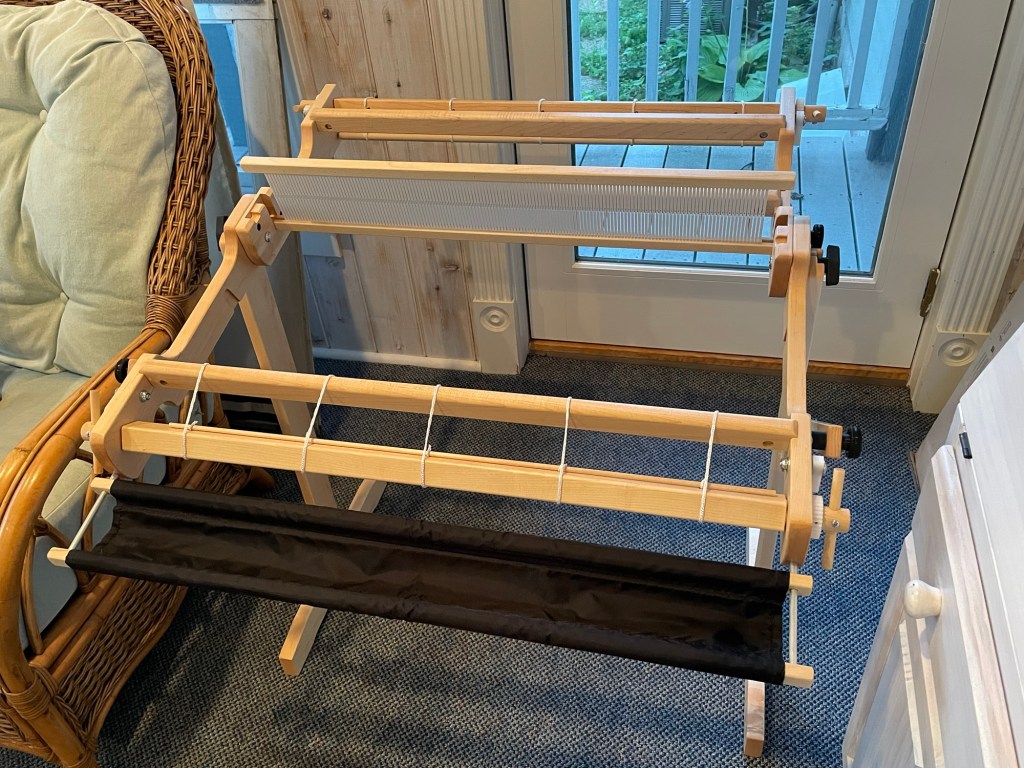
In the photo below the 25″ loom is all assembled and ready to go, with a handy tray on the front for accessories used while weaving. I did not think about the fact that it would be deeper, as well as wider.
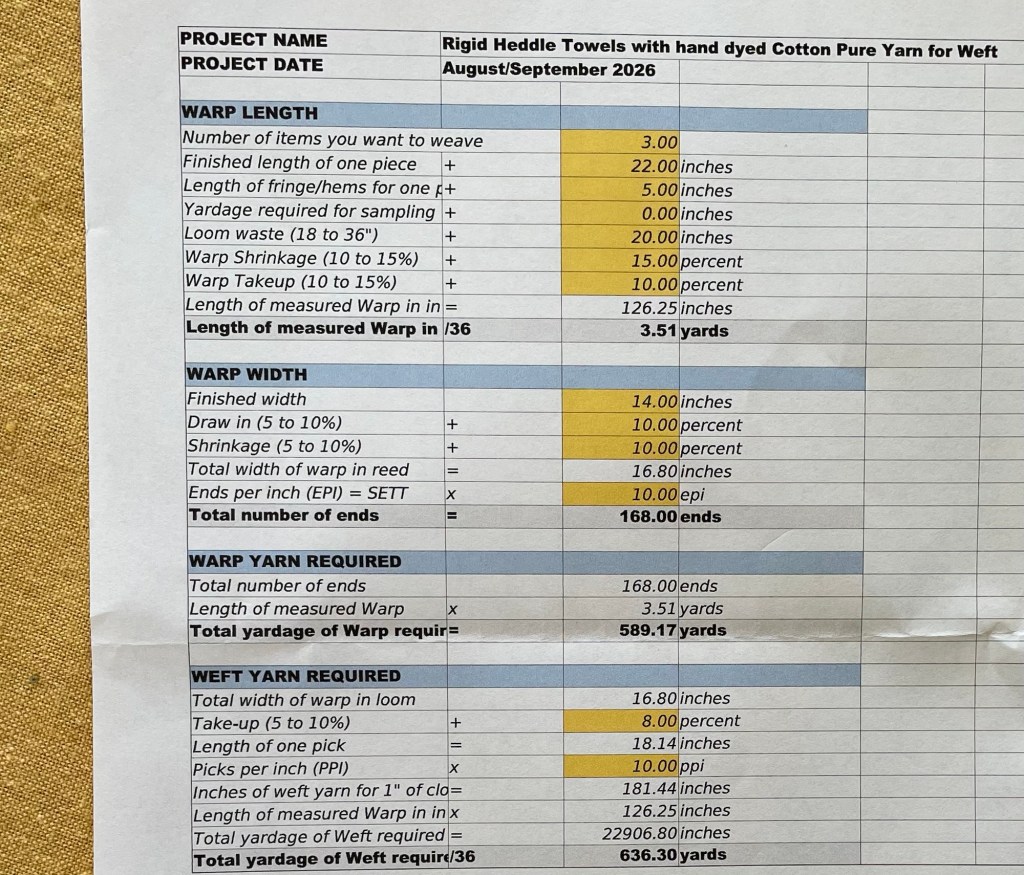
After finishing the Toolara Cardigan flat knitting machine project in August, I was ready to start something on the new loom, using the yarn I dyed at spring Fiber Day. I came up with a plan using the teal yarn, documenting the details with a spreadsheet available at the School of Sweet Georgia.
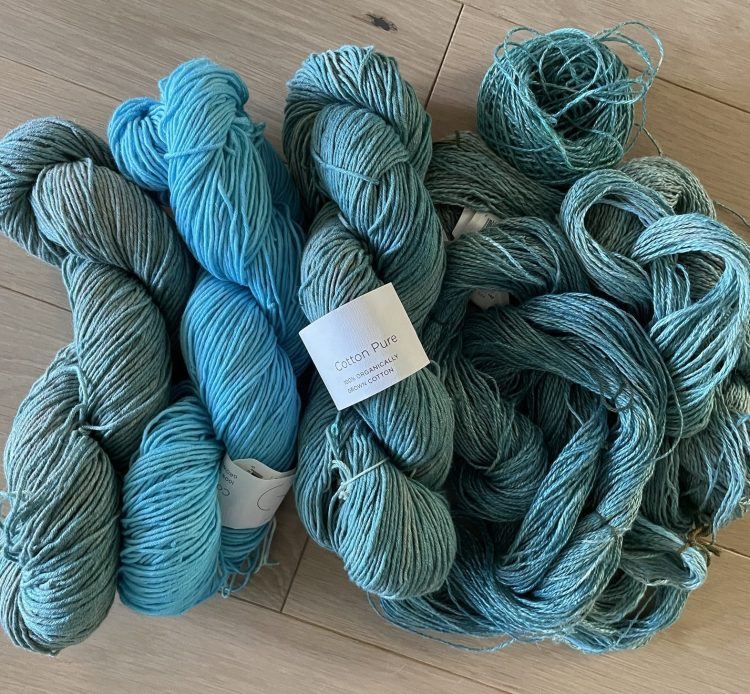
The first three yarns in the photo below are the Purl Soho Cotton Pure. The yarns on the right of the photo are 100% linen. I ended up using the linen yarn that is the fourth from the left, but not the other linen yarns.
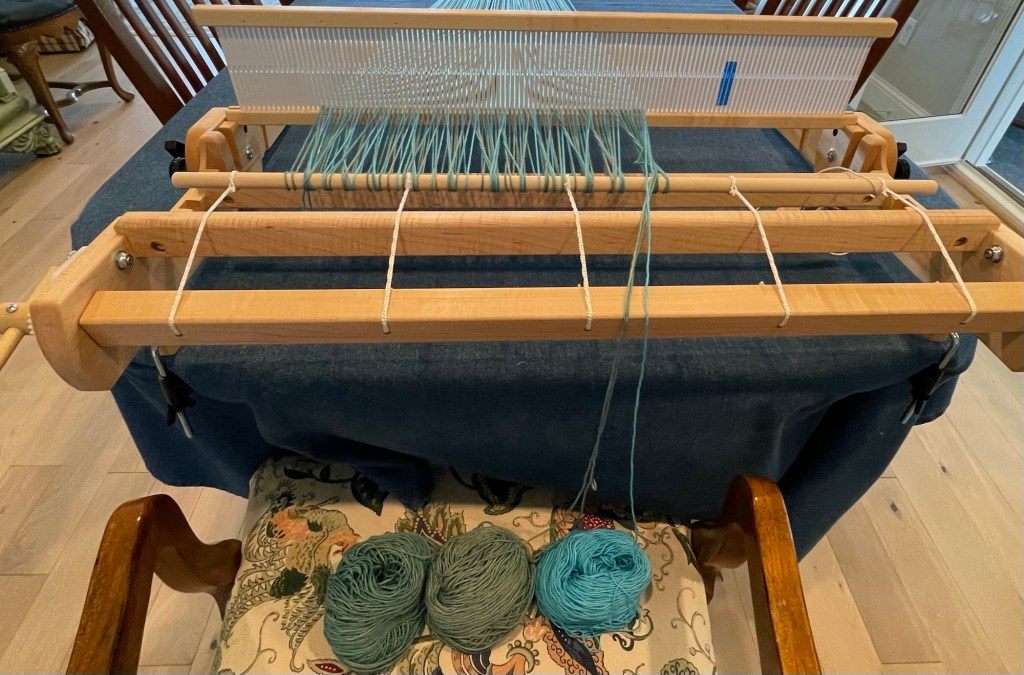
For direct warping a set of towels, I took the loom off the stand and clamped it to the dining room table. For the warp yarn I selected the three skeins of Cotton Pure yarn. Two of the skeins were in the darker teal color, and the third skein was brighter turquoise. I used the three skeins by alternating two ends of each skein. The way direct warping works it is natural to add two strands of one skein, then go to the next one.
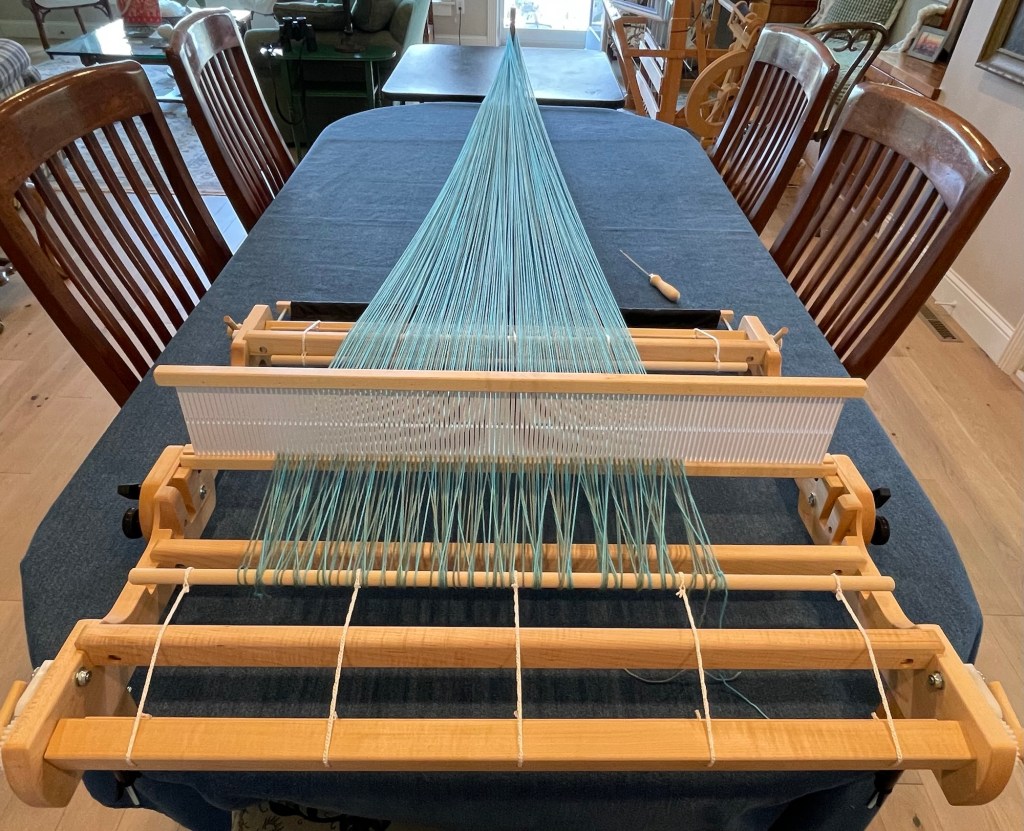
The following photo shows the yarn all measured out. There are 138 “ends” (warp yarns) that spread across 16.8 inches on the loom, using the 10 dent reed (10 ends per inch). It should be centered on the loom. I thought I measured before starting, but my warp yarn is not exactly in the middle, which is not a big deal.
The weaving goes fast once you get a rhythm going. The first actual towel starts after the darker green spacer rows, with two rows of hem stitch at the beginning of the towel, followed by plain weave rows.
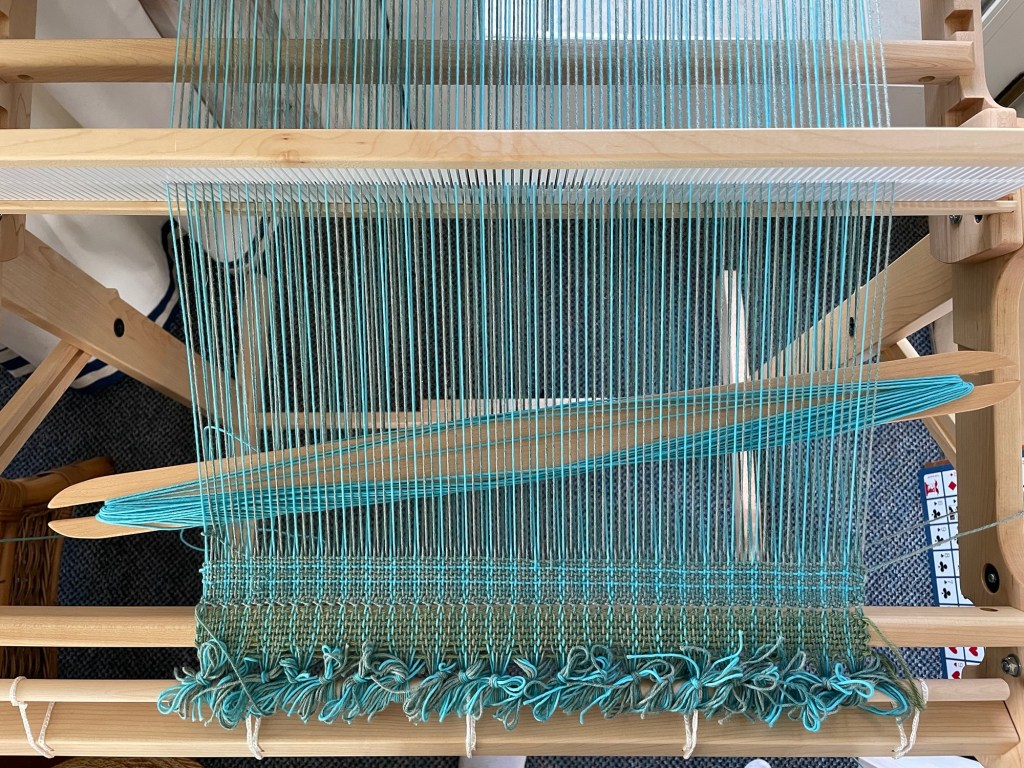
I did not have enough of the three cotton yarns left for weft yarn for weaving all three towels. There are any number of possibilities for how to design the weft colors with those three yarns plus the linen yarns I had dyed at Fiber Day. I decided to go ahead with the three cotton yarns for the first towel, and then figure out what to do about the other two towels after I finished the first one.
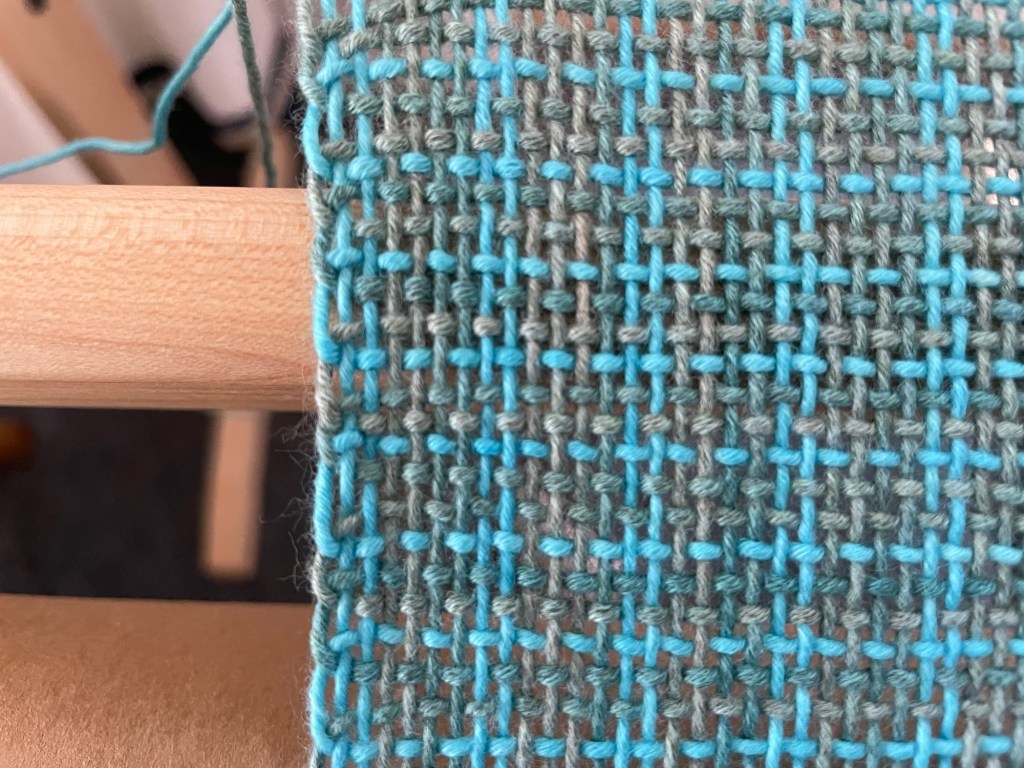
I thought I would copy the pattern with the weft rows with two rows of each color, but I also wanted to carry the yarns up the sides when changing colors without having to cut the yarn and weave in ends. I unintentionally ended up with alternating one row of each yarn, rather than two, which made a very nice pattern along the selvedge that matched on each side.
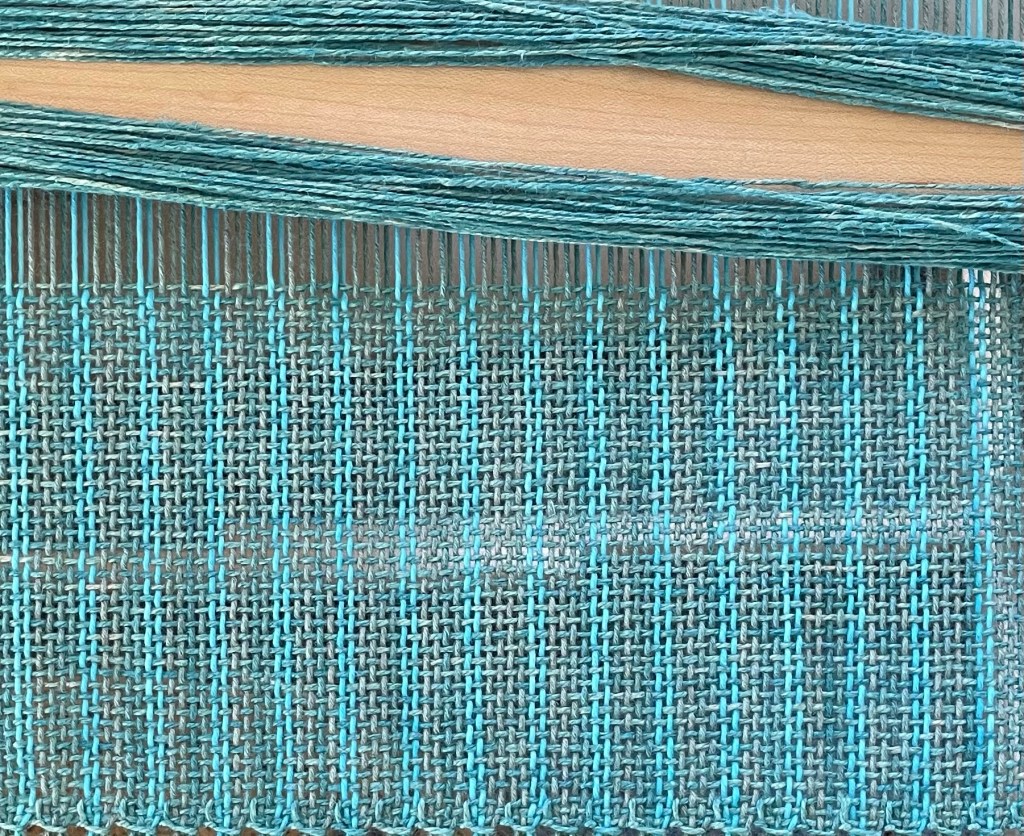
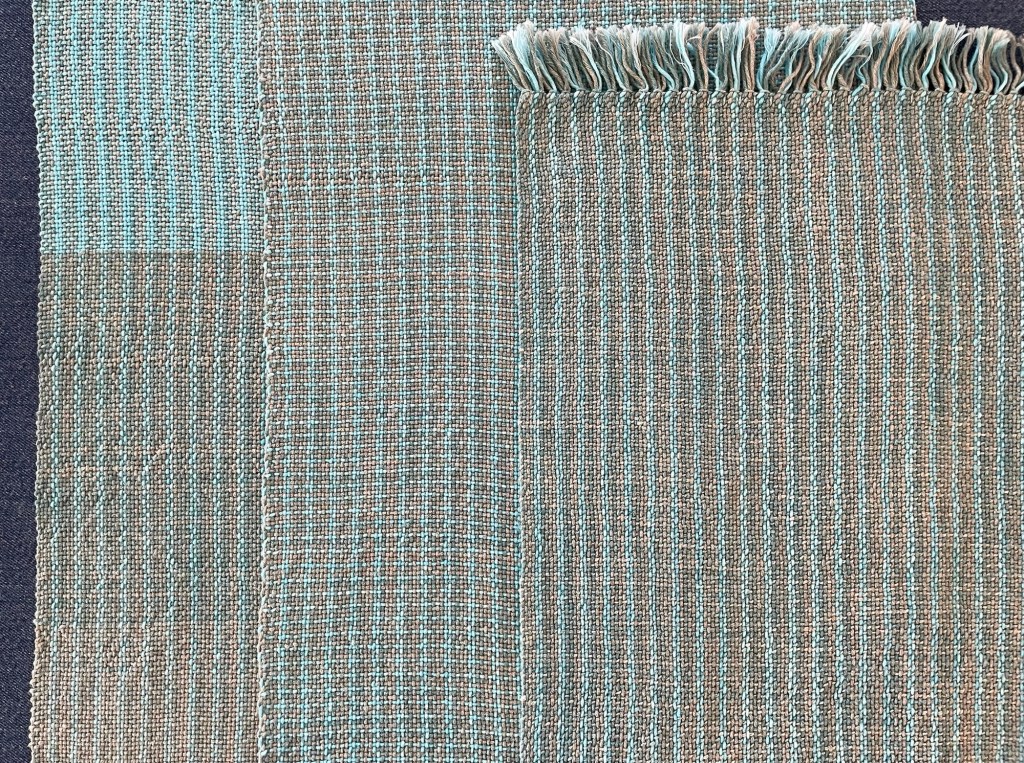
For the second towel I decided to use the skein of 100% linen turquoise dyed yarn exclusively. I really like that yarn, and it was easy and quick not having to change yarns. With only one weft yarn, the pattern comes out with vertical strips.
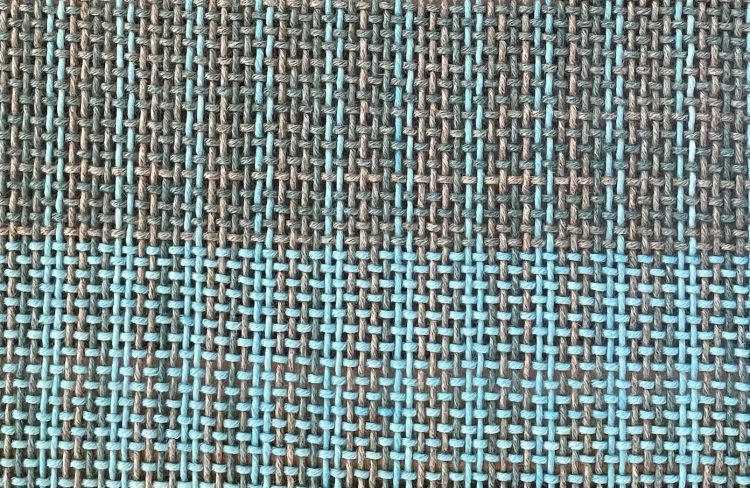
For the third towel I wove three large blocks of each of the original warp yarns. They each started with a full skein, so I knew that if I could weave 1/3 of the towel with the first color, then I would be able to weave 1/3 of each of the other two colors. Following is a section of the first two blocks of color. The third block was not as much of a contrast from the second color.
The 100% linen weft yarn is a little thinner than the Cotton Pure yarn, but the woven cloth using it was wider than the other two before washing. It was narrower after washing. I don’t know why this third towel with the three blocks of color was so wrinkly when I unwound it off the loom, even though there was a layer of paper on the cloth beam.
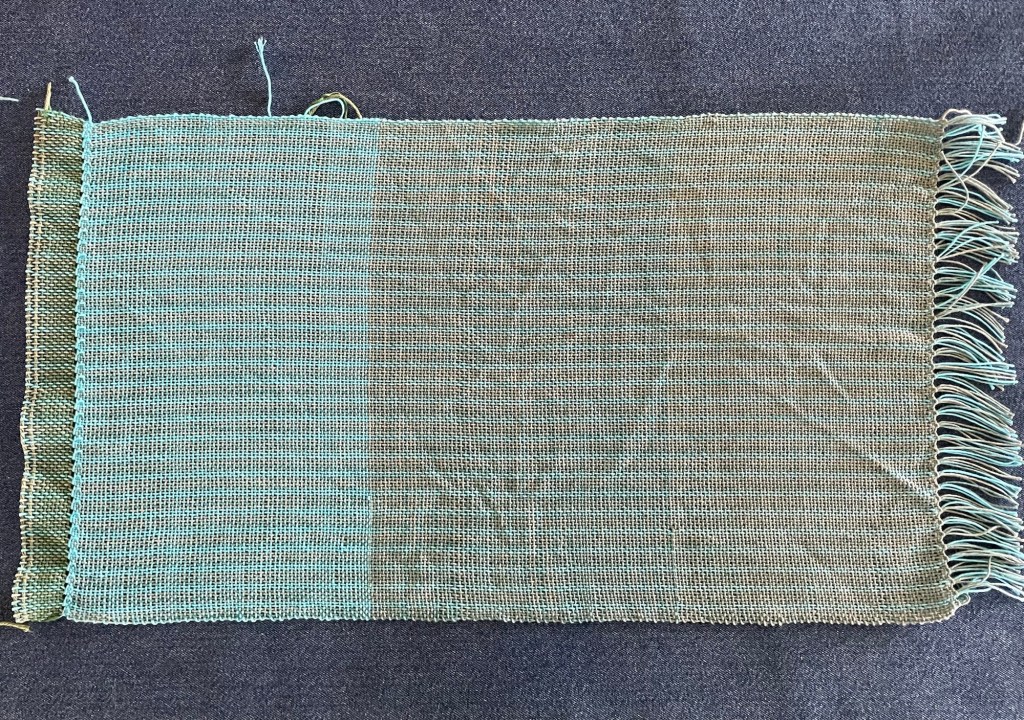
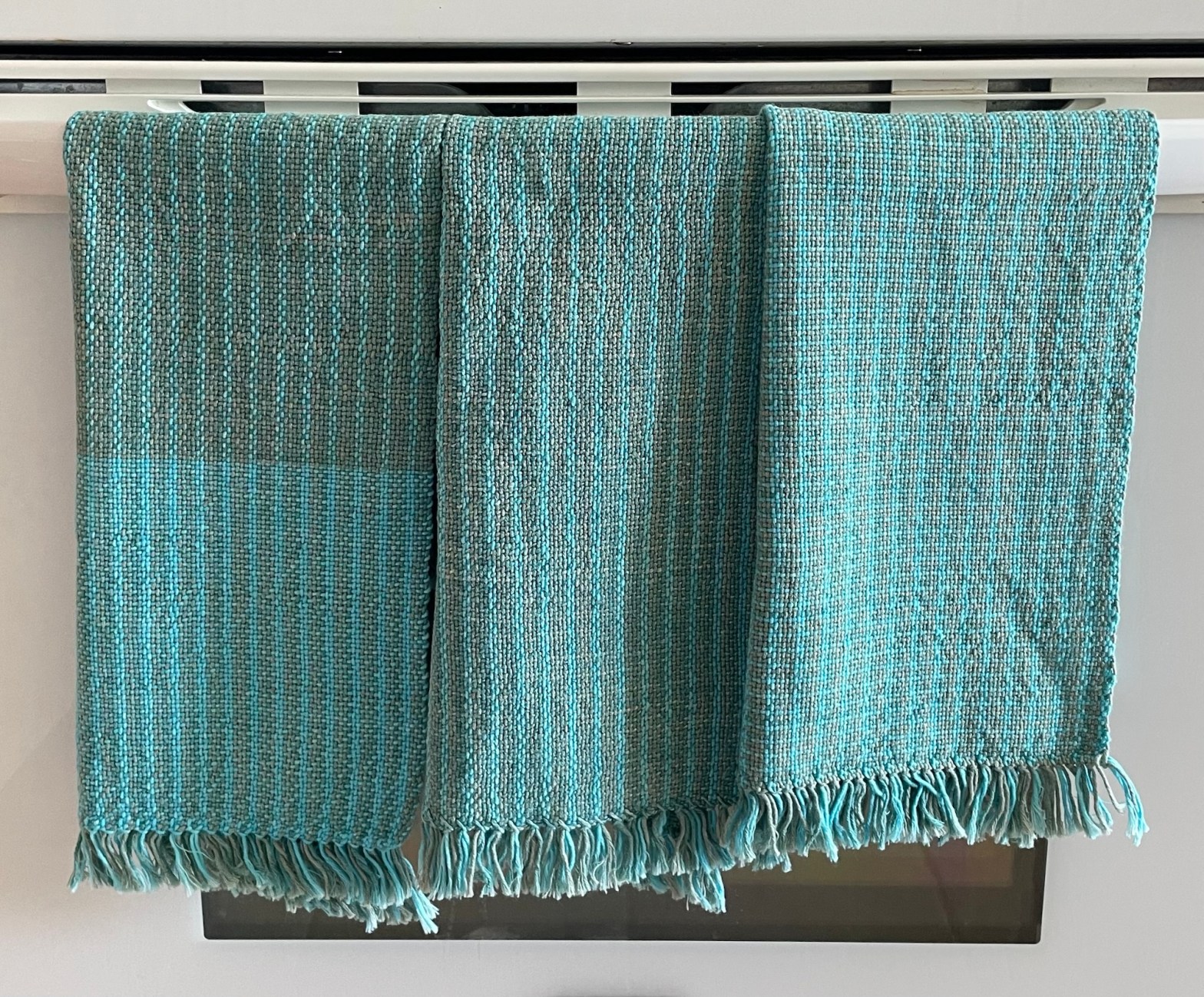
After weaving in ends, washing, and ironing, I laid the three towels out next to each other.
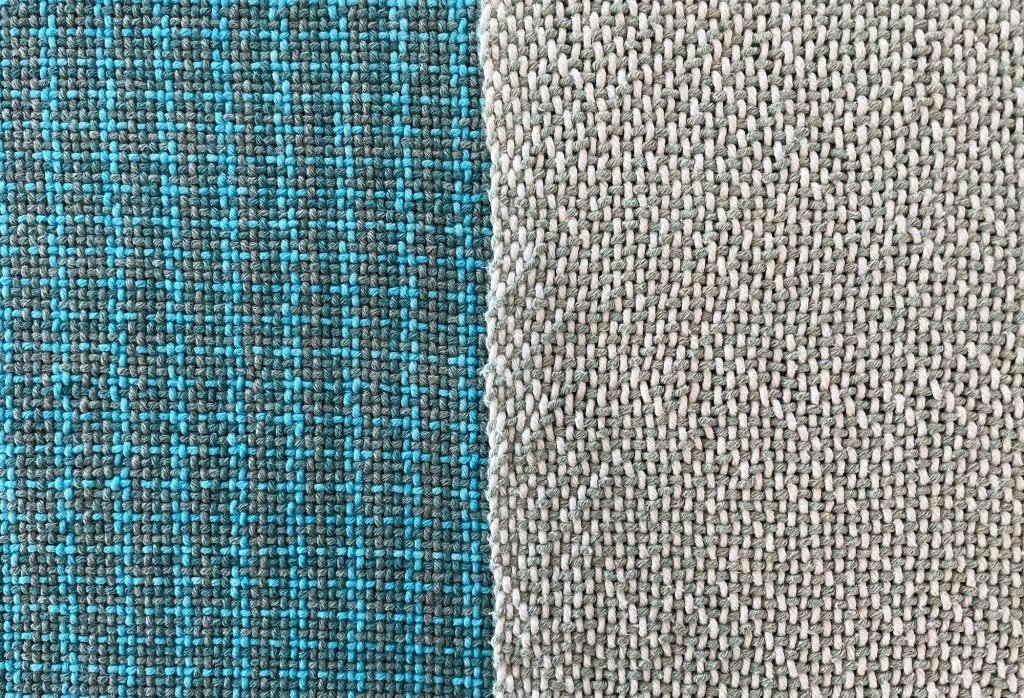
Back when I was a very new weaver, I made towels using Purl Soho Cotton Pure yarn on the 15″ rigid heddle loom. Those towels had 8 ends per inch, which is what the pattern from Purl Soho said to do. They came out with a looser weave then the current towels, which were woven with 10 ends per inch. The looser weave would be nice for a scarf, but is not ideal for a towel. The photo below shows one of the current towels next to the looser towel woven earlier.
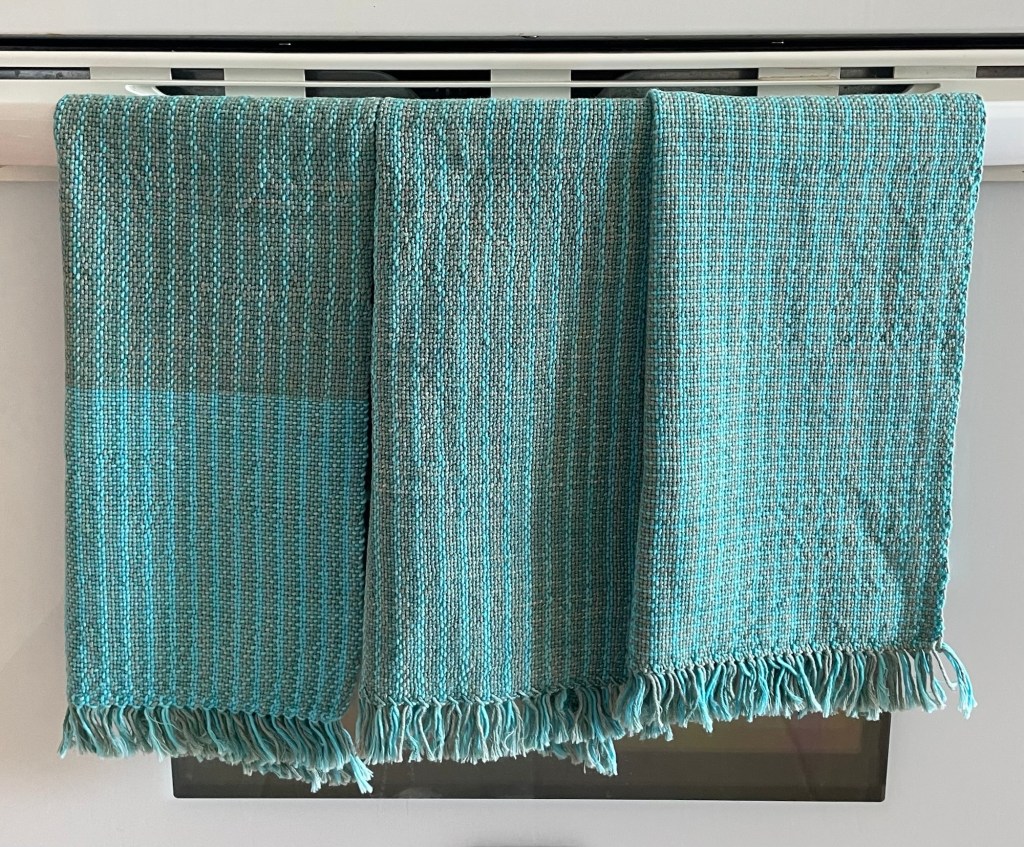
The three finished towels are on display in my kitchen in the next photo.
I hope to make another set of towels on the wider rigid heddle loom yet this fall, before we leave for Arizona at the end of December. I also want to make more towels on the floor loom, and work on some other projects. With several trips back and forth to the Twin Cities on the calendar before the end of the year, plus other things going on, that may be too much. What I want to do and what is realistic to accomplish may not be the same thing.

