
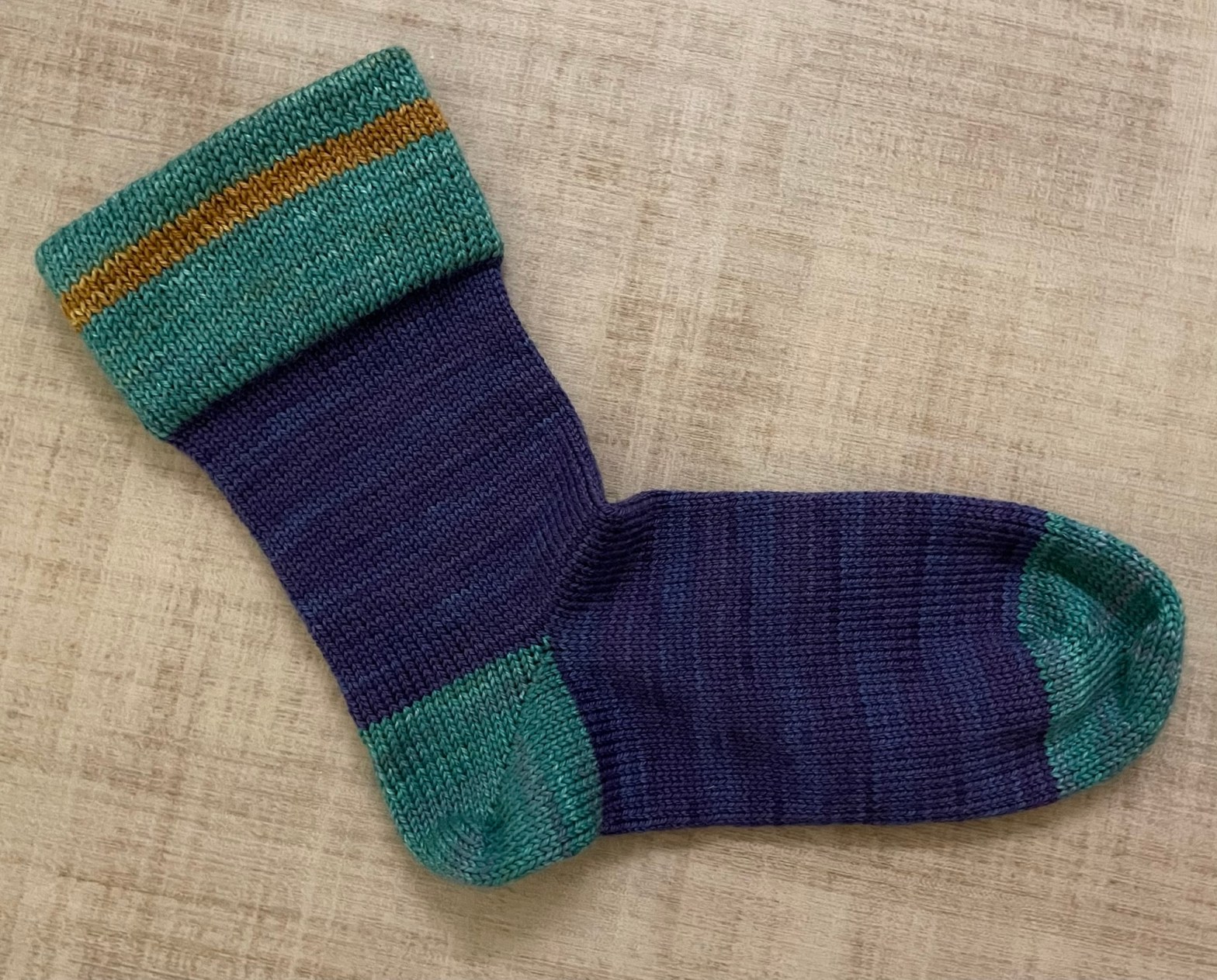
October is Socktober in the knitting world. I have not spent much time with my circular sock machine this fall, or knit any socks by hand since I bought my CSM two years ago.
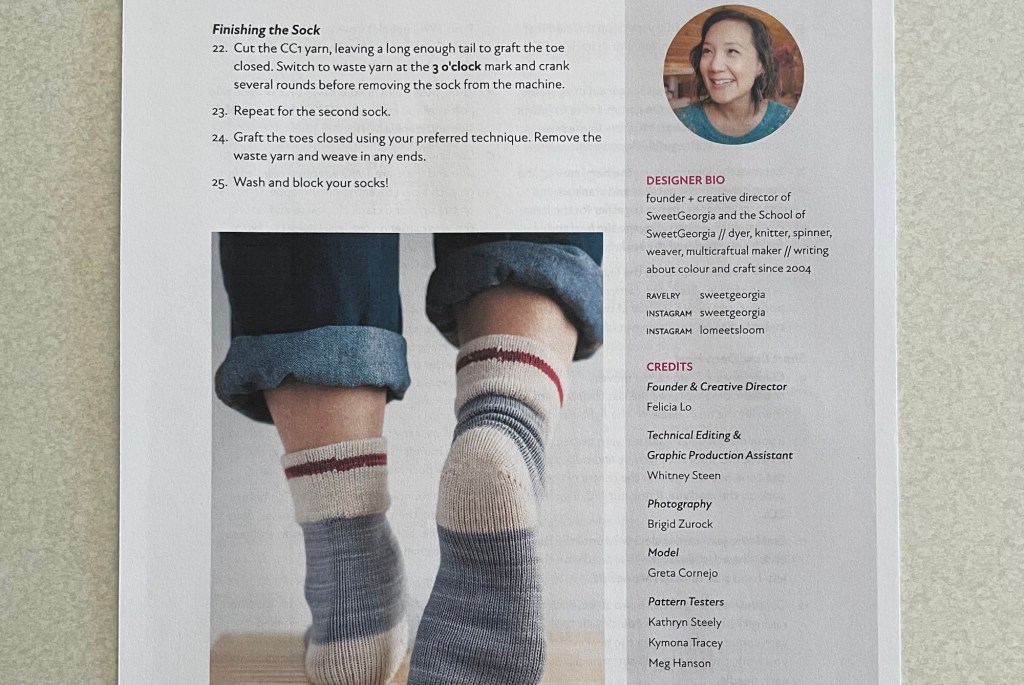
Over the summer I was contacted by the School of Sweet Georgia team to see if I would be interested in testing a new pattern for a circular sock machine sock. Yes, absolutely! The pattern is called Classic Cabin Socks, a slouchy sock with a wider and looser hung hem, and contrasting colors in the cuff, heel, and toe. They sent me a draft of the pattern, which of course suggests using Sweet Georgia Tough Love sock yarn.
I could have tested the pattern with any sock yarn, but I found one skein of Tough Love Sock Yarn in my stash. The pattern uses smaller amounts of the contrasting color yarn.
I happened to also have a Sweet Georgia sock blank made out of Tough Love sock yarn. A sock blank is yarn that has been knitted into a tube or square for the purpose of hand dyeing it. Once dyed, it is unraveled for knitting. Sometimes sock blanks are made with two blanks on top of each other dyed identically, so a pair of matching socks can be made using custom dyed yarn. For some reason when I ordered the sock blank, I thought there were going to be two matching socks. In this case there was only one 100 gram blank. That is enough for two socks, but they would be cousins rather than twins.
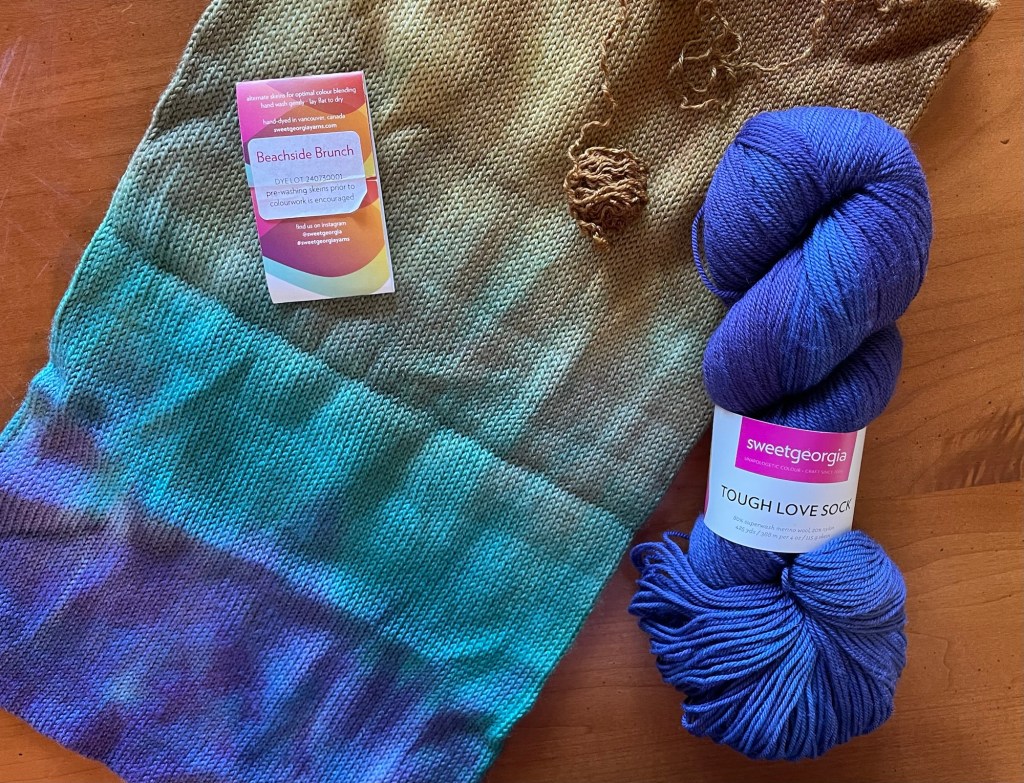
I had been pondering what to do with the one sock blank. I could knit two socks with pretty colors that would not match each other. Or I could make something else. Since the test sock pattern used smaller amounts of contrast colors, that would be a good way to use the sock blank. First I had to unravel it and wrap it into a skein. It was super kinky from being knitted.
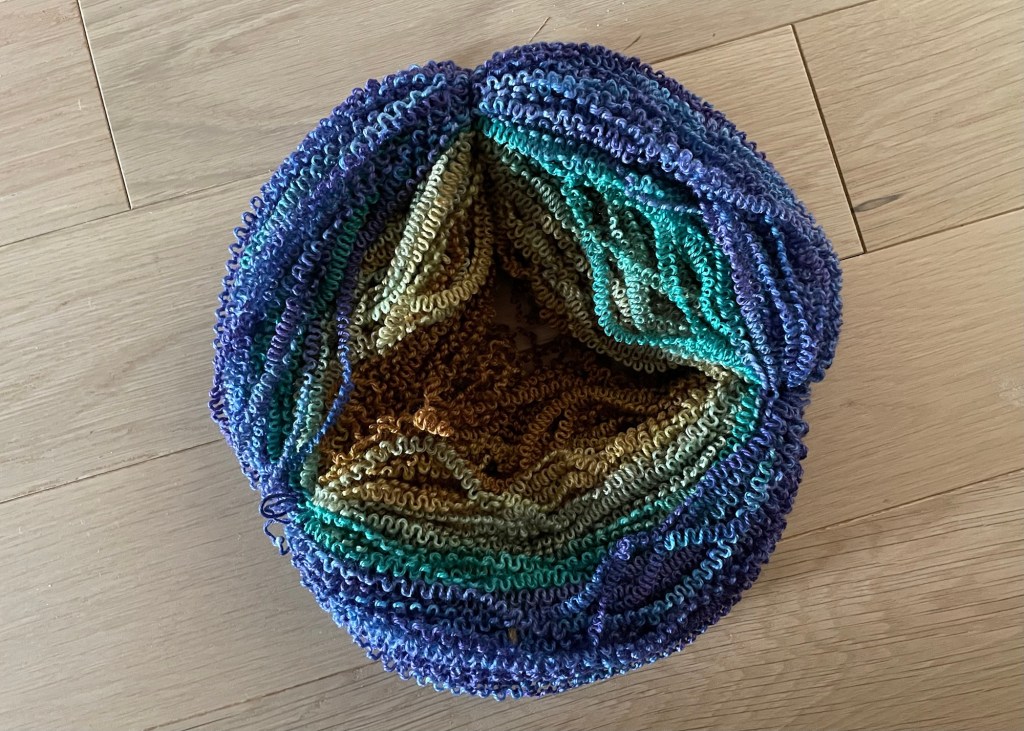
I soaked the kinky skein in water and hung it out to dry, with the goal of straitening the yarn out. It was still a little kinky after coming out of the water, but a lot better.
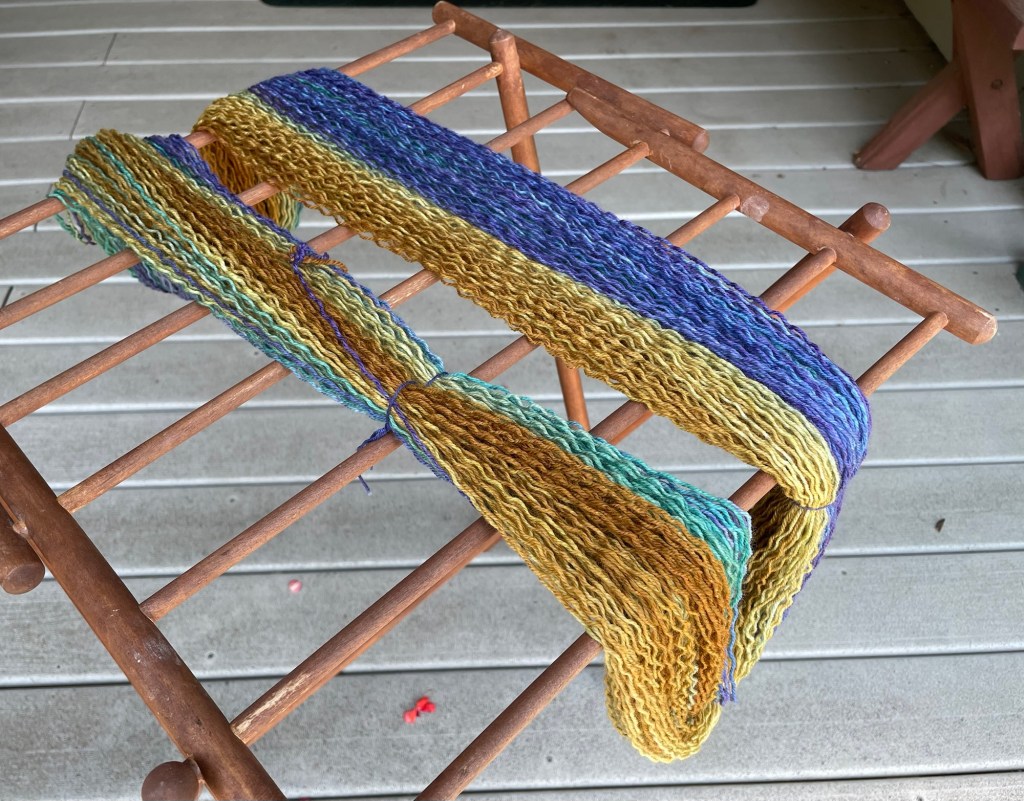
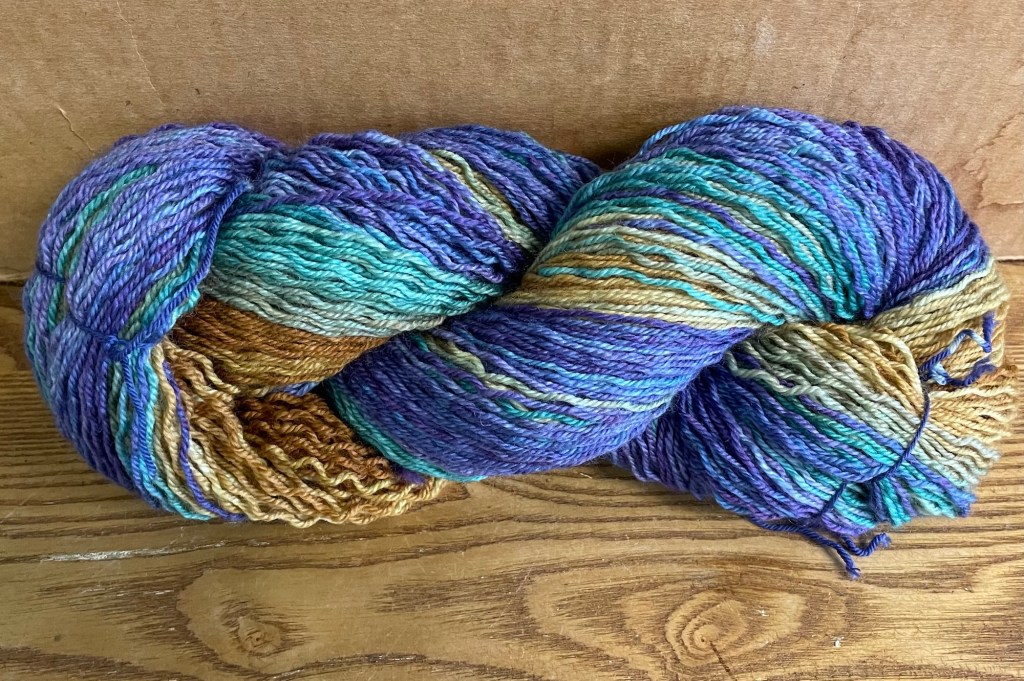
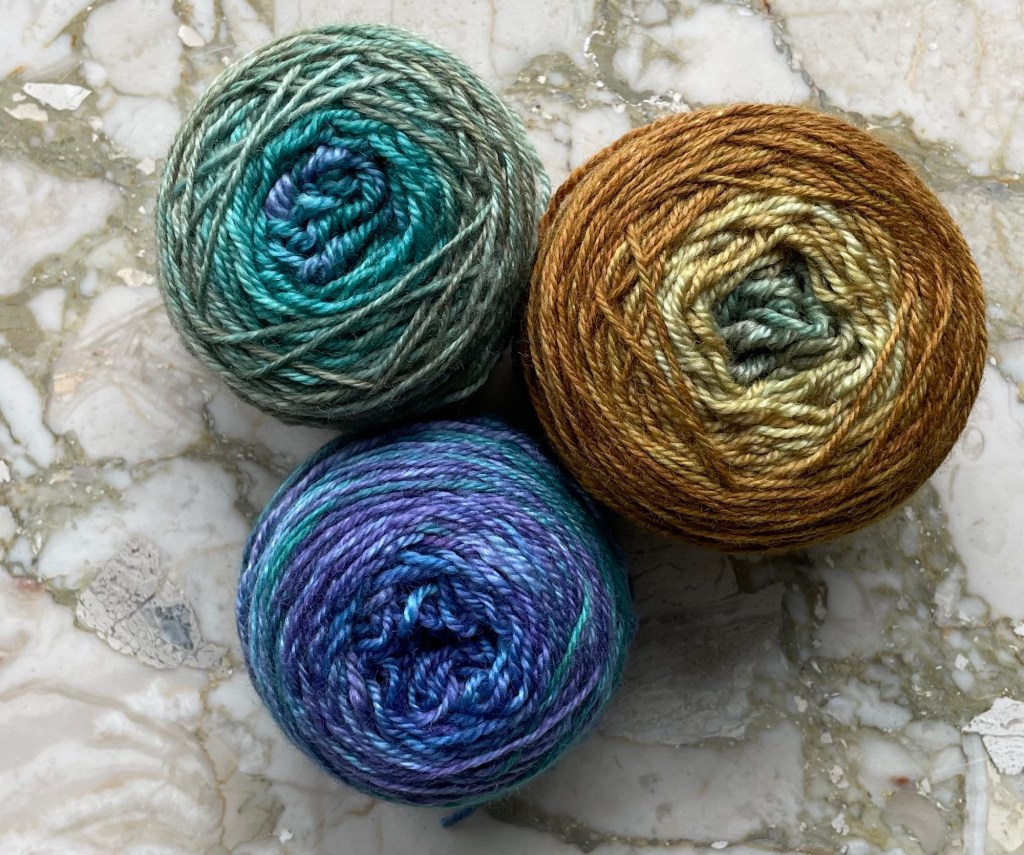
After the sock blank skein was dry, I separated it into smaller balls of each color. The color changes were gradual with different shades, so it was hard to get only specific colors in each ball.
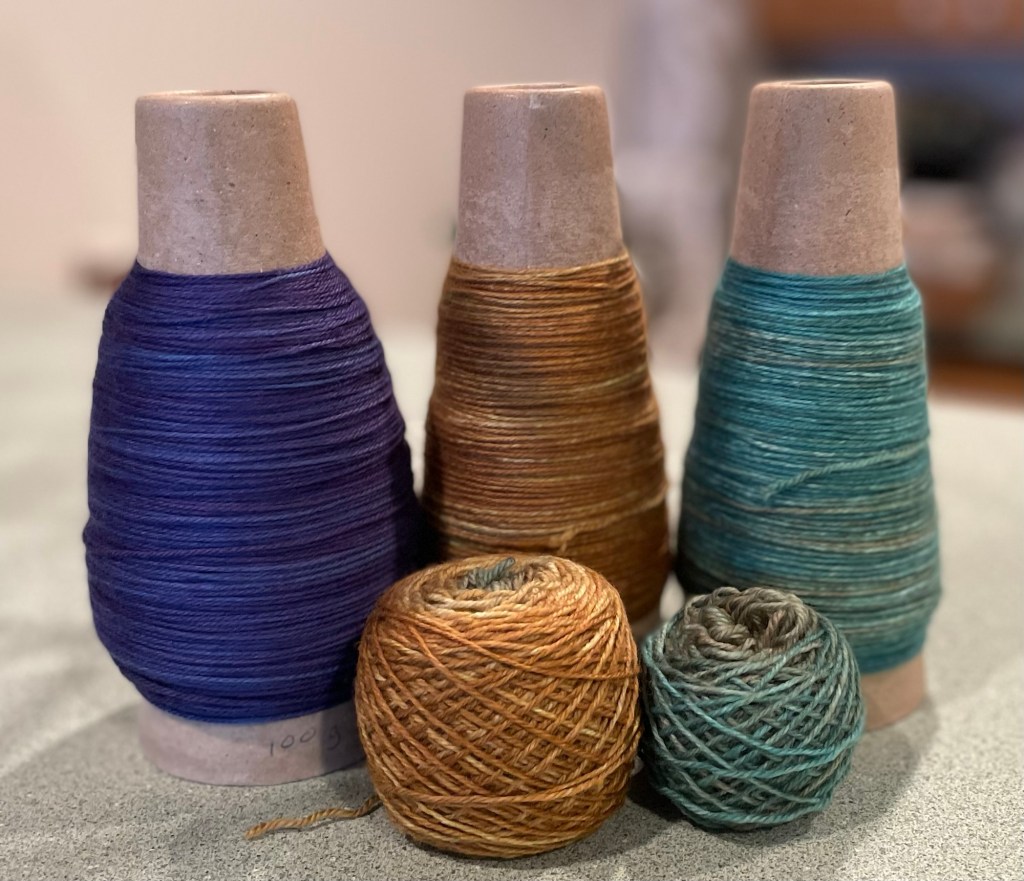
For cranking the sock, I wound the main color and two contrast colors on to cones.
Making the sock was pretty straight forward. There were a couple of places in the pattern where I took a double take (the location of color changes), and one thing I had not ever done before (changing color without cutting the yarn in the corner of the heel). The pattern had you create the toe opening on the top of the foot, where my normal way is on the bottom. It is actually easier to do it on the top, so I went with that.
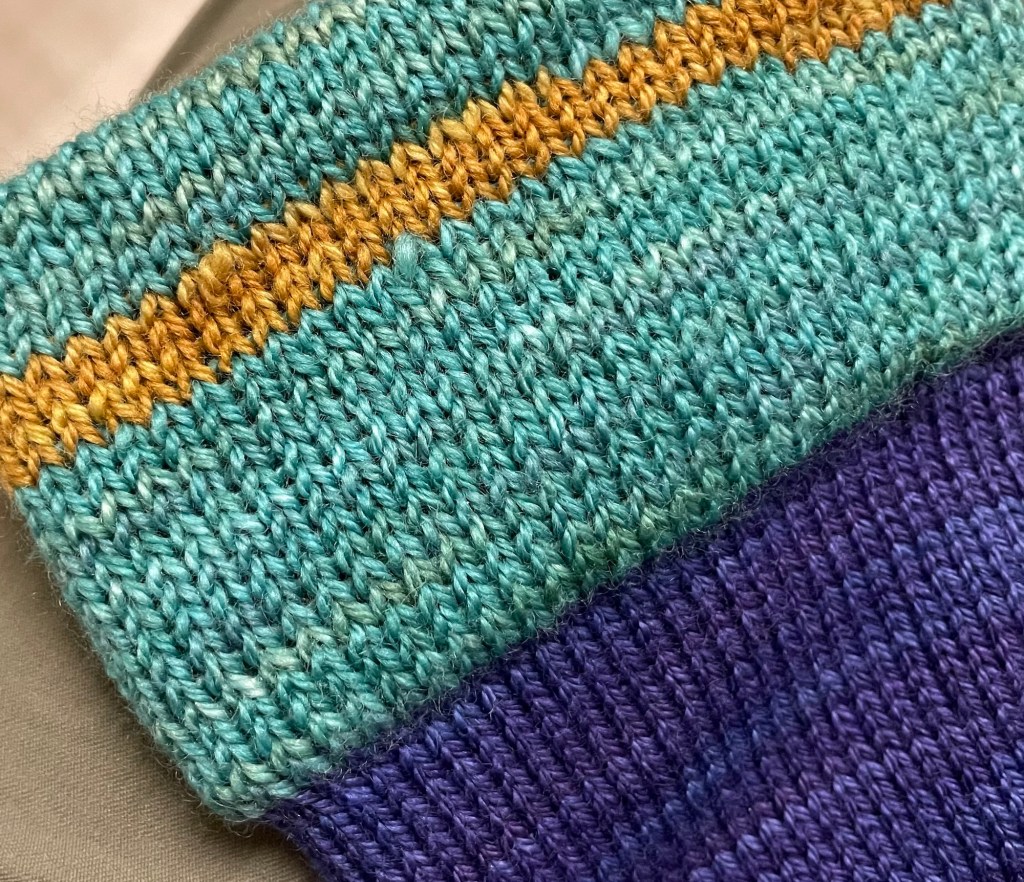
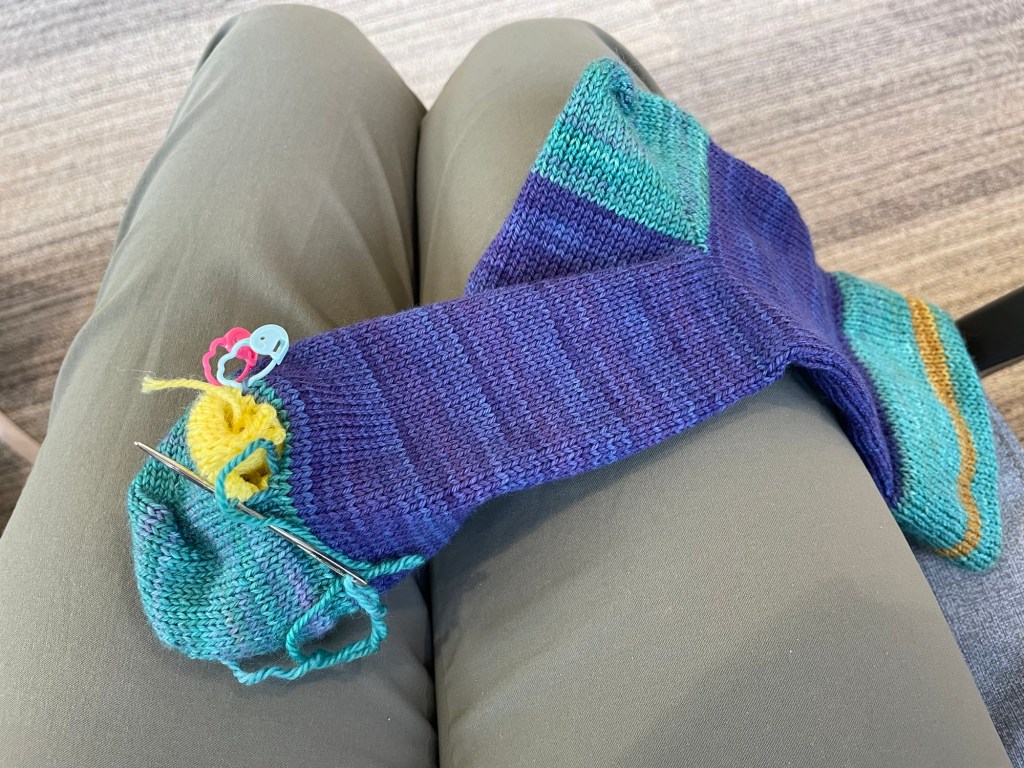
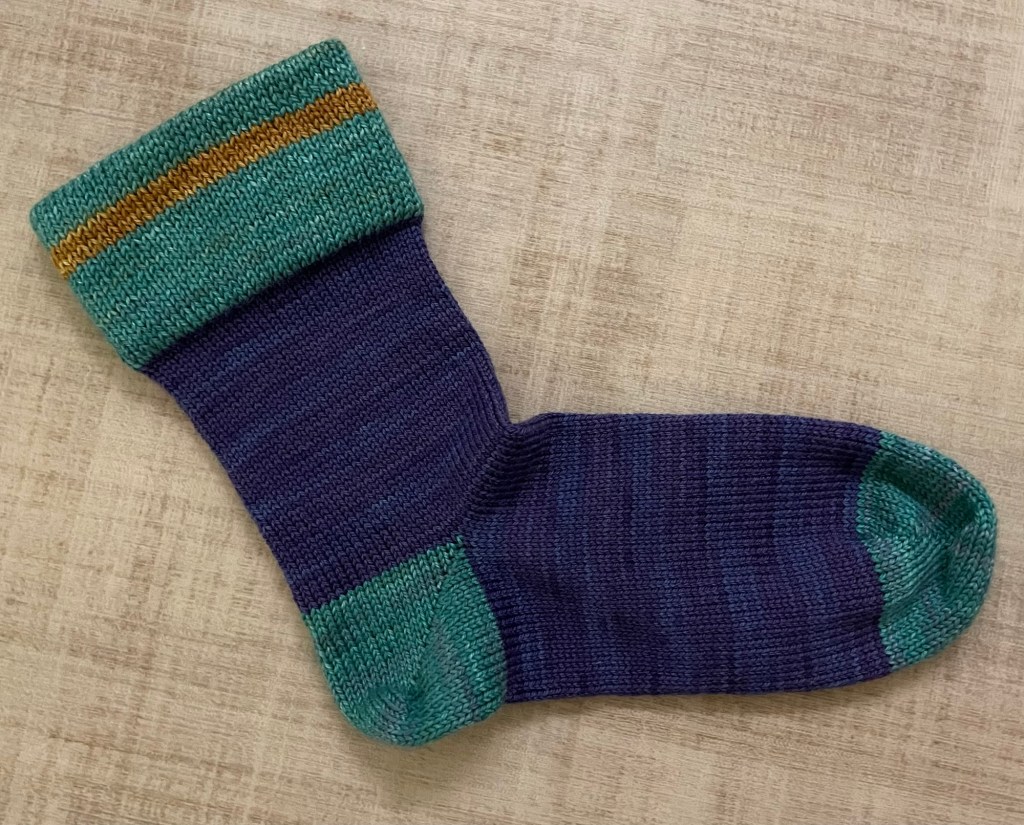
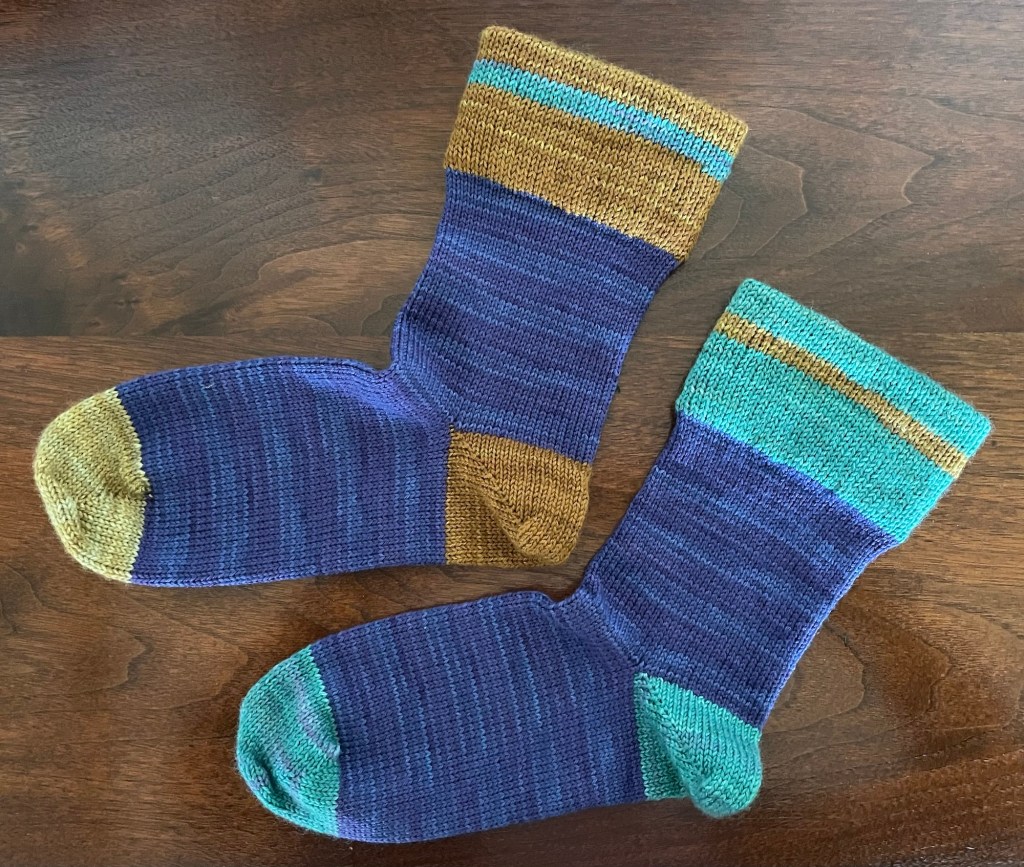
The first sock turned out well. There was not enough of the teal yarn left for the heel and toe of the second sock. It seemed like it would work and be fun to swap the two contrast colors, using the gold for the heel and toe of the second sock, and teal for the stripe in the cuff.
The second sock was going along nicely until I dropped a stitch while working the heel. I do not do this very often any more, but it happens. Given where the dropped stitch was located, there was not an easy way to fix it. I had a lot on my plate that day getting ready for a trip to the Twin Cities, so I left it as is to be dealt with after we got back. After I was back home and had thought through what to do, I removed most of the gold heel stitches from the needles.
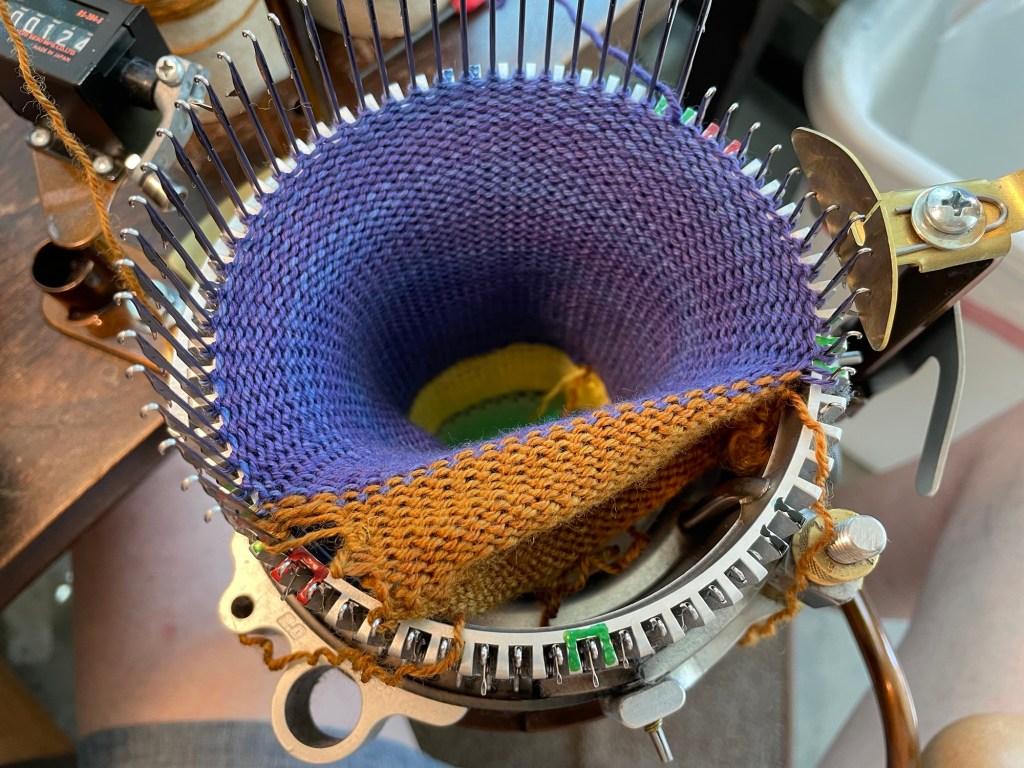
I was able to put the stitches from the last purple row back on the needles and get it to the part of the sock just before I started the heel. It took some time and patience to get it ready to start over with the heel, and involved raising needles out of work, and moving the yarn carriage around so I did not lose more stitches.
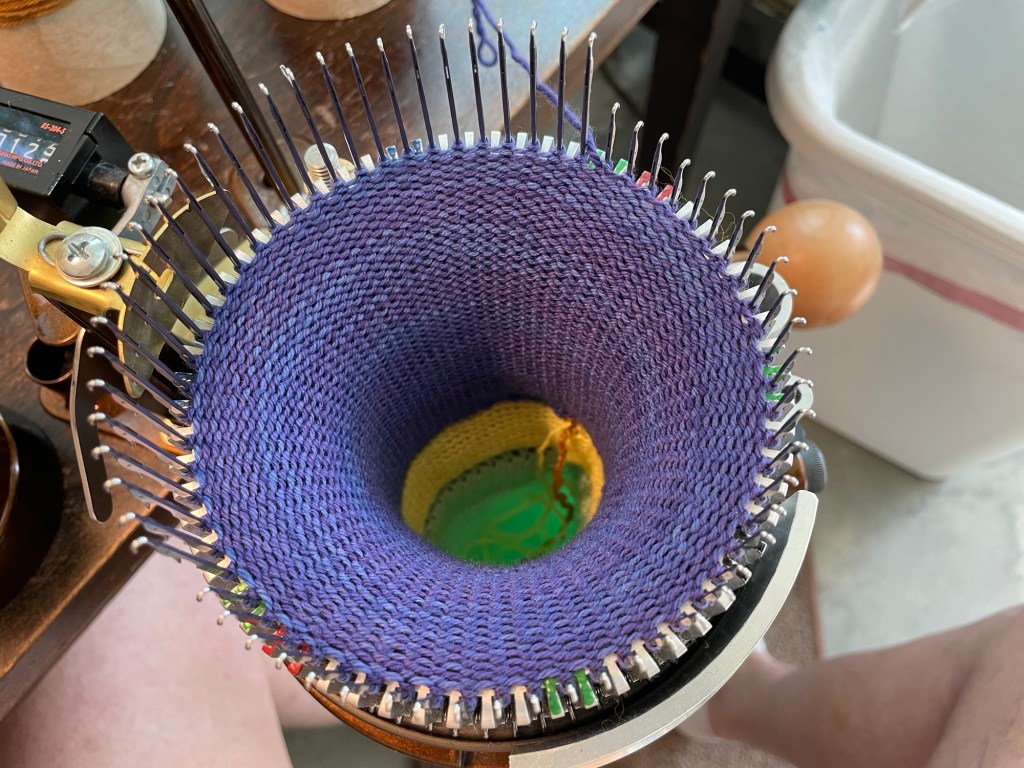
There are different ways to change colors or yarns when using the CSM. When doing the heel, a preferred way if you have a slotted yarn carrier is to take the yarn out of the yarn carrier and tuck it down inside the sock without cutting it. You can then knit the heel with contrasting yarn. After the heel is done, the still attached original yarn is threaded back in the yarn carrier. There are tails for the contrast heel yarn, but no break in the main yarn. I did this method successfully for the first time.
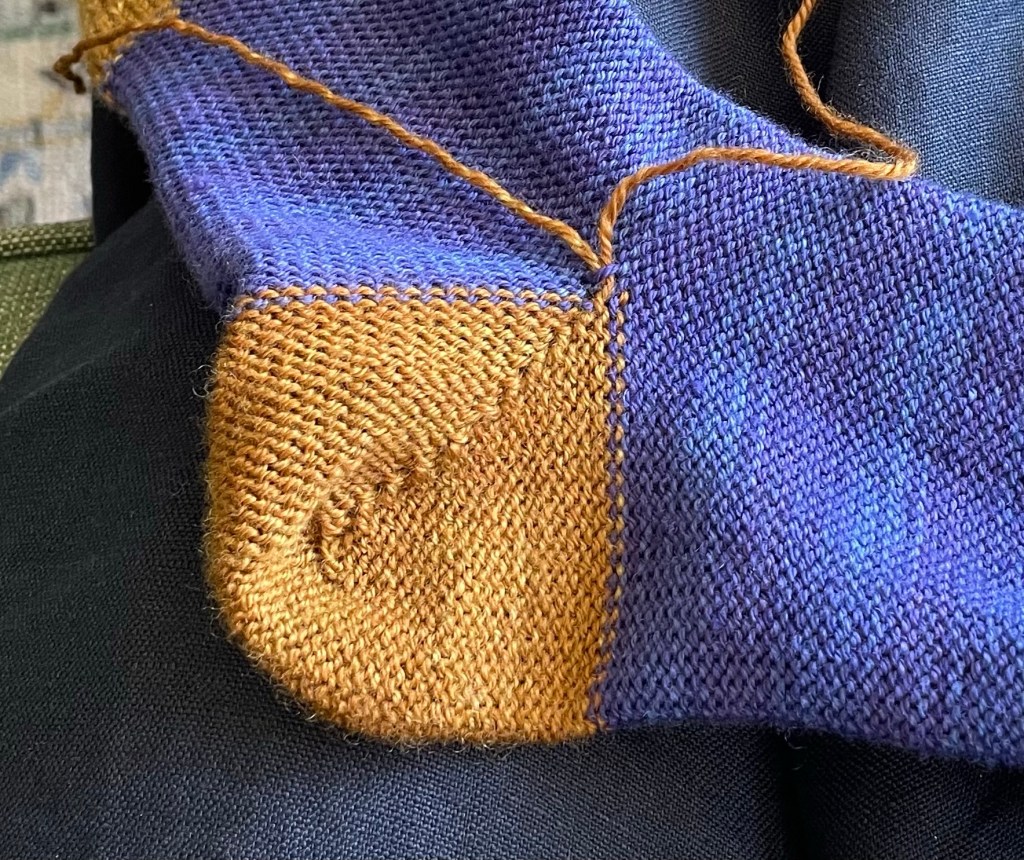
The second try on the heel went smoothly, and I continued on with the foot.
When switching color for the toe, a couple of rows of the contrast colors are knit before starting the toe for a smooth transition. I forgot to put the heel spring back on. I noticed the stitches were loose, and stopped just before actually starting on the toe. Again, I was able to remove those two rows, put the purple stitches back on the needles, and start again with the heel spring on. After that I finished the toe without any issues. The color of the remaining contrast yarn for the toe morphed from gold to a more mustardy color.
I do not really like the way the colors of the second sock turned out, but I guess all-in-all as a pair they work okay together.
I found one statement in the pattern that I thought needed to be edited, and a few that could be more clear. Two other pattern testers shared suggestions also.
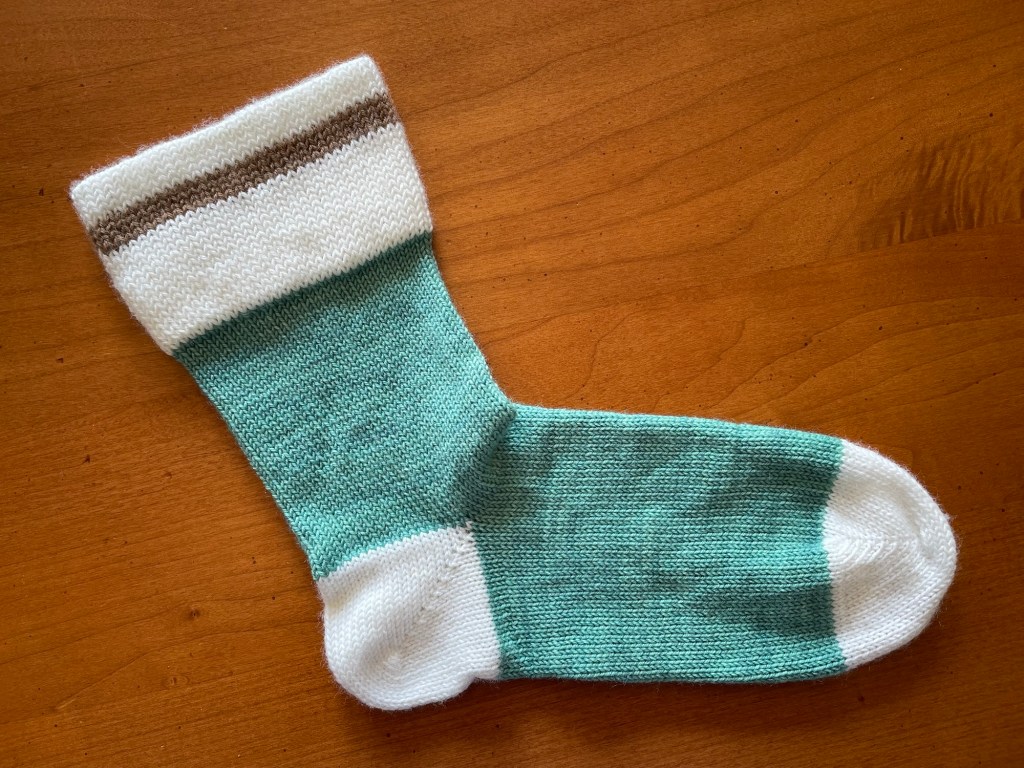
Later I received a revised version of the pattern incorporating information from the three testers. I cranked out another pair of socks with three different yarns I had on hand.
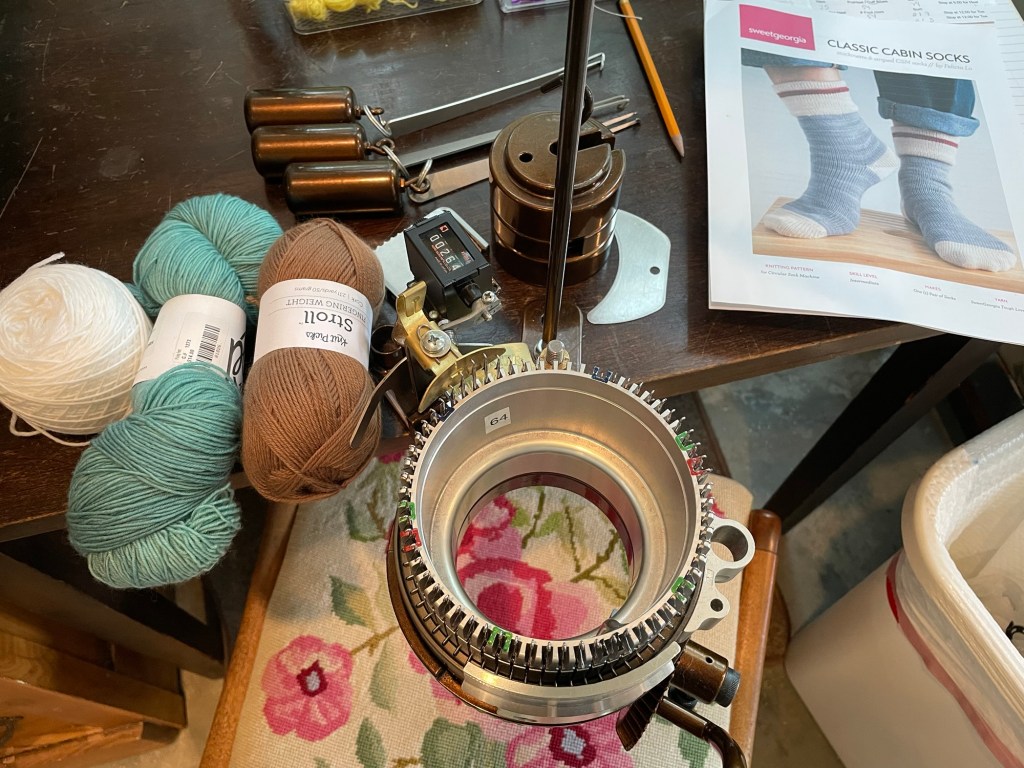
I received a $25 gift certificate for yarn at Sweet Georgia Yarns as a thank you for testing the pattern. In August there was a 15% off back-to-school sale, so it was a good time to order a skein of yarn. Sweet Georgia Yarns and the School of Sweet Georgia are based in Vancouver, Canada. The yarn is hand dyed, the shipping is expensive, and there is currently a tariff. Using the gift certificate, I ordered a skein of yarn called Mohair Silk Sock, which is a blend of Merino, Mohair, Silk, and Nylon, and at $36 is more expensive than the standard Tough Love Sock yarn. Even with the discount and the gift card, the total was around $28 after adding in shipping and tarif. It would have been about $50 without the deal, which I would not have paid. The yarn is very soft and luscious.
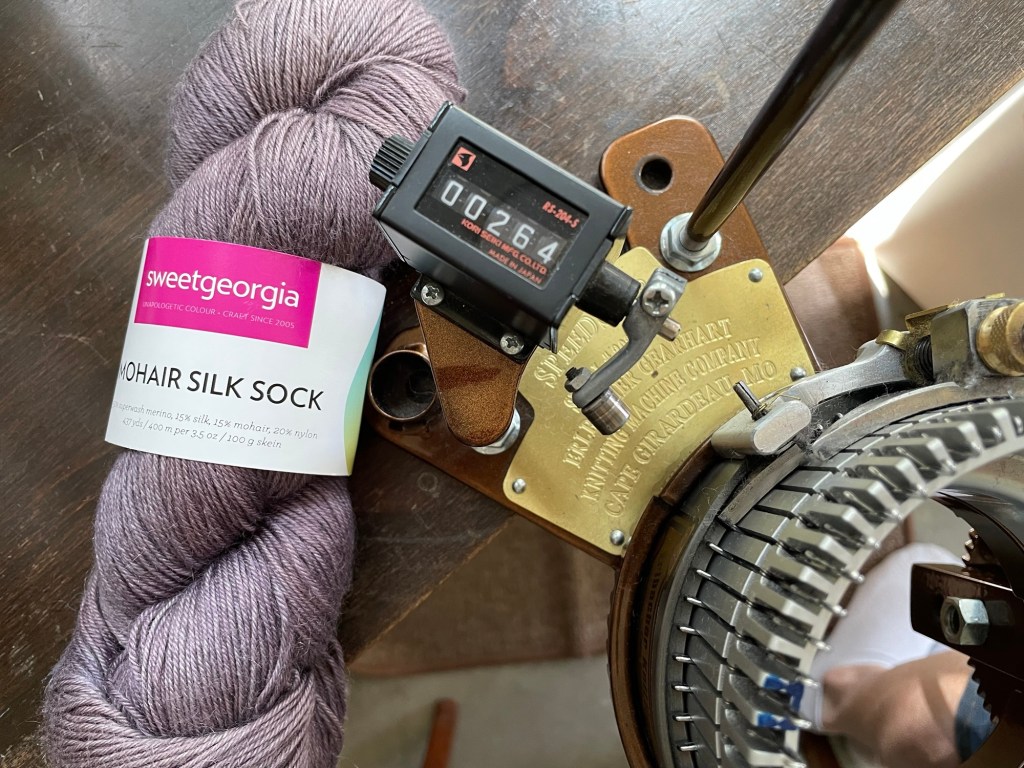
I was impelled to crank up socks for myself using the Mohair Silk Sock yarn right away, using my normal basic sock pattern. They feel super soft, but should also be durable. Mohair and silk are both strong fibers that can be used in place of nylon to provide strength in a sock, if someone does not want to use nylon, a petroleum based product.
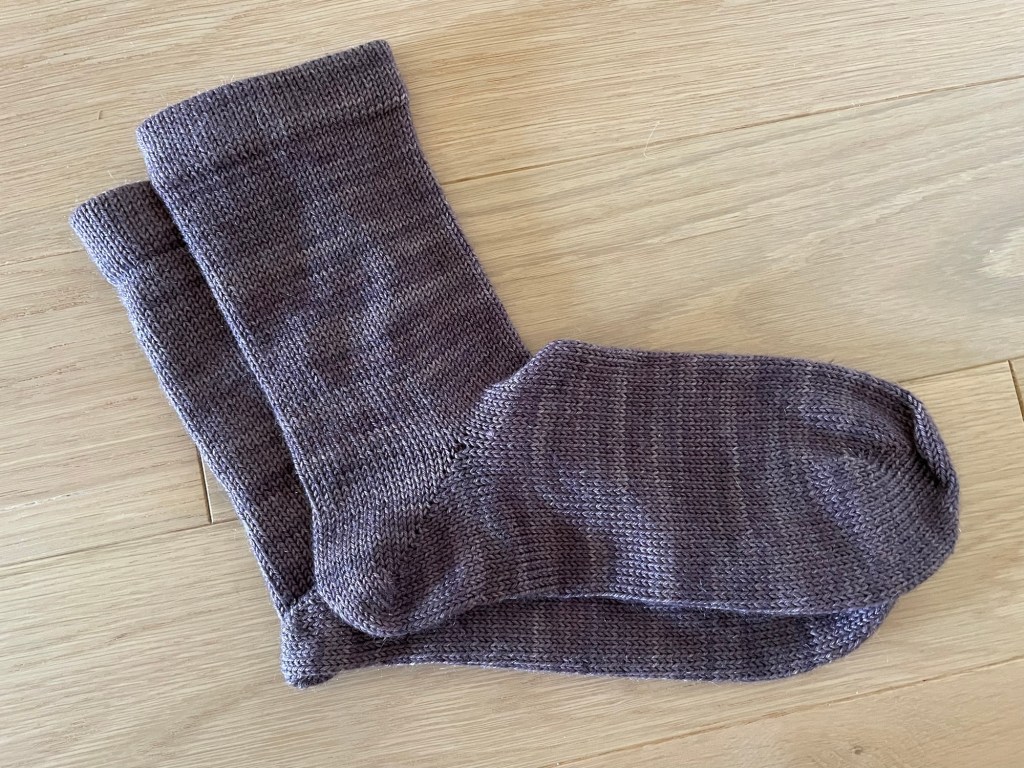
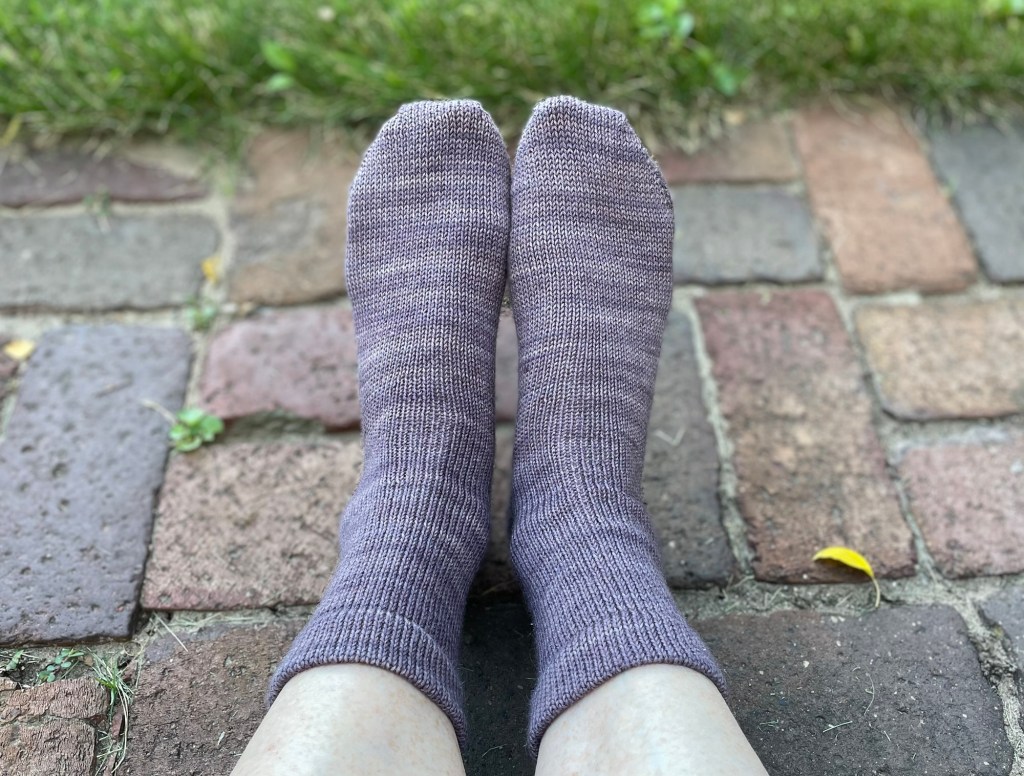
At the beginning of October, the Classic Cabin Socks pattern was published for Socktober.
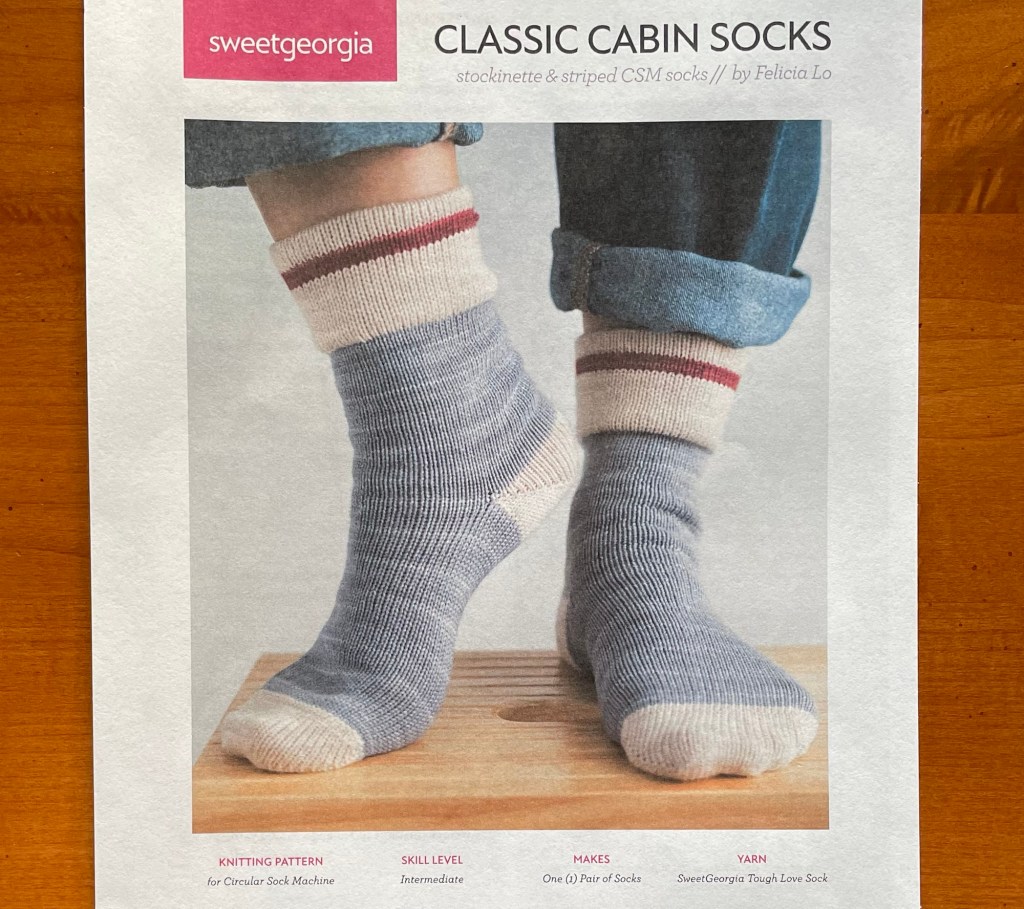
It is fun to be credited with the other two pattern testers on the back of the pattern. Our names are listed on the lower right on the last page.
My next sock machine project will be a new pair of Vikings football team color socks for my husband. The pair I made before were in an overnight bag that got left behind at an Airbnb that we never got back 😟.


I like all three pairs of socks. Those cabin socks look like fall to me! Too bad about your husband’s lost socks! I wonder if they will ask you to test more patterns. I bet they will! Good job on all fronts, Meg!
LikeLiked by 1 person
Thank you! Thanks for reading and hope you have a great weekend.
LikeLiked by 1 person
Betty I had a weird thing happen with my WordPress.com the last time my laptop updated. Now when I try to comment on someone else’s blog it will not let me type in the box. And worse, when I select a post on my own blog to edit, I get a blank screen, all the text and media is gone. Fortunately I know it still exists because I can see it on my phone, and if I log on to my husband’s laptop all is normal. We are currently on 2 back to back trips to Northern Michigan and then San Diego for weddings, so I won’t be able to figure it out for a while. Maybe my computer will update again and fix itself.
LikeLiked by 1 person
Good luck and enjoy your travels!
LikeLiked by 1 person
Wow, I have sock knitting machine envy! All of the socks look awesome; the mohair must feel like a cross between a cloud and a hug. 🙂
I was really excited to learn that Sweet Georgia is north of the border, somehow I always thought it was in Georgia! Tariffs suck so so much. Sigh. Hopefully it won’t last too much longer and the sweet fibre goodness will flow freely again.
Happy Socktober and I love you blog as usual!Renata
LikeLiked by 1 person
Thank you! I thought Sweet Georgia was in Georgia, US, too at first haha!! We are hoping to go to Seattle and Vancouver next fall l, coinciding with Knit City Vancouver. My husband can find things to do while I am at the convention.
LikeLiked by 1 person
That would be amazing! And if you want to come somewhere in the middle of the country next year maybe the Manitoba Fibre Fest too? I’d love to meet you in person and it’s a really wonderful festival!
LikeLiked by 1 person
I will keep that in mind!
LikeLiked by 1 person
How nice you got credit and a gift certificate! Knit on!
LikeLiked by 1 person
Yes I was happy to get it!! Thanks for reading and have a great weekend.
LikeLiked by 1 person
We’ll see how it goes with Hurricane Isaias set to say hello.
LikeLiked by 1 person
Good luck…hope it is not too bad where you are
LikeLiked by 1 person
It shouldn’t be too bad. 🤞
LikeLiked by 1 person
Good luck!! Enjoy your travels!
LikeLike