
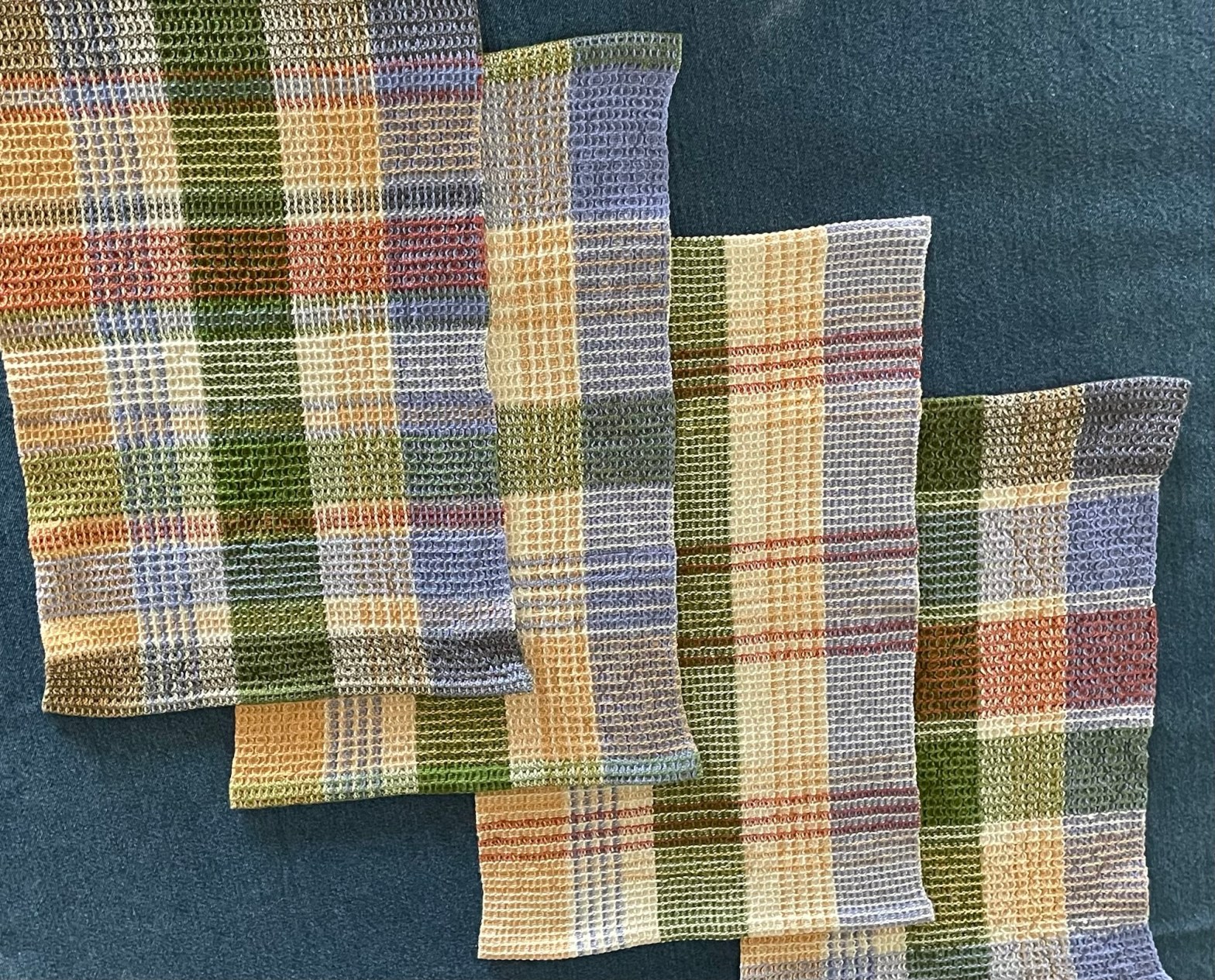
Waffle Weave is a weave structure that looks like actual waffles with little indents, usually made with a multi shaft loom. It is commonly used for towels because it is especially absorbent. Before I owned a floor loom, I attempted waffle weave towels on my simpler rigid heddle loom using a pickup stick.
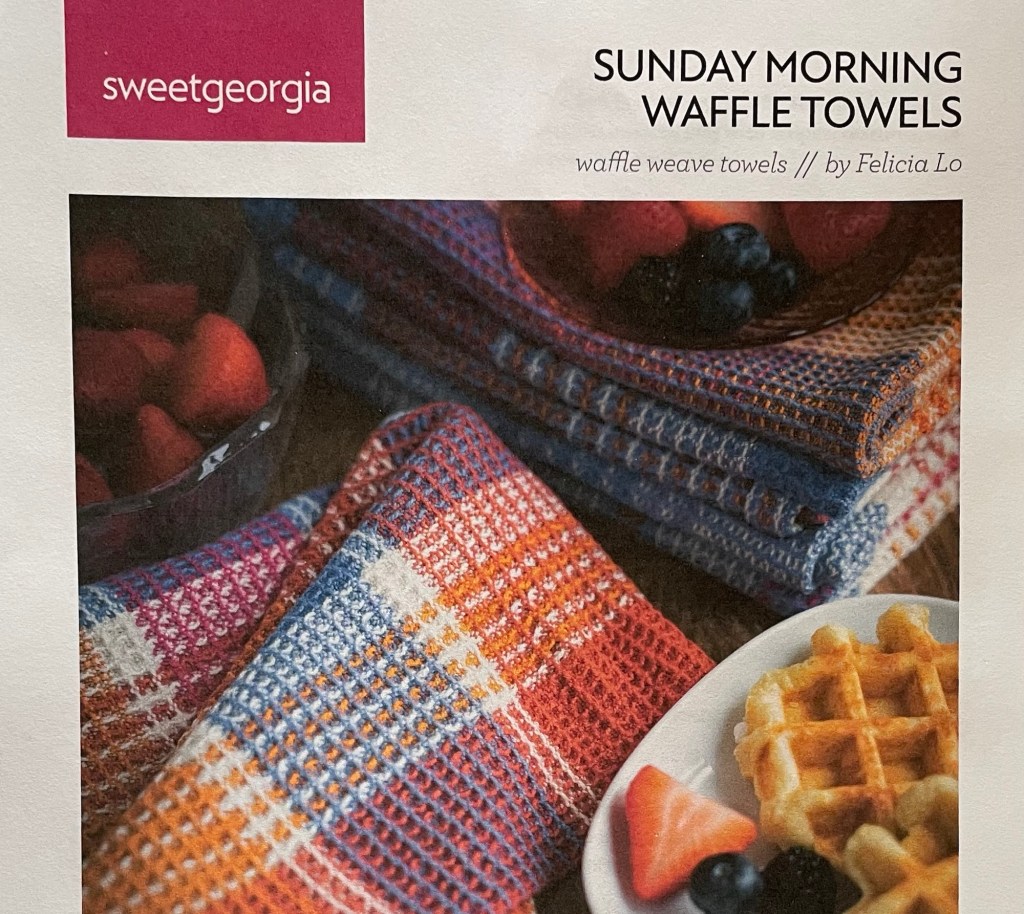
The School of Sweet Georgia recently added an online class for Waffle Weave towels on a multi shaft loom. After returning from snowbirding in Arizona and getting my life in order back home, I was ready to try Waffle Weave again with my floor loom and good instructions.
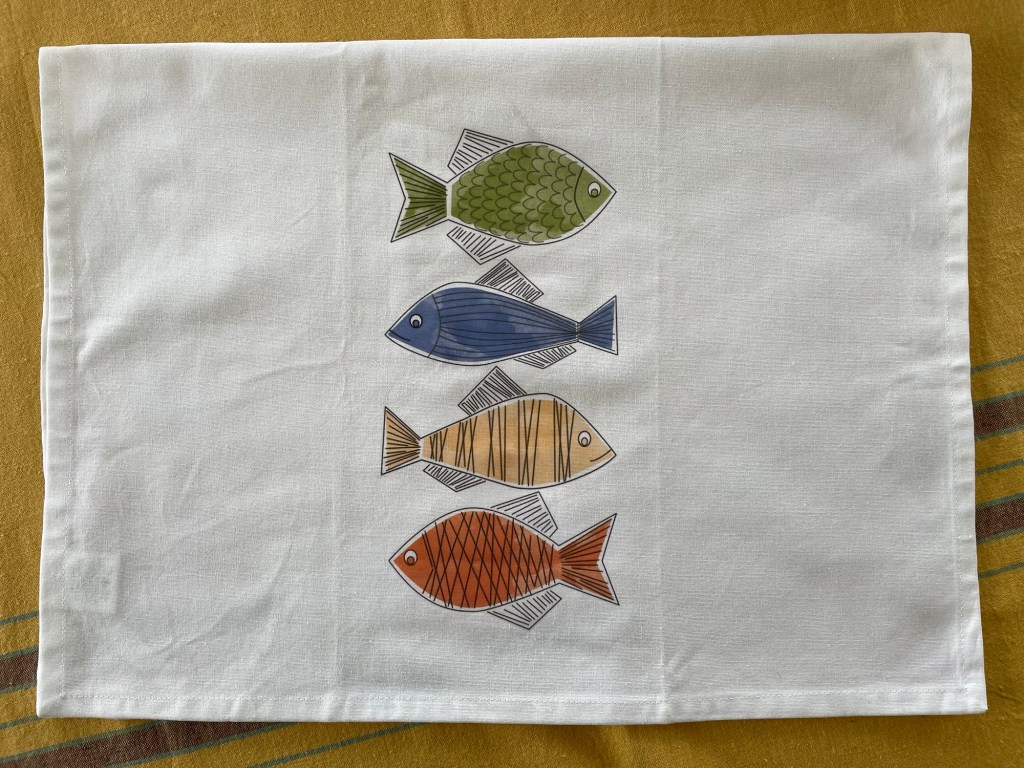
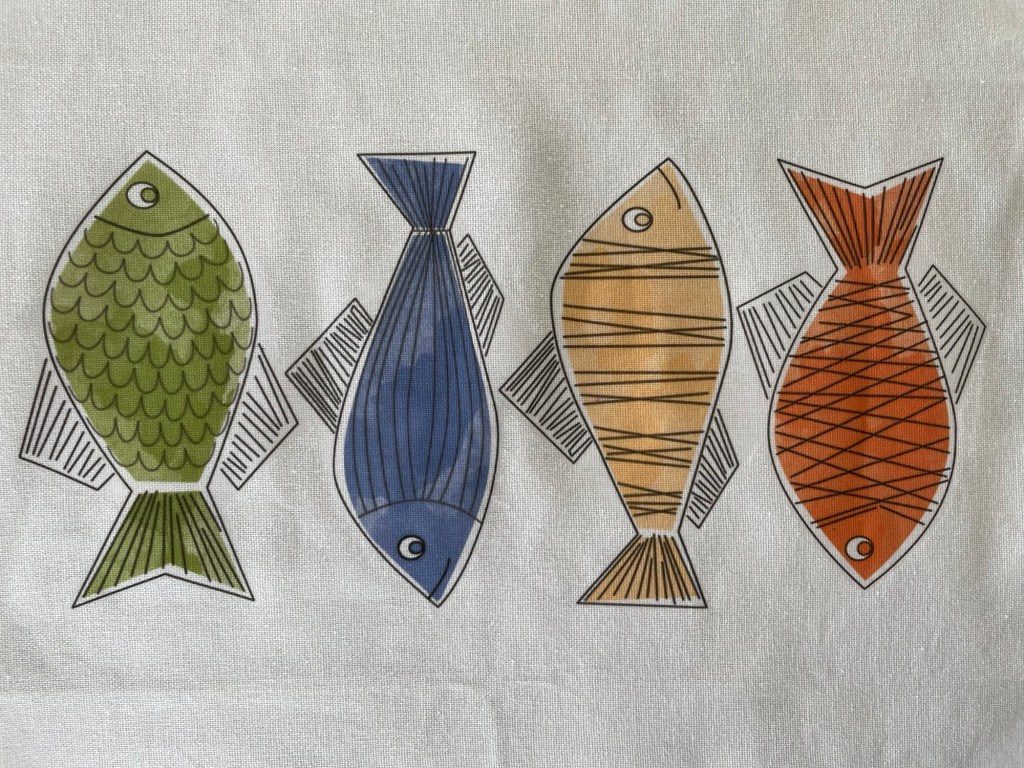
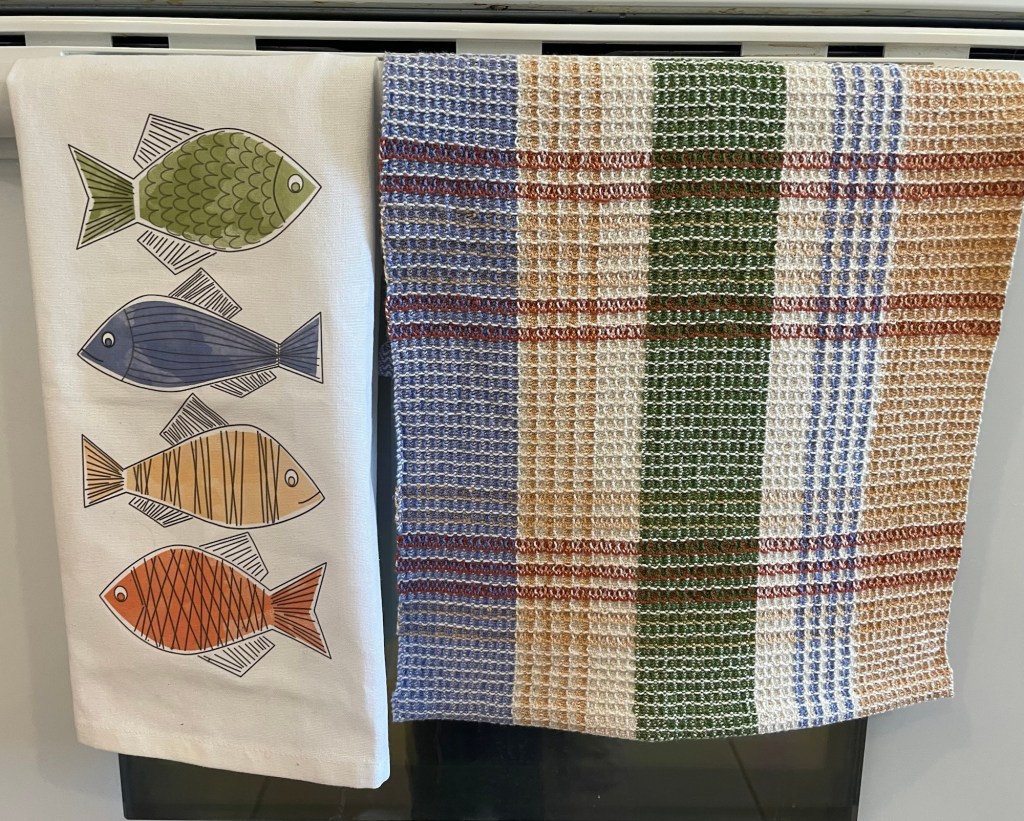
Last summer when we went on a trip to Michigan, I bought a souvenir tea towel with the idea of hand weaving matching dish towels. Picking out color combinations is not my strongest suit, but I know when I see something I like. Choosing colors that a designer selected is a winner.
I spent some time trying to understand the Waffle Weave towels pattern. I wanted to make it a bit wider, which meant figuring how many more warp yarn ends were needed to make the pattern come out right, and what color distribution to use.
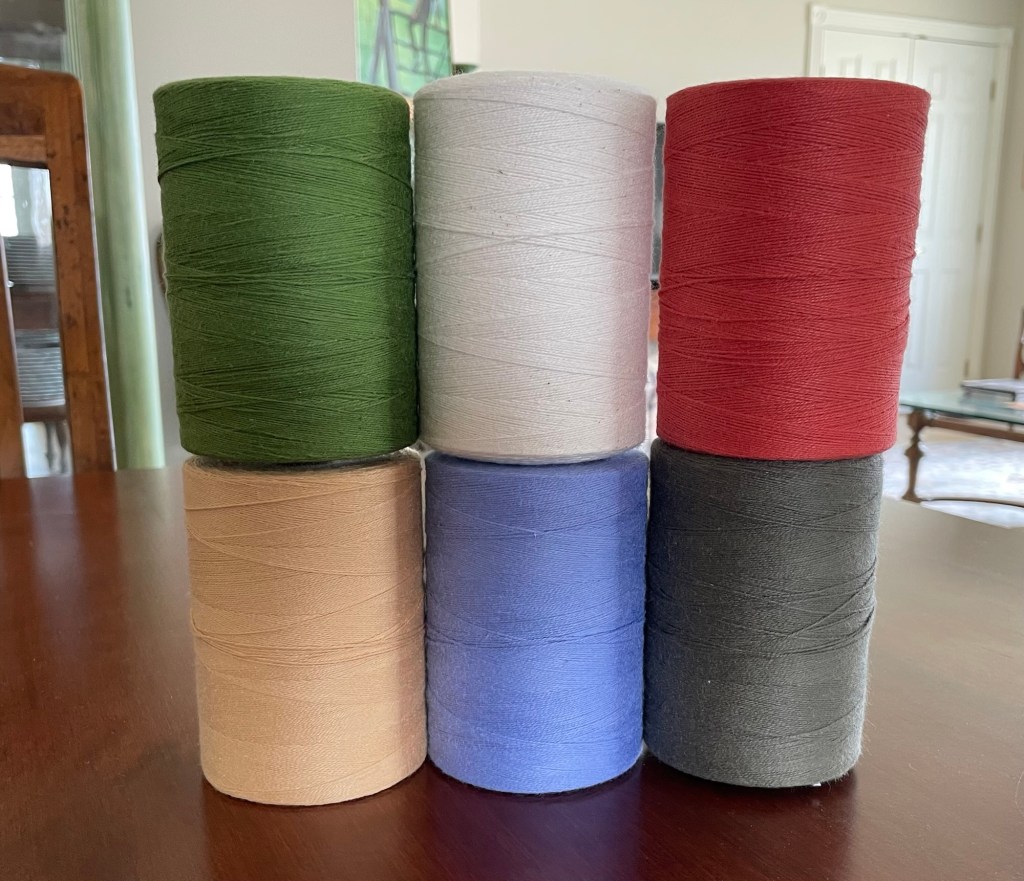
Sometimes I am feeling thrifty and want to use yarn I have on hand. This time I chose to order the exact yarn specified in the pattern, in the colors matching the towel from the trip. Picking out yarn online is risky as sometimes the choices are limited and not exactly what you are looking for, or the colors you get do not end up being what you were expecting. In this case the colors of 8/2 cotton I got were pretty close.
Before I started measuring out yarn for the towels, we made a weekend trip to the Twin Cities for dentist appointments. Since we were going to be in “the Cities”, we bought tickets for a matinee performance of the play “Sleuth” at the Guthrie Theater, using a gift certificate our Son and Daughter-in-law had given us for Christmas.
The Weaver’s Guild is located within blocks of the Guthrie Theater in Downtown Minneapolis. At my request we left early for the play so I could buy some yarn at the Weaver’s Guild for future projects. It is nice to see the colors in person and not have to pay for shipping. I liked the cayenne color I had ordered online, but the Weaver’s Guild had a different orangy color that more closely matched the fish on the towel.
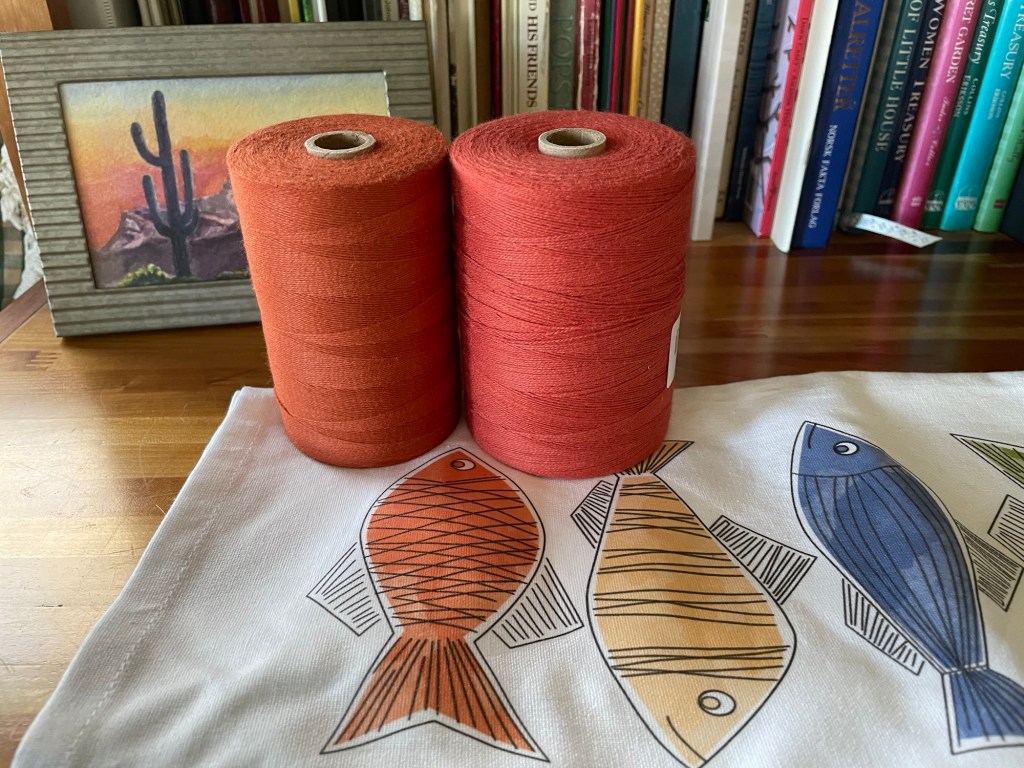
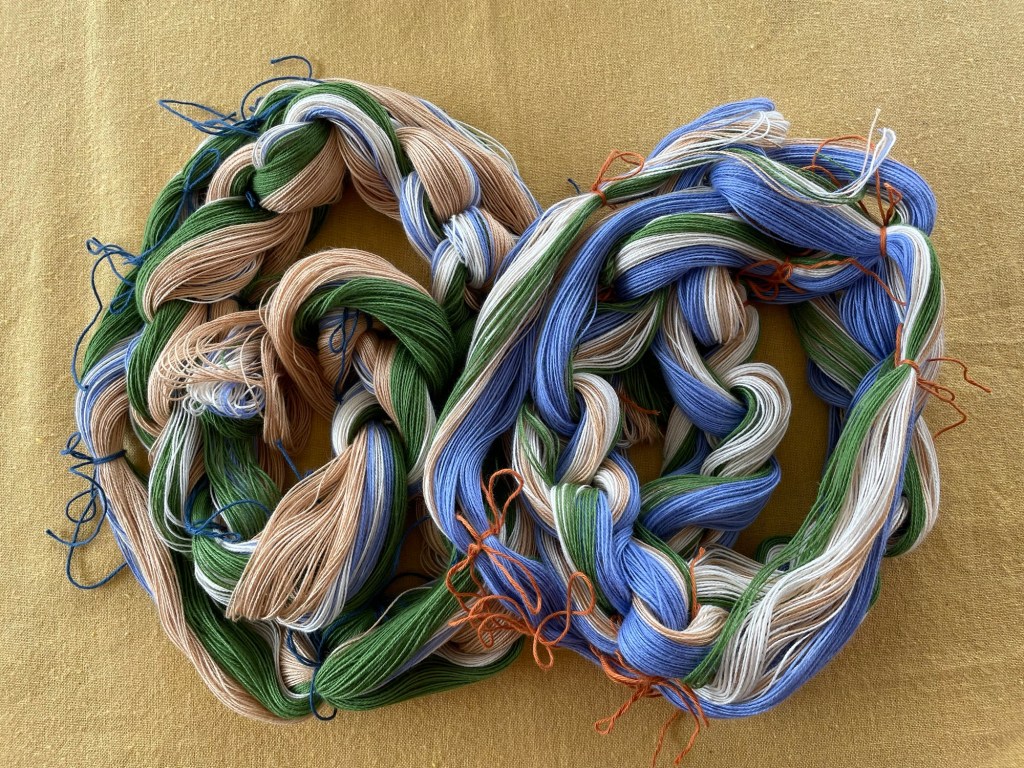
After we were back home, and I felt comfortable that my calculations were right for the warp yarn length, as well as the number and order for each color, I measured out the warp yarn.
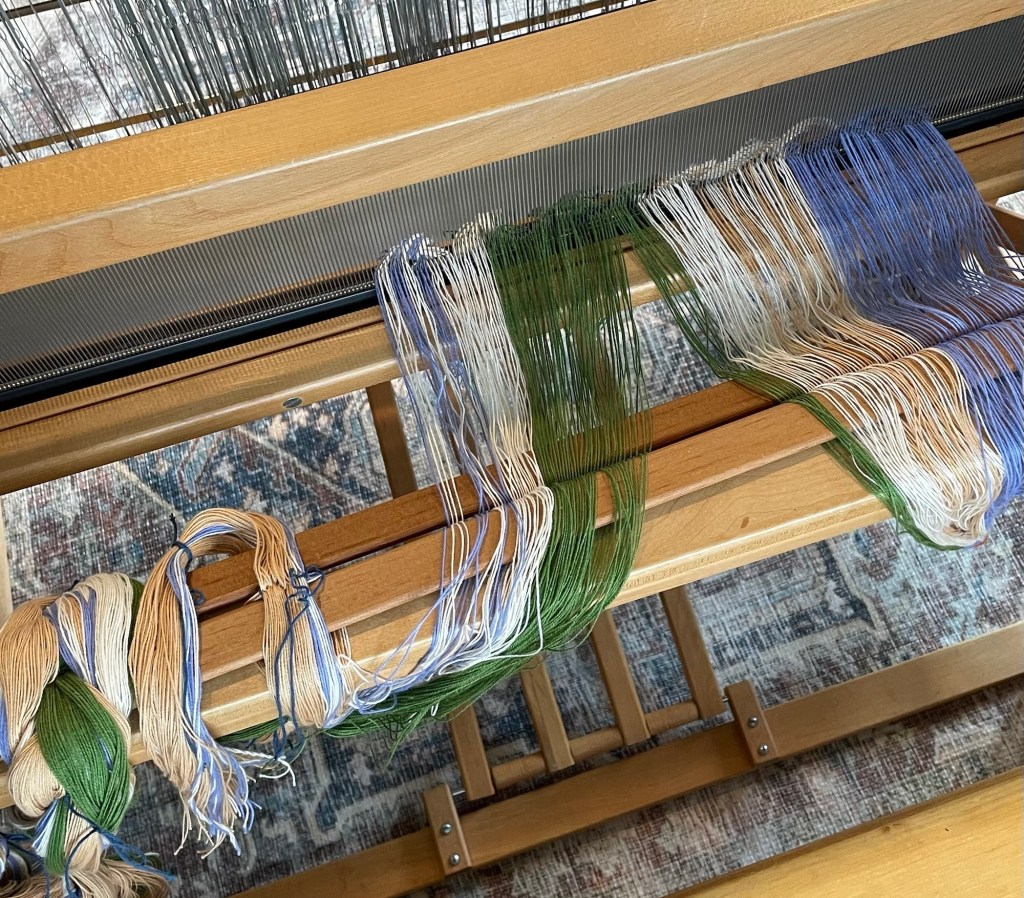
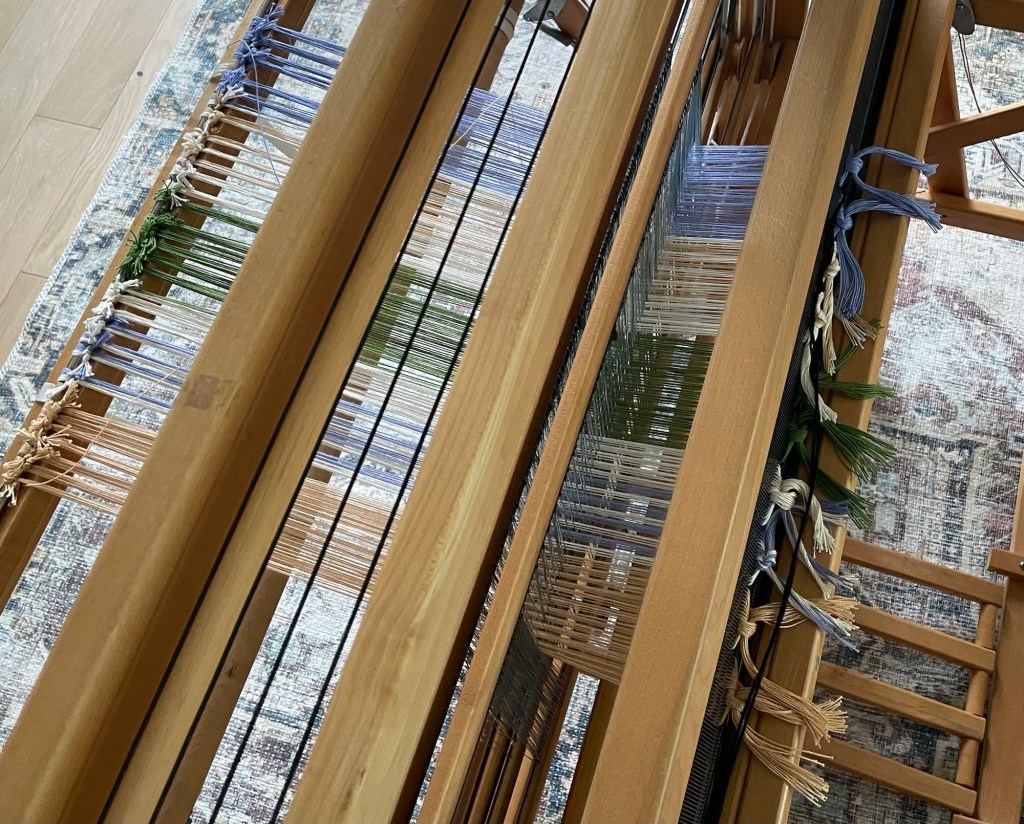
Threading 392 warp yarns through the reed and heddles is slow, but I do not mind. That translates to about 16 inches wide on the loom with 24 ends per inch.
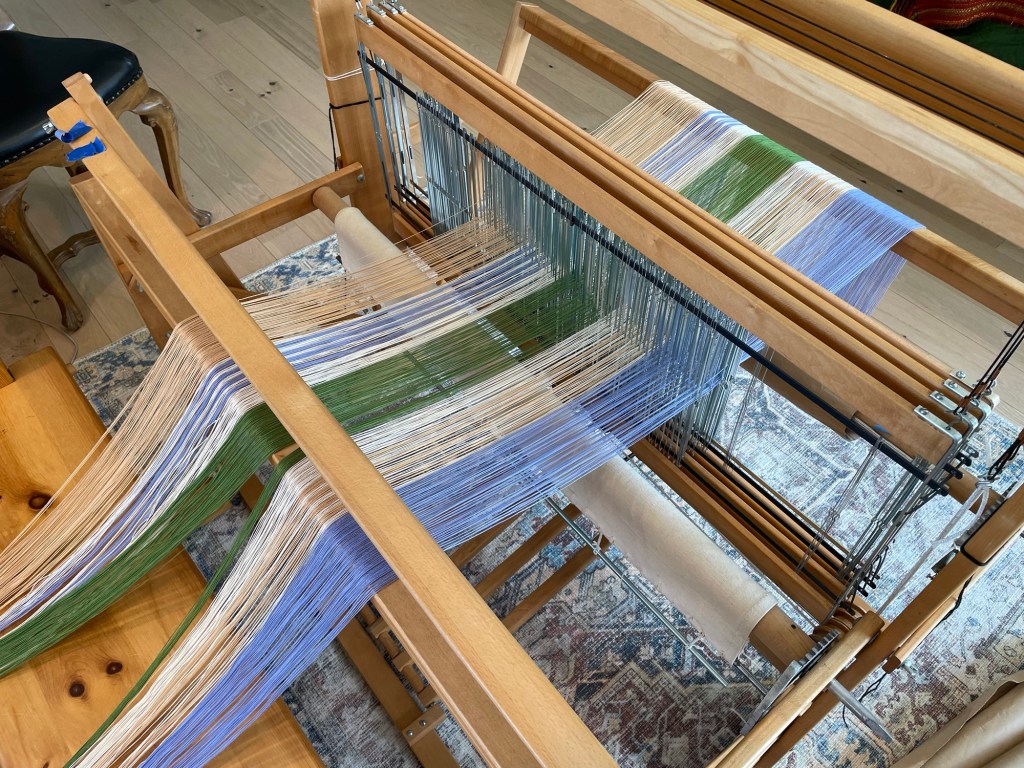
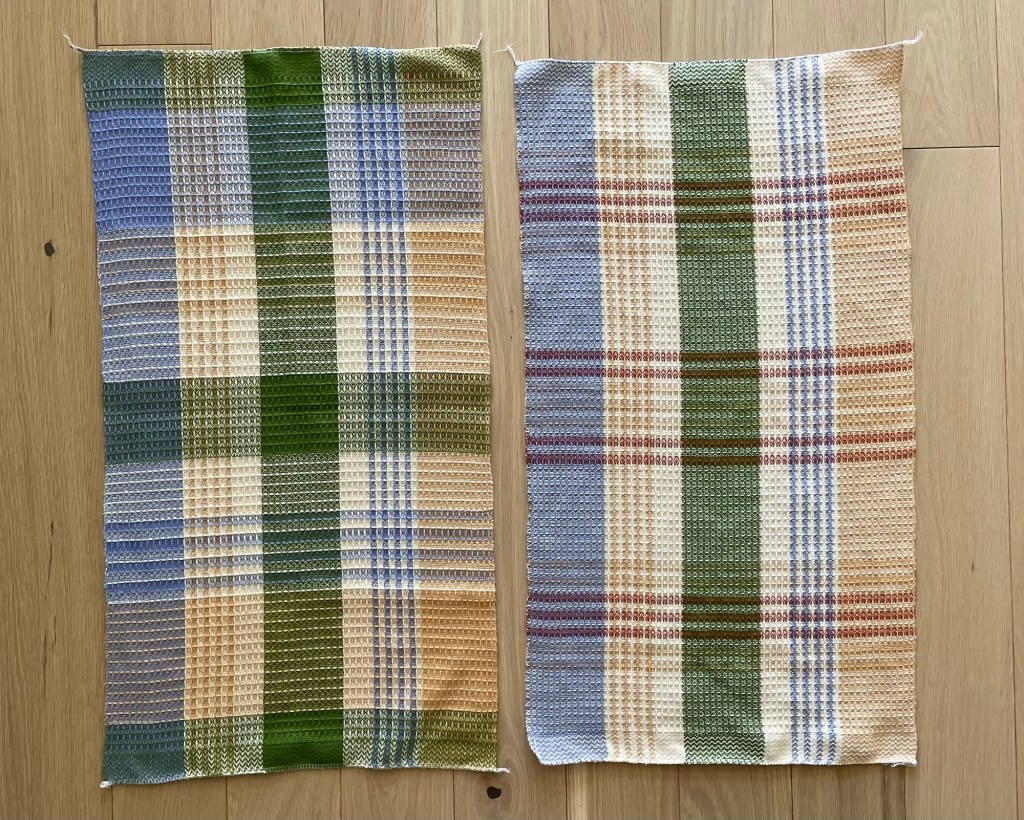
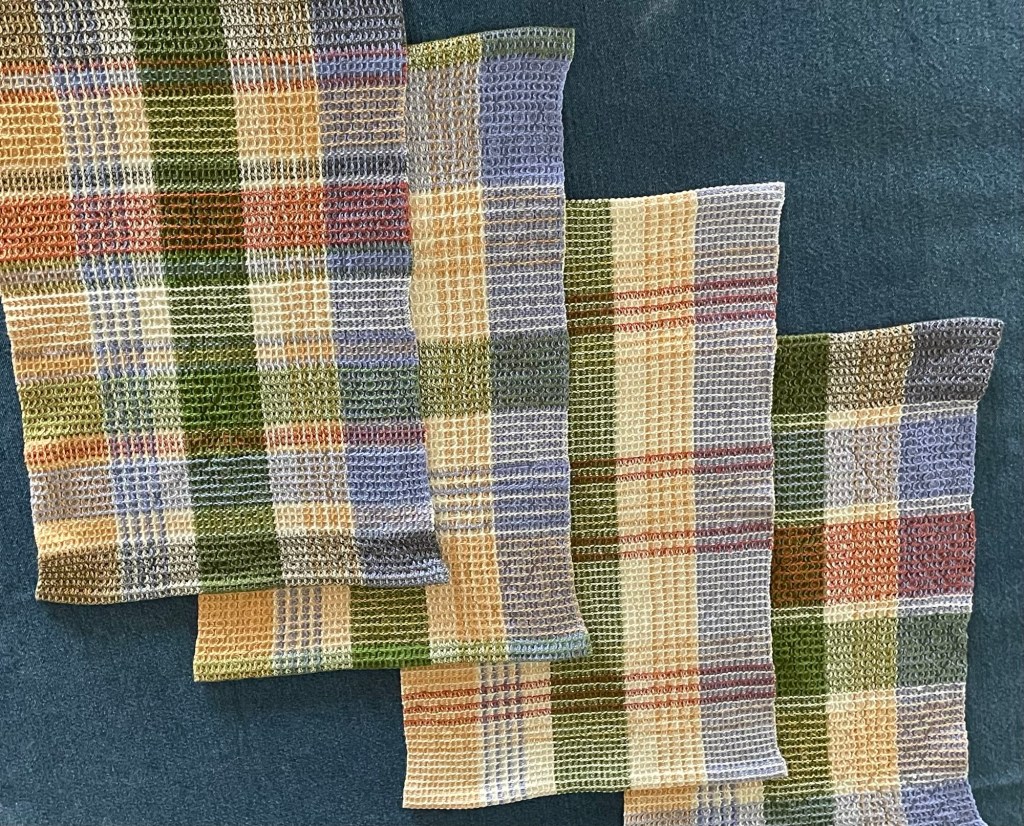
There was enough warp yarn for four towels. The pattern includes two different versions of the waffle structure, “big waffles” with eight rows, and “baby waffles” with six rows. The four towels were different combinations of colors, and of big and baby waffles. The first towel was all “big waffles”.
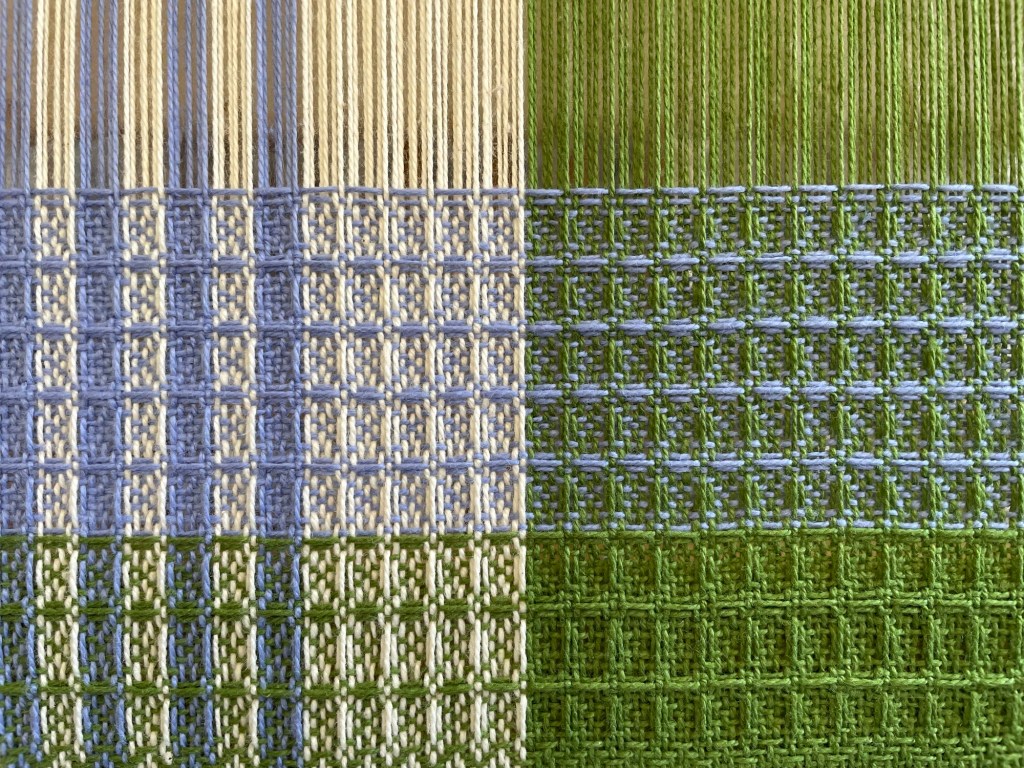
The second towel was baby waffles with a different pattern of colors.
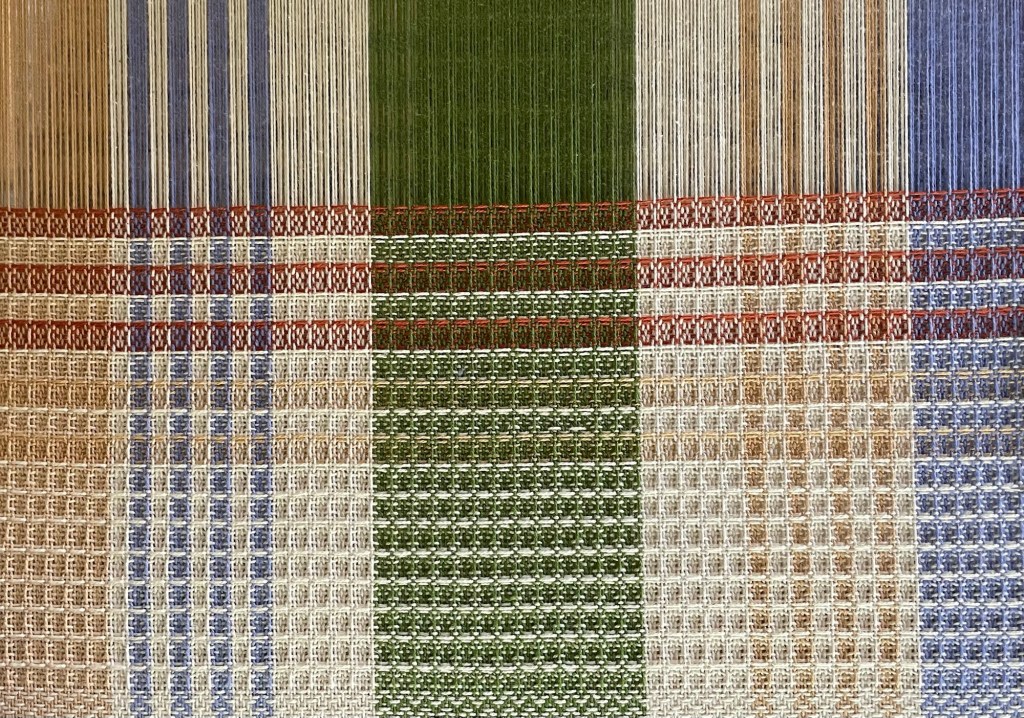
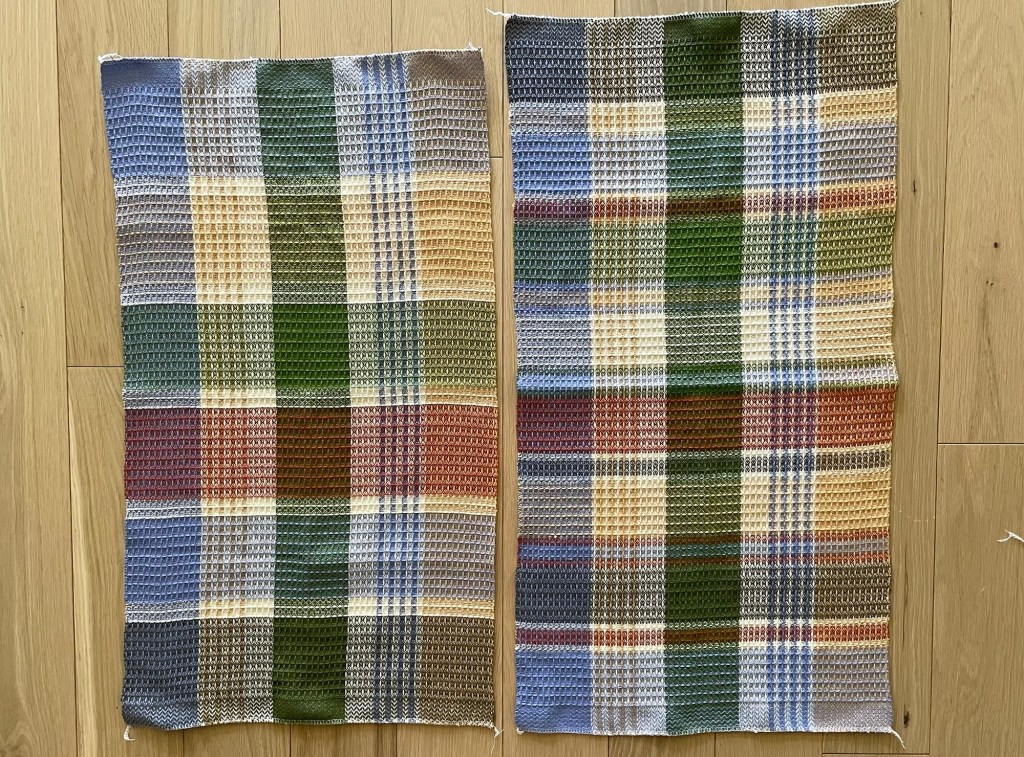
The third towel was back to big waffles.
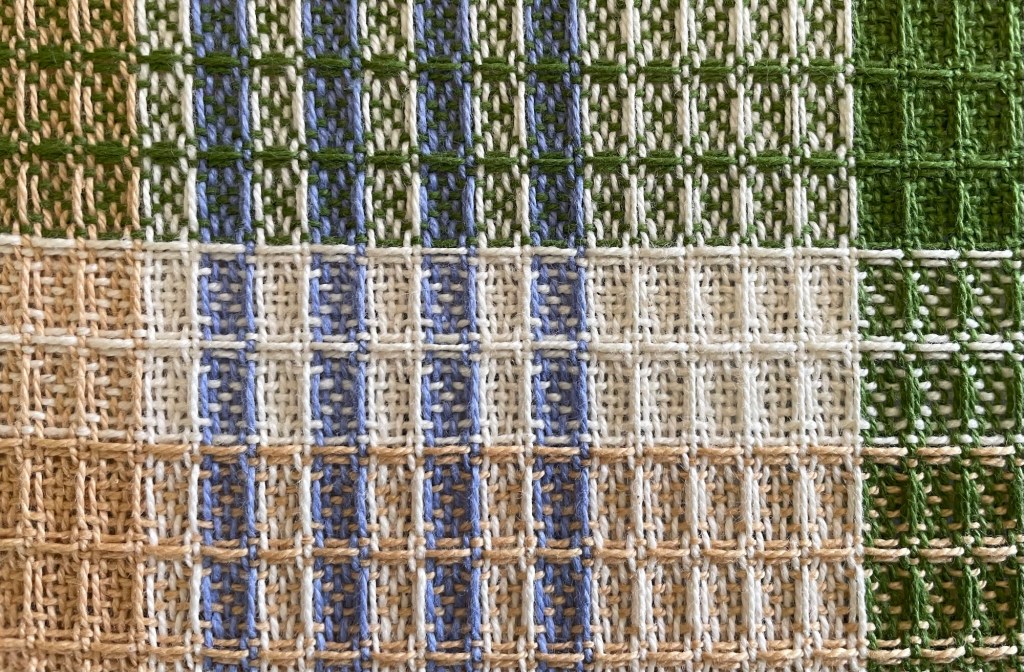
I was having a small problem with a “smile”, where the edge of the weaving formed a sort of smile shape with the edges not packing in as far as the middle. I tried to fix this by playing around with looser or tighter tension on the warp yarn, but it did not go away. I attended a School of Sweet Georgia virtual weaving meet-up where I got some ideas about this problem from the attendees. It was likely due to tension being tighter on the edges, so there was not much to be done at this point in the project. It was not terrible, and I thought maybe it would even itself out later when I washed the towels. I did not get a good photo showing this problem, but you can just barely tell on the following picture.
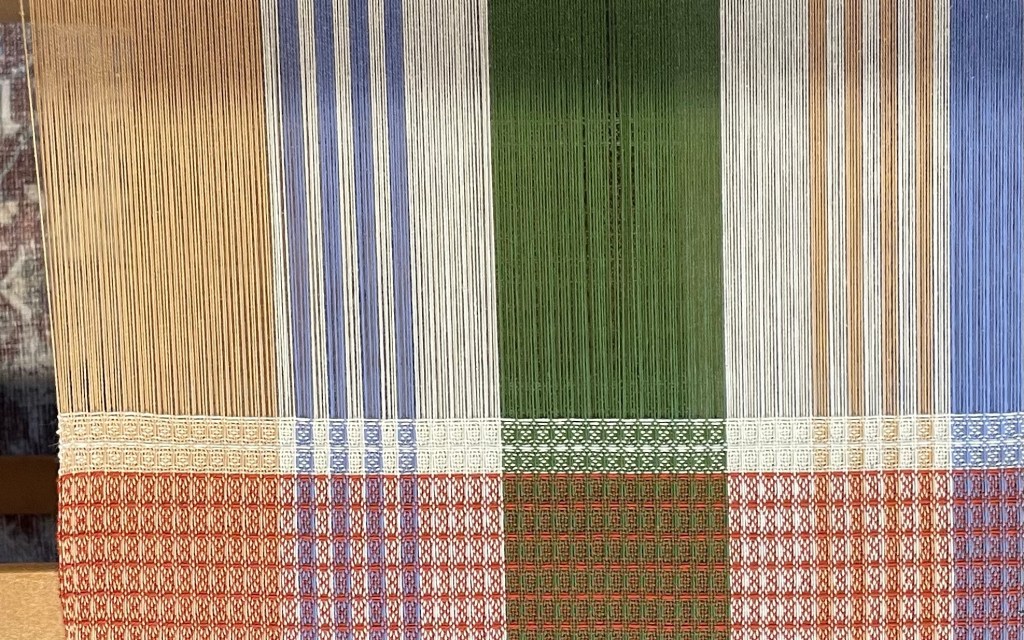
Towel four was a mix of big and baby waffles. After giving up on trying to fix the smile problem, I focused on getting the selvedges to be as even as possible and not draw in too much.
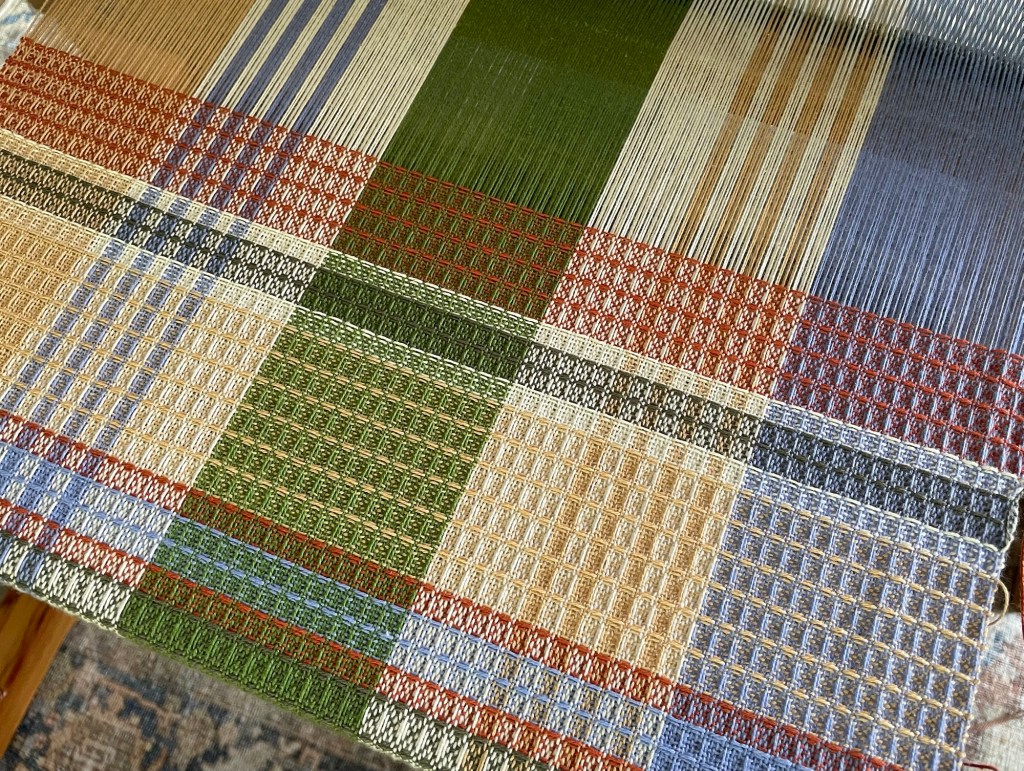
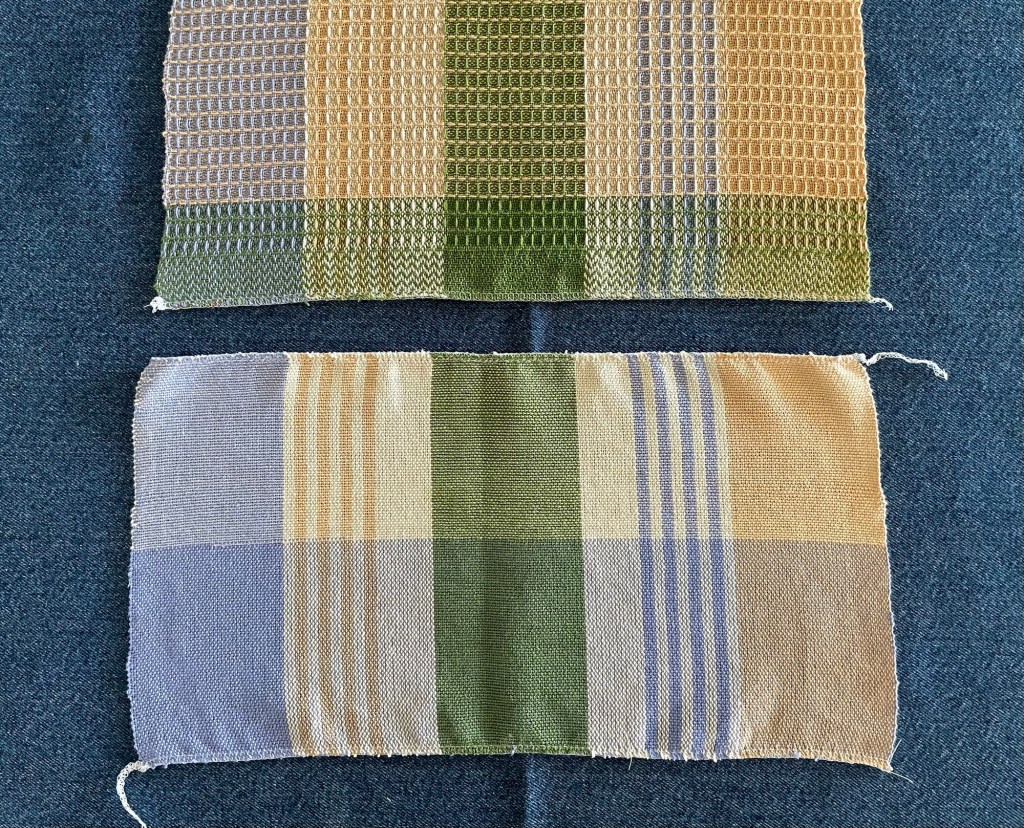
Each towel had 24 rows of twill weave at the beginning and end for the hem. The waffle weave is bulky, and will shrink up a lot and be narrower than it is on the loom. The twill is flatter and will shrink in a little more than plain weave. After finishing the fourth towel, there was still warp yarn left, so I wove some plain weave rows to see what that would look like. The photo below shows twill weave hem rows after waffle weave rows and before the plain weave section.
There was an extra warp yarn on each side for a selvedge. For the first time, I hung an S-hook on each selvedge yarn at the back of the loom to keep the tension on that warp yarn from getting too loose. I cannot say this has been a big problem in the past, but I was interested in trying it. Some people even hang additional weight on the S-hooks. When I reached the end of the warp and removed the S-hook, there was a bunch of slack in the selvedge yarns. Interesting.
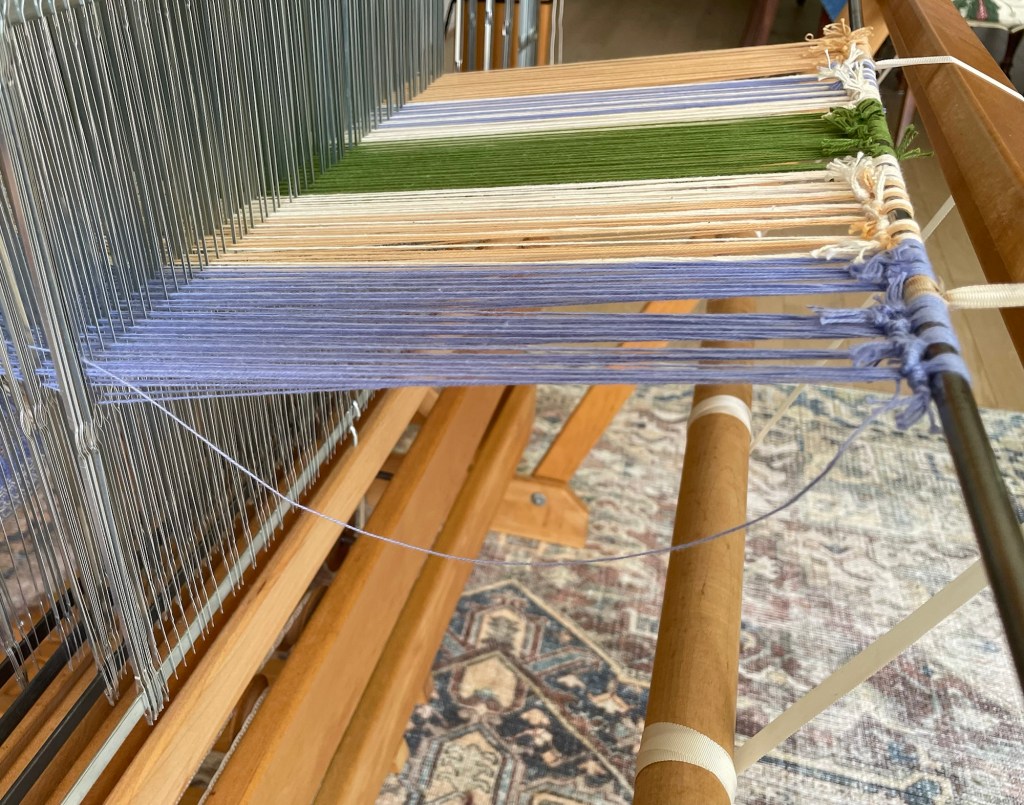
I also noticed that the back beam where the warp ends were tied on was actually bent in the middle. I don’t know how this is even possible with a metal bar, but likely it was a factor in my “smile” issue.
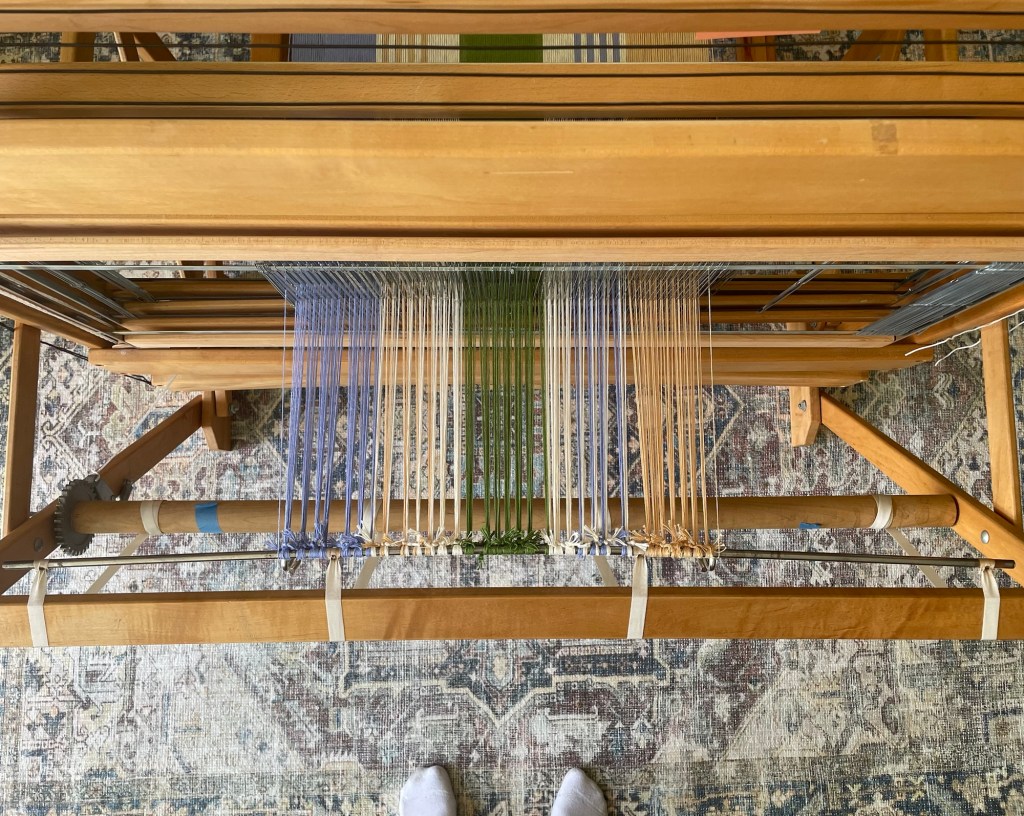
After the weaving was removed from the loom, the back beam was straight.
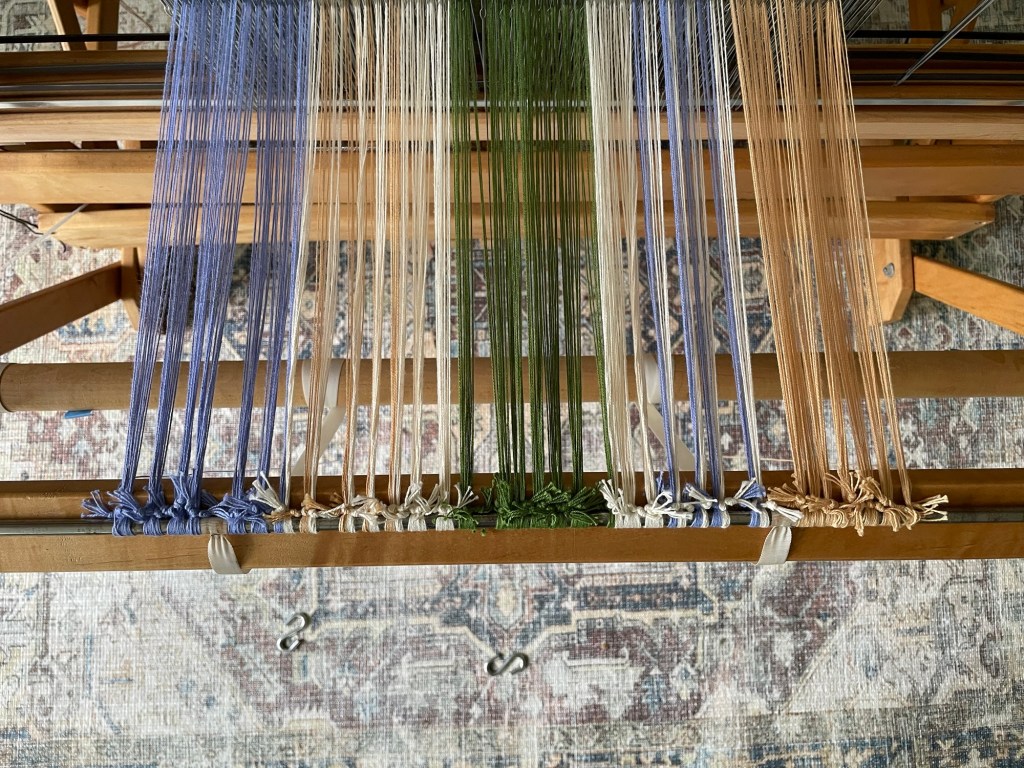
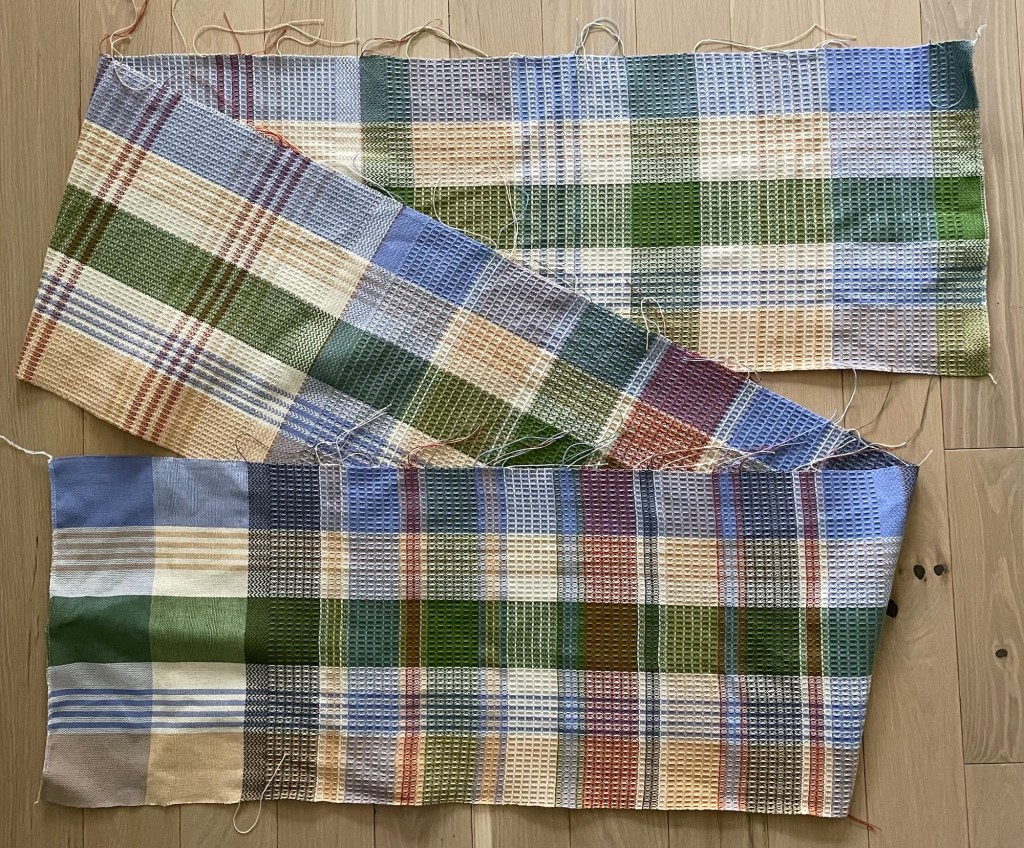
Following is a photo of the entire weaving off the loom.
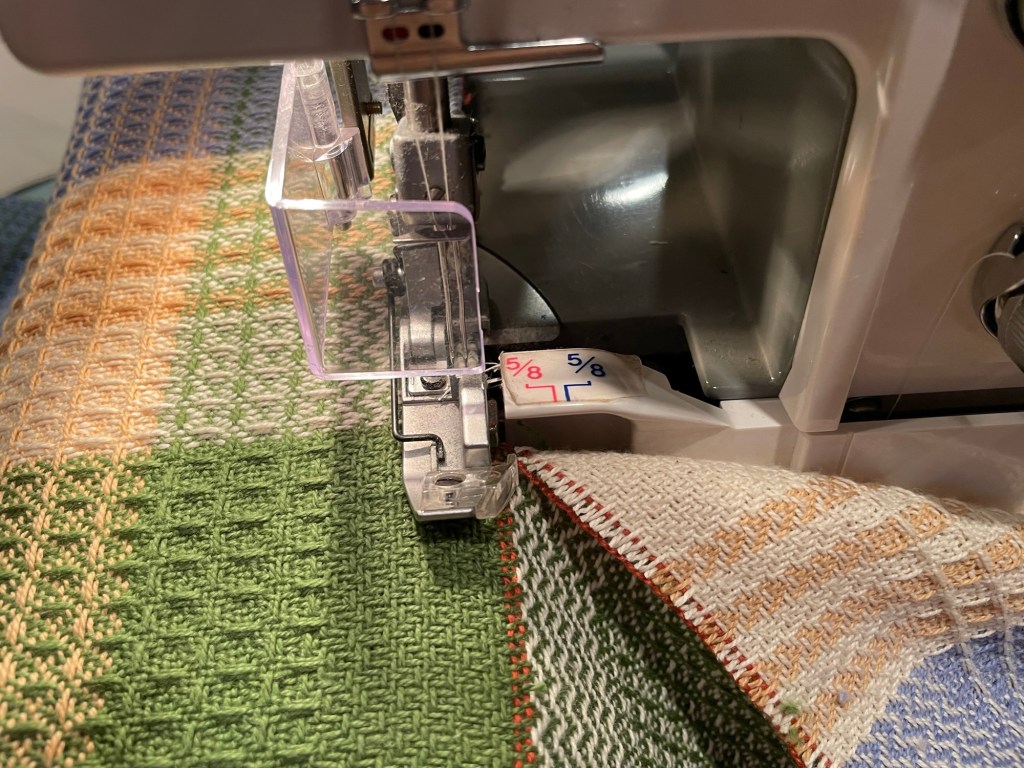
I used my serger sewing machine to separate the towels, while also finishing the edges so they would not unravel.
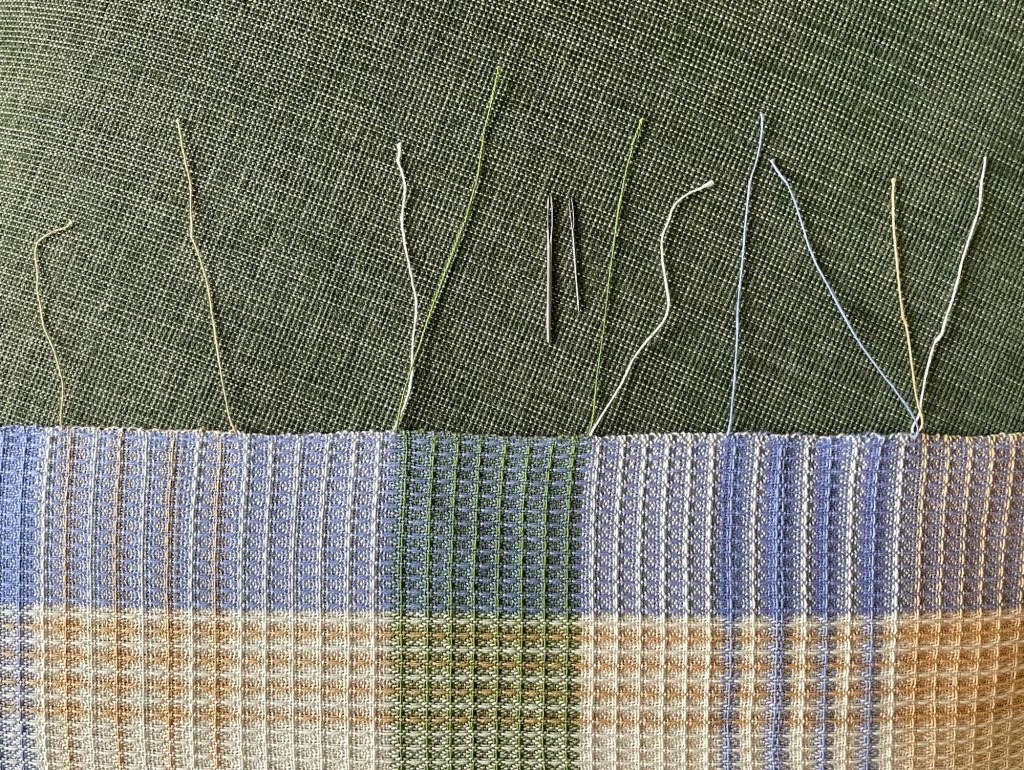
Next there were tons of ends to weave in, not my favorite thing. It is possible to weave the ends in as you go. Due to my smile problem I did not want to add even more bulk at the sides, so I left most of them hanging as I went. In a few cases when I was alternating colors I carried one color up the side, which reduced the total number of ends to weave in.
The next two photos show the four towels separated, with different combinations of big and baby waffles and colors.
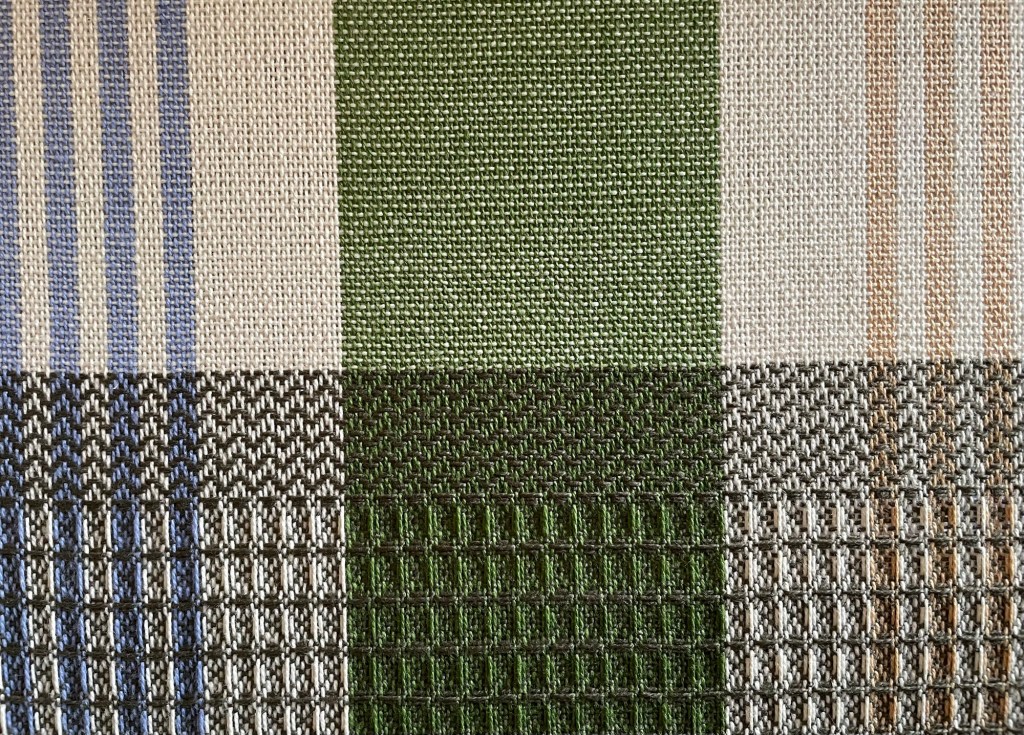
The following photo shows the plain weave section at the very end of the warp.
I usually make fringe to finish the ends of towels. Hemming looks nicer, but it is a lot more work. The pattern said to weave 24 rows of twill pattern for each hem. With a perfectly balanced weave that would make one inch of weaving, since this project was woven with 24 ends per inch.
In my head I was expecting to have about a one half inch finished hem after the end of the waffle weave. Given the cotton shrinks and you have to fold it over twice, that was not possible. I could have done the math to figure this out before I started weaving. I had to either make a very tiny hem, or fold the hem over on top of the waffle weave. For three of the towels I folded the twill hem rows over the waffle weave rows and hand stitched it down. On the fourth towel I tried to make a narrower hem but there was not enough to avoid overlapping on to the waffle weave. If I make waffle weave towels again I will weave more than 24 twill hem rows. The following photos were taken after the towels went through the washing machine and dryer.
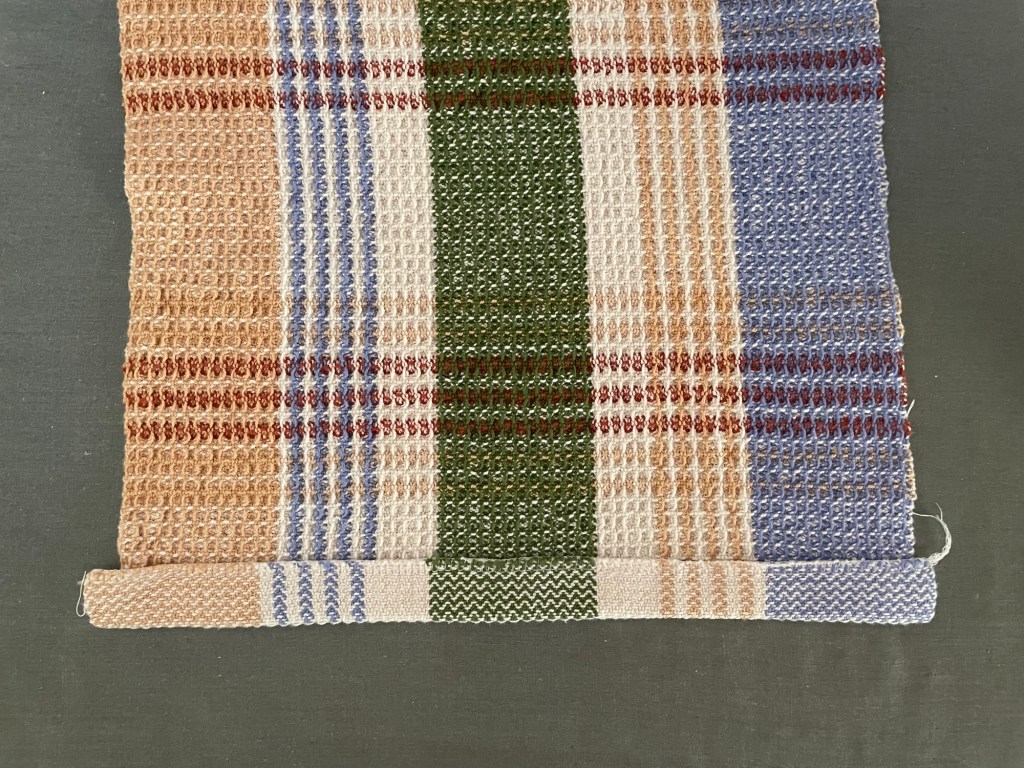
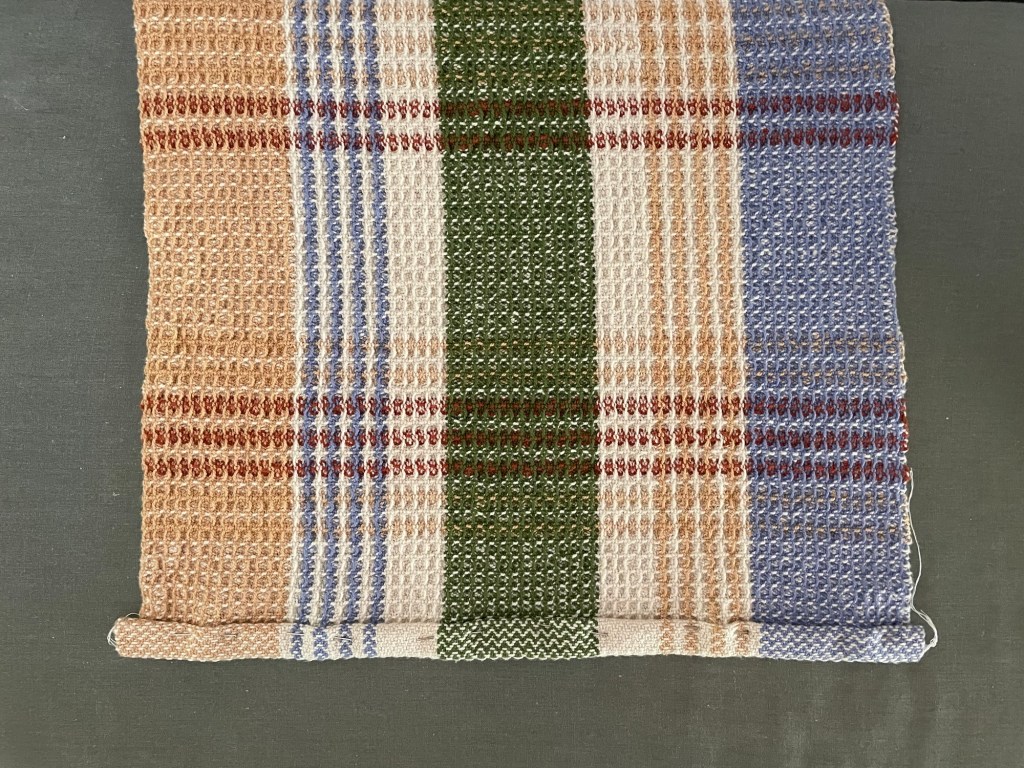
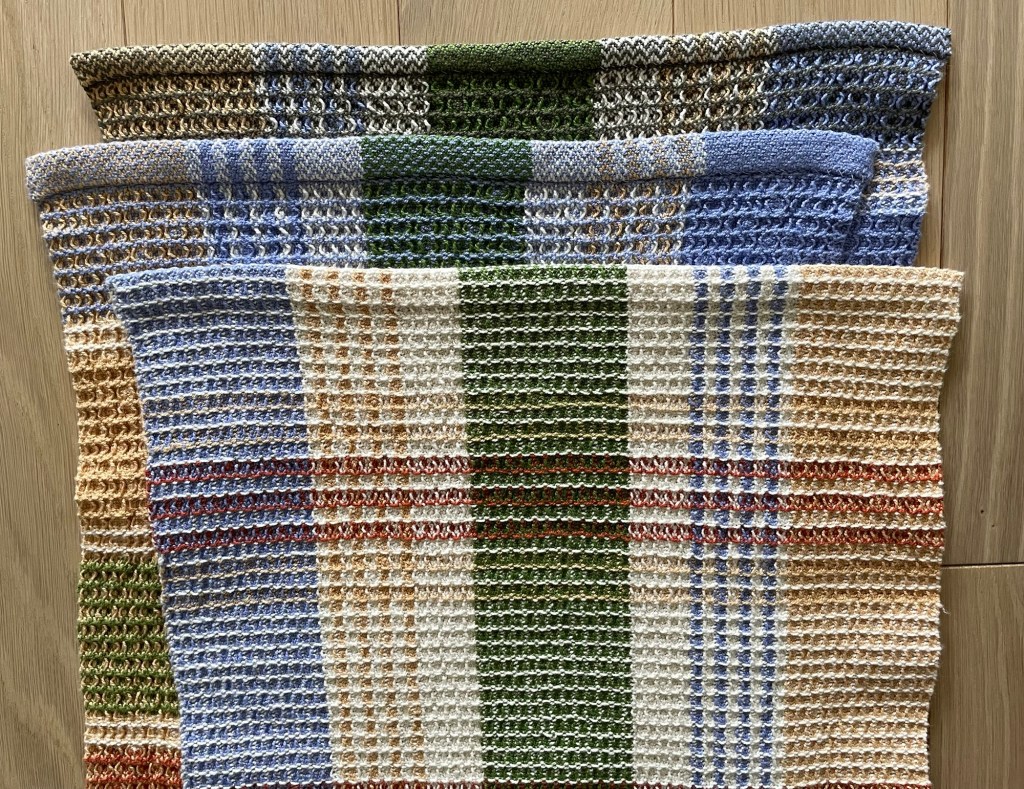
After going through the washer and dryer, the towels went from 16″ wide on the loom to about 12″ wide. In addition to the expected shrinkage from the cotton fiber, the waffle weave scrunches up more than a plain or twill weave would. My selvedges were evenish within each color, but not so much in the places where I carried a second color yarn up the side.
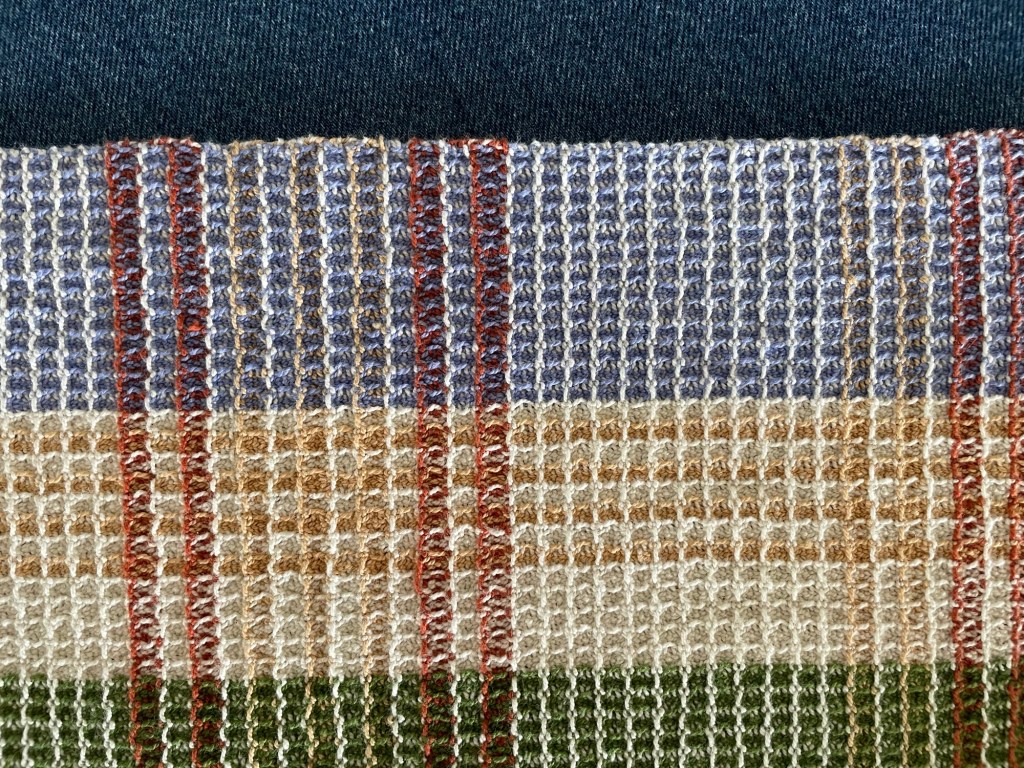
The towels got wrinkly in the dryer, and ended up with some crinkles that I could not get out with the iron. Otherwise, I like how they came out.
The next photo shows one of the waffle weave towels I woven on my rigid heddle loom in 2021, next to one of the current towels made on my 4-shaft floor loom. The yarn used for the towel on the left is 8/4 cotton which is twice as thick as the 8/2 cotton yarn for the towel on the right.
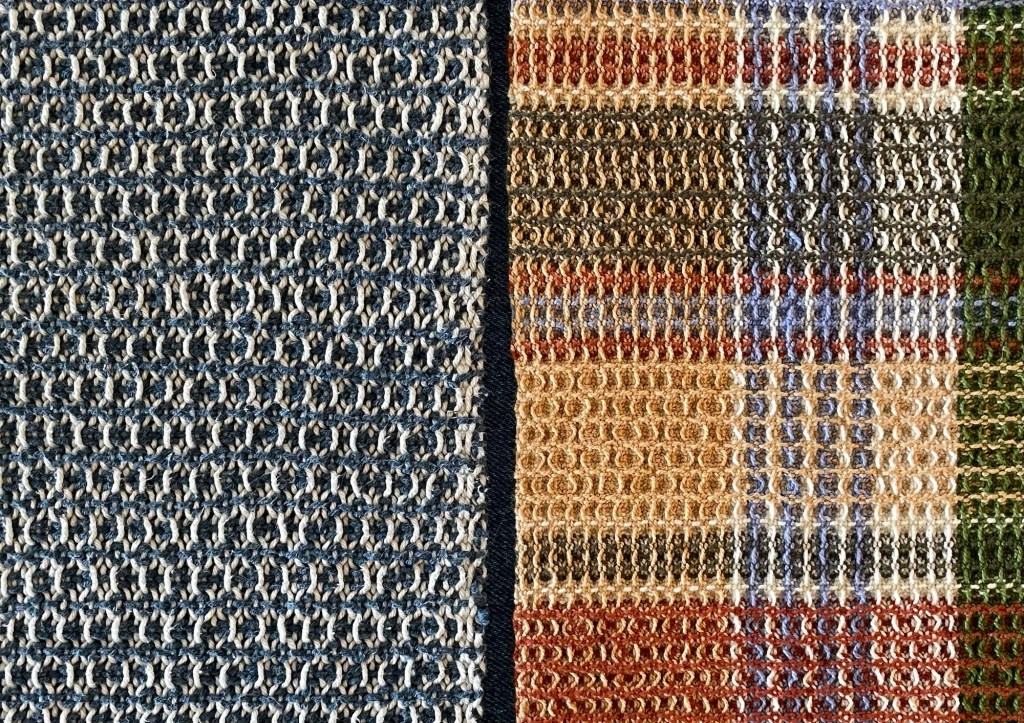
I do not remember where I got the instructions, but here is a link to the blog post I wrote about waffle weave towels on the rigid heddle loom.
If you want to try waffle or similar weaves with a pick up stick on a rigid heddle loom, there are a couple of options. The School of Sweet Georgia has a class called “Weaving Lace on a Rigid Heddle Loom”, with warp and weft floats similar to waffle weave. In November 2026 they will be publishing a new rigid heddle pattern for a waffle-like scarf. There is also a pattern for Rigid Heddle Waffle Weave from Kelly Casanova here.
I left the warp yarn waste on my loom for now, with the yarn ends tied so they will not accidentally get pulled out. I may measure out yarn for another set of waffle weave towels and tie the ends on to the leftover ends from this project. That takes time, but less than starting from scratch threading all the ends through the reed and heddles.
All in all I am happy with the way these towels turned out. Even having a few imperfections and wrinkles, they are functional towels, they dry hands or dishes, they look nice.


I think these towels are beautiful, and I really like how you used your tea towel to pick the colors! And I do like the new yarn you bought in person that was closer to the color of the fish. You are so talented, Meg!
LikeLiked by 1 person
Thank you! It was a fun project. I think it would have been OK with the other color orange, but I am glad I found the new one also.
LikeLiked by 1 person
Your towels match the colors of the fish on the tea towel and came out very nice. I love reading how you approach your projects and share your difficulties.
LikeLiked by 1 person
Thank you! It is kind of a record for me, and maybe informative for others.
LikeLiked by 1 person
What a fun project, and being able to match the colors to the fish all the more so!
LikeLiked by 1 person
Thank you! I might make another set at some point, but with different colors TBD.
LikeLike
Wow, these turned out amazingly!
LikeLiked by 1 person
Thank you! I hope to make another set at some later time.
LikeLike