Structo Artcraft Loom

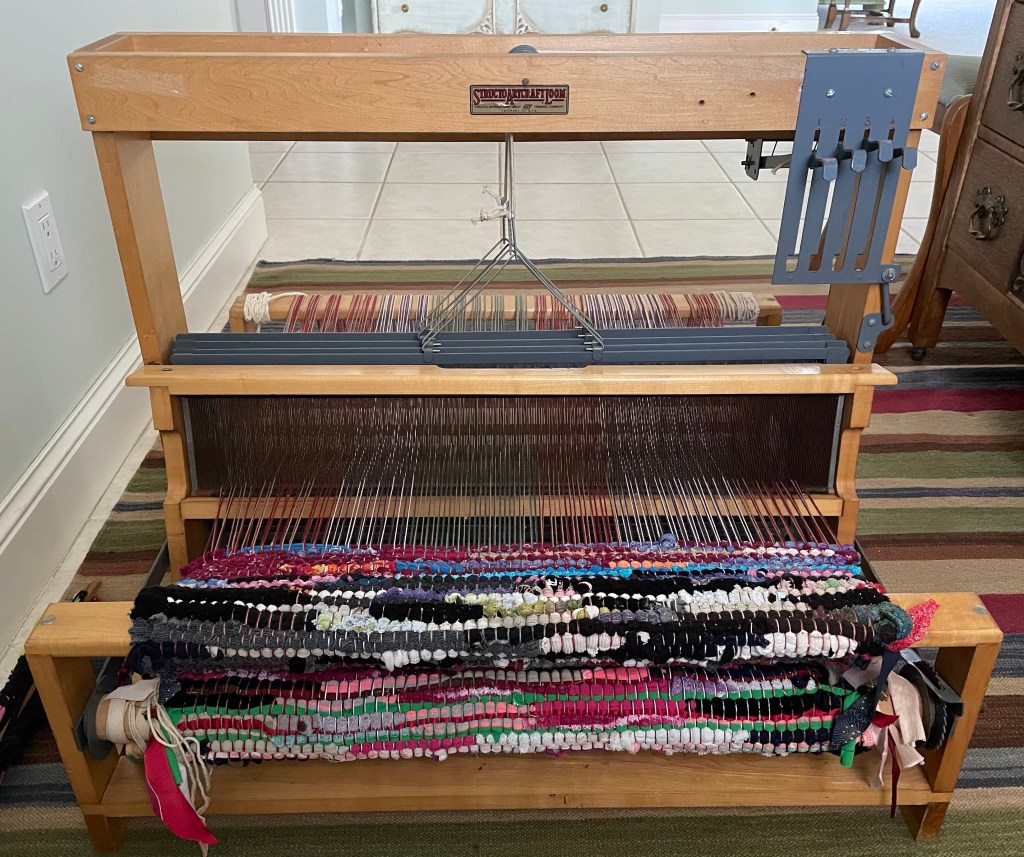
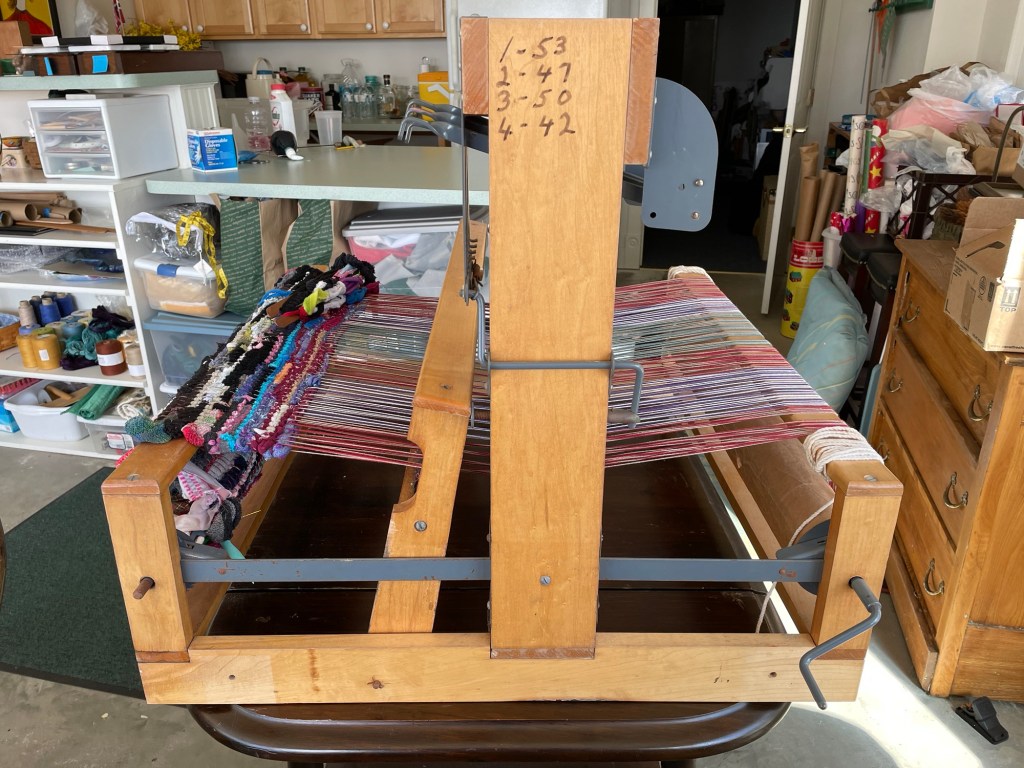
I friend of mine was helping clean out a storage room at her church. It was packed with crafting supplies that had not been used in a long time, including a table top weaving loom. She sent me a photo of the loom and asked if I wanted it. YES! I wanted this vintage four shaft Structo Artcraft loom.
Vintage Structo Artcraft loom from the front

I was not familiar with the brand, but found information online. Structo Artcraft looms have an interesting history starting in the early 1900’s. Structo Manufacturing, located in Freeport, Illinois, made metal toys. In 1921 they started making toy looms out of the same metal. Later they made looms for adults out of wood, eventually selling the Structo Artcraft Loom business to Dick Blick in 1972. The Dick Blick company manufactured and sold several sizes and models of the looms until 1981. You can find listings for Structo Artcraft looms on ebay, Etsy, and Craigs List. What you can’t find are current replacement parts. There is a Facebook group for people interested in these looms, so that is a place to look for information, advice or parts.

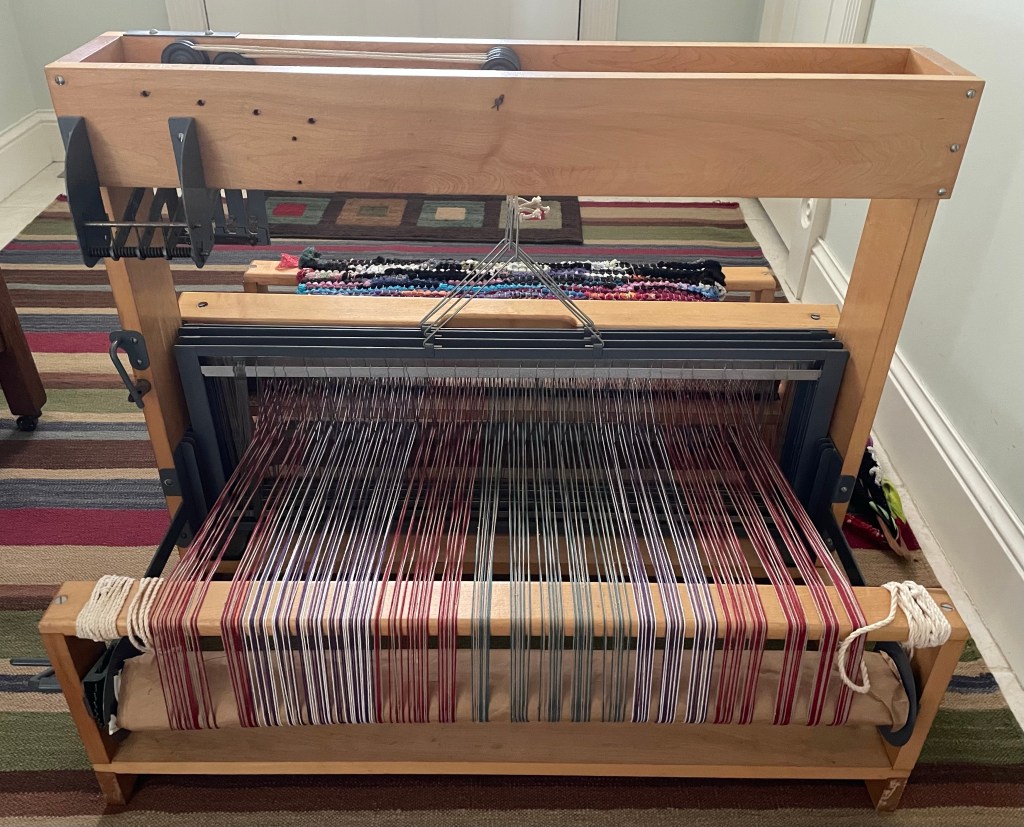
From the back

This loom is a hybrid of my other two looms. It has four harnesses, the same as my floor loom. The wood frame is 30″ wide with a weaving width of about 26″. My rigid heddle loom has a weaving width of 15″, while my floor loom has a weaving width of 36″. The 15 dent (ends per inch) reed on the Structo Artcraft loom is more dense than the reeds I have for my other looms. It seems to be in working condition, with a rag rug in progress.

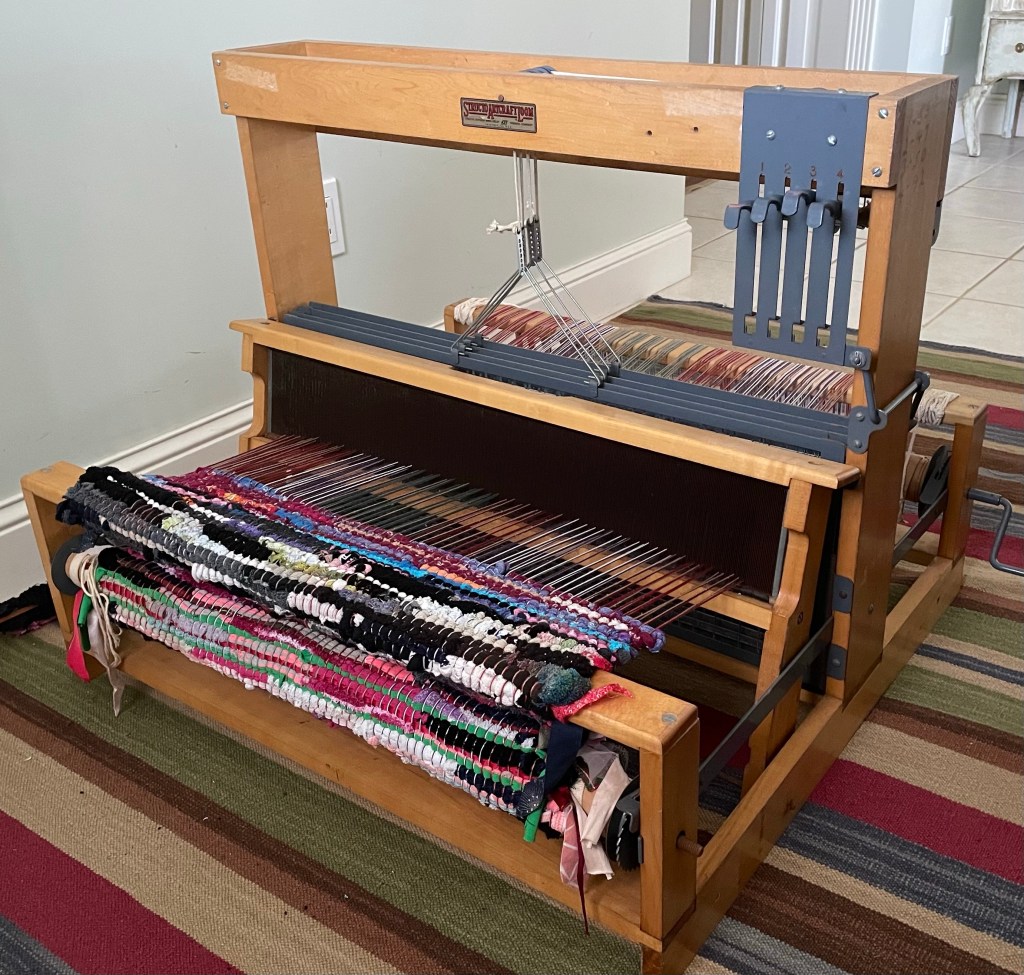
From the front at an angle

I am not interested in making a rag rug at this time, and I do not have the right materials to finish the one partway done on the loom. I had intended on cutting the rug off and re warping the loom with a different project. Then it occurred to me that I could just stop weaving the rug weft rows, and start weaving weft rows with some other yarn that I have, in order to try the loom and not waste the warp yarn.

From the side, the front handle is missing

One concern is that the handle to turn the front beam is missing, as shown in the photo above. On my floor loom there is one handle that is used for both the front and back beam. It is easy to move it back and forth as needed. On this Structo Artcraft loom the handle on the back beam is firmly attached, and I have seen photos of other Structo looms with two handles.

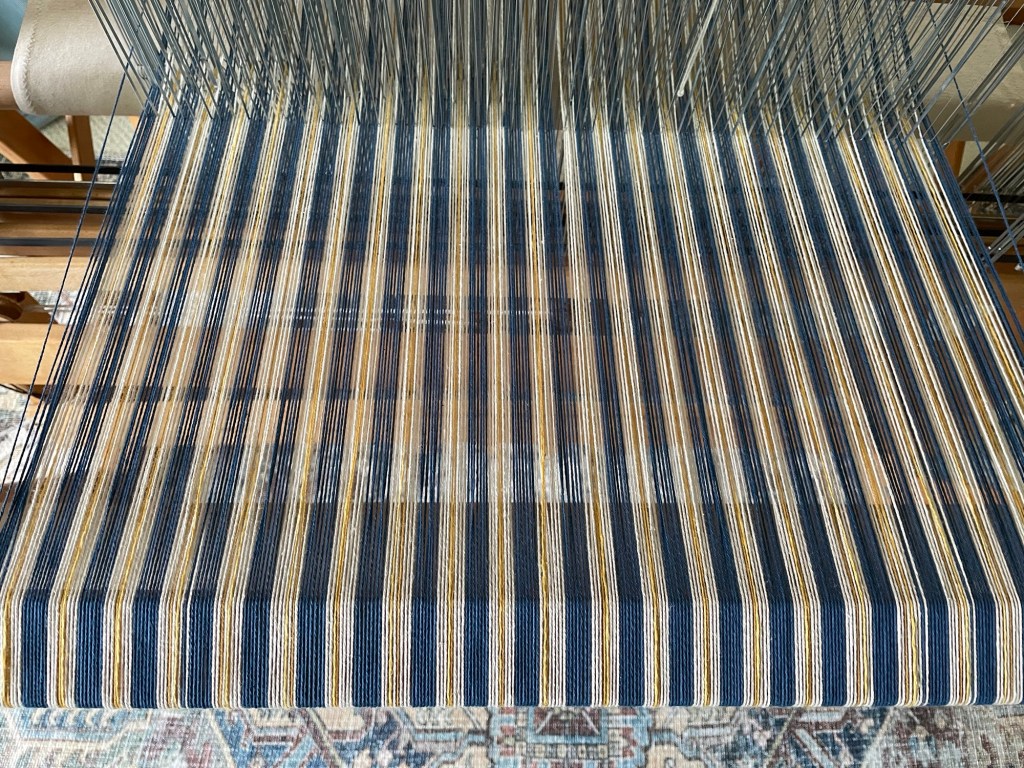
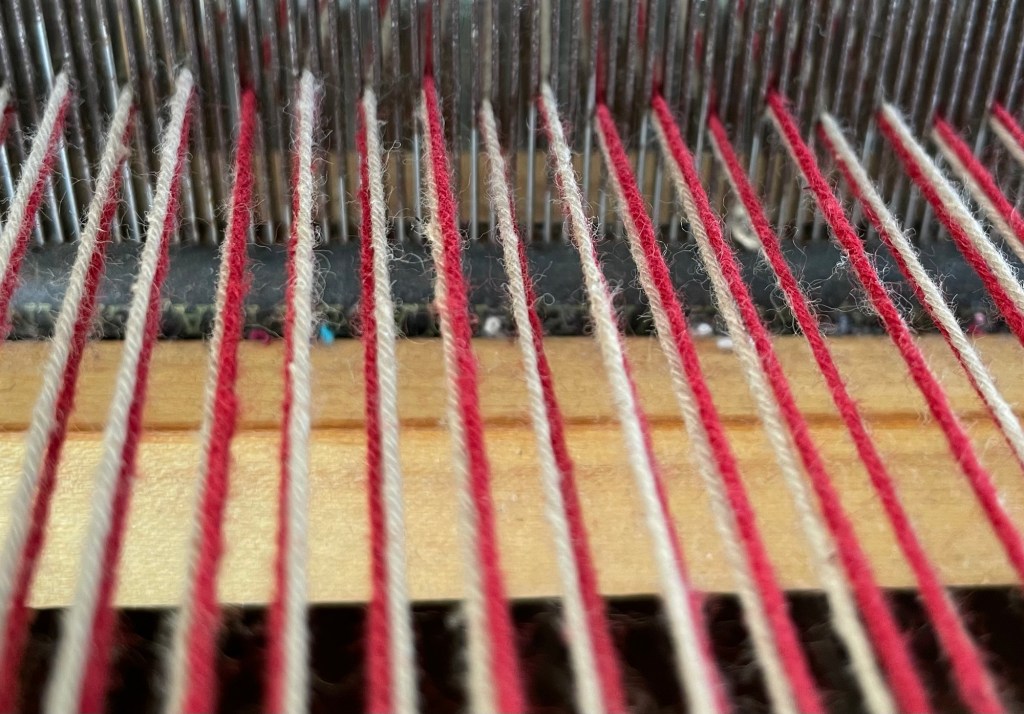
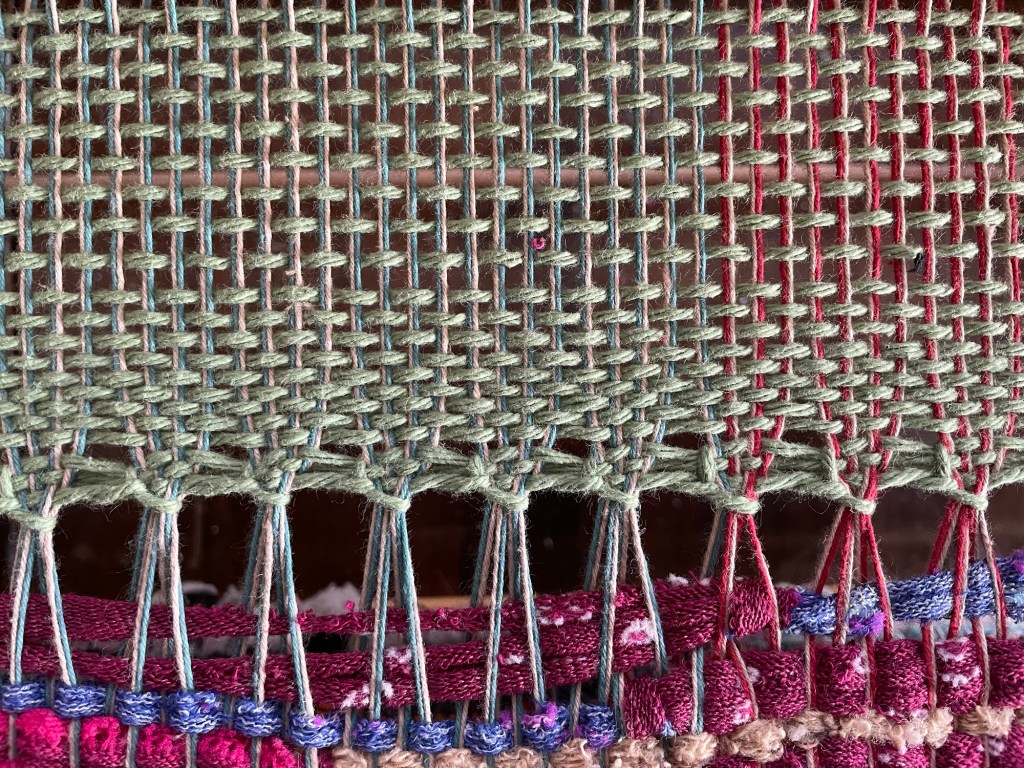
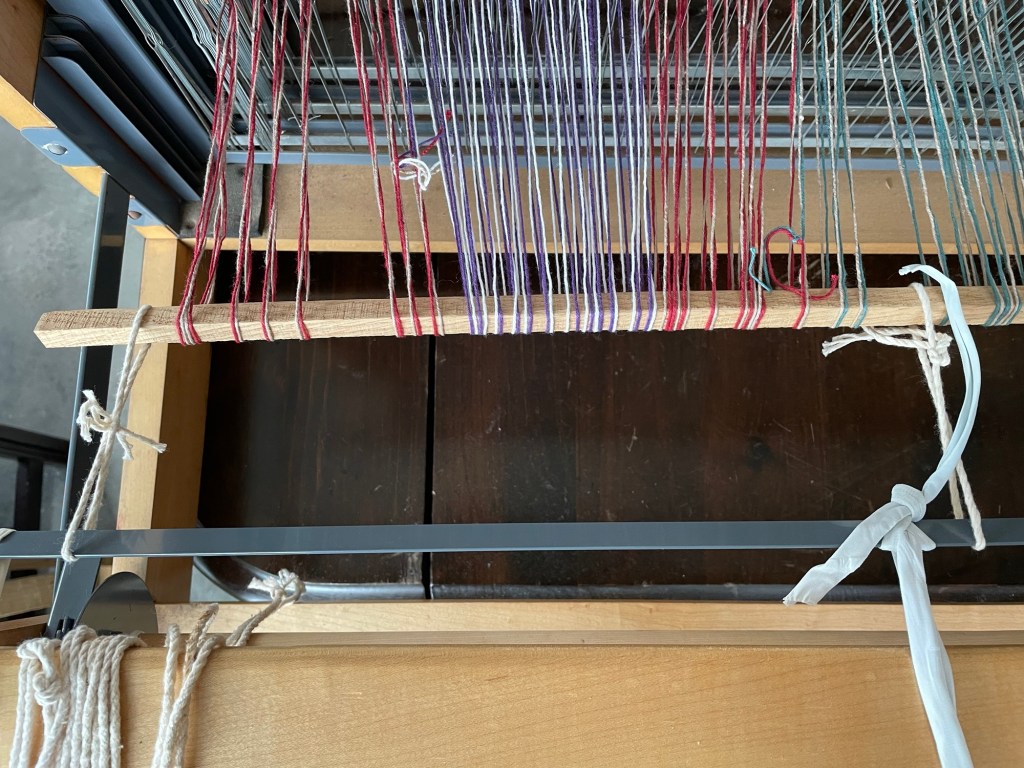
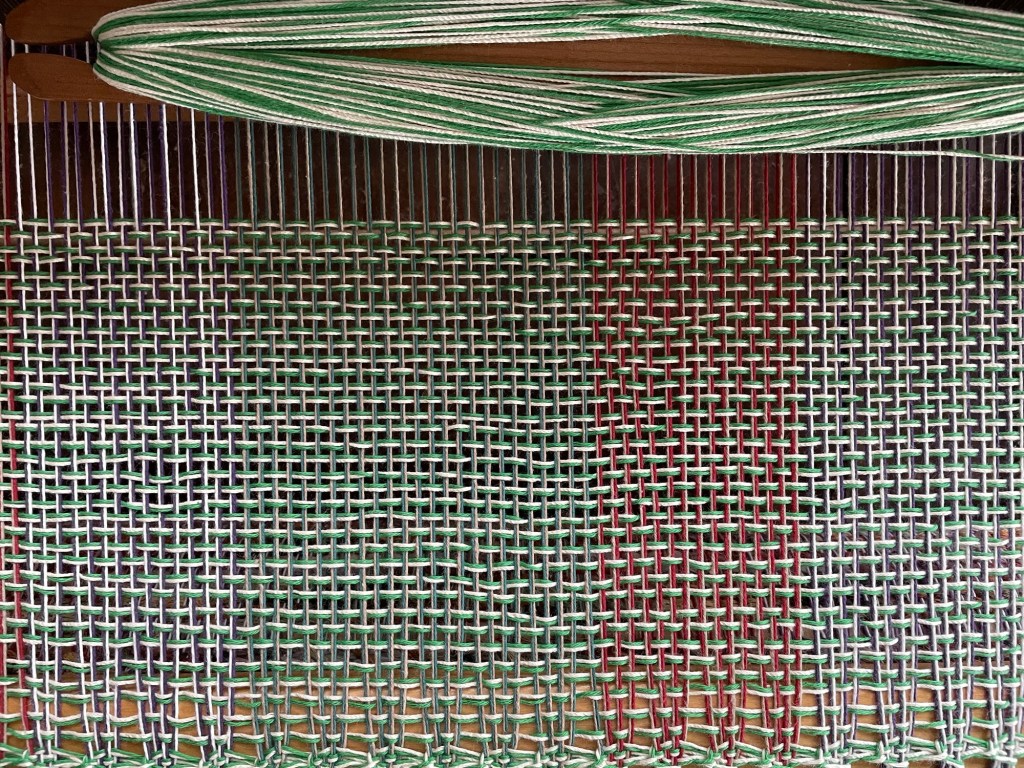
The yarn warped on the loom is something like 8/4 rug warp cotton, and not threaded through every slot in the reed. Instead there are two yarn ends together in a slot, followed by two empty slots. The weft “yarn” for the rug is a series of stretchy strips of fabric joined in a chain. The large space between warp yarns is needed for the thick rug weft “yarn”.

Warp yarns through the slots in the reed

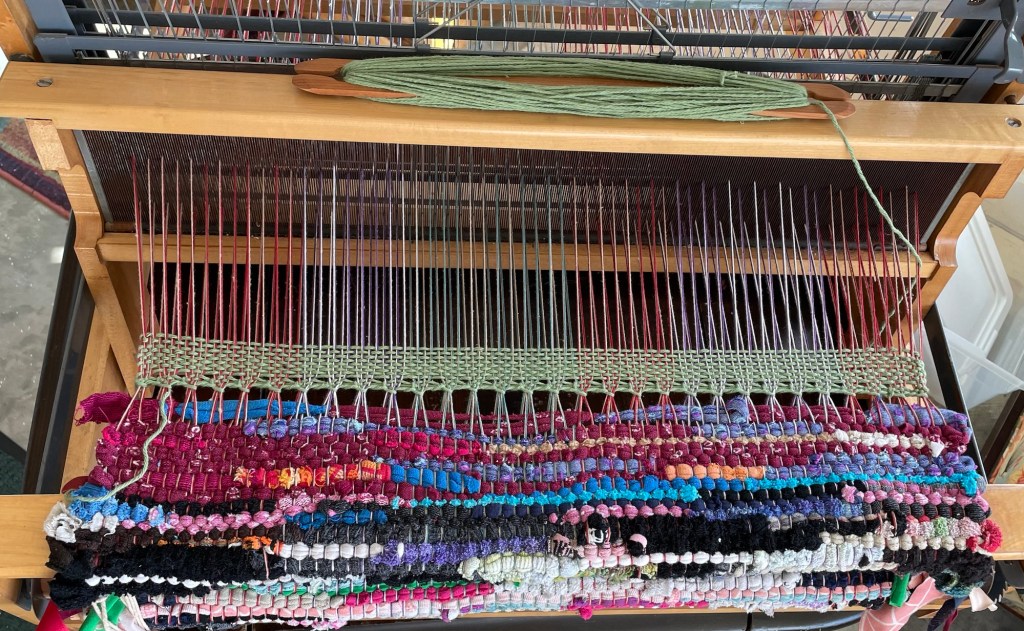
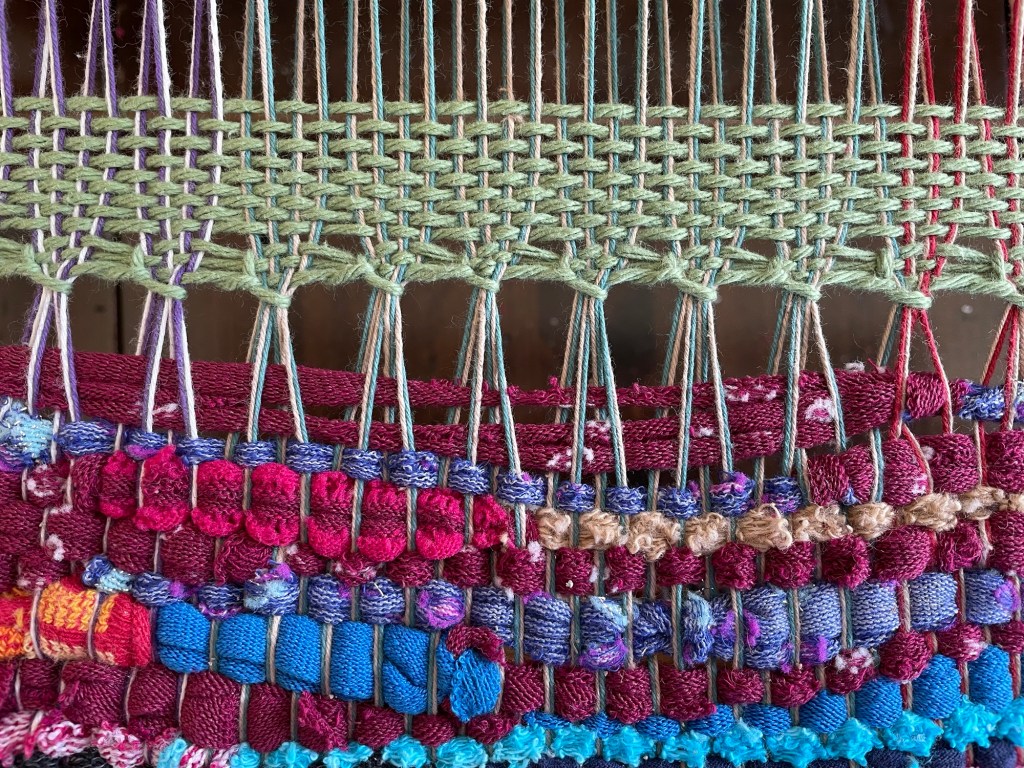
I found a couple of options for weft yarn in my stash. For my first attempt at weaving on this loom I chose some green Peaches & Creme 100% cotton yarn. It is not nearly as thick as the rug “yarn”, but it seemed like it would work. I wove a couple of rows, packing them close together, which resulted in a “weft faced” look where the weft yarn is dominant, like the rug.

First rows of weaving with Peaches & Creme yarn packed tightly

After talking to Torri, my weaving mentor, I started to place the weft rows farther apart in order to achieve a more “balanced” weave. This was all experimentation, a good opportunity to try some different things.

More rows Peaches & Creme yarn packed for a more balanced weave

After using up the green cotton warp yarn on the shuttle, I was ready to try something else. I had some Berroco Espresso yarn that is thicker than the Peaches & Creme cotton. It is a 50% cotton / 50% polyester chain type (rather than plied) yarn. The colors went well with the various colors of warp yarn and the texture of the yarn made it more interesting.

Next section with Berroco Espresso chain plied yarn

I got around the problem of the missing handle by using a pair of pliers on the piece of metal sticking out where the handle would be attached, so I could turn the front beam. However my husband pointed out that would strip the grooves on the piece of metal that maybe were needed to hold the handle on, if there was one. After that I used my hands to roll the completed weaving onto the front beam.

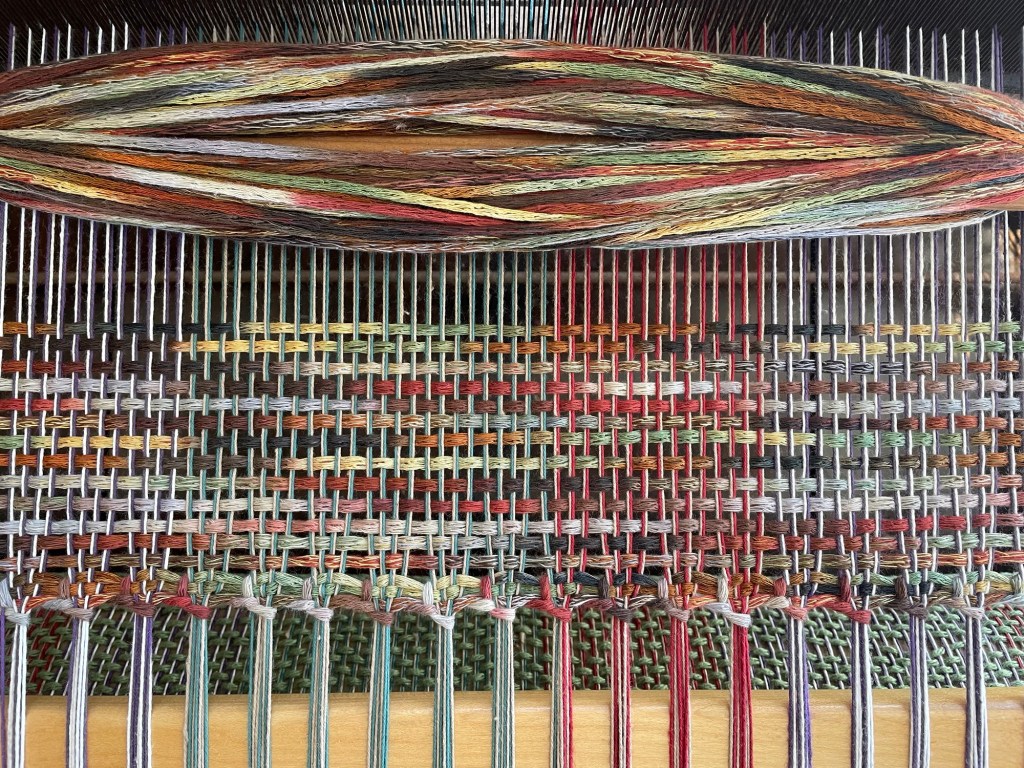
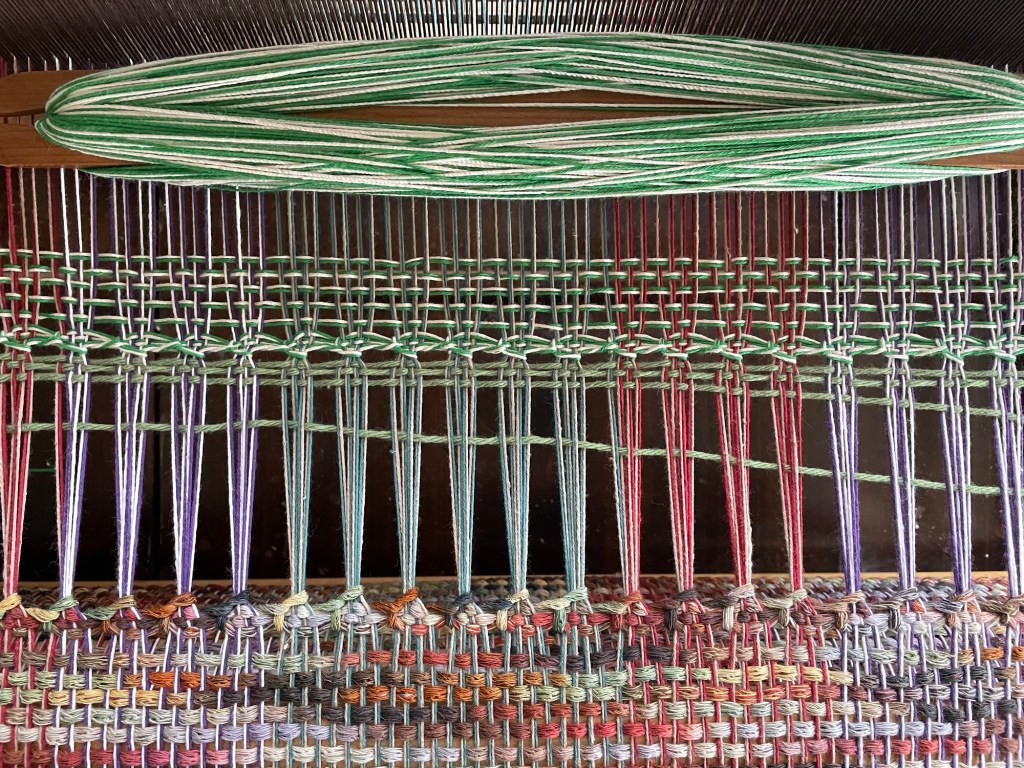
After I ran out of the Berroco yarn I wove with two strands together of 8/4 cotton, one green and one white, which I believe is about the same thickness as the warp yarn. It is quite open, although it will shrink some when I wash it.

End of the Berroco weft yarn, beginning of weaving with 2 strands of 8/4 cotton
A big section of 8/4 cotton weaving

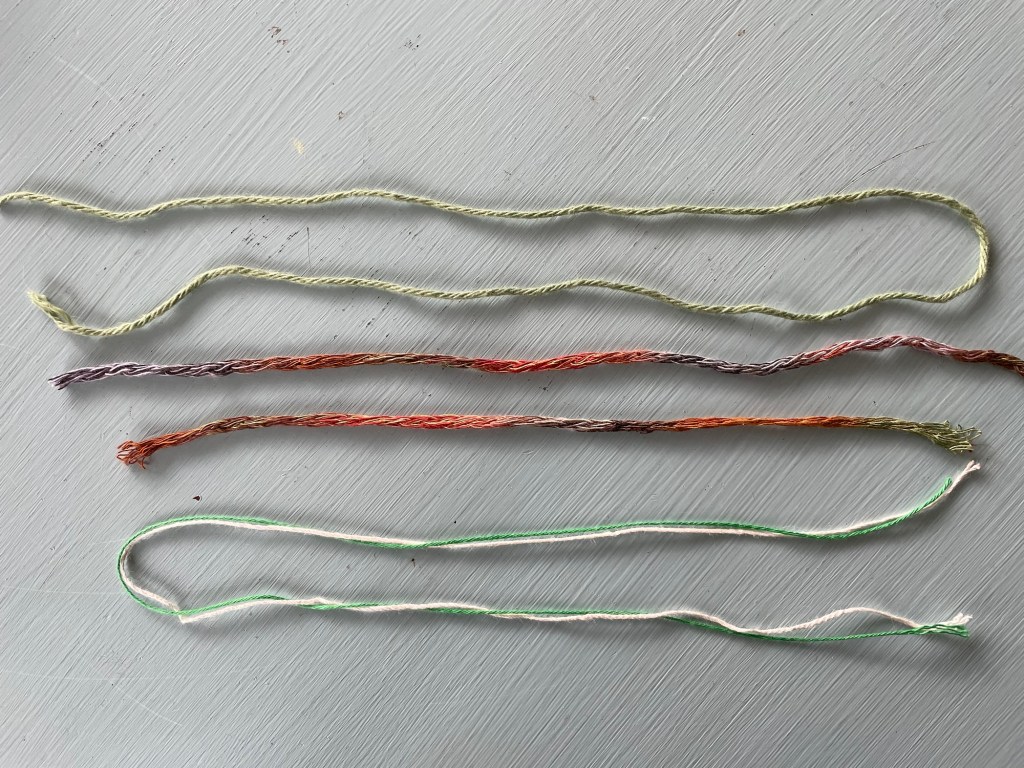
Following is a closeup photo of the three different weft yarns I tried (Peaches & Creme cotton, Berroco cotton/polyester, two strands of 8/4 cotton).

Three different yarns used for sections of weft rows

I was very interested in getting a better look at the loom once I got to the end of the warp yarn. The next photo shows the back of the loom after I had woven as much warp yarn as I could. A flat metal bar is tied on to the back beam. The warp yarn is wrapped around a length of square wood dowel, that is tied on to the flat piece of metal.

Warp yarn ends tied on at the back of the loom

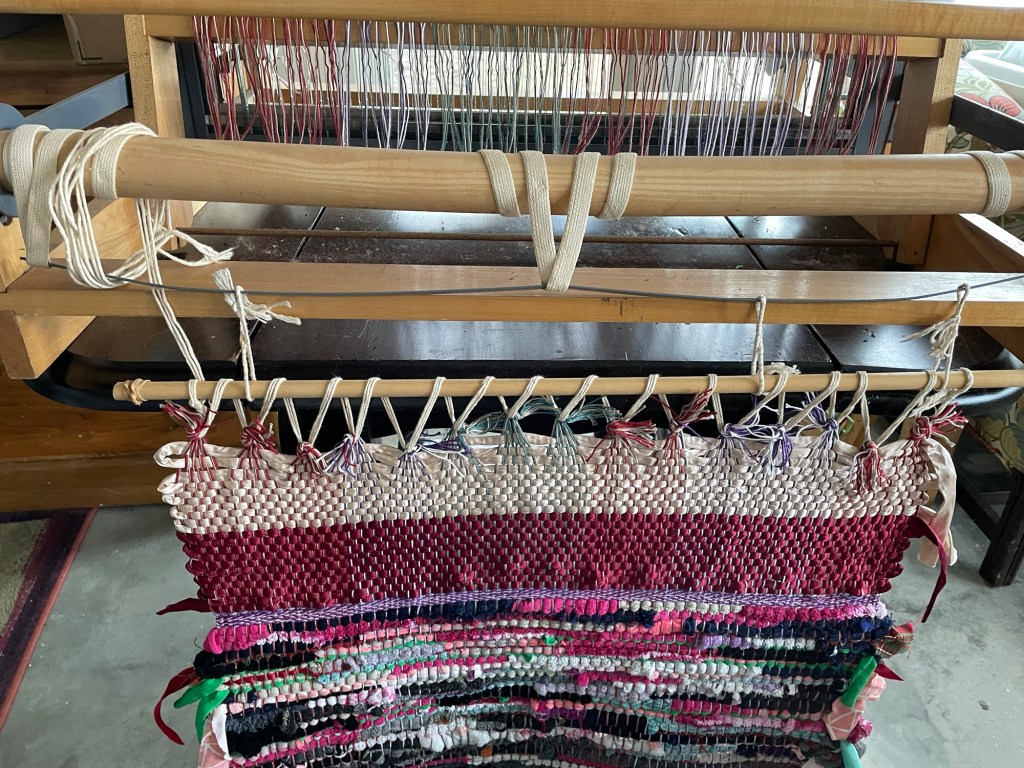
After examining what was going on at the back of the loom, I cut the warp yarns and unwound the completed weaving from the front beam. Following is a photo showing the beginning of the project where it was tied on at the front of the loom. The front beam is a thick round piece of wood that is warped. As on the back, there is a flat piece of metal tied on to the front beam that is warped and bent out of shape. A wood dowel bar is tied on to the flat piece of metal. The beginning of the rug is lashed on to the wood dowel.

Warp yarn lashed on to the front of the loom
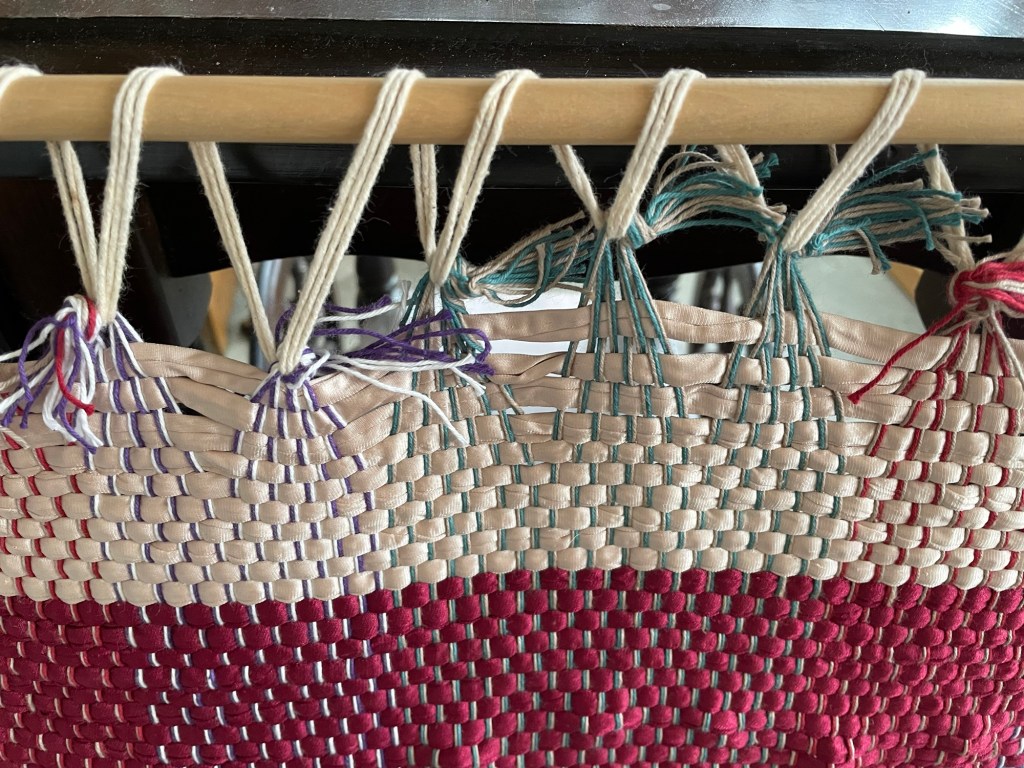
Close up of warp yarn lashed on to the front of the loom

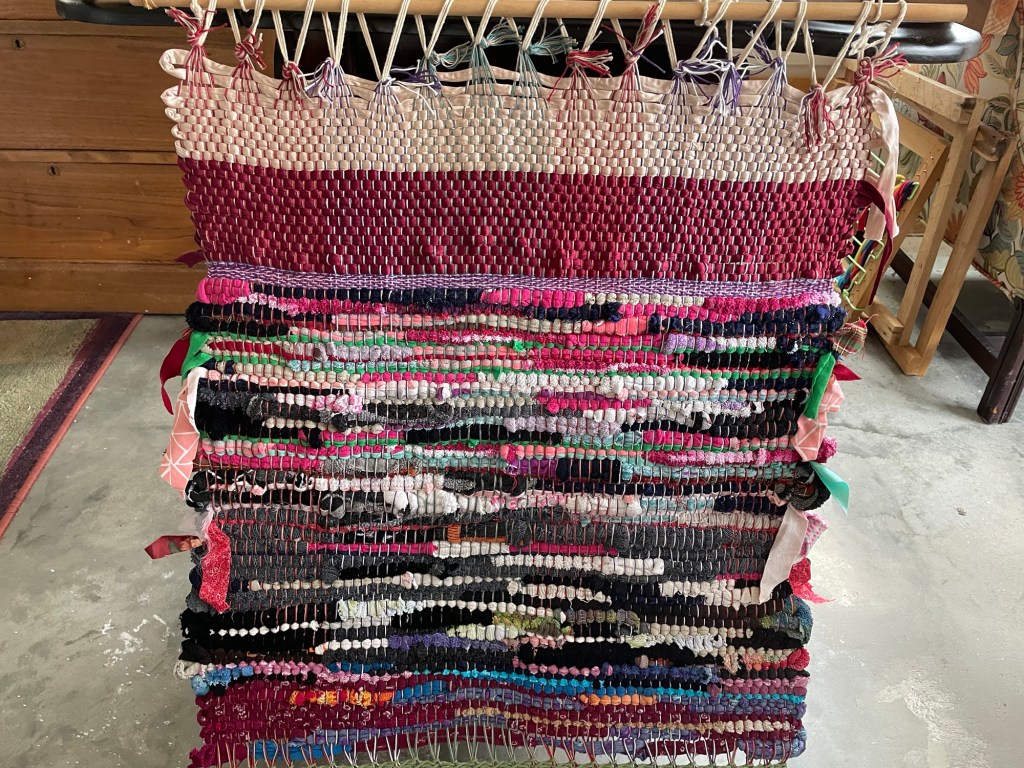
It looks like the person who started this rug was also experimenting with different warp yarns. There are some rows of two different colors of some kind of flat shiny “yarn”, followed by a couple of rows of purple worsted weight cotton (something like Peaches & Creme yarn), followed by the thick stretchy rag rug “yarn”.

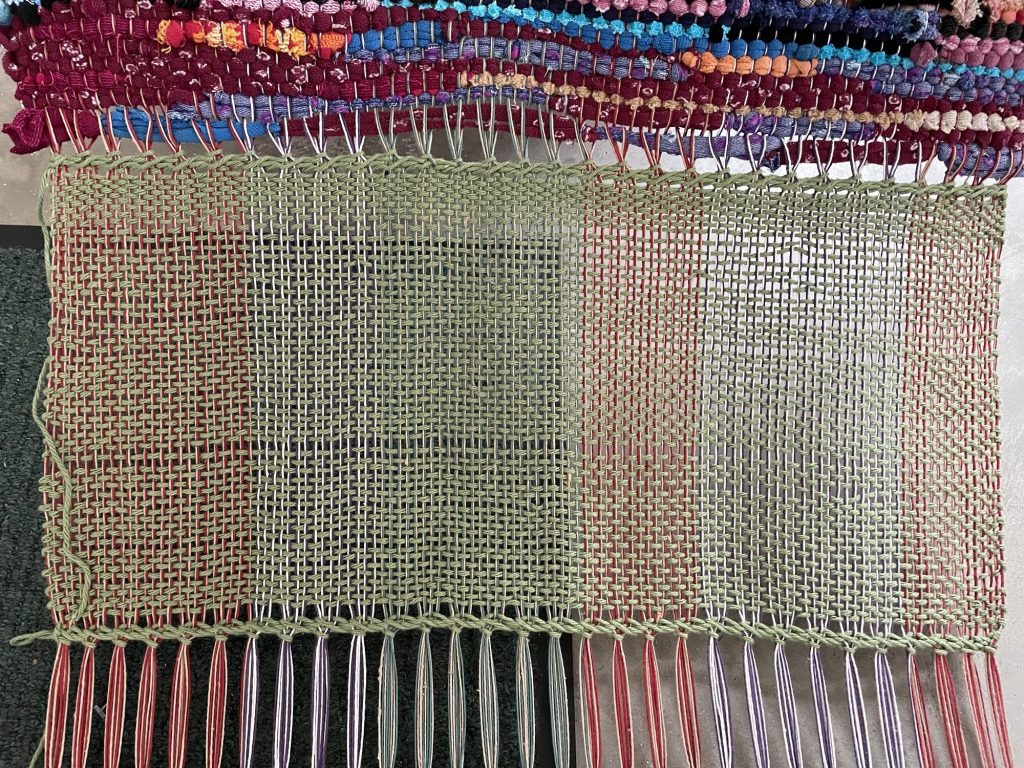
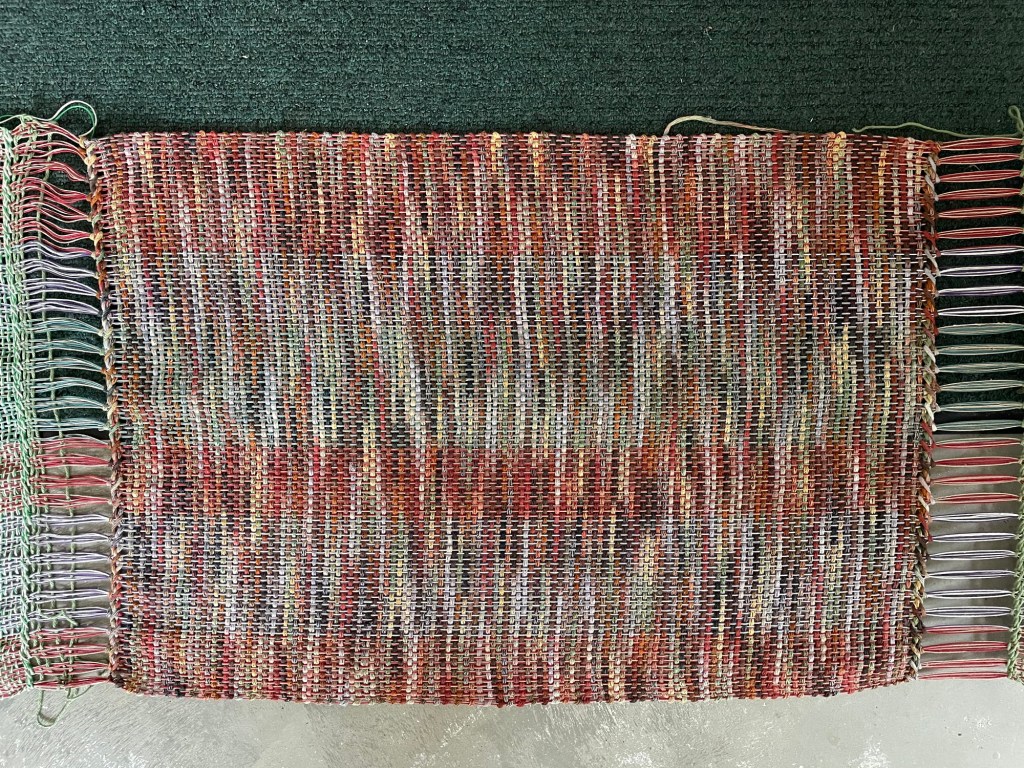
My sections of weaving are shown below, as they came off the loom. First there are rows of the green Peaches & Creme cotton, and then the Berroco variegated color chain type yarn, followed by the green and white strands of 8/4 cotton together.

Rows of Peaches & Creme cotton
Berroco Espresso cotton/polyester blend warp yarn
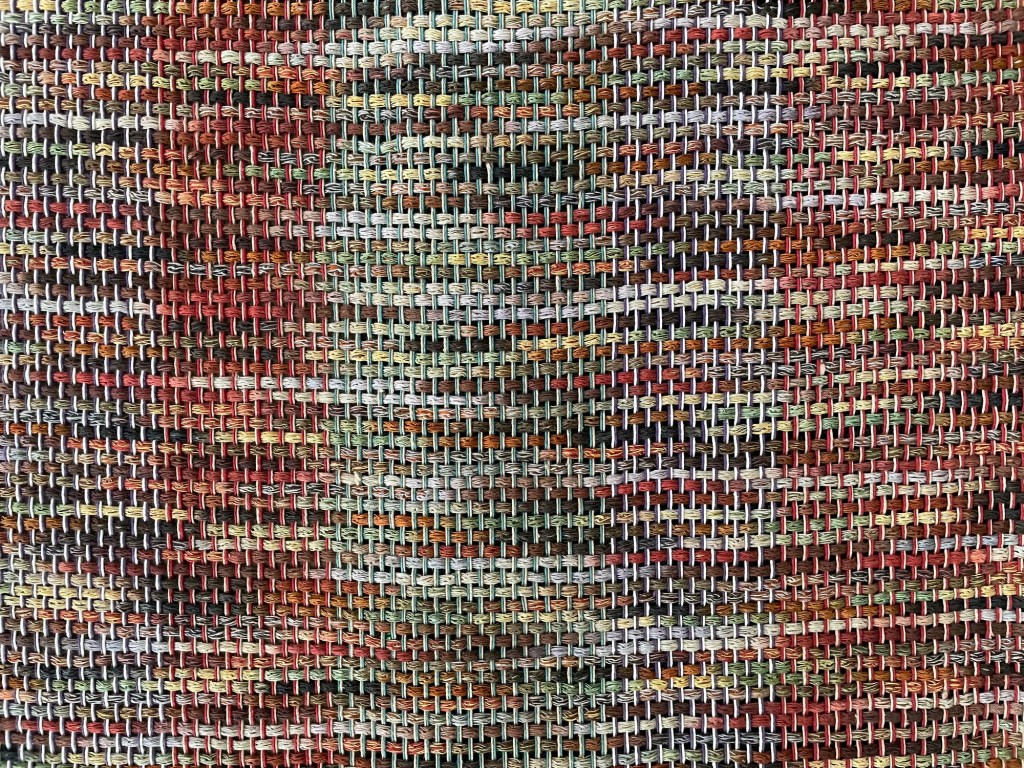
Close up of the Berroco Espresso weft yarn rows
Larger section with 2 strands of 8/4 cotton warp yarn

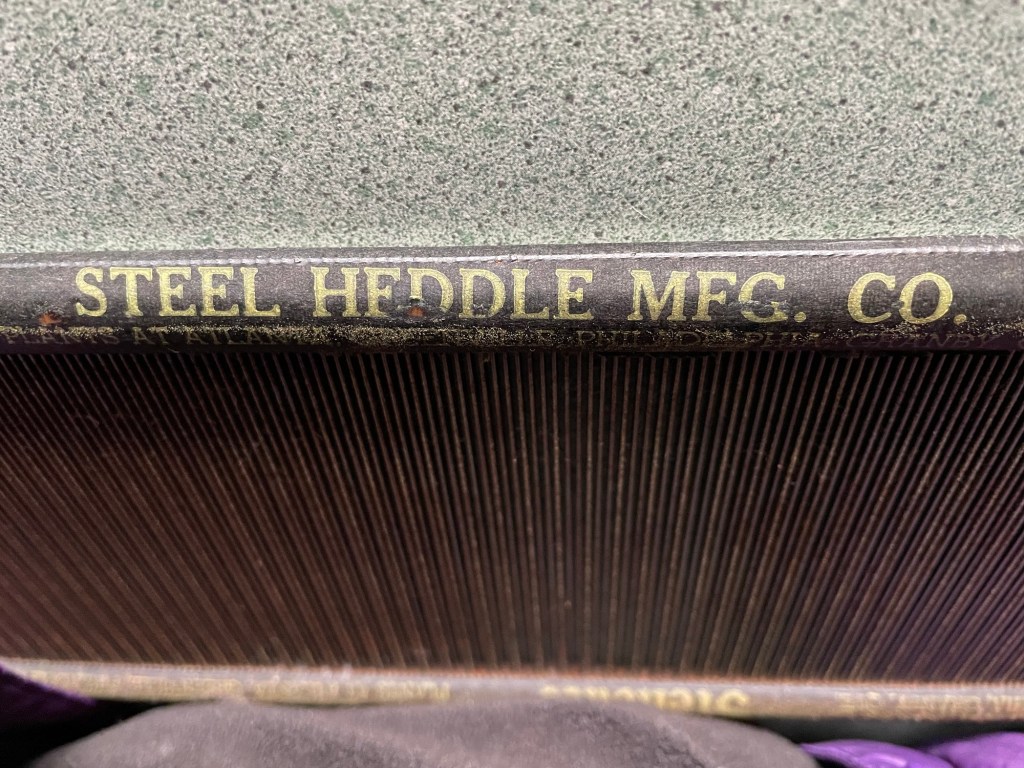
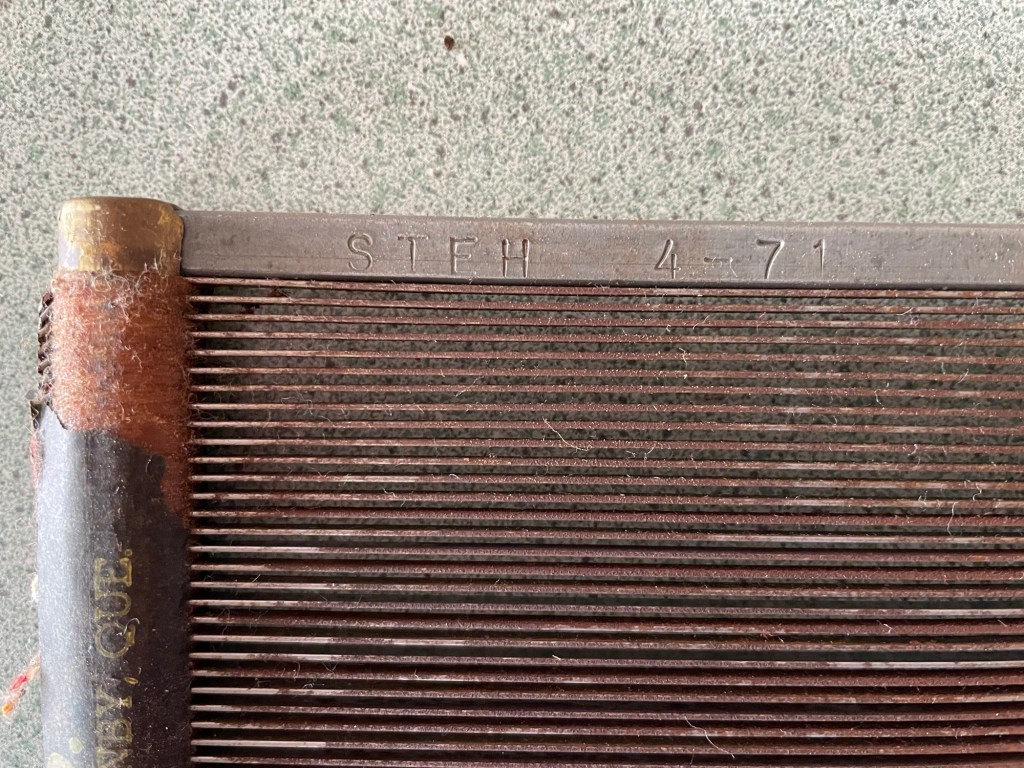
I was able to remove some screws and take off a strip of wood at the top of the reed, which allowed me to remove the reed from the loom. The reed is very rusty, but it looks like the same size as replacements available from the Schacht company.

Label along the top of the reed
Identification stamped on the side of the reed

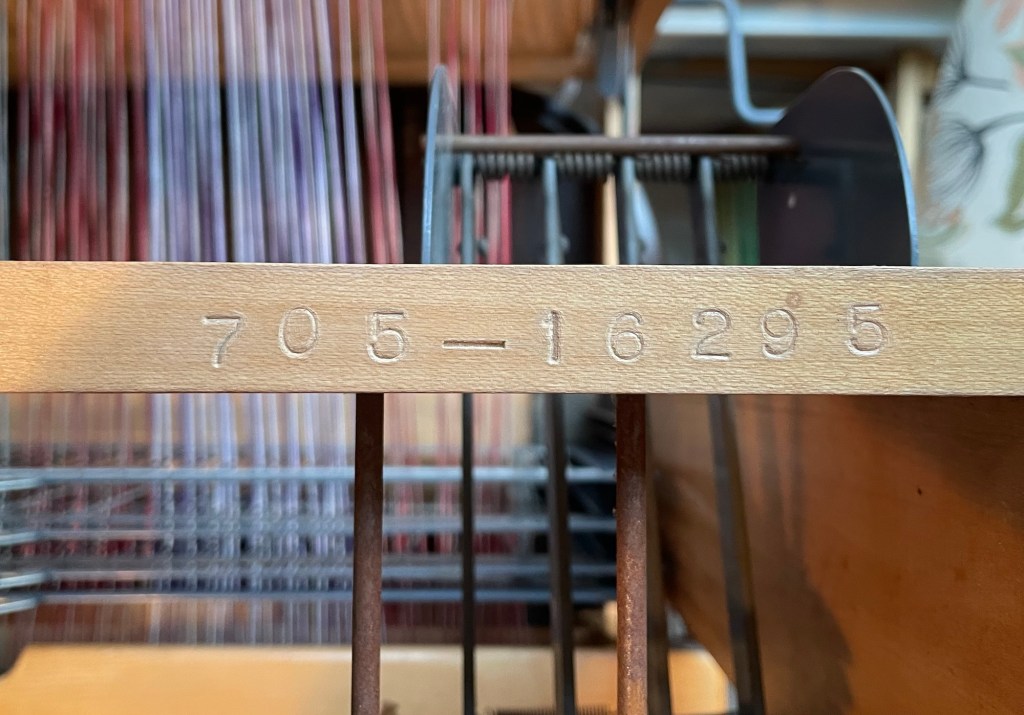
I communicated with a woman on the Structo Loom Owners – Repair & Refurb Facebook group regarding the date that my loom might have been made. She has a list of serial numbers with their associated production dates. Between the serial number stamped on my loom and the number stamped on the reed, she is pretty sure my loom was manufactured in 1971.

Serial number stamped on the loom

705 is at the beginning of the serial number which should indicate the model number. However information I found online indicates that it is more likely a model 740, which is an eight shaft version of the model 705. My loom currently has only four shafts but there are spaces for four more. 740 is what you get when you multiply the ends per inch of the reed by two ends per inch by the weaving width, for the maximum number of threads you could have in a warp (15 x 2 x 25 = 740).

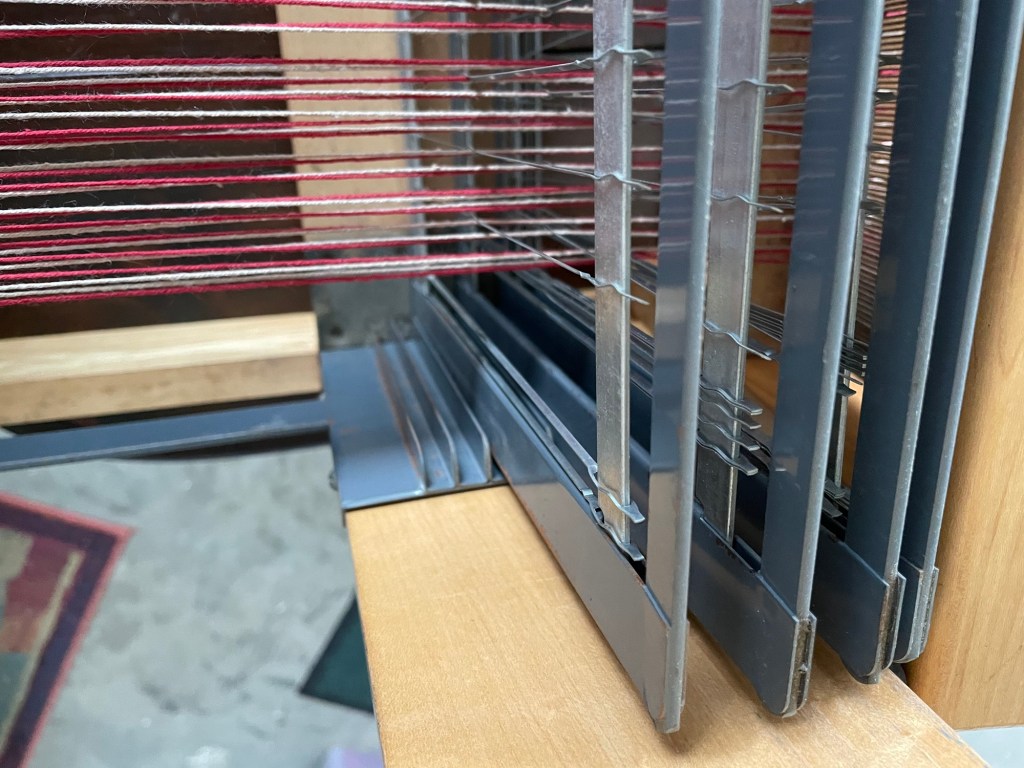
The next photo taken from the top shows the four harnesses, and some empty slots for two more. There are spaces for two more in between the harnesses on the loom, that you cannot see given the angle of the photo.

From the top you can see spaces for more harnesses. There are slots for a total of eight harnesses.

I wove in the loose ends and washed the individual sections of weaving (except for the rug at the beginning). As expected, they shrunk some, ending up with a slightly more dense weave, but still on the loose side. I think the large section of all 8/4 cotton could be used as a towel.

Section with two strands of 8/4 cotton yarn, after washing and shrinking

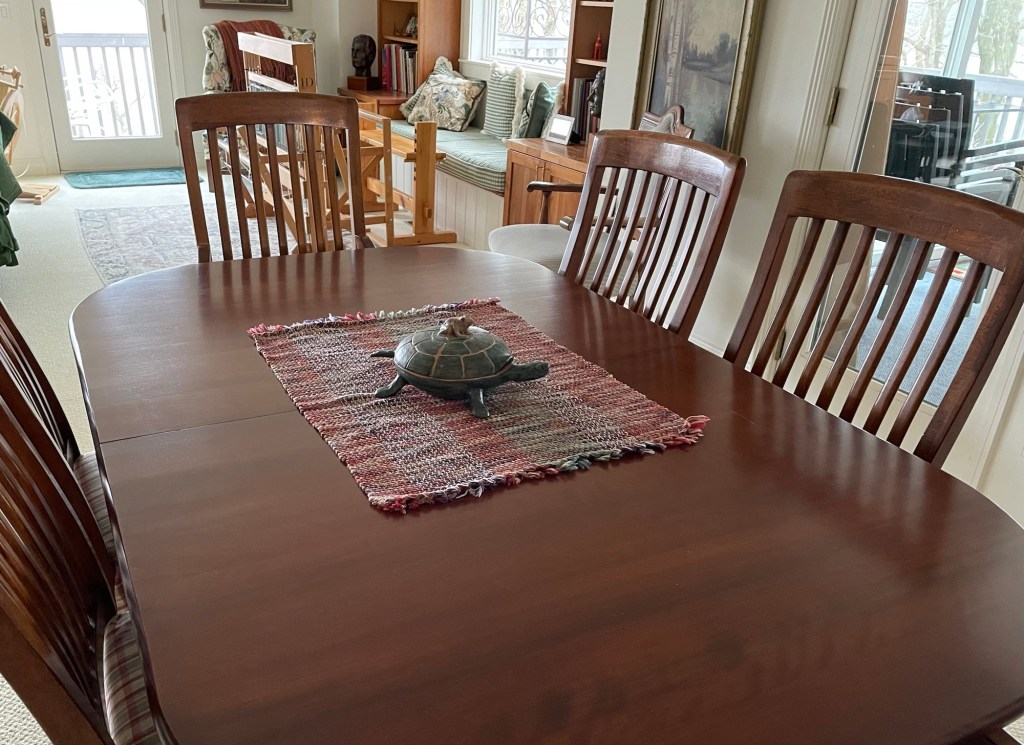
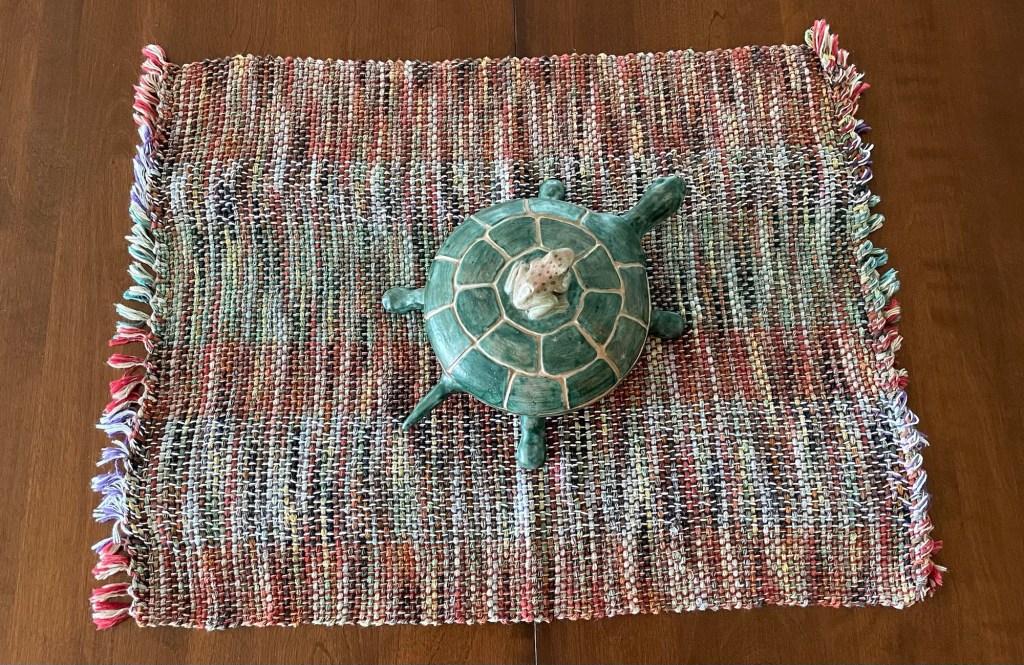
I was not expecting to have any usable final product from weaving off the rest of the warp yarn that came on this vintage loom. However I did end up a table runner of sorts, and a string bag! The section woven with the Berroco weft yarn works as a runner on my dining room table, adorned with the ceramic turtle bowl and lid that my mom made. My four harness floor loom is in the background waiting for another project.

The section with Berroco yarn works as a table runner

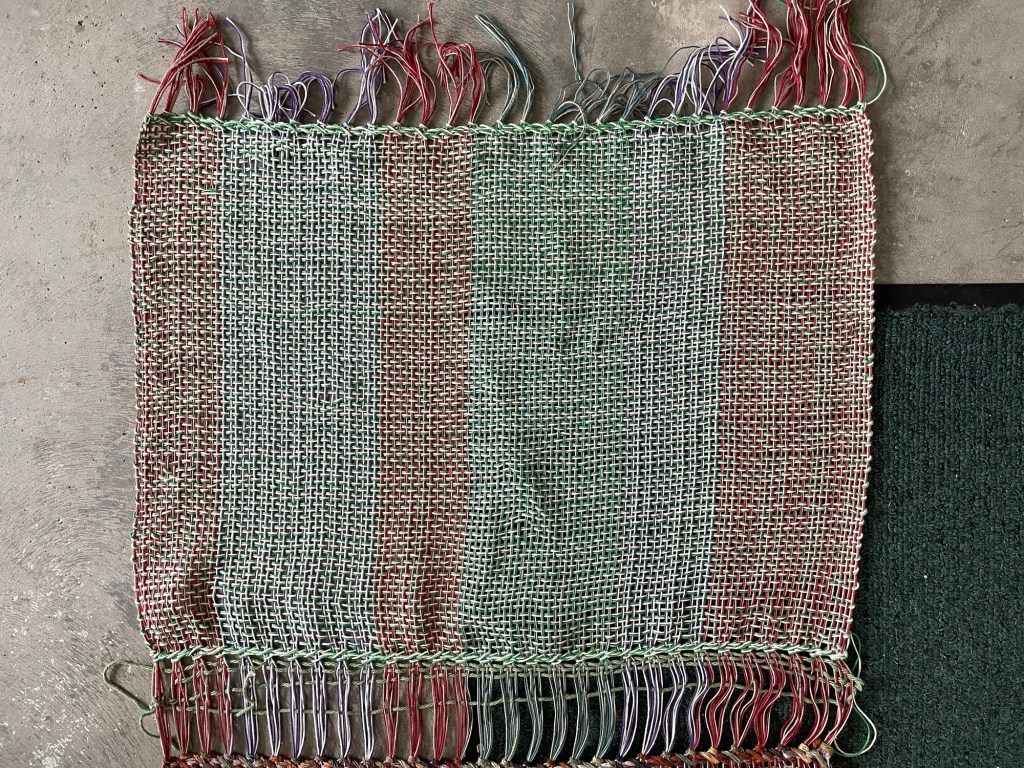
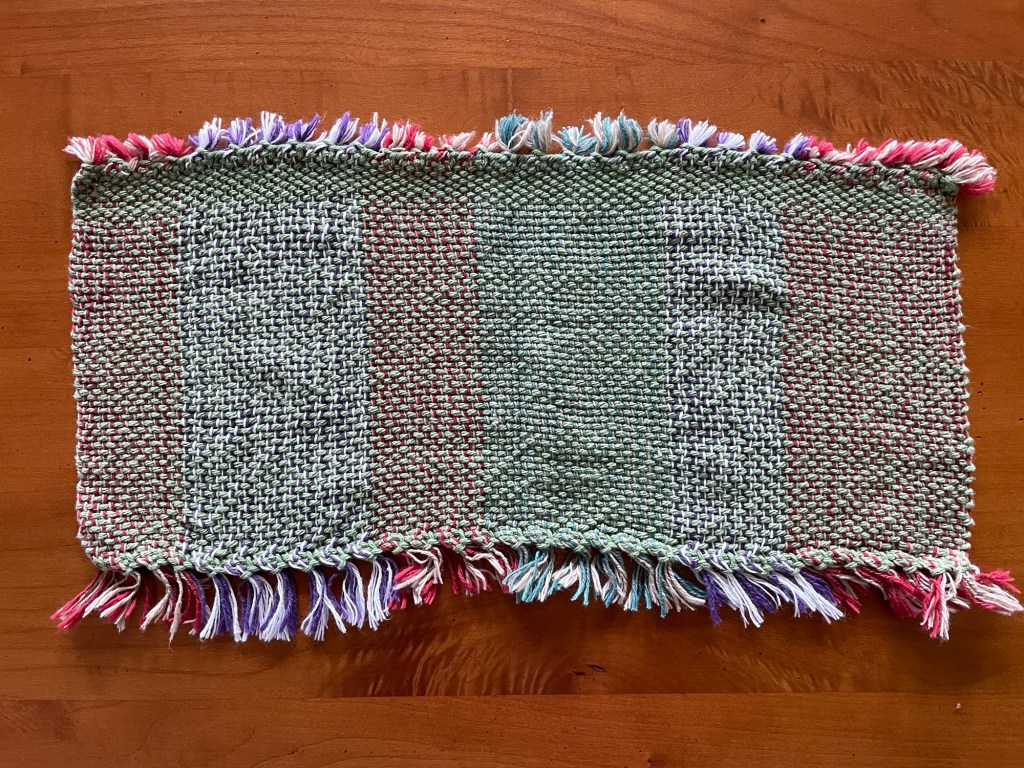
The shorter section woven with Peaches & Creme cotton could have been a loosely woven narrow towel, but I was inspired to make it into a small string bag.

Smaller section woven with Peache & Creme cotton yarn
String bag made out of the small section with Peaches & Creme yarn

Now that the Structo loom is free of a project, I plan on cleaning it and fixing it up as much as I can before using it again. That will include wiping it down with some wood conditioner, trying to figure out a replacement handle for the front beam, replacing the dowels that warp yarn is tied to at the front and back, and ordering a new reed.

Sometime in the next couple of months, we will be replacing the flooring in our living / dining area. I dread having to move all the furniture, including emptying out and moving my mom’s large china cabinet. Once that is all happening, my floor loom will be folded up and moved out of the way. My next weaving project will be on the floor loom, while it is still accessible and before the flooring chaos starts.

Gold Canyon 2024

We are back home in West Central Minnesota now. Some snowbirders stay in Arizona (or wherever they go) for as long as 6 months. I am starting to miss home before the end of our three month reservation at Gold Canyon RV & Golf Resort.

This winter of 2023/2024 was a non event in Minnesota with record warm temperatures, hardly any snow, open water on the lakes at Christmas, and one of the earliest ice-outs on record in March. On the other hand, there were more than average cooler and wetter days than normal in the Phoenix area. The many days with temperatures in the 60’s were great for hiking or biking, going on outings, or generally walking around outside without winter coats, so I am not complaining. The rainy days working on knitting or weaving projects and listening to the rain patter on the roof of the RV were quite cozy.

This year I took advantage of some exercise classes and even learned a few line dances. I spent time on my blog and on my part time “job” of being the treasurer for our extended family cabin LLC. We got to know some of our neighbors. I knit a pair of socks, and wove shoelaces and a scarf. I worked on a counted cross stitch project that is very slow going, and that I won’t be able to write about for months.

We spent time with Wayne’s sister and brother-in-law who were there for two months, and with friends and family visitors including our son, daughter-in-law, and granddaughter. The time goes fast.

Outings included Boyce Thompson Arboretum, about 20 miles east of Gold Canyon, and the Desert Botanical Garden in Phoenix. We bought a membership at Boyce Thompson, and then realized it is good at many arboretums around the country, including the Minnesota Landscape Arboretum west of Minneapolis. There was a fun collection of giant colorful art cacti at Boyce Thompson, created by Oliverio Balcells to celebrate 100 years of the arboretum.

Outdoor art at Boyce Thompson Arboretum near Superior, AZ

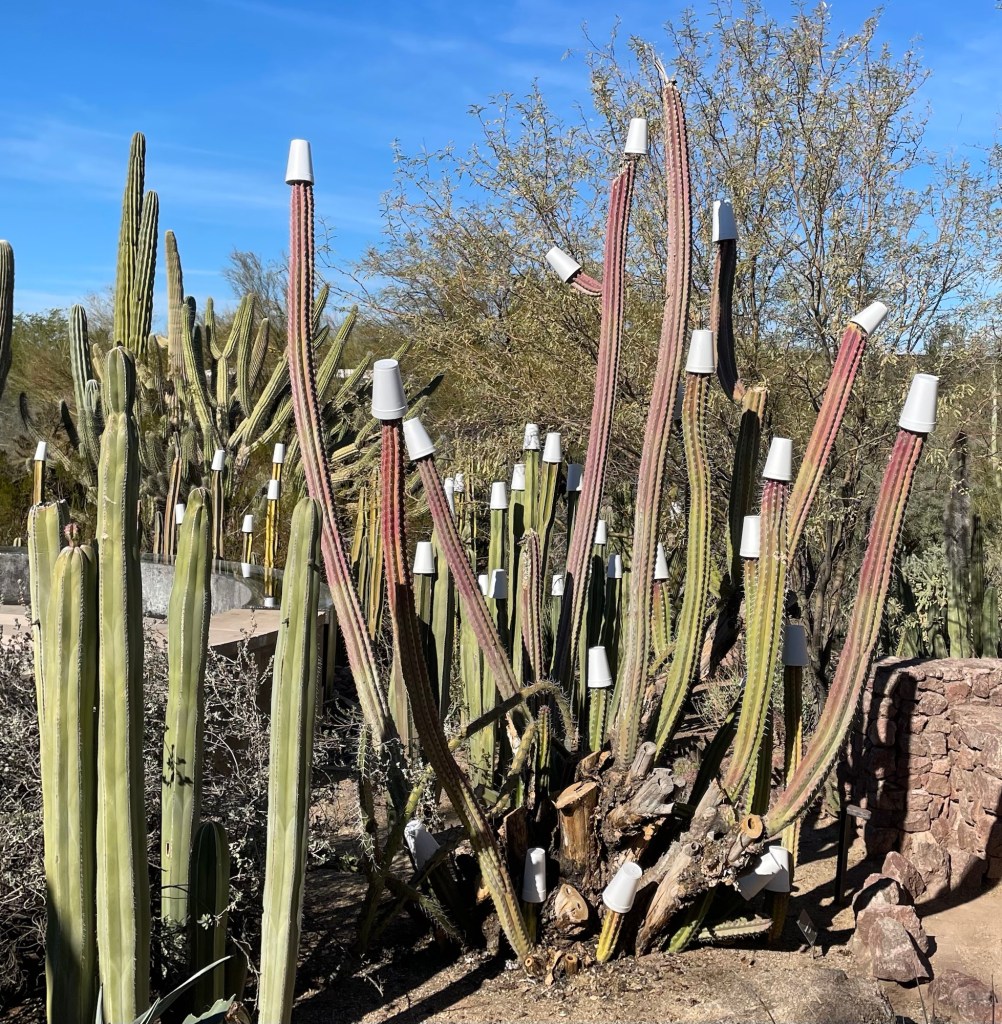
Cacti at the The Desert Botanical Garden were adorned with foam cups to protect against freezing when we went there in January.

Desert Botanical Garden in Phoenix

I experienced the Mesa Market, otherwise known as the Swap Meet, a place with hundreds of stalls for vendors selling all kinds of things including clothing, yard art, household goods, golf equipment, and you name it. I am not into shopping, but I braved the giant parking lot and crowded maze of hallways at this place once to buy an Arizona theme sweatshirt. At a block party on our street at the resort, we talked to a woman we had not met before. When asked what she liked to do, she said she goes to the Swap Meet on Thursday, Friday, and Saturday, every weekend. Oh my. Then she said they had only been at the resort for a couple of weeks and she was buying gifts for people back home, so it made a little more sense.

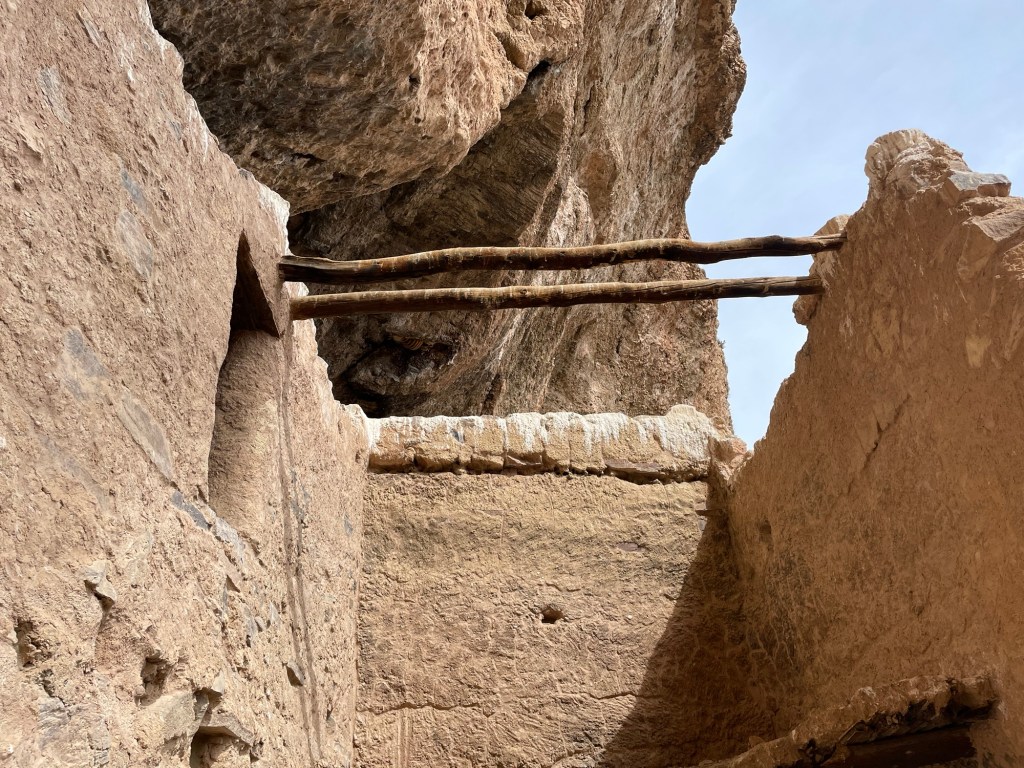
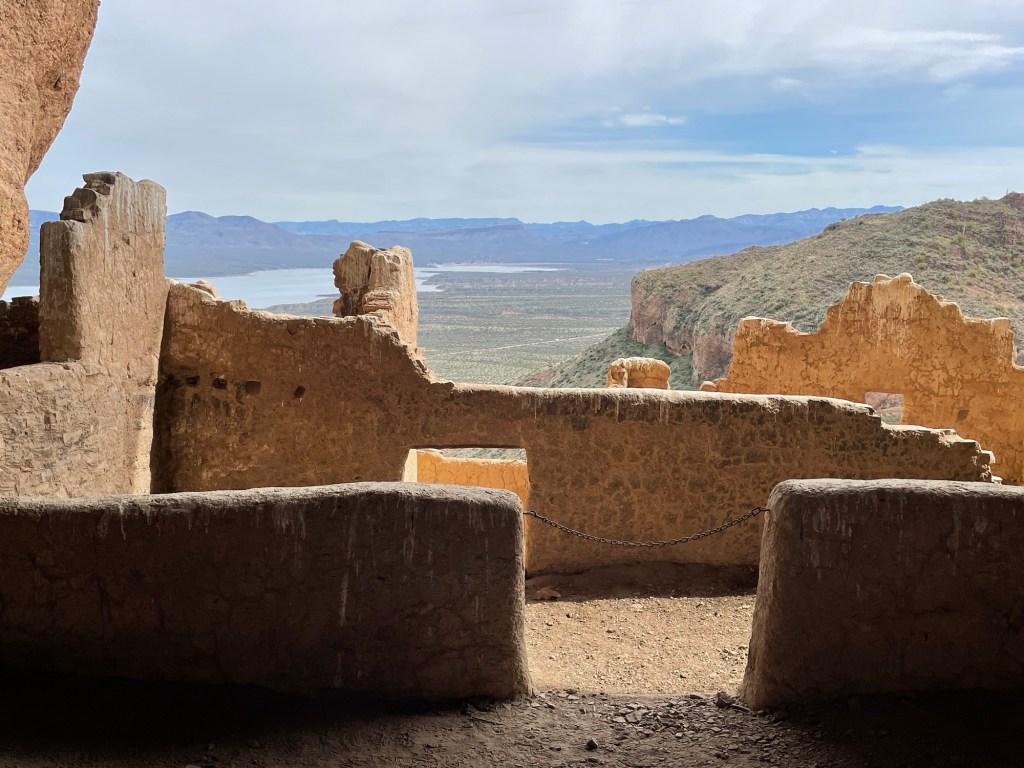
We went on a day trip with Wayne’s sister and brother-in-law, Marlene and Steve, to see Cliff Dwellings at Tonto National Monument, about 1 1/2 hours away near Roosevelt Lake. After the long drive and time in the visitor center, there was a hike to get up to the Cliff Dwellings. The site is amazing and the view is beautiful.

Cliff dwellings at Tonto National Monument
Cliff Dwellings at Tonto National Monument
Cliff Dwellings at Tonto National Monument with view of Roosevelt Lake

Gold Canyon is east of Apache Junction, on the far east side of the Phoenix metro. It has a very wild west vibe, where you might see a trailer with a horse in it at the nice grocery store parking lot.

Horse in a trailer in the grocery store parking lot

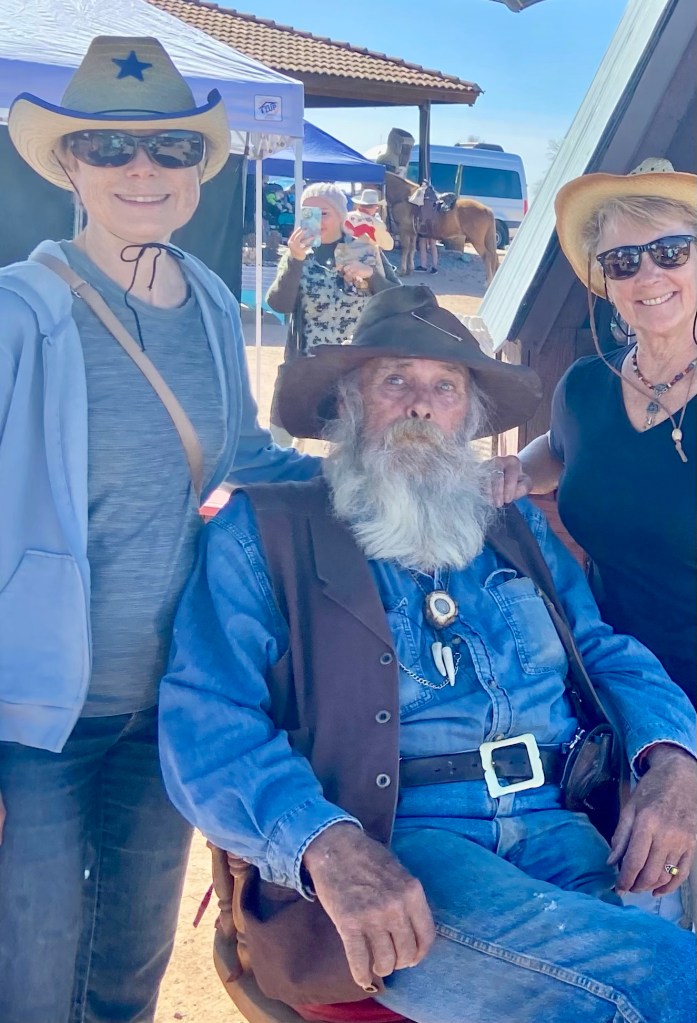
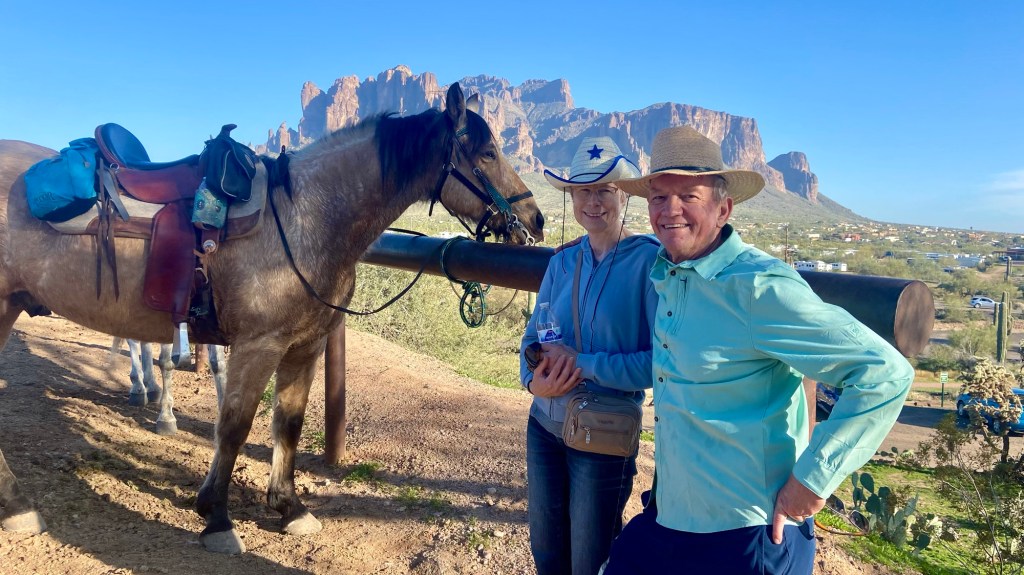
The Superstition Mountain Museum in Apache Junction was worthy of several outings. Click here for a link to the website for this attraction that includes a historical museum, assorted old west buildings, some old Mining machinery, and a cool model train. We attended a couple of events there including “Western Cowboy Day” where we watched a fake old west shoot out, and cowboy “Teton Ken” flirted with Marlene.

Posing with Cowboy “Teton Ken”
Posing with more cowboys from the fake shootout

We also went to the Native American Arts Festival at the Superstition Mountain Museum, where we saw hoop dancing by the Yellow Bird Indian Dancers. It was hard to get a good photo, so following is a picture from the brochure. Click here for a link to info about the talented Duncan family. Click here for a video of champion dancer Tony Duncan.

Members of the Duncan family at the Native American Arts Festival

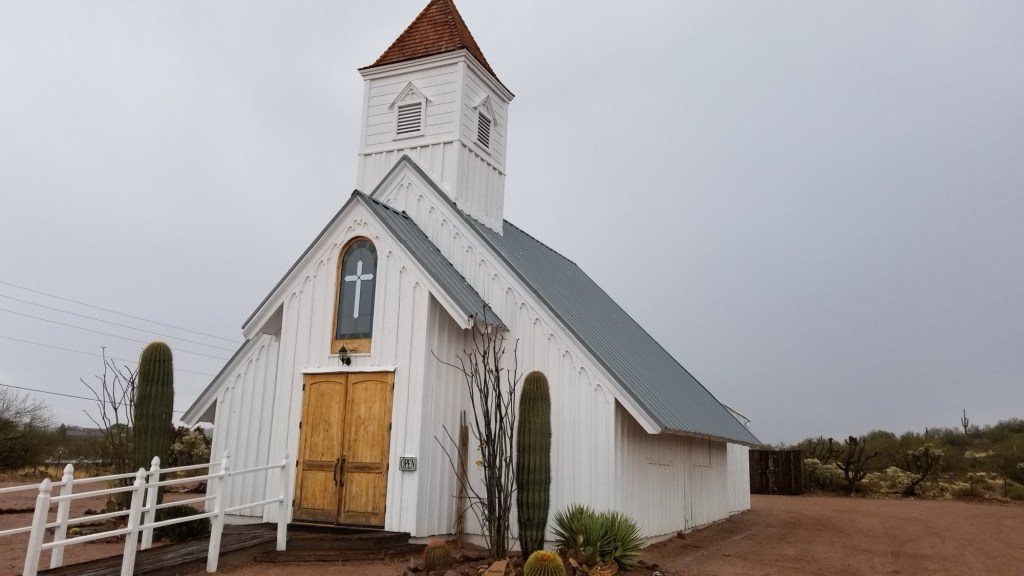
From1960 to 2004 there was an 1800 acre old west town movie set in Gold Canyon called Apacheland Movie Ranch. Classic western movies and TV shows were filmed there, including Bonanza, Death Valley Days, Gunfight at the OK Corral, and Charro. A fire in 2004 burned down most of the buildings, but the barn, chapel, and gallows were saved and moved to the site of the Superstition Mountain Museum. No visit to Gold Canyon is complete without a stop at the Elvis Chapel.

The Elvis Chapel at the Superstition Mountain Museum, originally from the Apache Land Movie Ranch

There is a large display of photos and memorabilia from the Apacheland Movie Ranch inside the barn, including photos of Ronald Reagan, Clint Eastwood, Elvis Presley and many movie stars who were before my time.

Barn relocated from Apache Land Movie Ranch to the Superstition Mountain Museum

The following collage was on display in a local restaurant.

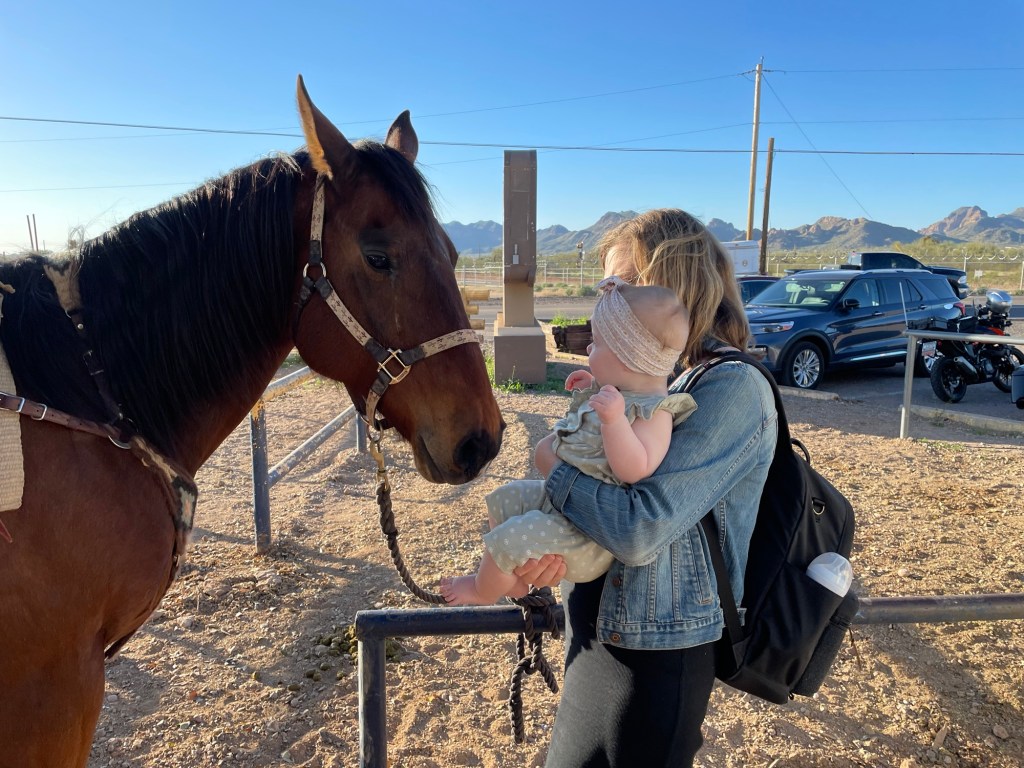
There are a couple of saloons in Apache Junction where locals arrive on their horse and tie it on a rail while partaking of happy hour. Our granddaughter got to see her first horse up close at the Hitching Post Saloon.

First in person encounter with a horse at the Hitching Post Saloon, Apache Junction

Gold Field Ghost Town is another activity in Apache Junction that is on the list of places to take visitors. It is a very touristy 1890’s old west town, and the other place with a real saloon where locals arrive on their horse. There is outdoor seating in the back of the Mammoth Steakhouse and Saloon with a great view of the Superstition Mountains. Note that if you are vegetarian or vegan, find a different place for dinner!

Behind the Mammoth Steakhouse & Saloon at Goldfield Ghost Town

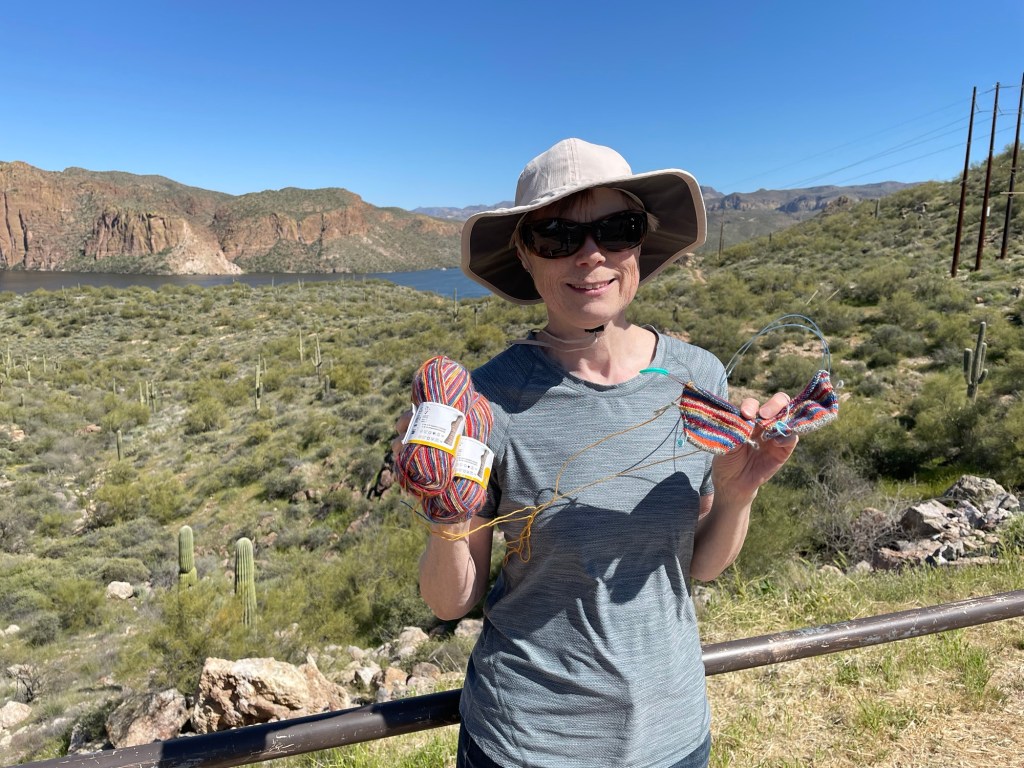
The Apache Trail Scenic Drive starts in Apache Junction near Goldfield Ghost Town, and goes on for 40 miles of beautiful scenery. We did this outing twice. The road was constructed in the early 1900’s to connect Apache Junction with Roosevelt Lake. Before that it was an Apache Indian trail, and then a Stage Coach route. If you are not familiar with this area, you do not think of lakes in Arizona, but there are a couple of them east of Phoenix. The Apache Trail goes past Canyon Lake, which you can see in the background at the scenic overlook in the next photo. There is camping, as well as a marina and restaurant at Canyon Lake.

Bringing my knitting on the Apache Trail Scenic drive

Tortilla Flat is the next stop after Canyon Lake on the Apache Trail. Tortilla Flat is a one block long “town” with a population of six. There are a couple of touristy buildings including a saloon and gift shop, and an outdoor space with bar food and live music every afternoon. The ladies room has some unique art on the stall doors.

Stall doors in the ladies room at Tortilla Flat

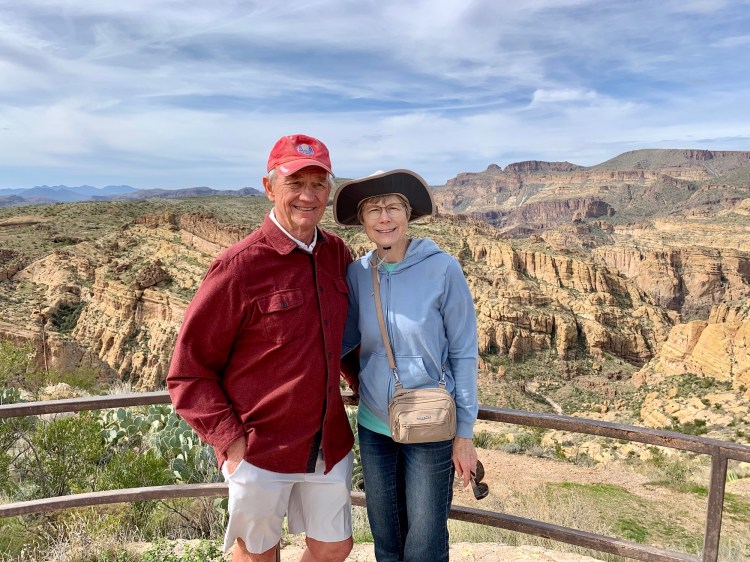
A few miles after Tortilla Flat the road is no longer paved, and becomes very windy, narrow and scary. There is an overlook at a Fish Creek Hill that looks like a mini Grand Canyon. At this point you cannot go any further due the road being washed out. If you could continue on, or if they fix the road, you would be able to continue on to Roosevelt Lake and Roosevelt Dam. The next photo was taken at the Fish Creek overlook. If this looks familiar, I already used it in a previous blog post. If it does not look familiar, then you are not really reading my posts. LOL.

Fish Creek Overlook on the Apache Trail Scenic Drive

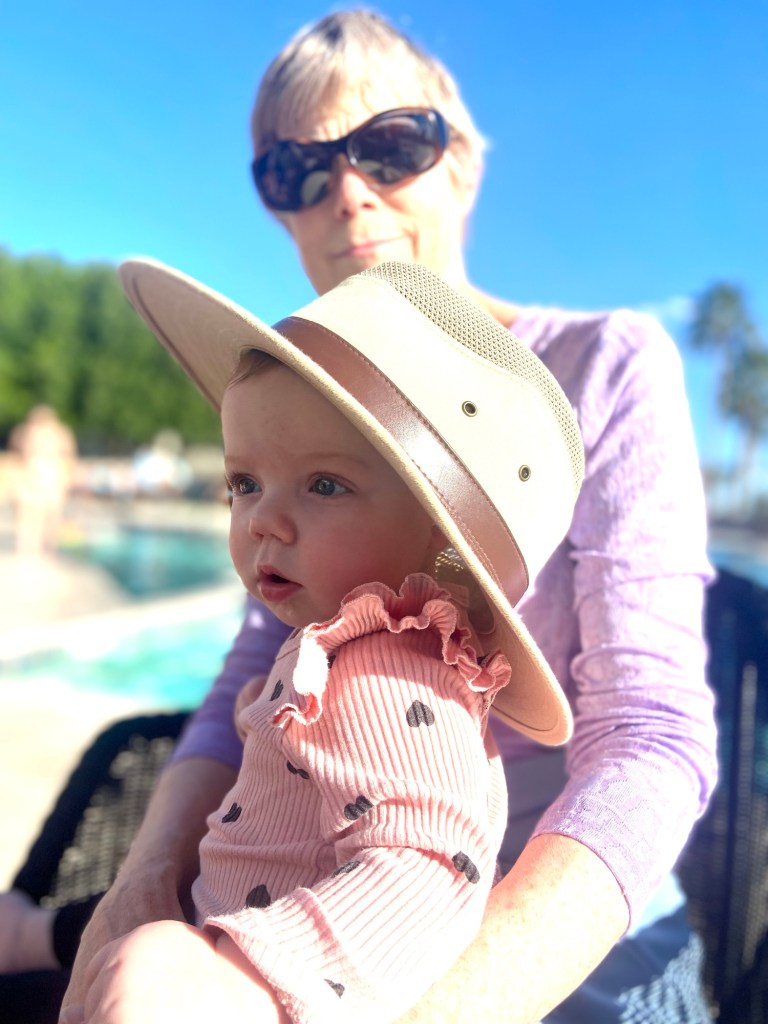
Continuing with the “wild west” theme, I have a photo of my granddaughter wearing our friend’s western hat, while we visited at the pool.

Future cowgirl?

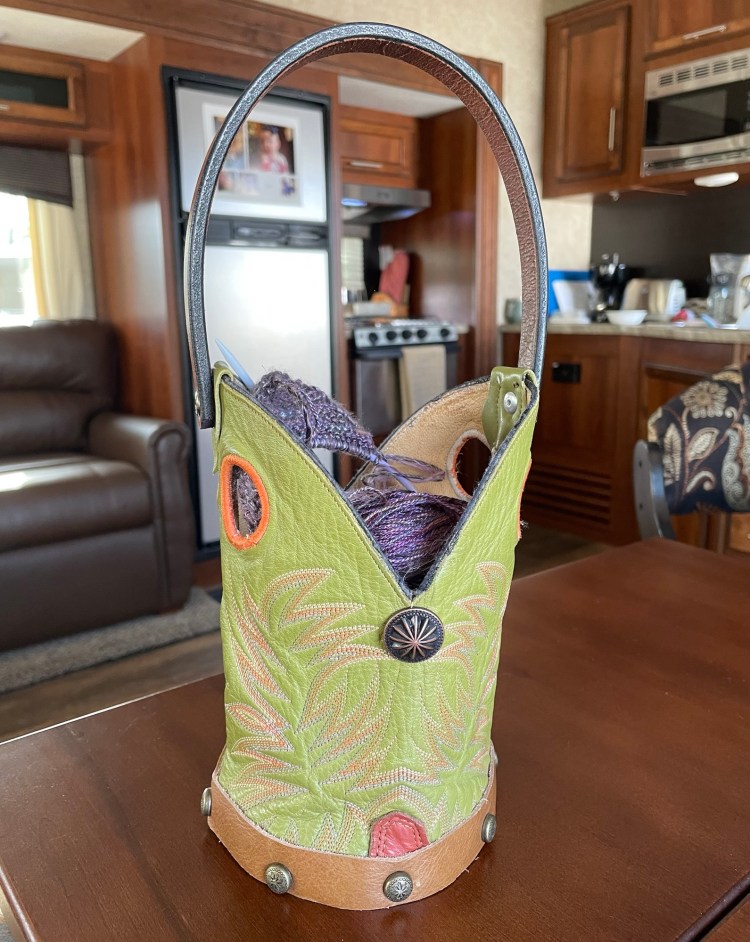
And then there is a photo of the repurposed cowboy boot bag that I bought at an art fair, that I also used in a previous post.

Cowboy boot repurposed into a bag

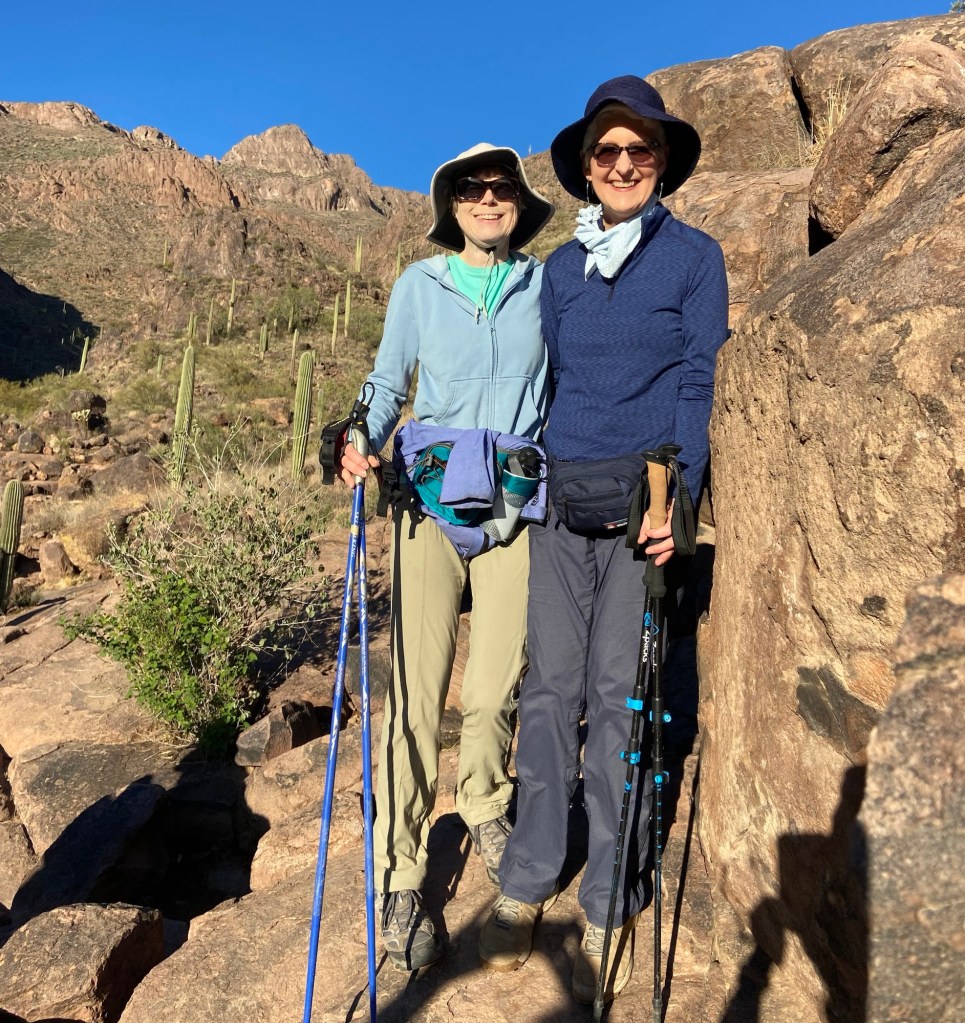
Following are random hiking photos from this year.

The Hieroglyphics trail, Superstition Mountains
The Hieroglyphics trail with my friend Kris from back home
Photo from a hike in the Superstition Mountains
Also in the Superstition Mountains

I am glad we have the opportunity to get away from winter, and take advantage of all the things to do in Arizona that we can’t do in Minnesota. It is nice to be able to be outside a lot, and also have minimal chores living in our 5th Wheel Trailer. But by the end of our time there I am ready for my normal routine at home, and maybe the RV is starting to feel a little too cozy.

After being home for over a week, I am finally starting to feel like my life is back in order here. The taxes are done, but I still have to put the Christmas decorations away. We moved them all down to the basement bedroom in late December. Out of sight, out of mind. Going for a walk around here is not quite as dramatic as hiking in the Superstition Mountains, but the rolling hills and lakes of Otter Tail County are beautiful too.

Rigid Heddle Scarf

Like most knitters, I have many random skeins of yarn that I love, but don’t know what to do with. Some I spun myself, some I bought while on vacation, some I bought on sale, others I thought I was going to use but never made that project. They look beautiful sitting in baskets. They fill up plastic tubs. I try to think of ways to use the yarn that are worthy of their quality and beauty.

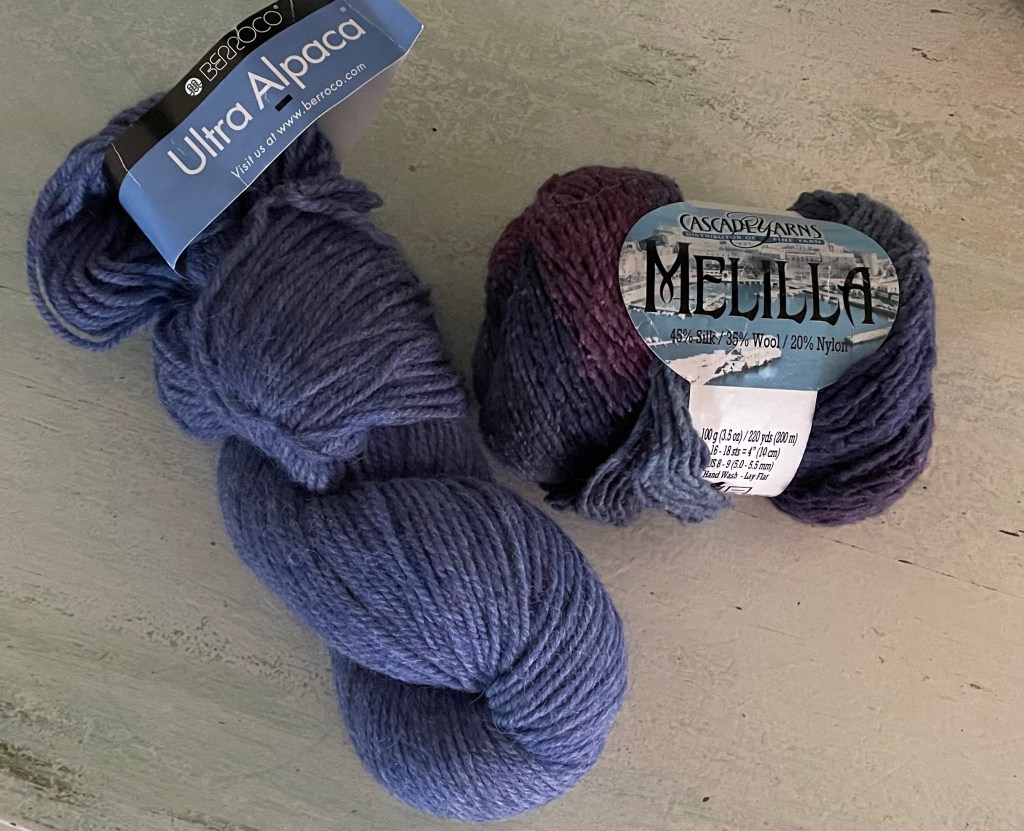
I looked through my stash in December while planning for our Arizona trip this winter. I found two skeins of yarn that worked well together for a woven scarf on my Rigid Heddle Loom. For the warp I had some Berroco Ultra Alpaca 50% Alpaca / 50% Wool leftover from a sweater, very smooth and squishy. For the weft I had a skein of Cascade Yarns Melilla 45% Silk / 35% Wool / 20% Nylon. It has a more inconsistent texture with nubs.

Warp and weft yarn from my stash for a woven scarf

I wove a small sample with eight ends per inch to get an idea what they would look like together. The Melilla yarn for the weft has multiple colors that do not show up on the photo of the sample. I happened to get a section of the weft yarn that was close to the same color as the warp yarn. The woven sample was soft and I love the colors separately and together.

This is the weaving project I mentioned in my last post that involved wasting an hour and a half of time. I wanted to get this scarf warped on my rigid heddle loom, and figured it would go quickly. I took my loom and supplies over to a room in the community building at the RV Resort, where there was enough space for direct warping. After getting about 2/3 of the warp yarn on the loom the ball of yarn ran out, so I looked in my bag to get the other ball. I was swearing in my head when I saw that the other ball of yarn was not a ball of yarn. It was warp yarn that I had already measured out on my warping board at home, so that I could warp the project indirectly in the RV, without reserving a community room at the Resort. AAAHHHH. This meant that I had to remove the yarn that I had just warped on to the loom and start over.

The warp yarn was one long thread going in and out of the reed on the loom. I could have cut it off easily, but that would have ruined the yarn. Instead I pulled it out one slot at a time which took longer than it took to get it on there. I should have taken a photo of this laborious process, but I was not sure I wanted to admit I had been so dumb. After finishing that and being really disgusted with myself, I packed up all my stuff and went back to the RV. I was back to square one. It was already close to dinner time, so best to save this project for another day when I could start fresh. It was a waste of that time, but nothing else was lost.

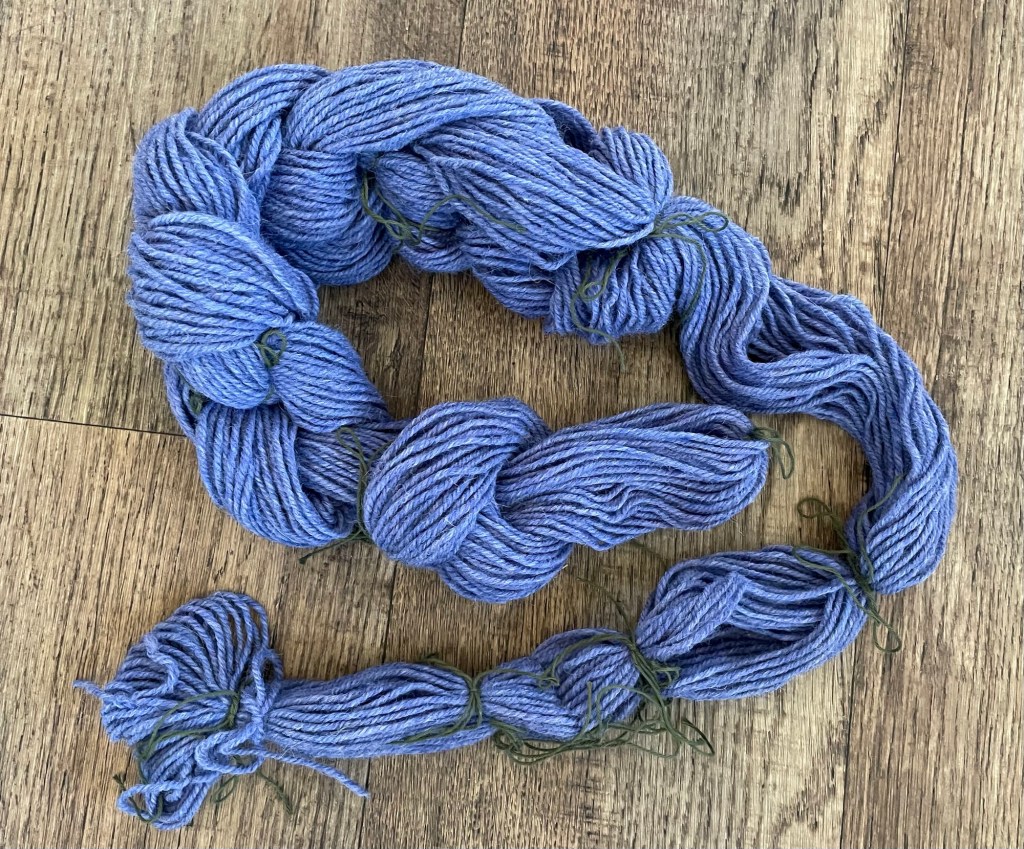
Following is a photo of the bundle of warp yarn (“warp chain”) that I had measured at home, ready to go on the loom.

The “warp chain” that I measured out at home on my warping board

I may have warped my rigid heddle loom indirectly once before, but I wanted to review the process before starting to avoid any more dumb mistakes. As with everything, there are many sources of instruction online with many variations of steps to warp directly and indirectly. I re-watched the section from the School of Sweet Georgia class on Rigid Heddle Weaving Basics that was specifically about indirect warping.

The School of Sweet Georgia instructions suggested using lease sticks to keep the yarn ends in order, the same as when using a floor loom. That is not the only way to do it, but I decided to try their method. It was also suggested to put the yarn ends loops around the back bar instead of tying the ends on, which is essentially how it would be if I had threaded it directly. The rest of the process was similar to direct warping.

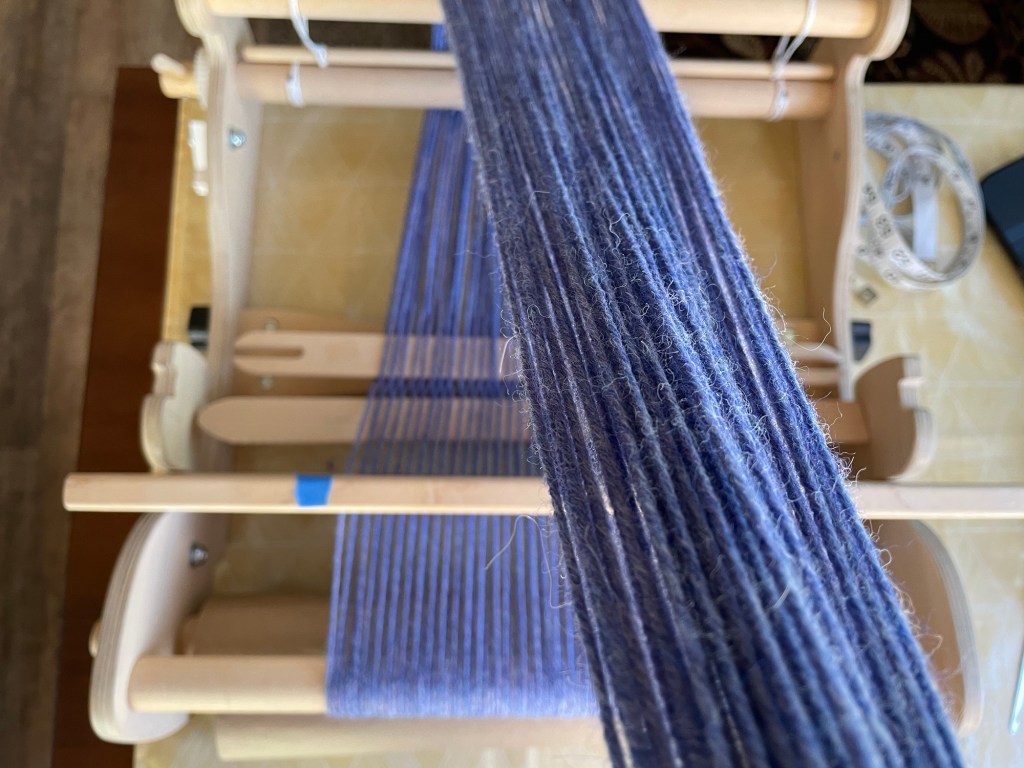
Following is a photo of the front of the loom with the yarn ends going through some makeshift lease sticks and then through the slots of the reed.

The next photo is the back of the loom, showing the loops of yarn from my warp bundle wrapped around the back bar.

The School of Sweet Georgia method recommends holding the length of warp yarn across the loom from the front to the back, creating even tension as you wind the yarn on.

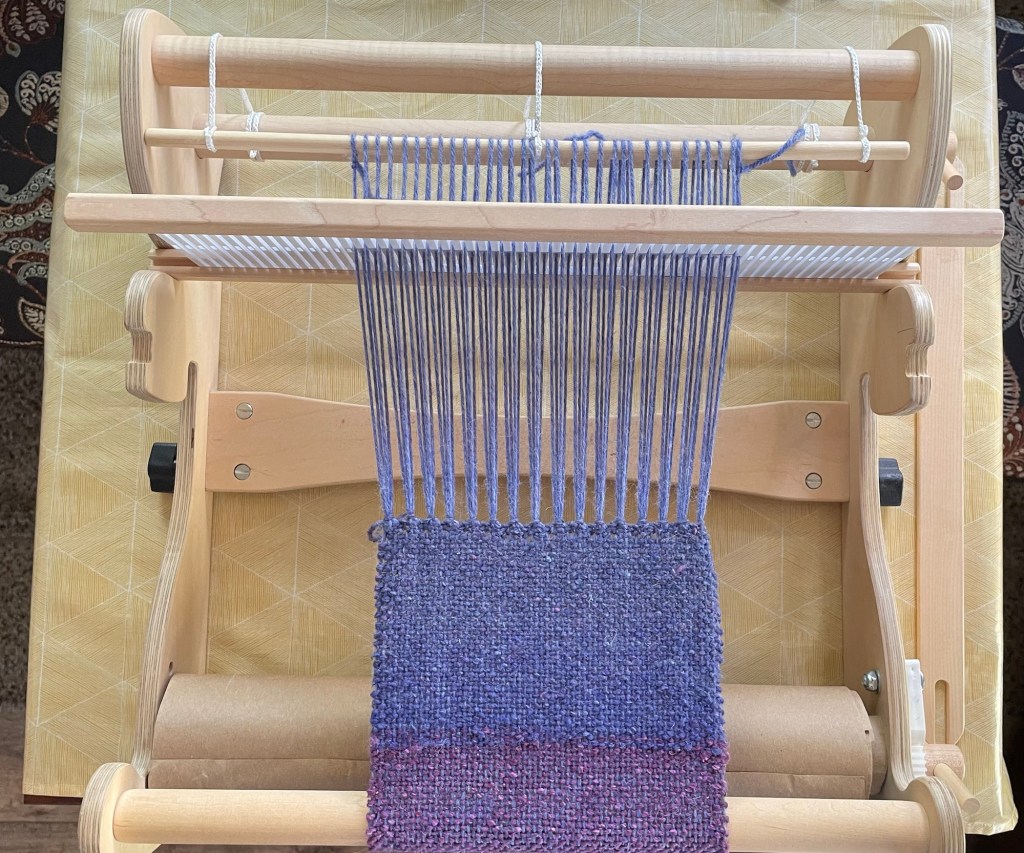
After winding the warp yarn on to the back, moving one yarn end from each slot to the adjacent hole, and tying the ends on to the front apron bar, I was ready to weave. The beginning of my weft yarn was a pretty dark violet color, very different from what my small sample looks like.

The beginning of the scarf
Starting to look like a scarf

I did not measure the weaving as I went, so I didn’t know how long it was when I got to the end of the warp. When I got to the end of the weft yarn on the shuttle there were a few more inches of warp available. I wanted to make sure the scarf was not too short.

The weft yarn was variegated with different colors of blue and purple. The result was different than I expected, more Ombre than stripes. For some reason I don’t remember, I had unwound a few yards of blue at the beginning of the skein of weft yarn and set it aside. The weft yarn was purple when I got to the end of what was on the shuttle. After the purple, in order to made sure the scarf was long enough, I added the blue that I had separated off at the beginning. I worked the hem stitch so I could remove the weaving from the loom and see how long it was. Following are two photos of the weaving at the end of the loom with the extra blue yarn added after the purple.

Blue added abruptly after purple at the end of the scarf
Close up of the blue added at the end

The scarf turned out to be very long, and the abrupt transition from purple to blue did not look right, compared to the more gradual changes of color in the rest of the scarf. After seeing it off the loom, it was clear the scarf would have been plenty long and look better without the extra couple of inches of blue. I decided to remove the extra blue rows.

I worked some hem stitch at the end of the purple, and then removed the blue that did not look right. The next two photos are the entire scarf with the hem stitch added after the purple, but before I removed all of the blue.

The entire scarf off the loom, with hem stitch added between the purple and blue
Close up of hem stitch added after the purple

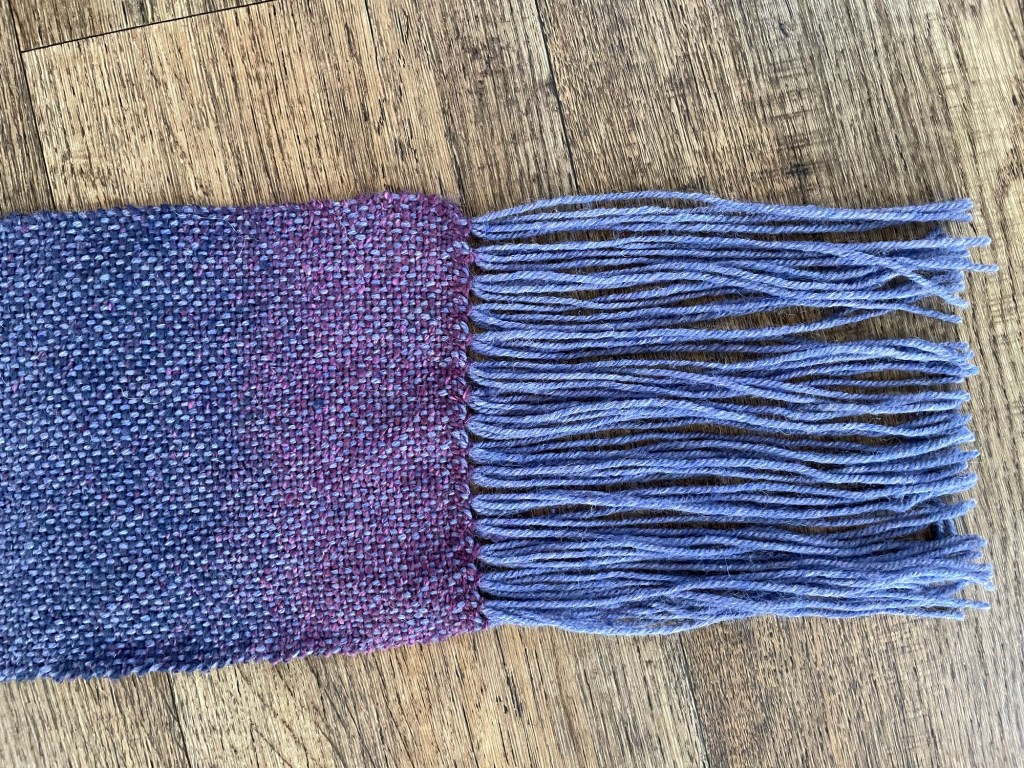
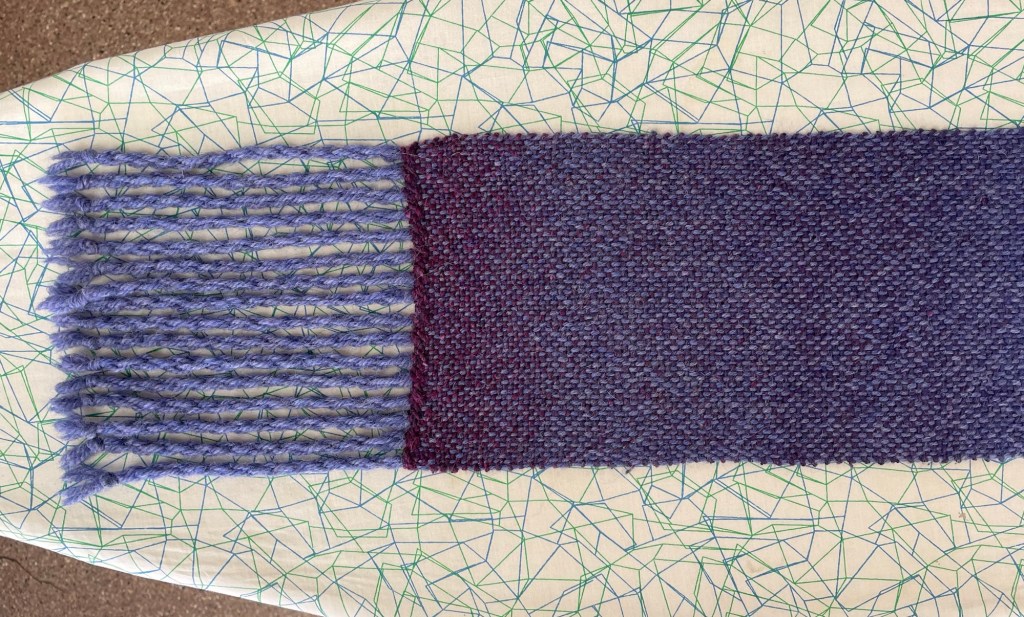
Following is a photo after the extra blue had all been removed, and I had trimmed the warp yarn evenly for fringe.

Leaving the loose warp yarn at the ends was an option, but instead I started working twisted fringe by hand.

Making twisted fringe by hand

After gently soaking the scarf in warm water with a bit of dish soap and then rinsing, I squeezed out the extra water with a towel and laid it flat to try on the picnic table outside our RV. It was a warm day, so the scarf dried fast in the very dry Arizona conditions. Not including the fringe, the scarf is 98″ long (2.7 yards) and 6 1/2″ wide.

Drying outside on a towel after gently washing

The next day I went over to the laundromat at the RV park and used the ironing board and iron to gently steam and press the scarf, using a linen kitchen towel for a pressing cloth.

After steaming with an iron and pressing cloth

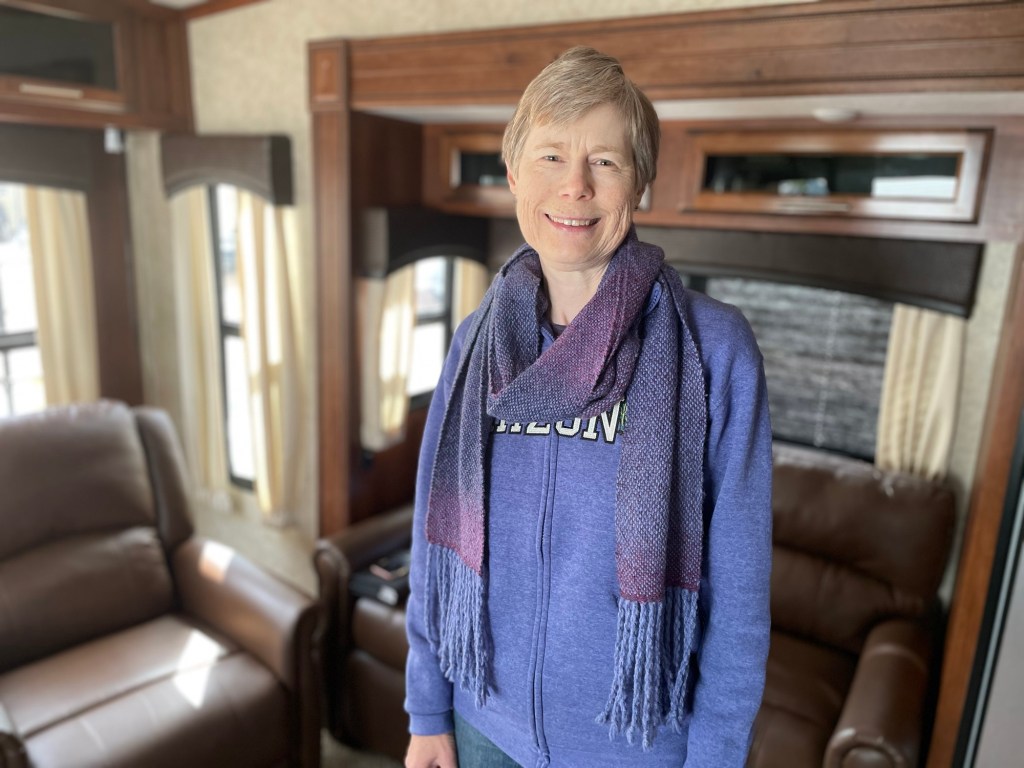
The scarf is long enough to wrap around my neck twice. Ombre is not my favorite, but when wound and bunched up, you just notice the pretty colors.

Our time in Arizona is over for this year. The weather has been inconsistent with more rain than usual. One day last week we wore shorts and tee shirts while bike riding. The next day a sweatshirt with the new scarf was comfortable.

After being here for three months, I am ready to go home. I am even a little disappointed that we missed the winter storm that happened last week in Minnesota. As long as I do not have to go anywhere, I love working on a project in the house while watching a storm outside.

Last winter there was a lot of snow in Minnesota. When we got home in April the side of the driveway where we park the RV was piled high with a big snowbank. This year there was hardly any snow until now. The report from back home is that we got almost 10″ of snow from the recent storm, but likely it will melt by the time we get there. I would not be surprised or disappointed if there is another late season snowstorm in April, giving me an opportunity to sit inside knitting and watching the weather outside.

Socks Re-Do

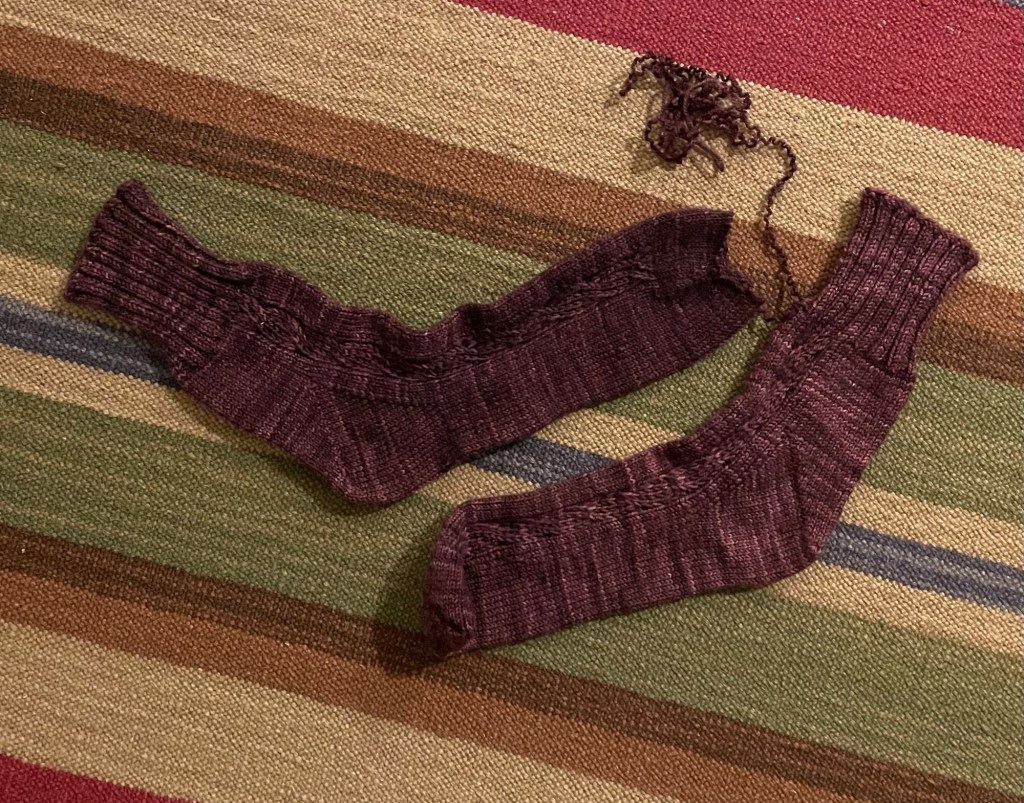
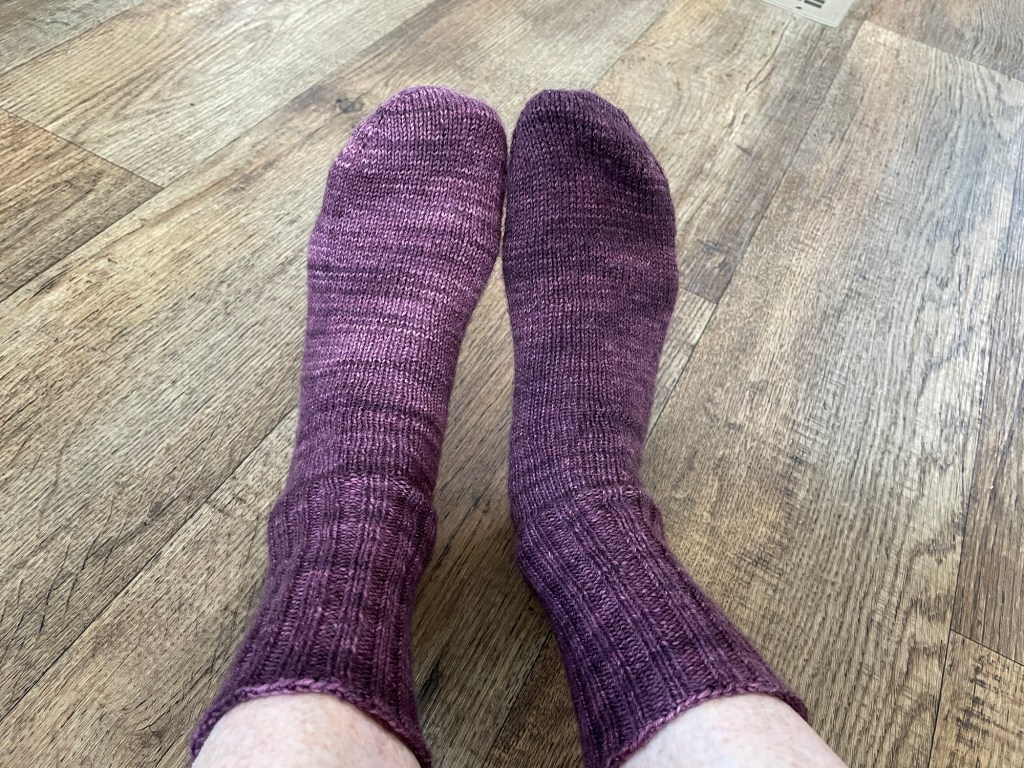
I made this pair of socks two years ago when we were in Arizona (click here for blog post). They looked great but they did not fit right. The pattern was complicated, they took forever to complete, there were too few stitches around, and the cable pattern made them even tighter. I used a new heel pattern that I started in the wrong place. They ended up being too long and too narrow.

I considered re-doing the toes to make them shorter, and giving them to my aunt who is very petite. I assumed her feet would be small. It turned out they were not that much smaller than mine, so they would not fit her either.

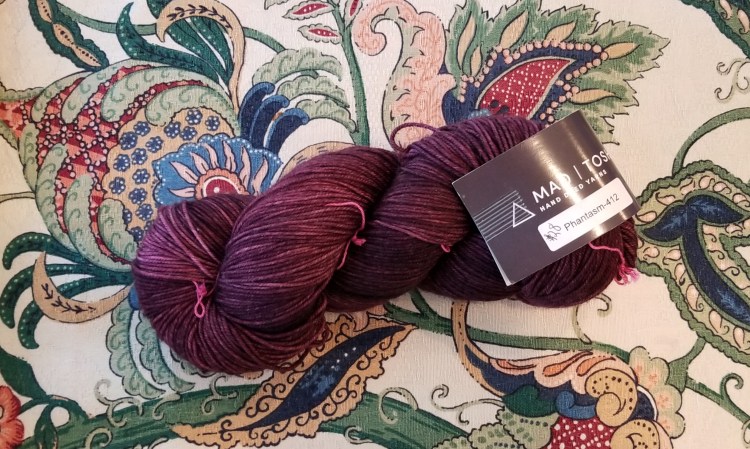
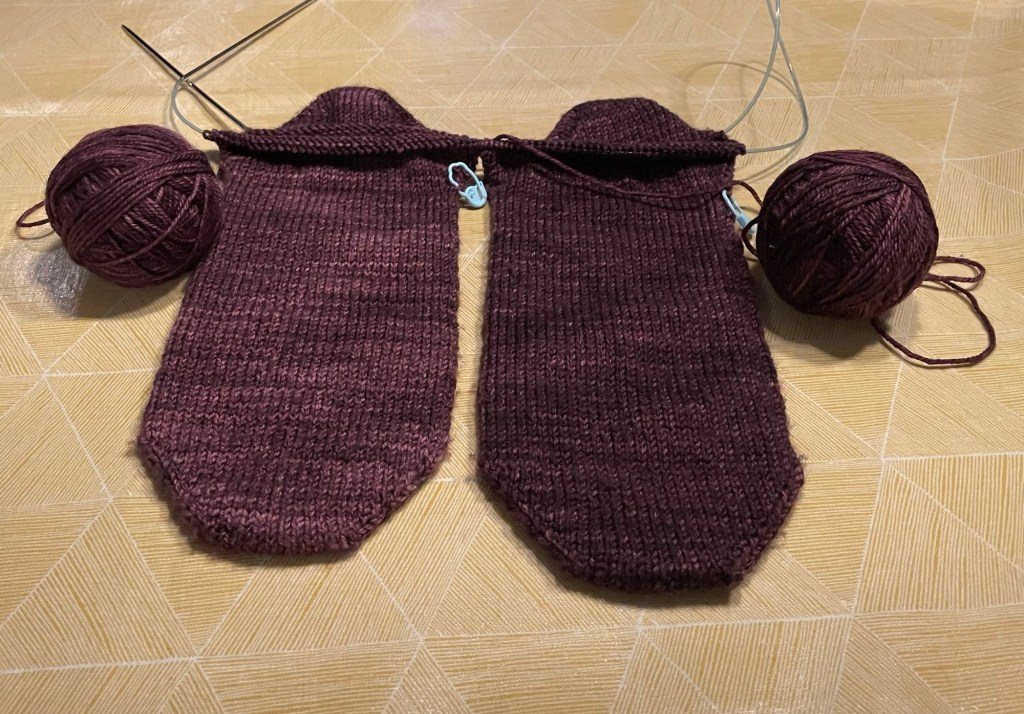
After a year of pondering this problem, I decided to “frog” (rip out) the socks and start over. The Madelinetosh Twist Light yarn is good quality and I really like it, so better to have a pair of socks I can actually wear. Following is a photo of the original skein of yarn.

One of the things I like about knitting is that if, or rather when, you make a mistake, you can unravel that section and do it over again. Or even frog an entire finished object and reuse the yarn. I used to sew clothes back in the day. Once you cut the pattern pieces out of the fabric, there is only so much you can do if you make a mistake. You can’t get the original length of fabric back. I have read about people who want to knit with good quality yarn, but do not have the budget for it. They find really nice sweaters at thrift shops, unravel them, and use the yarn for something else. There are many tips online about how to pick out sweaters that will work best for this.

Unraveled yarn is very kinky, as the wool remembers the state it has been in. It is OK to knit with kinky yarn, but I thought it would be distracting. Instead of rolling the yarn into a ball as I unraveled it, I wound it into skeins on the back of a chair, so it would be ready for washing to remove the kinks.

Unraveling one of the socks

After tying the skeins and removing from the chair, they bunched up into funny looking blobs like big kitchen scrubbers. I do not know why one of the skeins looks smaller. As far as I know the two socks were the same size. I might have wrapped the one on the left of the photo tighter around the chair as it relaxed into a smaller blob than the other one.

Yarn unraveled from hand knit socks

I was recently reading about sock blanks on the School of Sweet Georgia web site. A sock blank is sock yarn that has been machine knitted flat or into a tube. White sock blanks are dyed for self striping yarn. They can be purchased white or already dyed. You start at one end and knit directly with the yarn as you unravel it, in which case it will be kinky like my yarn above.

Following is a photo of a sock blank from Sweet Georgia Yarns. You can see how colors have been added in gradations for self striping socks.

Sock blank from Sweet Georgia Yarns

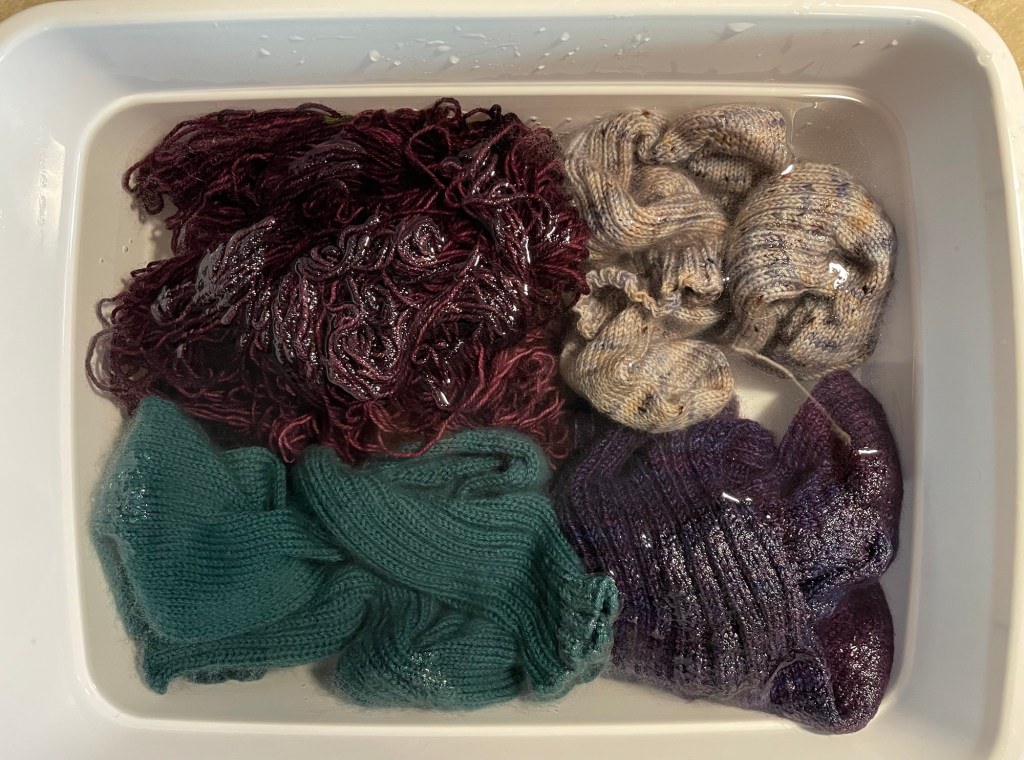
Following is a photo of my unraveled sock yarn soaking with some hand knit socks.

The yarn looked good, and was ready for a new project after drying flat. One of the skeins looks a bit smaller. The two original socks should have been the same, but maybe they weren’t.

Kinks gone after gentle washing

I don’t have my ball winder in the RV, so I rolled the two skeins of yarn into balls the old fashioned way by hand and I was ready to begin. I liked the School of Sweet Georgia pattern “Custom Toe Up Socks” that I used for the green socks I knit recently, so I used it again for this pair.

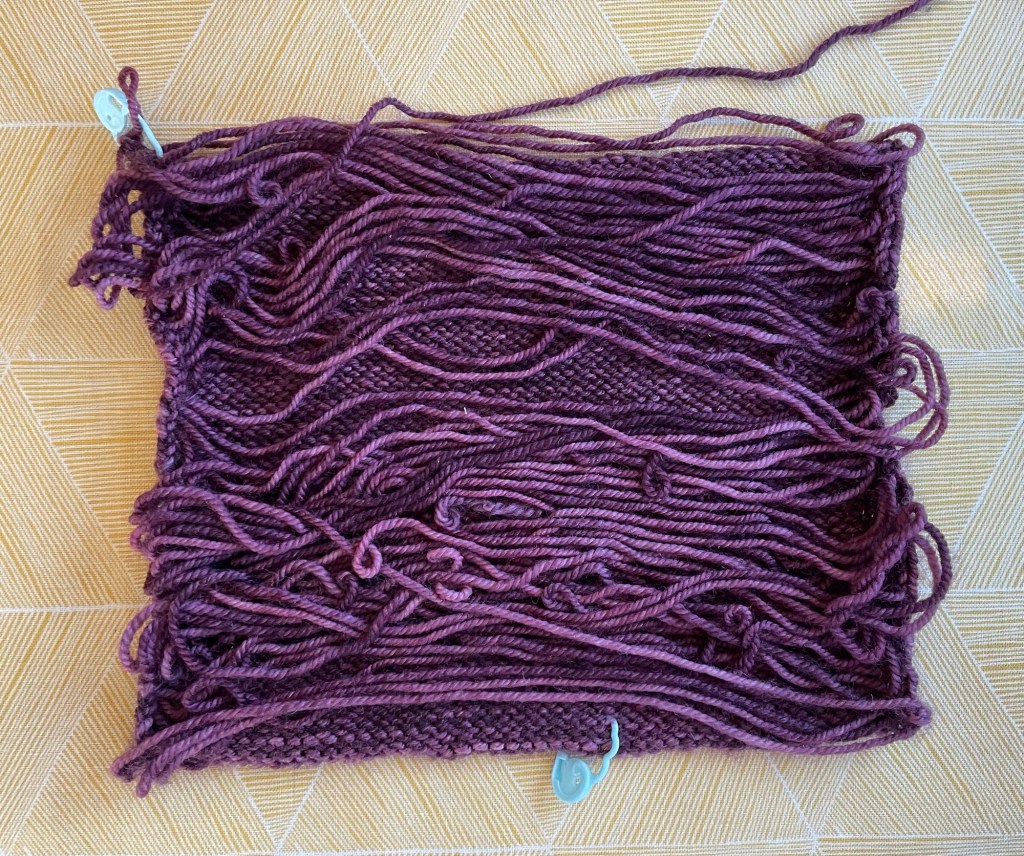
I have never been much of a swatch maker. The pattern (click here for the link) includes making a “faux circular swatch”, so it seemed like a good exercise to follow the pattern and make the swatch. The faux swatch instructions are also available as a stand alone module (click here for the link). Knitting stockinette stitch in the round will get you a slightly different gauge than knitting stockinette flat back and forth. The faux circular swatch is knit flat on double pointed or circular needles so you can slide the yarn across to the other side after each row, creating a long loop on the back where the working yarn is carried across. Sort of messy looking but resulting in a more accurate gauge. Sometime I will knit a regular plain old swatch AND a faux circular swatch with the same yarn to see how different they are. The next photos are the front and back of my faux circular swatch.

The front of my faux circular swatch
The back of my faux circular swatch

I measured my gauge using the swatch, and then using my foot length and circumference, I filled in the worksheet for the School of Sweet Georgia toe up socks pattern. I was pretty sure I would want to have 60 stitches around based on the other socks I have made using the same yarn, so luckily that is what the worksheet came up with.

Measuring my guage

The pattern suggests using Judy’s Magic Cast-On for the stitches at the beginning of the toe. I have used this before, but it had been awhile. The School of Sweet Georgia pattern has video showing how to do it in detail, and there are other videos online. It is a good cast-on for toe up socks but I find it a bit mind bending. I watched the video multiple times and started over more than once before I got it right and felt comfortable. The toe is easy once you get the stitches cast on. I ripped out the swatch and wound that yarn back on the ball since I needed all of it for the second sock. That yarn was kinky, but I went ahead and knit with it that way.

The two balls of yarn I was using for the socks re-do came from the original two socks, which began as one skein of yarn. The two new socks started out with one lighter in color and one slightly bigger than the other. One of the balls is bigger, so now I am wondering if the bigger blob of kinky yarn (pictured above) is due to the yarn being different rather than the way I wound it on the chair. The differences in color and weight are a mystery. The kinky looking yarn on the smaller and lighter ball is due to being unwound from the swatch.

One ball of yarn is lighter in color and smaller

I worked on sock knitting feverishly over a period of several days, including bringing the project in the car on some outings. We went on the Apache Trail Scenic drive (north and east of Phoenix) when Wayne’s brother was visiting. We have done this multiple times, but it is always a great outing with visitors. We took a photo at a scenic overlook, and then later I kicked myself because I should have been holding the sock knitting project.

Scenic overlook on the Apache Trail, the socks project is in the car

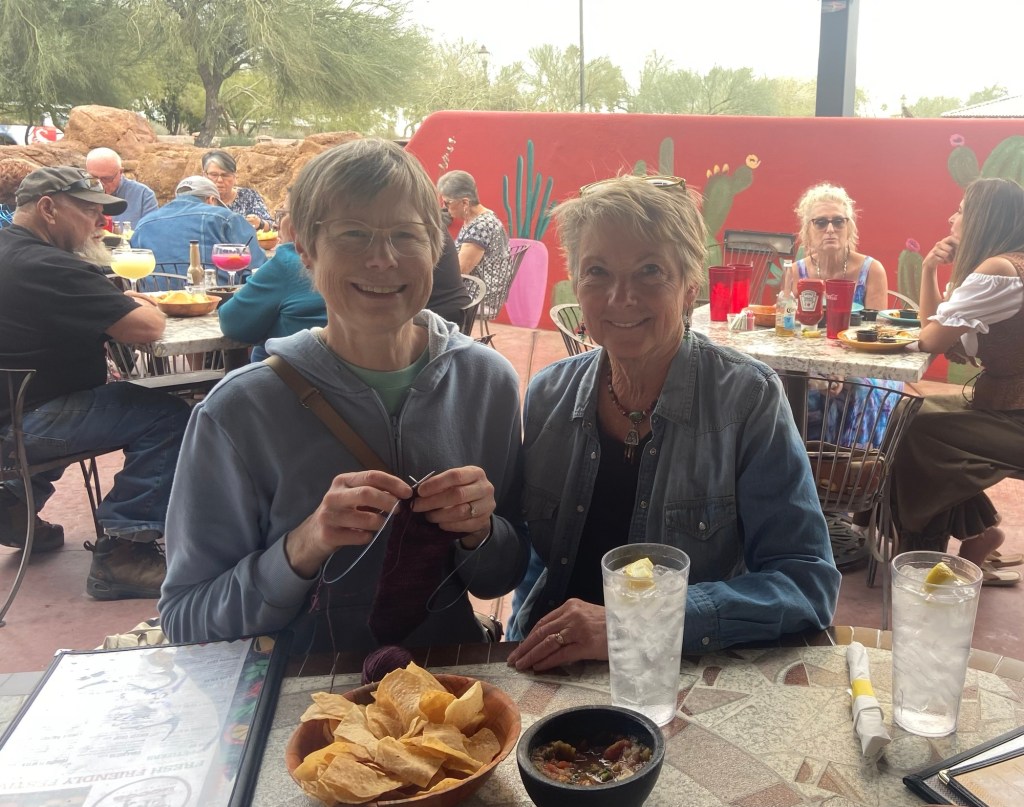
At the end of our scenic drive we ate dinner in a Mexican restaurant in Apache Junction. I got a photo with my knitting there, sitting next to my sister-in-law Marlene.

I was worried about running out of yarn, after I realized that I was using it up faster for this pair than the original pair I ripped out due to having more stitches around. It was a relief when I finished the Fish Lips Kiss heels and there was plenty of yarn left for cuffs.

I was not sure how long the remaining yarn would last. Shorter cuffs would stay up better with K1P1 ribbing, so I went with that. Following is a photo of the socks with several inches of cuff in K1P1 ribbing. Hmmm, it is OK but not my favorite look.

As it turned out there was plenty of yarn for the cuffs. These socks seem boring compared to the original pair I ripped out, and to “fancy” socks I have seen other people knit. I have to remember not to compare myself with other people as far as knitting, and also anything else in life. Each day is different. Sometimes we barely make it through the day. Other days we are up for more challenging tasks. Each person is on their own journey.

After getting toward the end of the yarn with the K1P1 ribbing, I was not liking it, and it seemed a little bit tight at the point where the ribbing started. I considered doing a picot bind-off to make it more interesting. I had that dreaded decision of “should I just keep going and it will be fine” versus “rip back the part that isn’t quite right and do it over”.

The “Up North Socks” I knit last fall fit very well and have a similar gauge, so I looked at my notes for how many stitches I had at different points in the sock. Without going into too much detail for the non knitters (I probably lost them a long time ago) the ribbing had more stitches than the foot. If the only problem was the style of ribbing, I might have just left it, but it seemed worth it to adjust the fit also. Soooooo I ripped the ribbing and a few more rows out until I had the right number of stitches around for a cuff that would fit me better. On the same day I also wasted an hour and a half on a weaving project, but that will be a story for another post.

Following is another photo after re-knitting the cuff in K2P2 ribbing, with a couple of more stitches around. I like the look better, and more importantly, they fit me better.

Socks with K2P2 ribbing, instead of K1P1

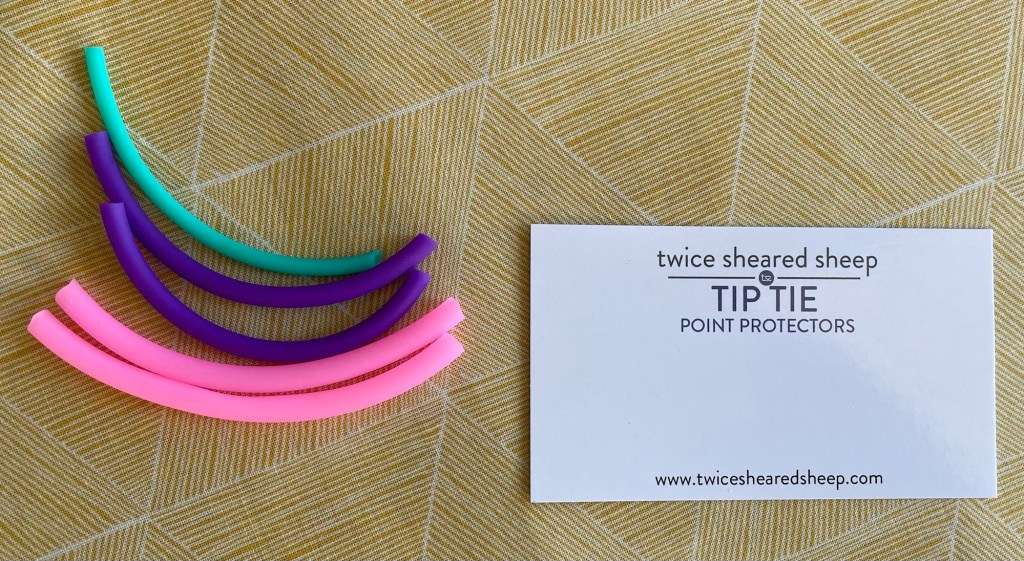
Meanwhile I saw an ad from Twice Sheared Sheep for “Tip Ties”, an ingenious version of knitting needle tip protectors. I have tried to use old fashioned needle tip protectors to keep my knitting from falling off, but they do not stay on. This product is a flexible tube that you stick on the ends of your needles. They stay on, keep the knitting from coming off, and also keep the needles from poking through my fabric project bag.

Needle tip protectors from Twice Sheared Sheep
Tip protectors on my circular needles needles

As I got to the end of the yarn, I wanted to use up as much as I could, without running out in the middle of binding off. I unwound and measured the remaining yarn, adding some markers so I could see how much was used up knitting one round. After some math, I estimated that I could knit for another inch or so before binding off.

After binding off the first half of the stitches on both socks, there was not enough yarn to bind off the second half of one sock, and lots of yarn left on the other sock. I don’t know how I could have knit more rows on one sock when knitting two at a time. And it is consistent with one of the balls of yarn being bigger at the beginning. Maybe one of the original socks was bigger. I used some of the yarn from the sock that had extra to finish binding off the other one. When I was all done I had about five inches of ribbing and a total of one yard of yarn leftover.

One side of each sock bound off

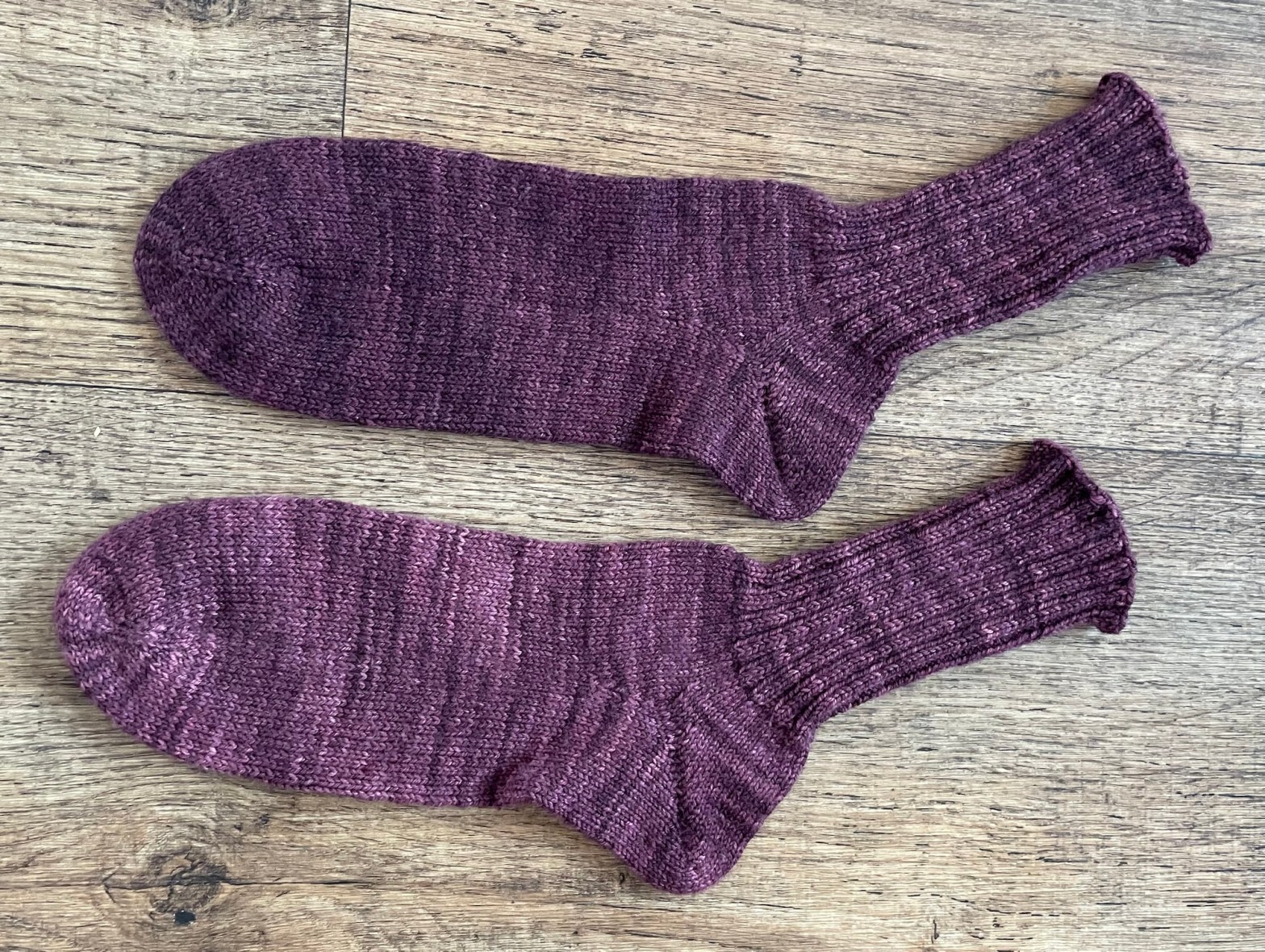
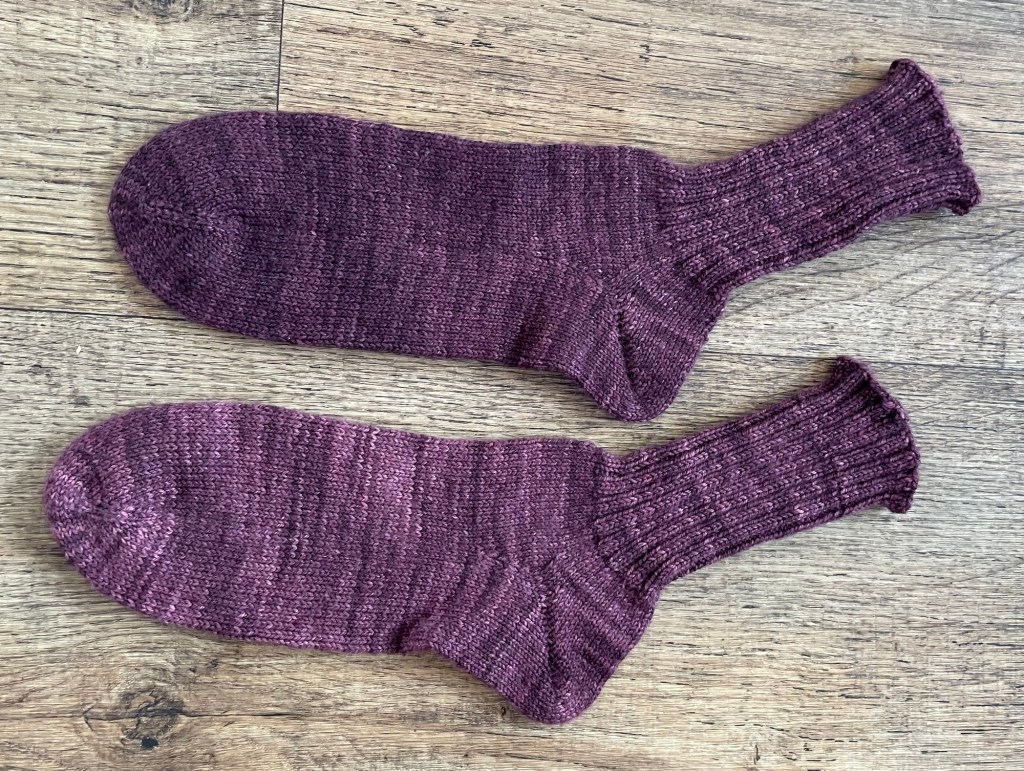
After hand washing and laying out flat to dry, the socks were done.

My husband is a big fisherman. We have all seen photos of people with their fish held way out towards the camera to make them look bigger. I saw some photos of a woman showing off her hand knit socks like they were a fish, so I copied the idea.

The socks fit well and I like them. No fancy pattern or bling. They are boring, but I guess I like boring and functional.

Towels with Hand Dyed Linen Yarn

I brought my rigid heddle loom with me to Arizona, along with yarn for several weaving and knitting projects. I always think I am going to get more done than is realistic, but better to be prepared with extra supplies than not enough.

I have been looking forward to using the 100% linen yarn that I hand dyed at Fiber Day. After I finished the tablet weaving shoelace project (link to blog post here), my loom was freed up and I was ready to weave some hand towels using the linen with two other yarns.

I dyed commercially purchased linen yarn two different times at Fiber Day at the Ellison’s sheep farm in Pelican Rapids, Minnesota. They have all the supplies there and people who know what to do. I published a blog post about it the first time that you can read here. The next photo shows jars of yellow, red, and purple dye with the linen yarn from the second time.

Jars of dye with linen yarn

I used my swift and ball winder at home to make a ball out of the red linen yarn to bring to Arizona.

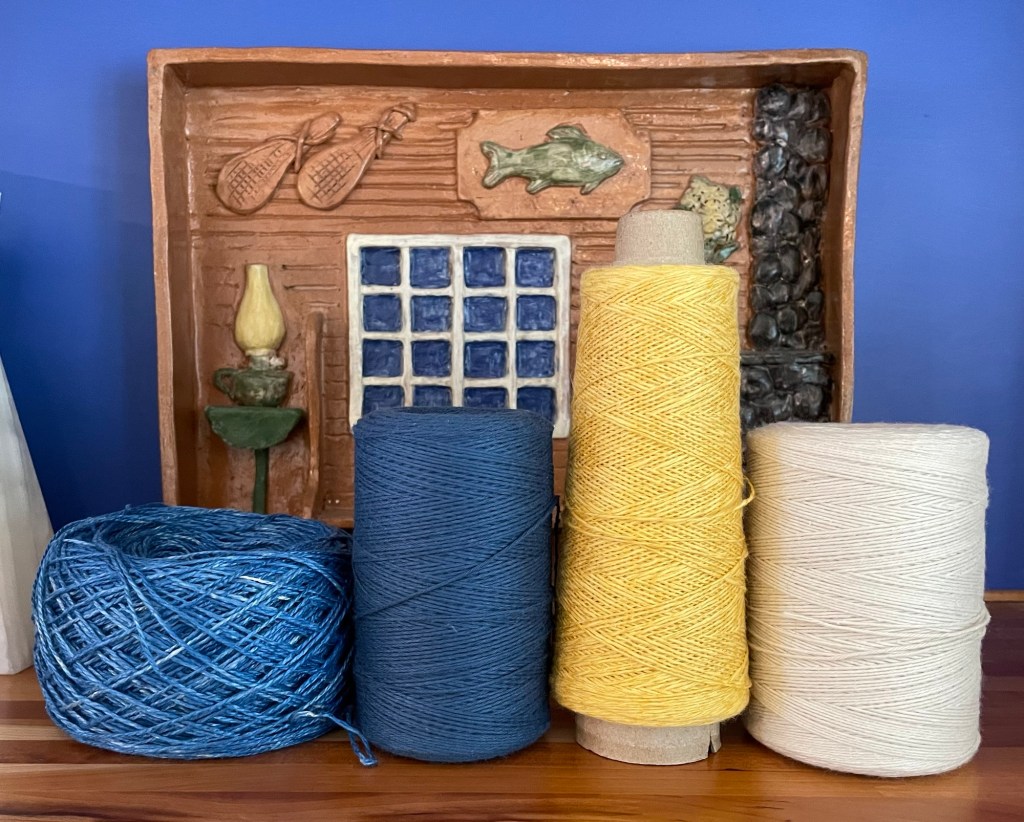
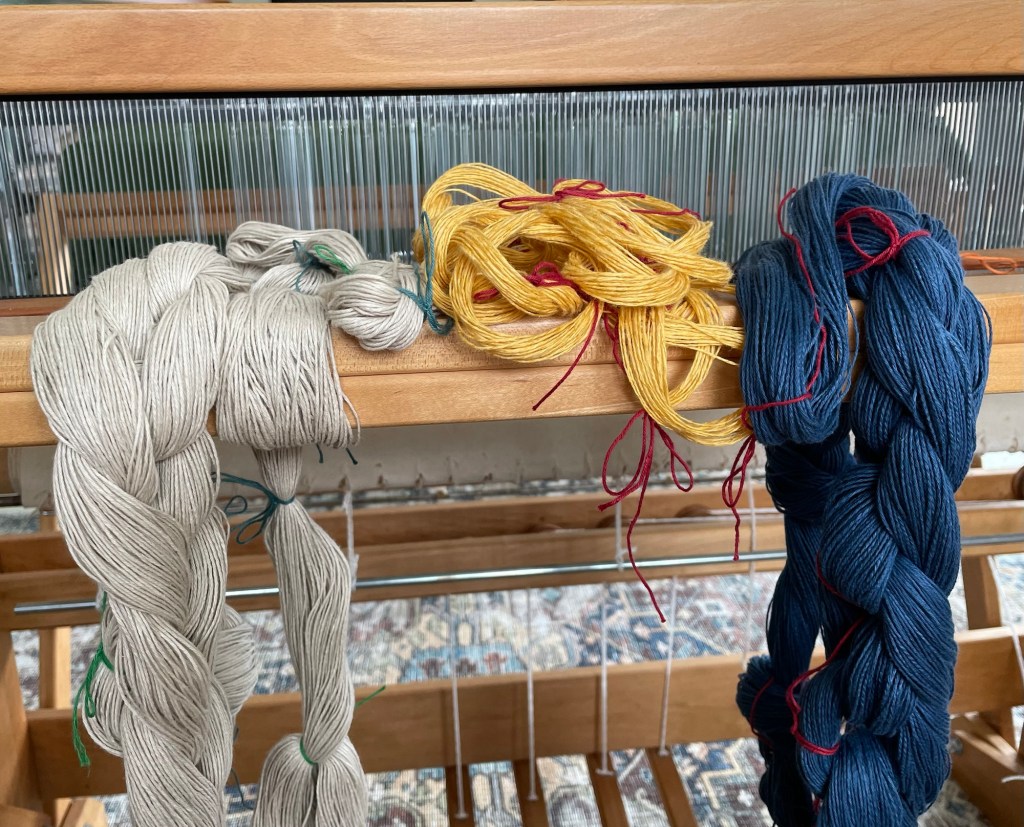
Following is a photo of most of the yarn I assembled to bring to Arizona for weaving towels. The tubes of off white and blue yarn are 100% 8/4 cotton. The rest is the hand dyed 100% linen in several colors.

Yarn for weaving towels

The linen is harder to work with than cotton because it has no elasticity. It is recommended to use for weft only. It is stiff but softens up after being washed. I made a small sample of plain weave with the natural color cotton warp and red linen weft, to see how I would like the feel and the interaction of the colors.

With the tiny sample loom I have a hard time packing the weft rows so they are not too tight or too loose, and not either drawing in too much on the sides or not enough. As expected it shrunk and tightened up after washing. It felt nice, but I thought maybe it needed some vertical stripes.

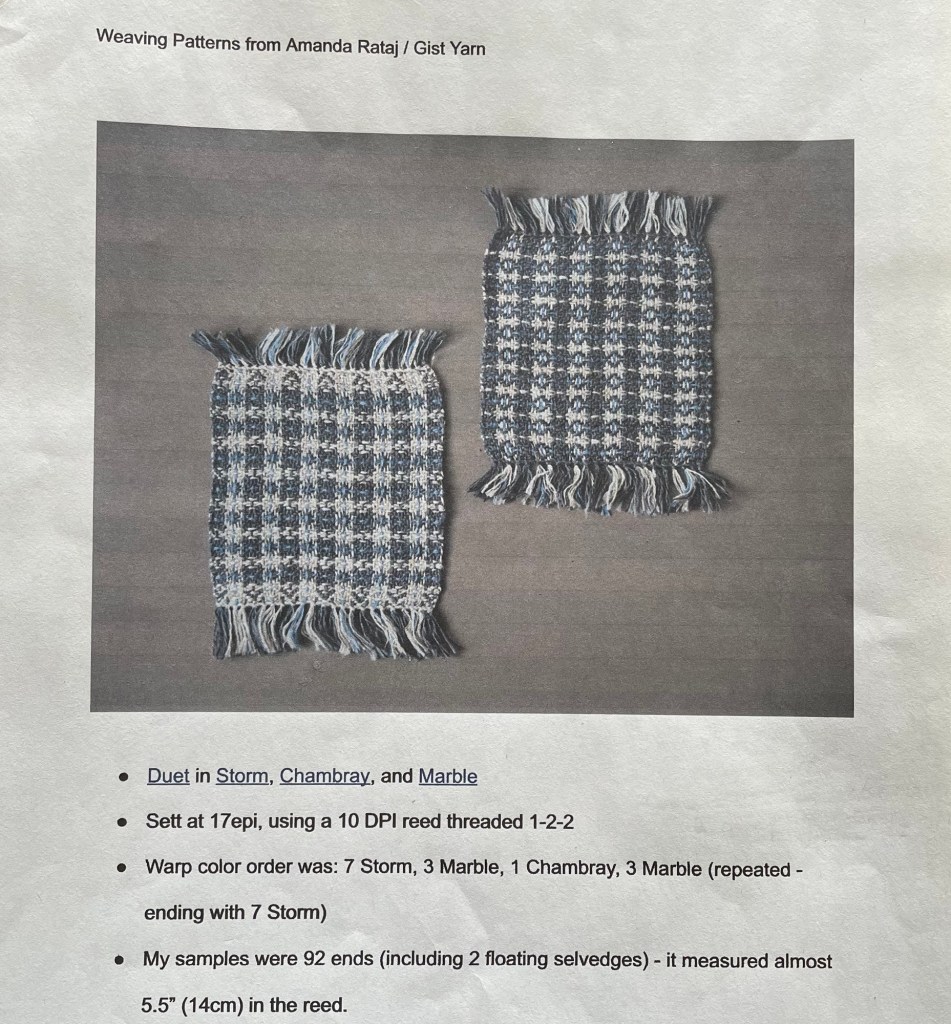
The red linen was not good for warp stripes, but I had some Gist Duet cotton/linen blend yarn in a different shade of red. In order to figure out if the colors worked OK together, I made another sample using some of the Duet yarn in the warp. The Duet has some elasticity due having cotton blended with linen. I used it for vertical stripes placed evenly throughout the warp, but not on the edges. I only put in enough rows in the sample to get an idea what it would look like, so it is quite small. The weft yarn is too loose on the sides, but I did not try very hard to get it right as I just wanted to see how to colors worked together.

My very small sample was 3 1/2″ by 1 1/2″ before washing. I did not have any laundry to wash the sample with, so I just swished it in some hot soapy water, dried it with a towel and a blow dryer. After washing and drying it was even smaller, but it was enough to know that I could use this combination of yarns for my towel project.

Red Duet cotton/linen yarn, off white cotton yarn, red linen yarn with my small sample

I reserved a common room in the community building at our RV Resort, so I would have enough space for warping the towels project. My sister-in-law Marlene, and our friend Jane, worked on painting projects while I worked on warping my loom. Following is a photo of the yarn for my project, in front of the beginning of Marlene’s painting. Marlene is a good artist. I am comfortable with knitting and weaving, but not painting. How do you know when a painting is done? The painting in the photo below could be done if you wanted an abstract look, but it was only the beginning done in water color. Marlene had brought pastels to add to the painting.

Getting ready to warp the loom. My yarn looks nice next to the beginning of Marlene’s painting

In the following photo, Marlene is working on her painting using a photo as a guide, but making it her own.

Jane started out working on a watercolor painting, but gave up and instead worked on a crochet hair tie.

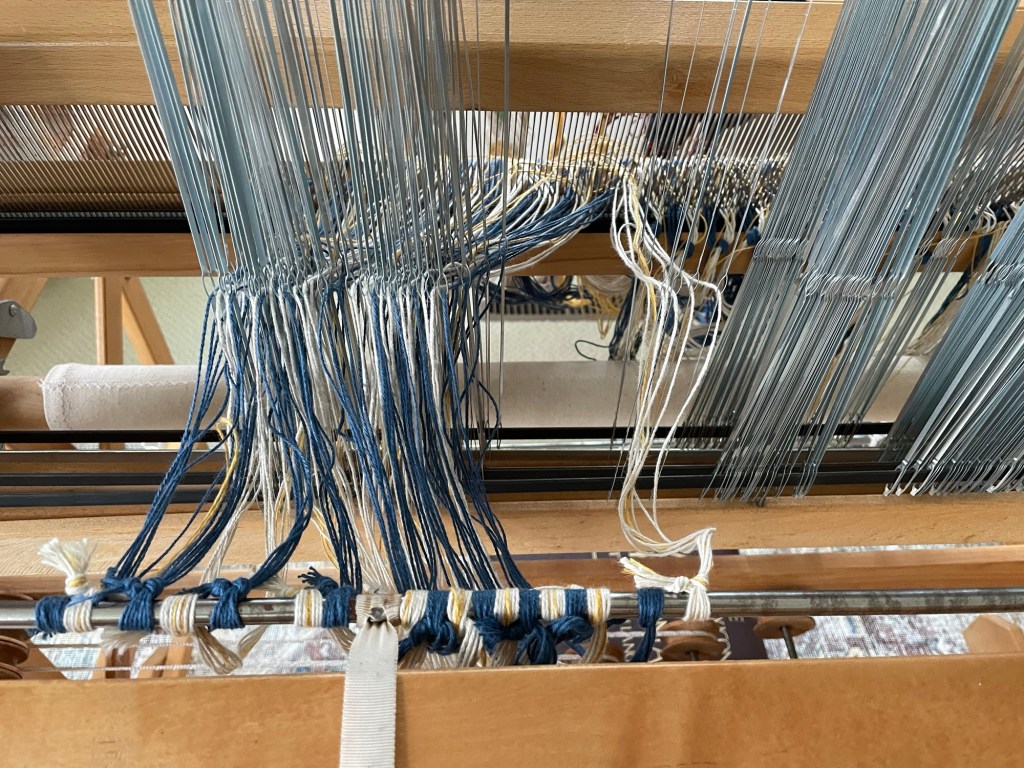
Following is me warping my rigid heddle loom with the natural cotton and red Duet cotton/linen blend.

Ready to roll the warp yarn around the back beam

I am pretty comfortable using my rigid heddle loom, having learned from my weaving mentor in Fergus Falls, Torri Hanna. There are many online sources of instruction, patterns, and tips for improving your weaving results. Before working on this current project, I watched a 12 lesson School of Sweet Georgia class called Rigid Heddle Weaving Basics. I was not sure if I would learn anything new, but I did and am very glad I watched the class.

Ready to tie the front warp ends to the apron bar

After the project was warped on the loom, I could work on the weaving part back in our RV. I used the red linen for every weft row.

I had been stressing about the different shades of red yarn for this project. It ended up looking good, partly because the red linen has periodic bits of natural and lighter red where the skein of yarn was tied together during the dying process.

The sections of red linen weft yarn with variations of color, or lack of color, are evident in the following photo.

There was not enough of the red linen yarn to make the second towel the same (so I thought), so I decided to go with weft stripes of natural cotton alternating with the red linen. After about 12 inches of weaving the second towel, I could see the end of the warp. WHAT? I thought I measured out enough warp yarn for two 28″ towels. After reviewing my notes I realized that I calculated the total warp length needed for only one towel.

I ran out of warp yarn after 12″ of the second towel

Following is a photo of both towels after removing them from the loom, but before washing.

I was concerned about the red from my hand dyed yarn bleeding all over my laundry if I washed it with a regular load, like I usually do. I rinsed the two towels out in the sink with some hot water and soap first, which did result in red dye rinsing out. After I did not see any more red in the water, I washed and dried them in the washing machine and dryer. It looks a bit like some of the red dye changed the color of the off white to a slight pink color on the towel with vertical stripes, but it might be just the way the colors interact together.

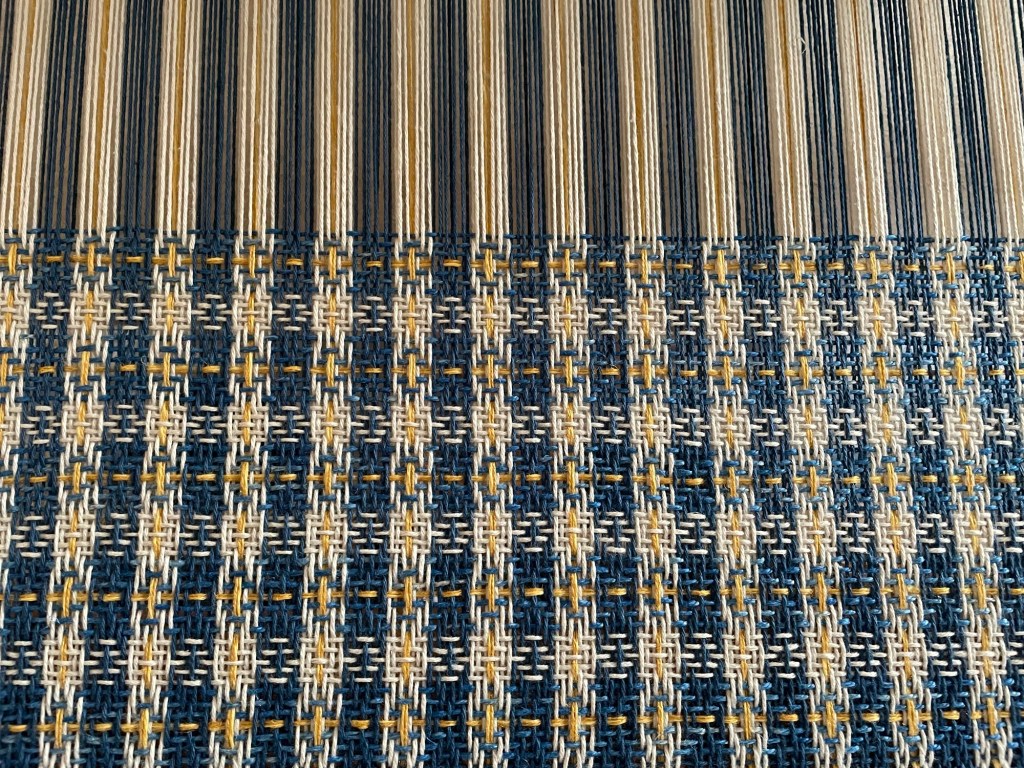
After weaving in ends, washing, drying and ironing, the towels looked and felt nice. I like the texture. I like the plaid pattern better, so bummer it is so small. It will have to be a napkin or fingertip towel.

People compliment me on my knitting and weaving skill, and ability to work on very detailed projects. However there was a time when I was knitting garter stitch scarves just like all beginning knitters. And I was very intimidated by weaving before I actually tried it. It has taken a long time to progress gradually to where I am now, and there are many people who are much more advanced in their skill in spinning, knitting, and weaving. If you want to learn these crafts, please do not give up. You can do it! On the other hand, it is a good thing that there are people who can paint or do other activities that are not in my skill set. We need what everyone has to offer. Marlene’s painting of the Superstition Mountains near our RV Resort turned out beautifully! I am going to get a print of it for our house.

Painting of the Superstition Mountains by Marlene Maloney

And lastly is a close up photo of the completed woven towels. I am going to make another set with the blue, yellow and white cotton and hand dyed linen yarns. I will make sure to measure the warp length correctly!

Tablet Woven Shoelaces

I have more knitting, spinning and weaving project ideas in my head than I can keep up with. The possibilities are infinite, there is always something new to learn or try.

I had heard of something called tablet weaving or card weaving. It had not sparked my interest…until I saw a photo and pattern for shoelaces made with tablet weaving. After that I was intrigued and wanted to try it. They looked practical and unique, and something you could give as a gift. Who doesn’t want a hand woven pair of shoelaces to match their shoes? I decided it would be a fun thing to try and a good project to work on in Arizona.

Tablet weaving is a very old craft where a set of cards with holes in them are used to weave bands and straps. It goes back thousands of years and has been practiced in many parts of the world including China, Turkey, Africa, Burma, Bulgaria, Yogoslavia, Greece, Iceland, Persia, France, and Scandinavia. Although not hard to learn, it can produce complex patterns. Following are some photos of old tablet weaving finds, from the book “Card Weaving” by Candace Crockett. The first one is of a “complete loom with fifty-two wooden tablets, found in the tomb of Queen Asa….part of the Oseberg ship find from A.D. 850 (Norway)”.

The next photos shows sections of a tablet woven band from sixth century Snartemo, Norway.

Last historical photo from the same book is of a “French ecclesiastical card weaving from the twelfth century”.

I liked the fact that tablet weaving can be done with minimal investment. The only mandatory tools needed are the cards and some yarn. You can make a set of cards yourself using supplies you probably have on hand, so it is possible to experiment without spending any money. Ideally you also have a small shuttle for weaving the weft yarn back and forth, but you can make one with cardboard, or just make a figure 8 with warp yarn and not use a shuttle at all. The shuttle is also used to beat the weft yarn, but if you do not have a shuttle you can use a ruler or the rounded edge of a table knife.

I like to have the right equipment, but I also did not want to spend very much money just to try tablet weaving. I bought a set of cards, a small used shuttle, and a book, which would be enough to get me started without a big investment.

Tools for card weaving

As with all types of weaving, the warp yarn must be under tension while you are working. There are small looms designed for tablet weaving, or other ways to anchor both ends of the weaving. Blackstrap weaving works well for this, where one end is tied to a doorknob or something stationary, and the end you are working on is tied to your waist. I also thought I could use my rigid heddle loom with the reed removed. It would not be too hard to make card weaving loom yourself using information online.

I watched quite a few videos on You Tube and read the detailed instructions in the book until I understood the basic idea. The instructions said to number the cards with a pencil to keep them in the right order. OK then why don’t the cards come with numbers already printed on them? I guess you might want to use card number one in a different position on the different project.

Following is a copy of the free shoelace pattern I came across online, probably on Pinterest. I have since learned that John Mullarkey is an expert in tablet weaving. He teaches and has published books on the subject.

I started this adventure with a practice project using 30″ long waste warp yarn ends from my cottolin towels project (click here for that post), so I could figure out how it works before beginning the shoelaces. After threading the yarn ends through the cards I tied one end on to a ring and made a knot in the other end, to prepare for weaving using the backstrap method.

Ready to practice tablet weaving

I put the ring over the warping peg from my rigid heddle loom, connected the other end to a belt on my waist, and I was ready to go. 

Tablet weaving with the backstrap method

Not surprisingly I made some mistakes when trying to follow the pattern, so I was glad I did not jump right in with the shoelace yarn. It is not a hard pattern, but I was trying to think about many new things and also getting distracted. You can see in the photo below where some of the rows near the beginning are different than the rest after that. None of it matches the photo on the pattern and it is too wide for a shoelace. The rubber band is used to keep the cards in the right order and orientation when taking a break from the project.

My first inches of tablet weaving had mistakes and did not look like the pattern

After awhile I figured out that the second half of the cards were threaded from the wrong direction. That resulted in the pattern that I was getting, rather than the one I was trying to make. Due to the short warp threads it was easy to re-thread the cards the right direction, and then I got the pattern that looked like the photo on the directions. My finished work got narrower towards the end as I pulled the weft threads tighter, and then I ran out of yarn. Not too bad for a first try by myself.

First attempt at tablet weaving

The weaving is warp faced, which means that the pattern you see is all warp yarn, other than at the sides. You actually cannot see the weft yarn at all except at the edges. The pattern is formed by the warp yarns getting twisted around each other as the cards are turned forwards or backwards. The weaving is very dense so when you have to start a new length of weft yarn you can overlap it in the same shed, and then just cut off the ends even with the edge. This is great as I do not enjoy weaving in ends.

After weaving the sample, I felt comfortable what I was doing. For the real shoelaces project I had two colors of 10/2 mercerized cotton in 1.5 ounce cones from Lunatic Fringe Yarns. Most of the places where I saw this yarn sold it only came in larger quantities, so I was happy to find these smaller cones. I had measured out the yarn for one pair of shoelaces at home, and packed it in with my supplies for Arizona.

10/2 mercerized cotton for shoelaces
Yarn measured out for shoelaces

After threading the warp yarn through the cards (correctly this time) I tied the ends of the warp yarn on to the back of my rigid heddle loom, to see how that would work as opposed to the backstrap method. There are ways to keep the long lengths of warp yarn orderly but I did not do any of them, so my yarn was a mess. The double pointed knitting needle through the cards was another way to keep them in order while I worked getting everything set up.

It took awhile to untangle the warp yarn, allowing the cards to slide freely.

Untangling the warp yarn

After the yarn was in order I would it around the back beam with paper, and then tied the other ends to the front apron bar. The cards were in the middle where the reed would normally be for a rigid heddle weaving project.

Warped and ready to begin card weaving project

The pattern is formed as the cards are rotated forward or backwards as a group, twisting the warp yarns around each other. Each time you rotate the cards, the warp yarns are twisted at the back too. The pattern I was making had four rotations forward causing the yarn at the back to be all twisted up, followed by four rotations backward, untwisting the yarns at the back. Following is a photo of the back beam after the four forward turns. If you kept on rotating forward without any backward turns, it would keep getting more and more twisted. If necessary it would be possible to unwind the threads at the back and untwist them.

Yarn twisted behind the weaving after four turns in the same direction

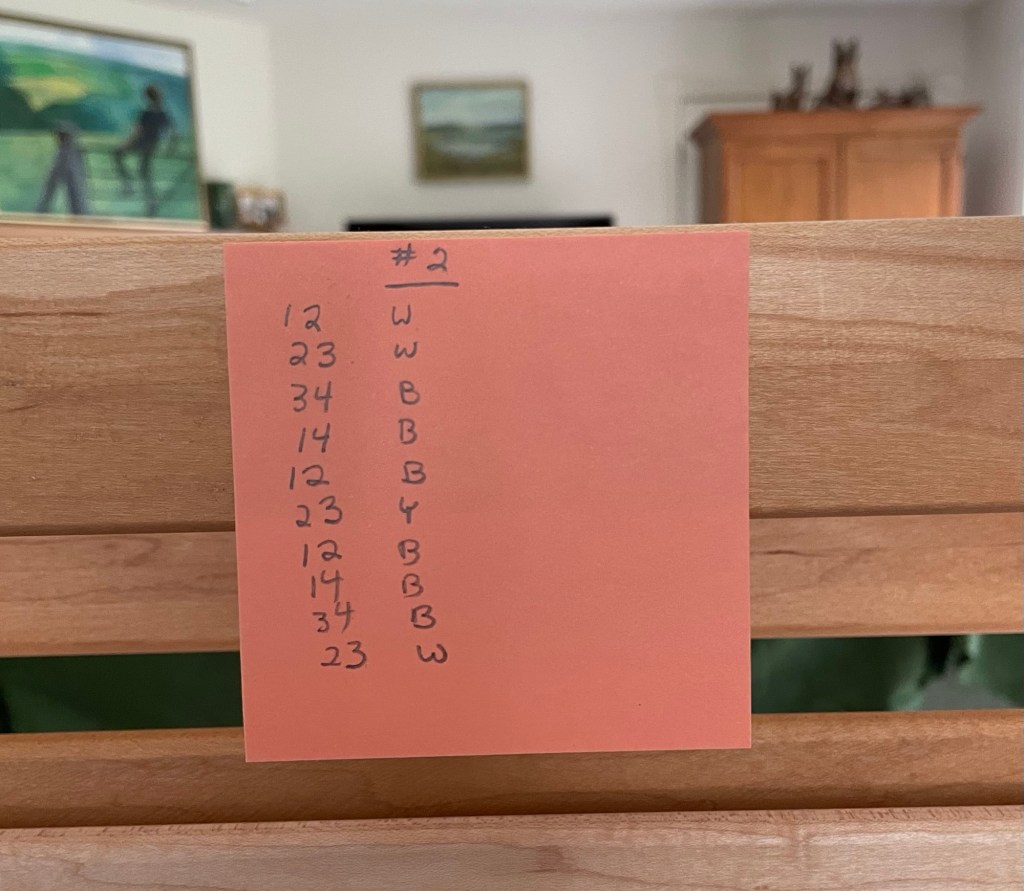
I used a post-it note to keep track of where I was in the pattern.

After a few inches of weaving while pulling the weft yarn tight on each pass across, the width was the way it was supposed to be.

Following are photos at the end of the weaving, with the completed part at the beginning rolled up on the front apron bar and the other end completely unwound.

After weaving as much as I could, I cut it off the loom.

I had to start a new weft yarn once, but no weaving in of ends! It is packed so tight the ends can be cut off flush with the side. There are two spots where a warp yarn is crossed over, I must have put the weft yarn through from the wrong direction.

Section of weaving where I started a new length of warp yarn, and showing 2 weft yarn mistakes

The finished usable length of the first shoelace was 64”. My sneakers shoelaces are 45″ long including the tips. If had measured my shoelaces before I started the project, I could have woven a shorter length but oh well.

Weaving shoelaces is like knitting socks one at a time. After finishing the first shoelace, I had to start over and make the other one. I wonder if you could make two at a time. The second one went faster and came out a bit longer at 67″.

Weaving finished for both shoelaces

This pattern could also be used for making a lanyard or eyeglasses strap, a bracelet, or a necklace to hold a chunky pendant.

The shoelaces need “aglets” on the ends, the tips that allow the lace to fit through the holes. Real ones are available for sale online, or the end can be wrapped with tape. Being that I was trying to minimize expenses on this project, I decided to make my own aglets with packing tape. I found the following article online with instructions https://www.wikihow.com/Make-Aglets.

Making my own aglets with packing tape
Aglets made with packing tape

I had 16″ and 13″ long pieces left after cutting off what I did not need for the shoelaces. It could be used for a keychain, a bracelet, or something else. I liked using my rigid heddle loom better than the backstrap method, the weaving stayed in place more effectively.

I was very pleased with the result after threading the new shoelaces on my sneakers. Everyone says “wow, the colors look good with your shoes”. Yes, I specifically picked out the colors because they match my shoes!

Not sure when I will do another tablet weaving project. I am already on to my next rigid heddle weaving project of dish towels using cotton, cotton/linen blend yarn, and 100% linen yarn that I dyed myself.

Silk Hankies and a Scarf

Last summer there was a Fiber Arts Festival in Fargo. I did not need any more knitting, spinning or weaving yarn, supplies, or accessories, and it was an hour drive one way to get there. Of course I wanted to go. A knitter friend visiting that weekend was more than happy to join me. There were the usual assortment of vendors with hand spun yarn, commercial yarn, fleeces, roving, baskets, knitting patterns, knitting accessories, and many other related products. I had seen some of the vendors before at other fiber fairs, many were new to me.

After circling around the large room twice to check out all the offerings and watch some demonstrations, I decided on two things to buy. I fell in love with some silk/wool/linen blend Malabrigo yarn in a muted dark purple shade. I didn’t know what I would do with it at the time, but being only one skein it would likely be part of a project with multiple yarns.

Malabrigo wool/silk/linen blend yarn

I also bought some hand dyed silk hankies. One silk hankie is actual silk from a silk cocoon flattened out into a very thin square. They are usually sold in layers of multiple hankies hand dyed together. I bought two “stacks” of hankies in different colorways. One was darker with purple and some blues and greens and a bit of yellow. The other one was lighter with some purple and more yellow and lighter blues. I thought the two colorways looked good together. I was planning on spinning them into yarn, but they can also be used in felting projects. To use the silk hankies a single layer, or a couple of layers, are separated from the rest. Following is a photo of the two stacks of silk hankies I bought, along with one layer from the lighter colorway stretched out ready to spin.

Silk Hankies in two hand dyed colorways

You can see in the next photo that the outside edge of each layer has a sort of ridge to hold on to in order to peel it apart from the rest.

Silk Hankies

In the following photo one layer of the lighter colorway is separated from the rest. Or it might be two layers. An individual layer is very very thin.

One or two layers separated from the rest

I worked on spinning the silk hankies at Fall Fiber Day at Northcroft Farm in Pelican Rapids, Minnesota. To spin a hankie, a layer (or more then one) is separated from the rest, a hole is poked in the middle, and then it is stretched out until it is the width desired for your yarn. The silk can be knit like that, but I wanted to spin it.

Peeling off a layer or two

I did not get any photos of the actual spinning, but following are the two bobbins of singles yarn I got, one from each colorway of the silk hankies.

One bobbin from each silk hankie colorway

I plied the two singles together. The bobbin with the darker color had more length than the other one so part of it did not get plied. I went ahead and wound it all into a skein including the two ply yarn and the singles yarn.

One skein of silk hankie yarn with both plied and singles yarn

While here in Arizona I did an excellent virtual School of Sweet Georgia class on spinning (click here to check it out). Even though I do not have my spinning wheel here, I learned a lot, including a couple of ways of plying that can be done with one length of singles yarn (as opposed to my usual method of having two bobbins). If I had had that information when I was still at home with my spinning wheel, I might have plied that extra length of dark purple singles into two play yarn. When I get back home I plan to watch the School of Sweet Georgia spinning class again when I can practice on my spinning wheel what is being presented.

As it turns out, I decided to use the silk hankie singles yarn in a project here in Arizona, so I separated the plied silk yarn from the singles part and then rolled them into balls.

The two ply yarn silk yarn separated from the singles yarn
The singles and plied silk hankie yarn rolled into balls

When we were in the Bay Area of California over Thanksgiving I bought a skein of 100% Mulberry Silk Malabrigo brand yarn. I knew it would go nicely with the darker Malabrigo yarn I had bought at the Fiber Fair over the summer.

100% Mulberry Silk Malabrigo yarn

In December when we were preparing for our three months in Arizona, one of my tasks was figuring out what projects I wanted to work on there, and accordingly what yarn and patterns to bring. I had an idea for a scarf using a hybrid of two patterns with the purplish yarns including the two Malabrigo yarns and the silk hankie yarn.

Yarns to use together in a project

The first pattern, Scarf in Sunset, is a shallow triangle with increases at each end every row. It is available for free on Ravelry, click here for the pattern.

The second pattern that I got from my mother’s cousin Mary Turak is called a “Slide Scarf”, using two different yarns. It is a good pattern if you have a limited amount of some handspun yarn that is not enough by itself to make something. The copy I have is in her handwriting, so I don’t know if she made it up or where she got it from. It starts like a basic scarf knitting every row flat on circular needles, but two yarns are alternated every row. When you get to the end of every other row the working yarn is at the other end, so you “slide” the yarn across to the other end of the circular needle and knit from there. The result is it looks like you are alternating stockinette stitch with garter stitch. It looks best if a larger needle size is used than you might normally use for the yarn, but it can be whatever you want as far as how wide and how loose.

Slide Scarf pattern from Mary Turak

I assembled the purplish merino, linen and silk yarns that I wanted to use in the project, including the two Malabrigo yarns and the small amount of the silk hankie singles that I had spun. I did not use the plied silk hankie yarn. I followed the shallow triangle pattern with the increases at the end of every row, but also alternated between two yarns every row, sliding the yarn when needed. I held the silk hankie singles yarn together with the darker merino/linen/silk yarn for the first yarn, and used the 100% silk Malabrigo yarn for the second yarn.

I cast on for the scarf using size five needles, which was bigger than recommended for both of the commercial yarns. After a few rows it seemed too dense, so I started over with size six. After getting about as far as in the photo below, I decided that was still too dense. I did not feel like starting over again, but I changed to size eight and continued on.

In the middle of this project we went to an art fair in Gold Canyon, Arizona, where I bought an up-cycled cowboy boot bag. Most of the cowboy boot bags were narrower and taller, the right size for a wine bottle carrier. I liked the wider shape of the one I bought for use as a knitting project bag. It is a functional wild west conversation piece!

Upcycled cowboy boot bag from an art fair

The scarf knitting went pretty fast, and I had to change to a longer cord after a short time as the scarf got wider. You can tell where I used the smaller needles at the beginning. Ideally I would have started over rather than changing needle size mid project, but I don’t think it will be noticeable when the scarf is on my neck and all bunched up.

I liked this project because it was easy enough to work on while watching TV, or while listening to a School of Sweet Georgia class, which I have been doing a lot of. I also loved the blending of different colors in the yarns that varied with each stitch.

Watching a School of Sweet Georgia class while knitting

After a few inches I realized I was going to run out of the silk hankie yarn way before the end of the scarf, although that was obvious even before I started knitting. It would look funny if it just stopped in the middle of the scarf, so I started using it every other time I knitted with the darker yarn for a few inches, then even less often. I am not sure anyone will even be able to tell it is there at all due to the variegated colors in the yarns. Even the darker yarn that seems like all one color actually has some variation that I noticed as I was knitting with it.

Scarf in progress

The next photo shows the project up close after completing a row using the silk hankie singles yarn held together with the Malabrigo merino/silk/linen yarn.

Closeup showing the silk hankie yarn held together with the commercial yarn

After it seemed big enough for what I had in mind I cast off the long edge, although there was enough yarn to make it larger. The two sides of the triangle looked different and raggedy, so I did a single crochet border all the way around that gave it some shape and consistency.

Crocheting a border around the entire edge

I blocked the scarf by steaming it gently, using an iron with a linen dish towel for a pressing cloth, in the laundry room of the RV Resort.

Blocked with steam using a pressing cloth and an iron

Following is a photo of the completed scarf rolled up like a Crescent, with the leftover yarn.

Rolled up like a crescent with the leftover yarn

The scarf can be worn multiple ways. It can be wrapped with the tails tucked in like a cowl, or with the tails hanging down. It could also have the tails hanging one in the front and one in the back, or however one wants.

It would be interesting to compare a woven scarf using the same yarns to the knitted scarf, but alas there is not enough yarn. The leftover yarn may end up combined with something else in a woven scarf in the future.

School of Sweet Georgia Socks

I started knitting a pair of socks in December, to bring on our post holiday road trip to Arizona. It was so unseasonably mild at that time in Minnesota that it barely felt like winter. It was 55 degrees on Christmas Day. Some of the bigger lakes in Minneapolis were open water over the holidays which is unheard of. I saw an article on my google feed describing “Five Lakes in Minnesota that Freeze Over in the Winter”, or something like that. Hello, in a normal winter ALL of the 10,000 lakes freeze over solid. This year has been very strange.

I used Valley Yarns Huntington 75% Superwash Merino Wool / 25% Nylon yarn in the colorway North Sea for this pair of socks. I thought it was thicker than the Up North Yarn used in my last sock project. Note to self, always knit a swatch before starting a project.

Yarn for green socks

I cast on the green socks and knitted the toe with size 2 magic loop needles, increasing until I got to 60 stitches, the same as the Up North Yarn socks but with one size bigger needles. Although the Up North socks fit very well they are straining a bit at the heel diagonal. For that pair I had added a few stitches before working the Fish Lips Kiss short row heel in order to increase the heel diagonal, but not in any scientific way. I had figured that if the green yarn was a bit thicker, knitted with the same number of stitches on size 2 instead of size 1 needles, the socks would be just a little bigger around.

The gauge for the green yarn is a mystery. After completing the toe and knitting a few inches of foot they seemed the same circumference as the last pair that were on smaller needles. I do not get how that can be. The label on the green yarn says that the 50 gram ball is 218 yards. I realized that The Up North Yarn was also a 50 gram ball, with 219 yards. That would imply it is very similar, so not sure why the the larger needle size and fewer stitches per inch is suggested for the green yarn.

Toes complete

After a week in the Twin Cities over the holidays, we had only two days before leaving for Arizona. That included putting some Christmas decorations back in the basement, because I did not want to see them all over the main floor when we got back home in April. I had done a lot of preparation earlier, so it was doable. On the day of departure Wayne backed the truck up and connected to the RV hitch on the first try. Woohoo! It was a pretty morning about 25 degrees. The first time we did this in January 2022 it was zero degrees, there were many attempts, and it took a long time.

Getting ready to back the truck up to the RV
Ready to head out

If we are in our car on a road trip I do some of the driving. When we are towing the RV Wayne does all the driving. That is fine with me as I have more time for knitting. I continued working on the sock foot while we were on the road.

Knitting in the truck

In recent months I had been following social media posts and watching YouTube videos from Sweet Georgia Yarns (a hand dyed yarn company) and the School of Sweet Georgia (a membership based school and community for multicraftual makers). They have online learning for knitting, weaving, spinning, dying, and other related crafts, patterns, and ways for members to share their projects, questions, ideas and journey. I saw a Sweet Georgia video about Circular Sock Knitting Machines. I have been intrigued by vintage circular sock machines for a long time, but now my eyes were opened to a world of new machines that are amazing things. There are people who get together to “crank”. Haha that is what it is called. I really want one of these machines but they cost anywhere from $800 to multiple thousands of dollars and they have a steep learning curve.

I am continuing to enjoy knitting socks and learning different patterns and methods of making them fit better. I would like to be able to make more pairs of socks for gifts but it takes me forever to knit the foot and the cuff. I like the idea of cranking out a pair of socks in one hour! There are ways to make the entire sock using the machine, or you can just crank a tube and knit the sock and heel manually. I have so many questions about how it works and how you can customize sock sizes. I cannot justify buying a CSM now (or probably ever), plus I do not have the bandwidth to learn another thing right now. There are “crank-ins” where people get together to crank, so I may try to find a group of “crankers” in my area to observe and learn. Following is a photo of a CSM from the website of Dean & Bean’s sock machine company. 

Circular Sock Knitting Machine from Dean & Bean’s (photo from their website)

In December there was a promotion from the School of Sweet Georgia for a two week membership for $1.00. The timing was not ideal since it was the last two weeks of 2023 when I was busy with the holidays and packing for Arizona, but I decided to go for it. I downloaded some patterns that were available to members, and reviewed the list of virtual classes offered.

I found a School of Sweet Georgia class on knitting custom sized toe up socks that included a PDF workbook and videos (click here for a link to the course). I had not gotten very far on the green socks so it was a good opportunity to take advantage of their instructions. I have knitted socks using a similar pattern with a short row heel but this one had a worksheet with calculations using measurements for your foot, along with the specific row and stitch gauge for your yarn. This info is used to determine when to start increases so that the heel diagonal is the right size, how many increases to make, when to start the short row heel, etc.

Continuing the mystery of the green yarn, the measurements and instructions said I should have 64 stitches around for my sock. I had started the socks with 60 stitches, so I went ahead and increased to 64 after already knitting a couple of inches of the foot. On the Up North Socks I had increased 8 stitches near the short row heel to make the heel diagonal wider. That was probably not enough, but this pattern had me increase 20 stitches which sounded like way too many. Note that most patterns using a short row heel or afterthought heel do not include any increases for the heel diagonal.

Following is a photo of the sock instep (the top part) with the increases.

Sock instep (top) with 20 stitches increased before starting the heel

We spent New Year’s Eve on the road in a hotel room watching the Minnesota Vikings football team get creamed by their arch rival, the Green Bay Packers. I should say Wayne watched the game, I worked on the sock project. When traveling with the RV we must eat dinner within walking distance of the hotel, to avoid towing the RV to a crowded restaurant parking lot. In this case there was only one option, Popeyes chicken. We got take out fried chicken and ate it in front of the TV. Not something I would normally choose but at least they had a healthy side choice of rice and beans.

New Year’s Eve take out fried chicken in a hotel room

In order to knit the heel, I transferred one of the socks to double pointed needles so I could knit one heel at a time on the magic loop needles. This pattern uses a short row method with yarnovers. The instructions are very detailed and helpful but there was one place where I was unsure what to do, so I googled to see if there were some tips or help online. When doing short rows you turn your knitting around in the middle of a row, causing your working yarn to be on the left needle instead of the right. The instructions said to do a “reverse yarn over” at this point with the working yarn on the left needle. If you are a knitter you might know what this would look like, but in any case it is an awkward thing to do. I found a conversation online where another person was trying to figure this out too, beginning with “what fresh hell is this?” Haha I understood where she was coming from but I figured it out.

When I got almost done with the first half of the first heel on the magic loop needles, I could tell that something was wrong. I went ahead and knit the heel for the second sock on the double pointed needles. That one came out correctly, so I ripped out the first heel and started over. The next photo shows one heel in progress.

Working on the second half of the heel

We arrived at the RV park on the far east side of the Phoenix metro on the first of January. This is our fifth Snowbird adventure at Gold Canyon RV & Golf Resort, the third time in our fifth wheel trailer. As usual there were some swear words as Wayne got the RV leveled and utilities connected, but it all worked out OK and after a few days everything was organized inside the trailer.

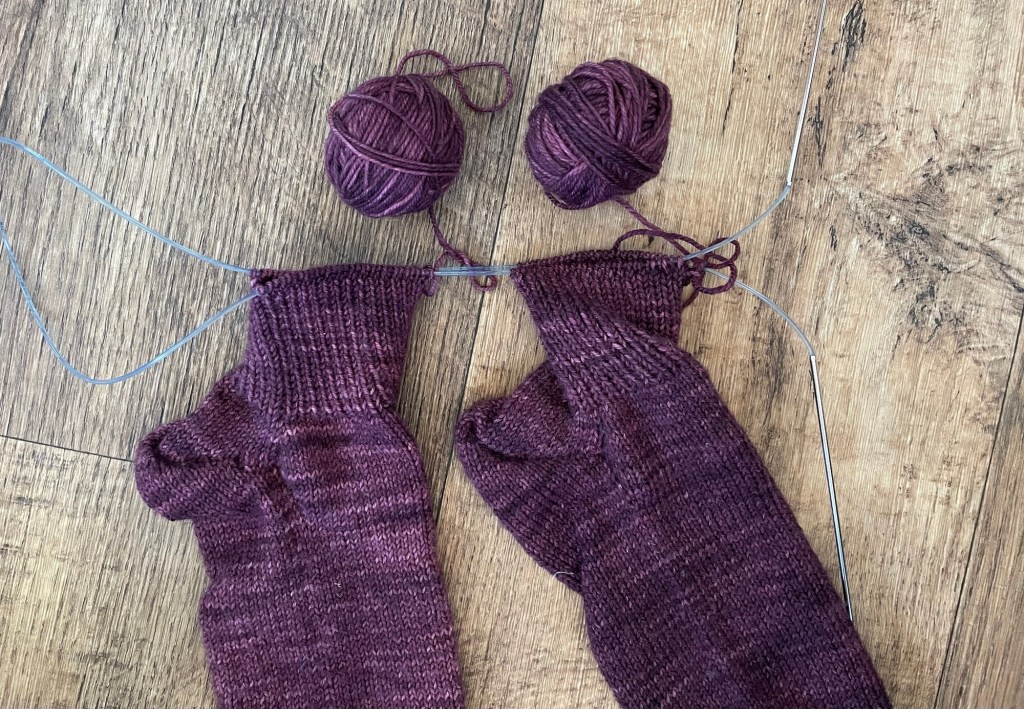
I continued knitting on the socks after we were all settled. After finishing the second heel, I transferred that sock back to the magic loop needles. The next step was decrease rows to get back to the original number of stitches for the cuff.

Heels complete

After the initial two weeks for $1.00 the School of Sweet Georgia charged me $24 for the next month. Wayne has already spent about $250 on golf in the three weeks since we have been here so I guess it is OK for me to spend $24 on a whole month of information and support related to my main activity. The following photo shows the green socks with the cuff in progress.

The School of Sweet Georgia pattern uses a type of bind off that I have not used for socks before. It involves knitting two stitches together, and then knitting the next two stitches together, etc. It is considered to be a stretchy bind off which is what you want for socks. I liked it and will use it again.

Binding off

After I finished the knitting and woven in the ends, I put the green socks in a tub of water to soak with a bit of dish soap along with two other pairs of socks that needed to be hand washed. I also put in some yarn that will be featured in a future post.

Completed green socks in with some other hand washing

This yarn is very soft and fuzzy. It also split regularly and pills a lot. The socks are a little bigger and looser than the Up North Yarn socks. I should have done a sample with a size 1 needle. The fact that the yarn label suggested size 2 or 3 needle threw me off. That is why you are supposed to knit a swatch. Despite all that the finished green socks looked pretty good after laying out flat to dry.

Socks complete using School of Sweet Georgia pattern

The School of Sweet Georgia pattern was very detailed with both video and written instructions. The section with abbreviations had mini instructions for exactly how to do each thing. I really liked the suggested bind off method. There was even detailed information and video on weaving in the ends. Even though my socks came out a bit loose, I will use the pattern again with adjustments for how I like my socks to fit. I recommend checking out the School of Sweet Georgia if you are looking for instruction and community related to knitting, spinning, weaving, etc. The classes are all very thorough and include written transcripts you can download, as well as video instruction, and also forums for discussions and questions. Click here if you want to check it out.

We have had some cool weather here, even getting down to freezing a couple of nights, but we did not complain. At the same time the high temperature back home in west central Minnesota was minus 10. The next photo is me modeling the socks in front of our RV, ready for a bike ride in Gold Canyon.

Modeling my new socks in Gold Canyon

I could keep the socks for myself despite the generous fit, but instead I will give them to my daughter. Her feet are the same length as mine but wider and I know she will be happy to have them.

Knitted Baby Shoes

Many years ago I came across a book called “50 baby bootees to knit” by Zoe Mellor. I had to have it. I did not have any babies to knit for at the time, but the booties were just so cute and I liked the idea of a project that would not take too long or use very much yarn. I knit one pair for a shower gift, and then the book when on a shelf for about 15 years.

One problem with knitting pattern books is that usually there are only a couple of patterns that I would actually make. In this case, in addition to the many booties in the book I would not make, I realized that I generally don’t like projects that involve more time on assembly than actual knitting. Nowadays I get most of my patterns on Ravelry. Almost all knitting and crochet patterns are available there, it is easy to search for a pattern when you have something in mind, you can see photos of things people made with each pattern, and you can buy the specific pattern you want. Many patterns offered for free.

In the fall of 2022 after I found out that we would be having a grandchild, I dug the book out again and picked out a pattern to work on in Arizona last winter. I had some Rowen 4-ply cotton yarn in my stash. Many of the booties in the book are variations of one basic pattern that is knitted flat, as you can see in the photo below. The two sides of the heel are joined, and then the upper part of the bootie is sewed on to the sole, with some gathering at the toe. It did not take very long, but had too much assembling for my taste.

One bootie knitted flat
One of two booties assembled

The next photo shows the sole of the booties after sewing the top on to the bottom.

Bottom side of the booties

I don’t remember what size I made, but I believe it was not the smallest or largest size. I had no concept of what size a baby’s feet are. I did not know how old the grandchild would be when they fit her. They are like tiny Mary Jane shoes.

Booties complete

Following are photos of the knitted shoes on our granddaughter Blair’s feet in November, when she was about five months old. They were the right width, but too long.

When I was a baby my mom knitted and sewed clothes for me. I have a few of these items, including a purple dress with a yoke that she smocked herself. When our daughter Britta was an infant, I remember wanting to get a picture of her wearing the purple dress, but I don’t think it happened or in any case I cannot find a photo.

Dress my mom sewed and smocked for me when I was a baby

When Britta was a baby, Wayne’s sister and brother-in-law gave us a small wooden rocking chair with her initials, BEH, carved in it. Wayne found the chair this fall and noticed that if he filled in the bottom of the “E”, changing it to an “F”, it would now have Blair’s initials. We brought the chair with us to St. Paul to our son and daughter-in-law’s house for Christmas. Their dog immediately chewed on one of the armrests.

Chair with the middle initial changed from E to F

Blair was pretty proud of herself sitting in the little rocking chair.

While we were there at Christmastime I also got a photo of Blair wearing the purple dress and the booties, while sitting in the rocking chair. The wet spot on one side is where she stuffed a wad of dress in her mouth. Usually Blair is wearing something more practical, and everything is so casual these days, I don’t know if she will ever wear the dress again.

I am glad I got some photos, but also a little sad that my mom is no longer with us to see her great granddaughter wearing the dress she made about 65 years ago.

Knitted Holiday Ornaments

We had a week of quality time with family in the Bay Area of California over Thanksgiving. Wayne’s sister Yvonne, and brother-in-law Gayle, were very generous hosting us at their home in Alameda. Our son and daughter-in-law, James and Kelsey, came too, bringing their five month old daughter on her first plane ride. It was a full house with our niece and her boyfriend home for the holiday. We were able to spend quite a bit of time with our daughter Britta, and her boyfriend Isaac, who live nearby in Oakland. It was a good blend of fun outings and just hanging out.

My project for this trip was a set of knitted Christmas ornaments. I used a pattern called “Fancy Balls Ornaments” from Tin Can Knits. The link for the pattern on Ravelry is here. They are similar to the Arne & Carlos knitted balls (see my blog post here), but work up faster due to fewer stitches around and less complicated designs.

I had some Norwegian Rauma Finullgarn fingering weight wool yarn in my stash that was perfect for this project.

Norwegian wool yarn for knitted ornaments

I started the first ornament while on the flight from Minneapolis. The pattern has you start by casting on four stitches in the round. That is very slippery and it is hard to keep the double pointed needles facing the right way and not sliding out. I was trying very hard not to drop a needle on the floor of the airplane in which case I might never find it. The man sitting across the aisle was surprised that the airline let me take the knitting needles through security. I almost always bring a knitting project on a plane trip, and so far it has never been a problem.

Beginning of knitted ornament

I got about 2/3 done with one ornament on the plane, when you are supposed to turn it inside out to weave in the ends and then put in some stuffing. I did not have anything to stuff it with so I had to stop.

Ornament 2/3 done, turned inside out to weave in ends before adding stuffing

Later when we were at Yvonne and Gayle’s house, Yvonne had a big wad of dryer lint from a new cotton blanket that she had washed. I was able to use that and finish the ornament at their house.

The pattern has equal numbers of increases at the beginning to the number of decreases at the end, but for some reason it came out pointier on the top half. Wayne said it was shaped like one of the holiday gnomes that are all over these days. The gnome in the photo below with my completed ornament belonged to my mother-in-law. Yvonne refurbished it and has it on display in her house.

Completed ornament

I started a second ornament, but I did not really do much knitting on this trip, so I did not finish it until we got back home. My goal when bringing a knitting project on a trip is to make sure that when there is some down time I have something to do, not necessarily to get a lot done.

Instead of knitting, other things I did on this trip included walks through the neighborhood, watching football games, working on a puzzle, and hiking with our kids on the Tennessee Valley Trail to a beach. No we were not in Tennessee. You can click here for a link to the Tennessee Valley area of Golden Gate National Recreation Area. Following is a photo of Isaac, Britta, Kelsey with Blair, and James at the beach we hiked to.

We had an afternoon adventure with Britta and Isaac driving south to Santa Cruz. As we were driving along the coast we saw massively big waves. Isaac has lived in Oakland most of his life and said he had never seen waves that big. We ended up pulling over to a place where we could park and get out of the car. Britta and Isaac walked way out on some rocks which of course made us very nervous. A park ranger came by to warn us about “Sleeper Waves”, which are random even bigger waves. In Santa Cruz we went on a scenic walk along a path high up above the coast, ate tacos for lunch, and got ice cream cones before it was time to drive back to Alameda. Following is a photo of the giant waves crashing again the rocks, with Britta and Isaac getting a little too far out for our comfort.

Ginormous waves
On the beach near Santa Cruz, CA

Another activity we did was go to Reboot Float and Cryo Spa where our daughter works. We are not normally “spa” kind of people, but we decided to try the float tank. Normally it costs about $60 to $100, but we got the “parents” price of “free”. Our son James also tried it. There are “pods” with warm water and tons of salt. The large amount of salt causes you to float. You lay in the pod for about an hour with music and light on or off as you choose. You do not have to close the lid, but most people do. You are supposed to get completely relaxed and in a state of sensory deprivation. I thought it would be claustrophobic with the lid closed, but it wasn’t. There was a sort of optical illusion so it felt like you were in a bigger space. Wayne loved it and would do this regularly if money were no object. My son and I were both glad we tried it, but are not interested in doing it again.

Sensory deprivation pod

James and Kelsey are very experienced travelers, but were not sure how it would go with a five month old baby. Kelsey had a work trip right before the Thanksgiving trip, so traveled from Mississippi to St Paul, and then on to San Francisco all on the same day. They were able to see some friends who live in Oakland, and enjoyed walking in the neighborhood as well as the outings and time with family. James was in the bedroom with Blair during the Thanksgiving meal. Other people offered to relieve him, but he declined. I think maybe he needed a quiet break himself, and was ready to be back home. Later I asked Kelsey if their experience on this trip affected their thoughts about possible upcoming trips, like coming to see us in Arizona. She was very positive and talked about visiting her sister in LA in January, visiting us in Arizona in February, and going to see a friend in Texas in March. OK then.

We had five pies for Thanksgiving, with several people contributing their labor. My daughter made her first apple pie, using apples from the neighbor’s tree. My niece made pumpkin pie. Gayle’s cousin was asked to bring a pecan pie but instead brought home made cinnamon rolls. That is not traditional but oh well. We bought a pecan pie from the freezer section of the grocery store instead, since the freshly made pies were sold out on the day we went shopping.

I made French Silk Pie. Wayne complained that that is not traditional for Thanksgiving, but everyone requested it. French Silk Pie has raw eggs and is not baked, so you are supposed to use pasteurized eggs. I used to be able to buy a carton of pasteurized eggs at the grocery store, but have not been able to find them for years. Last year I decided at the last minute to make this pie, and after researching options, decided to try using liquid eggs which are pasteurized but also they are only egg whites. The texture did not come out right. This year I had a new recipe that takes care of the egg problem by cooking the eggs with the sugar to 160 degrees F. The chocolate has to be melted and then cooled, so the butter does not melt. The chocolate was not melted enough, so there were big chunks in the final completed pie. As I was mixing the ingredients together it seemed too buttery. I thought it was due to the pieces of un melted chocolate that were not blended in. I squirted in some Hershey’s syrup, and then melted and added more chocolate I found in my SIL’s cupboard. Later I realized that I accidentally put in double the amount of butter. I was worried that it would taste like we were eating solid butter, but actually it was OK. I knew it was not right, but no one else would have noticed if I had not pointed it out.

My brother-in-law Gayle and their son Jason always make lemon meringue pie for Thanksgiving, using lemons from their tree. Jason was not home this year, so Gayle made it by himself. The pie looked amazing, but it was pretty sour. No one was sure if he did not use enough sugar or if the lemons were more sour than normal. Despite the problems with the French Silk and Lemon Meringue pies, no one complained about the variety and quality of dessert options!

Thanksgiving pie selection

There was one free afternoon at the end of the week after all the adult children had gone home and the guys were golfing. I googled places to go for a hike that were also near a yarn shop. I found an area where we could do this about 10 miles away in Berkeley. At home I have to drive 12 miles to get from our house out in the country to the grocery store in Fergus Falls, so I drive that far all the time. But this 10 mile drive involved going on highways and driving through densely populated, congested and possibly unsafe areas. Yvonne was hesitant about venturing out that way, but we went and it worked out fine. There was a parking place on the street directly in front of the The Black Squirrel yarn shop.

I bought some long magic loop needles so I could make the Christmas ornaments with magic loop instead of double pointed needles. I also bought a skein of luscious 100% silk yarn. I have an idea for what I am going to do with this yarn, but that could change.

Malabrigo 100% silk yarn

By the time we got done at the yarn shop it was getting late in the afternoon. We decided to skip the hike and head back to Yvonne’s house, cutting through the cute commercial area of Berkeley. I would have enjoyed walking around there, but we will have to do that another time. Following is a photo of the second ornament after I moved it onto the new magic loop needles.

Starting a second ornament

Our flights were direct on Delta between MSP and San Francisco. The Oakland airport is a lot closer to Alameda but all the flights to that airport from Minneapolis have at least one stop. We did not want to ask Gayle to drive us to the San Francisco airport in rush hour traffic. Instead he dropped us off at the BART station near their house. We had to transfer once, but it was easy. The train stopped right at the departure entrance of the airport.

After we were back home I finished the second ornament and made a third one. I went rogue and did not follow the designs for the third one, but instead knitted alternate rows of red and white. I crocheted some chain stitch for loops to hang the ornaments.

Lengths of crochet chain for ornament handles

I actually like the red and white striped one the best. I swear it has the same number of stitches as the others, so I don’t know why it came out fatter. Maybe the colorwork on the other two caused the stitches to be closer together. They are all about five to six inches tall.

Following is a photo of the three “Fancy Balls” ornaments on our tree, along with a round shaped Arne & Carlos ornament you can see on the far left (that I did not make), a needle felted gnome that my other niece made, and my favorite wool sheep ornament.

I hope everyone has a safe and peaceful holiday season, whoever you are with and however you celebrate.