Tables & Crank-Ins

I needed a small table for using my sock machine in the RV during the winter, and also for bringing to crank-ins. The dining table in the trailer will not work because there is not a good place to attach the CSM, and also we need that surface for other things. Wayne said he would make me a sock machine table, as well as a small side table for the RV. He got started on the tables at home, but was not able to finish them before we had to leave for Arizona at the end of December.

We were able to get small pieces of wood for the table tops, leftover from my uncle’s recent new house construction project. The wood was milled from trees that had fallen down in our extended family “woodlot”.

I wanted the CSM table to be small for using in the RV and taking to crank-in’s, but big enough to be stable and hold a few work tools. The widest boards that my uncle had in his garage were 12″ wide. I might have wanted it a bit wider, but given what was available we went with that, and cut a piece 20″ long. Wayne also picked out a piece of wood for the RV side table.

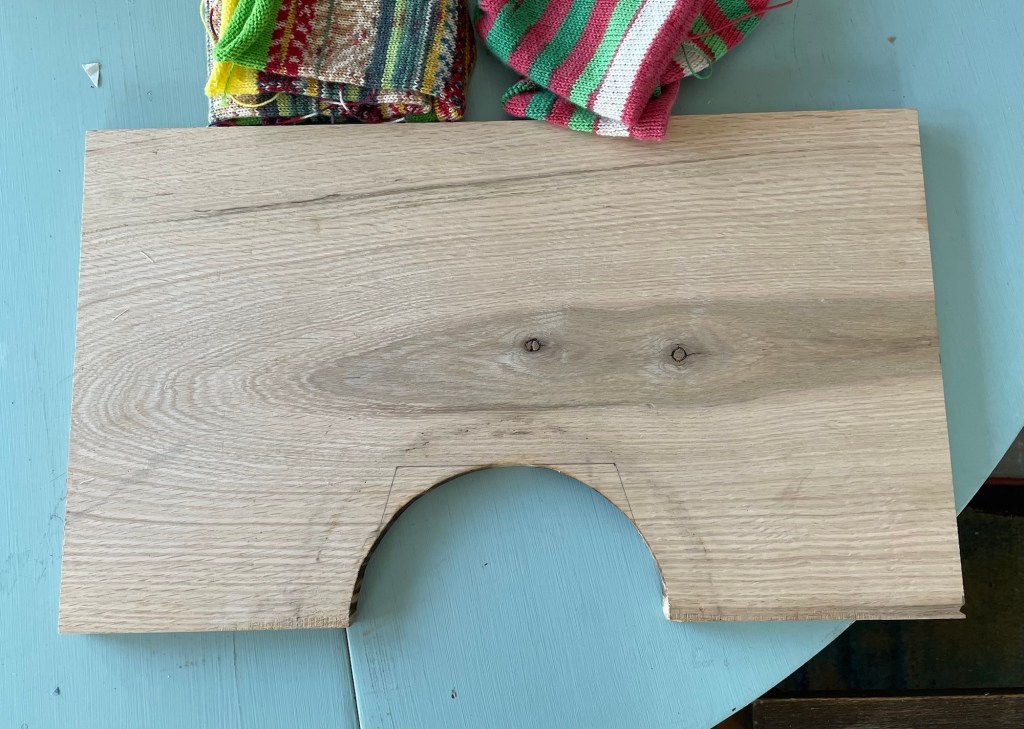
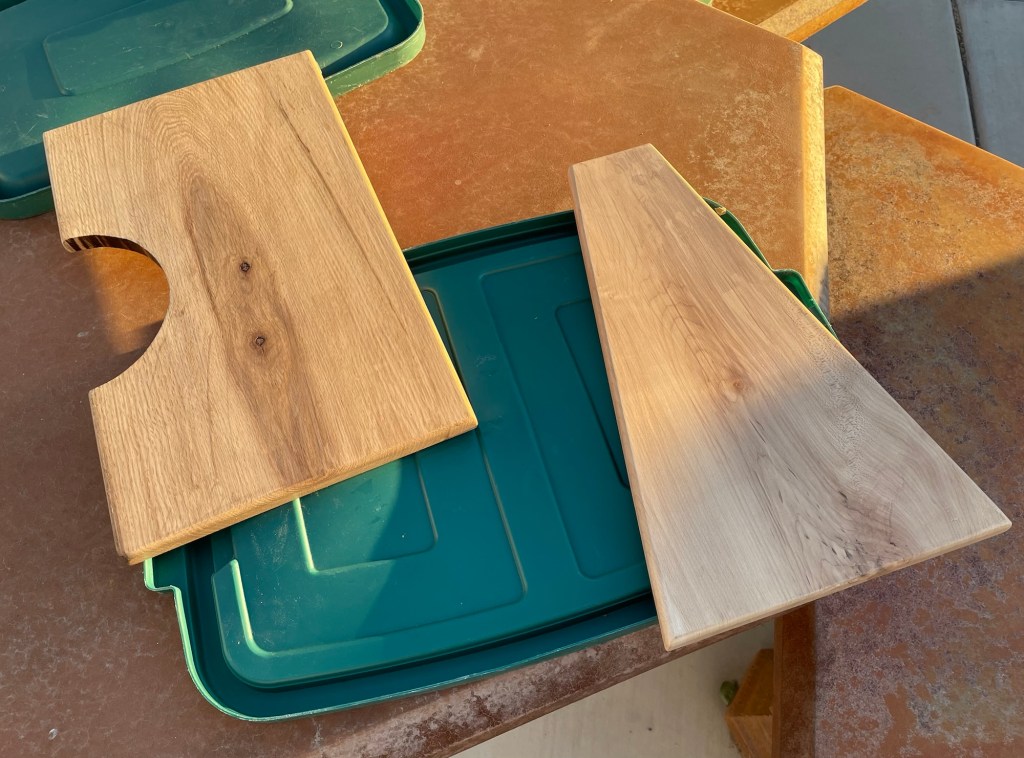
When my cousin was in town, he made a cutout in the wood for the CSM table. This is helpful so that when the heavy sock machine is clamped on, the weight will be closer to the middle of the table, rather than hanging off the front. Following is a photo of the wood, with the cutout in the front.

Wood cut and ready for legs to be added

I had ordered a set of adjustable height table legs online, but when they arrived we decided they were not right. I thought the table would be done before we left for Arizona. There was not enough time to get alternative legs, and our hardwood floor installation project used up a lot of time in December. On to plan B, completion of the table using the woodshop at the 55+ resort in Gold Canyon, Arizona.

We also needed a small side table to put between the matching RV recliner chairs in the RV, for setting down beverages and the TV remote. I had been keeping my eye out and had seen a few tables that might have worked, but Wayne had something very specific in mind. Last year, and the year before, he said he was going to make a table at the RV Resort woodshop, but it never happened. Now that he was committed to making my CSM table, it was the motivation he needed to make the RV end table.

Wood for csm table and end table

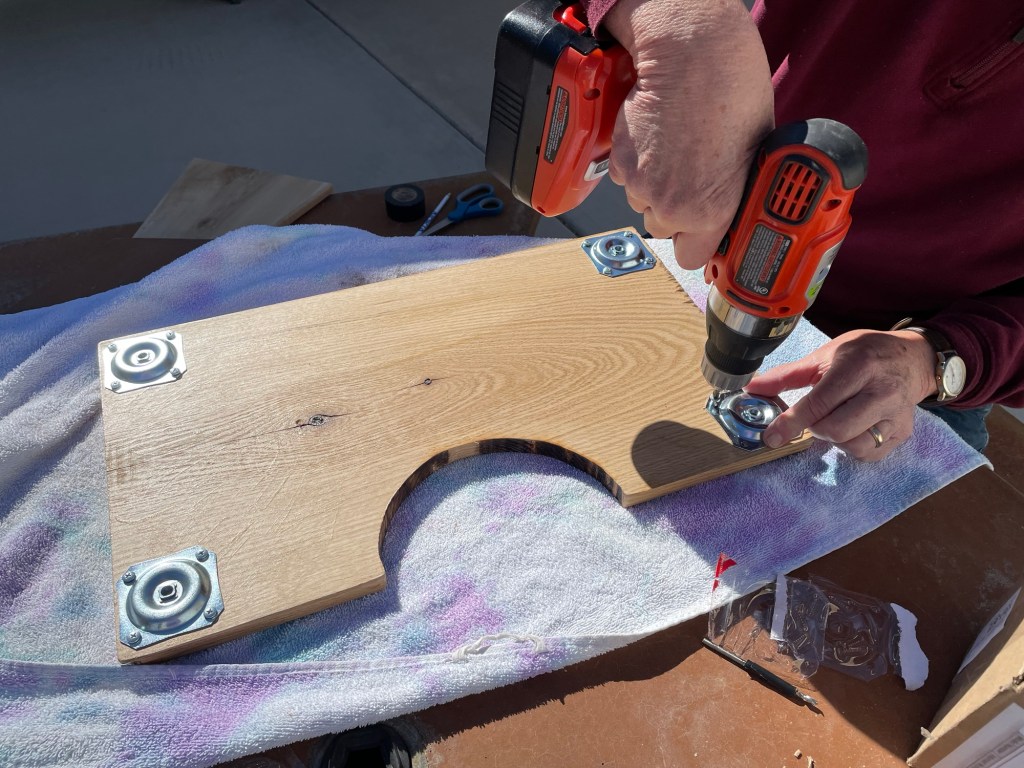
Wayne worked on sanding and preparing the table tops on the patio area outside our RV in Arizona. He bought one and a half inch wide dowels for the legs, four for the CSM table, and three for the end table.

Legs for the tables

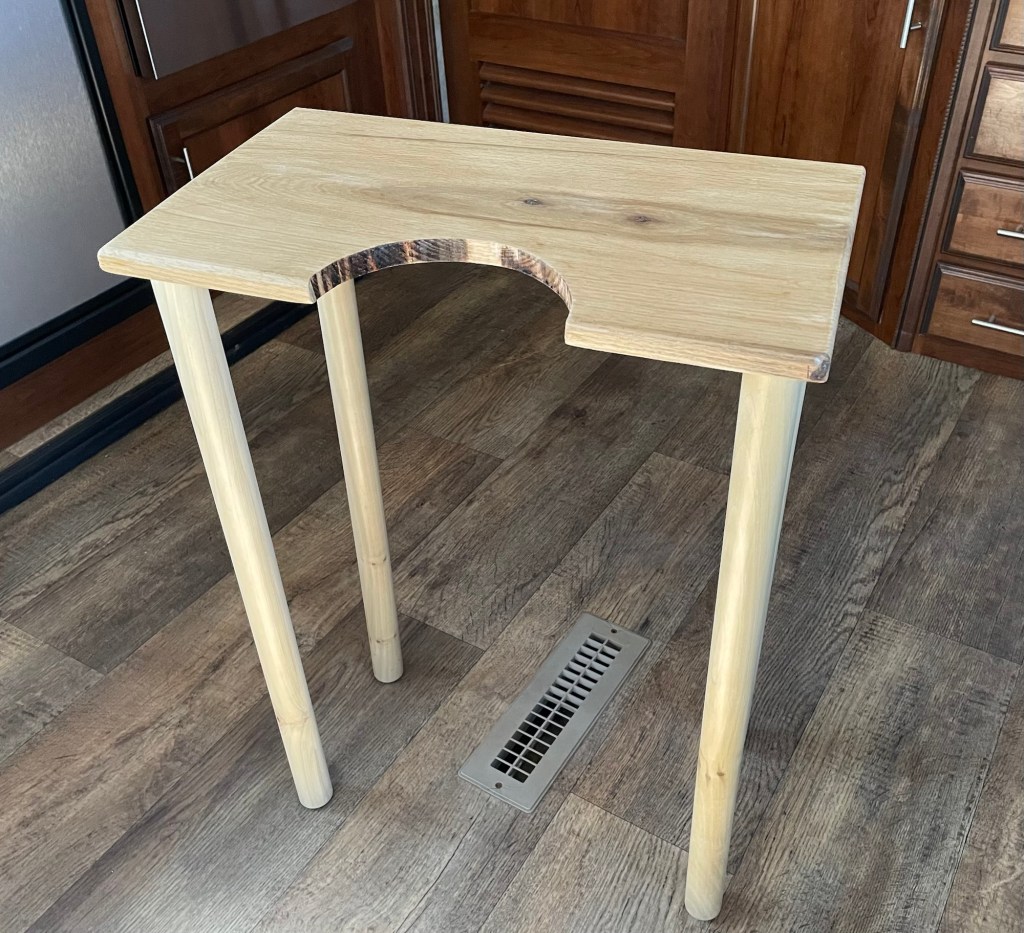
Following is version one of the sock machine table, after the legs were attached.

CSM table version one

The end table is just the right size, although it is a little tippy. The chairs swivel, so it is easy to accidentally hit the table with one of the chairs. We have learned to be careful.
The floor in the RV is somewhat uneven. The CSM table was too wobbly and unstable with the legs going straight down, given the small size of the surface. I had to put some rags under the legs to make them all touch the floor. When I clamped the CSM on, there was too much weight on the front and it was going to tip over. We could see that this was not going to work. For the short term I bought some hand weights to set on the opposite side of the table to balance it out, while we figured out what adjustments to make.

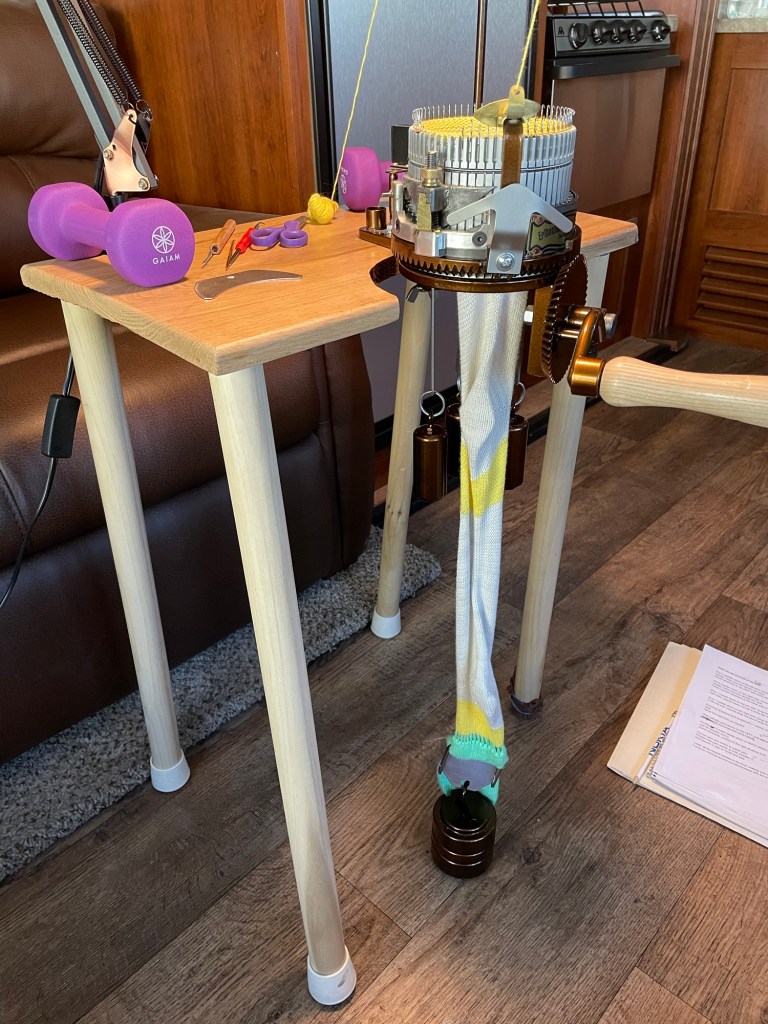
Wayne ordered alternate hardware so the legs could be mounted at an angle, adding some stability. We also ordered rubber tips to put at the bottom of the legs. After putting on the new hardware and reattaching the legs, we attempted to put the rubber tips on. When trying to put the fourth tip on, the hardware attaching the leg to the table broke. Wayne put the old hardware back on that leg so it came straight down instead of at an angle. Following is a photo of version two of the table with the three angled legs and one straight leg, rubber tips, hand weights and a lamp. It looked funny but worked.

CSM table version two

I have seen many unique versions of hand made sock machine tables, both in person and online. For the record, you can buy a specially designed CSM table for taking to crank-ins that is adjustable in height and folds, with legs in the style of an ironing board. I was starting to think I should have just bought one of those.

It is amazing how you can find your people that you did not even know existed a year ago. When I started thinking seriously about buying a circular sock machine, I researched online for information and resources. It turns out there is a ton of information, and people with sock machines who get together regularly to “crank” at “crank-ins”.

I found a Facebook group of crankers in Arizona. They share ideas and progress, and have crank-ins in Prescott, and sometimes in Tucson. I was surprised that there were no crank-ins in the Phoenix metro area. There was a crank-in scheduled near the end of January in Prescott, which is about two and a half hours north of Phoenix. Wayne, along with his sister and brother-in-law, Marlene and Steve, agreed to drive up there with me.

On the day of the crank-in we hit rush house traffic at 7:30 am. The Phoenix metro is huge, spread out over a large geographic area. Gold Canyon is on the farthest eastern edge. After driving west for an hour, we were still in the metro area! It ended up taking 3 hours to get to Prescott.

Wayne, Marlene, and Steve, dropped me off, and then went hiking and to Jerome, while I was at the crank-in. Their brother is named Jerome, so there are always jokes about going to Jerome. Marlene bought a “Jerome” tee shirt for their brother. Following is a photo of me at the crank-in at my wobbly table with three angled legs and one straight leg.

Going to a crank-in involves taking the sock machine apart and bolting the parts into a special box, packing up the table and a bunch of stuff to bring, loading it all in the car, unloading it at the crank-in, setting the machine back up, then taking it all down, packing it up, etc, after the crank-in is over. The benefits of attending make it worth the trouble.

I have seen a photo of a large group of people associated with the Arizona crankers group. Only three other people attended this event, a married couple and another woman. The married couple each have their own sock machine. Interestingly, I am aware of several people who own two or three sock machines.

The people at this crank-in gave me some helpful information for more successful cranking, and I was able to get ideas for efficiently packing and transporting the necessary equipment and supplies.

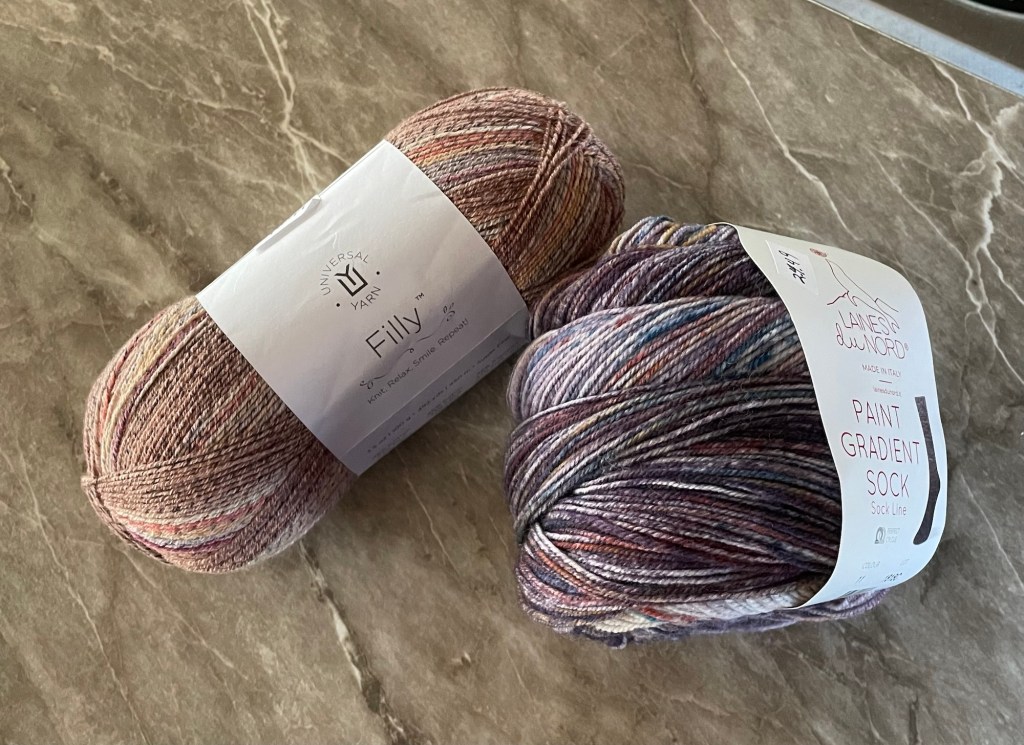
I had arranged for a friend who lives in Prescott to pick me up at the end of the crank-in. We had a little time before meeting up with my group, so she took me to the local yarn shop that was only a short distance away. Fiber Creek LLC was huge and active and wonderful. As usual I was very inspired and of course I had to buy more sock yarn. There were sample socks knitted up in the following two yarns that I bought. The one of the left in the photo below is a cotton blend. Most sock yarn is wool with some nylon for strength, but it will be interesting to try the cotton yarn. We still had some time to visit at Wild Iris Coffeehouse, a fun quirky place nearby, before my friend dropped me off with Wayne and the others on the main drag in Prescott.

Yarn purchased at Fiber Creek LLC

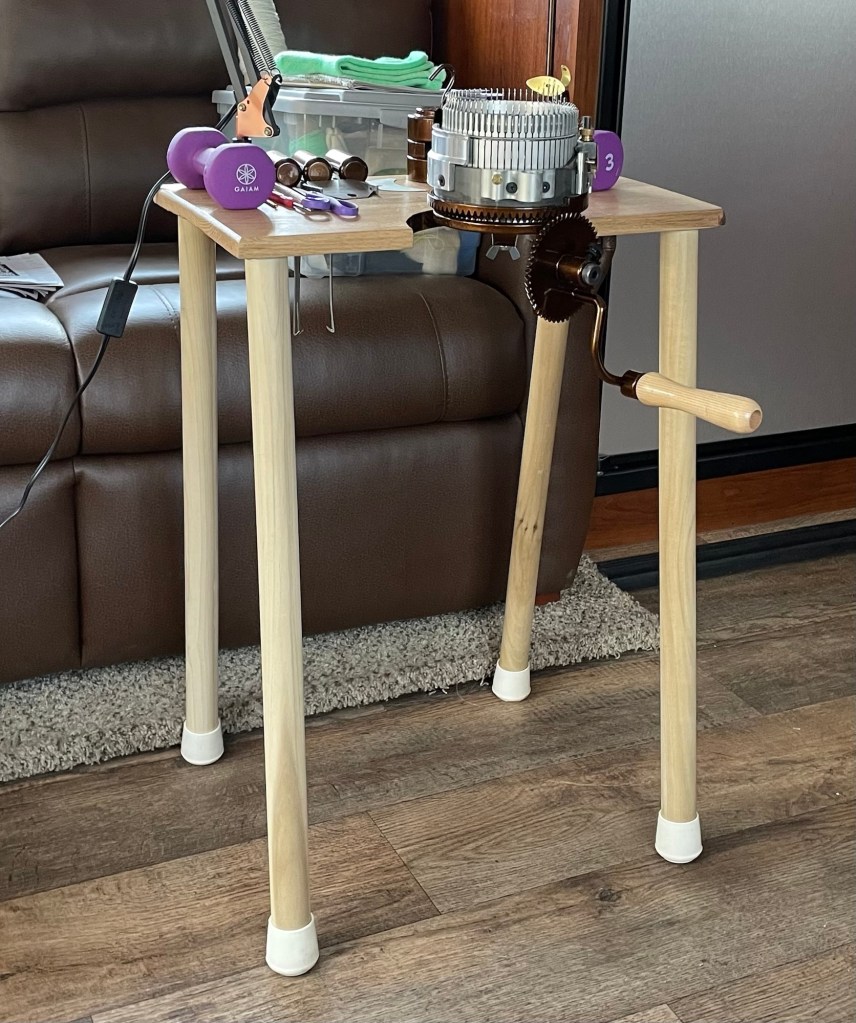
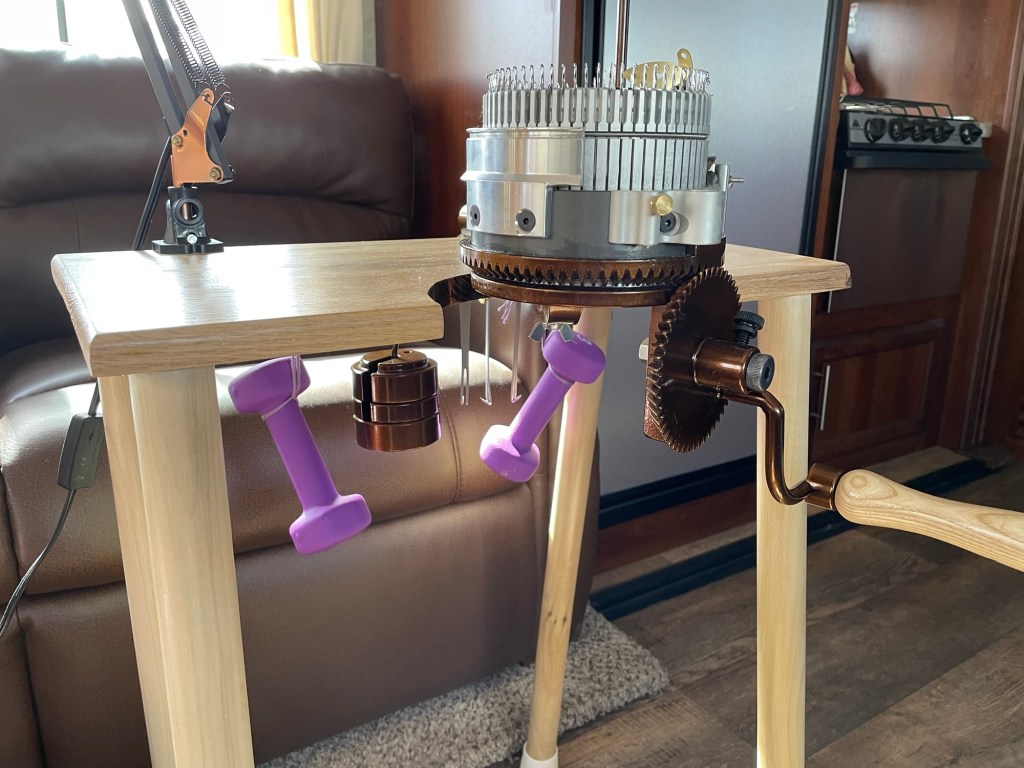
After the Prescott crank-in, and with the right parts, Wayne got four matching legs on the sock machine table all installed at an angle, with rubber tips at the bottom, and cup hooks underneath. Version three of the CSM table is shown below.

Version three of the sock machine table

Having the two three pound hand weights hanging underneath the table adds plenty of counter weight, so the table is very stable, and gives me more space on the surface for supplies as I am working.

The table is not going to tip over, but it jiggles a little when I am cranking on the machine. It is not perfect, but it is serving the purpose for something portable and not too big to use in the RV. I may try to come up with something collapsible for taking to crank-ins after we are back home.

Given that no crank-ins were scheduled in Phoenix, I decided to organize one myself. First I posted on the Facebook group to get an idea if anyone would come. After receiving some positive responses, I scheduled a room to use in the activity building at the 55+ resort where we are staying. I figured that even if only one other person came, it would be worth it for me and I would not have to drive somewhere else.

Two people ended up coming. A couple of other people wanted to come but had conflicts. One of the people that came, Nicole, was a little less experienced than me, or about the same. She was grateful to get some help and have someone on hand to answer questions and provide assistance. The other gal, Sheila, was very experienced. I was glad to have her help in figuring out how to use the ribbing attachment on my machine. Both Sheila and Nicole own a different brand of metal circular sock machine, but they all work the same way. In the following photo the ribber attachment is on the top of my CSM.

Using the ribber attachment

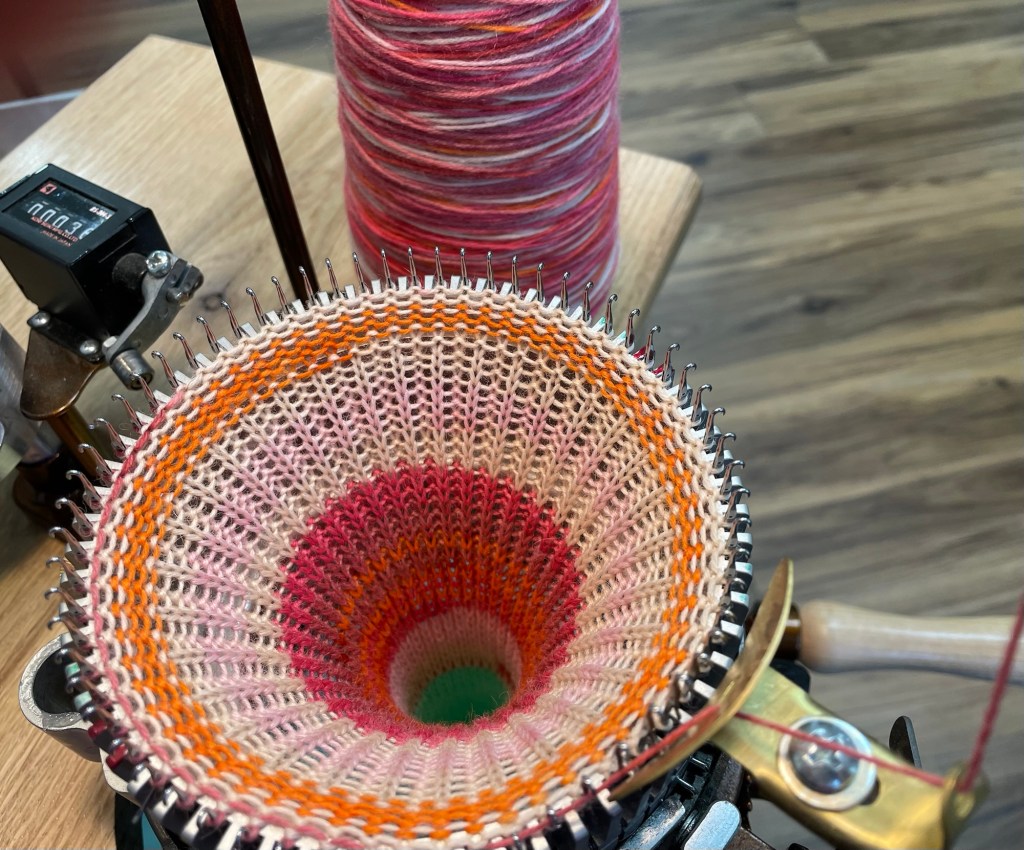
The next photo shows the machine making knit 1 purl 1 ribbing stitches. It was amazing to watch.

The ribber in action

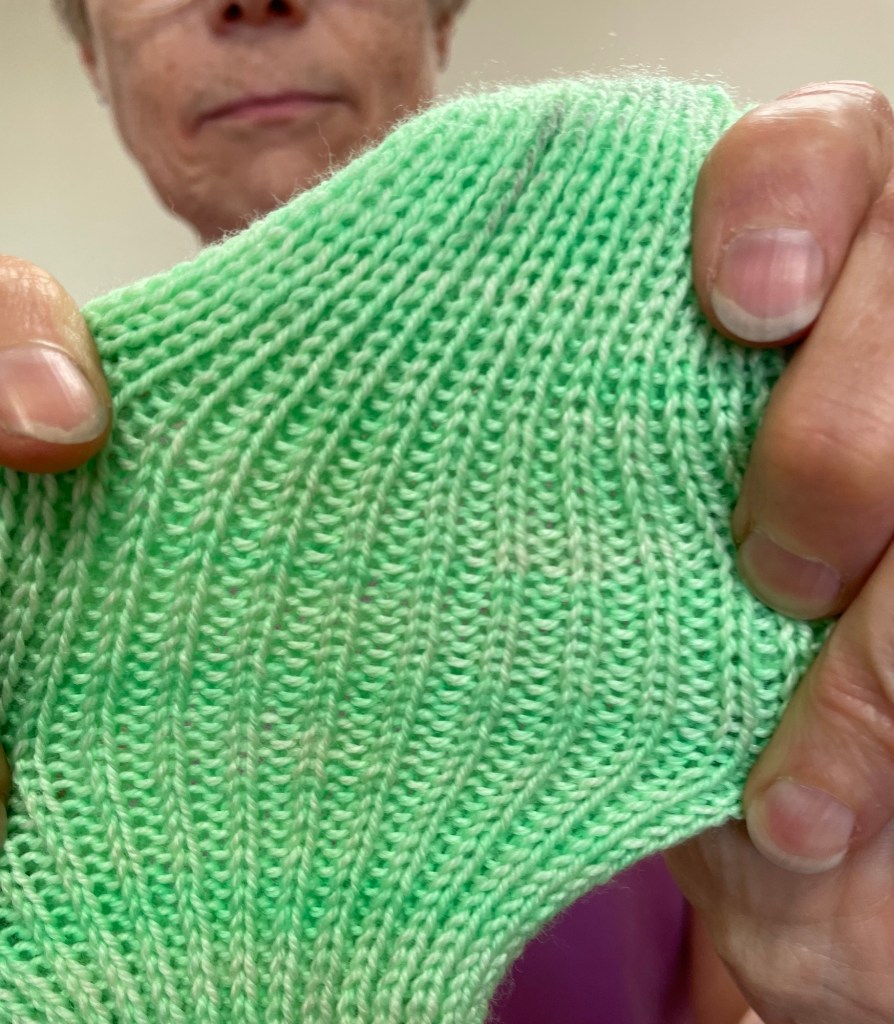
Once I had cranked a length of practice ribbing, I started a sock with a ribbed cuff.

The following photos show the practice ribbing, and then the sock attached to the green ribbing.

Practice 1×1 ribbing
Practice green ribbing, with ribbed sock attached

Sheila had a clever combination CSM travel box and table.

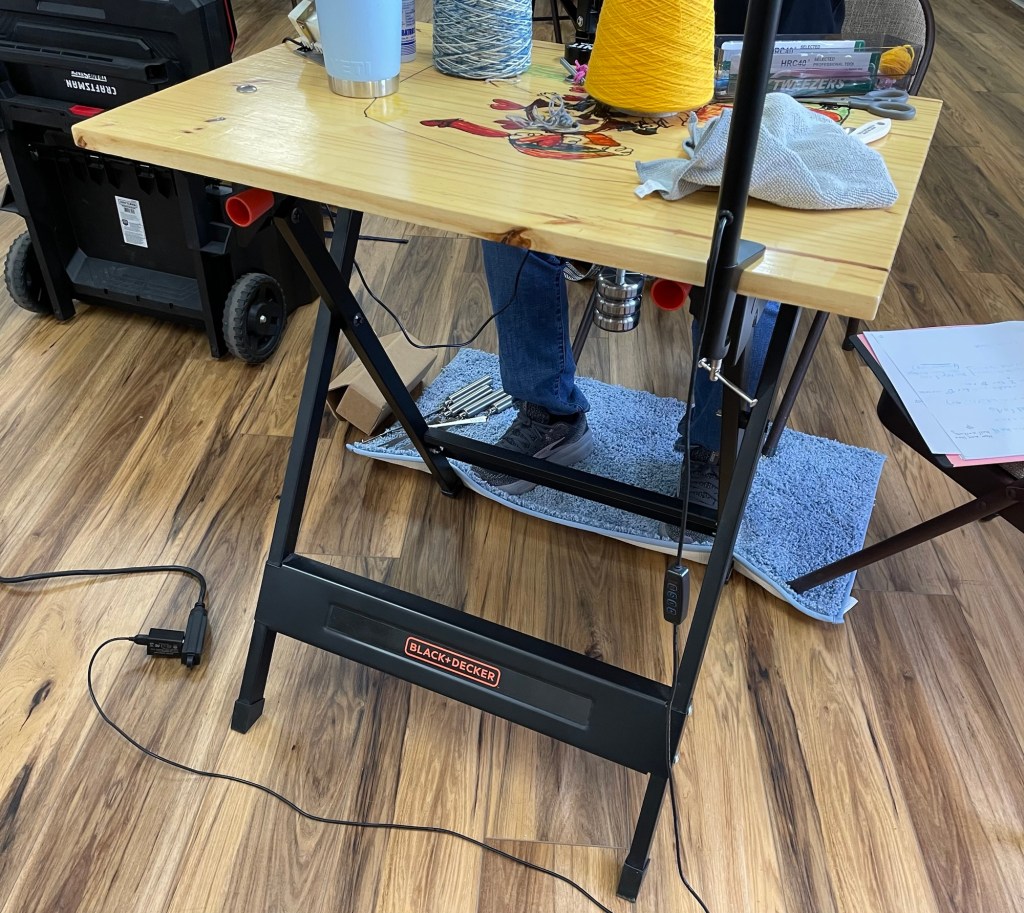
Nicole completed cranking a pair of self striping socks. She had another style of table using a Black & Decker folding workbench for the base. Two people at the Prescott crank-in had tables like this.

Nicole’s CSM table

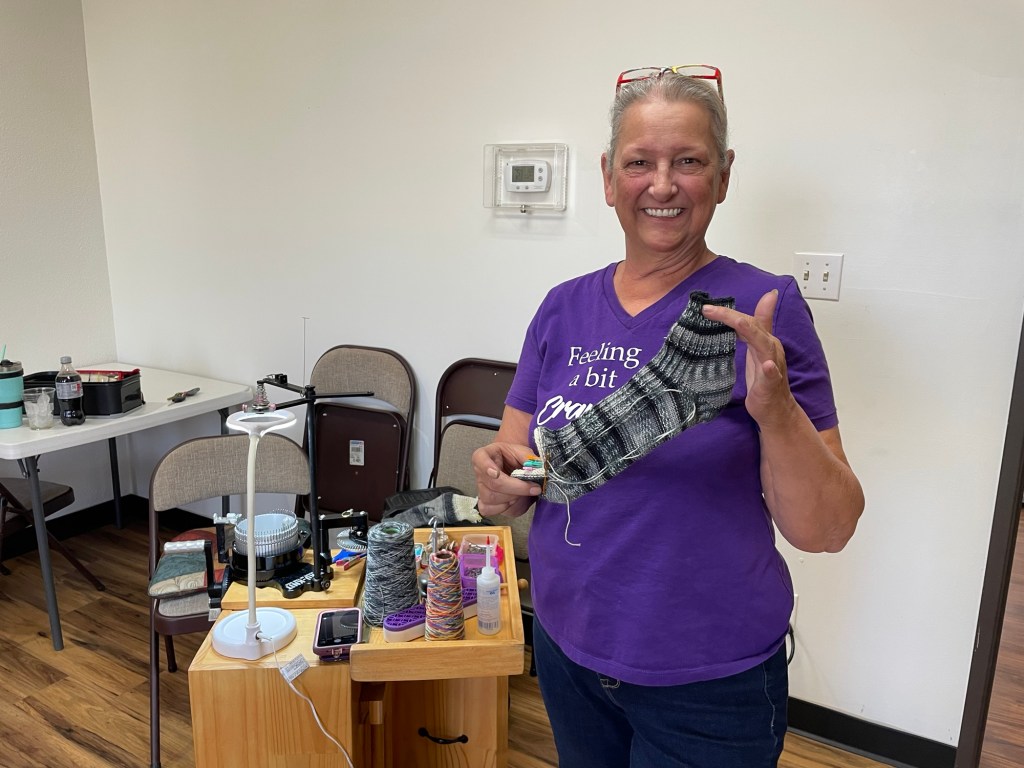
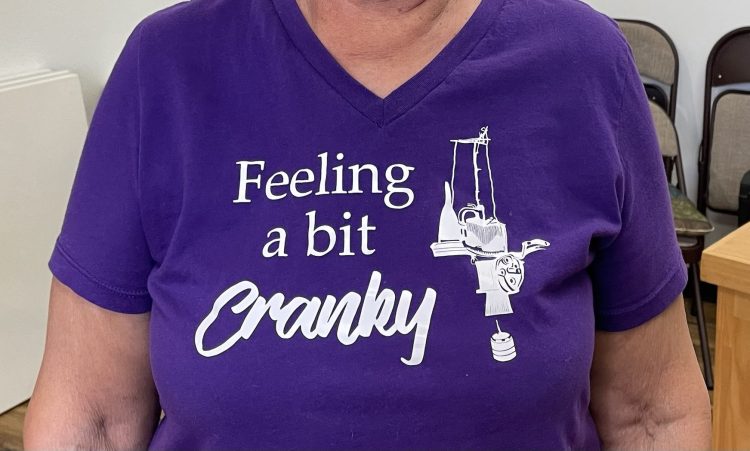
I am generally a reserved person, being happy for hours by myself. At the crank-ins I am completely at home and immediately feel a rapport with the other attendees. My new friends and I pose with our projects below.

I need one of these shirts. Sheila said that they are not available any more. I know people who can do graphic art and a source for custom tee shirts, so maybe I will get some made.

I spent more time on my own with the ribber after the crank-in.

I was sad having to pack the sock machine up at the end of our time in Arizona, but also ready to go home. When we get back home I will be focusing on other things for a few weeks, including meeting our new granddaughter, expected around the beginning of April.

Heels & Toes

While snowbirding in Arizona I have been doing the usual activities that I do here. I have been hiking and bike riding, attending exercise classes (there is no excuse not to go, when it is a five minute walk to get there and it is free), walking (without worry of slipping on ice), going on outings, hanging out with people we know (who live here or are visiting from back home), and working on knitting projects.

One thing we do every year is the Apache Trail scenic drive. This 40 mile long road twists and turns all the way from Apache Junction to the Roosevelt Lake, through the Superstition Mountains. Some parts are normal pavement, most is very rugged and narrow. A section of the road was closed for several years due to a washout. It was finally open again this year, so we did the entire drive. I took the following photo of a map that was posted at a scenic overlook.

I have not taken many photos this year, and I have not been motivated to write about non fiber-related topics. I apologize to readers who are getting tired of reading about socks. I have been very focused on learning to use my sock machine while I am here, with fewer distractions than at home.

In December, after many failed attempts at cranking heels on the sock machine, I was getting discouraged. There are so many opportunities for something to go wrong and I experienced all of them, sometimes more than one at the same time. I saw many social media posts of perfectly cranked socks. I did not understand why I was having so much trouble, but I was also pretty sure that if they could do it, I could too.

There are many factors involved in cranking out a successful sock. The tension must be set appropriately for the yarn being used. There must be enough weight hanging off the project, and additional weights on the heel or toe. The needle latches must be open. There is understanding the pattern and steps for making a heel or toe. There are so many things to think about that I would forget where I was in the instructions, or forget to do something important, while I was fixing a problem or focusing on something else.

My Erlbacher circular sock machine, waiting for a project

After we were settled in Arizona, I resolved to learn and practice until I could make a heel, and then a complete sock. The first thing to understand was the tension adjustment on the machine. I watched some videos, consulted with my sock machine mentor in Minnesota, and even talked to someone at the Erlbacher company. I learned some important things that I had not understood before. I got the tension at a setting that was looser than ideal, but better than being too tight in order to complete a heel without dropping stitches.

Watching a video of someone making a heel was necessary and helpful, but I also needed very detailed step by step written instructions. I typed out the steps in a document, and printed it out for reference as I was cranking.

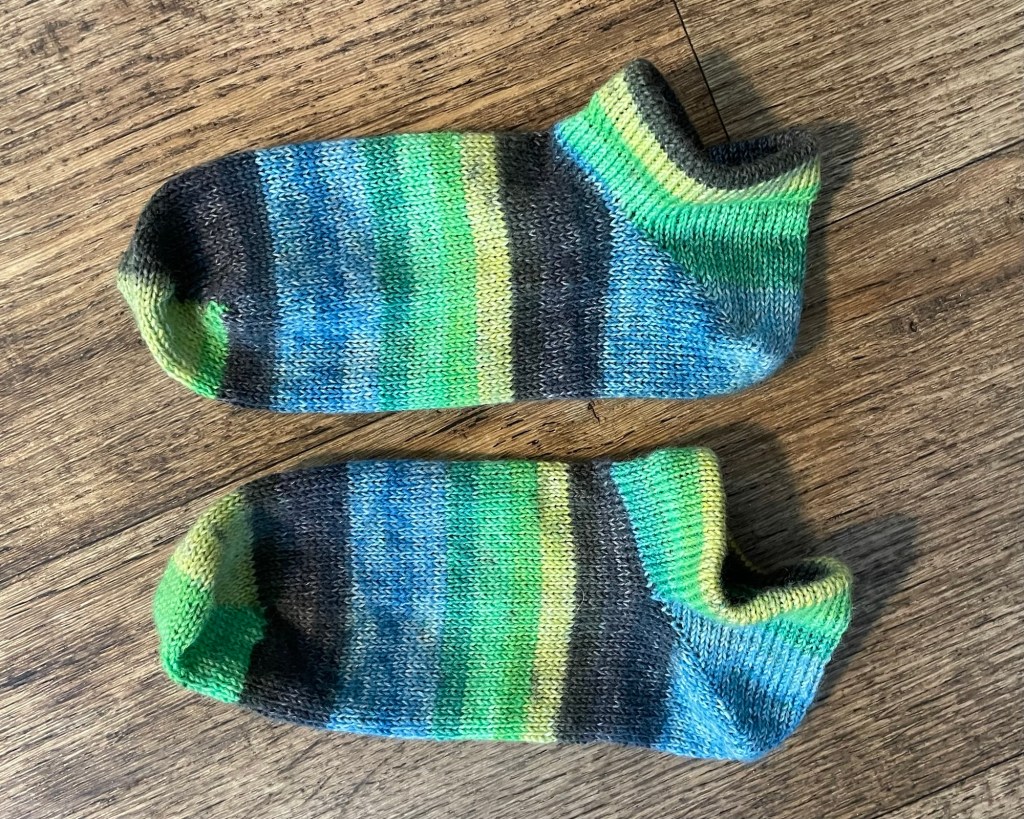
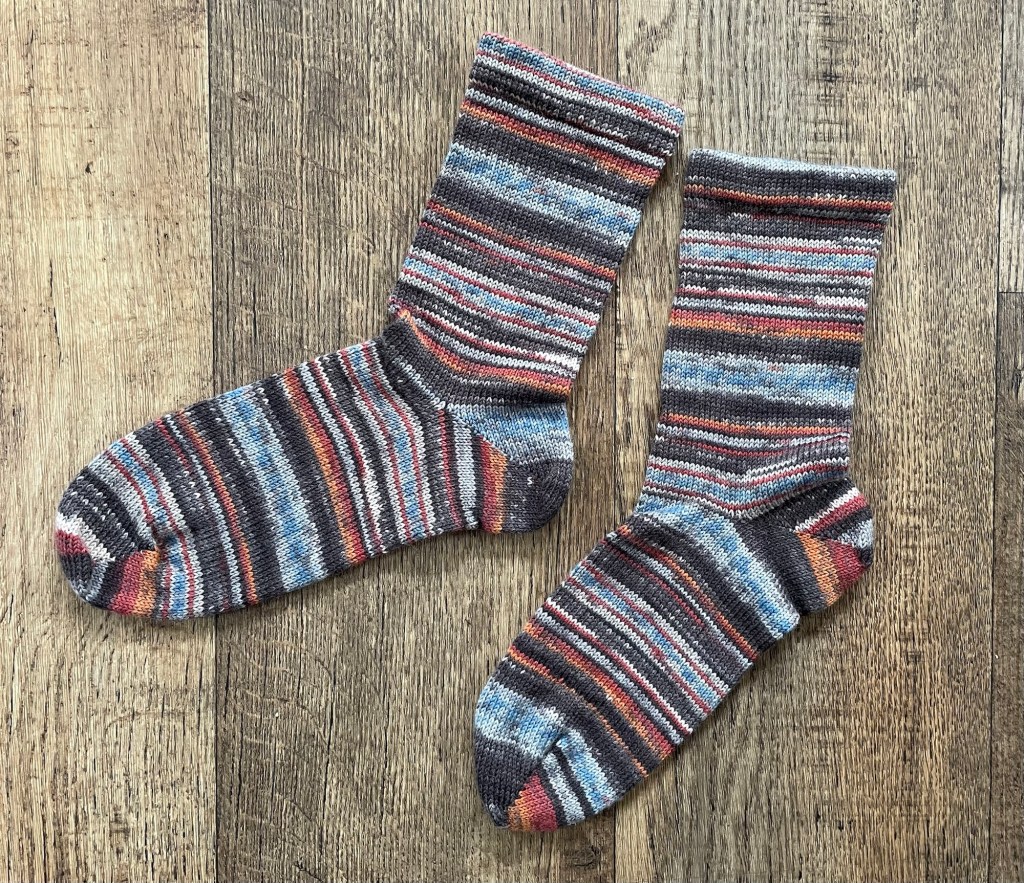
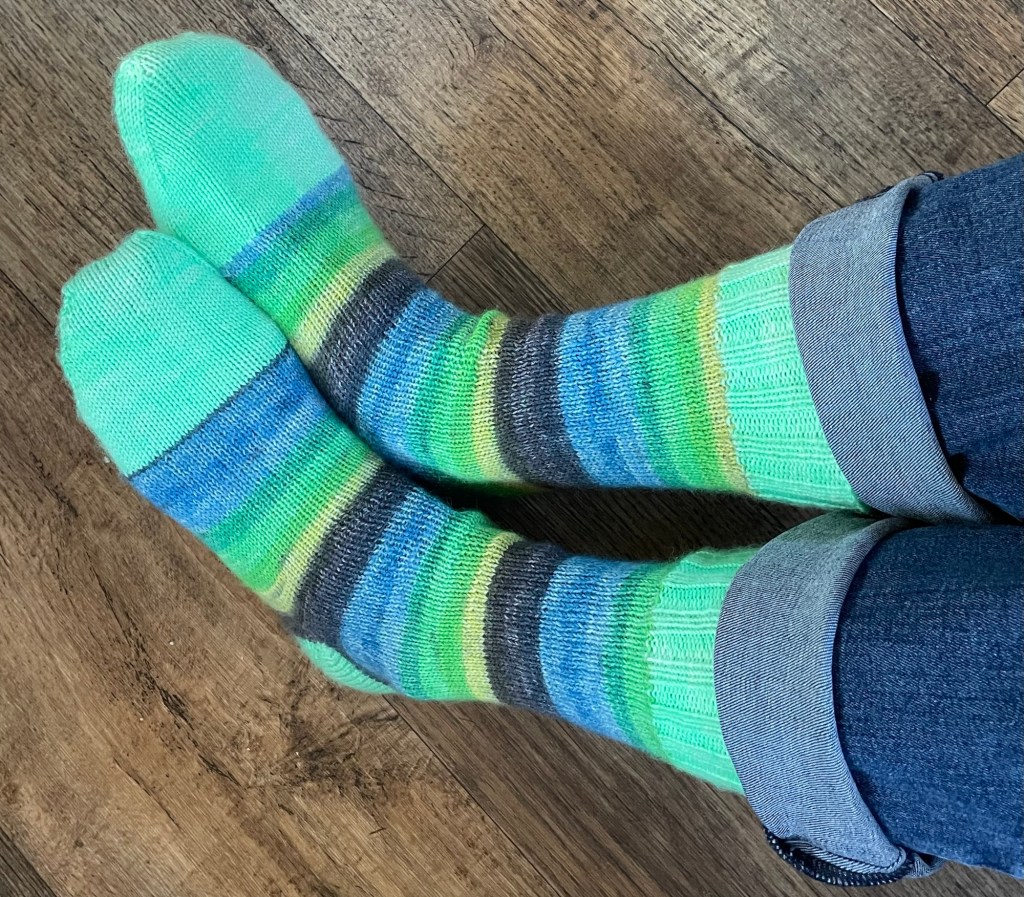
With the step by step instructions and loose but workable tension, I finally cranked out a perfect sock!! I did not take the time to completely understand the toe, which is made the same way as a heel except for the very end, but I got it close enough. After that I practiced cranking more heels with the same yarn, adjusting the tension one notch tighter each time until eventually it was just right. I was then able to make a complete shorty sock in the right tension that fit me. Woohoo!

Perfect shorty socks!!

The following photo shows the smaller shorty sock with the tighter tension on top of the sock with the looser tension.

Correct tension sock on top off looser tension sock

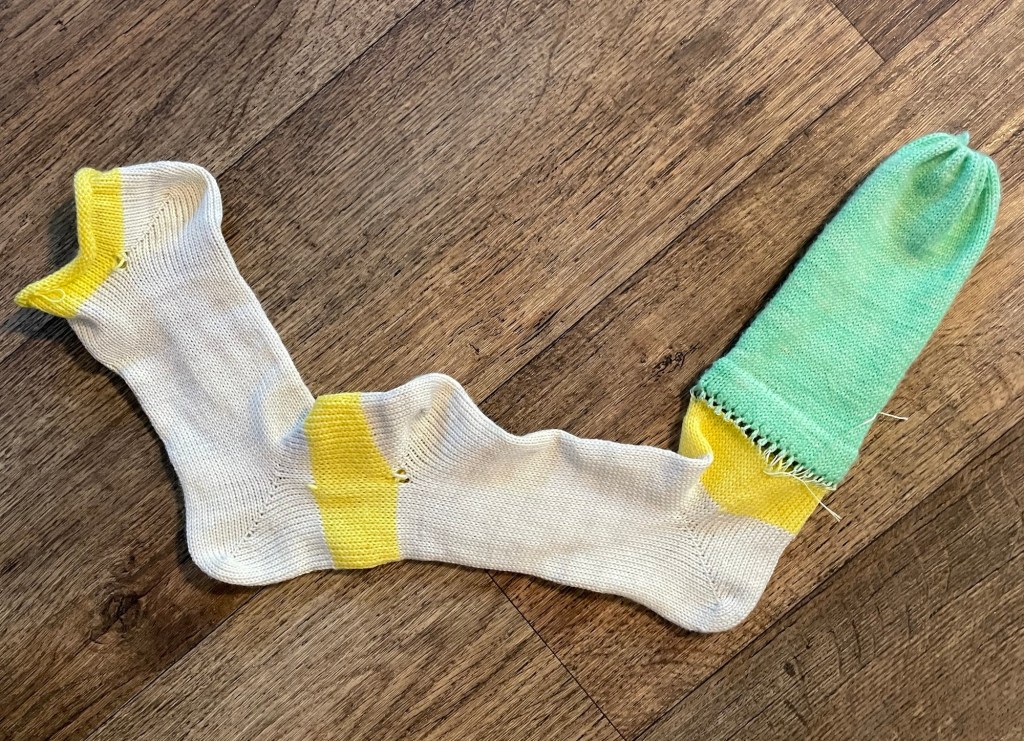
The next project I tried was a pair of off white shorty socks using Madelinetosh Twist Light Yarn. After cranking out the first sock, I realized that I forgot to do the hung hem, the most common way to finish the cuff on a CSM sock. I like a ribbed cuff, but I was a long way from figuring out the ribber attachment for the machine and it was too late for that anyway. I decided I would add a ribbed cuff by hand on this pair, so I went ahead and cranked the second sock the same way.

The next photo shows both of the off white socks connected and hanging down under the sock machine, separated by yellow waste yarn.

Two socks connected by yellow waste yarn

In the photo above the brown weights are hanging down at the bottom almost to the floor. That is a bad mistake which I made a couple of times. I did not notice and kept on cranking when the weights were sitting on the floor. That is the same as not having any weight, which causes the working yarn to be way too loose and the stitches to not knit.

The next photo shows the white socks after I removed them from the machine, before separating off the green setup bonnet (used for casting on) and yellow waste yarn.

Following is a photo showing the toe of one sock with knitting needles inserted into the live stitches in preparation for being grafted together. Later I learned a different way to graft the toe that I like better using a yarn needle, while the waste yarn is still attached.

Starting to graft a toe with knitting needles

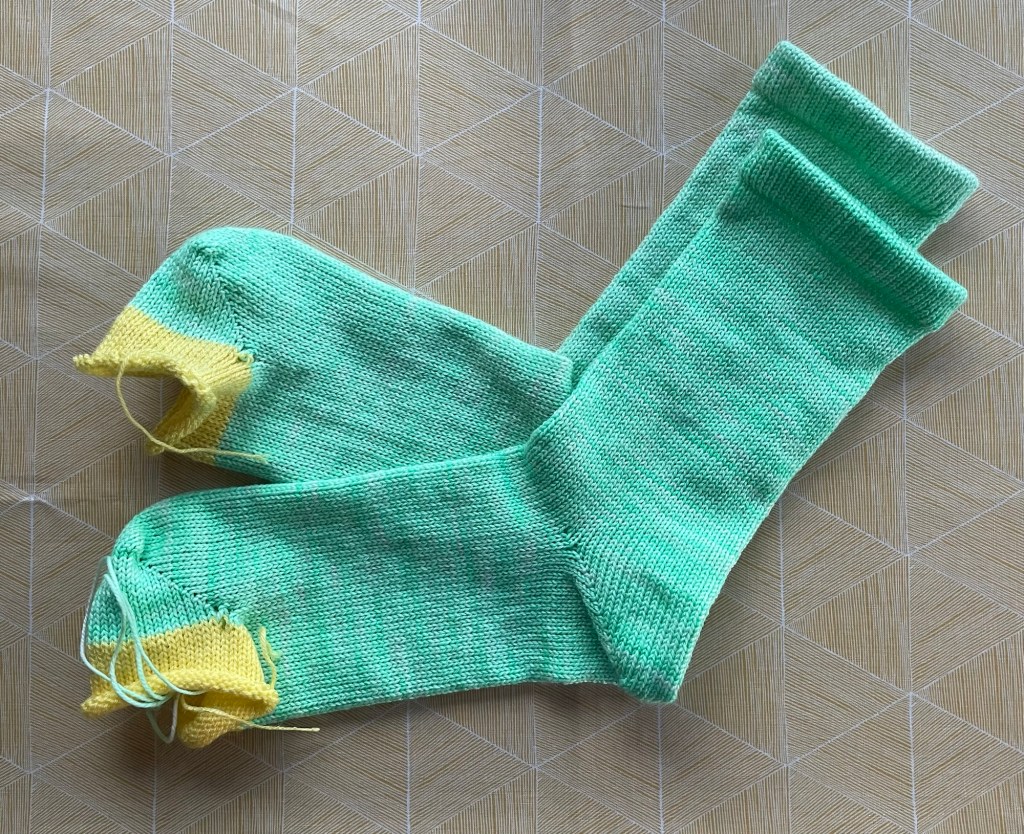
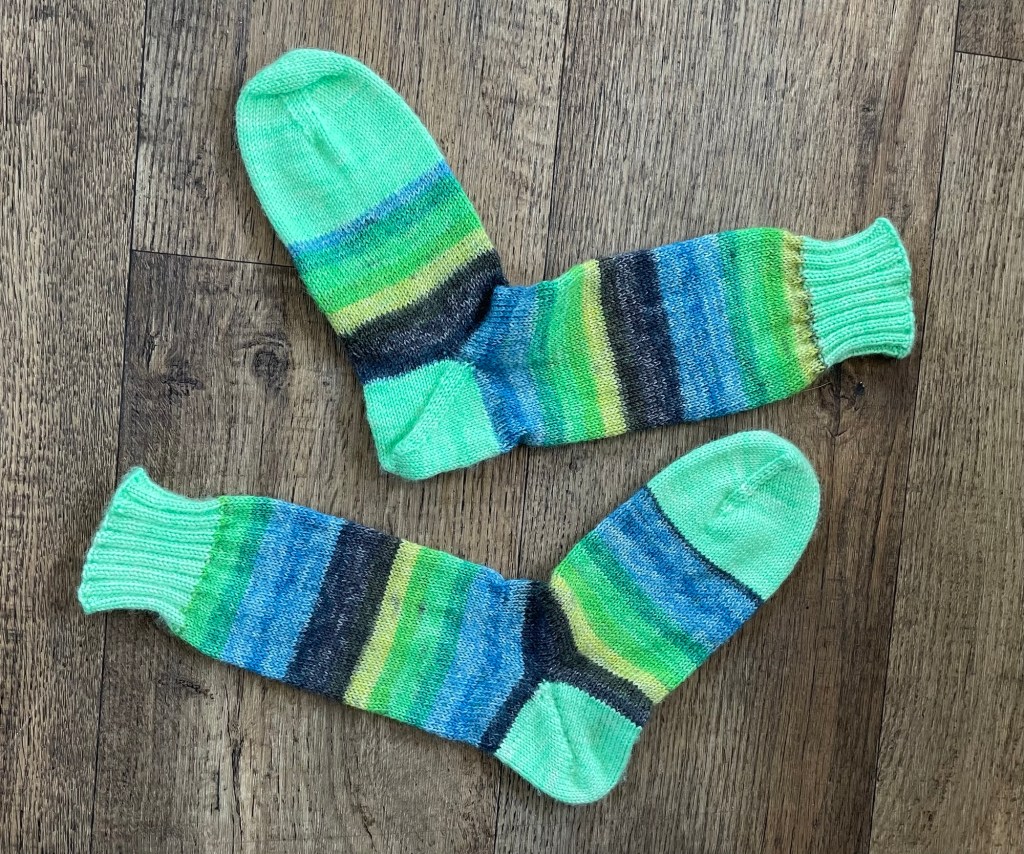
The next pair of socks I cranked had a mid calf leg, using green Madelinetosh Twist Light yarn. They are shown below with the waste yarn still attached at the toes, waiting to be grafted together. That is expensive yarn and normally not what someone would use for practice, but I owned quite a few skeins in this color from my 2018 yarn store inventory purchase.

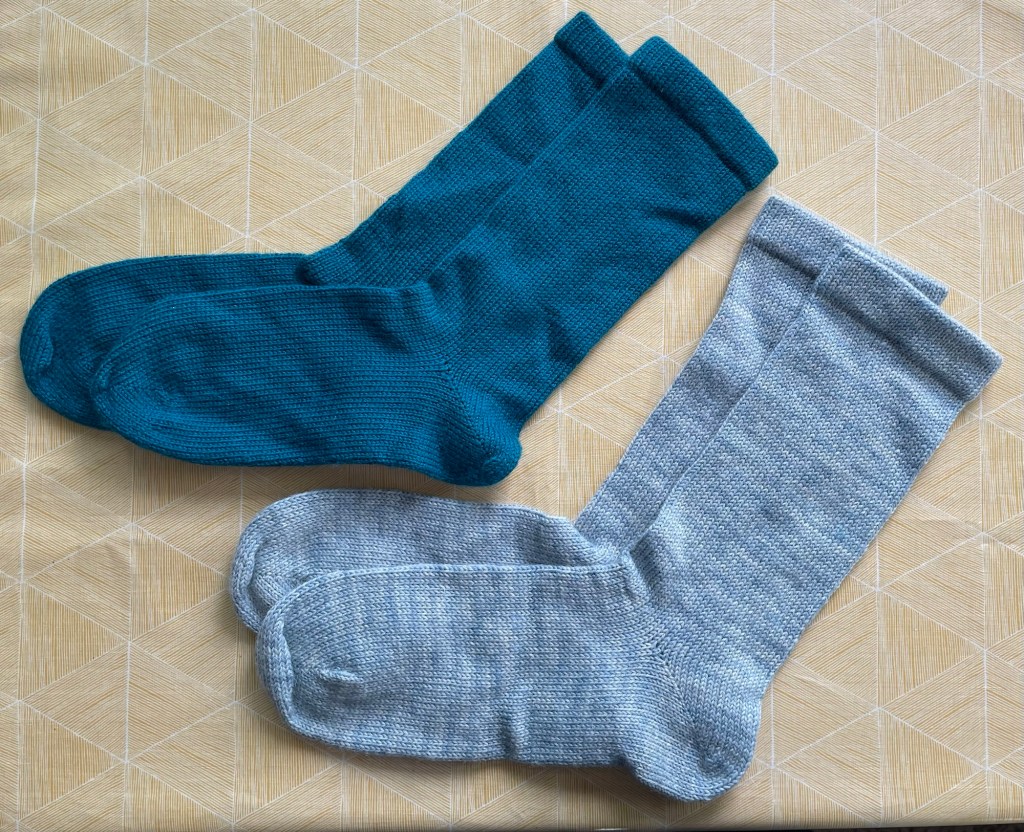
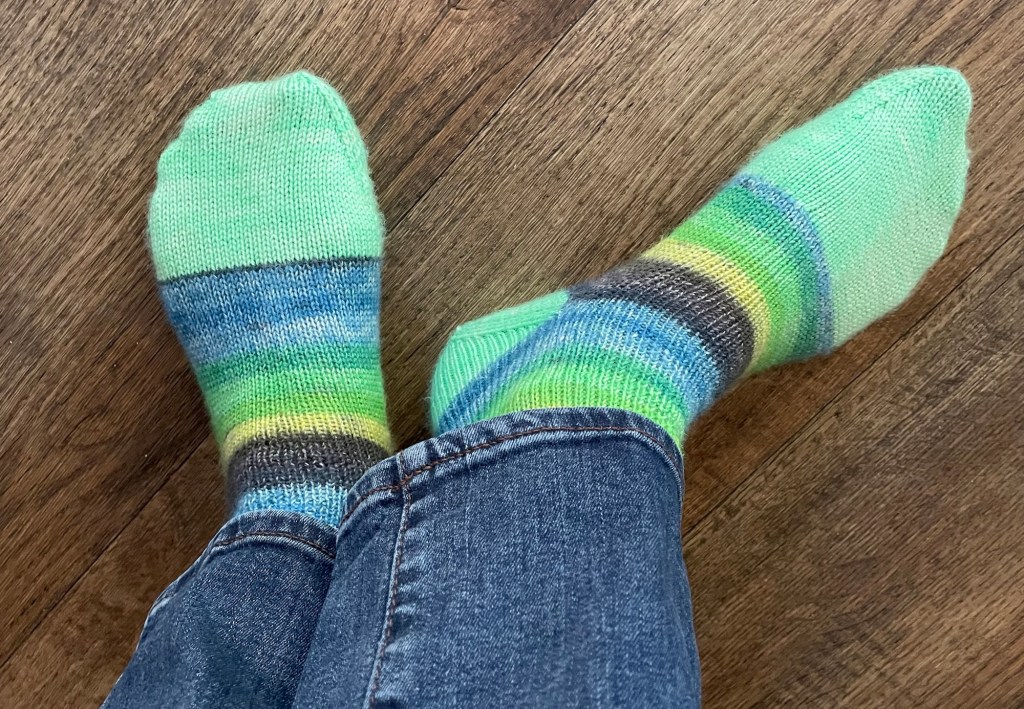
Three pairs of successful socks

When the news came out that Joann Fabrics would be closing all of their stores, I headed over to see if they had any sock yarn on clearance. I had never shopped there for sock yarn, but I came home with multiple skeins of some nice self striping store brand yarn, at a very good price. Later I went back and bought more of the Joann Sock Star K&C yarn.

Sock Star K&C yarn on clearance at Joann Fabrics

Since the Joann yarn was such a good deal, I decided to go ahead and use some of it right away for more practice socks. I was ready to try a new pattern called “Heel Tab Shorty Socks”. They turned out perfectly.

Following are photos of more pairs of successful socks. Over time and with repetition, the basic sock pattern has became familiar and I do not have to think so hard about each step. Some of the following socks have small mistakes where I fudged something while it was still on the machine, or did some cleanup by hand. A couple of times I tried to fix a mistake, but wasted time and then ended up starting over.

The next step in my learning journey was to change the 64 stitch cylinder out for the 72 stitch cylinder. 64 stitches make an average ladies size sock. 72 stitches makes an average men’s size sock. I attempted to make a pair of socks for my daughter’s boyfriend, Isaac. His feet are the same width as my husband’s, but a little longer. I was pretty sure he would like the following yarn in bold colors.

I messed up on the toe of one sock, but was able to salvage it so that I don’t think anyone would be able to tell. I made a mistake on the heel on the other one, but again, nothing that anyone would notice. After blocking the socks and measuring them, I found they were a bit too short for Isaac, but they will fit someone else.

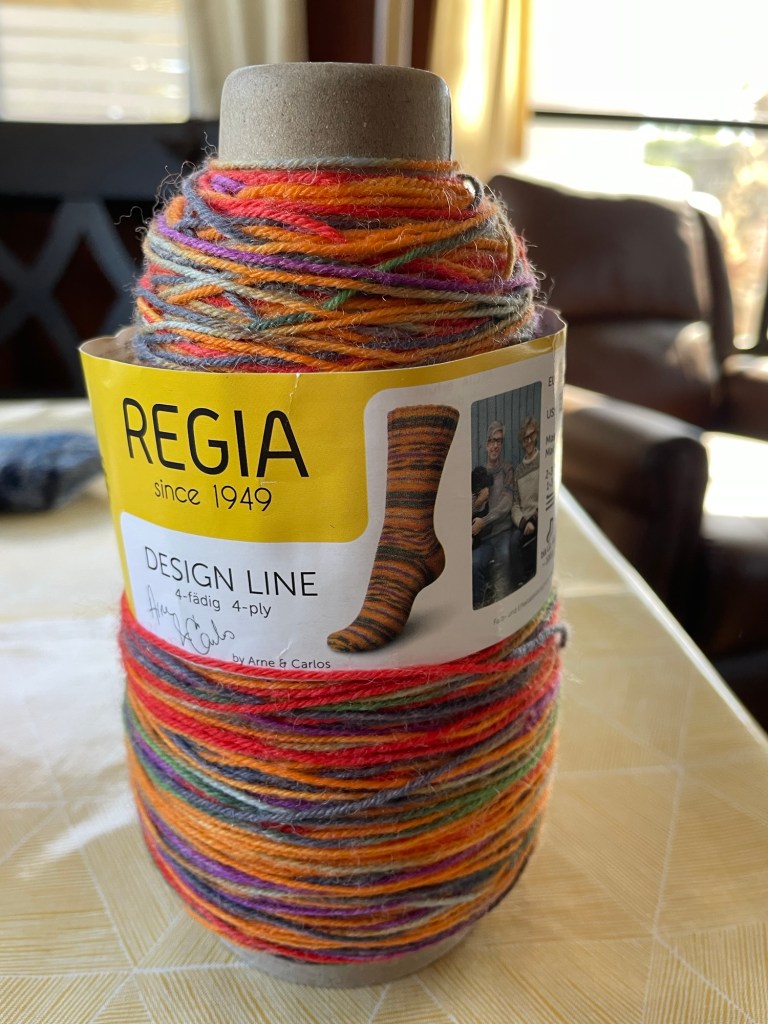
I had never knit my husband a pair of socks before, but now was the time. I cranked a pair for Wayne using the Schachenmayr Regia 4-ply Arne & Carlos yarn he picked out himself. Both he and Isaac have wide feet. With the tension one notch looser they came out a tiny bit wider. The narrower man’s sock will probably fit our son James, but not sure if he wants those colors.

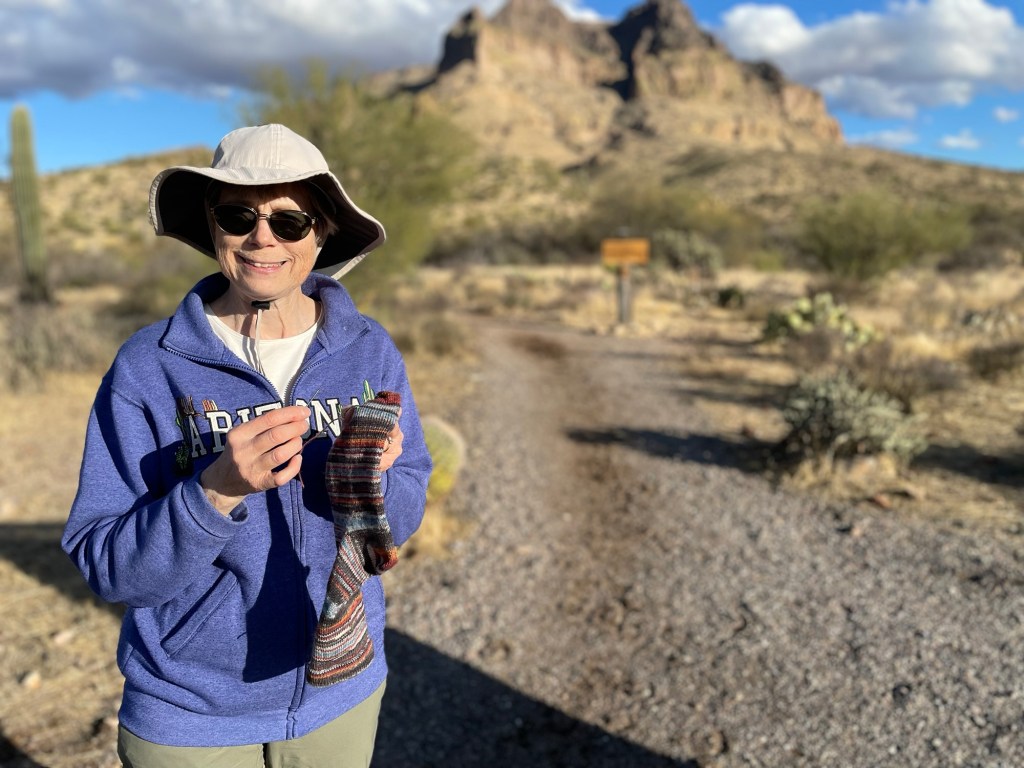
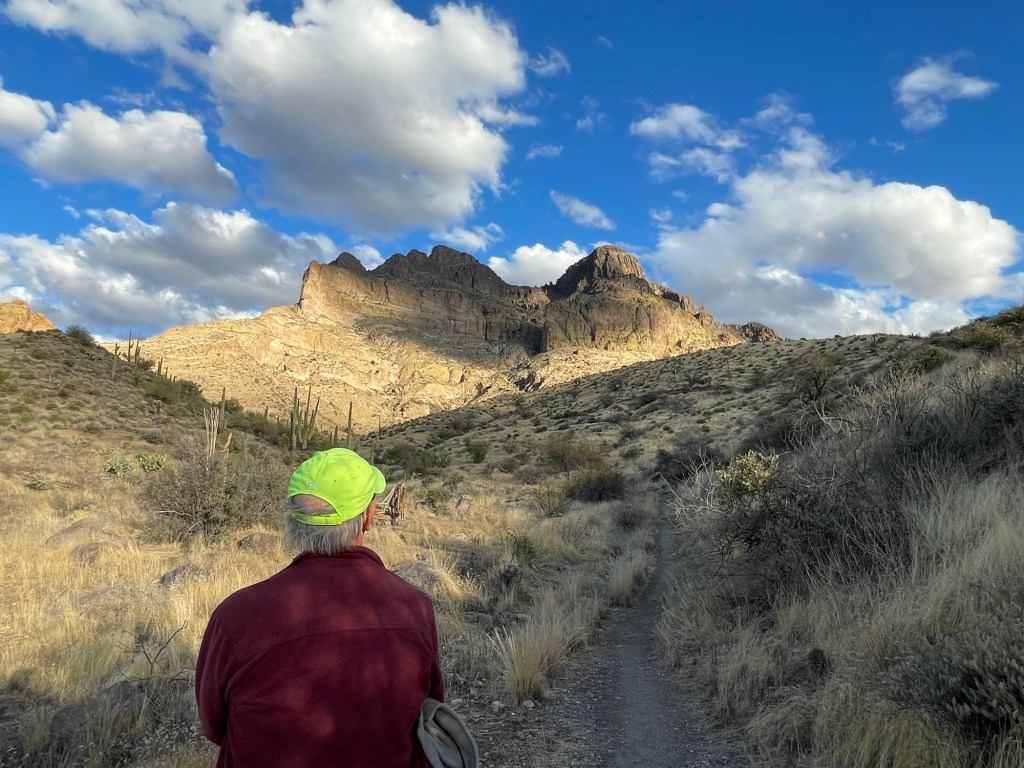
Following is a photo of me holding the socks for Wayne, with the toe grafting in progress, when we were out on a hike at Picket Post trail near Superior, AZ.
Wayne on Picket Post trail

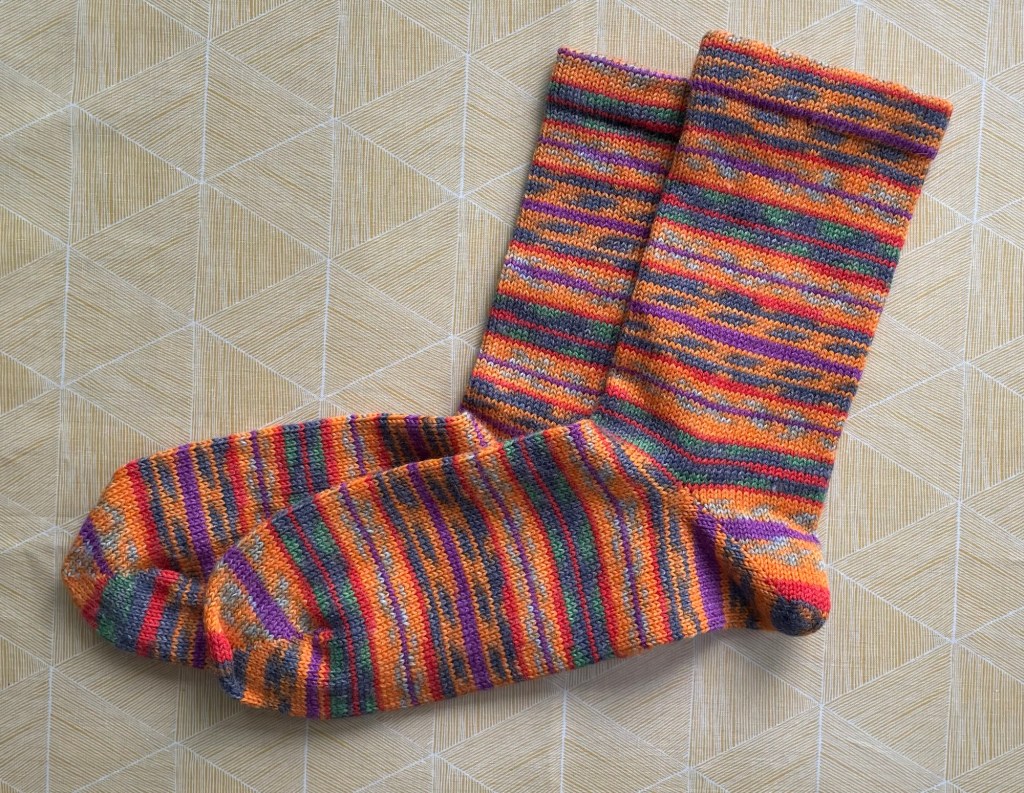
The socks for Wayne turned out well.

Socks for Wayne

The next pair of socks I crank will be for Isaac, using the looser tension and extra length that he needs.

Our snowbird season is winding down. I am happy with my progress using the sock machine. I went from pretty frustrated, to successfully making complete socks with heels and toes, sometimes without a single mistake.

Afterthought Socks & More

In December, when I was trying to find things to make without heels on my circular sock machine, I started a Taco Fold Headband. I eventually finished the headband and posted about it last week.

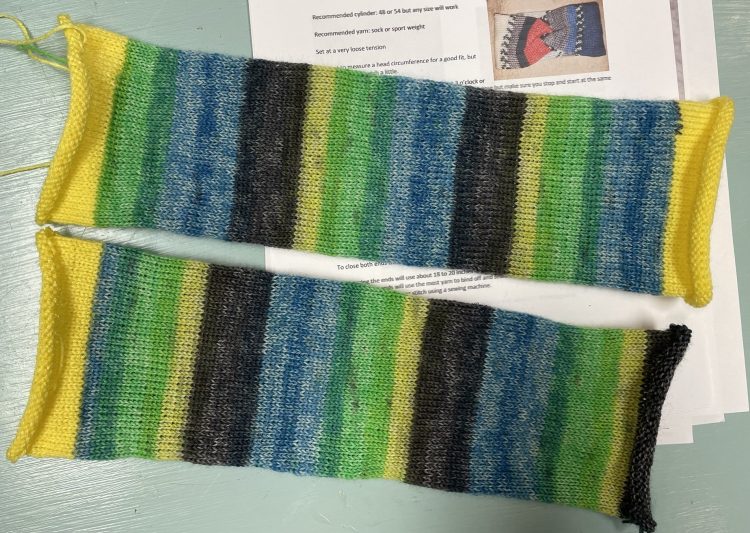
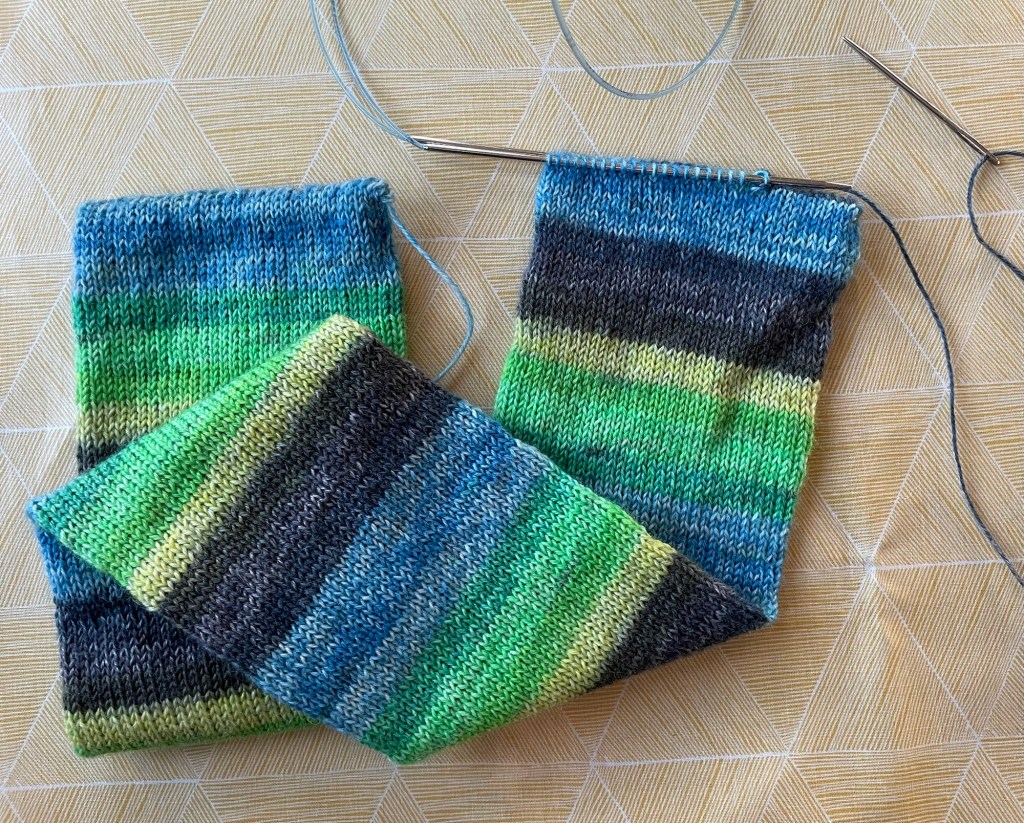
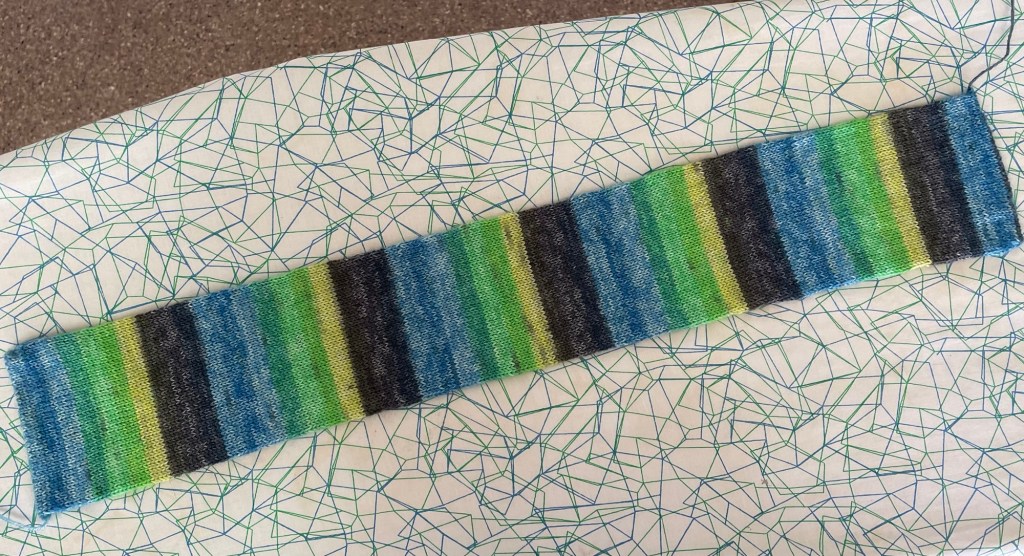
Due to user error of not reading all the instructions, my first cranked tube for the headband was only half the length it needed to be. I could have unraveled it and started over. Instead I cranked another tube about the same length, with the idea of making the two tubes into afterthought heel socks by knitting on the heel, toe and cuff by hand. It was another good project for knitting in the car.

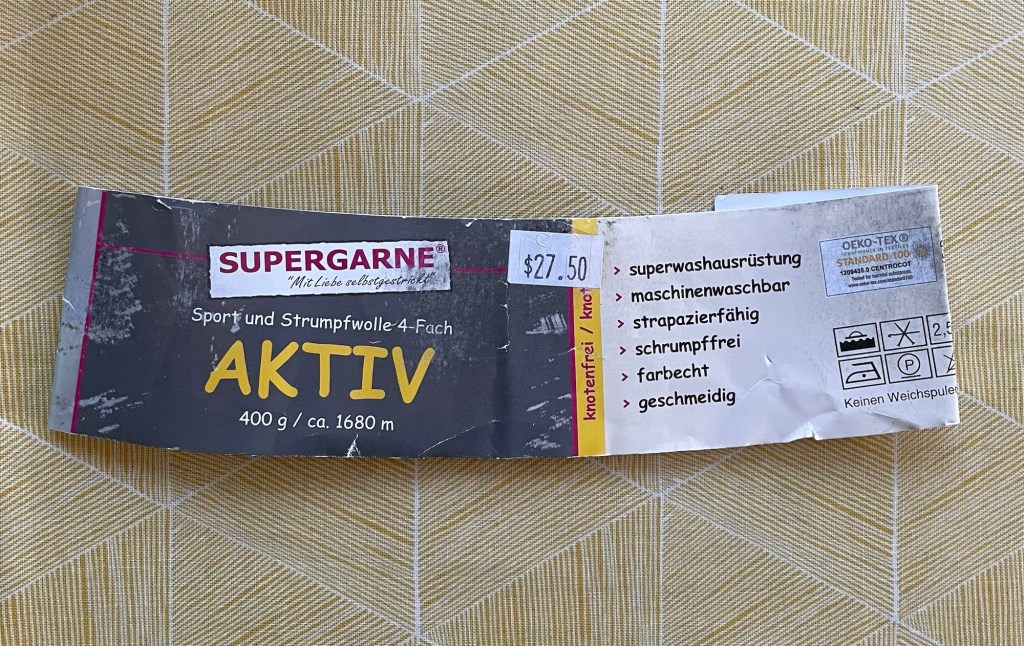
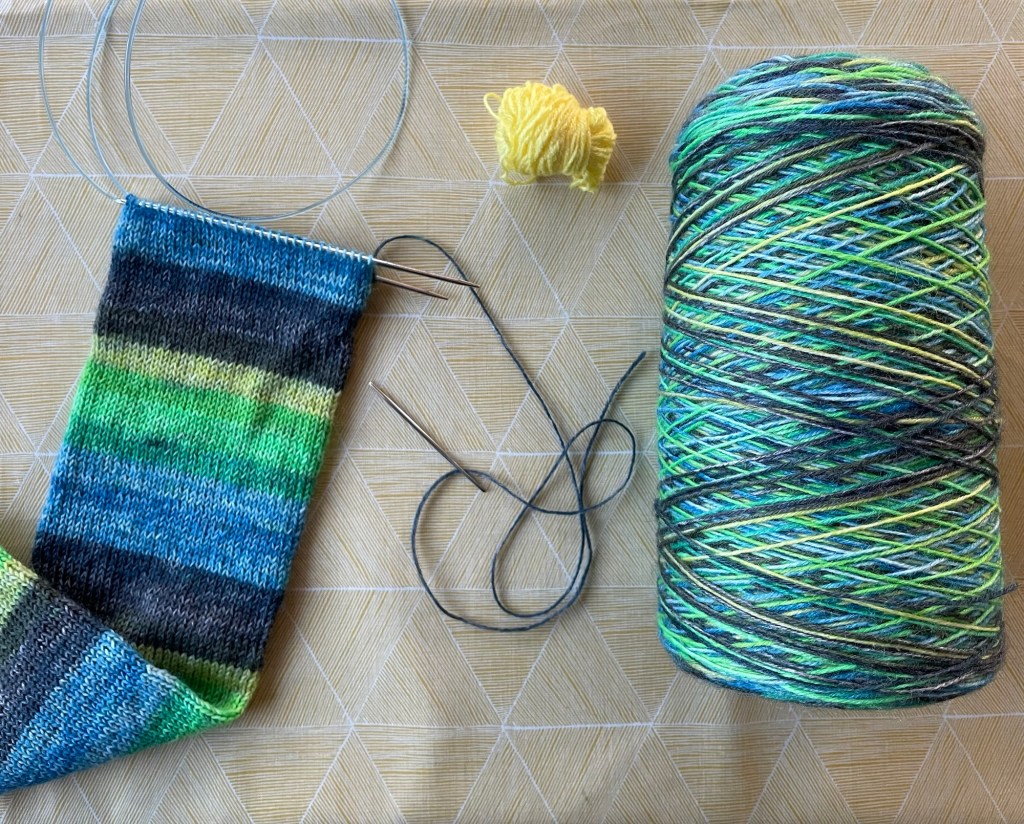
The next photo is the same one I used in the last post, of the Aktiv Supergarne self striping yarn that I used for both the headband and the afterthought socks. That started out as a very big cone of yarn that got a lot of use over the last months.

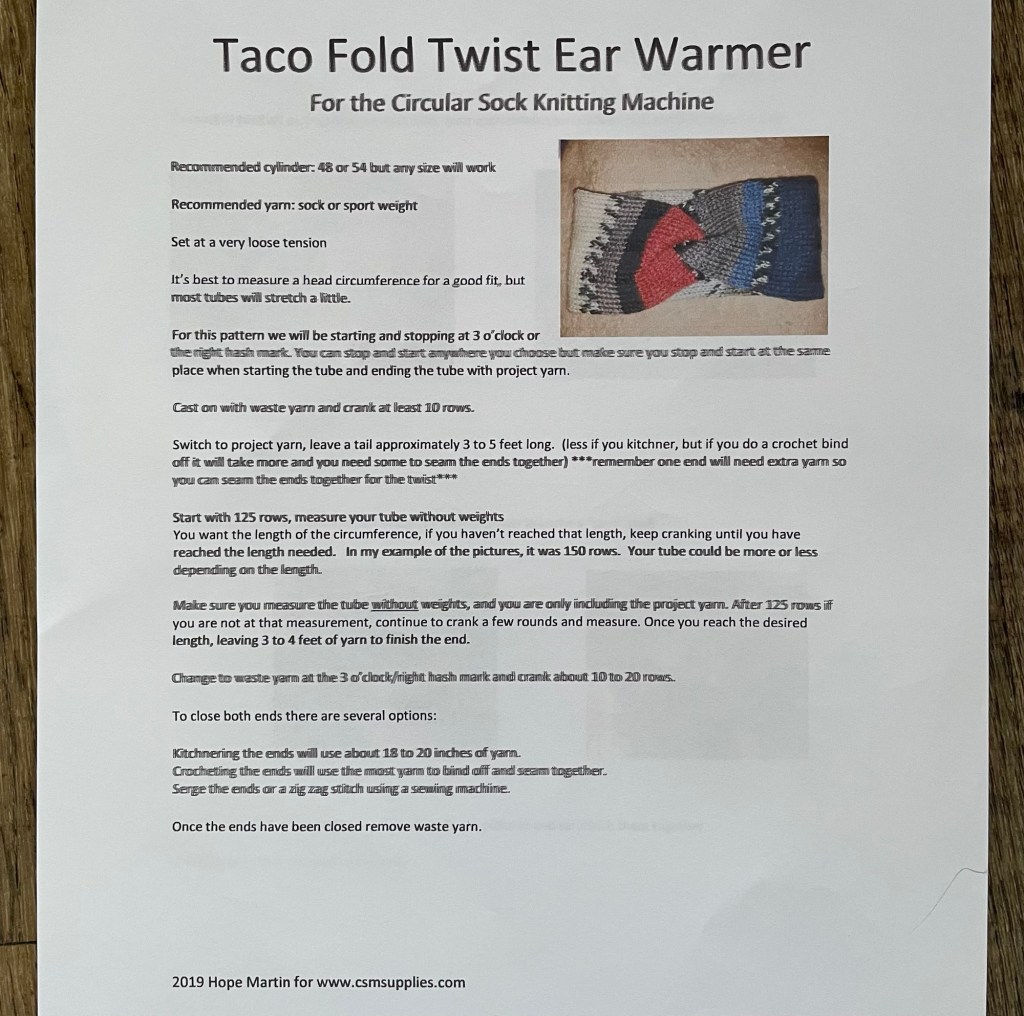
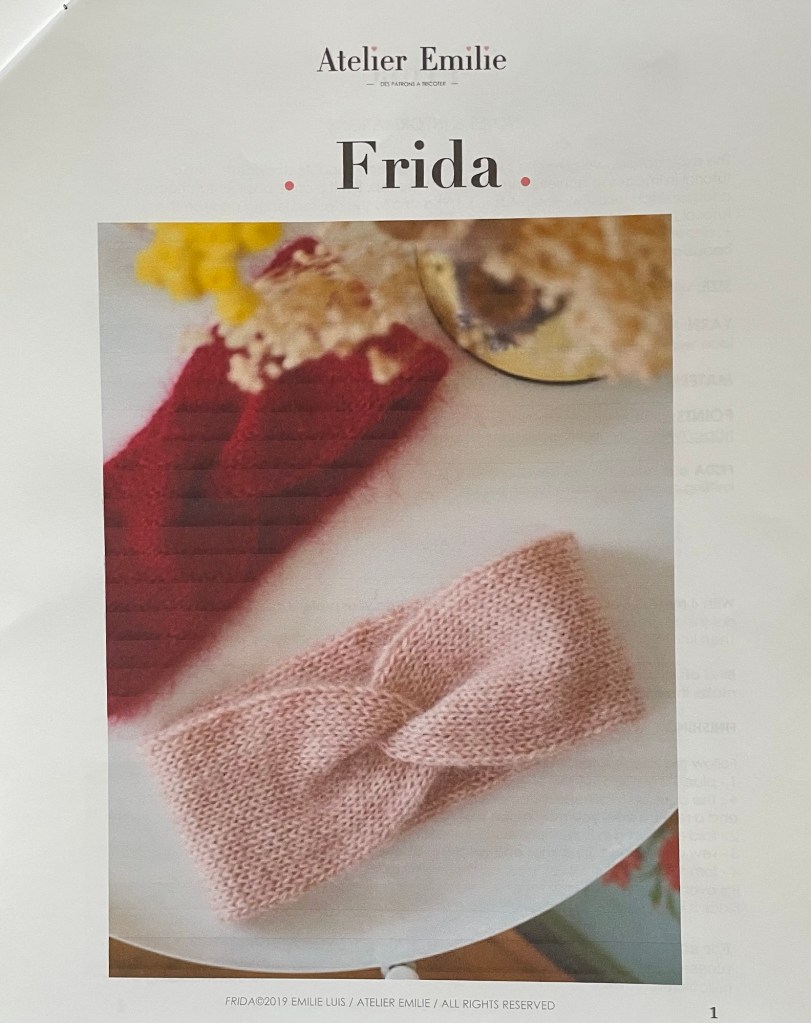
Following is a photo of the two too short tubes on top of the Taco Fold headband pattern.

I like to have hand knitting projects in process at all times for when I am watching TV and for road trips. Making these tubes into actual socks seemed like a good idea for bringing in the car on the way to our snowbirding stay in Arizona.

I have knitted afterthought heel socks before, where the heel is inserted at the end, rather than in place as you go. It is not hard, but it is not my favorite method. There is the challenge of figuring out where exactly to insert the heel, the extra yarn tails to be woven in, and the tendency for the heels to end up with holes in the corners. In this case the heel could be placed at a random location.

There are two versions of afterthought heel. One has waste yarn knitted in at the point where the heel is going to be, sometimes called a “forethought heel”. A true afterthought heel is where two rows of stitches are picked up directly from the knitted tube after the fact, without using any waste yarn. The row in between the picked up rows is cut and unraveled. It sounds scary but it works great. Click here for a video with good instructions for both versions of afterthought heel.

Picking up the stitches for the afterthought heel

Once the stitches are picked up and the waste yarn or row in between is removed, knitting the heel is very similar to knitting a toe with decreases on every other row.

Ready to start knitting the heel

The hardest part of this heel method is adding a couple of stitches in the corner on each side, which gives the heel a little more depth and is supposed to help with the gaps in the corners that invariably happen. Additional cleanup up of holes or gaps is taken care of when weaving in the tails at the end.

After I had started this project, I saw a link on Pinterest for a YouTube video with instructions for making socks out of a long tube cranked on a circular sock machine, exactly what I was doing. The woman who made the video sells kits with a pre-knit long cranked tube, along with mini skeins of contrasting color yarn for the heels, toes and cuffs. Click here for that video from Polka Dot Creek.

I knitted the heel on the first sock using the traditional method of decreasing every other row like a toe, and then grafted the stitches together at the point of the heel.

Heel completed like a traditional toe, with decreases on each side

I knitted the heel on the second sock using the Fish Lips Kiss Heel short row method, instead of the usual decreasing every other row method. In this technique the first half of the heel is knitted, and then second half is knitted. If you were knitting the whole thing by hand, you would just continue on knitting around the foot or leg. I forgot that in this case, after the heel was complete, I would have to graft the heel stitches all the way across to connect it to the leg of the sock. The two sock heels are pictured below with the different heel methods.

I continued working on this project after we got to Arizona. Generally there are not many pool days there in January, but there must have been one. At home I am not tempted to swim unless it is really hot out. In Arizona, if the sun is out and there is no wind, even 73 degrees can be warm enough to get in the heated pool. That is usually followed by a session in the hot tub.

Knitting the cuff at the pool

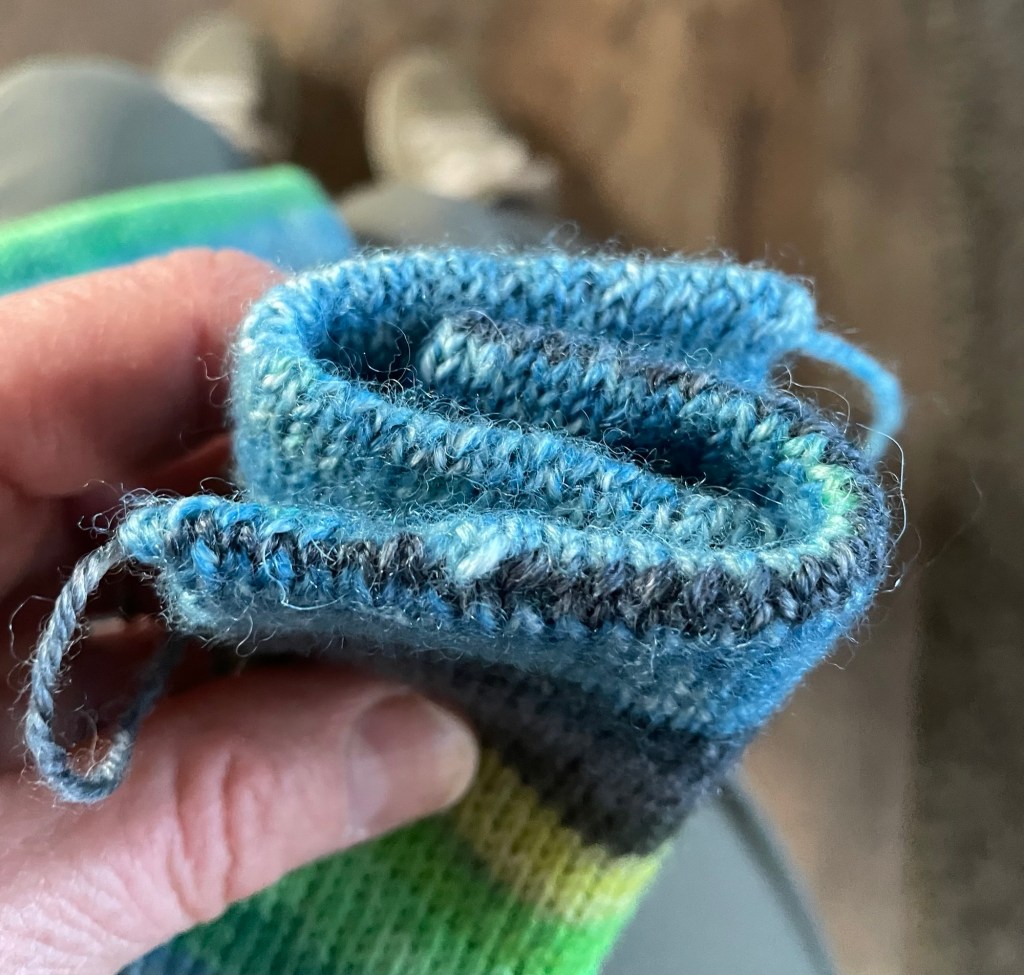
I knitted about two inches of ribbed cuff on each sock.

Knitting on the ribbed cuff

I had to knit even for a number of rows in the contrast yarn to get the foot long enough before it was time for the toe. I neglected to take photos of the toes in progress.

There are some beautiful self striping yarns that have amazing results looking like complicated colorwork, without any changing of yarn. In a sock knit continuously with all the same yarn, starting at one end and finishing at the other end, there are only two ends to weave in. This pair of socks with the heel, cuff and toe added in with contrasting yarn had TEN tails to weave in. UGGG.

After finishing the cuffs and toes, the last step was to weave in all the ends. This reminded me of why knitting afterthought heels, or contrasting heels and toes is not my favorite. There are ways of changing to a different yarn resulting in smooth transition without a tail, that I did not do on this project. My husband is encouraging me to make socks in sports teams colors which would involve changing the yarn multiple times. It is a good idea, but I will have to learn better methods of changing yarns, or maybe dye my own self striping team color yarn.

The afterthought heel ends up with a gap in the corners where the heel joins the leg and foot, so there is some fussing with the tail to close that up. You can see the hole in the corner of the heel in the middle of the next photo.

Showing the hole in the corner where the heel meets the leg

I did not like the way the second toe looked, so I re-knit it the same way as I knit the first toe. The following photo shows both socks complete and blocked, with matching toes but different heels. There is more contrasting yarn before the toe on one sock than the other, due to where I inserted the heel in the original knitted tube.

After completing this pair of socks, I saw more tips for adding the afterthought heel with minimal holes in the corner, and other ways of grafting. I might try another pair of afterthought socks some time to experiment with better methods, and use up smaller amounts of yarn.

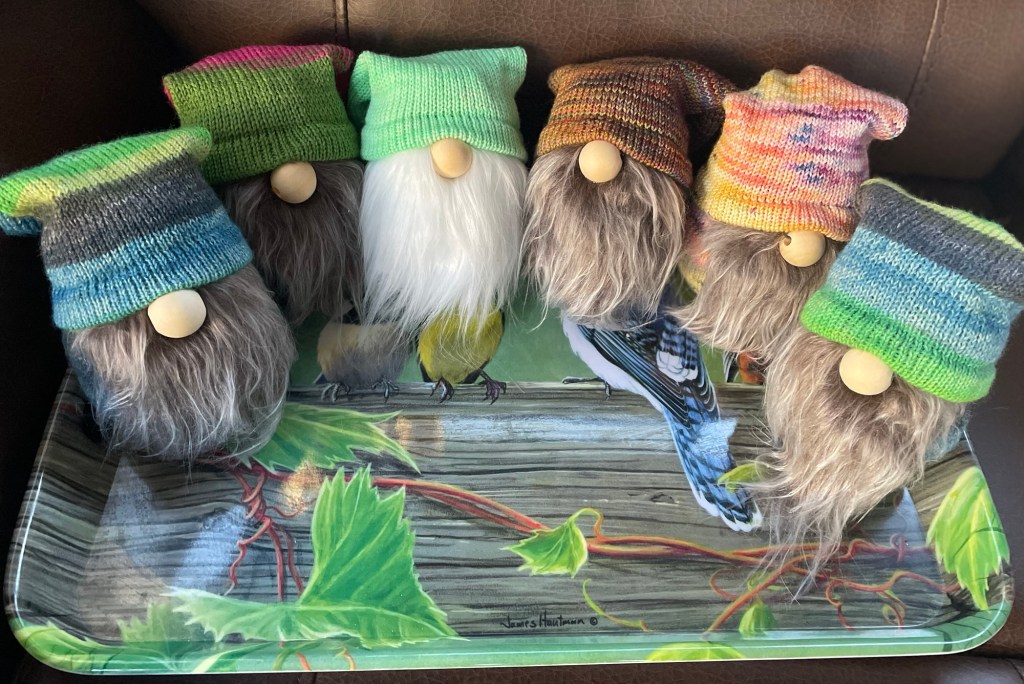
Since completing the afterthought socks and more gnomes, I have mastered making heels on my circular sock machine. My progress on the CSM has been faster than my ability to publish blog posts. Following is a photo of more sock machine gnomes, assembled with the help of my sister-in-law, Marlene.

Three of the gnomes went to my daughter and nieces who were visiting us in Arizona. The three cousins had a good time hanging out together at the 55+ resort where we are staying. While spending time in the hot tub one evening, another more “mature” adult noticed that they were not in the same age category haha. There was a conversation about what bars the younger people like to frequent and what else they like to do. The girls replied that the bar they frequent is “Marlene’s refrigerator”, and what they like to do is sit in the hot tub. They also like hiking and playing pickleball and other outings, but while on this short break from their regular life and work, they were all enjoying taking it easy.

Taco Fold Headband

At the end of December, I attempted another project without heels on my new sock machine. I used self striping Aktiv Supergarne sock yarn that came on a large 400 gram cone. This company, located in the Czech Republic, sells yarn on large cones that are popular with sock machine knitters. My CSM friend in Minnesota who goes through a lot of yarn reports that this sock yarn ordered directly from the company is the best deal she can find, in spite of the shipping cost.

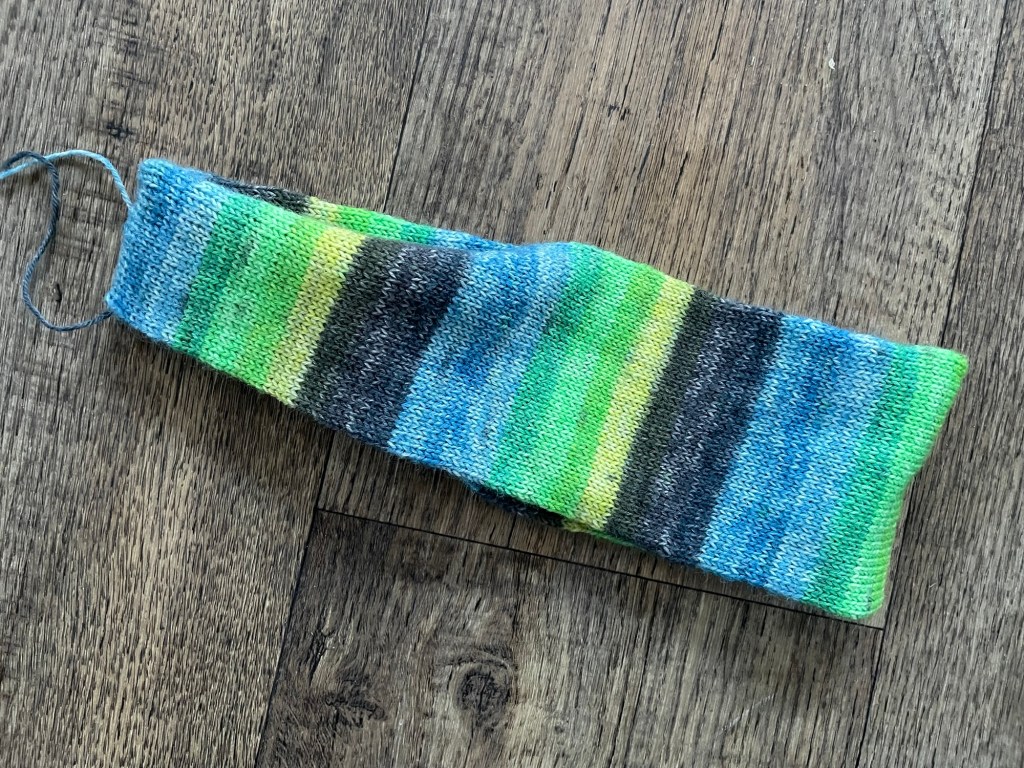
The Taco-Fold Headband is made with a long tube, so it is perfect for a sock machine project. I used a pattern specifically for circular sock machines, but there are other patterns for hand knitting the same style of headband. I followed the instructions that said to crank out 125 rows, and then check the length without weights. I neglected to pay attention to what the instructions said after that (oops).

I ended the tube after 125 rows, added the waste yarn. and removed it from the machine. It looked way too small and no way would it wrap all the way around my small head. It was only 11 inches long. After looking at the instructions again, it said that for the example project the author cranked 150 rows. That would still be too small. I would need 250 rows to get a 22 circumference headband. Later I started over again and cranked a tube with 250 rows for a headband. I did not have time to finish it while we were still at home, but it was a good car project for the three day road trip to Arizona.

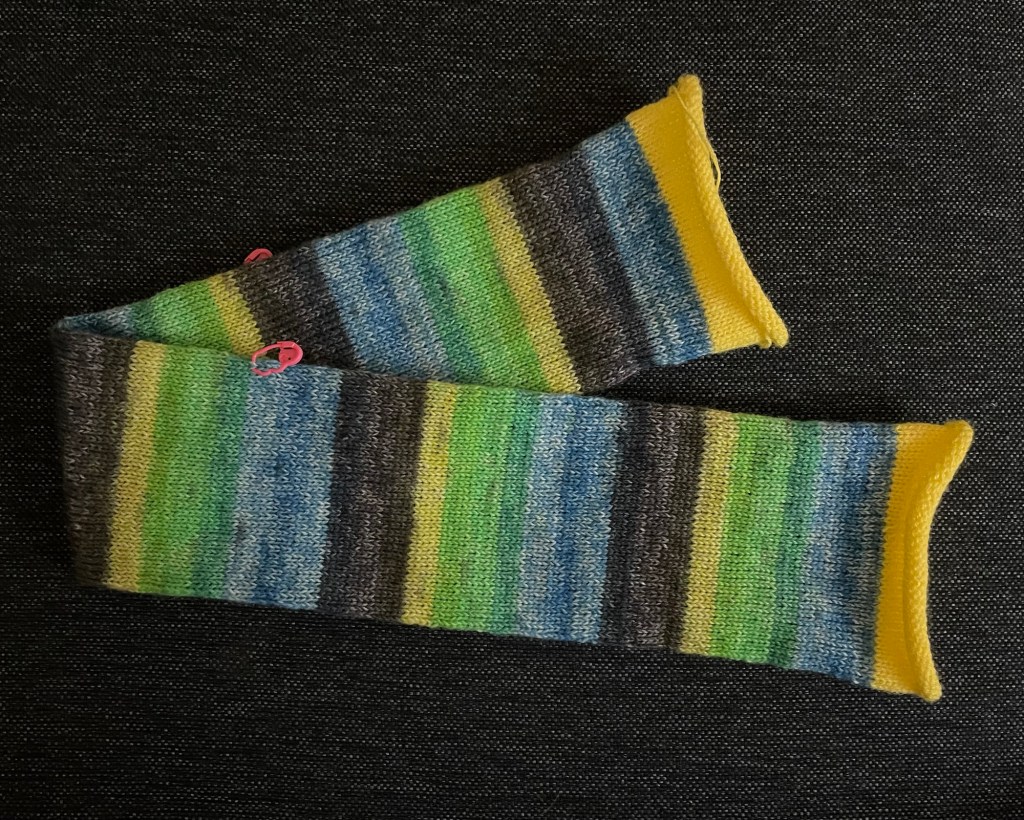
Tube for a headband

The headband was very easy to make. Step one after cranking out the tube was to finish off each end and remove the yellow waste yarn. There are multiple ways this can be accomplished. The pattern suggests kitchener stitch, crochet bind off, or zig zagging the ends together using a sewing machine. I chose to use kitchener stitch, as I thought that would be nice and smooth and flat. I picked up the stitches just below the waste yarn with my long magic loop size one needle. Since then I have learned some other ways to do kitchener stitch without putting the stitches on needles.

Once all the stitches were on the needles, I unraveled the waste yarn.

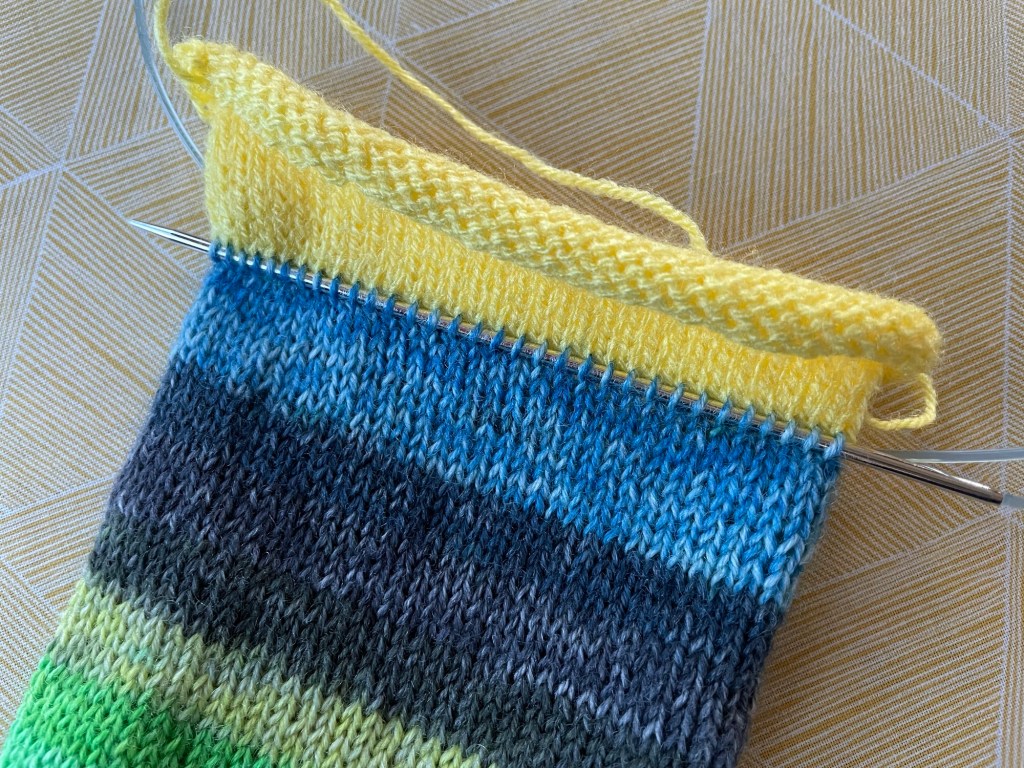
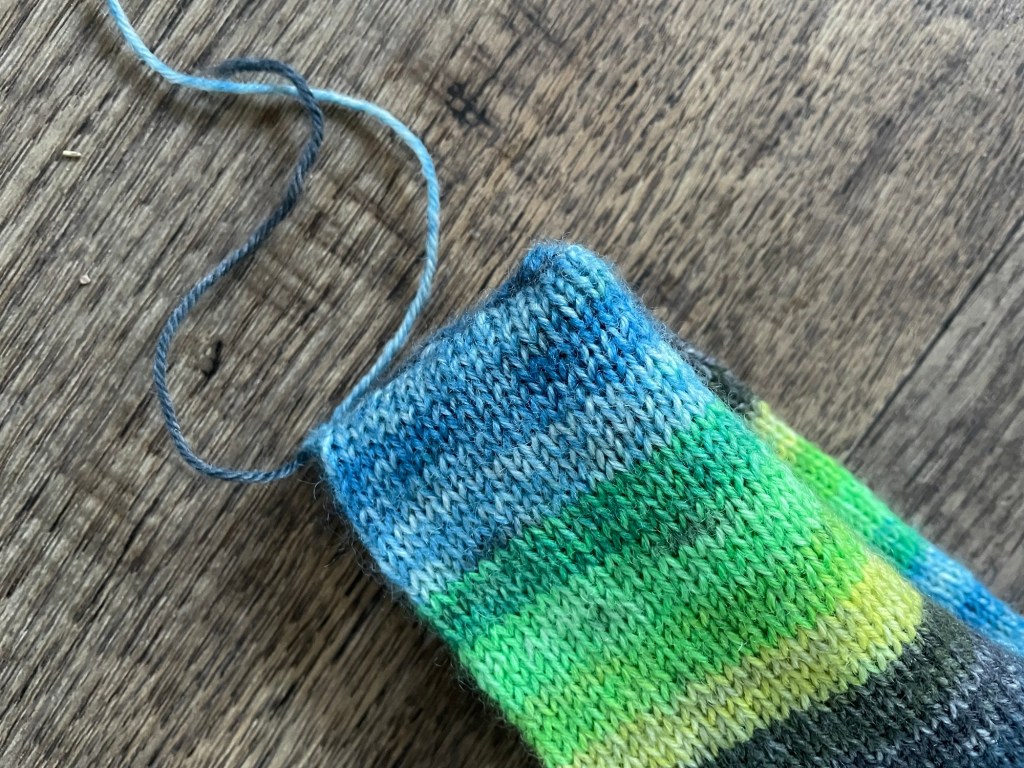
The following photo shows one end of the scarf with the stitches on the needles and ready for the kitchener stitch.

The next photo shows one end grafted together, and the kitchener stitch in progress on the other end.

Non knitters are always amazed at self striping yarn, or maybe knitters too. The yarn is dyed to result in stripes or other complicated patterns when knit up.

I found the assembly instructions a little confusing, so I found another similar pattern for hand knitting with more detailed step by step instructions including photos. This pattern can be found here on Ravelry.

The last step of finishing the headband involved folding the ends together like two tacos, and then hand stitching it together.

This headband was made with 64 stitches around, because the 64 stitch cylinder was on my sock machine. The pattern will work with any number of stitches. A larger number of stitches around for a wider headband will work too. The next photos show the two ends of the tube stitched together.

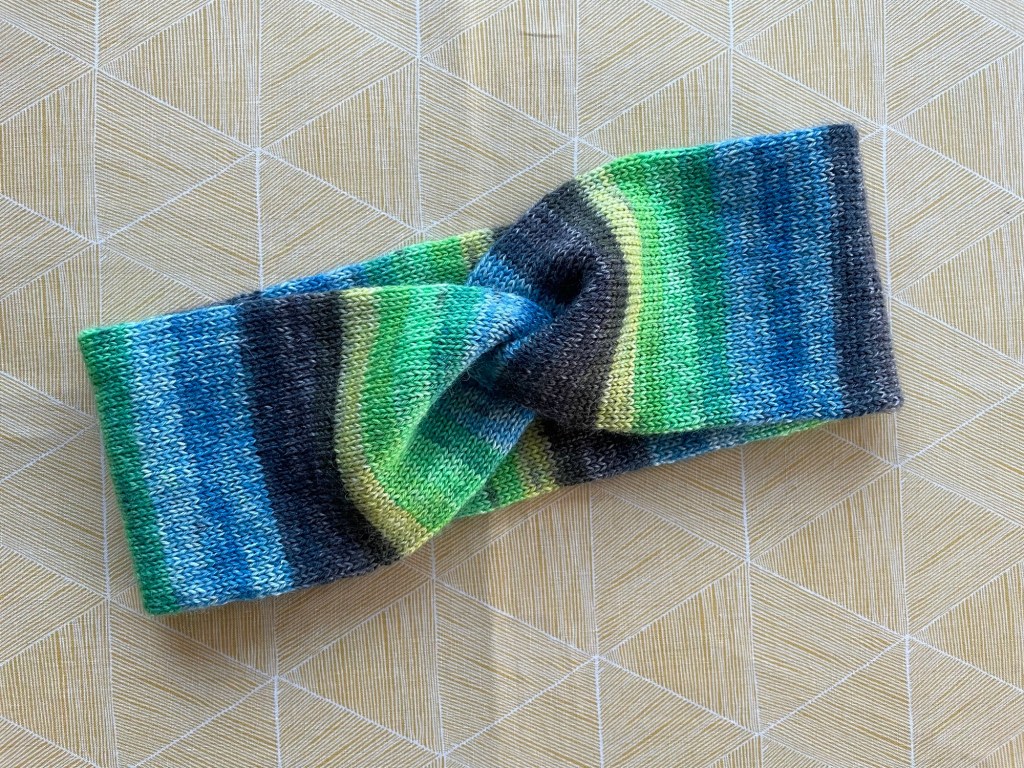
After the end is sewed shut, it is turned right side out and Voila, you have a headband.

Following is a photo of me modeling the headband while on a bike ride in Arizona in January. It gets cool here at night, even down to freezing in January. In all the years we have been coming here during the winter, there have never been more than a few “hot” days, even in March. This year it has been very dry, with only a few sprinkles of rain since last August. We are now coming up on a long stretch of very warm weather with temperatures getting to the upper 70’s and into the 80’s (and no rain in sight), which coincides with our daughter and other extended family visiting. Any hiking will happen in the morning, and afternoons will be spent at the pool. I won’t be needing the headband!

Commission Hat

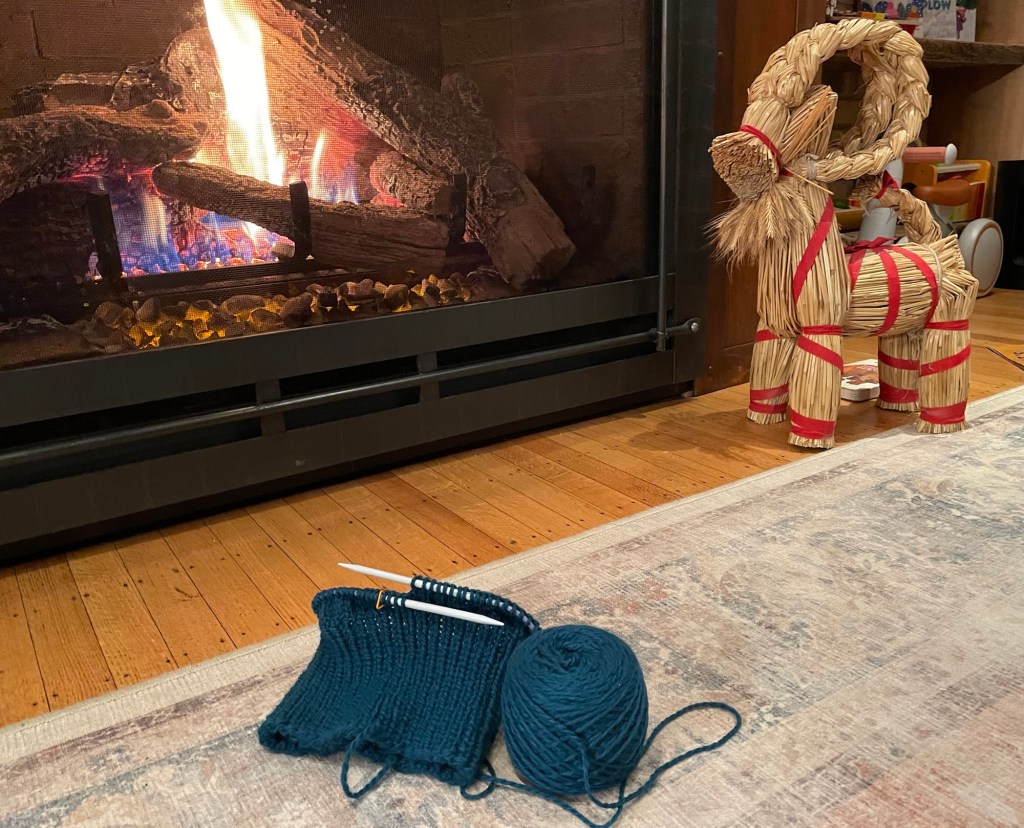
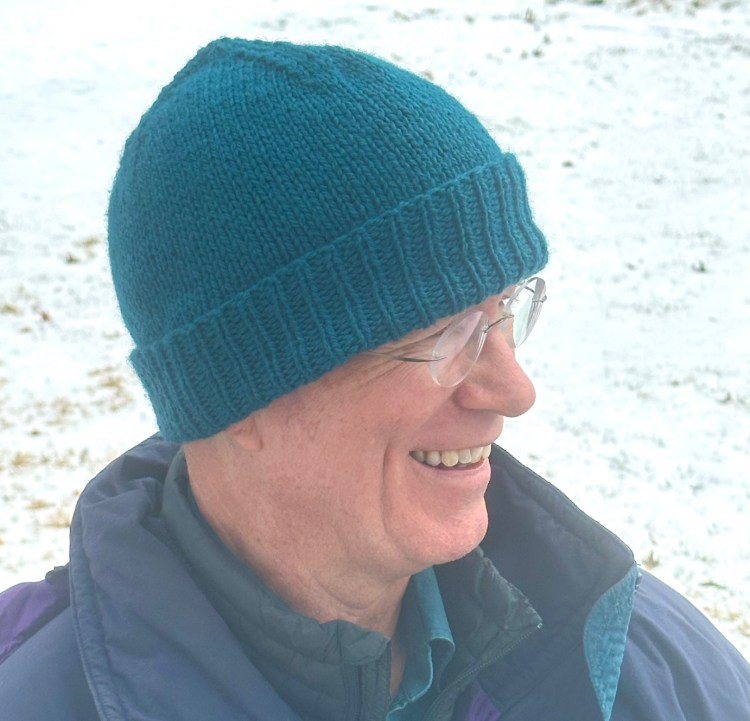
My friend Polly went on a trip to England. She was exited to see sheep all over countryside there, but surprised to find out most of them were bred for meat and not fiber. She bought a wool hat for her husband that turned out to be too small. Polly asked me if I could knit a hat the right size in teal wool yarn, that she could give him for Christmas. Hats are pretty quick, so I said yes to the project.

I happened to find two skeins of 100 % wool Plymouth Homestead yarn that matched the request exactly at Torri’s Tangles to Treasures, from my 2018 yarn store purchase.

100% wool Plymouth Homestead yarn

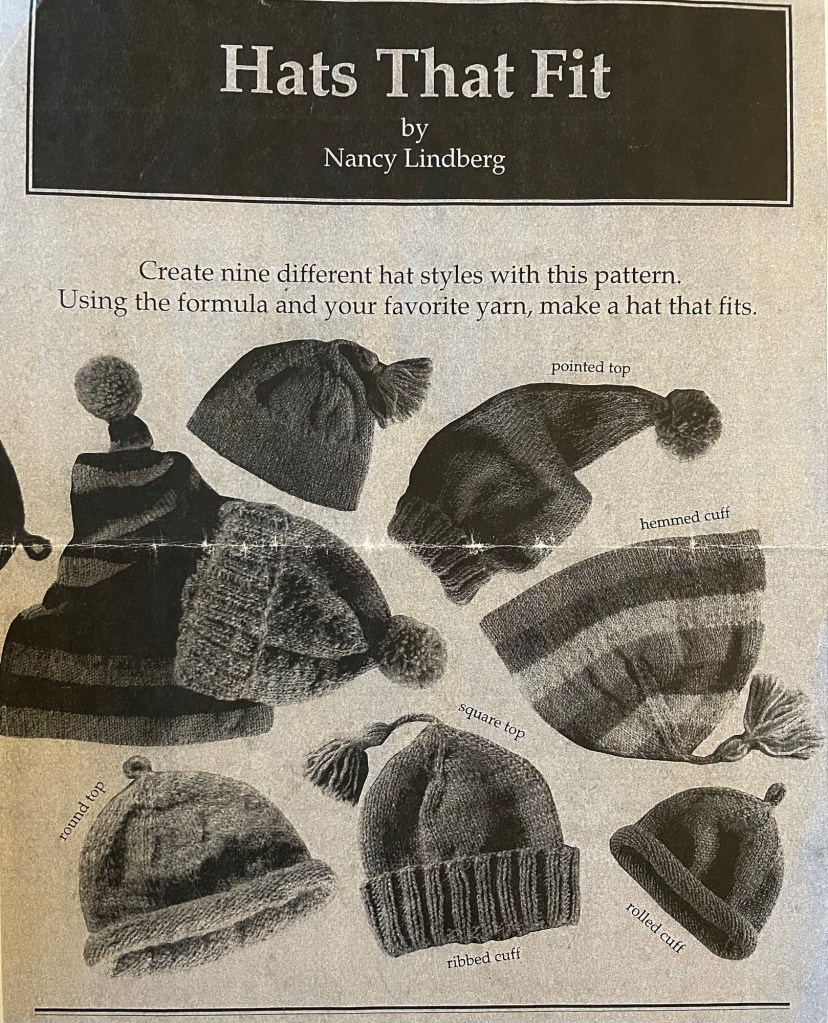
I have paper copies of quite a few knitting patterns saved over many years, although usually I forget to check there when deciding what to make. This time I remembered to look, and found an old pattern for hats with different options for the cuff and hem.

I chose the style in the bottom center of the photo above, with the ribbed cuff and square top, but without a tassel. Polly provided me with her husband’s head circumference by measuring two different hats he wears regularly. I worked on the hat while we were in California for Thanksgiving.

In order to figure out how many stitches to cast on, I made a swatch to determine my stitches per inch for this yarn, with the needles that seemed best. The pattern has a formula for figuring out the number of stitches based on your gauge, and then subtracting an inch for negative ease, and also adjusting down 10% for the ribbing.

I started out with 2 x 2 ribbing, but after a few inches I did not think it looked right, and it seemed too big around. I ripped it out and cast on over again with fewer stitches and started knitting in 1 x 1 ribbing. After knitting several inches, I liked the 1 x 1 ribbing better, but now it seemed too tight. ARGGGHHH. I should have just trusted the formula. I ripped it out again (or “frogged” it as knitters say) and started over with the original number of stitches, but with 1 x 1 ribbing.

We were staying at Wayne’s sister’s house in Alameda for an entire week. Our daughter lives nearby in Oakland. In order to give Yvonne a break and also spend some quality time with Britta, the three of us went on an overnight side trip to Monterey. We went to the aquarium, where we loved seeing all the different kinds of jellyfish, and watched a huge octopus. We also went on a coastal hike. The weather was excellent the whole time.

The knitting went pretty fast with the Aran weight yarn, and I was on vacation so I was not too annoyed or worried about having to start over twice.

While in California, we had lunch at In-N-Out burger. I am trying to reduce my red meat consumption, but we do not have In-N-Out Burger in Minnesota, so it was a treat.

I got a lot of knitting done on the plane back to Minnesota, and at my son’s house in St. Paul where we stayed overnight after the late flight home.

At my son’s house in St. Paul

The next day we drove to our house three hours away, through some snow squalls with a few stretches of minimal to zero visibility. Despite needing to get back home, we might have waited another day in the Cities if we had realized the driving would be that scary and dangerous.

The pattern said to make the ribbing 4 1/2″ wide which seemed very wide, so I looked at another pattern for comparison. The other pattern had a much narrower cuff, and also seemed to suggest quite a few more stitches for the size and gauge. That was perplexing, but I had enough of the hat complete to be able to measure the actual circumference so I felt mine was correct. The wide cuff was practical as it would be folded over for extra warmth, more or less depending on fit and preference.

Back home after the Thanksgiving trip we were very busy preparing for a new hardwood floor installation in our living room / dining area and main floor bedroom. There will be a future post about that project, which we thought would be wrapped up by the holidays, but in fact I won’t be able to post about it until spring.

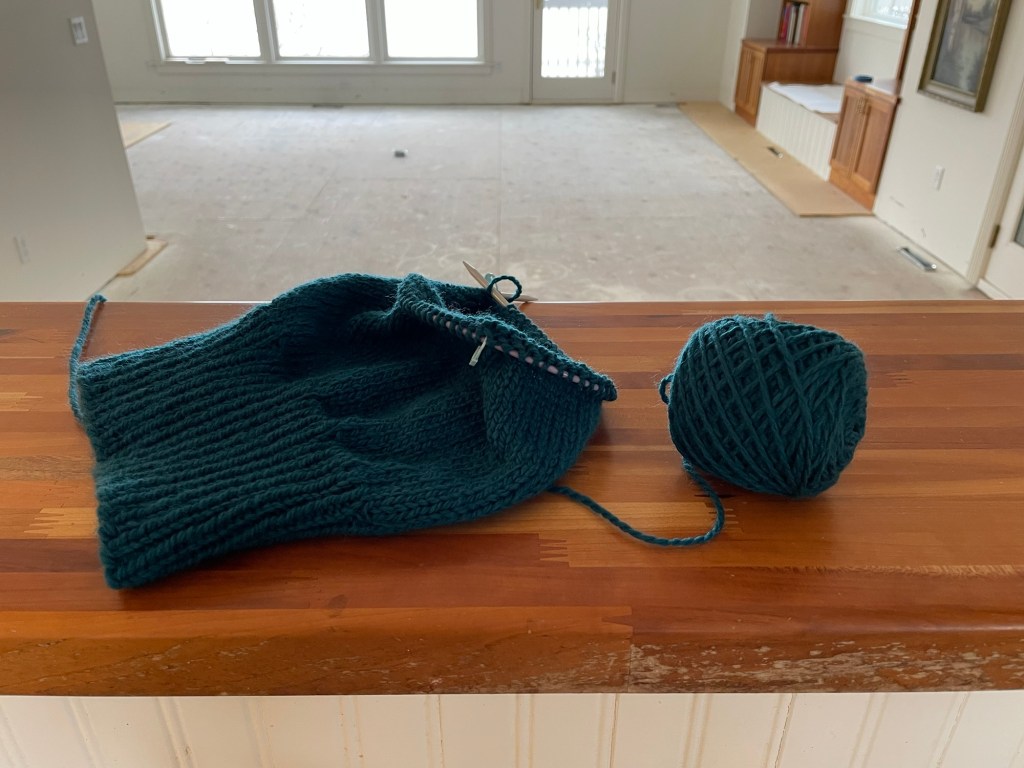
Hat in progress

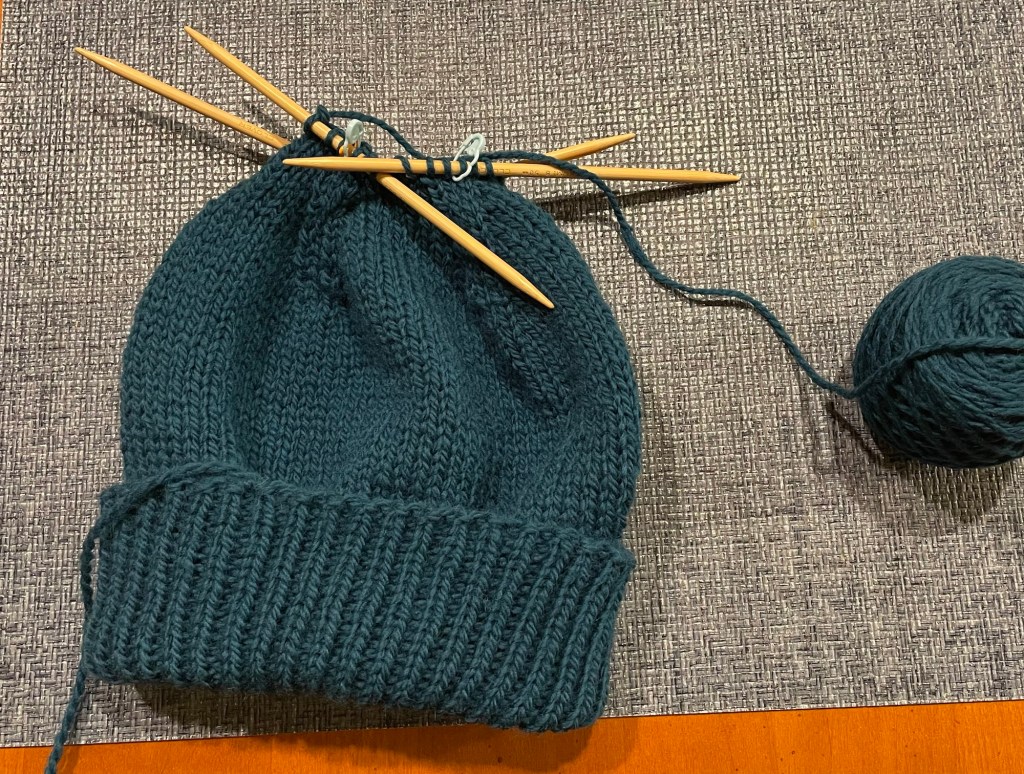
I had to switch from circular to double pointed needles as the number of stitches decreased at the top of the hat.

Hat almost done

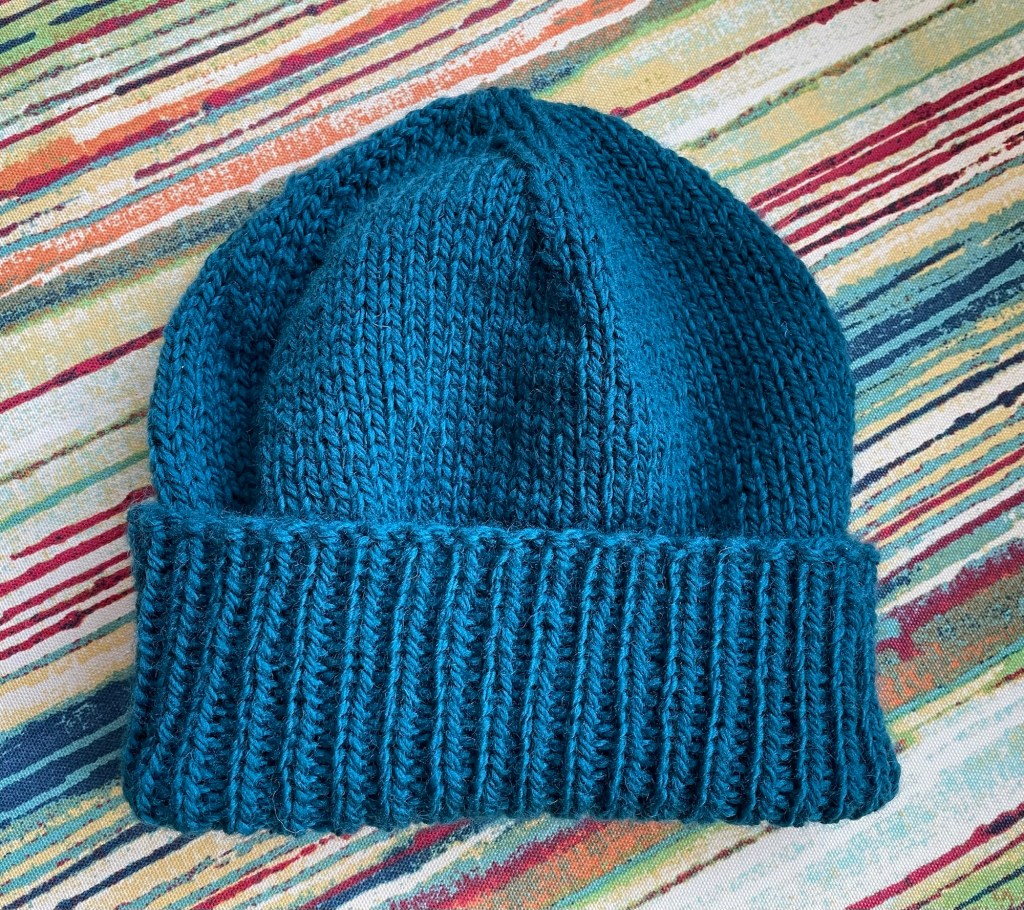
I think the hat turned out well. I was pretty sure it would fit the recipient, but I was going to have to wait a bit before finding out for sure.

I mailed the hat off to the Polly with plenty of time before Christmas. As it turned out, she was out of the country in Morocco with her daughter when the hat arrived. In any case, I wanted this project off my plate so I could get on with other gift items that I also needed to finish. After Christmas, Polly reported that the hat fit her husband James, and she posted this photo on her blog.

Polly’s blog pollycastor.com is A journal of art, photography, spirituality, ideas, books, movies, food, poetry & hope. She inspired and encouraged me when I was thinking about starting my own blog five years ago.

Later Polly sent me more photos of James wearing the hat from different angles. I like the square decrease pattern at the top. It would also be nice with a tassel or pom pom on the top, for the right person.

Hats are a quick easy knitting project. I need baby gifts for several babies due in the spring and summer. I expect there will be some baby hat knitting in my future, as they are very cute and even faster than an adult hat.

Mother & Daughter Socks

After finishing self striping socks for my son, but still long before I had my sock machine, I decided to knit socks for my daughter-in-law for Christmas. She liked this pretty blue and white hand dyed yarn I had from Greenstone Fiber Arts in Minnesota. I bought it at a fiber fair, but they have an ETSY shop that can be accessed here.

I made two center pull balls of equal weight, one for each sock. The cake that looks bigger is actually a few ounces less than the other cake, because it is wound looser.

I started off making the toes separately, because it is easier to do Judy’s Magic Cast-On one at a time. I knitted the entire first toe on size one magic loop needles, then transferred it to double pointed needles while I knitted the second toe. While I was working on the second toe, I noticed a problem with the first toe. After finishing the second toe, I ripped out the first toe and started over.

I have knitted several pairs of socks for myself that fit well with 60 stitches around for the foot. They have a few extra stitches added before the heel, and for the cuff. Kelsey has almost exactly the same size narrow feet as me, so I started out her socks with 60 stitches around. It is nice to know that if the sock fits me, it will fit her. After finishing the toes I got both socks on to the magic loop needles for two-at-time knitting.

At the time I started this pair of socks, I had begun to seriously think about buying a circular sock machine. I wanted to knit these socks as if they were knit on a circular sock machine, so I would know how that would come out. Knitting a sock by hand means you can make any adjustment you want to any part of the sock to get a perfect fit. You cannot add stitches on the sock machine.

If I knitted Kelsey’s sock with 60 stitches, the heel and cuff would be too tight. ARGGG, I concluded there should be 64 stitches around. That meant unknitting a couple of rows, putting one sock back on the double pointed needles and doing another increase row on each sock.

We were on a scenic drive around Otter Tail County, Minnesota, looking at the fall colors while I was working on this. It should have been pretty easy, but I had to re knit one of the additional increase rows due to a very big sloppy stitch I found in the corner a couple of rows later. Better to fix it and be happy with the sock, rather than later wished I had. Finally I got both socks at 64 stitches around and back on the magic look needles with a couple of rows of toe knitted.

We had some beautiful colors across the road from our house this fall.

Peak fall colors across the road from our house

We also had unseasonably warm weather late in the fall, which caused some lilac bushes to bloom in Minnesota. Our big overgrown lilac bush did not bloom again, but a small bush had new growth. This seems very unhealthy and not what is supposed to happen. I heard that if a bush blooms in the fall, it will not bloom in the spring. We will see.

A small lilac bush with a new bud in the fall

I had two goals for this pair of socks. One goal was for them to fit Kelsey, and the other goal was to get information on whether a 64 stitch sock machine cylinder would work for a generic ladies sock. After knitting more of the foot with 64 stitches, I started to get worried they were going to be too loose. I thought about options for making the foot have more elasticity, including adding some rows of ribbing in the foot, which would make it fit more tightly.

I was prepared to add a section of 1 x 1 ribbing in the middle of the foot, but when I got to the right place to start the ribbing they did not seem too big around after all. This pair of socks was coming out a similar size around to other socks I knit with yarn that is a little thinner, with only 60 stitches around. It is all a mystery. I did not do the ribbing in the foot after all.

I worked on the heel in the car using my favorite short row method, Fish Lips Kiss Heel. I can almost do this without looking at the pattern. The standard way to do the heel is using exactly half of the stitches. Since you cannot add stitches on the sock machine to make the short row heel fit better, the way to make the heel “deeper” is to use more than half of the stitches. Since I was trying to mimic a sock made on the sock machine, I made the heels using two more stitches on each side of the heel.

Working on the heel in the car

Following is a photo of the socks complete, before blocking.

Socks complete but not yet blocked

I had some other hand knit socks that needed to be washed. I put all the socks in a tub of warm water with a bit of wool soap, carefully rinsed them with clean water, squeezed out extra water, rolled them in a towel to remove more water, and then spread them out to dry. Most of these socks are made with superwash yarn that has been processed so it won’t shrink in the washing machine. The process used to get it this way is not good for the environment, but that is a different topic. I have always been nervous about putting handmade socks in the washing machine, not wanting to take a chance on ruining them. Later I tried it with a couple of pairs and found it worked fine, noting that I did not put them in the dryer.

Washing five pairs of hand knit socks

There was enough yarn left to knit a pair of matching toddler size socks for my granddaughter.

Toddle size socks with the leftover yarn

One ball of yarn was going to run out before I finished knitting the socks.

More yarn left on one sock than the other

I spread the remaining yarn out, so I could cut off half of the yarn from the ball that had more, to use on the other sock.

After knitting a couple more rows I stopped. I might have been able to knit one more row, but I did not want to find out. I went ahead and cast off, leaving only a few inches of tail on one of the socks.

Toddle socks complete with only inches of yarn left

I gave the pairs of matching socks to Kelsey and Blair for Christmas, along with another pair of toddler socks I had knit years ago. Blair was not excited about the socks (no surprise), but she did like the baby doll she got from Santa. She also got an American Girl size doll from her great great aunt who has never met her, with a whole box of clothes and accessories hand made by a friend of hers.

Blair knew right away to put the tiny bottle in the baby doll’s mouth.

Blair feet and doll foot
Wayne holding Blair wearing one of the pairs of hand knit socks

I find it fascinating how much happens in a child’s first two years of life. Blair goes to Spanish Immersion day care. Her first word was “agua”, which she uses for all beverages. At Christmas time she was 18 months old and saying more words that we could identify, such as dog and ball. She very clearly pointed to her other grandpa and said “papa”. There were three dogs in the house including their own dog Winnie, the other grandparent’s dog, and Kelsey’s brother’s dog Olive. Blair had been referring to all dogs (and all children) as “dog”, but she clearly said “Olive” while pointing at the correct dog. Not sure why she did not try to say the name of her own dog, or why only the other grandpa was “papa”. I am sure her language will develop quickly over the next months.

It seems like Blair recognizes us now on facetime which makes me very happy, since there is a long stretch of time while we are in Arizona when we won’t see her in person. When we get back home in the spring, she will have grown a lot and be speaking many more words, and her baby sister will be arriving at any time. I hope to knit matching infant and toddler sweaters by then.

Rabbit Hole & More Gnomes

A fiber art friend commented that my new sock machine journey is a “rabbit hole”. That is an excellent description. According to Wikipedia, “down the rabbit hole” refers to “getting deep into something”. I think that starting a new activity that involves buying a bunch of supplies and equipment, and that takes up inordinate amounts of time when you should probably be doing something else, qualifies as down a Rabbit Hole.

After posting about getting my circular sock machine (CSM) and trying to make heels, one reader wondered if I used up all the yarn I had assembled. No. Hahaha. The photos in that post included only a small part of my sock yarn stash. Before I bought the sock machine I already had a supply of sock yarn for hand knitting. After I got the machine, I started looking for sales and deals on sock yarn, knowing I could go through it quickly. Since then I have purchased yarn here and there online, from the Erlbacher circular sock machine company, in person at yarn stores, at thrift stores, at a re-sale shop when we were on vacation, and I received yarn for Christmas. Following are photos of all the skeins of sock yarn I have. Some will be used for practice, some is waiting for me to become proficient at using the machine.

The first photo includes small amounts of yarn leftover from previous sock knitting projects, two large cones of waste yarn, a large cone of variegated sock yarn, and some other random yarn.

In the next photo are two cakes of yarn that I wound for knitting socks a long time ago, but never used. The rest are more recent purchases.

The yarn in the following photo is more expensive. I will wait until I am able to make a sock with a heel successfully and consistently before using any of these skeins.

Wayne gave me four skeins of self striping sock yarn for Christmas, for me to make him socks in colorways he likes.

So maybe I got a little carried away, but I do hope to crank out many pairs of socks for everyone and their brother once I am able. After my less than successful attempts at making heels on the sock machine, and the limited time I had in the last weeks before Christmas and leaving for Arizona, I did not want to spend any more time trying to make heels. It made more sense to practice with the CSM by making a Gnome, which involves cranking out a long tube with three parts separated by waste yarn.

For my first gnome all by myself I picked out some green and red self striping yarn. The long tube I cranked came out twisted looking. There are a couple of reasons that might have happened. It could probably have been fixed by blocking, but it did not matter for a gnome.

A crooked cranked tube for a gnome

Two of the three gnome sections have a “hung hem”, which is a method of finishing the edge while it is still on the machine, that is also used for sock cuffs.

Hanging the hem on one of the gnome sections

After cranking out the tube, there is quite a bit of hand work separating the three sections, finishing off ends, assembling pieces, sewing on the nose, gluing on the beard, and sewing the hat on. Following is a photo of the three gnome parts separated, with yellow waste yarn still attached.

Three parts of one gnome

The sock machine gnomes make great Christmas gifts, but at first I was not sure if I would have time to make more than one for this holiday. After realizing that I could do some of the gnome hand work in the car during another trip to Twin Cities and back, it made sense to crank out a couple more gnome tubes in the evening, when I might otherwise be watching TV.

After cranking out another gnome tube (see the next photo), I thought the cool self striping pattern on that yarn was wasted. The longest section for the “body” of the gnome is folded in half so that part is not visible at all, and most of the other half is covered up by the “shirt”, which is covered up by the beard and hat. This yarn would make excellent holiday socks. I am not ready for that yet, but I will have to order more for a pair of socks for next Christmas.

One long tube consisting of the three parts of a gnome

After that I cranked out an even longer tube with all the sections for two more gnomes connected by waste yarn, using the same two yarns, plus some plain red for the body sections.

Parts for two gnomes connected by waste yarn

The red yarn turned to be much thicker. I had to loosen the tension. There were 50 grams of red yarn which is enough for one sock, but apparently not enough for two gnome bases. About three fourths of the way through the second base I had to switch to the red and green striped yarn to finish that section.

Following is a photo with all the parts for four gnomes, after removing all the waste yarn and doing some of the hand work. One of the hats has a ribbed cuff instead of a hung hem. It is fun to have one that looks different, but it was because I forgot to hang the hem while I was cranking that section, so I had to come up with a different bind off for the hem.

All the sections for four gnomes

The next photo shows the four gnomes after completing the bottom “body” part, putting the “shirt” piece on over that, and sewing on the nose. The beards and hats are ready to go on next.

The hardest part of making a gnome is cutting the pieces of fake fur without accidentally clipping off the actual beard fur. I completed the four gnomes in time to give them as Christmas gifts.

I gave one of the gnomes to my son and daughter-in-law. It is shown in the next photo on their mantel, with two nutcrackers. They live in a house built in the 1880’s that has been remodeled multiple times. It is a cool house, but not without problems related to being a very old building. In the weeks before Christmas they had water leaking from the ceiling in the kitchen, and they had a rat inside the house. There were multiple people trying to figure out the water problem, and I am not sure it has been solved yet. An exterminator caught the rat. No, it was not a large mouse, I saw a photo. My daughter-in-law bought a rat nutcracker as a joke for our son.

The other gnome made out of the same yarn went to my sister-in-law, who has a gnome collection. She and her husband also stay for a few months at the 55+ resort in Gold Canyon where we are now. She brought her gnome along, where it is pictured below next to some metal quails. She was working on a painting project when I stopped by to visit and take the photo.

Later we went on a hike in the Superstition Mountains nearby. We happened upon gnomes hanging from trees along the trail!

There was a sign about the gnomes on the trail. We missed some as they were pretty small in the vast landscape.

The gnomes on the trail were made a different way than the CSM gnomes. It looked like the base was composed of two pieces of felt stuffed and sewn together, with a hand knitted pointy hat. I have seen many different versions of gnomes over the last few months, including crocheted, metal, wood, and various knitted patterns.

After completing the four gnomes, I had to take a break from “cranking”. The CSM was packed away over the holidays, while we were getting settled in Arizona, and while I waited for Wayne to make me a table to use in the RV. I will be making more gnomes in the future, as it is a fun easy project for the sock machine (without a heel!), and who does not want a gnome as a gift?

Socks for my Son

Last year I knit a pair of self striping socks for our son, before I had any idea of buying a circular sock machine. This pair took forever to knit due to getting side tracked with other projects. The socks have been finished for a while, but I could not post about the project until after I gave them to James for Christmas.

I used Schachenmayr 4-ply self striping yarn, a German brand.

I had knit James a pair of socks in the past out of the same yarn, in a different color-way. I did not have a record of how many stitches around I used for the other pair, but I did have some notes on what the width of his sock should be. He has narrow feet like me.

I cast on for toe up socks, and then knitted the increase rows until I got to what I thought was probably the right number of stitches. It is hard to tell how wide across it is going to be until you knit a couple of inches of foot after the toe. I put a “lifeline” in before starting the even foot rows. A lifeline is when you put a piece of waste yarn in a row of stitches, so that if you have to undo the knitting, you can quickly rip back the rows up to the lifeline, without accidentally dropping any stitches. The string holds the stitches so you can easily put them back on the needle. I have never used a lifeline before, but it seemed brilliant in this situation, in case I needed to un knit the foot rows and add more stitches to make the socks wider around.

Beginning of the sock with a lifeline at the toe

I knit the toes one at a time, but then put both socks on magic loop needles for knitting two at a time once I was on the foot part.

Making progress on the foot

I brought the socks with me on an outing when we were in Arizona last winter.

Bringing my knitting on an outing in Arizona last winter

In the middle of knitting the socks, I started a different higher priority project, so the socks went on the back burner. I put the stitches on waste yarn and set it aside so I could use my size 1 circular needles for the other project. Later I knitted on the socks again.

Working on the foot of the socks

When I got close to the place to start the heel, I added some stitches on each side to make the short row heel fit better, using the Custom Toe Up Socks course from the School of Sweet Georgia as a guide.

Ready to start gusset increases

I don’t know how many times I have lost track or made a mistake when doing increase rows alternating with plain rows. More than once I have been going along thinking everything is fine, and then I realize that I have more stitches on one side than the other, or somewhere. Or else I lose track of whether I am on an increase row or a knit even row. The increased stitches look different, but sometimes it is hard to tell.

I came up with a way to solve both of these problems. When I got to the increasing stitches for the gusset section, I put markers on each side of the original 34 stitches on that half of the sock. As I added stitches, they were on the outside of the marker. This way I could see how many stitches had been added to the original, without counting every single stitch. I also put another stitch marker on as I was knitting the increase row. Then when I came around again, I removed it and knew it was time for an even row.

Using a marker in the inside of the gusset increases

After adding a couple of stitches on each side I worked the Fish Lips Kiss heel, one sock at a time. I prefer to do the heels one at a time, and then put both of the socks back on the needles for the cuff.

Working on the heel

I continued working on these socks over the summer when the young adult kids were playing Kubb at the lake. They are too old to be kids. Are they still “young” adults when they are in their late 20’s?. What do we call them? What do we call us? Anyway, I had never heard of Kubb until we went to a birthday party for one of Wayne’s friends at a brew pub. They had an area for outdoor games, including Kubb. One of the cousins brought this game to the lake. They all had a blast throwing blocks of wood, trying to knock over other blocks of wood. That is about all I can tell you about this Swedish game. You can read more here if you are interested.

Knitting while the kids played Kubb

I also knitted while sitting on the beach at the family cabin.

Knitting on the beach at the cabin

I don’t remember where the next photo was taken, but the socks were almost done at this point.

Finishing the cuffs

The socks were finally finished in the fall. I put them away until Christmas.

We spent Christmas morning at our son’s house, watching the gift opening with his in-laws. Our 18 month old granddaughter got the most gifts, of course. The socks fit James, and I think he liked them.

When our kids were growing up I put a lot of effort into creating a special Christmas morning experience. As the kids got older and moved on I had a hard time with the transition, and there were a few years when I was pretty stressed out and no one else seemed to appreciate it. After we moved, and during Covid, there were a couple of very strange holidays. There was one year (2020?) when Wayne and I were alone for the first time ever, and there were a couple of years when plans were disrupted by people getting covid.

Today I am fine with wherever we are and however things play out, for the most part. I do not need a whole pile of gifts, or anything expensive, but it is nice to have at least one thing to open. Wayne needed some direction on what to get for me. By the time we talked about it, it was too late to order something online, so I suggested he could go to the LYS near James’s house in St. Paul, The Yarnery, and pick out some yarn that he would like for socks for himself. He was intimidated, but I described what kind of yarn to buy and told him to ask the sales people for guidance.

On Christmas morning I did have a couple of gifts. James and his wife gave us a gift certificate to see a play at the Guthrie Theater in Minneapolis. The box from Wayne to me contained FOUR skeins of Schachenmayr Regia sock yarn in colorways he liked. Interestingly, that is the same brand as the yarn I used for the socks I had made for James.

Christmas gift yarn to me from Wayne

I look forward to knitting socks with my new circular sock machine. First I have to figure out how to make heels on the CSM without dropping stitches all over the place. That is my goal while we are in Arizona for the winter.

Skirt from Woven Fabric

My daughter, Britta, asked me if it was possible to weave fabric that could be made into a skirt. I liked this idea, so when she was visiting this summer we talked about how that could work, and what yarn fibers and density would be best. We looked at colors and patterns, and took measurements for how wide and how long the woven fabric would need to be.

Following is a photo of the skirt Britta saw online that inspired this project. Click here for a link to the listing. This skirt is very tight and short. It has a zipper in the back and is made with viscose fabric. We agreed a similar look could be achieved by taking a rectangle of woven fabric, wrapping it around, adding some darts for shape around the waist, and using buttons or a zipper on the side.

Skirt that inspired this project

I showed Britta some of the scarves and towels I had woven to get ideas for yarn and weave pattern. Some cotton/linen blend towels had the best fiber and density, at least in the universe of things I had hand woven. Britta liked the following pattern best from that set, but with yellow for the contrasting color instead of green.

Green towel with the pattern Britta liked
Yarn and colors Britta liked for her skirt, but with a the other pattern

Since the fabric was going to be turned sideways for the skirt, I figured out how to write out the pattern with the warp and weft reversed for my four harness floor loom.

I was worried about whether I could make the fabric wide enough. The width of the weaving would be translated to the length of the skirt. One pattern repeat used 26 yarn ends. I had enough heddles for 23 repeats, which adds up to 598 heddles, out of the total of 600 that I have on my loom. 600 ends at 24 ends per inch makes a fabric on the loom of 25 inches wide. The final width would be less than that after take up and shrinkage from washing.

Two of the harnesses would use more heddles than the other two. Based on the pattern, I had to move some heddles from two harnesses to two other harnesses in order to have the right amount in each place for the pattern.

Moving heddles to have the correct amount on each harness

I found yet another placement for my warping board that worked really well. I strapped it on to the side of a big box to keep it upright, and set it on the kitchen island. It was the perfect height so my arms did not get tired reaching too high, I did not have to bend down, and the yarn could feed up freely from the floor.

Measuring warp yarn for the skirt

With one extra yarn end on each side for a selvage, I needed 600 ends. I wound three warp chains of 200 ends each. The next photo shows a few ends threaded through the reed from the front.

Following is the loom after all the 600 ends were threaded through the reed.

All 600 ends threaded through the reed

After all the ends were through the reed, it was time to work from the back of the loom and thread the ends through the heddles. The next photo shows the some of the ends threaded through heddles and tied on to the back.

Warping the loom takes concentration and time. It is easy to make a mistake, which will mess up the pattern. A mistake caught at this point in the project can be fixed. A mistake in threading the heddles found after weaving weft rows will be hard or impossible to fix.

When I got about three fourths of the yarn ends threaded I knew something was wrong. Harnesses two and four had only 12 heddles left, while harnesses one and three had way more. Oh no! The numbers of heddles left should have been pretty even.

Let me say here that weaving is like life. We need challenges in order to progress. When everything is going along perfectly we are not learning anything. Or that is what I told myself.

In this case it did not take too long to figure out my mistake. It turned out that when I figured out how many heddles I needed in each harness I was looking at the pattern from one direction. While actually threading the heddles I was in the back and looking at the pattern from the opposite direction. Harnesses one and three were now two and four. Arghhh. I moved some heddles around, which is much easier to do before you start threading, but I got it done.

After threading all 598 heddles for 23 pattern repeats and then including the extra selvedge yarn on each end, there were still some yarn ends left unthreaded. Oh No!!!! When winding yarn on the warping board at the beginning of the project I must have wound 20 extra ends. After removing the extra ends, it was finally time to begin weaving. The following photo shows a few weft rows to spread out the warp yarns, and then the hem stitch at the beginning of the fabric to keep it from unravelling when I removed it from the loom later.

Hem stitch on the first three rows of weaving

The next photos show a big section of weaving on the loom, and then the entire weaving off the loom, before washing.

The entire weaving off the loom, before washing

There was a mistake in one row. It really stands out, especially if you squint at the following photo. I am not saying that was the only mistake, but I noticed it, and I had a way to fix it.

A row with a mistake

In order the fix the bad row, I first identified the correct version of that row in the previous repeat, and wove a strand of blue yarn through that row by hand so I could see what was going on. Then I took the yellow yarn and wove a new row in the place where the mistake was, by copying the blue row. Lastly I removed the bad row.

Fixing the bad row

Following are photos of the woven fabric after I fixed the row with the mistake, and it had been washed and dried.

After washing and drying

We went to California for Thanksgiving, staying with Wayne’s sister and brother-in-law, and spending time with Britta who lives about 10 minutes from them. I brought the woven fabric with me on the trip, plus some practice fabric and supplies to work on the skirt project in person with Britta.

Our nephew’s puppy thought the woven fabric was very cozy. His girlfriend crocheted the dog sweater.

I started out by pinning some darts into the practice fabric, and later hand stitching them.

My sister-in-law had given Britta an old heavy duty sewing machine that we used for zig zagging the hand woven fabric before cutting, to stop it from unraveling. The zig zag was not working correctly, but it was the best we could do given our limited time window to work on the project together.

Step one with the hand woven fabric was to zig zag near the hem stitching and fringe, and then cut off the end. Scary!!!!

After figuring out how much of the length of the fabric we needed for the skirt, I zig zagged and then cut off the extra from the other end.

Using the plain fabric sample I basted in the darts so Britta could try the skirt on. I made notes on necessary adjustments, and that was as much as I had time to do while we were together in California.

Hand basting in the darts

Back home in Minnesota I got out my serger to finish off some of the raw edges. I don’t use my serger very often and usually have problems with threading it. This time I got a good stitch after only a little fiddling with the tension.

Once I was comfortable that the darts were placed correctly and the waist measurement of the skirt was right, I sewed them on my regular machine.

In order to reduce the thickness of the hand woven fabric darts, I cut the darts open and trimmed each side with the serger, so they could be ironed flat.

There are not many places to get sewing supplies anymore. When I used to make clothes as a young adult, there were several large fabric stores I frequented regularly. They are all gone now. I was lucky to find some bias tape in the very small craft section at Walmart in Fergus Falls. I used the bias tape to reinforce the waistband on the skirt. Hand sewing is not my favorite thing, but in this case I hand sewed the facing on to the waistband so there would not be any stitches showing on the outside.

I found some snaps and a hook and eye in with the supply of sewing accessories I have on hand.

I had been concerned about whether the maximum width of the weaving would make a fabric long enough for the skirt. That was not a problem at all. The skirt seemed a reasonable length to me as it was, but Britta preferred a shorter style. I cut off 3 inches from the bottom using my serger. Following is a photo of all the fabric cut off from the original weaving. There is one 21” by 23” piece that I cut off one end, and a long strip 3” by 46” that I cut off of the bottom of the skirt.

Fabric cut off from the original weaving

The skirt looked pretty good if I do say so myself, as shown in the next photo.

The last step was to pick out decorative buttons. I did not want to attempt button holes on this fabric, which is why I used snaps for the closure instead. I went to Tangles to Treasures in Fergus Falls, where the vintage buttons live that were part of my 2018 yarn store purchase. Torri reports that customers often comment on the buttons, but not many are sold.

Torri and I found quite a few button possibilities that we arranged on the skirt to see what looked best.

Vintage button options for the skirt

Fish buttons would have been fun, but were not the final selection.

I left Britta a message while I was looking at the buttons to see if she could facetime with me, but she was not available. I made an executive decision, and later she confirmed that I made the right choice. It would have been easy to swap out the buttons later if she did not like what I picked.

Final selection for skirt buttons

I got the skirt in the mail with a couple of other Christmas gifts, including two “Smores-on-a-Stick” that I bought at a craft fair.

Britta received and opened the package, and ate a Smore-on-a-Stick before I got a chance to tell her she was supposed to heat it in the microwave or oven. Following are photos of Britta modeling the skirt.

Screenshot

The skirt is a bit wrinkly, but that is the nature of the cotton / linen blend fabric. I am not sure if Britta has an iron! I do have an iron but my linen pants are always wrinkly.

Britta is pleased with the skirt and wants me to make her a matching camisole top out of the leftover fabric. I am up for that, but not until next summer.

Another Journey

In the fall of 2018 I bought the entire inventory of a yarn shop that went out of business. You can read about that adventure here. It was a scary decision for me. At the time I did not know exactly what I was going to do with all the yarn and everything else that came with it.

A few months later I was introduced to Torri, a weaver who had recently rented a storefront in Fergus Falls so she would have space for her large looms. Torri had not intended to be a retail store, but after finding out about my yarn, we embarked on a business relationship where she sells my yarn on commission. It has worked out well for both of us. After getting my bookkeeping up to date this fall, I realized that I had earned back all the money I spent on the 2018 yarn inventory purchase, plus more. This is huge, as I was not sure it would ever happen.

In the meantime, over the last year I have become very interested in Circular Sock Machines (abbreviated as “CSM”). They are expensive. I wanted one. I thought a lot about whether I could justify buying one. One sock machine knitter I met has earned back the money she spent on her CSM by selling socks at craft and fiber fairs. Another friend who does not do any crafts went to a fishing resort with her husband. In the little store / gathering area at the resort there were socks everywhere. It turns out the owners of the resort had a circular sock machine, and said they put their kids through college selling socks. That translates to many pairs of socks. Selling products to recoup the cost of a sock machine was not a factor for me in deciding whether to buy one. Following is a photo of an antique circular sock machine from the early 1900’s.

An antique sock machine

The amount of “profit” I have earned selling the yarn store inventory I bought in 2018 was almost the same amount as the cost of the circular sock machine with accessories I wanted to buy. After much reflection and consideration, it seemed like spending this money on a CSM was a valid decision for me. It was OK. After attending the “Crank In” gathering of Circular Sock knitters in October (read about that here), I decided to go for it. It felt right. I ordered an Erlbacher CSM the very next day, a new machine modeled after the antique one in the photo above. This was another big decision for me, and the start of a new creative journey.

While waiting for my circular sock machine to be manufactured and shipped, I watched a lot of Youtube videos, and assembled yarn and supplies that I would need. I bought some inexpensive acrylic waste yarn that is used when making items on the CSM, and for practice socks. I bought some recommended sock yarn on big cones.

I bought an adapter for my bobbin winder that I use for weaving, so I could wind sock yarn onto cones. The following photos show the bobbin winder on the left with weaving yarn on a bobbin, and on the right with the adaptor for winding sock yarn onto cones.

I knew that sock machines have a learning curve. What I did not expect was a learning curve figuring out how to wind yarn onto cones. It seemed pretty straightforward. I put a cardboard cone on the adapter and started winding. What happened was that the yarn near the pointy end of the cone started to creep closer to the top, and pretty soon all the way off the top. This is not acceptable, as it will get tangled up when trying to use it.

My first attempt at winding yarn onto a cone
Cones with yarn that creeped off the top

After googling for some tips, I tried re-winding both the turquoise and red/green yarn on to new cones, staying farther from the tip and winding tightly on that end. This was not easy since the part that was no longer on the cone turned into a “yarn barf” as they say.

Re-winding the messed up cone onto a new cone

That method did not solve my problem, but I took measures to keep the yarn near the tip of the cone from sliding off.

Better but still not right

There is a facebook page for users of Erlbacher circular sock machines, with posts including photos of successful projects, as well as people asking for help with problems, and even replies and posts from the employees at the company. I figured it was worth a try asking for some ideas from this group, so I posted with a photo and explaining what was going wrong. I got a whole bunch of responses, including from Amanda from Broken Unicorn Crafts who I met at the Crank In in St Cloud. I am starting to understand that “Crankers” might not be a large number of people, but they support each other. The best tips I got related to winding cones were to wind the yarn on at an angle rather that straight around, and to get cones with a wider top. Since then I have been successful with this process. I also wound some leftover sock yarn onto toilet paper rolls using my ball winder for knitting. This is not a perfect method, but acceptable if you use the yarn end off the outside of the cake.

Sock yarn successfully wound onto cones

The day finally came when my sock machine was delivered. It arrived in a wooden box with two cylinders (64 stitches for an average women’s size sock, and 72 stitches for an average men’s size sock) and 1 ribber (accessory for making ribbing), plus some tools and accessories. The second ribber I ordered was not ready, but will be shipped later. Earlier I had enquired about the weight of the sock machine for the purpose of preparing an appropriate work table. I knew it was going to be heavy, but was surprised that the box handed to me by the FedEx employee weighed 40 pounds with all the accessories! I got it to the kitchen counter, and then waited for Wayne to carry it downstairs where my work area was ready.

I had watched a video of a woman in Wales unboxing her Erlbacher CSM, so I had a pretty good idea how it was going to go. Her shipment included a paper manual. My shipment had a link for a PDF file. I prefer having an actual paper document, but this document is 40 pages long. I managed by looking at the electronic version on my tablet. It worked OK, and it was helpful to be able to enlarge some of the diagrams. Later I got a paper version at a copy center in town.

Inside the box, after removing a bunch of wadded up paper
The main part with one of the cylinders

I had a temporary small table ready to clamp my sock machine on to, something we had in the house. It turns out it is too low, and because the CSM sticks out, I had to put a 20 pound kettle bell on the table to keep it from tipping forward. Wayne is going to help me make a better table. Many people with CSM’s have a homemade table, and many of them have a cutout in the side where the machine is clamped on. This is to move the center of weight closer to the middle, and so it is easier to get closer when working. Following is a photo of the small table with the sock machine and kettle bell.

Small CSM table that was not ideal

The next photo shows some of the accessories that came with the sock machine, including the other cylinder, the ribber, and weights used when cranking a sock.

Sock machine accessories

I was able to assemble the machine and get it to work. Woo Hoo! I practiced making a few knitted tubes. The following photo shows the first tube I cranked, out of leftover sock yarn. The blue and white yarn is the same type of yarn used in the hand knit sock below. The green is waste yarn that came with the machine. The tension is looser in the machine knit tube, making it bigger around. The tension can be adjusted, one of the things I will be learning about.

After I was comfortable with that, I followed the directions in the manual for making something called a “bonnet” which is used at the beginning of a project, so you have stitches to cast on to. My shipment included a bonnet for the 72 stitch larger cylinder, so I made one for the 64 stitch cylinder. The rust colored bonnet on the left in the photo below is the one that came with the machine. I made the green bonnet on the right.

“Bonnets” for 72 and 64 stitch cylinders

My next adventure with my CSM was knitting a long tube using the same green yarn I used for the bonnet. I have used this yarn before for hand knit socks, but in a different colorway. I cranked sections with different tensions settings to see how much of different it would make.

At the end of the long tube, I followed the instructions in the manual for a “fast and easy” heel. Hahaha. What would have taken 10 minutes for an experienced cranker took me hours. Up to this point, I had only cranked in one direction, around and around. Making a heel on the CSM involves putting half the stitches out of work and then going back and forth on the other half of the stitches. I made a mistake at the beginning of the first row going “back” and got the machine stuck. I was dead in the water. Remembering all the helpful folks on the facebook group, I posted there about my problem. I got some responses about what went wrong, but I was still not sure how to fix it. I emailed my new CSM friend Amanda to see if she might be able to facetime with me. She responded right away with her phone number. After talking to her and looking at it again with Wayne, we were able to fix the problem and I was back on track. A short time later I was having problems with the gears skipping. In that case the bolts holding the handle on had come loose. I must not have screwed it on tight enough and it had jiggled itself loose. After resolving that problem, it was time for dinner.

After dinner I told Wayne to go ahead and watch football on TV, and when I finished the heel I would let him know that I was ready to watch something with him (not football). I kept having trouble with dropped stitches. I think this had to do with the tension and extra weights needed for heels. I spent more time picking up stitches then knitting rows. After the heel part was done I worked some plain rows and then a few rows with waste yarn (every CSM project has waste yarn at the beginning and end). Many stitches were dropping. When I finally finished this project it was 10:30 pm, way past time for me to watch TV. Following is a photo of the long green tube with a heel, below a sock hand knit from the same brand of yarn.

I cranked another heel with some user errors and dropped stitches again. My third attempt at a heel was even worse. That time I decided not to bother picking up all the dropped stitches, and I skipped the waste yarn rows, instead just taking the project off the machine unfinished. The following series of photos show the last unsuccessful heel attempt, starting with the bonnet on the machine.

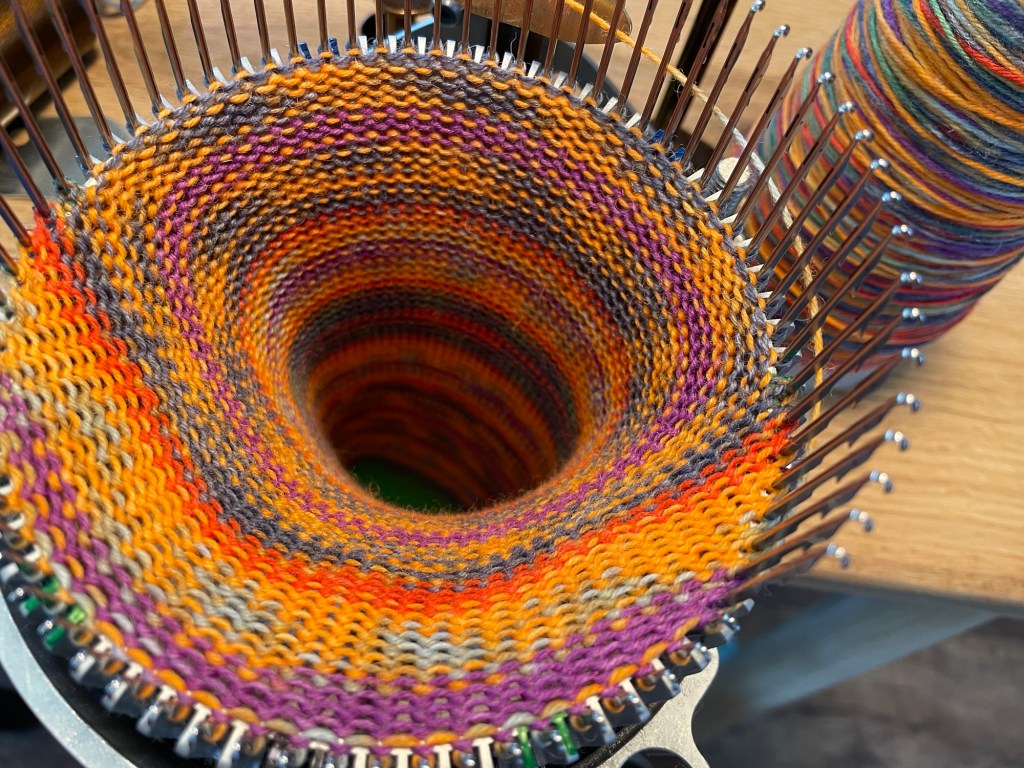
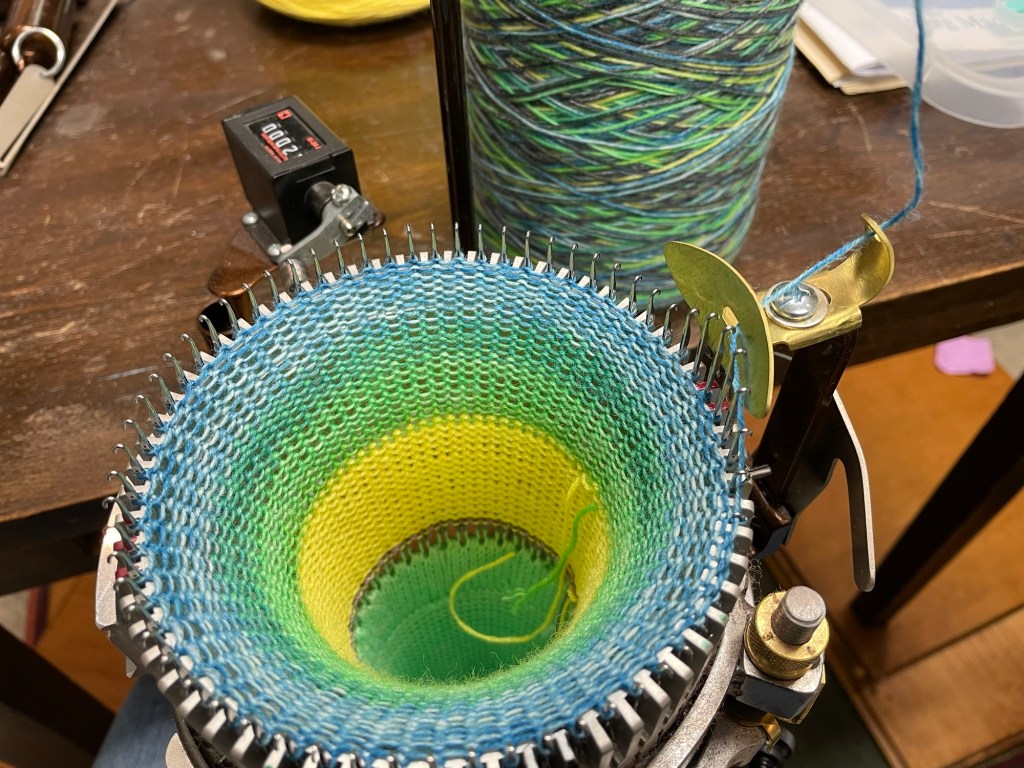
The bonnet on the cylinder, ready for casting on a project

I cranked one row of purple cotton yarn onto the bonnet. That is a “rip cord” to make it easy to separate the waste yarn from the bonnet. After that I added yellow waste yarn.

One row of purple rip cord, and one row of yellow waste yarn

Next you can see another row of purple rip cord between the yellow waste yarn and the darker green project yarn.

One row of Purple rip cord after the yellow waste yarn, followed by darker green project yarn

Lastly is a photo of the unsuccessful heel still attached to the waste yarn and bonnet.

Bonnet, yellow waste yarn, and unsuccessful heel

While moving furniture around in preparation for new flooring in our living room, I noticed a different table that was an improvement over the one I was using for the CSM. It was much heavier and sturdier, did not have wheels, and was a couple of inches taller. If I removed a drawer, there was a place to clamp on the sock machine. Wayne is still going to make me a custom table with adjustable height legs and a cutout, but this table is much better for now. It does not need the kettle bell to balance out the weight.

A better CSM work table

I had to take a break from the sock machine to help Wayne with new flooring preparations, and because we were leaving for a trip to California. For the third year in a row we spent Thanksgiving with Wayne’s sister and brother-in-law in the Bay Area. They live near our daughter, so it is a good opportunity to have some quality time with her.

During some down time during the trip I watched a video of heels being made on the sock machine (multiple times), using the same method I was trying to do. The written instructions I was using were confusing, and after watching the video tutorial, I understand it, and I think there is a typo in the written instructions. I was dreaming about cranking out heels after that.

While we were going for a walk the day before Thanksgiving we passed a consignment shop dedicated to crafting supplies. The window was filled with yarn. I know that once I get proficient with the sock machine I will go through a lot of yarn, so I have been watching for deals.

Inside The Recrafting Co consignment shop were many, many skeins of all kinds of yarn.

I bought four skeins of sock yarn at half the original price.

We are back home now, but I have not had any time to spend on my CSM. I am going to bring it to Arizona when we go there for the winter. There are fewer distractions living in the RV away from home, so it will be a good time to focus on and learn the sock machine. I have faith that I will be able to make a successful heel and a complete sock in due time, with support from the helpful CSM community.