

I recently went on an overnight stay at the Nome Schoolhouse, a fiber arts retreat center and fiber mill located in Nome, North Dakota. Everything about this place, along with how it came to be, is amazing.
Two gals with fiber related businesses decided to combine resources. Chris had a fiber mill in her barn. Teresa taught needle felting, and sold kits with supplies and detailed instructions. They used all their money and raised more to purchase an old schoolhouse in Nome, North Dakota. The school building had been abandoned after being in use from 1916 until 1970.
Chris and Teresa undertook an ambitious project of restoring and expanding the building, transforming it into a fiber arts center with space for classes, retreats, events, overnight stays, meals, and a gift shop. Chris’s fiber mill equipment was moved to the basement of the school building, with the needle felting kit materials. They are producing products for sale using every scrap of fleece from Teresa’s sheep, plus wool purchased from other sources. Following is a photo of the Nome Schoolhouse today, from the cover of one of their brochures.

My friend Mary and I finally found an opportunity when we were both available to visit the Nome Schoolhouse. We signed up for a Sunday “Maker’s Afternoon” that was followed by dinner, an overnight stay in one of the hotel rooms on site, breakfast and lunch the next day, and a mill tour.
Mary drove two hours to get from her house to my house in west central Minnesota. Together we drove another two hours west and a bit north to get to Nome, in the middle of nowhere North Dakota. It was worth it.
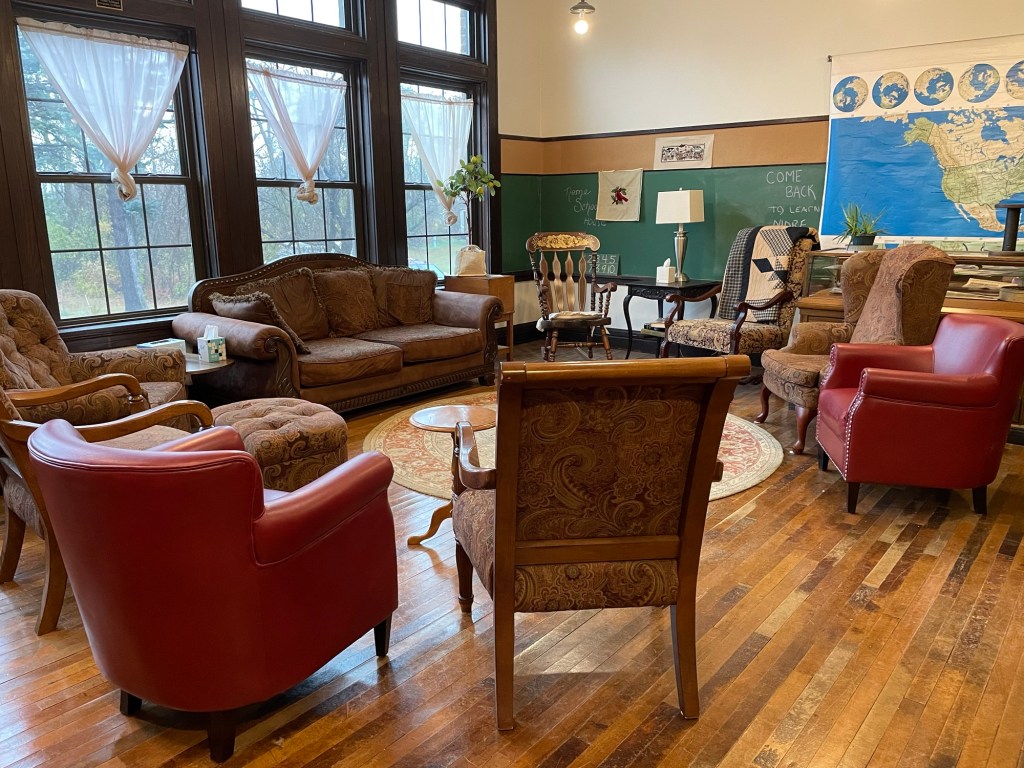
Communication from the Nome Schoolhouse staff about our visit was great, with messages to confirm our plans and let us know where to go when we got there. Upon arriving, we put our project supplies in the History Room that was up one level from the main entrance, and then found our hotel room up another level and down a hall. The next photo is the History Room, one of the original classrooms that is now used as a gathering room for people to hang out and work on projects. It looks sooo inviting, and so like an old school room. We sat in here during the first afternoon and evening, when we were not walking around gawking at everything and scoping out other rooms in the building.
Someone donated a giant 12 harness floor loom. My friend Torri, experienced weaver and proprietor of Tangles to Treasures in Fergus Falls, was recruited to assemble the wood parts into a working loom. Torri’s daughter helped her warp a complicated project which is now on the loom waiting for someone to weave some rows. There is a large rigid heddle loom on a stand in front of the big floor loom, along with a smaller tapestry loom.

Following is a photo of the project Torri warped on the big loom.

The next photo was taken from the third floor landing, looking down to the main entrance.

Everywhere you look there is art on display, along with antiques and items that had once been in the school or are related to the school. When word got out the Chris and Teresa were restoring the building, people returned many items that had been removed from the building or belonged to former students. Some items on display have been in the building all along, like old textbooks.
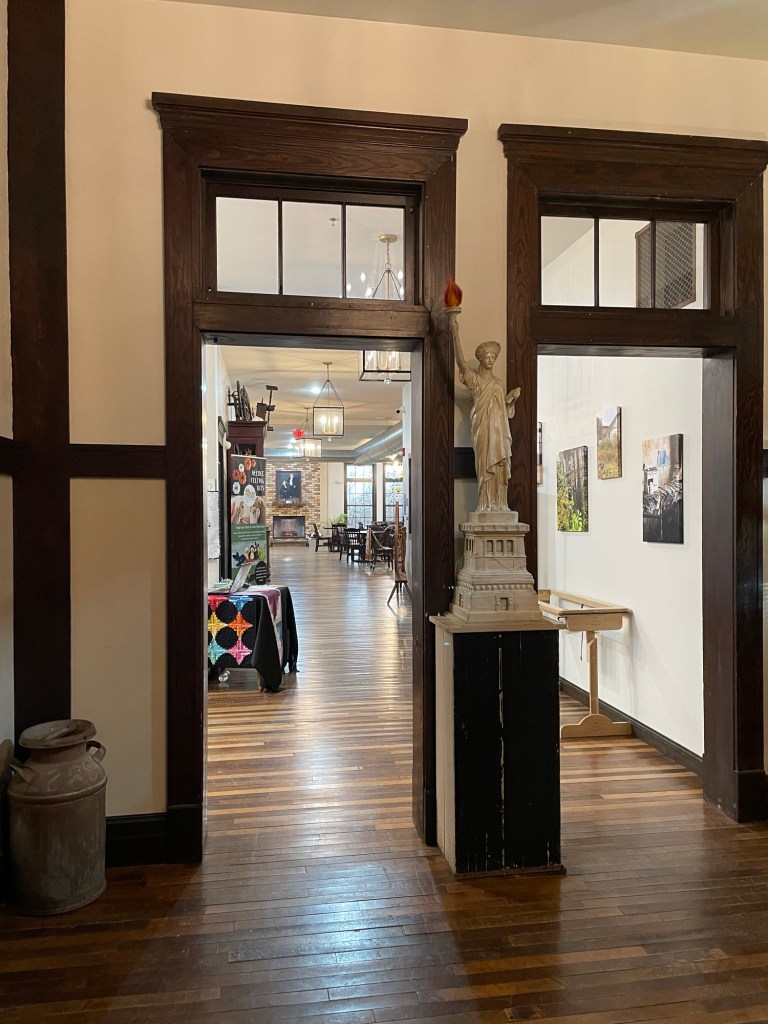
Following is a photo showing a replica of the Statue of Liberty that was in the building when it was used as a school. You can see the dining room down the hall at the back of the building.
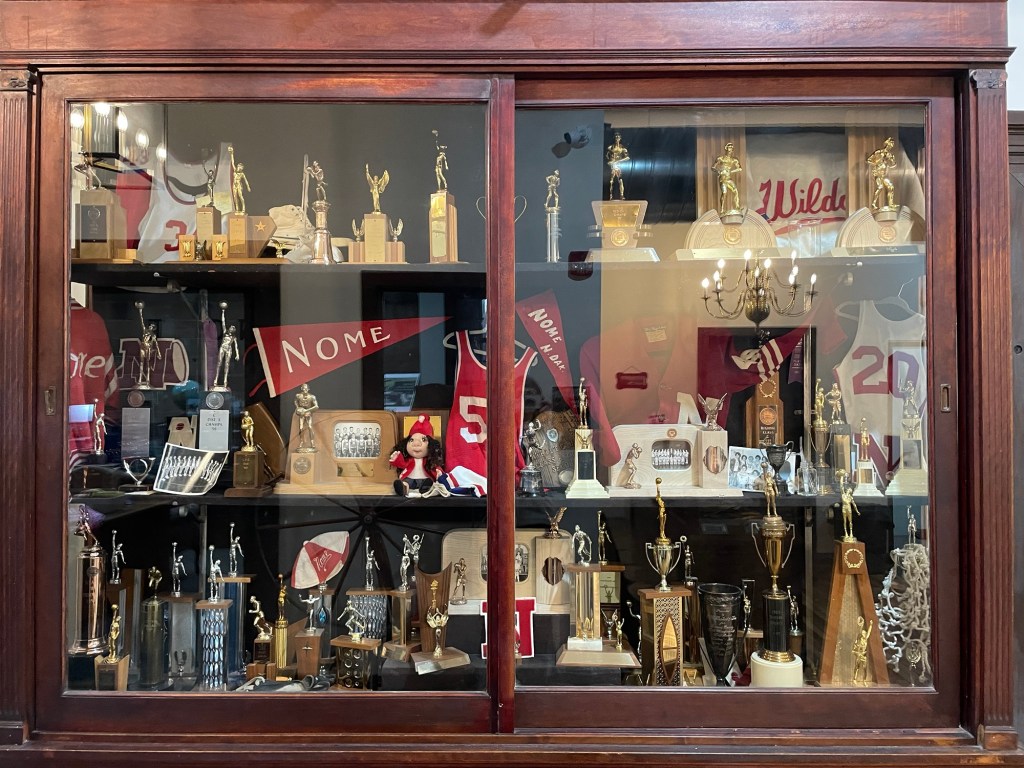
The trophy case in the hall is filled with items that people gave back to Chris and Teresa after they found out about the building restoration.
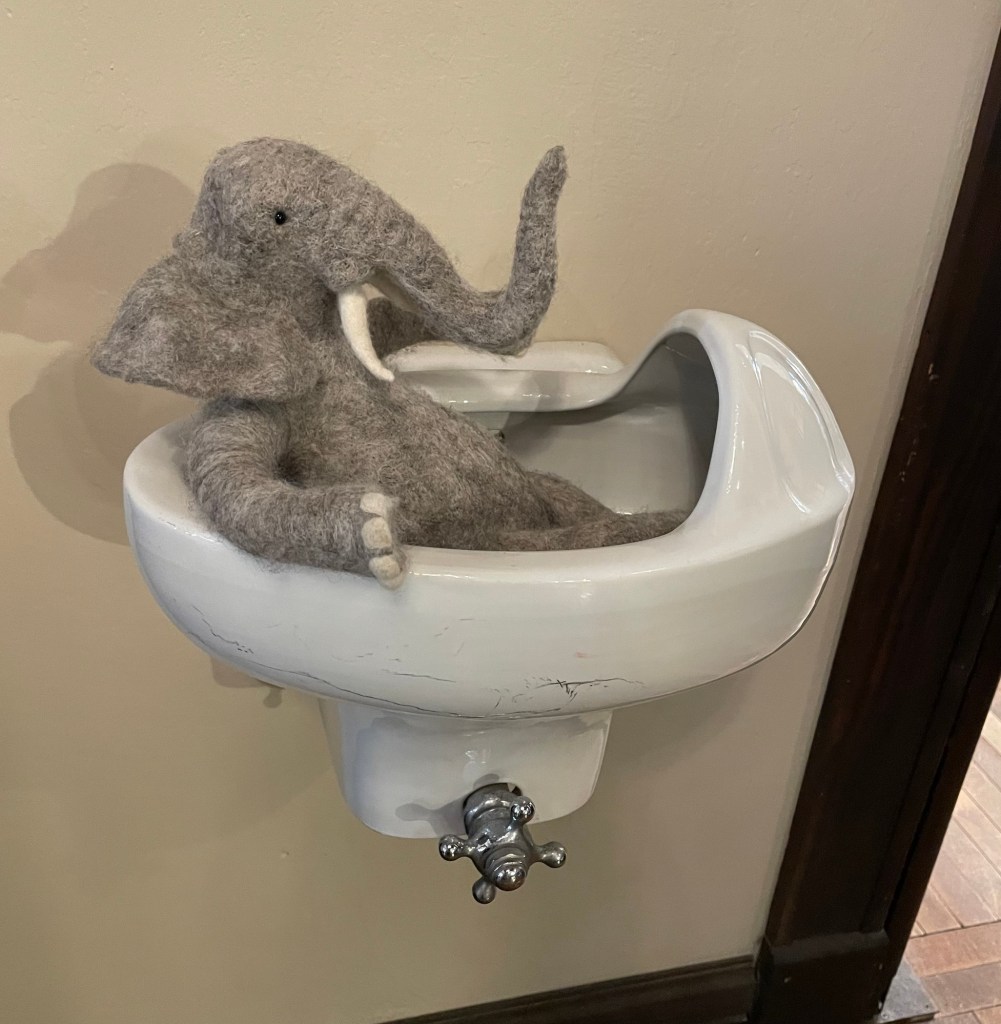
A needle felted elephant lives in a non-functional drinking fountain in the hall.
I liked the fiber art representation of the building that has an old school desktop for a frame.

The view out the back of the building from the dining room was beautiful.

In the hallway where the hotel rooms are located there was a small lounge with a couple of easy chairs, many books, and a coffee station.

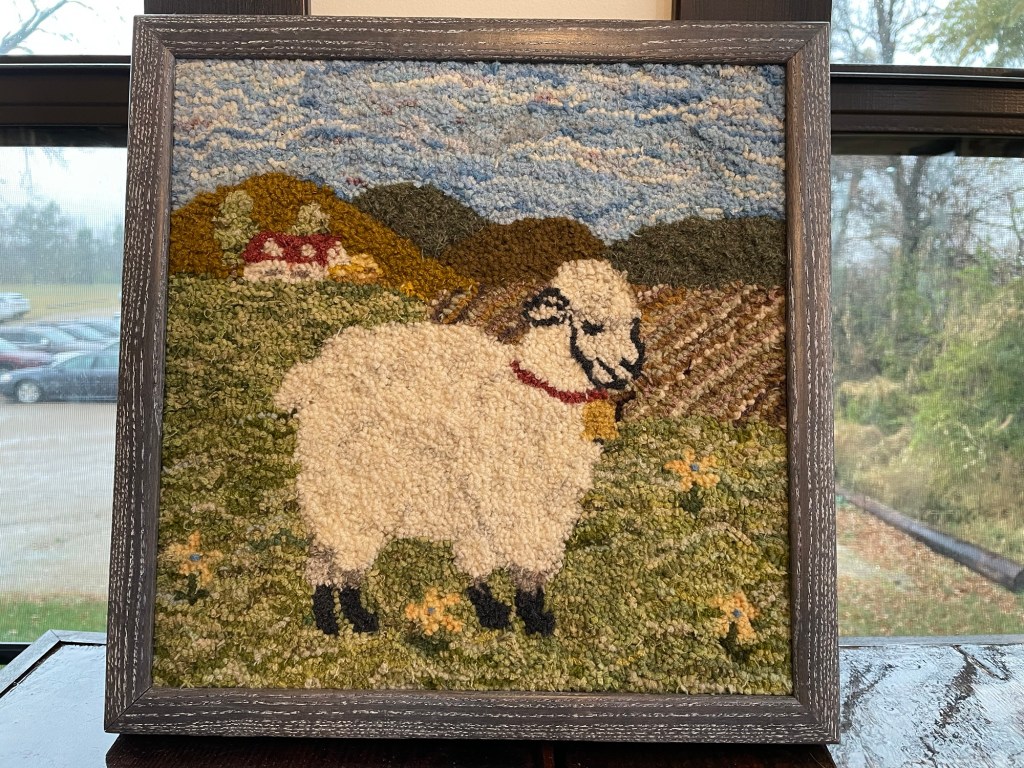
Following is another fiber art scene on display, of a sheep of course.
Mary brought a needle felting project, and a vintage loom that she had received as a child but never used. The loom was manufactured by Spear’s in England; you can find these for sale online.

Following is the Spear’s loom assembled, with the original instruction book.
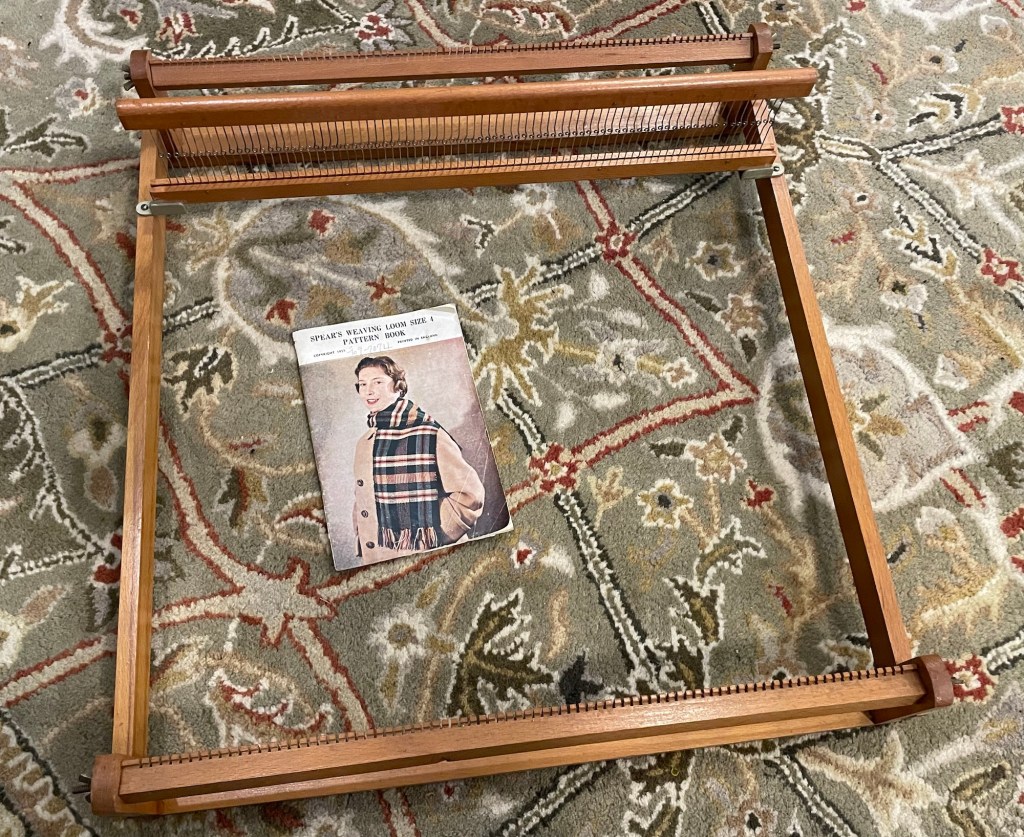
The loom is a version of a modern rigid heddle style loom.

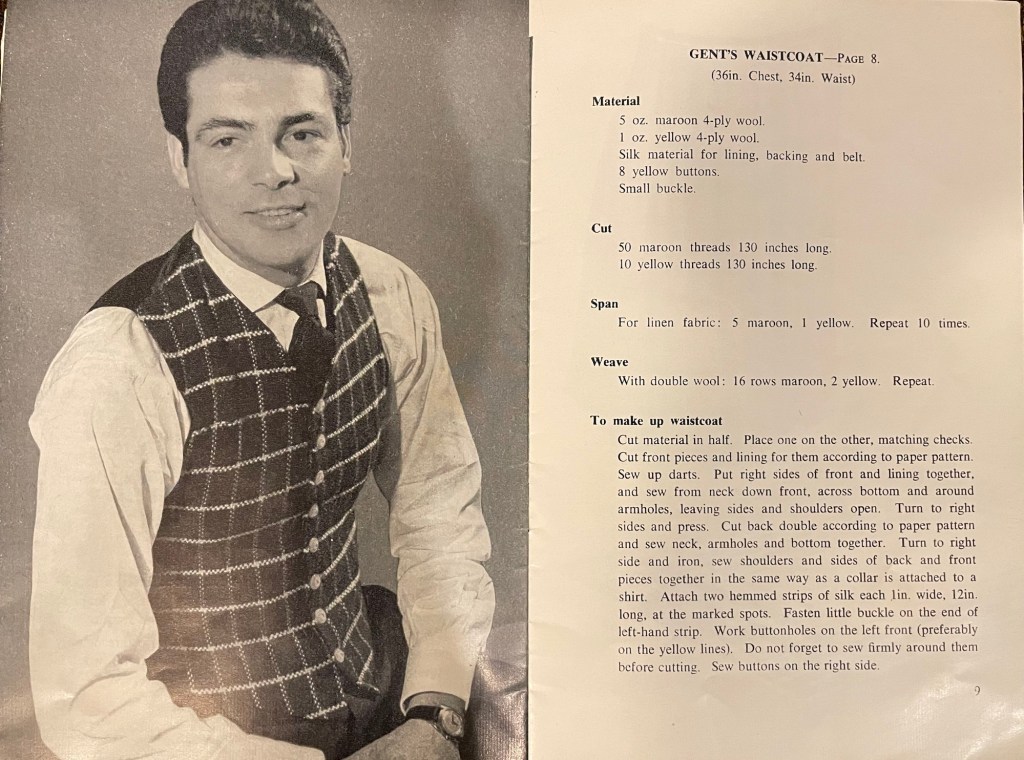
In case you want to make a “waistcoat”, a pattern is included in the instruction book.
I brought my spinning wheel, a knitting project, and a newly acquired four inch wide loom. I bought the narrow loom to use for tablet weaving, but it is a rigid heddle loom that came with a reed. I wanted to make another pair of shoelaces using weaving cards. Normally you would be either rigid heddle weaving with the small reed provided OR weaving with cards. After threading my yarn ends through the tablet weaving cards, I also threaded them through the reed just to keep them orderly.
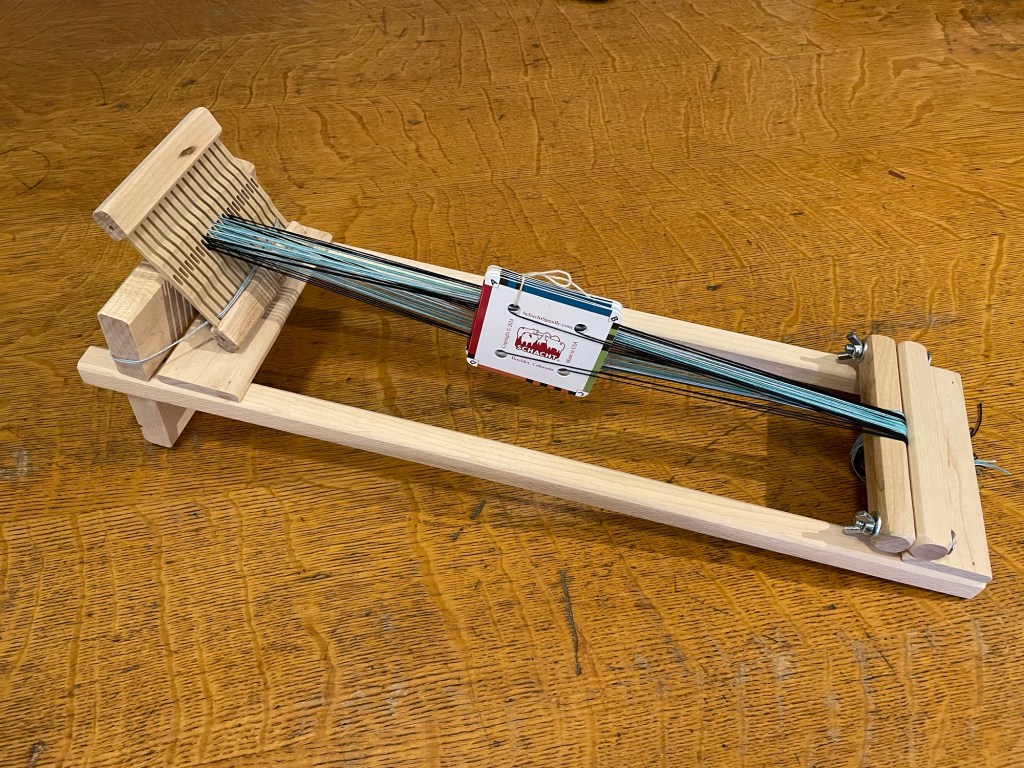
I used some yarn that I thought was very similar to the yarn I used last spring for shoelaces (you can read about that project here), but it turned out to be a bit thicker and have a different texture. I am not sure I like it. I did not get very far, made a lot of mistakes, and probably won’t finish the project until we get to Arizona this coming winter. Or maybe I will start over with different yarn. I am going to bring this small loom to Arizona and until then I have other things I will be doing.

The giftshop has yarn produced in the mill on site, needle felting kits, baskets, weaving and spinning equipment and supplies, Nome Schoolhouse merchandise, and various other fiber related products for sale.

Following is a photo of crocheted gnomes for sale in the gift shop, along with some caps and dryer balls. The woman who makes the gnomes happened to be staying at the Nome Schoolhouse with her mother the same two days my friend and I were there. They had come from somewhere farther west in North Dakota for a quilt show that was going on in the gym. While we were hanging out in the History Room after dinner, they joined us and worked on their projects, including crocheting more gnomes.

There are also kits for needle felted gnomes (and other cute things). Gnomes are very big right now!
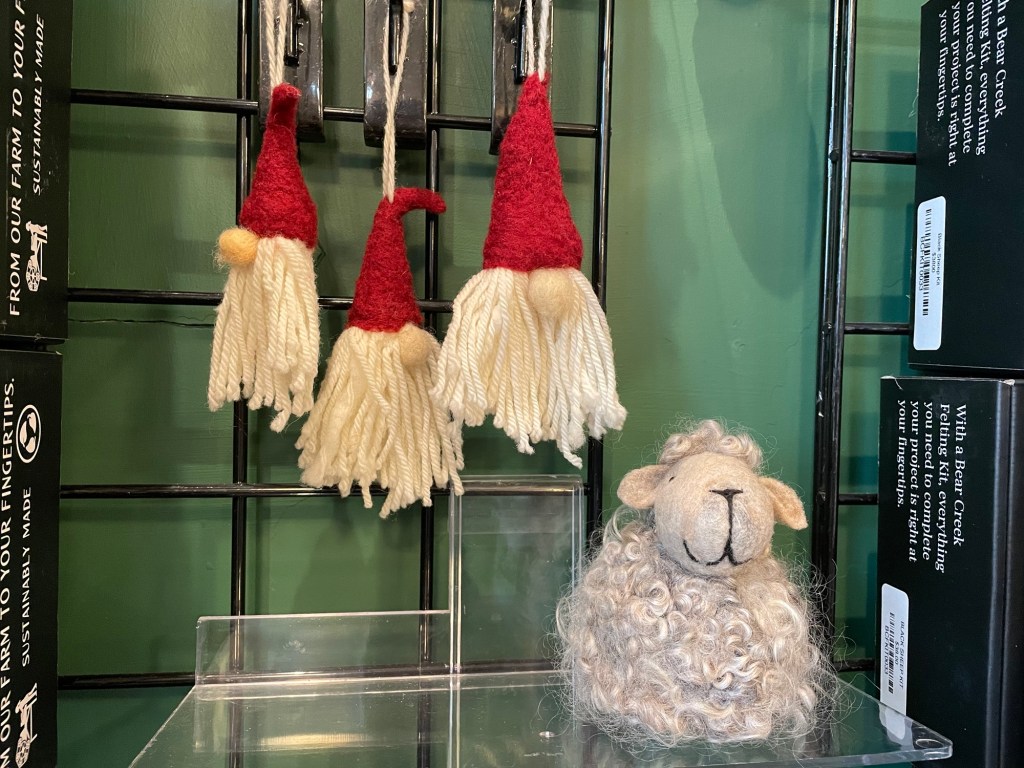

I loved looking at all the display cases with Nome Schoolhouse related memorabilia and fiber related art.

We paid extra for a tour of the mill in the basement. Chris previously had the mill equipment in her barn near Kindred, ND, about 40 miles east, before being relocated to the Nome Schoolhouse. The first stop of the tour was the skirting table. After fleeces are washed (by hand in a big sink), parts of fleeces that are unsuitable for batts and yarn are removed. However noting that nothing is thrown away. Even the dirty bad parts that are removed from a fleece are used for something.

Behind the skirting table is an area used for dyeing. Following is a photo of custom blended dyes stored in jars.

I had seen the mill when it was in Teresa’s barn years ago. The way that came about was that I had an entire raw fleece that needed to be washed before I could do anything with it. Having washed smaller amounts of fleece with mixed success, I knew I did not want to wash an entire fleece. I saw on the website for Chris’s mill at that time that washing a fleece was one of the services her business offered. My husband and I had a fun outing driving to her farm and delivering my fleece to be washed. Chris showed us a few of her fiber animals, and the mill equipment.
Chris told Mary and me how she bought the vintage mill equipment in 2009 from a guy in England, and had it shipped to North Dakota. She hired the previous owner to come and stay at her house for 3 weeks to show her how to operate the machines. After that he went back home to England, and any questions or issues had to be handled by phone (before facetime or zoom was an option). Fortunately, Chris’s husband is good with machines.
Following is a photo of the picker machine that is used to separate and fluff out locks of wool in preparation for carding. It is also used for blending different types of fiber.

The next photo shows fleece coming out the other end of the picker, ready for carding.

I have a hand crank drum carder for making batts. I like using the larger electric drum carder at Fiber Day because it can process so much more in a shorter amount of time. Chris has an enormous carding machine on steroids, as seen in the following photos.


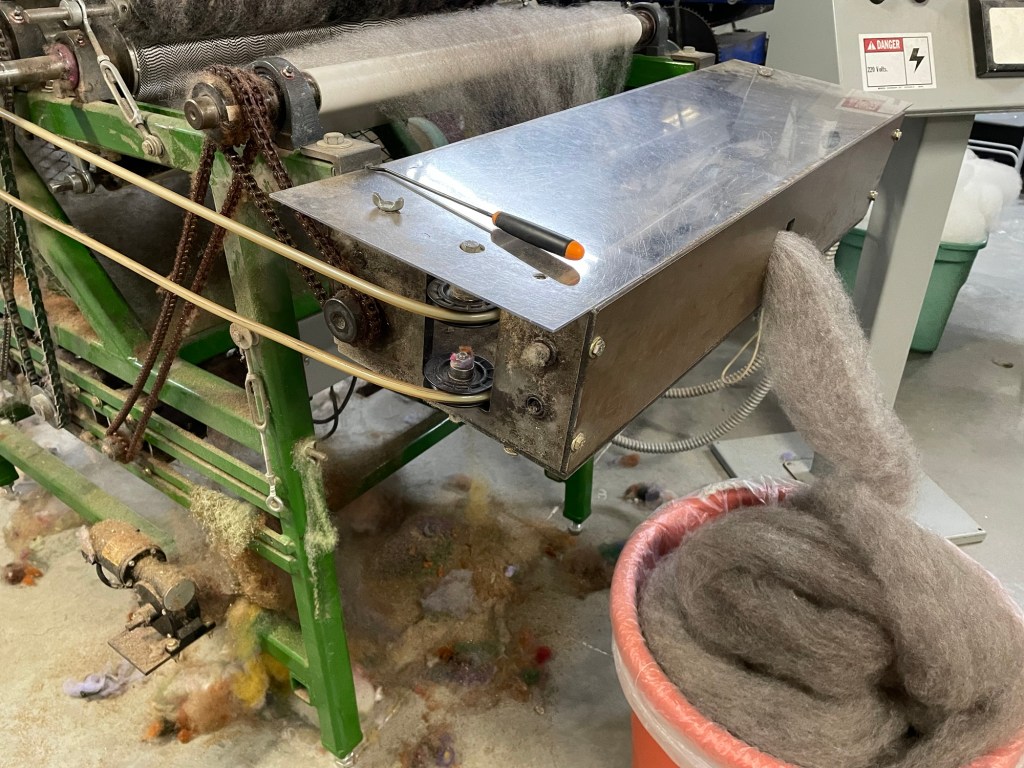
Roving from the drum carder is sent through the pin drafter machine to make it into narrower strips for spinning into yarn.
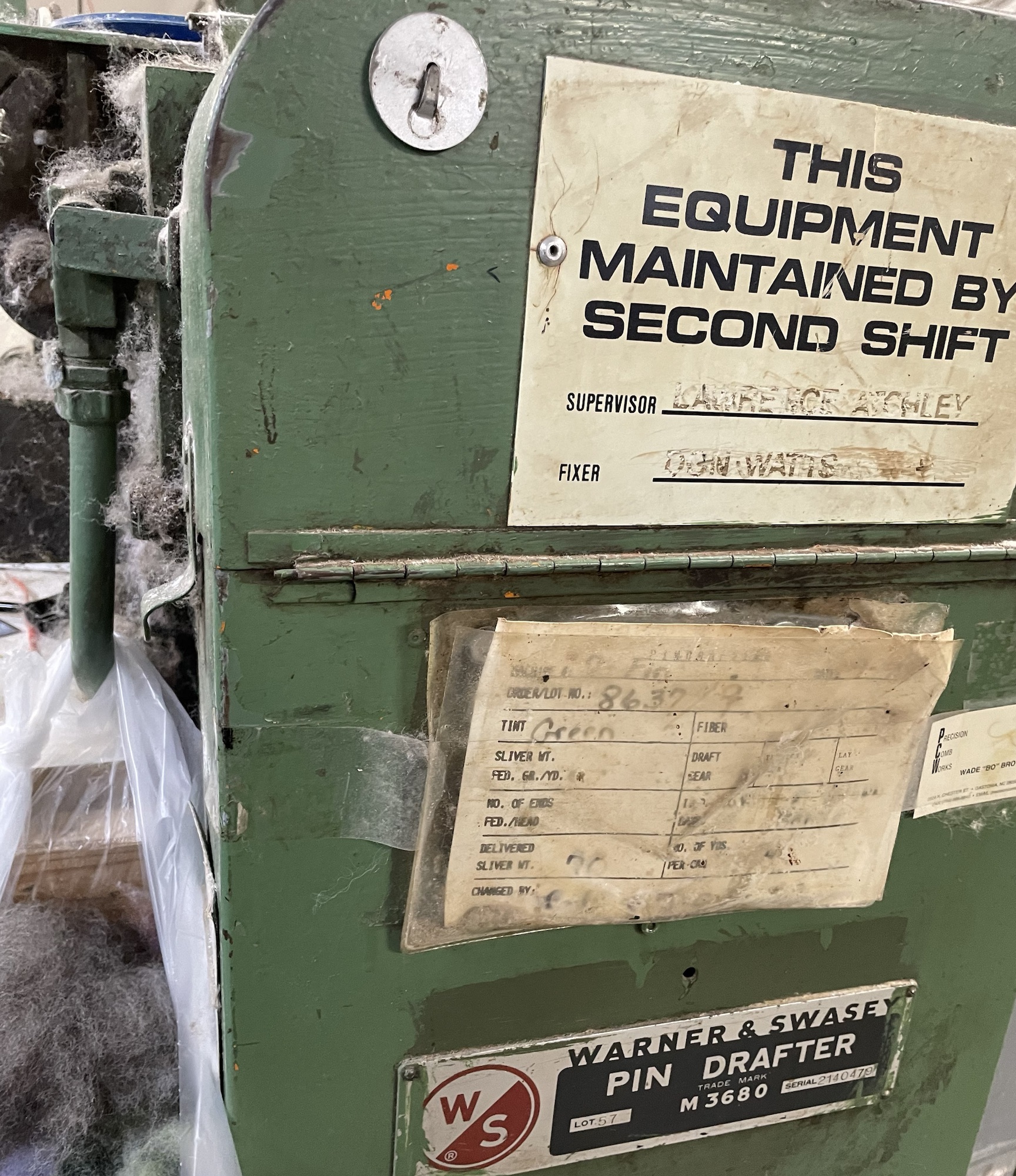
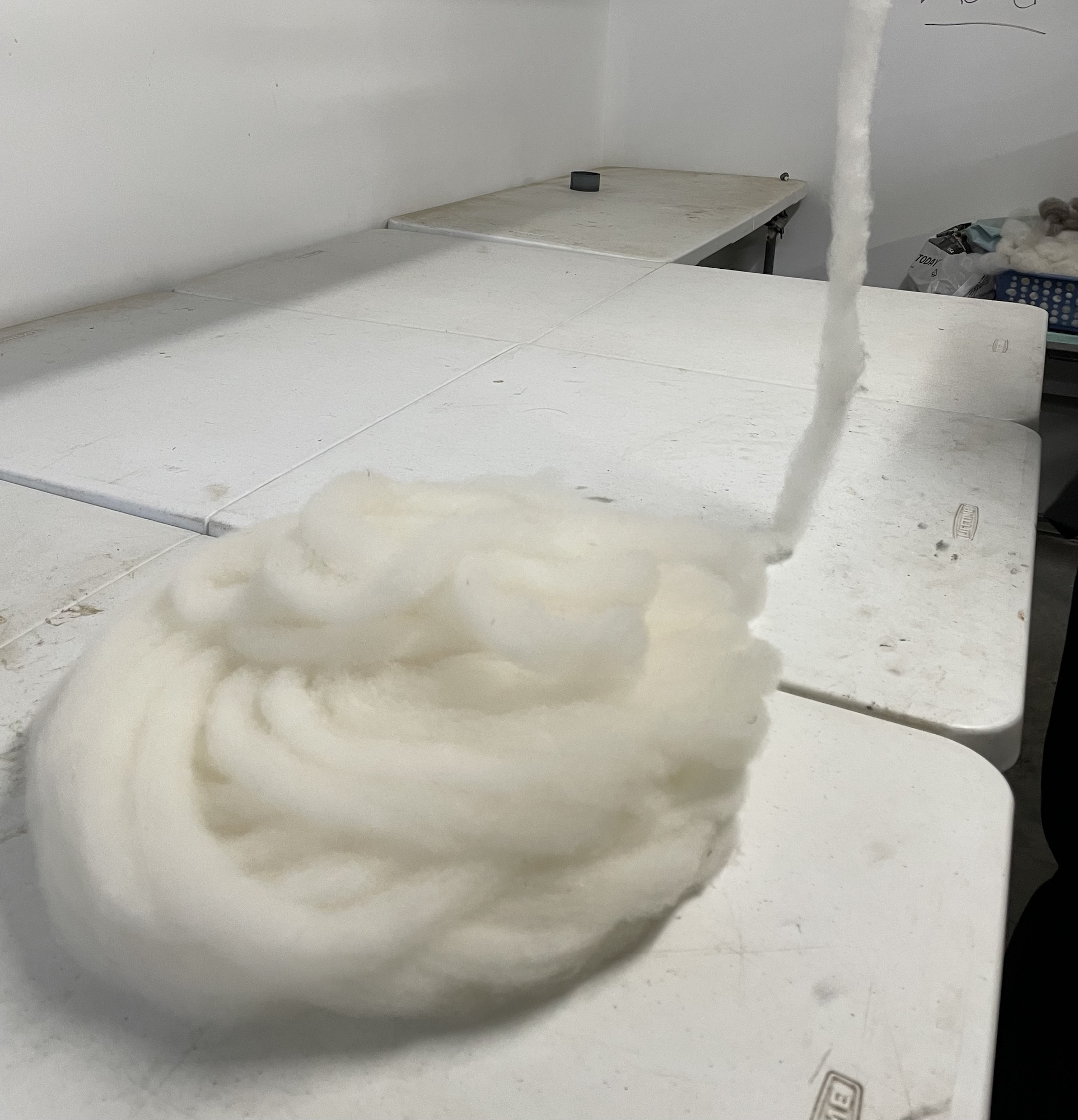
The next photo is the “skeiner” machine that processes strips from the pin drafter into a single ply yarn.

The last step is plying together strands of singles yarn into a multiple ply yarn. Following is a video showing the plyer machine plying together two strands and winding it onto a cone.
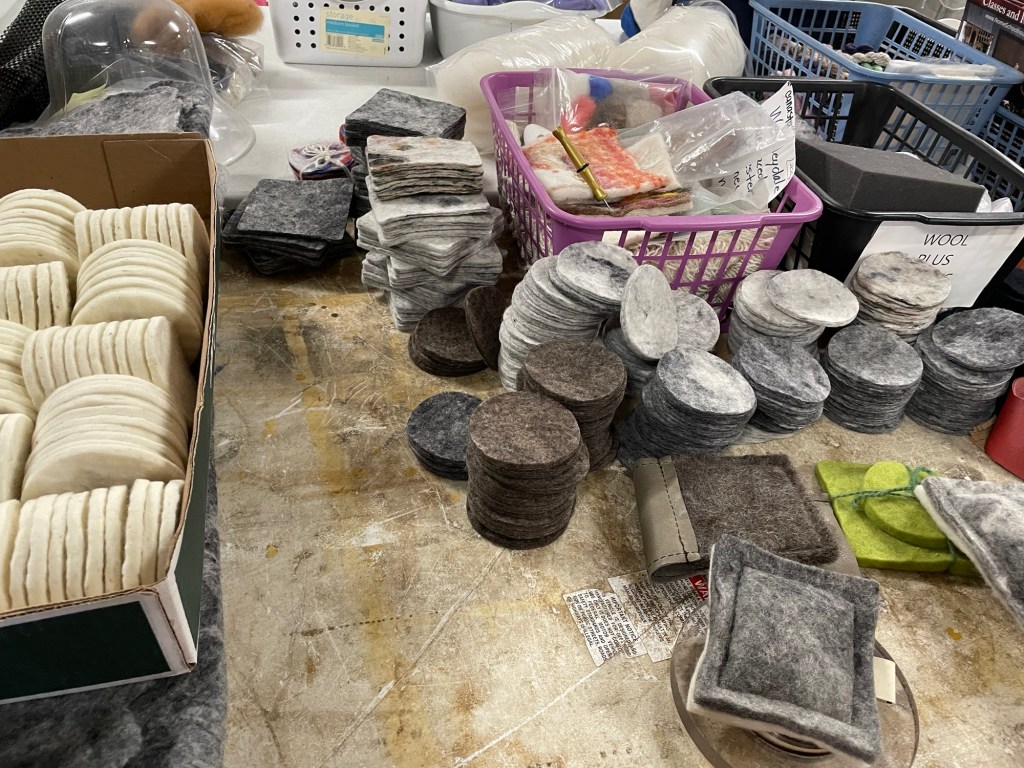
There is a another machine to make felt mats with scraps of wool that are not able to be used for needle felting or spun into yarn.

Squares of wool felt are layered and sewn together to make pillows used as a work surface for needle felting.

Smaller pieces of wool felt are cut up into coasters and cupholder liners.
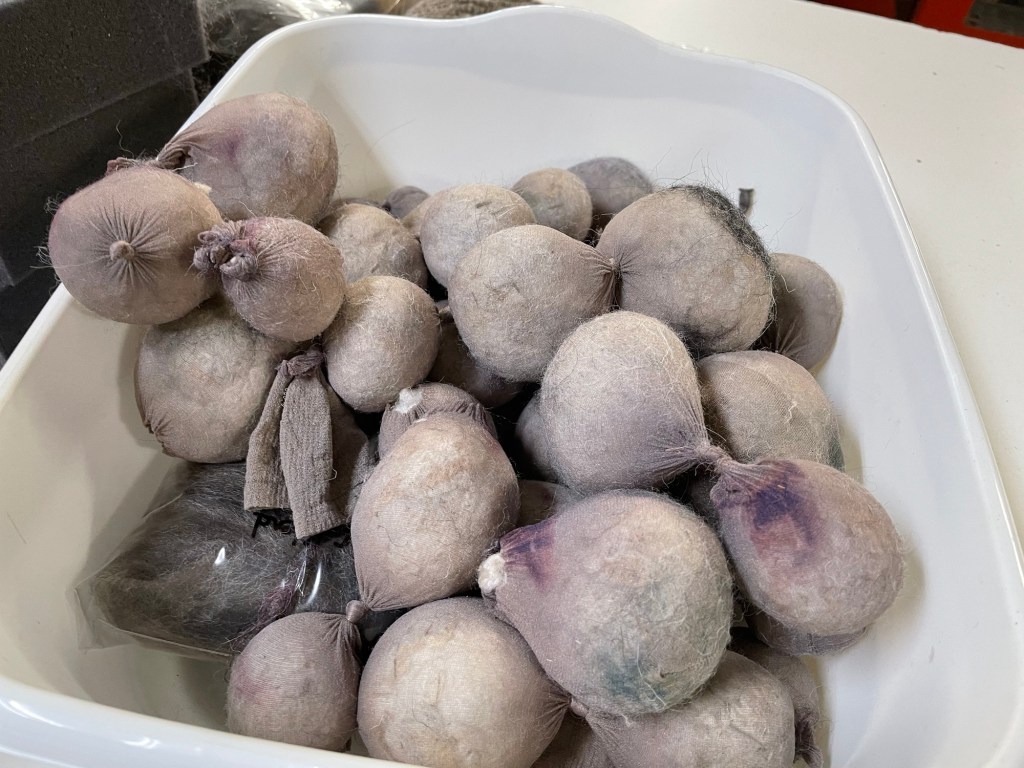
Dryer balls are made out of scraps of wool. While in process they are tied inside old nylon stockings.

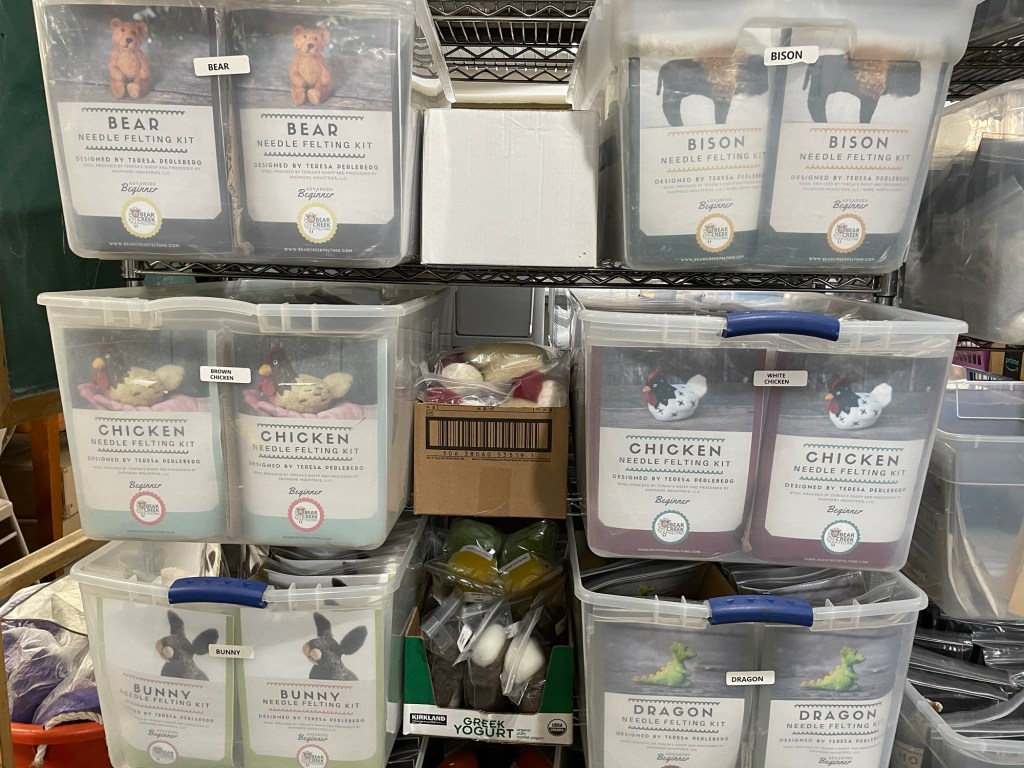
Needle felting kits are packaged in plastic bags for efficient shipping, and also boxes with necessary supplies for the in-person store.
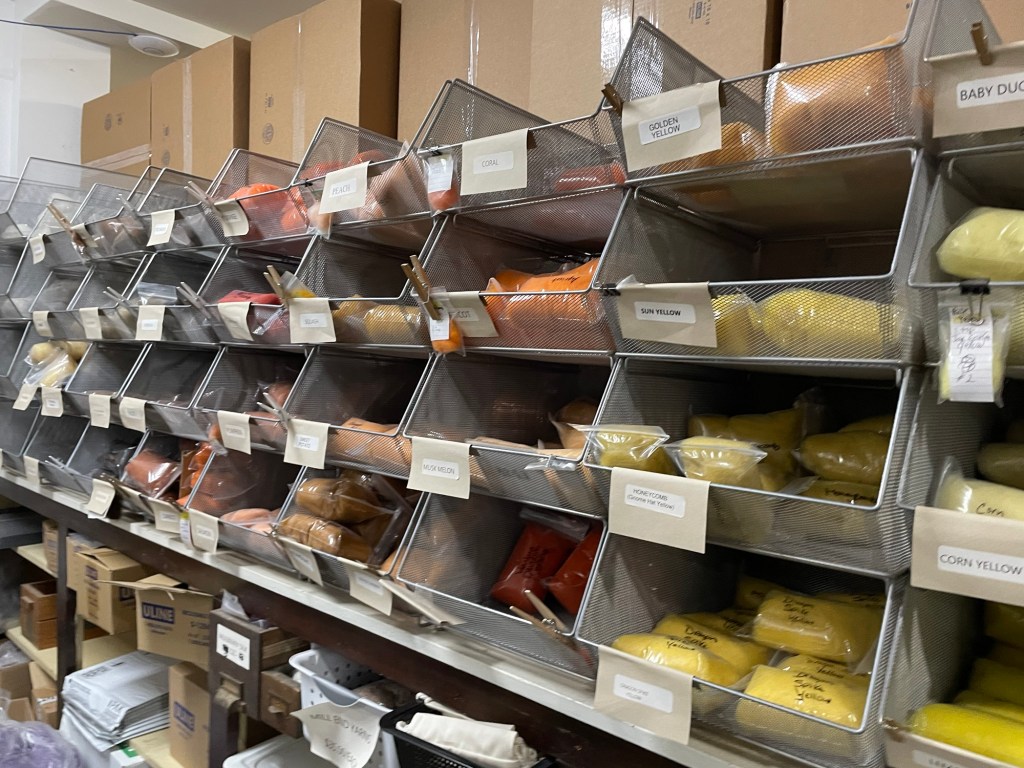
Following is a photo of little bags of fiber for felting in many colors.
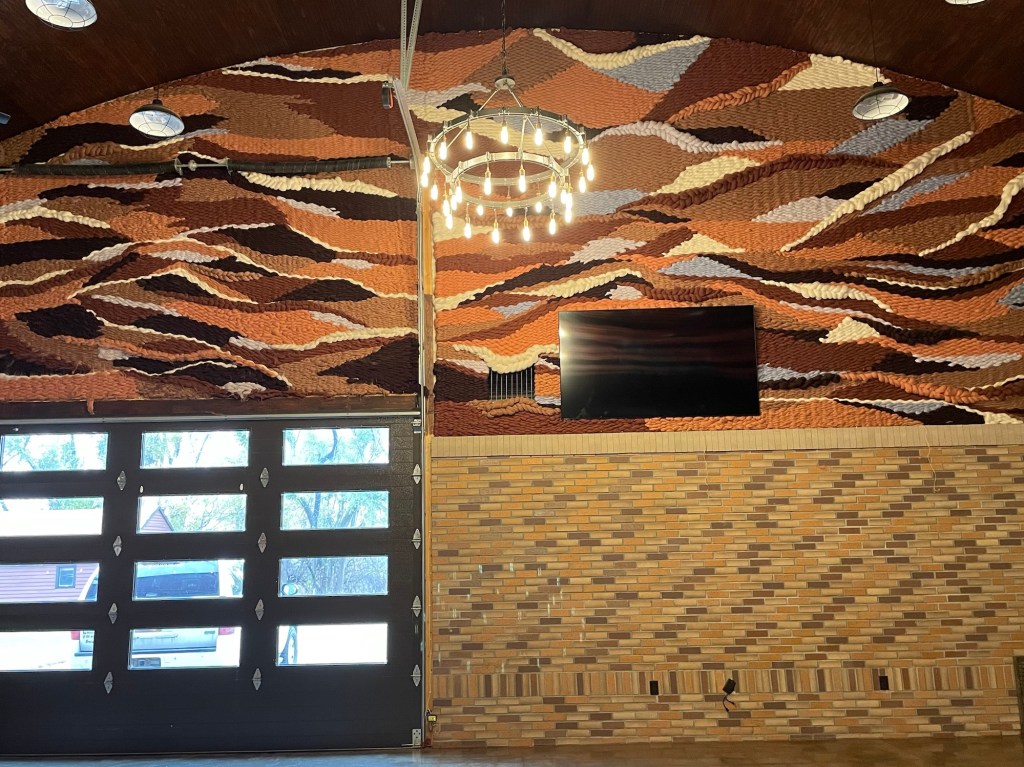
After the mill tour we checked out the gymnasium. I did not get a good picture, but following is one end that has a huge weaving covering the top half of the wall. This space has a commercial kitchen and bar area, and is available to rent for events.
There were several photo books with images from specific years of the school house renovation. The next photo from the cover of one of the books shows what the building looked like when it was purchased, with overgrown trees and a cinderblock entryway built on to the front.

Here is another one with Chris and Teresa in front of the building before renovation.

Mary and I were sad when our visit was over and we had to leave (and go back to reality). We look forward to coming back another time with more people.

 Yarns from the Lake
This looks like a fabulous place! Even though I am not a weaver, I would love to visit here and make something. I don’t know if I could ever get a visit there arranged with my daughter, but it is something in my mind now. I love places like this. I also looked to see if I could purchase a felt project online, but it didn’t look like they had an online store. Thanks for a great post!
LikeLiked by 1 person
I love this type of place too. I found where you can buy the needle felting kits online https://bearcreekfelting.com/ Not sure why they don’t have a link on the Nome Schoolhouse site. Anyway….my house is on the way to Nome from St Louis, so be sure to let me know if you plan a trip this way!
LikeLiked by 1 person
Thanks for the link!
LikeLiked by 1 person
Wow! What a restoration project, with genius thrown in. I can see how you would have thought you were in a candy store. (we went to a penny candy store when we were little, Ten cents bought a whole little bag full. Licorice sticks were 1 cent, and jawbreakers with a coriander seed in the middle were two for a penny.)
To return to Nome, three things struck me: 1. “Why did she go all the way to Alaska?” 2. The wool that came out of the carding machine was brindle colored; cream, tan, brown and gray all mixed together. In the next picture it was beautiful, pure cream colored. How did it get that way? 3. The big felted sheep with curly fleece: “I WANT ONE”.
LOVE, Maggie
LikeLiked by 1 person
Do you meant to England to get the equipment? I don’t know. I guess that is where she found some to buy. The white pin drafted fiber may not have been the result of the exact stuff that was seen coming out of the carding machine. Just a different sample. Yes, the curly sheep is really cute. I have not done needle felting, but a lot of people really like it.
LikeLike
Not England, I laughed because I thought Nome, Alaska
LikeLike
Oh got it. Lol!
LikeLike
What an incredible story! It makes me want to hop on a plane and fly there to visit it! And now I want to buy a small loom and weave something (my husband and I have jokingly talked about it).
LikeLike
The Nome Schoolhouse does look so inviting! Another blog reader also said she wanted to go there. I fully support you buying a small loom. If you decide to go for it at some point, I recommend starting with a rigid heddle loom. Hope you have a great Thanksgiving!
LikeLike
What a fund experience! I love it when old school houses are repurposed!
LikeLiked by 1 person
Yes me too! It is sad when they are abandoned. Hope you are having a Happy Thanksgiving.
LikeLiked by 1 person
What a lovely place to get away and enjoy something you love to do surrounded by not only others who love it but examples of fiber art. It reminds of a few places close to me where someone has taken an old school and turned it into lodging but left the characteristics of the building intact so while you are there, you can imagine what it was like in its earlier days.
LikeLiked by 1 person
I love when people repurpose old buildings. Especially school houses!
LikeLiked by 1 person