

Many years ago I saw images of antique circular sock knitting machines. I have always thought they were a cool, interesting part of history.

In the last few years I have been knitting socks and learning about sock construction, but it takes me a long time to make one pair. I would like to make more socks for myself and for gifts, but I can only manage to knit a couple of pairs per year. Most of my knitting happens while watching TV (unless there is part of a project that requires extra focus) or while a passenger in the car. I saw a meme online that there should be a Netflix category for shows that you can watch while knitting haha.
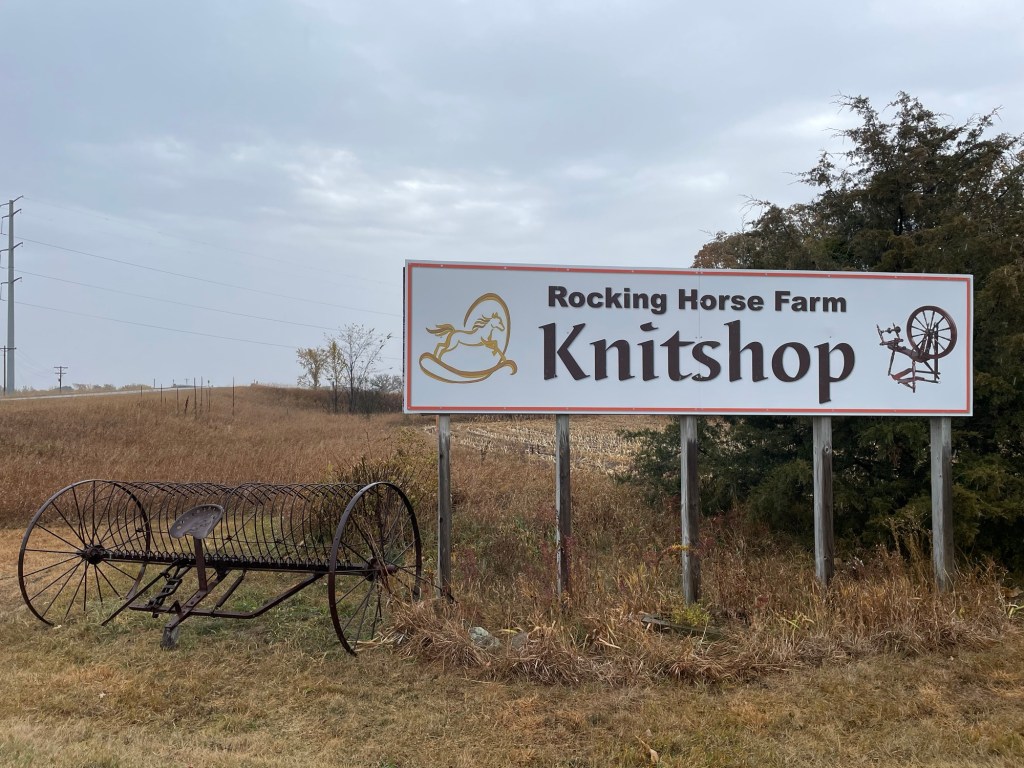
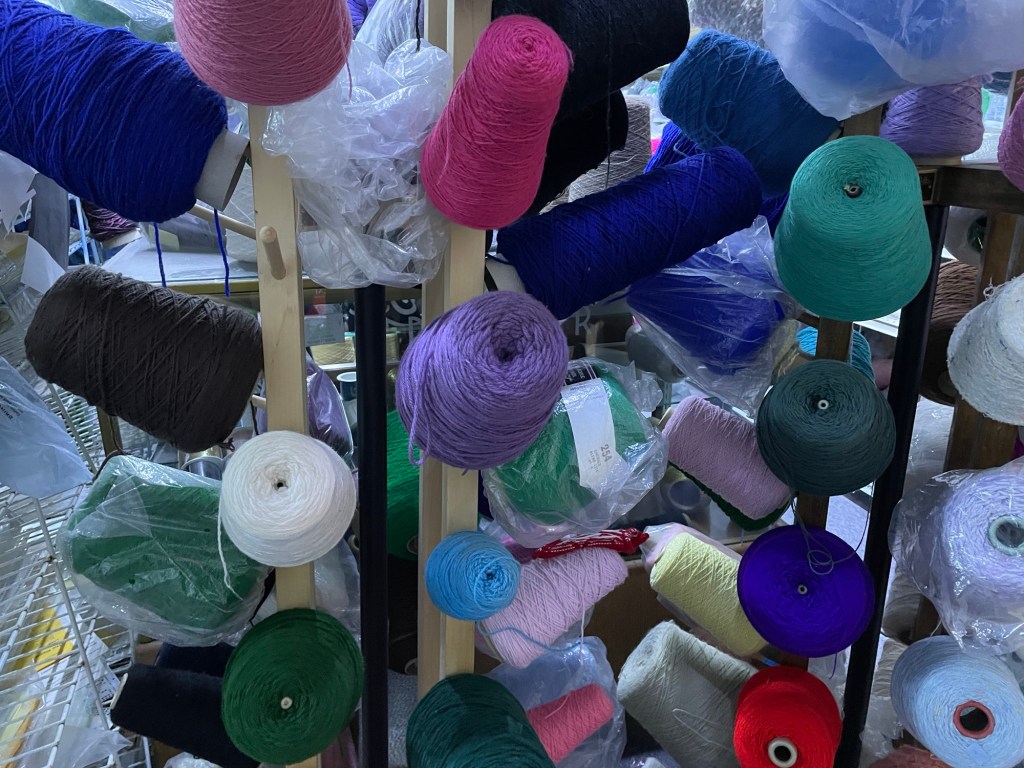
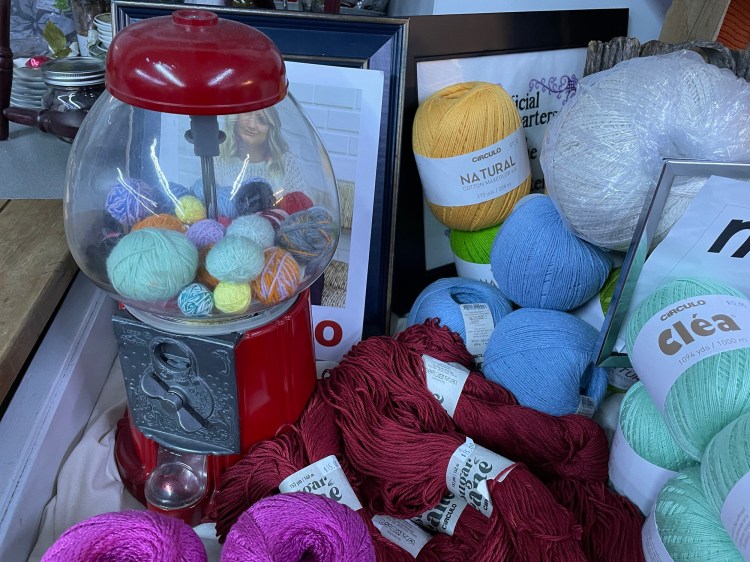
It turns out there is an active community of people using restored antique circular sock machines (referred to as “CSM”s), as well as newly manufactured machines. I became aware of one of these groups within range of my home, and attended a get together (called a “crank-in”) last April at the Knitshop at Rocking Horse Farm in St. Cloud, Minnesota. This business sells yarn and supplies for knitting, spinning, and weaving, with a focus on machine knitting. Following are a couple of photos I took there last spring.
Recently I was supposed to be on a trip with friends in Asheville, North Carolina. We were disappointed to have to cancel the trip due to devastating damage there from hurricane Helene. We were grateful that we received full refunds for the Airbnb and car rental, and for our flights, even though they had been booked with tickets that only allowed for a credit for future travel.
Instead of going to Asheville, my friends and I went on an outing to the Minnesota Landscape Arboretum. It was a beautiful, warmer than average day for looking at the fall gardens and displays, and walking on their Three Mile path. A series of fun scarecrows were set up near the main building. Our visit there ended at the Arboretum’s Apple House, where we all bought bags of locally grown apples. In case you did not know, the Honeycrisp apple was developed at the arboretum’s Horticultural Research Center.

On the way back home from the Twin Cities, it worked out for me to stop in St. Cloud, for the fall get together of the Circular Sock Machine “crankers”. Cancelling the Asheville trip was a bummer, but I was glad to be able to attend this event instead. I was very eager to observe and ask questions. The people there were all friendly, had stories to tell about their CSM and what they were making, and were happy to answer my questions and share their knowledge. Several people were using antique CSM’s from the early 1900’s. These machines are metal and basically last forever. There was a man at the event who is well known in the sock machine world, Pete Oswald, who works on adding missing parts and restoring old CSM’s that have been found on ebay or in antique shops. A few people had new CSM’s made by the Erlbacher Knitting Machines company, that have been designed to be compatible with antique Gearhart machines. There are other brands of new metal sock machines, and a company that makes 3D printed plastic CSM’s. They are quite a bit cheaper, but, well, they are plastic.
Some people at the event were making socks, but others were making gnomes using supplies and a pattern provided. The pattern is free on the Erlbacher web site.

I was only expecting to observe and get information to help me understand how the sock machines work, and the differences between the various CSM’s and related accessories. One of the experienced crankers, Deb Oswald, steered me to her CSM, and got me started making a gnome. Deb is the wife of Pete, and these two are gurus in the CSM community around the country. They have 30 years of experience with sock machines. At the time I did not realize the level of expertise I was getting in on. It was a great opportunity to actually use Deb’s Erlbacher machine and end up with a fun outcome.
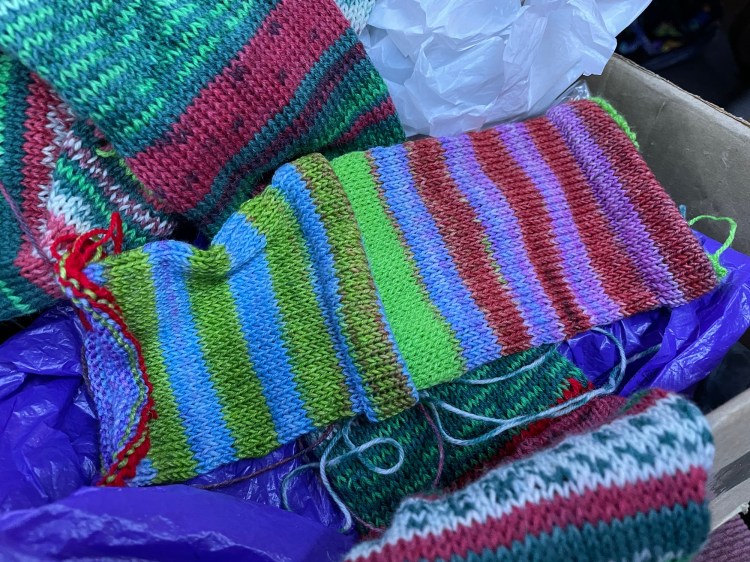
The first step was to pick out which self striping yarn I wanted to use for my gnome. There was a box of samples, showing what some yarns looked like knitted up. I liked the one you can see on top of the pile in the photo below, so Deb found the cone of that yarn.
Following is the cone of yarn I picked out for my gnome. Yarn should be on a cone for use with a sock machine, rather than a ball or skein. You can buy yarn already on a cone, or use a special winder to get it onto a cone.

I cannot explain exactly how a sock machine works, but there is a cylinder with needles that go up and down to pick up and knit the stitches. A handle is manually turned to make the cylinder go around once for each row of knitting. Following is a photo of Deb’s CSM with part of my gnome in progress.


I cranked out three different tubes separated by waste yarn. Each tube had a specific number of rows according to the pattern. The CSM has a row counter so you can easily keep track of when to stop. Two of the tubes had a hung hem on one end. That is a common way to finish the cuff of a sock when using a CSM, in place of ribbing. It is sometimes used in hand knitting also, at the edge of a hat or sweater. The ends of each tube that did not have a hung hem were gathered together using the yarn tail. The next photo shows the process of using a tool to pick up the stitches at the end of the tube using the yarn tail, just where the waste yarn starts. After yarn was threaded through each stitch, the red waste yarn was removed.

The following photo shows the same green, blue and purple tube that I was working on in the photo above, with the hung hem at the bottom and the top gathered together. On my right leg are the other two tubes that have not been separated from the waste yarn. I dropped some stitches when trying to do the hung hem, so Deb fixed it up as well she could.

The three parts of the gnome are displayed below, before being assembled. The longest tube on the right, with both ends gathered up, will end up being the bottom of the gnome, after folding the two ends inside each other.

The next photo shows the blue and purple bottom part folded and stuffed, with the head stuffed and basted on and nose sewed in place. The furry stuff would get glued on next for the face, and lastly the hat was basted on.

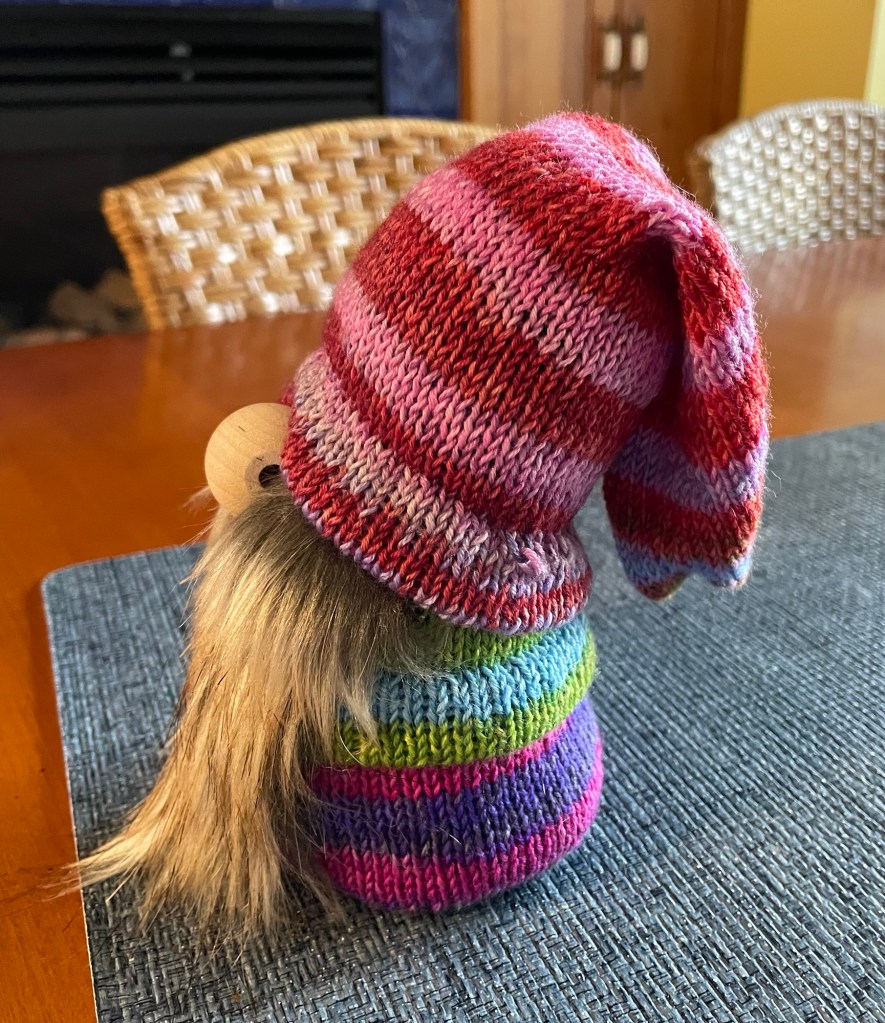
After sewing the hat on, my gnome was complete! I accidentally cut off part of the fur on one side of the nose, so my photos are all from the other side.

A woman I met at the April crank-in, Amanda, was there again. At that event she talked about having made 180 – 200 pairs of socks since getting her CSM last fall. She has made a bunch of money selling socks at Shepherds Harvest Sheep and Wool Festival, and other fiber fairs. At this CSM gathering, Amanda shared that one time when she did not have any clean socks, it was faster to crank out a new pair, rather than do the laundry. She cranked out three pairs of socks at this crank-in!! You can find Amanda’s Broken Unicorn Crafts Facebook page here.
Following are more photos of my gnome from the side and back, with better lighting at my house.

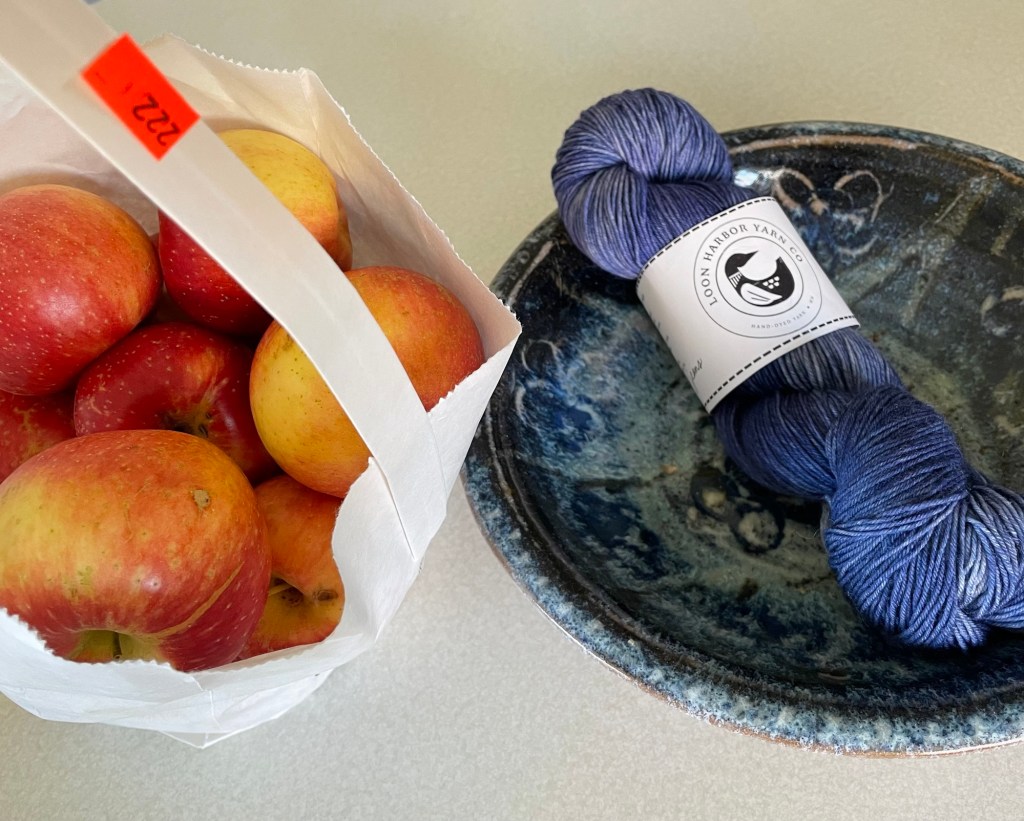
Before leaving Rocking Horse Farm I bought a skein of pretty blue sock yarn, shown below next to my bag of apples from the Arboretum Apple House.
As a wrap up to this fun weekend, I ordered my very own circular sock knitting machine from the Erlbacher company. It will be about a month before I get it, as each machine is custom made to order and they have a back up of orders. I am very excited about this new direction in my fiber journey.
 Yarns from the Lake
It is so great to be constantly learning new, fun, useful skills.
I think this CSM is what I saw being used to knit a dog sweater recently. So that is another product you could make with your new CSM!
LikeLiked by 1 person
Yes I have seen quite a few fun ideas for things you can make with the sock machine, in addition to socks. The first step will be to figure out how it works!
LikeLike
Wow! with a sock knitting machine even I could knit. I would love to find an antique one both to experiment with and exhibit as an antique. I have run across interesting antiques at thrift stores now and then, and bought them just for the novelty, if they were cheap. The one exception was something I paid $100 for several years ago, that no one in the store could figure out. They could see it was a keyboard instrument of some type, but had no idea how to make sound come out. It is a nearly flawless 1865 harmonium, a tiny bellows-driven organ which creates three octaves of notes, by air blowing through thin wooden reeds. The bellows are operated by foot pedals. West-ward bound pioneers took them in covered wagons to provide church music, because they were small and light.
LikeLiked by 1 person
It is cool that 100 year old antique sock knitting machines can still work! I think that often parts are missing and they need some tweaking to get them to work. Also, I believe there is a steep learning curve even for a new one. There are also less complicated circular knitting machines that are way cheaper, for making things with a bigger circumference.
LikeLike
Very interesting! I never knew such a thing existed. I look forward to reading about your projects with your new knitting machine. Also, we love Honeycrisp apples; we eat them nearly every day. Your gnome turned out great!
LikeLike
Honeycrisp is my favorite too. Thanks for your comments on the sock machine. I look forward to figuring out how it works, and eventually making socks for everyone and their brother, and posting about it!
LikeLike
What a fun project! It is interesting someone invented a sock machine. I look forward to hearing more about your experiences with it.
LikeLike
Thank you. I am excited to figure out how to use the sock machine (once I get it in a few weeks), and then when I am comfortable I will be making socks for everyone and their brother, and writing about it!
LikeLike
Oh that’s exiting. He is very smart and handsome and cheery. I hope when your new machine arrives you’ll make him some buddies to hang out with as well as socks.
LikeLike
Yes, he does need some gnome friends. My sister-in-law has a gnome collection, so she will be the first recipient after I get the machine and figure it out.
LikeLike
Very late to comment – but this is VERY clever (I also love the scarecrow!) Well done, Linda xx
LikeLike
Yes, circular machines are very clever! I own my own now! I am pretty good at making socks without ribbing. Still learning the ribbing attachment. Thanks for reading.
LikeLike