My grandma Lu knew about all the local birds species, and here at my parents house where we live now, there are bird books and binoculars ready for use in the kitchen. Displayed on shelves are beautiful wooden birds and ducks hand carved by my grandfather and uncle.
Birds carved by my grandfather and uncle
I know many people who love bird watching. But somehow I did not get the birds gene, and even developed an aversion to them. My apprehension goes back to seventh grade when I watched Alfred Hitchcock’s “The Birds” at a sleepover party. I was traumatized, and for months I was sure that tree branches brushing against my bedroom window were birds pecking to get in. I have never gotten over that completely. To me birds seem like creepy miniature dinosaurs with sharp beaks and beady eyes.
There was a bird feeder outside our den window in Minnetonka, but I did not pay much attention to it. My husband, Wayne, spent more time in that room reading the paper in the recliner, and taking over the desk. The bird feeder would sometimes be empty for months at a time until Wayne got around to filling it. Woodpeckers in Minnetonka pecked dozens of holes in our cedar siding.
One time years ago my sister was on a trip with her family near Traverse City, Michigan. While having a picnic lunch at Sleeping Bear Dunes National Lakeshore, aggressive seagulls swooped down and took sandwiches out of the children’s hands.
At the lake where we live now, there are multiple bird feeders in view outside the kitchen windows. We regularly have multiple kinds of woodpeckers, including red bellied, hairy, and pileated at the feeders. There are hummingbirds during the summer. An owl regularly hangs out in a tree at the edge of the yard (what kind?), and in the woods on the path to the cottage. We have had a wild turkey hen walking down the road followed by her 10 chicks in a line.
A pileated woodpecker at the feeder in front of the house
Last fall we had flocks of trumpeter swans flying low overhead, looking like small aircraft coming in for a landing on the field across the road. We see eagles regularly perched in trees near the lake, or flying past.
Trumpeter swans in the field across the road
Later in the fall we took a walk over to our family cottage. The water at the shore was frozen completely clear and still, looking like a diorama with plexiglass ice at a natural history museum. There was a section of open water, then more ice. Out in the lake, an eagle was sitting on the edge of the ice. Further south we saw two trumpeter swans.
Water at the shore frozen over last winterThat black dot in the middle right is an eagle. There are 2 trumpeter swans barely visable to the left.
I don’t know how the birds manage all winter but we continued to see them every day regardless of weather conditions. Wayne went out in the middle of a blizzard to refill the feeders. I hope the birds appreciate that!
Wayne refilling a bird feeder during a blizzard
My dad had placed a shelf in one of the upper corners of the front porch so the robins had a safe place for their nest, and there are usually one or two batches of nestlings raised there each summer. This summer we found a nest in the other corner of the porch, where there is only a narrow ledge. One day when I went out on the porch to sweep away spider webs, I realized the nest was piled high with birds, looking like it would tip off the ledge any second. It was not clear they were alive, so I put the broom away and used a step latter to get a better look. Without getting too close I could see they were breathing, so I backed away. A few days later it was hot out and the hanging plant near the nest desperately needed water. When Wayne reached up with the watering can, all the young birds flew out of the nest simultaneously, landing in nearby tree branches.
A heap of Baby Robins
Birds are still not my favorite part of the animal kingdom, but I have come a long way from the bird trauma days of my past, and am learning to appreciate their beauty and variety.
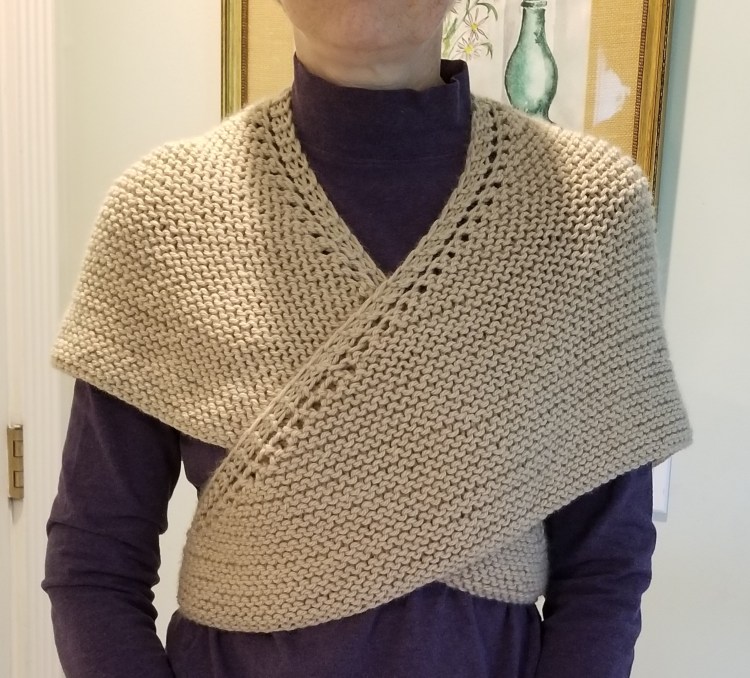
I decided to knit a traditional Danish Tie Shawl, after observing all the beautiful knitwear worn by characters on the TV series “Outlander”.
My tie shawl from the back
I used a pattern from the spring 2008 edition of Spin Off Magazine. A traditional tie shawl is knit in a crescent shape which allows it to cross in the front, with the ends wrapping around the sides and tying in the back.
Close up of the ends meeting in the back
The pattern is composed of alternating increase rows and straight knitted rows. The increase rows have six yarnovers, two in the middle and two on each side. I messed up one of the increase rows, but by the time I noticed I was many rows beyond and decided it was not worth ripping out the stitches and fixing the mistake. I can find the incorrect row immediately, but in the overall scheme of things, for something I will only be wearing around the house, it is not a big deal.
The completed project
My husband and I have been watching Outlander together. I had heard about it for years and we finally decided to give it a try. It is nice to find a show we both like and look forward to the next episode together. I also started reading the books that the TV production is based on, which is turning out to be a different experience. Certain aspects of the story are easier to show on the screen, but the character development and other details are more thorough in writing. I read that it is a huge challenge to condense each of the very long books (ranging in pages from 642 to 1456) into one 13 episode season, requiring major editing, cutting out plot elements, or adding story lines to make the adapted version work. The TV show has some very graphic sex and violence which I think could have been toned down. We had to fast forward past a few scenes.
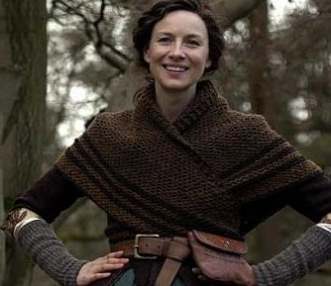
If you are not familiar with Outlander, the story is about Claire, a WWII era British combat nurse. While on a second honeymoon with her husband in Scotland after the war, she accidentally time travels 200 years earlier to the same location. There is beautiful Scottish scenery, period costumes, romance, adventure and intrigue. Claire gets herself into and out of many dire situations due to her knowledge from the 20th century, her medical experience, and her inability to adapt behavior and language to the expectations of the times. She cannot explain how she knows things without people thinking she is crazy, a witch, or a spy. Amidst all the action and mayhem, I particularly notice the many knitted shawls and accessories worn by the 18th Century women.
I wear a down vest around the house most winter days. It takes the chill off while allowing free use of my arms. A tie shawl is the eighteenth century version of a down vest. On Outlander, and in real life, women wore them as a regular part of their outfit for warmth and practicality.
My 18th century down vest / tie shawl
Claire wearing a tie shawl and wristlets on Outlander
A different tie shawl and wristlets worn by Claire on Outlander
Another Outlander character wearing a knitted capelet
During one of our zoom calls with family members, we posed the question “if you could travel back in time without risk of getting the plague or being in grave danger, where and when would you want to go?” Interestingly, several of the young adult women said they were not sure there is any time or place they would want to go due to the unfair treatment of women in the past.
After some prodding and setting of conditions, times and places that were selected for time travel included an indigenous culture, the 1920’s flapper era, an ancient but advanced civilization from the Middle East, the time of the Dinosaurs, and England in the Regency era. I picked our family cabin property in the 1920’s when the cabin was brand new, and the lake was almost completely undeveloped.
People sometimes talk about the “good old days”. Maybe there are times and places in history that were better for certain parts of society, but were they better for most of the people?
Update in January 2024: This post has received way way way more views than any other post, probably because it mentions Outlander in the title. I love Outlander. I have read all the books and watched all the episodes of the TV series, and am waiting for the next (possibly last) book and series. I have done a lot more knitting since this post, and learned how to weave. I recently found a wonderful online school and community called the School of Sweet Georgia for knitters, spinner, weavers, etc. They have amazing classes with both written transcripts and video. I am loving it. If you are interested in learning more, click here. There is a pattern at the School of Sweet Georgia that might work for a tie shawl, so stay tuned, I may knit it up and post about it.
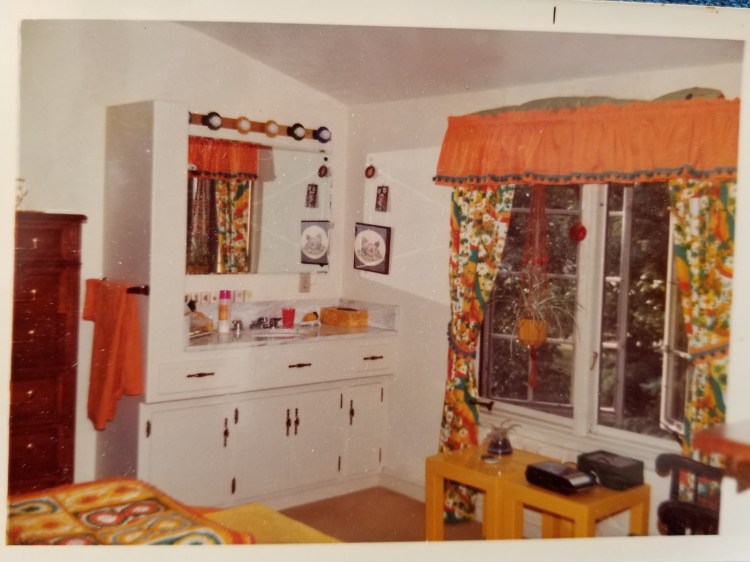
During high school in the 1970’s I crocheted several granny square style afghans. I recently came across a photo showing the afghan I made for my orange and yellow themed bedroom, with the coordinating curtains my mom had sewed.
My bedroom in the 1970’s
You can see the afghan on the bed in the lower left of the photo, and the flower print curtains on the windows. Our house came with sinks in each of the three bedrooms, a very unusual but practical feature. Even though I did not spend hours on my hair or makeup, it was still nice to be able to do teeth brushing and personal care privately in my room without tying up the bathroom. My color coordinated bath towel is hanging on the bar next to the vanity.
I believe I made the macrame plant holder that the spider plant is hanging in. Notice the cassette tape player on the little yellow table under the window. Occasionally I would listen to the radio, and then quickly hit “record” if a good song came on. LOL. I have no memory of the stuffed animal snake on top of the curtain rod.
That house was a lovely traditional story and a half. However it was smaller than the homes nearby, and had only one and a half baths, and a single stall garage. There was not enough room to add a second garage stall on that side of the house. When my parents sold it around 1999 the new owners removed the bedroom sinks. Later the house was bought by a developer and torn down to make room for a larger house with a modern floor plan, placed differently on the lot so it could have a bigger garage.
Following is a photo of my afghan, taken last spring when we were sorting and purging in preparation for moving. I have not had any rooms decorated with orange since those days and it was starting to come apart in several places. Even so, it is hard to part with something you spent a lot of time making.
The afghan I crocheted in the 1970’s
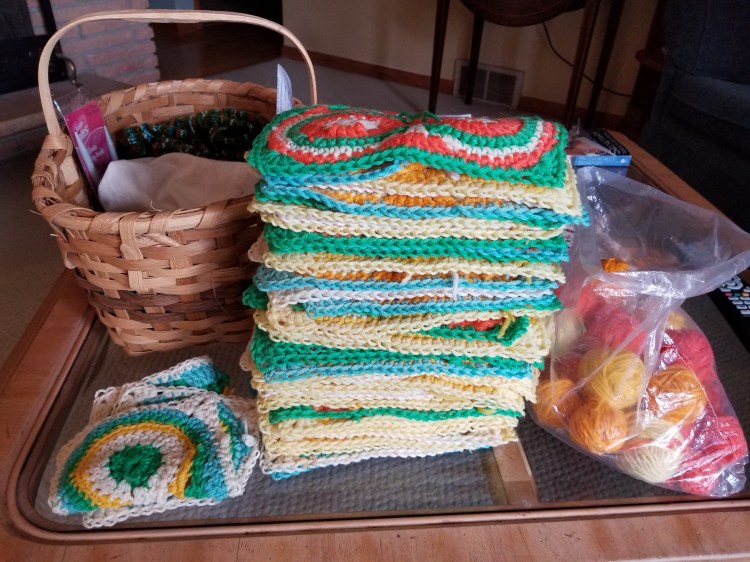
The afghan was not in good enough condition for donation, and I could not bring myself to throw it in the trash. I had made it, I would be adding to the landfill and wasting yarn that could be repurposed. I decided to rip out the stitches that held the granny squares together and save the sections that were still usable. I was left with a pile of the squares plus small balls of the yarn I had removed.
The remains of my afghan after ripping out the yarn holding the sections together
Some day I will be inspired to make something new with the crocheted rectangles from the afghan. Maybe pillow covers, or bags, or a smaller afghan. Suggestions?
Last summer, when my mother was still with us, mounds of dirt were appearing in the front yard. One day when we were looking out the kitchen window my mom commented that the last time she noticed there was only one mound, but now there were two. At the time she was struggling with memory challenges, so I thought to myself “maybe”.
My husband had also been observing the dirt piles, each one next to a hole. He had been filling the holes up with the dirt, but as fast as he could fill them another mound would appear.
Later when I happened to look out the window again, I saw dirt fly up from the ground, a small head pop up and look around, and then disappear. It was just like the gopher in the movie Caddyshack.
I got this Caddyshack image from the internet, but it looks a lot like our yard
With the giant gopher holes in the yard making steady progress closer and closer to the house, we figured the gophers would be digging up in our kitchen in a day or two. Action was required.
Following is Wayne’s account of what happened next: “I drove to Fleet Farm, which as we all know, has everything you could possibly need. I found my way to the section with mouse traps. I was looking perplexed when one of the Fleet Farm workers approached. I explained to him the situation, telling him I had gophers digging up my lawn and they were heading towards the house, getting closer by the minute.
“You have one gopher, and the trap you need is not in this section. Follow me.”
We headed to the far end of the store, near the sporting goods.
“We may not have our larger animal traps out yet, as they are a seasonal item, but if they are not out, I will take you back to the warehouse where I know we can find them.”
The trap he was looking for was not on the show floor, so off we went through two double doors into the spacious warehouse area. We walked and walked forever, until we finally came to a big bin full of twisted wire. It turned out the twisted wire was actually individual gopher traps — the infamous “Death Klutch” DK-1!
“This is what you need,” said the Fleet Farm trap expert confidently. He showed me how to set the trap once but knew I would forget. “Just look it up on YouTube, they will show you how to set it.”
You dig a hole in the dirt mound, to get air into the tunnel below. The gopher will sense the fresh air, and return to patch up the hole. If you are lucky, he will spring the trap. The first try was unsuccessful, but the second was the charm. End of gopher. Our yard, and our living room, were saved”.
Minnesota is known as the Gopher State
Minnesota is the Gopher State. A political cartoon from 1857 is credited with giving Minnesota this nickname. In the 1850’s the legislature was considering a five million dollar loan to the railroad tycoons. Regular folks were skeptical and wondered why this was necessary and whether only a few people were benefiting. The drawing by St Paul artist R.O. Sweeney showed the rich railroad owners as gophers with human heads pulling a train with paid off lawmakers. The cartoon went “viral” as we say today and thereafter Minnesota was known as the Gopher State.
The original University of Minnesota mascot from the 1940’s
Goldy Gopher has been our University of Minnesota mascot since the 1940’s, being represented over the years by various logos with a striped tail. Actually it turns out that gophers do not have striped tails. The rodent with the striped tail is called a 13-lined ground squirrel. I guess the mascot has been depicted with the striped tail for so long that no one notices or cares that it is not accurate.
My daughter carved me a set of willow wood knitting needles for Mother’s Day. They are beautiful, light and smooth.
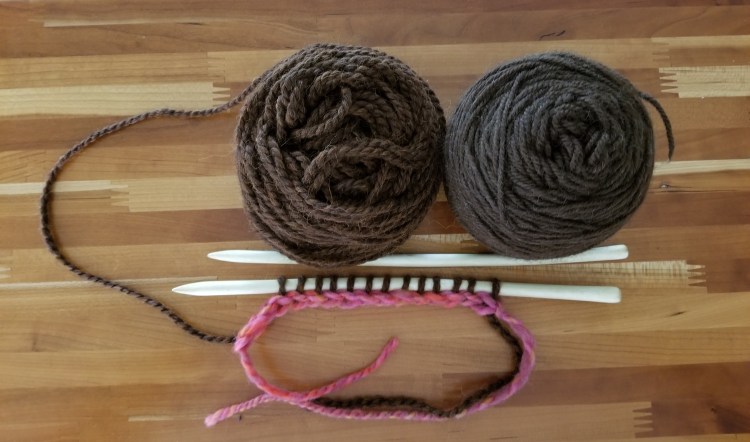
I decided to knit a scarf with the hand carved needles using a pattern I got from my cousin Mary Turak. I used a crochet provisional cast on so I would be able to join the beginning live stitches with the last row to make an infinity scarf. Other times I have made an infinity scarf by using a normal cast on and cast off, and then sewing the ends together.
Beginning of a scarf using a provisional cast on and 2 different brown yarns
The pattern uses two different yarns, alternating every three rows. Every sixth row you slide the stitches across and knit from the other end of the needle, picking up the working yarn for the next color. Normally you would use circular needles or double pointed needles for this pattern. Since the hand carved needles do not have a knob on the end, they worked fine.
Switching between two yarns every three rows allows you to carry the working yarn up the side without having any loose ends to weave in. Sliding to the other end of the needle every six rows results in knitting on the back of the stitches, causing a flat “stockinette” look after that row for some variation in the pattern even though you are knitting every row. The exact size of the needles does not matter, as long as you like the outcome. If you use a larger needle than normal, your scarf will be lacier. The hand carved needles are a bit smaller than size 11, so they turned out well for the brown yarns I found in my stash.
The first time I used this pattern years ago I had been looking for a way to use one skein of my hand spun yarn. Adding another complimentary yarn makes for an interesting design and allows the hand spun yarn to go farther. Using yarns with different fibers, thicknesses or textures, or using bigger or smaller needles, is another way to mix it up and make a unique scarf.
The following image shows my project after knitting row three of the thicker yarn. You can see the working yarn on the right, from the last row knitted with the thinner yarn three rows earlier.
After completing three rows of the thicker yarn, with the working yarn from the thinner yarn on the right
In order to pick up and continue knitting with the thinner yarn for the next row, the stitches are slid across the needle to the other end, resulting in knitting on the back of the stitches. Normally a circular or double pointed needle would be used, but my hand carved needles worked for the purpose.
The stitches are pushed across to the other end of the needle in order to continue knitting with the second yarn
After knitting enough rows so the infinity scarf would wrap around my neck twice, and I was almost out of the thicker yarn, it was time to graft the two ends together with kitchener stitch. I removed the crochet provisional cast on one stitch at a time, inserting the second knitting needle into the stitches as I went.
Inserting a needle in the stitches as the provisional cast on is removed
I flipped one end of the scarf from front to back before grafting so there is a twist in the infinite loop. I had always been confused with the kitchener stitch used to join two sets of live stitches together, until I came upon the method described in the sock pattern Smooth Operator Socks by Susan B. Anderson. After doing it a couple of times on the toes and heels of socks I can remember what to do without looking at the pattern.
Completed infinity scarfAnother view of the completed scarf
It is likely I will make this scarf again as a way to use single skeins of yarn from my stash. Next time I will experiment with knitting a different number of rows per color, using different sizes of needles, or other methods for carrying the working yarn up the side.
My cousin-in-law is undergoing chemotherapy treatment for breast cancer. There is never a good time for this, but right now is particularly hard with social distancing precautions in place. I know she is receiving many virtual hugs and prayers and support.
I decided to contribute in the form of a knitted chemo cap. I researched what yarn would be best for this purpose and looked at patterns. Recommendations included cotton or a cotton/acrylic blend, or bamboo. Being it will be in direct contact with her skin, and summer is hot where she lives, I decided on some cotton and rayon blend yarn that I had in my stash.
Yarn selected for the chemo cap
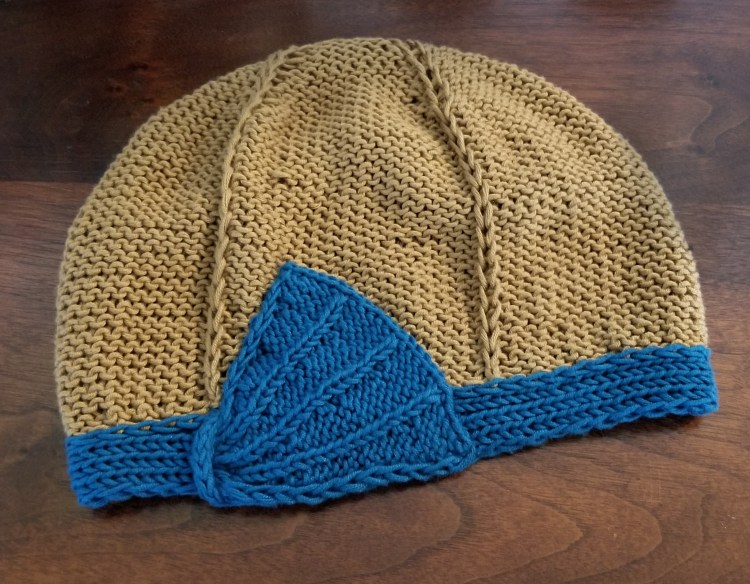
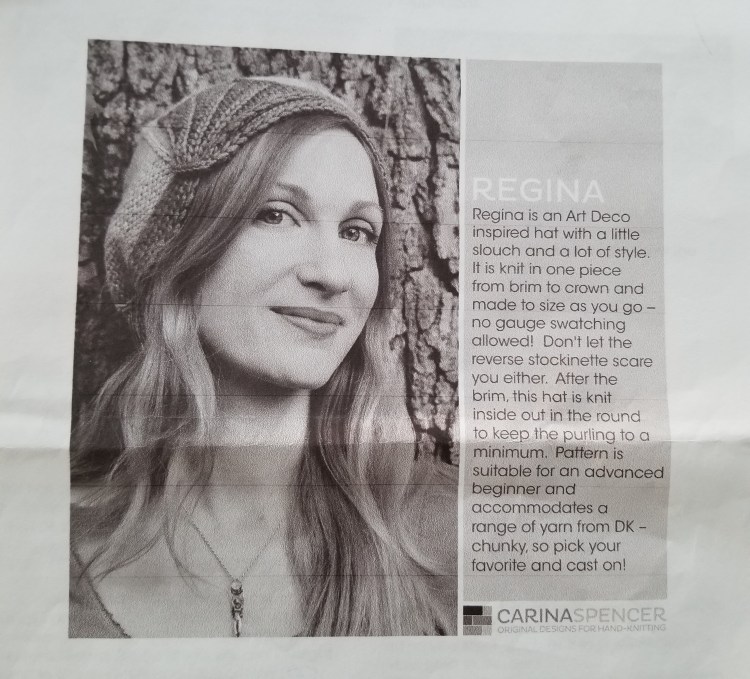
I found a pattern on Ravelry that looked fun and stylish, the Regina Hat by Carina Spencer. I could visualize it on my giftee and she liked it too. The pattern involves knitting a long narrow band with a fan shape at the end in one color yarn, then picking up stitches from the band to knit the main part of the hat in a different color yarn, with a slouch style. Following is a photo of the knitted band with a fan shape at the end.
Band with fan for the beginning of the hatStitches picked up from the band for the main part of the hat
This pattern is knit inside out. Normally when you knit in the round the front or right side is the smooth looking side with all the little “v”s. This pattern has a stitch pattern that is showcased on the back, which is the “right” side in this case.
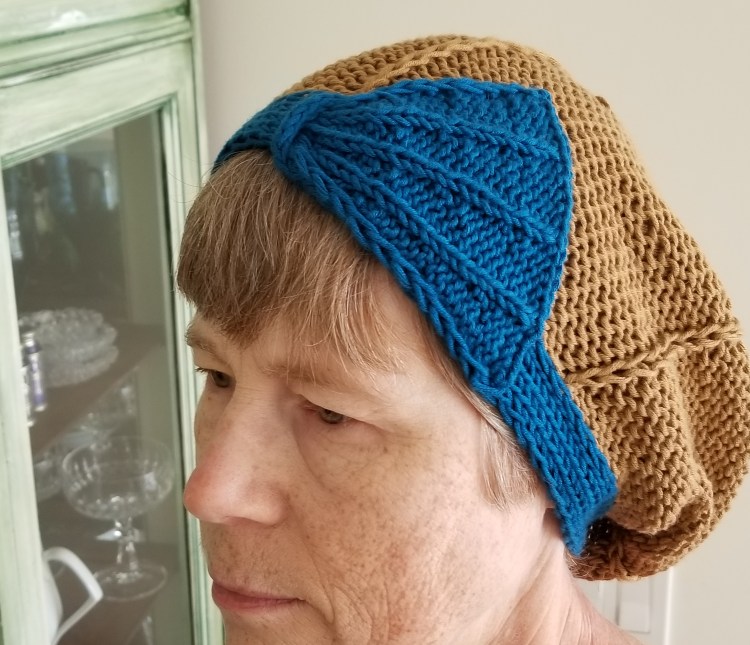
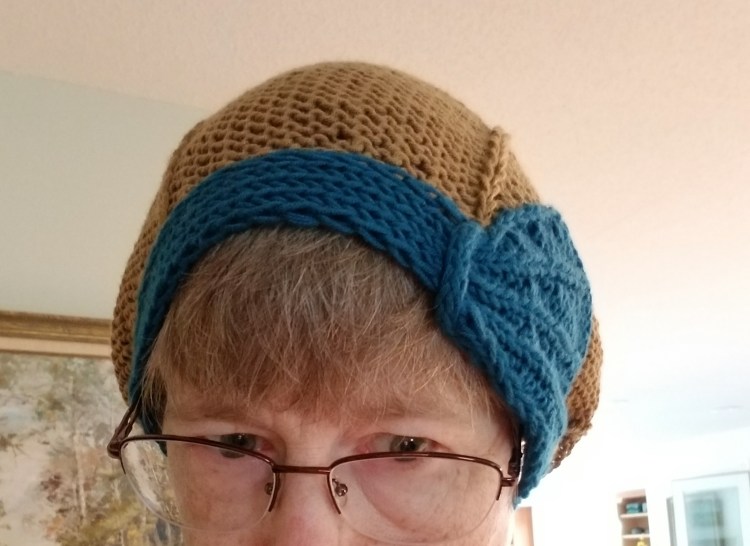
After starting decreases for the crown and switching to double pointed needles, with the color not showing accuratelyCompleted hat
It looks like there are mistakes in a couple of places, but after looking and looking I think the tension is just wonky there. The cotton yarn acts differently than wool or a wool blend, with less elasticity. The pattern called for using needles three sizes bigger than normal for the main part of the hat, which makes it loose and drapy.
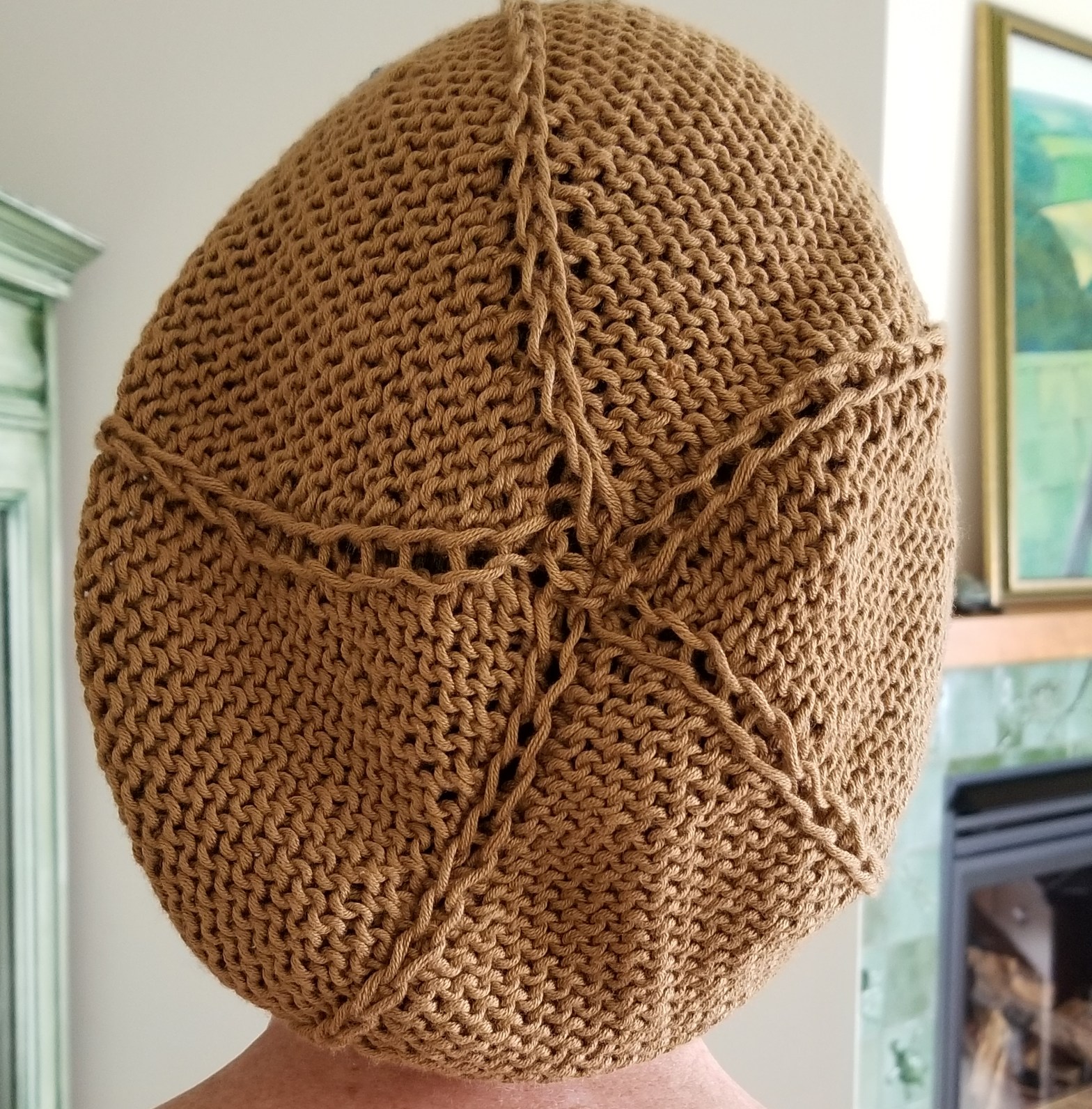
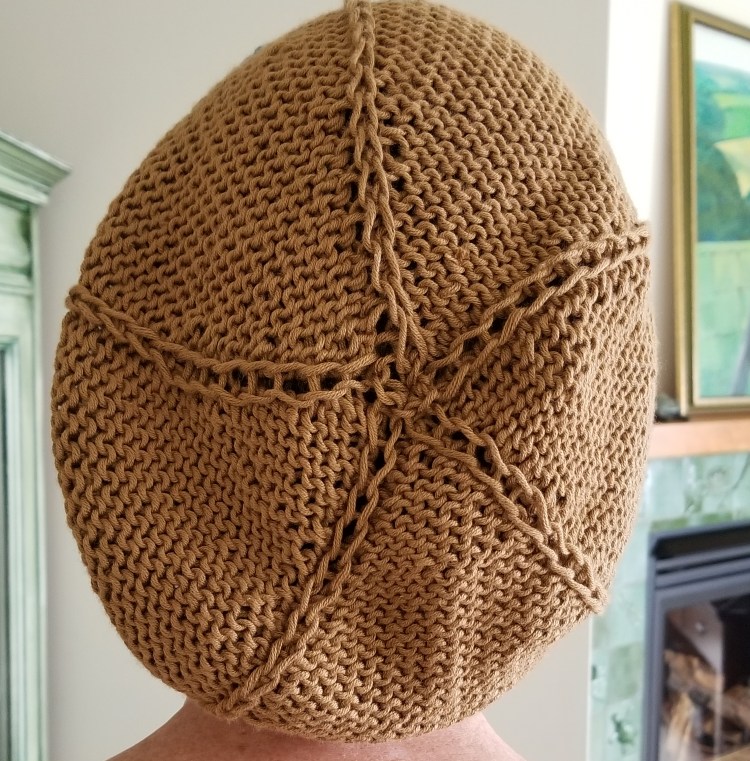
The center back is very loose due to the large needle size (or my knitting?)
Where the stitches all come together at the top looks way looser than the photo in the pattern, but I guess it is OK as long as they do not come undone. For the purpose, it is just as well that it is “airy” as it will be cooler to wear during this summer’s hot weather.
What it is supposed to look likeModeling the finished hat
Wigs are another method used throughout the centuries by both men and women to cover up bald or thinning hair, as well as for fashion and hygiene purposes. My mom had one in the 1960’s when they were in style. I also remember that when my grandma was getting older and her hair was thinning, she wore a wig that was supposed to look like her own hair.
My mom’s wig from the 1960’s or 1970’s that we found stored in a trunkMarie Antoinette in a “pouf” hair style with her own hair on top of a hairpieceThomas Jefferson wearing a wig in 1786
When my daughter was on a semester abroad in Equador during college, she and another student shaved their heads. It was not because of the hot humid weather there, rather it was a statement about being beautiful with or without hair. A few months later when she was back home she was a bridesmaid in her cousin’s wedding. By then her hair had grown enough to have it professionally styled into a cute short cut. My mom was beside herself that not only did my daughter have this non-standard looking hair for the wedding, but my niece, another bridesmaid, had remnants of blue dye in her hair. It was a boho wedding with the bride wearing a long wedding style skirt with a camisole top, and her fringed moccasin boots. It was perfect.
My giftee’s hair completely fell out after one chemo treatment. She posted a bald photo of herself…she was and is beautiful. It is wonderful that she has options for going natural, or wearing a fun hat or stylish scarf. Or even a wig if she wants to.
In the late 1950’s my grandmother’s sister and her husband, Margie and Doc, were teachers in Glen Arbor, Michigan, near Traverse City. Margie liked to knit, so Doc had the idea of selling yarn to make money during the summer. They rented space and “The Yarn Shop” was born. Doc also ran small ads in a major magazine and sold yarn by mail during the winter.
A few years later the father-in-law of Margie and Doc’s daughter received a patent for a type of soda dispenser that is still used at restaurants today. Looking for more ways to supplement their teacher salaries, Doc bought a lot on the main drag in Glen Arbor and built himself a retail space with a soda fountain and ice cream on one side, and yarn for sale on the other side.
My mom and her Aunt Marge at the Yarn Shop in Glen Arbor, MI, in 1959
In the early 1960’s when I was a little girl we lived in Grand Rapids, Michigan. At the same time, Margie and Doc’s daughter, Mary, and her husband, Ted, lived in Ipsilanti while Ted worked on his PhD at the University of Michigan. Mary and Ted had two kids, who were close in age to me and my sister. We spent quite a bit of time with them, travelling between our homes and to Glen Arbor.
I can still visualize the inside of the soda shop/yarn shop with it’s unique layout of soda counter with tables and chairs on one side, and displays of yarn on the other side. Fuzzy soda and sticky yarn. Outside in front were tables with trays of shells for sale. At that time Glen Arbor was a sleepy backwater town with a few stores, wide streets, and lots of sand everywhere. Lake Michigan was a couple of blocks to the north. I remember going to the Sleeping Bear sand dunes a few miles west, and to a swimming hole on the Crystal River in the opposite direction.
Later we moved back to Minnesota, and Mary and Ted settled in the D.C. area. Ted was a professor at American University, Mary was an elementary school teacher. Around 1975 Margie passed on and the next phase of the Yarn Shop and Soda shop began. Mary would spend the summer in Glen Arbor running the Yarn Shop, while their daughter Lissa and her high school friend, who were close to my age, worked at the Soda Shop.
Some time in the late 1970’s, after Doc passed on, the Yarn Shop moved to a different retail space in Glen Arbor and Lissa took over the Soda Shop. The growing number of tourists in the area needed more places to get food, so Lissa expanded the Soda Shop by adding a grill and making it into a full service restaurant. Around 1980 Lissa moved to Glen Arbor full time. Mary moved to Glen Arbor full time after Ted passed on and she had retired from teaching.
A Yarn Shop sign with Mary’s logo
By the mid 1980’s Lissa had sold the Soda Shop and moved on to other activities. The Yarn Shop grew into a thriving business in several different prime retail locations in Glen Arbor over the years, as the area became a popular summer tourist destination. In addition to selling yarn, Mary designed and knit original sweaters and knitwear that she brought to high end trunk shows.
Yarn for sale at The Yarn Shop in it’s hey day
I have always loved trips to Glen Arbor as an adult. All the colors and textures at the Yarn Shop were magical and inspiring, and Mary would always send me away with a new knitting project.
Another generation of our extended family modeling a Mary Turak creation
Over time the business climate evolved with more online yarn sales, and cost for commercial space increasing. As Mary got older and rent went up, Lissa remodeled the main floor of her house in Glen Arbor into a lovely space for The Yarn Shop.
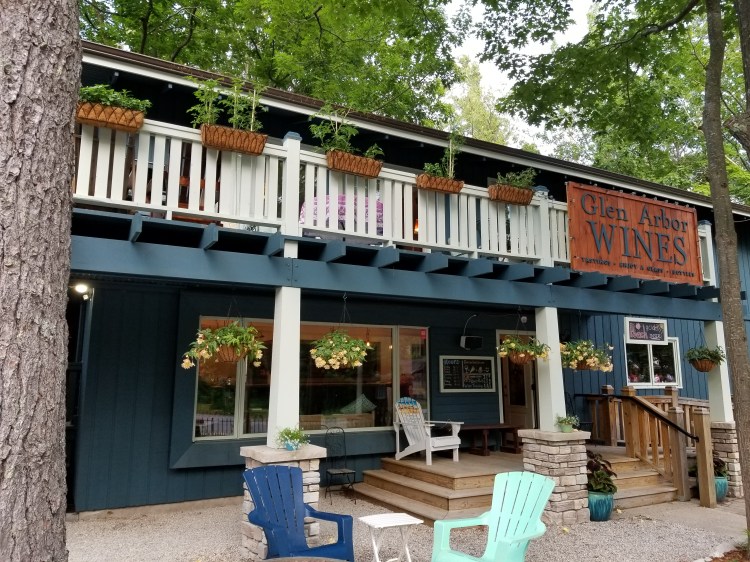
A few years ago Lissa’s entrepreneurial nature kicked in and she repurposed most of her home retail space into a successful wine tasting room, featuring locally made wine and a large outdoor space for games and socializing, 6 feet apart for now. Check it out if you are in the area. https://www.glenarborwines.com/ As part of this evolution, the Yarn Shop was downsized and moved to an alcove on the side. Mary was able to continue making a few yarn sales using the staff and point of sale system for the wine business, work on her knitting, and visit with customers.
Glen Arbor Wines is open for socially distant business
At the end of summer 2018 when Mary was 86, she finally decided to retire. The yarn was put into empty wine boxes and bags, and stashed in a back room with all the related accessories and fixtures. Lissa figured she would have to sell the yarn on EBay, but did not have time with her full time job as editor of Traverse Magazine, plus running Glen Arbor Wines, and taking care of her mom.
I have been knitting and spinning for a long time, and the wheels started to turn in my head when I heard that the Yarn Shop was closed. Wouldn’t it be fun to have a yarn shop! It would be cool to keep the Yarn Shop going in another location. I thought about all the positives and negatives and what I could do with all that yarn. I discussed the risks and benefits with my husband, considering that I was planning on retiring from my “day job” in the spring. I could sell yarn on the internet one way or another, or have in person sales from my parents large house on a lake, where we were expecting to move in the summer. After agreeing on a price with my cousin, I decided to go for it given that the worst case scenario was trying to unload the inventory on EBay and lose money on the deal. In any case it would be a crazy adventure, and we get to do that once in our life.
I had a four day weekend break from my school district job in October 2018, so we made the 12 hour drive from Minneapolis to Glen Arbor to get the yarn, thinking it would fit in our Honda CRV. HAHAHAHA. After we got there and saw the inventory, we realized no way would it all fit in the car. We rented a uhaul trailer at the last minute and it turned out to be one of those trips where you remember the details for years to come.
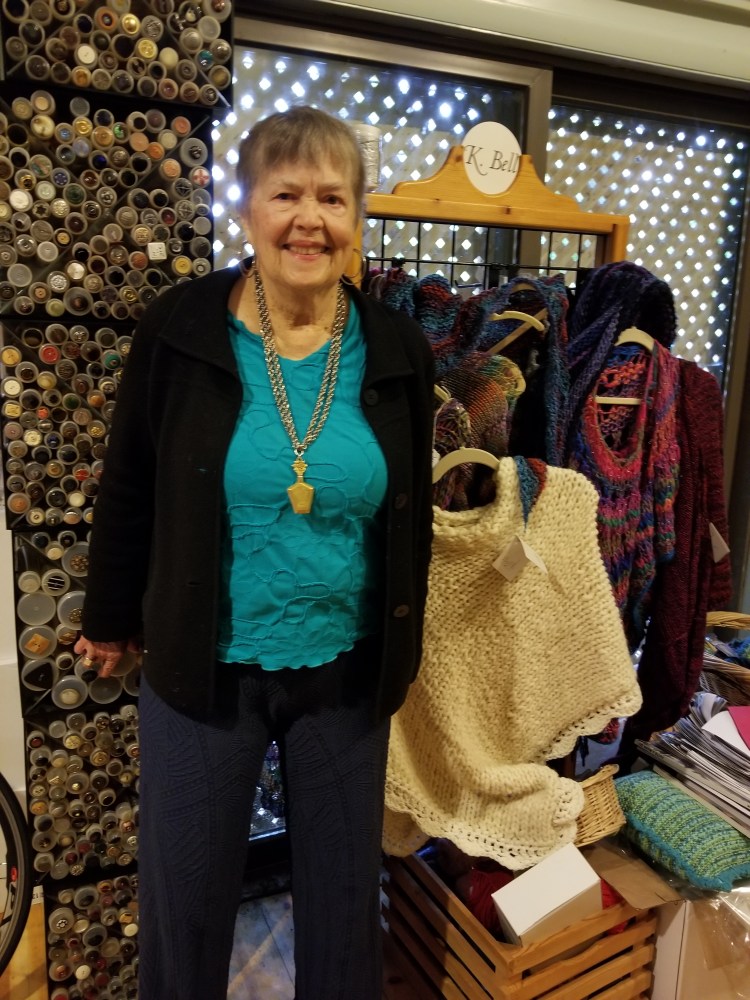
Mary Turak in front of some Yarn Shop inventory that had been stashed in the back after closing the shop
By the time we had the UHaul Trailer, there were only a few hours to load up and get on our way. The wine boxes had to be repacked with less yarn so they could be shut and stacked in the trailer. Several people stepped up to help us toss yarn from shelves and overfilled boxes into plastic garbage bags, close up the boxes, and load everything into the trailer. There were also fixtures with vintage buttons, boxes of accessories, finished sample knitted goods, patterns, and random miscellaneous related yarn stop “stuff” that Lissa would have no use for. Finally the trailer and the back of our car were both stuffed full and we hit the road.
Loading the trailer
We drove through Chicago both directions, staying overnight with our son in his condo. Heavy rain and wind whipped the trailer around on the way from Glen Arbor to Chicago. We were worried about parking when we arrived at James’s condo as it can be a challenge to find one parking spot. We needed TWO contiguous spaces on the street to fit the car with uhaul trailer attached. Amazingly, we found two spaces just around the corner.
Later at home I had fun dumping all the bags and boxes of yarn out on the floor in our downstairs for admiring, sorting and documenting. I made a spreadsheet, did an inventory, reorganized it, and reboxed it all up again. A funny moment happened when I opened one box and found empty wine bottles instead of yarn!!
Checking out boxes of yarn in our basement….oops one has empty wine bottles from Glen Arbor WinesYarn Shop inventory unloaded into our downstairs
The yarn shop inventory was stored in our downstairs guest bedroom for the rest of the fall and all winter. During that time we were packing and preparing to sell our house in the summer and move to my parents house near Fergus Falls, to take care of my mom.
That winter of 2019, my uncle Steve who is active with doings in Fergus Falls connected me with Torri Hanna, a weaver and fiber artist. Torri had just rented a storefront space in Fergus Falls with room for her multiple large looms as well as gallery space for fiber art, work space, and sales space. Torri and I started communicating and she agreed to sell my yarn on commission. With our move, taking care of my mom, and other unexpected things that happened, it took until fall 2019 to get all the yarn into Torri’s shop, Tangles to Treasures.
Vintage Buttons from The Yarn Shop
The commission sales arrangement has worked out very well for me and for Torri. There is room to display all the yarn at the shop, it is a better place for customers to access the yarn than our home outside of town, and Torri buys some of my yarn for her weaving projects.
Following is the website for Tangles to Treasures http://www.tanglestotreasures.com/ In addition to inventory from the Yarn Shop, Torri sells locally hand dyed yarn and wool yarn from sheep raised in the area, as well as Schacht looms, spinning wheels and related equipment, and one of a kind hand made goods. Torri is currently open on a limited basis and available to assist customers from a safe distance and via phone, and is exploring options for ecommerce.
My own hand spun yarn for sale at Tangles to Treasures
Looking back over all the unexpected events of 2019 and 2020, who could have predicted this evolution of The Yarn Shop or what our lives look like today with social distancing. We all look forward to some return to normalcy, and who knows what new adventures await.
I love fresh bread. I could never do one of those diets where you can’t eat bread. I have been gradually changing my diet in recent years to be more healthy, including eating less meat and processed food, and transitioning to whole and multi grain bread.
When the kids were young we ate white bread. Occasionally I would buy wheat bread, but it always seemed dry and no one would eat it. Over the years I found some brands of multi grain and oat bread that I liked for sandwiches. These days I never buy grocery store white sandwich bread, although our local bakery has some amazing olive bread and french boule that are a regular treat.
During the stay at home order I have been experimenting with a bread maker that we have had for years. I had only used it a couple of times a year with mixed success. I never knew what went wrong with the flops, but probably one problem was old yeast because I did not use it very often. I wanted to give the bread maker away when we moved last summer, but my husband convinced me not to and I am glad about that.
Now that I have more time and fresh ingredients, I have been trying the bread maker again. So far I have made french bread, 100% whole wheat bread, and multi grain bread. I have also used the “dough only” option for egg bread and pizza dough, where the bread maker stops after mixing and rising so you can do the baking yourself in the oven. I separated off part of the egg bread dough for buns. They turned out quite good.
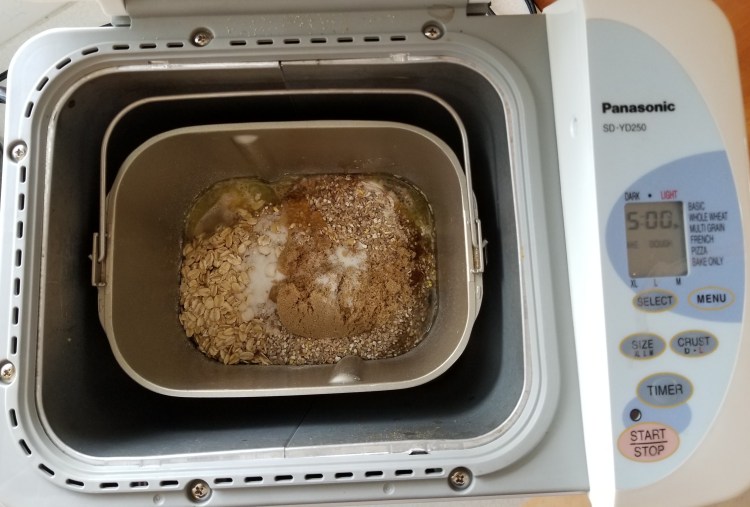
Whole wheat flour, oatmeal, 7 grain cereal, brown sugar, honey and salt ready to add to water, olive oil, white flour and yeast in the bread maker.
Today I made a loaf of multi grain bread with a recipe that I tweaked a bit from the one in the bread maker booklet. I have made this version successfully several times now.
Following is my version of multi grain bread: 1 cup plus 2 tbsp water, 2 tbsp olive oil, 1 ⅓ cup white flour, 1 cup wheat flour, ¼ cup oatmeal, ½ cup 7 grain cereal, 3 tbsp brown sugar, 1 tbsp honey, 1 ¼ tsp salt, 2 ¼ tsp yeast
Ready to close the lid and press “start”
The multi grain bread takes 5 hours, so if we want to eat it fresh, it is going to be an afternoon snack or a side with dinner. Or I guess I could get up earlier.
One problem with the home made bread is that it is hard to cut evenly. I am particularly inept at it and usually end up with a slice that is thick on top and thin on the bottom. To solve this problem I ordered a bread slicer gadget that is really slick. It is a bamboo sort of frame with slots on each side to keep the knife slicing even. There are different widths of slots so you can have thin, medium or thick slices. It folds down for storage.
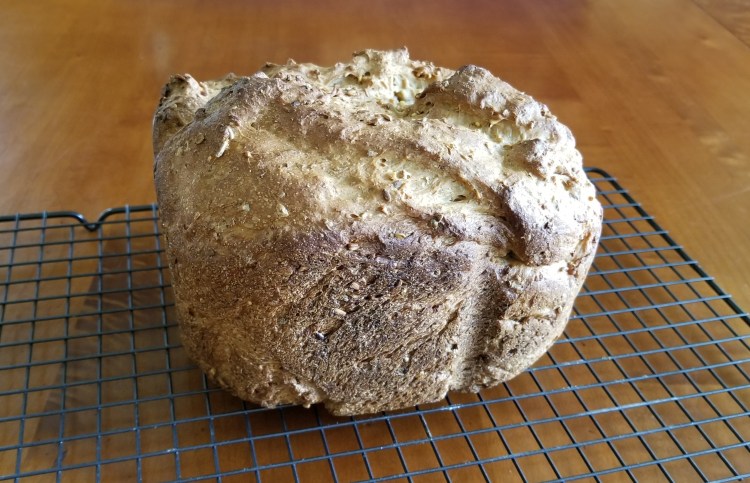
Bamboo foldable bread slicerCompleted and removed from the bread makerSlicing a piece of breadFresh bread with dinner…yes that looks like a lot of butter
There is a recipe for croissants (using the dough only option) I would like to try when we have more people around. The recipe uses seven ounces of butter, so how could it not be good? Watch for a future post about that.
My mom passed away last fall. To honor her for Mother’s Day, I am sharing a little bit about her. My mom loved being at home. She rivaled Martha Stewart in her homemaking and creative abilities which included entertaining, cooking and baking, gardening, sewing, knitting, painting, ceramic art and writing.
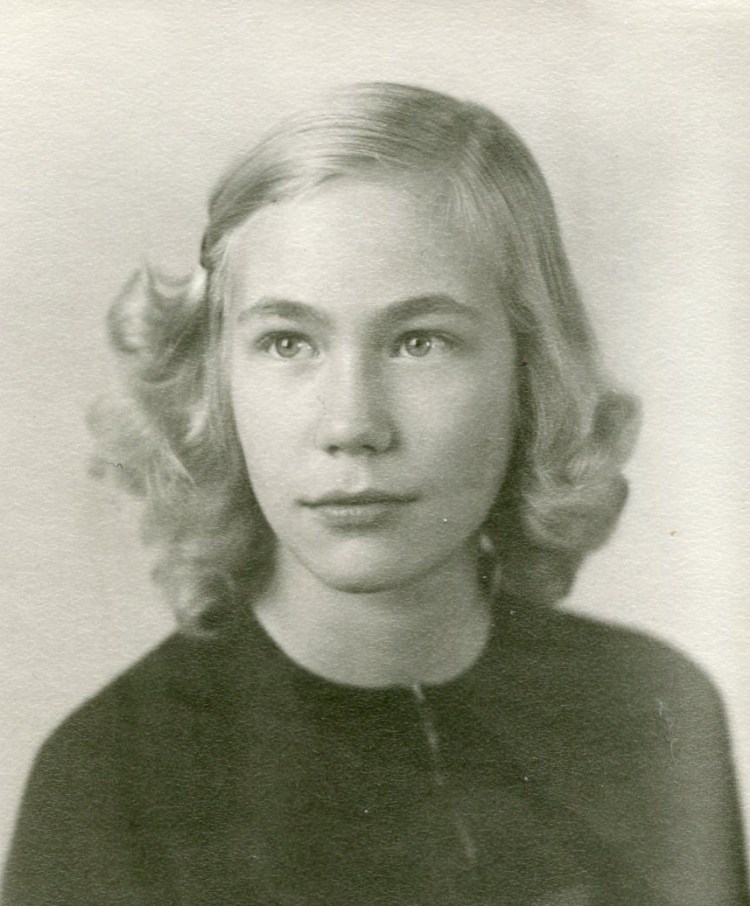
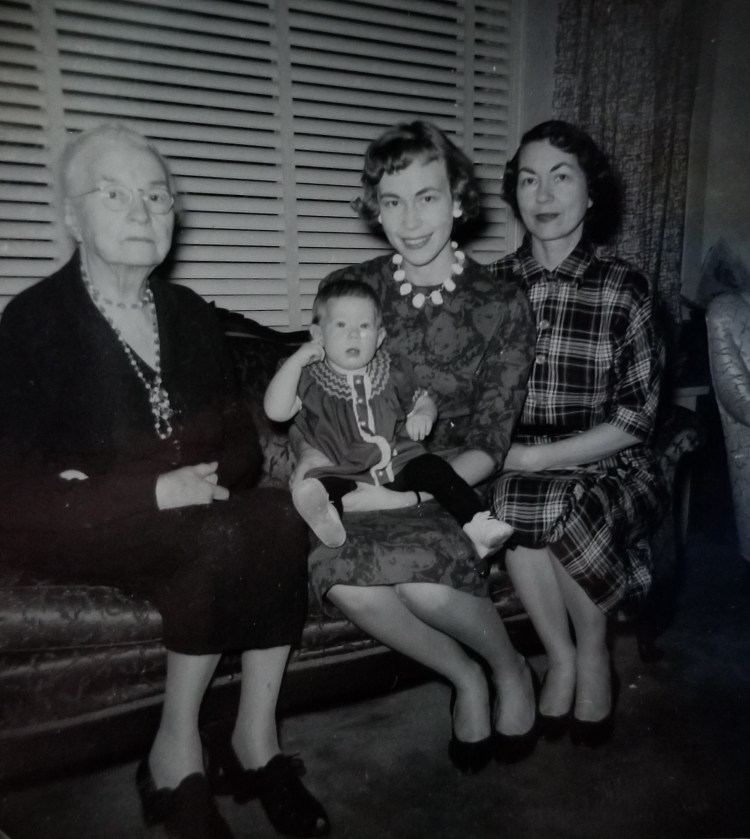
My mom circa age 12My mom holding me, with her mother and grandmother
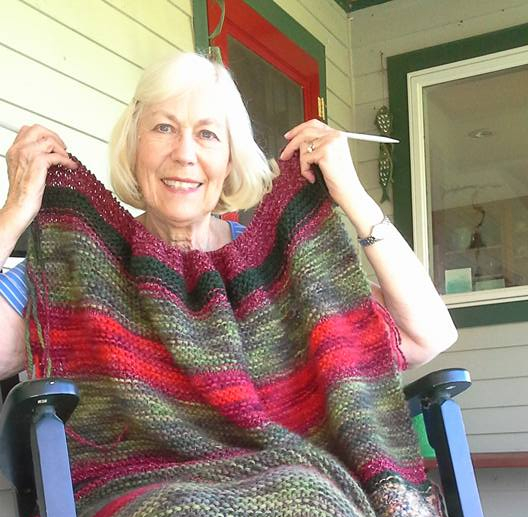
Following is a photo of my mother taken a few years ago, holding an afghan she was knitting. Later in this post are more photos of her ceramic art, a painting she did in 1957, and a dress she made for me when I was a child.
My mom holding an afghan she knit
Here are a few sentences my sister and I shared at the memorial service last fall, including her 10 rules for living a good life.
From the Elizabeth Sweder Eulogy
Liz Sweder was living the dream. How many people know exactly what they want to do, excel at it, and get to do it their whole adult life? In her later years, I think she was increasingly conscious of and grateful for this fact. Many of you heard her say this past year “I was so lucky, I got to be a homemaker.”
You could say our mom was lucky. But I think the fact that our mom was clear about her values and lived them is the more important ingredient. She focused her time and her energies on the things that were important to her: her family, keeping a home that was warm and welcoming, her creative activities, and her spiritual life. Our family could have had more money, gone on fancier trips, and gone out to eat more if she had gotten a job outside the home. But she willingly chose a different life and was so happy with it.
Since we know our mom would want each of us to be as happy as she was, we want to share with you Liz’s 10 rules to live by:
Start each day with a cup of hot cocoa.
Eat three square, home cooked meals every day.
Make sure you are put together every time you go out. You simply cannot have too many sweaters, scarves, purses, shoes, coats, and jewelry.
Always be reading a good book.
Show up. Ideally show up at family and community events with a pot of homemade baked beans, or an apple pie, or a pan of brownies.
Stay informed about current events and be prepared to discuss them in a civil fashion.
Do some Bible study or other activity every day to feed your soul.
Keep the porch light on and the coffee pot plugged in so you are always ready for company.
A little travel is nice if it involves a road trip to visit friends or relatives; otherwise, there is no place like home.
Go all in on the activities that bring you joy.
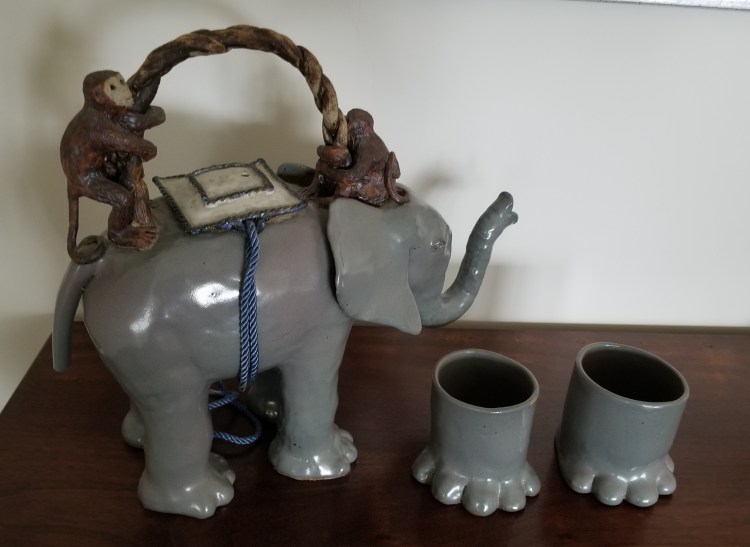
Part of a series of ceramic sculptures focusing on chairsA dress with smocking my mom made when I was a child, in front of her china cabinetHand knit sweater to go with the smocked dressA bust my mom made of her motherA ceramic elephant pitcher and cups my mom madeA lake shore scene painted by my mom in 1957The cover of my mom’s memoir
There is more information about my mom’s memoir on the tab “The Red Cottage” in the menu above, including links to the Amazon listing. When she realized that my sister did not remember where she was born, my mother abandoned her ceramic studio mid projects and started writing.
I am grateful to be living in my parents house where there are reminders everywhere of all my mom’s creative accomplishments.
I finished knitting a pair of socks that I started ages ago in March, when we were in California.
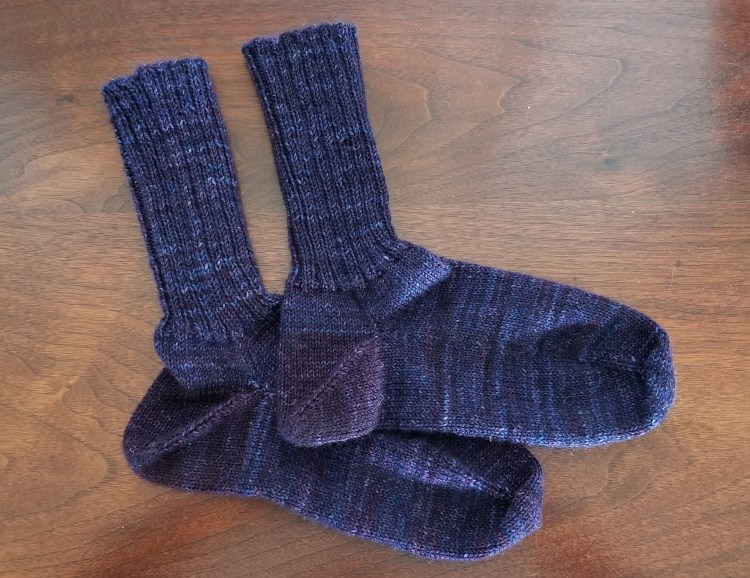
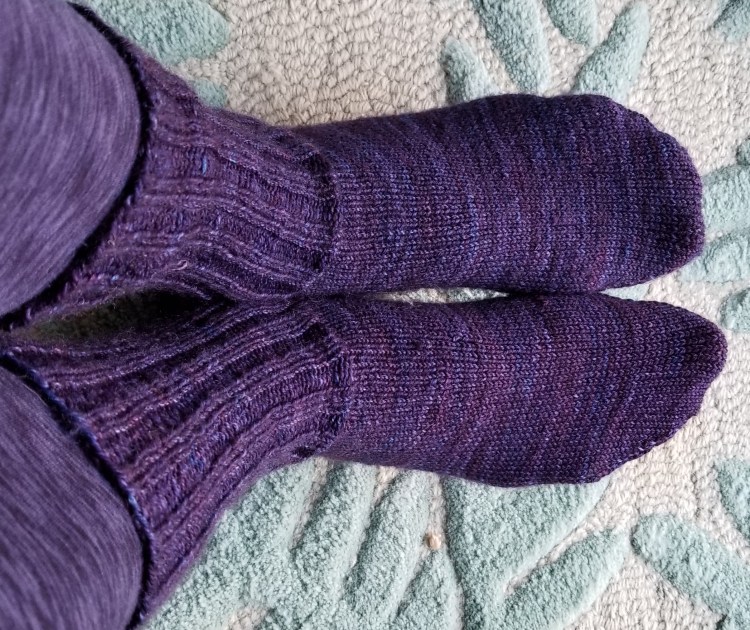
Completed sock knitting project
One of my knitting mentors, my mom’s cousin Mary Turak, once told me how she could not understand the popularity of sock knitting. In her mind that is boring, they wear out, and it makes more sense to buy socks. For many years I never tried making socks because her words were in the back of my mind, the pattern seemed complicated, and I usually prefer knitting with thicker yarn and needles. In recent years I decided to take on the challenge and have made several pairs of socks with mixed success.
There are many methods for knitting a sock. You can start at the cuff and knit down to the toe, or start at the toe and knit up to the cuff. There are multiple ways to knit the heel, including the flap heel, short row heel, square heel, fish lips heel, and afterthought heel. You can use double pointed needles, tiny circular needles, or something called “magic loop” using a circular needle with a super long connector. You can have more or less ribbing on the cuff, you can make the cuff longer or shorter. You can make them very basic, or with a complicated stitch pattern.
Starting at the cuff with magic loop needles
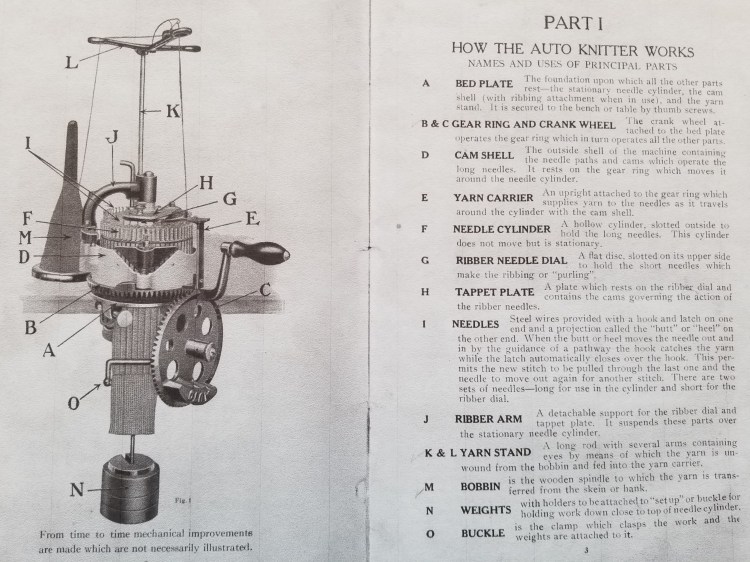
Once at a fiber fair I saw someone with a cool antique circular sock knitting machine. You can buy a brand new circular knitting machine that can make socks and smaller tubular or flat items. There are also larger flat knitting machines. Is that cheating?
Page from an antique sock machine manual
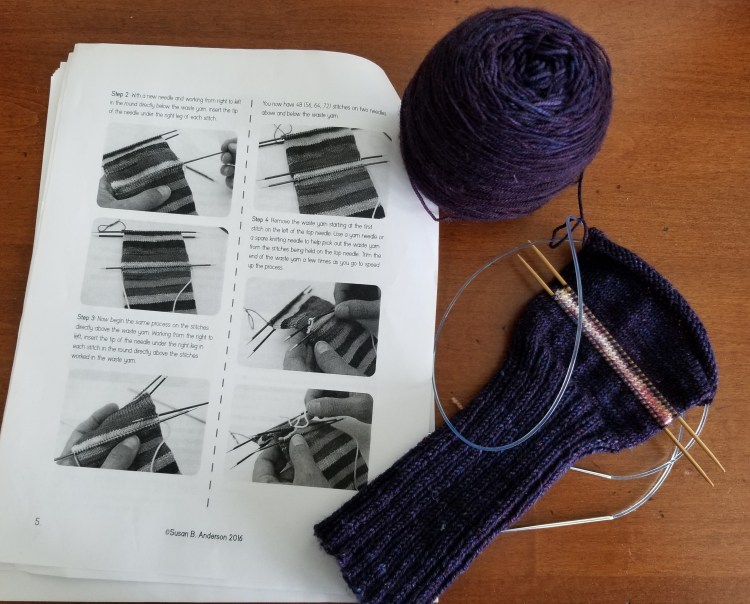
For the current project I used some purple merino wool and nylon blend Madelinetosh yarn, and a pattern called “Smooth Operator Socks” by Susan B. Anderson that I purchased on Ravelry, where I get most of my patterns. I cannot recommend this pattern enough if you are a little nervous about knitting socks, or in any case. It is 20 pages long but includes a summary version as well as detailed explanations of every step, instructions for multiple sizes and gauges, many photos, and links for video demonstrations.
Cuff finished
The Smooth Operator pattern uses an “afterthought heel” which means you knit some placeholder rows where the heel is going to go, and then go back and complete the heel later. Some of the advantages of this method are that you can easily use a contrasting yarn, and it is easier to replace later if it wears out.
Preparation for the “afterthought heel”The bamboo needles are on the heel stitches, the other needles are on the foot
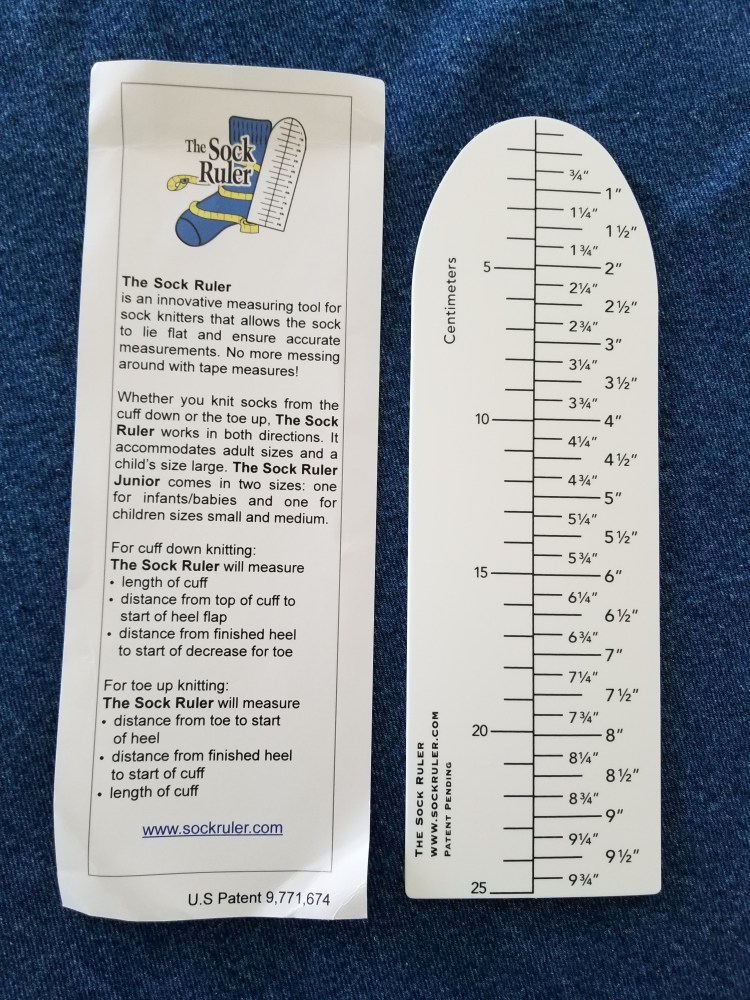
I used a tool called a “sock ruler” for measuring how much foot I had knitted, so I knew when to start decreasing for the toe. It can also be used for measuring how much cuff you have, or if you started with the toe, how much foot you have knitted before starting the heel. It is more accurate than trying to measure the project on your foot or laying on a surface.
Sock RulerMeasuring the length of the foot with the sock ruler
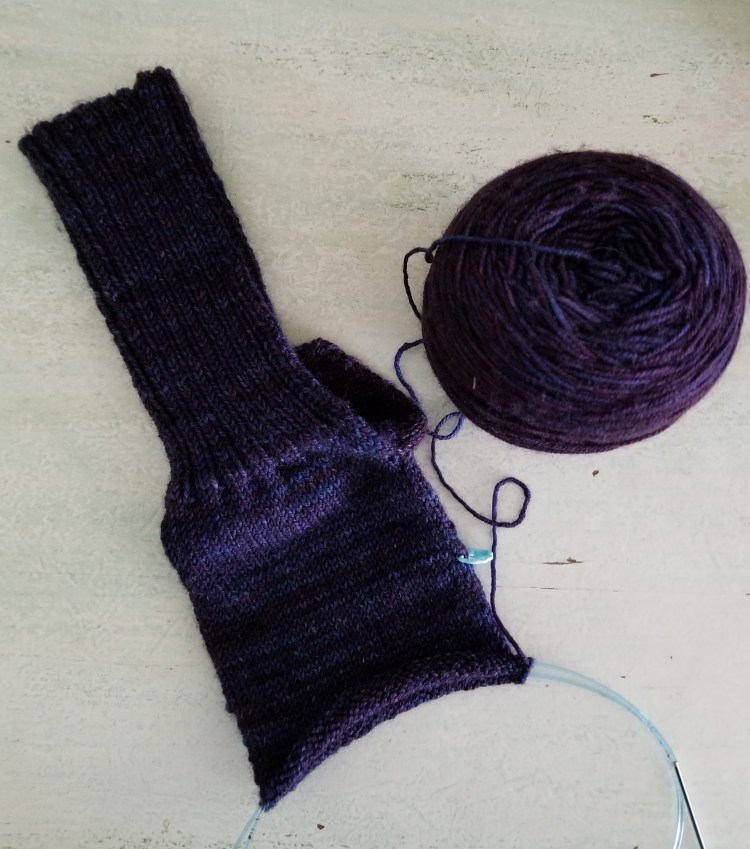
I love the dark purple yarn that includes tones of blue, but knew it would be harder to work with than something in a lighter color. I had to make sure to have plenty of light and wear the right glasses when knitting, or I was subject to mistakes and frustration with not being able to see what I was doing. Not surprisingly, I had to fix some mistakes.
Knitting the foot, with the completed heel underneathCompleted socks!
There was quite a bit of yarn left after completing the project, so I decided to knit a pair of tiny socks using a pattern called “Infant Socks” by Judy Ellis. I finished one baby sock using the cuff to tow with heel flap method, but have something else in my queue to work on before I finish the second one.
Adult sock with baby sock out of the same yarn
Now that this adult pair of wool socks is finished, it is past the season for wearing them. Oh well, fall will be here before we know it.































 Yarns from the Lake